Daniele Garofalo warns that radical networks can use social unrest to spread propaganda, recruit supporters, and deepen political divisions, even when legitimate economic grievances drive the original protests
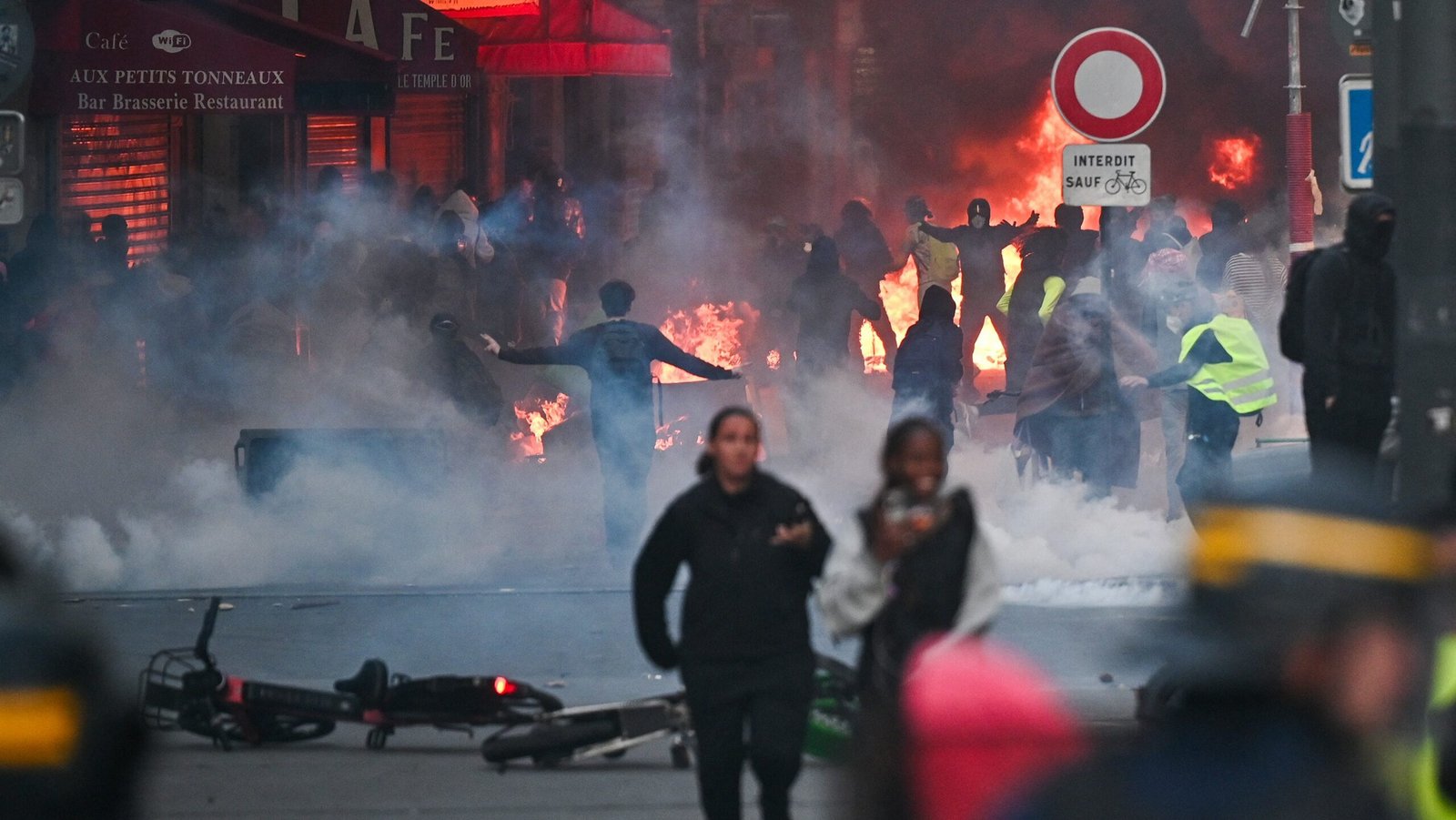
France is confronting one of its worst episodes of civil unrest in years after weeks of student demonstrations over deteriorating school conditions converged with nationwide protests against the rising cost of living, culminating in riots, looting, and attacks on public buildings.
Hundreds of thousands of people demonstrated across the country on October 17, with turnout estimates ranging from 550,000, according to authorities, to 800,000, according to organizers. Most participants protested peacefully, but violent clashes erupted in Paris, Lyon, Marseille, and several other cities.
Approximately 2,400 people were arrested over the weekend, nearly 1,000 police officers and gendarmes were injured, and about 3,000 businesses were damaged or looted. In Paris, a demonstrator died after suffering a cardiac arrest, with no reported evidence linking his death to police actions.
Among the most serious incidents was an arson attack on the historic City Hall in Limoges, where flames devastated much of the 19th-century building, causing most of its roof to collapse.
The violence has placed President Emmanuel Macron’s government under mounting pressure. Interior Minister Laurent Nuñez acknowledged that security forces had lost control in several cities and offered his resignation, which Macron rejected. Prime Minister Sébastien Lecornu backed localized curfews, which authorities began imposing on Monday in parts of Paris and other cities to prevent further disorder.
French officials have attributed much of the violence to far-left extremists and opportunistic looters. The scale of the destruction has also prompted wider questions about how social grievances developed into a national security crisis, whether extremist networks are exploiting the unrest, and what the consequences could be for France’s political future.
From Economic Grievances to Violence
The initial student demonstrations began in September over teacher shortages, overcrowded classrooms, and inadequate educational facilities. Their grievances subsequently converged with a separate movement against rising fuel prices and living costs, bringing together students, trade unions, and participants in the Yellow Vest movement, which emerged in 2018.
For Sharon Adarlo, a conflict analyst, editor, and operations and research director at Militant Wire, economic hardship remains central to understanding the demonstrations.
People are motivated by concerns over the high cost of living—the overarching concern
Adarlo told The Media Line: “People are motivated by concerns over the high cost of living—the overarching concern. That must fuel rage and feelings that they have little stake in the safety and harmony of commercial corridors in Paris.”
Similar economic pressures have generated protests elsewhere in Europe, including demonstrations over housing, public services, and declining purchasing power, although the immediate causes and political circumstances differ from country to country.
Counterterrorism and extremist groups expert Daniele Garofalo argues that the grievances driving the demonstrations must be distinguished from the actions of those responsible for the violence.
“These grievances explain the support for the protests, but they are not sufficient to explain arson, looting, and attacks against institutions,” Garofalo told The Media Line.
He believes relatively small groups can exert considerable influence over demonstrations, even when most participants remain peaceful.
The influence of a radical component does not depend solely on its numbers: even a small group can affect the outcome of a demonstration if it succeeds in provoking confrontation
“The influence of a radical component does not depend solely on its numbers: even a small group can affect the outcome of a demonstration if it succeeds in provoking confrontation,” he explained.
The disorder has exposed weaknesses in France’s security preparations. Despite warnings of possible violence, authorities struggled to protect commercial districts and public buildings. Some local officials criticized the government for failing to provide sufficient police protection, while security officials acknowledged that the size and organization of the demonstrations had proved difficult to anticipate.
Lecornu has accused radical left-wing groups of seeking to destabilize the country ahead of the 2027 presidential election. Left-wing political figures have disputed the allegations and demanded evidence.
Islamist Networks and the Question of Extremist Cooperation
The riots have also revived questions about a possible so-called red-green alliance, a term used to describe cooperation between radical left-wing movements and Islamist networks around particular political causes.
Although these movements differ ideologically, some groups have cooperated in opposition to particular policies or political adversaries. Whether such cooperation has played any role in France’s current unrest remains unproven.
Garofalo cautions against attributing the violence to Islamist organizations without supporting evidence.
“Based on verified public sources and the various private channels monitored, there is insufficient evidence to attribute a significant operational role in the violence to the Muslim Brotherhood or other Islamist organizations. Making such a claim today would go beyond what the available evidence supports,” he said.
The potential influence of Islamist networks in France has previously attracted government scrutiny. In May 2025, the French Interior Ministry published a report titled Frères musulmans et islamisme politique en France (Muslim Brotherhood and Political Islamism in France), examining Muslim Brotherhood-linked networks and their influence through associations and local institutions.
The report generated political controversy over the extent of the threat posed by political Islamism, but it predates the current unrest and provides no evidence connecting those networks to the riots.
Garofalo distinguishes between organizing violence and exploiting instability after it occurs.
“Moreover, a network can exploit a crisis without having caused it, using it for propaganda, establishing contacts, mobilization, or strengthening its influence,” he explained.
The possibility that extremist organizations might seek to benefit politically from the disorder does not establish that they directed or coordinated the violence.
Social Media and Foreign Interference Concerns
The role of social media has attracted attention because the October 17 mobilization was promoted extensively online before developing into nationwide demonstrations.
The initial call to protest rising fuel prices appeared on TikTok in September. As student demonstrations gathered momentum, the proposed date attracted wider support, including from participants in the Yellow Vest movement.
According to figures published by Le Monde from social media monitoring company Visibrain, approximately 460,000 posts concerning the October 17 mobilization circulated between September 27 and October 16. Videos mentioning the protest date accumulated approximately 132 million views on TikTok.
The expression Gilets Jeunes, or Young Vests, emerged online as a play on Gilets Jaunes, the French name for the Yellow Vest movement, reflecting the convergence of student demands and broader economic grievances.
Adarlo believes the online attention has encouraged some participants to seek visibility through “aura farming,” a social media practice involving efforts to attract attention and enhance one’s online reputation.
“There needs to be a productive conversation about social media. Lots of the protesters are using TikTok and other platforms to ‘aura farm’ during the protests, which is no doubt fanning the flames,” she said.
The possibility of foreign interference presents another concern, given Russia’s history of using online influence operations to exploit divisions within European societies.
Russians are adept at using social engineering techniques to amplify societal tension
Adarlo warned: “In regard to a green-red alliance, the protesters have valid claims, but we can’t dismiss the possibility of foreign interference stoking underlying social unrest, particularly on social media. Russians are adept at using social engineering techniques to amplify societal tension.”
There is no established evidence that Russia organized or directed the current protests.
In September, France’s foreign digital interference monitoring agency, Viginum, told Le Monde that it had detected only limited and largely opportunistic foreign activity surrounding the original online calls to protest. Some suspicious accounts promoting the demonstrations appeared to be seeking followers or commercial visibility rather than advancing a coordinated foreign political operation.
The Policing Dilemma and France’s Political Future
For the French government, restoring public order without further inflaming tensions has become an urgent challenge.
The destruction has prompted demands for tougher policing, while serious injuries during police interventions have intensified scrutiny of crowd-control tactics.
In Saint-Étienne, a 17-year-old demonstrator lost his right hand during the October 17 protests after a grenade launched by security forces exploded. Investigators are examining the circumstances, including reports that the teenager picked up the grenade before it detonated. The Saint-Étienne prosecutor’s office opened an investigation, assigning it jointly to France’s national police and gendarmerie oversight agencies, the IGPN and IGGN.
Garofalo warns that both inadequate policing and an indiscriminate crackdown could deepen the crisis.
“An insufficient response may reinforce the perception of impunity; an indiscriminate response may extend the crisis to groups that did not initially support the confrontations,” he said.
The political consequences could extend beyond the immediate security response. Garofalo considers it plausible that the violence could strengthen demands for tougher immigration policies and border controls ahead of the 2027 presidential election. Such measures, he cautions, would not necessarily address violence involving individuals already living in France.
He also warns against attributing the actions of violent groups to entire ethnic or religious communities, arguing that collective accusations and perceptions of discriminatory policing could reinforce polarization.
France’s financial difficulties further complicate the government’s response. Growing public debt and budgetary constraints limit its ability to address demands for improvements in education, public services, and living standards.
The government has promised to assign 3,000 replacement teachers to address shortages, with 2,000 already assigned by October 14. Broader improvements in public services, however, face significant budgetary obstacles.
Trade unions have maintained plans for nationwide strikes and demonstrations on November 5, seeking higher wages, increased public spending, and measures to improve purchasing power. Union leaders have stressed their intention to continue the movement peacefully, arguing that the violence has diverted attention from their economic demands.
The unrest comes as France prepares for a presidential election in which security, immigration, and economic policy are expected to play major roles. Macron, who cannot seek a third consecutive term, faces a divided political landscape in which both the far right and the radical left are seeking to capitalize on public dissatisfaction.
For Garofalo, the deeper danger is that the unrest could undermine confidence not only in the current government but also in the institutions of the French state.
It is this transition, from challenging the government to delegitimizing the state, that needs to be monitored
“The most significant warning sign is the possibility that distrust of the government could extend to the institutions’ ability to represent citizens and guarantee security. It is this transition, from challenging the government to delegitimizing the state, that needs to be monitored,” he concluded.