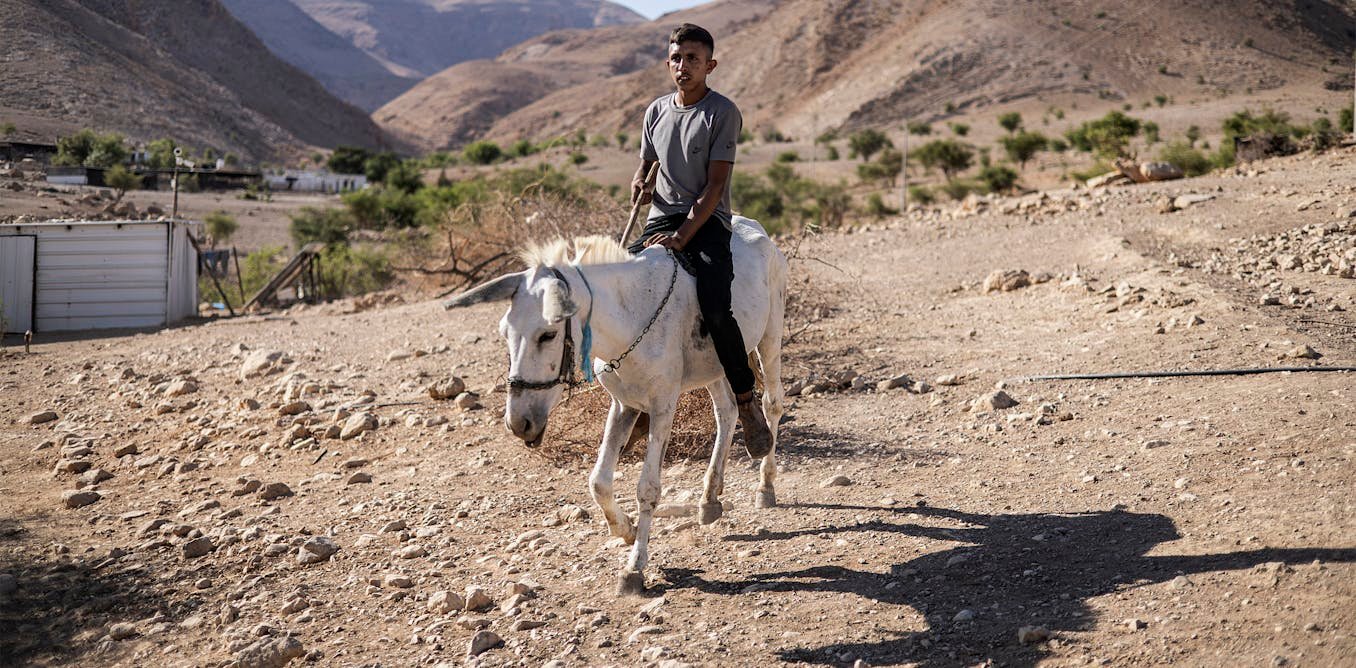
Donkeys tend to symbolize humility and redemption; in Jewish tradition, the Messiah will arrive on a white donkey.
But in today’s “land of the Bible,” donkeys have become victims of the war in Gaza and, increasingly, targets of the growing settler violence in the West Bank.
Take what happened in December 2025 near Jaba, north of Ramallah. While a Palestinian child watched, seven Jewish settlers from Gur Aryeh, a small illegal outpost, reportedly led away his family’s three donkeys.
When an Israeli peace activist later arrived at the scene, she found one of the donkeys with a rope around the animal’s neck and in severe pain. She later told me how she had to avert her eyes as she shone the flashlight at the stricken donkey for the rescue crew from the Starting Over Sanctuary, a nonprofit dedicated to treating and rehabilitating animals in Israel, the West Bank and Gaza.
The donkey didn’t survive the journey to the hospital.
While violence toward animals tends to be seen as distinct from that directed at humans, the two phenomena are deeply intertwined. As someone who studies settler colonial violence alongside political ecology and human-animal relationships, I argue that Israeli settlers’ attacks on donkeys as well as the care they practice toward these animals reveal how colonial dispossession happens and is in turn naturalized on the ground.
Harming animals through direct attack, deprivation, seizure and forced separation has long accompanied Israeli violence against Palestinian communities. During the Nakba in 1948, in which 750,000 Palestinians fled or were displaced from their land by Zionist forces, farm and domestic animals were killed, seized, left without care or driven to starvation.
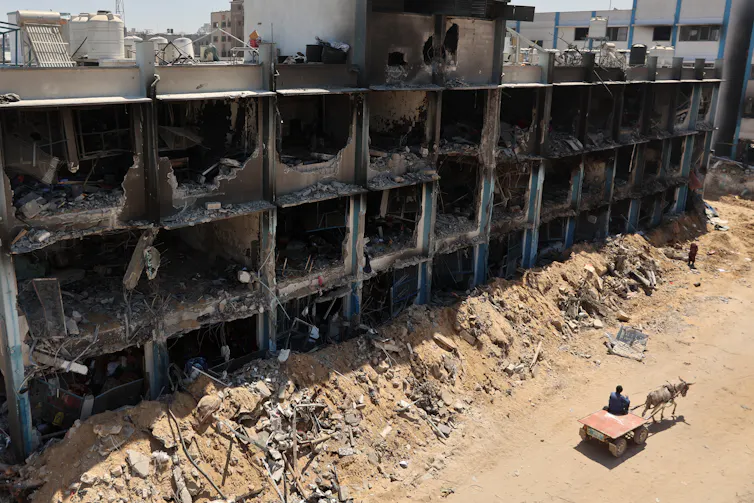
A similar pattern has occurred in the war on Gaza following the attack by Hamas and other militants on Israel on Oct. 7, 2023. By August 2025, as many as 97% of farm animals in Gaza were killed through bombing, starvation and the destruction of agricultural infrastructure, according to the Euro‑Mediterranean Human Rights Monitor. Farms were razed, and cats and dogs were left to fend for themselves as families were repeatedly displaced from their homes by the Israeli airstrikes.
Carrying the burden for millennia
Donkeys, in particular, carry a deep history in the region and today face heightened vulnerabilities.
First domesticated approximately 7,000 years ago in the Horn of Africa, they transformed human mobility and are still important in the daily lives of millions of poor people around the world.
To Palestinians, donkeys have become emblems of “sumūd,” or steadfast endurance – an ethic they often emphasize to describe daily life under Israeli occupation.
Prominent Palestinian poet Mahmoud Darwish said in a television interview in 1997: “I wish I was a donkey. A peaceful, wise animal that pretends to be stupid. Yet he is patient, and smarter than we are in the cool and calm manner he watches on as history unfolds.”
Amid the ruins in Gaza and with fuel scarce, donkeys have provided vital transport for the injured as well as for goods and belongings.
Palestinian political analyst Ahmed Najar put it aptly on July 20, 2025: “My mother, who is in Gaza, cannot walk. Since October 2023, my family has been displaced seven times. Every time the bombs fell too close or the leaflets rained down warning my family to flee, the only way she could be moved was on a donkey. … (In) the dust and the terror – donkeys became ambulances, buses, lifelines.”
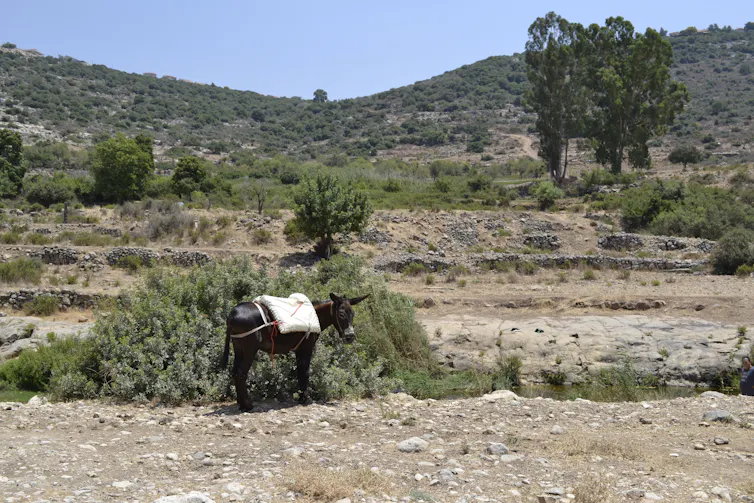
The December abduction of a donkey in Jaba was not an isolated incident. Settlers regularly seize and steal donkeys, alongside other farm animals, in raids on Palestinian pastoralist communities, especially in the Jordan Valley and Hebron Hills.
Since October 2023, such attacks have intensified significantly. In March 2025, U.N. agencies documented the theft or killing of more than 1,400 sheep and goats in one Jordan Valley attack.
Palestinian shepherds often ride their donkeys when taking their flocks out to pasture. But as settler harassment has increased, frequently carried out by armed settler shepherds riding on donkeys themselves, Palestinians rarely take their flocks out. With grazing routes rendered dangerous, Palestinian-owned donkeys are left behind, often spending their days tied to a tree – still loved, still named, but no longer moving across a landscape that has become hostile. They stand as quiet reminders of a disappearing pastoralist tradition.
‘Freedom flights’
A short distance from Jaba, a seemingly different donkey story unfolds. At the Starting Over Sanctuary in central Israel, volunteers prepare donkeys for “freedom flights” to Europe.
Since 2018, the charity has operated as Israel’s largest donkey sanctuary, rescuing and rehabilitating animals subjected to abuse, neglect and hard labor, particularly from the country’s south. Since the early 2020s, the Israeli sanctuary has periodically organized rehoming projects for the donkeys, transferring them by airplanes to partner sanctuaries across Europe. After a yearlong pause amid war-related disruptions, and newly overwhelmed with injured donkeys pouring in from Gaza, the Starting Over Sanctuary recently resumed the flights, airlifting the rescued donkeys to sanctuaries in France and Belgium.
When I visited the sanctuary in December 2025, there were 800 donkeys in residence, many rescued by soldiers or informal networks encountering the injured or abandoned animals near conflict zones.

While the donkey rescues carried out by the Starting Over Sanctuary are clearly motivated by what its workers describe as a deep love for donkeys, several Palestinian analysts and residents frame these rescues very differently. For them, a donkey taken from the Palestinian community represents another form of settler dispossession, regardless of whether that removal is carried out through acts of care by sanctuary workers near Tel Aviv or through physical violence by Jewish shepherds in the West Bank.
The tension between the cruelty toward Palestinian-owned animals by violent settler shepherds and the compassionate rescue of Palestinian-owned animals by Israeli animal activists exposes how animal and human life are mutually entangled, and morally charged, within the structures of what I and many others see as Israel’s settler colonialism.
The donkey stands at the center of these tensions: a symbol, companion, laborer, witness, target of violence and object of compassion.
Normalizing dispossession
Meanwhile, a third donkey story has been unfolding in the rural landscapes of the Israeli occupied West Bank, where Jewish settlers increasingly use donkeys while grazing sheep across the contested terrain. Settler shepherds on donkeys lead their herds across the open hills in scenes that closely resemble Palestinian herding routines, which were once common in the same areas.
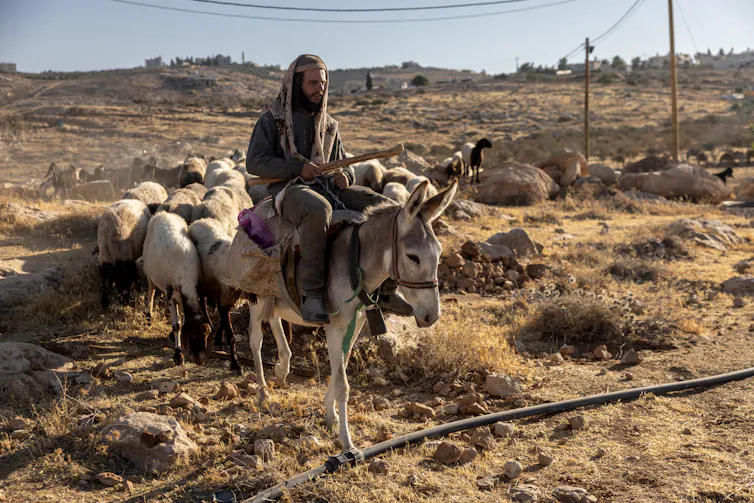
The resemblance is particularly striking because many Palestinians are now barred from practicing their pastoralist traditions in areas where settlers continue to roam freely. The settlers’ use of donkeys evokes a biblical past while recasting pastoralist forms of land use as their inherited birthright, even as Palestinian pastoralism is increasingly framed as backward, ecologically harmful and illegal.
Donkeys thus play an often overlooked role in the broader shift in settler strategy unfolding across the West Bank in the past decade or so – and increasingly since October 2023 – in which small shepherding outposts have moved from the margins to the center of settlement expansion. In recent years, herding has become a key tool for claiming territory beyond the established settlements, allowing settlers to control large swaths of land with minimal infrastructure. These outposts now form a cutting edge strategy for what The Guardian has described as the largest land grab in the West Bank since 1967.
Beyond their material effects, such pastoralist practices by the settler shepherds help normalize this land grab. Donkeys, sheep and cows, alongside olives and other natural entities, are part of ongoing ecological warfare that naturalizes both Palestinian dispossession and settler reclamation, as I explore in an upcoming academic paper in the journal American Anthropologist.
In the occupied West Bank, as in all other places, human and animal vulnerabilities are intertwined. A donkey may be flown to safety, but the humans who depended on her remain in danger. The animal’s rescue, as such, reveals disturbing asymmetries about who gets saved and who is left behind.