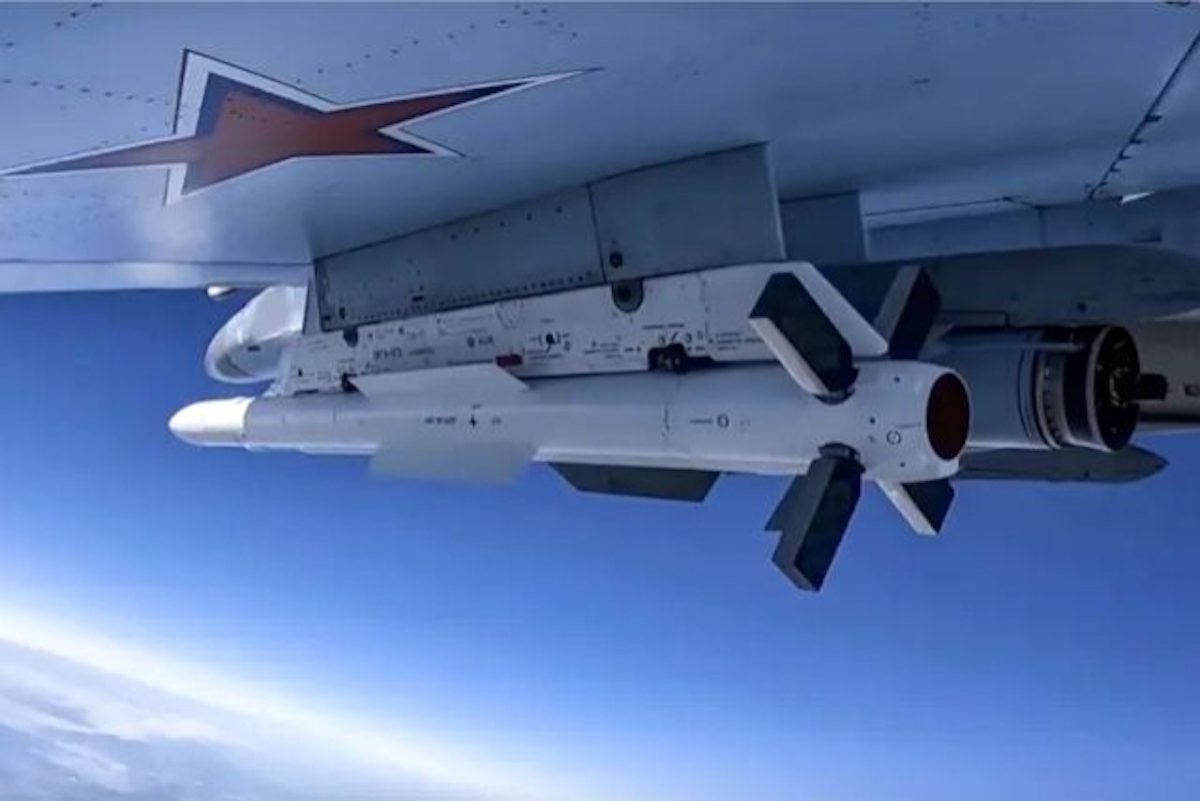
India’s planned purchase of Russian ultra-long-range air-to-air missiles aims to counter Pakistan’s China-backed air network but exposes deeper integration and escalation challenges.
This month, the South China Morning Post (SCMP) reported that India has signed a US$1.2 billion deal to acquire around 300 Russian R-37M ultra-long-range air-to-air missiles, with deliveries expected within 12 to 18 months and deployment likely on Indian Air Force (IAF) Su-30MKI fighters.
The missile, capable of speeds up to Mach 6 and a range of 300–400 kilometers, is designed to target high-value support aircraft, such as airborne early warning and control (AEW&C) and refueling aircraft.
The weapon could provide India with a “significant operational edge” by acting as a force multiplier in short, high-intensity conflicts, particularly following clashes over Kashmir that exposed vulnerabilities, including the loss of an Indian jet to a Chinese-made J-10C.
Pakistan, which operates J-10C fighters and PL-15 missiles and is acquiring KJ-500 AEW&C aircraft, may be forced to push critical assets farther from the front line, thereby reducing operational efficiency.
However, the missile’s impact depends on integration into broader sensor and radar networks, with the system seen as a stabilizing capability rather than a decisive advantage.
India’s R-37M purchase raises questions about integration, countering Pakistan’s China-backed kill chain, escalation control, and long-term strategic viability amid Russia’s closer ties with China.
The main tactical challenge is whether India can translate the R-37M’s range into effective combat performance despite integration limits within its mixed-origin force and Pakistan’s more cohesive targeting network.
Defense Security Asia notes in an article this month that Russia uses the R-37M on the closely related Su-30SM variant, reducing technical risk and making adaptation for Indian aircraft comparatively straightforward.
The article states that the integration will mainly involve software updates to the Su-30MKI’s Bars radar, mission computer, and weapons management system, rather than major structural changes.
It also notes that Indian officials aim to synchronize missile deployment with the Su-30MKI modernization plan, covering 84 upgraded aircraft, with each airframe carrying two R-37Ms and fully upgraded airframes capable of carrying six to eight missiles.
However, Sannan Pervaiz mentions in an August 2025 Belfer Center article that India operates a patchwork of Western, Russian, Indian, and Israeli platforms – each with different technologies and frameworks.
Pervaiz notes that this setup makes integration more challenging because many systems are not built to work smoothly or communicate efficiently in rapidly changing situations.
In contrast, SCMP reported that during the Kashmir clashes, Pakistan deployed an “ABC” system integrating ground radars, fighter jets and airborne warning and control system (AWACS) aircraft into a unified data-sharing network.
According to SCMP, the system operated on a “locked by A, launched by B, guided by C” model, in which ground systems detect targets, fighters launch from standoff range, and AWACS provide continuous guidance.
SCMP highlights Pakistan’s China-made ecosystem, noting that, in addition to the PL-15 missile and J-10C fighter, Pakistan also has HQ-9 long-range air defense systems and ZDK-03 AWACS planes.
At the operational level, the R-37M could strengthen India’s ability to manage a future India-Pakistan air crisis by deterring cross-border incursions, preserving standoff engagement patterns, and reducing the risk of unintended nuclear escalation.
In a January 2026 War on the Rocks article, Samfer Lawlani and other authors observe that the May 2025 conflict showcased “non-contact” warfare. Lawlani and others describe it as including standoff strikes with missiles, drones, and loitering munitions, along with non-kinetic cyber probes and information campaigns.
They note that although this type of warfare can involve intense kinetic activity, it is generally limited, resulting in small escalations that often send strong signals rather than achieving significant coercion or attrition.
In line with that, Frederic Grare, in a June 2025 article for the National Bureau of Asian Research (NBR), notes that there was no evidence of any manned aircraft crossing into the airspace of the other side during the May 2025 conflict, describing it as primarily a war of missiles and drones.
Grare adds that India did not cross any of the red lines enumerated by Pakistan to justify a potential nuclear strike, while Islamabad did not send any open signal that it could use nuclear weapons.
Delving into nuclear escalation dynamics in the context of the May 2025 India-Pakistan clashes, Rakesh Sood notes in a February 2026 Carnegie Endowment for International Peace (CEIP) report that leadership on both sides has been significantly more restrained in their nuclear rhetoric and actions than is commonly recognized, and that Indian and Pakistani leaders have rather adeptly managed and contained escalation.
Sood states that India, which follows a no-first-use nuclear doctrine, is keen on preventing any crisis or conflict from turning nuclear. Meanwhile, he says Pakistan views nuclear weapons as a means to counterbalance India’s conventional military dominance.
At the strategic level, India’s continued reliance on Russian arms raises questions about its viability as a hedge against China, given Russia’s increasing alignment with China.
Despite equipment losses in Ukraine and Western sanctions raising doubts about the quality and viability of Russian military hardware, India remains the top importer of Russian military equipment.
A March 2026 report by the Stockholm International Peace Research Institute (SIPRI) notes that between 2021 and 2025, Russia ranked as the third-largest global arms supplier, behind the US and France, accounting for 6.8% of worldwide arms transfers.
For comparison, the report says that during that period, the US contributed 42%, while France accounted for 9.8%. SIPRI data also show that India was the largest recipient of Russian arms sales, accounting for 48% of Russia’s arms sales during that period.
However, Russia’s arms sales to India could put the two at odds with China. In an April 2025 Geopolitical Intelligence Services (GIS) report, Aparna Pande highlights that India maintains a strategic partnership with Russia, serving as a key weapons supplier and a safeguard in its regional stance amid the unpredictability of US policies and Chinese expansion.
Pande notes in a separate October 2025 GIS report that India views China as a threat on both land and sea, yet considers itself better positioned in the Indian Ocean, while on the continental front, it sees itself facing either a one-front war with China or a two-front war with China and Pakistan.
While she says India views Russia as a counterbalance to China, she notes that the deepening “no-limits” partnership between China and Russia, as well as Russia’s stated neutrality in an India-China conflict, complicate India’s reliance on Russia as a continental counterweight.
Ultimately, the R-37M’s value will depend less on range than on whether India can build a more integrated air combat network while managing the tension between reliance on Russian arms and Russia’s deepening alignment with China.