Hezbollah played a central role in supporting Assad’s government after openly entering the Syrian conflict in 2013, deploying thousands of fighters across multiple battlefronts
[DAMASCUS] Syria’s Interior Ministry said Tuesday it had foiled an alleged attempt to smuggle a shipment of advanced weapons through Syrian territory to Hezbollah, while publicly describing the Lebanese group as a “terrorist militia” in what analysts say marks a significant shift in the new government’s official rhetoric.
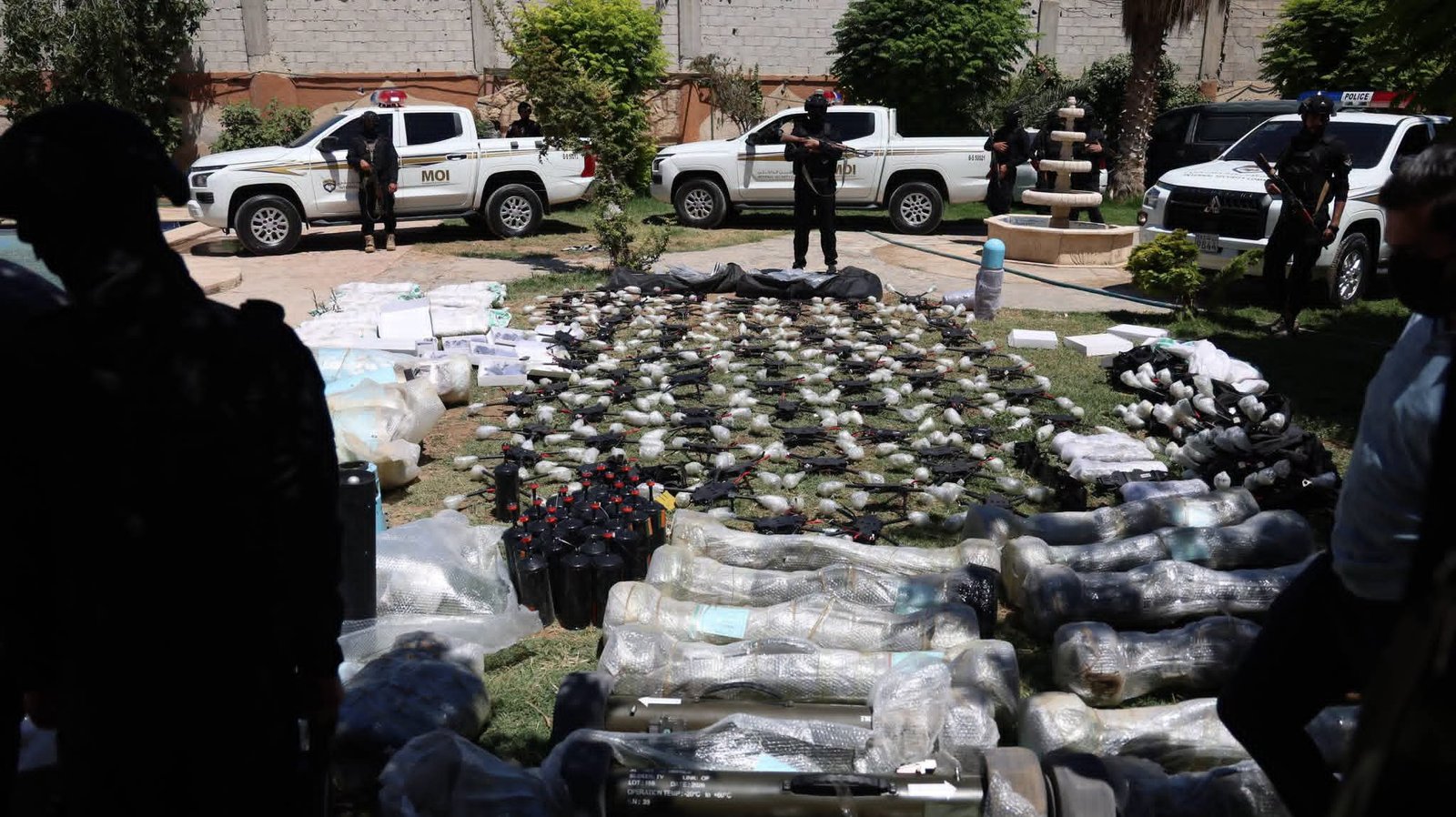
The ministry said specialized security units intercepted a suspicious vehicle near the Syrian-Iraqi border and discovered a cache of long-range missiles, guided anti-tank missiles and drones.

Drones displayed by Syria’s Interior Ministry after authorities said they were seized during an operation that foiled an alleged cross-border weapons smuggling attempt near the al-Tanf border crossing with Iraq, July 16, 2026. (Syrian Interior Ministry)
According to the ministry, preliminary investigations indicate that the shipment was intended to transit Syria en route to Lebanon for Hezbollah. Officials said the investigation remains ongoing to identify those responsible and dismantle the broader network allegedly involved in the operation.
A Syrian Interior Ministry source told The Media Line that the seizure was “an exceptional and highly significant operation,” adding that Damascus would share all available evidence with Iraqi authorities as part of a joint effort to pursue everyone connected to the alleged smuggling network.
The investigation treats this as a cross-border network rather than an isolated incident
“The investigation treats this as a cross-border network rather than an isolated incident,” the source said, adding that coordination with Baghdad would focus on tracing the shipment’s route and identifying all parties involved.
New details obtained by The Media Line from Mazen Alloush, director of public relations at Syria’s General Authority for Land and Sea Border Crossings, indicate that the weapons were concealed inside an oil tanker officially registered as transporting black fuel oil.
According to Alloush, Iraqi customs authorities sealed the tanker after processing it as a routine fuel shipment and attached instructions prohibiting inspectors from opening it until it reached its designated destination, citing delivery procedures.

A member of Syria’s Interior Ministry holds a drone that authorities said was part of an alleged weapons shipment intercepted near the Syrian-Iraqi border, July 16, 2026. (Syrian Interior Ministry)
The tanker departed Iraq approximately nine days earlier, after completing all customs formalities, and joined convoys transporting Iraqi fuel to Syria’s Baniyas refinery via the al-Tanf border crossing as part of an existing oil transport arrangement between the two countries.
Alloush said the shipment included large quantities of missiles and drones carefully hidden inside the tanker. He explained that the concealment method allowed the vehicle to pass multiple inspection points because specialized equipment capable of scanning liquid tankers remains limited, while the weapons had been wrapped in insulating materials and submerged beneath black fuel oil, making them difficult for police dogs to detect.
The shipment was discovered only after reaching the Syrian side of the border, where inspectors uncovered what Alloush described as a sophisticated concealment operation designed to evade customs inspections.
The al-Tanf crossing has long been considered one of the most sensitive border crossings between Syria and Iraq, serving for years as a corridor exploited by smuggling networks during Syria’s civil war. Syrian authorities say border security has been significantly tightened since the country’s new administration assumed power.

Members of Syria’s Interior Ministry display one of the missiles seized during an operation targeting an alleged cross-border weapons smuggling network near al-Tanf, July 16, 2026. (Syrian Interior Ministry)
The Interior Ministry said protecting Syria’s borders and national sovereignty remains a top priority and pledged that Syrian territory would not be used as a transit route for weapons trafficking or activities threatening Syria or neighboring countries.
In a subsequent statement, Hezbollah rejected the Syrian allegations, dismissing them as “fabricated claims with no basis in fact” that were intended to damage the group’s reputation.
Iraq responded by announcing the formation of a high-level investigative committee composed of security and technical officials to examine the incident.
In a statement, Iraq’s Security Media Cell said the committee would coordinate with Syrian authorities to establish the full circumstances surrounding the case and hold any negligent parties accountable “to safeguard the security and stability of the shared border and prevent any attempts to undermine national security.”
The announcement comes as Baghdad and Damascus seek to deepen security cooperation along their roughly 600-kilometer (370-mile) shared border, an area long exploited by cross-border smuggling networks amid years of conflict and weak state control.
For many observers, however, the most consequential aspect of the case extends beyond the weapons seizure itself.
Daoud al-Sayed, a Syrian researcher specializing in political science and international relations, said the Interior Ministry’s decision to publicly describe Hezbollah as a “terrorist militia” represents a significant departure from the rhetoric maintained under former President Bashar Assad, when the Lebanese group was regarded as one of Damascus’ closest military allies.
Last month, President Trump said he spoke with al-Sharaa at the G-7 conference, and that the two leaders discussed the possibility of Syria taking an active role in combatting Hezbollah.
The new Syrian administration has consistently emphasized that relations with Lebanon should be conducted through state institutions rather than armed groups
“The new Syrian administration has consistently emphasized that relations with Lebanon should be conducted through state institutions rather than armed groups,” al-Sayed told The Media Line. “The ministry’s statement reflects that policy.”
He argued that the alleged smuggling operation prompted Damascus to publicly define its position toward Hezbollah more explicitly than at any point since the new government took office.
“If this rhetoric is followed by additional security and political measures,” he said, “it could signal a broader restructuring of Syria’s policy toward non-state armed groups and a new framework governing relations with Lebanon and border security.”

Members of Syria’s Interior Ministry carry missiles and other weapons that authorities said were confiscated during an operation near the al-Tanf border crossing, July 16, 2026. (Syrian Interior Ministry)
Hezbollah played a central role in supporting Assad’s government after openly entering the Syrian conflict in 2013, deploying thousands of fighters across multiple battlefronts. Since the collapse of the former government and the establishment of Syria’s new administration, officials have repeatedly stated that all weapons inside the country should fall exclusively under state authority.
Against that backdrop, analysts say the Interior Ministry’s decision to officially label Hezbollah a “terrorist militia” marks a notable shift in Syria’s public discourse, suggesting that Damascus may be redefining its security and political relationship with the group.
The weapons seizure also forms part of a broader campaign launched by Syria’s new authorities to tighten border security and dismantle networks involved in arms and narcotics trafficking after years of conflict that left large stretches of the country’s frontiers vulnerable to organized smuggling.
Whether the investigation ultimately exposes a wider regional network remains unclear. But the joint Syrian-Iraqi inquiry is expected to determine not only who organized the alleged shipment, but also whether additional actors were involved in moving weapons across one of the region’s most sensitive borders.
For Syria’s new leadership, the outcome may prove to be more than a criminal investigation. It could become an early test of its stated commitment to reassert state authority, redefine relations with armed non-state actors, and demonstrate that Syrian territory will no longer serve as a corridor for regional weapons trafficking.