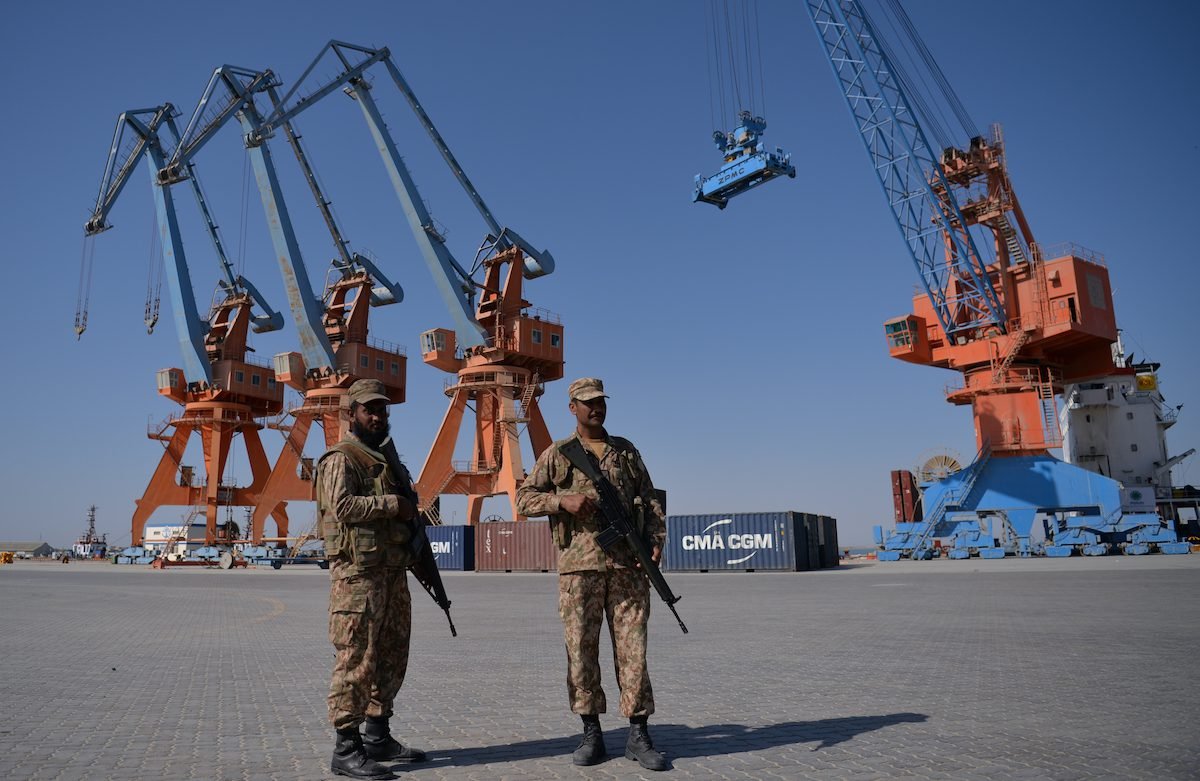
In 2015, Balochistan had power outages lasting 16 to 18 hours daily, according to provincial records at the time, roads that petered out into gravel tracks, and a port at Gwadar that saw fewer than 20 ships dock in an entire year.
A decade of investment under the China-Pakistan Economic Corridor, or CPEC, has changed each of those facts — not completely, not always equitably, but measurably. Whether CPEC’s Phase 2.0 turns that foundation into something Balochistan’s residents can feel in their own lives is the open question.
Nationally, 38 CPEC projects worth more than US$25 billion have been completed, including 17 energy initiatives valued at $18 billion. Daily power outages that once ran as long as 18 hours have been reduced to near self-sufficiency across the country.
In Balochistan specifically, the 1,320 megawatt (MW) China Hub Coal Power Plant in Hub District — built at an investment of $1.9 billion — became the province’s first large baseload power source.
Road connections through the western corridor did more to transform the province’s day-to-day isolation: the Surab-Hoshab N-85 highway, the M-8 linking Hoshab to Gwadar and the Khuzdar-Basima road together opened terrain that had been effectively cut off from national commerce.
The physical transformation of Gwadar is the most visible marker of the CPEC decade. The New Gwadar International Airport, inaugurated in January 2025 with a $230 million Chinese grant, is Pakistan’s largest airport by area and can handle wide-body aircraft.
The Pak-China Friendship Hospital, built with $100 million in Chinese funding, provided free medical treatment to around 43,000 patients from poor communities in Gwadar in 2025 alone. A desalination plant has supplied drinking water to a city that periodically ran dry.
Gap between cranes and careers
This is where honest accounting matters most — because the numbers are real, but the gap between construction employment and lasting economic activity is equally real.
According to official documents, CPEC projects in Balochistan have so far created or engaged 7,313 workers across road, energy, port, health and education schemes.
The breakdown tells the fuller story: the Pak-China Friendship Hospital created 515 jobs, of which 441 went to Balochistan domicile holders; Gwadar Port and Free Zone created 216 positions, with 214 going to local residents.
The New Gwadar International Airport generated 107 jobs, with 63 held by Balochistan-domiciled individuals — exceeding the federal government’s prescribed 6% quota. Most of these, however, were construction-phase or operational roles tied to individual facilities.
A significant share of high-skill positions is still occupied by technical experts from other provinces or overseas, namely China. The province’s own workforce has not yet been trained to the level industry demands – and that is the real gap CPEC 2.0 must work to close.
The broader economic signals are turning, at least on paper. Balochistan is projected to record provincial GDP growth of 5.8% in the upcoming fiscal year, outpacing the national average.
The federal government allocated a record 206 billion rupees — roughly $739 million — to Balochistan under the Public Sector Development Programme for 2025-26, with 73.5 billion rupees already disbursed across 148 active projects by March 2026, spanning roads, water, power and education.
In April 2026, Gwadar Port processed around 11,000 shipping containers in a single month, compared with roughly 8,300 for all of 2025 combined. That surge was driven in part by disruptions in the Strait of Hormuz, which rerouted global shipping to alternative ports.
Gwadar handled it — not a small thing for a port that was a construction site less than a decade ago. But it also underscores the central challenge: a port whose activity spikes because of a war elsewhere has not yet earned a permanent place in global shipping networks.
CPEC next phase
CPEC 2.0 is not a rebranding exercise of the original CPEC. There are specific, traceable actions behind it. The 14th Joint Cooperation Committee meeting in Beijing in September 2025 formally adopted an Action Plan for 2025-2029.
Its concrete outcomes so far include China’s commitment to finance 85% of the Karakoram Highway realignment; a mutual agreement to jointly secure around $6 billion in multilateral funding for the long-delayed ML-1 railway upgrade; and the signing of 21 business-to-business agreements worth $8.5 billion, presided over by Prime Minister Shehbaz Sharif.
These were not declarations of intent — they were signed documents with financing structures behind them. For Balochistan, the most significant institutional shift under Phase 2.0 is the planned expansion of Special Economic Zones from seven to 44, including 37 newly notified zones coordinated by the Board of Investment.
Bostan SEZ in Pishin, a 1,000-acre industrial zone, is among four priority SEZs that have moved into active implementation. Twenty-four enterprises have already been allotted plots there, with those investments projected to generate several thousand additional jobs, predominantly for local residents.
The Pak-China Vocational and Technical Institute in Gwadar graduated its largest-ever cohort of 1,200 students in January 2026, evidence that a pipeline of trained local workers is being built.
The most consequential long-term bet for Balochistan, however, sits alongside CPEC rather than inside it. The Reko Diq copper-gold project — one of the world’s largest undeveloped deposits, in Chagai District — secured $3.5 billion in international financing in late 2025 from the Asian Development Bank, the US Export-Import Bank and other lenders.
First copper exports are projected for 2029. Officials estimate the project will generate roughly $70 billion in revenue over its roughly 37-year life and create thousands of construction-phase jobs in Balochistan, part of a broader US-Pakistan financing package expected to support more than 13,000 jobs across both countries.
Reko Diq’s ore needs roads built under CPEC. Its investors need a functional Gwadar airport. Its workers need a surrounding functional economy. These projects are inseparable, and their combined effect on Balochistan over the next decade could dwarf everything CPEC’s first phase delivered.
Hard road ahead
Vietnam built its economic transformation on exactly this sequence: infrastructure first, then SEZ-anchored export manufacturing and then integration into global supply chains. The result was GDP growth averaging 6-7% annually for over a decade and a country that went from entrenched poverty to a global electronics hub.
Pakistan now has the infrastructure layer. The airport is open, the roads have been paved, and the port is now moving cargo briskly. What it still needs is the harder layer beneath – regulatory predictability, transparent revenue frameworks and institutions that outlast political cycles.
The Bostan SEZ must move from plot allotments to operational factories. The 1,200 vocational graduates of 2026 need industrial employers waiting for them in Balochistan, not in Karachi.
The revenue structure of Gwadar’s port concession — what Pakistan retains and how much flows back to the province — needs to be publicly accounted for and placed before parliament, not managed inside Islamabad’s ministries.
And the over 10,000 additional jobs projected under CPEC’s pipeline for Balochistan must be tracked publicly, project by project, with the same transparency that Phase 1 applied to megawatt counts and road kilometers.
Balochistan holds 75% of Pakistan’s mineral wealth, the country’s only deep-sea port and a coastline 400 kilometers from the world’s most strategically sensitive shipping chokepoint. It has waited long enough for those advantages to work in its favor.
CPEC gave the province its first international airport, its first major public hospital and its first baseload power plant. Phase 2.0 must give it something harder to build and easier to measure: a local economy that employs its own people, adds value to its own resources and does not need a war elsewhere to prove its worth.
Rabia Abrar is a researcher and freelance writer with a focus on public policy, governance and institutional reform in Pakistan. Her work examines state capacity, education systems and socio-economic development.