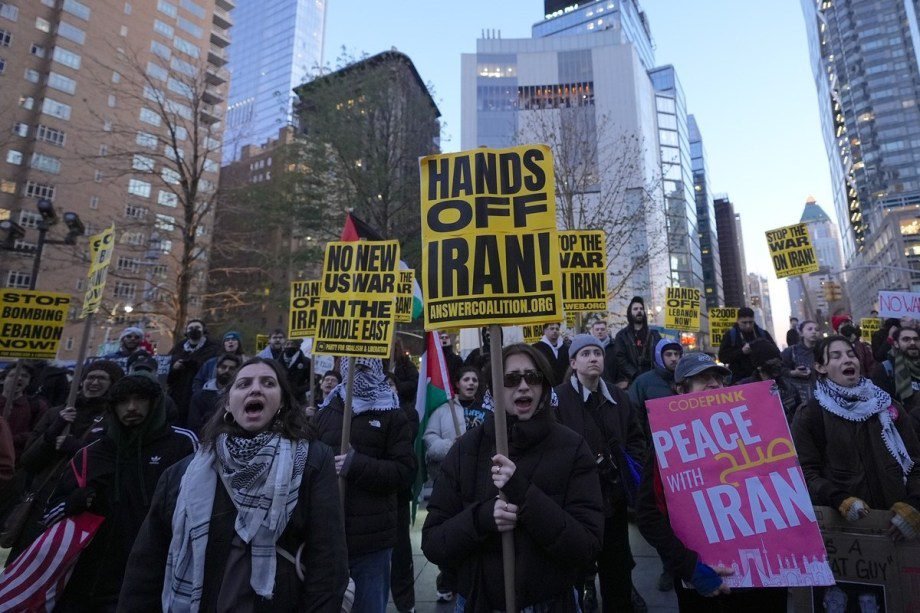
A political rally in Florida should not, by itself, tell us much about the direction of American foreign policy. This one might.
With only three days to go before Florida’s Democratic primary, a Fort Lauderdale venue cancelled an event featuring Congresswoman Rashida Tlaib and congressional candidates Angie Nixon, Elijah Manley and Oliver Larkin. The decision came after Democratic state representative Michael Gottlieb attacked the gathering as an “anti-Jew” event. The venue cited security concerns and the organisers moved elsewhere.
Reuters reported the story on Saturday, 15th August.
There is something familiar about the episode. American politicians who question Washington’s support for Israel have spent years being told that their position sits beyond the limits of respectable politics. What is less familiar is what is happening around them. Candidates are continuing to run on those positions, voters are sometimes rewarding them and the argument over Palestine is starting to merge with a much older American anxiety: the fear of being dragged into yet another war in the Middle East.
That is what makes 2026 different.
The war with Iran, begun in late February by the United States and Israel, has made foreign policy harder to keep at a comfortable distance from everyday American life. Nearly six months on, there is still no persuasive sense of where the conflict is meant to end. There is, however, a much clearer sense of what it costs.
Reuters reported this week that the average US petrol price had climbed to about $4.08 a gallon, roughly 29 per cent higher than a year ago. Donald Trump’s answer was essentially that Americans should accept the increase as the price of continuing the fight.
That is a remarkable political proposition from a president who built so much of his appeal around cheaper living and a promise to avoid the “endless wars” of earlier administrations.
And voters have noticed.
Pew Research Center found that around six in ten Americans believe the United States made the wrong decision to use military force against Iran. The numbers are especially stark among Democrats.
This is the context in which “No War on Iran” needs to be understood. It is no longer only a chant at demonstrations or the language of foreign-policy activists. It is becoming part of an electoral argument about what Washington does with American money, American military power and the authority voters hand to their government.
Abdul El-Sayed understood that earlier than most candidates.
After Trump ordered the first strikes in February, El-Sayed argued that the president had promised to end endless wars only to begin another one. He questioned both its purpose and its lack of congressional authorisation.
Five months later, Michigan Democrats nominated him for the US Senate.
That result deserves attention not because every voter who supported El-Sayed did so over Iran or Palestine. Elections are never so tidy. Michigan voters were also thinking about healthcare, prices, Trump, jobs and the usual mix of local and national grievances.
But foreign policy was not incidental to the contest either.
AIPAC and affiliated groups poured an extraordinary amount of money into the race. The Associated Press documented more than $30 million in spending connected to the pro-Israel lobby’s effort to shape the primary. El-Sayed nevertheless defeated Haley Stevens.
The lesson is not that AIPAC suddenly ceased to matter. It plainly does. The more interesting lesson is that spending on that scale was unable to turn El-Sayed’s criticism of Israeli policy and American militarism into the disqualifying liability it once might have been.
Something in Democratic politics has moved.
The change is visible in public attitudes towards Israel as well. Pew found in April that 60 per cent of Americans held an unfavourable view of Israel, rising to eight in ten among Democrats and Democratic-leaning independents. Meanwhile, 59 per cent of Americans expressed little or no confidence in Benjamin Netanyahu.
Those figures would have looked extraordinary not very long ago.
They also help explain why Palestine and opposition to war with Iran increasingly sit within the same political conversation. The common thread is not Iran. It is Washington.
For many voters, the question is becoming whether the United States should continue treating military escalation as its default response to crises in the Middle East and whether support for an Israeli government should remain largely insulated from the ordinary scrutiny applied to every other recipient of American weapons and money.
Members of Congress are beginning to test that argument.
Ilhan Omar, another politician whose opposition to Israeli policy has repeatedly been used against her, supported the Iran War Powers Resolution in March. Its demand was hardly revolutionary: the president should obtain congressional authorisation before committing the United States to further hostilities.
That principle should not be controversial in a democracy. Yet decades of presidential wars have made it seem almost unusual.
This brings us back to Florida.
The three candidates appearing with Tlaib will face voters on 18th August. Their individual races are different and none should be treated as a guaranteed victory for an emerging progressive bloc. But the attempt to stigmatise the event before voters even reach the polls tells us something about the stakes.
For years, criticism of Israel was often dealt with by raising the political cost of expressing it. Candidates learnt which subjects were safer to avoid. Donors learnt which challengers could be overwhelmed with spending. Members of Congress learnt how quickly criticism of Israeli military policy could become a controversy about the critic rather than the policy.
That arrangement becomes harder to sustain when voters themselves are changing.
It becomes harder still when the consequences of Middle East wars turn up on petrol station signs and household budgets.
Americans are being asked to accept higher prices while Washington spends billions sustaining another conflict. They are watching a president who campaigned against endless wars defend one that has already lasted nearly half a year. At the same time, they are being told that questioning military assistance to Netanyahu’s government remains politically suspect.
Eventually those contradictions reach the ballot box.
There is no reason to pretend that an anti-war majority has suddenly taken control of American politics. It has not. Nor will the victories of a handful of progressive candidates undo decades of bipartisan interventionism.
But the old political calculation is becoming less reliable.
A candidate can now oppose another war with Iran and win a major Senate primary. A member of Congress can demand limits on presidential war powers and survive attempts to remove her. Candidates can challenge unconditional military support for Israel without automatically ending their political careers.
For Washington’s foreign-policy establishment, that may be the development worth worrying about.
The question facing American politicians is slowly changing from “What will it cost me to oppose this war?” to something much more uncomfortable: What will it cost me to support it?
The views expressed in this article belong to the author and do not necessarily reflect the editorial policy of Middle East Monitor.