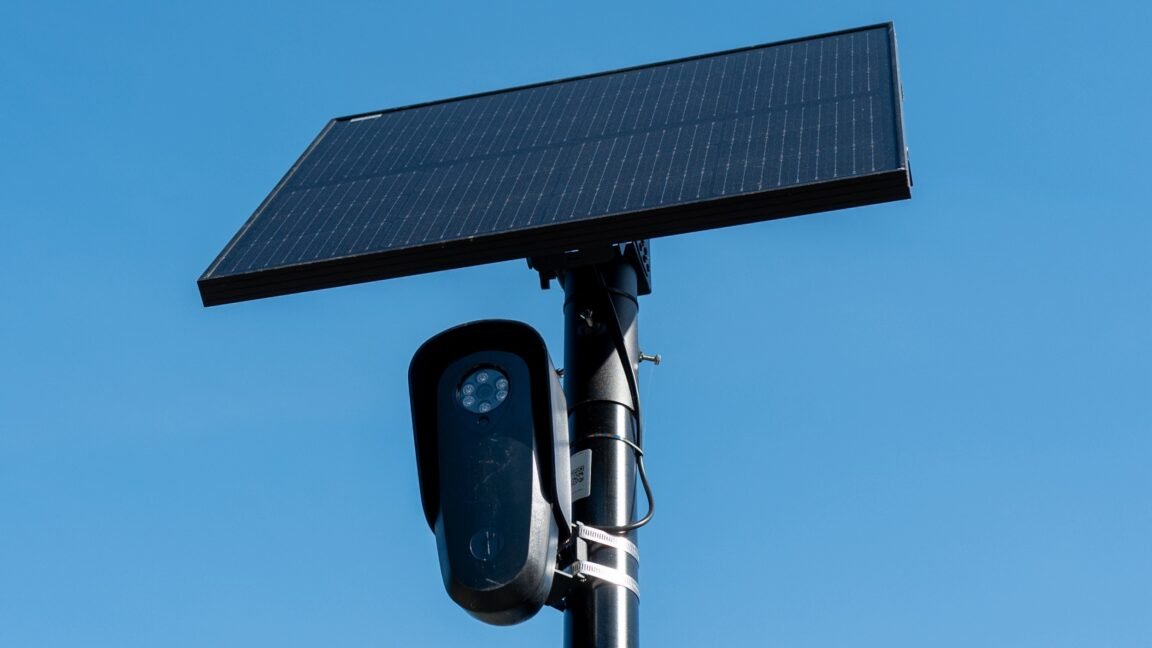
New data compiled by a Bay Area anti-surveillance advocacy group shows that not only are American localities dropping cameras from Flock Safety, but they are doing it at an accelerating rate.
Communities from Lansing, Michigan, to Pflugerville, Texas, are ending their relationship with Flock, largely over concerns regarding out-of-control surveillance, unwanted data sharing, high expenses, and reports of police abusing the tool.
Secure Justice, an Oakland-based advocacy group, has recorded 214 cities and counties that have dropped Flock since 2021. Of those, 90 ended their relationship with Flock in August 2026 alone, a fourfold increase compared to the previous month.
Put another way: During the last 30 days, an average of three localities per day have halted contracts with Flock.
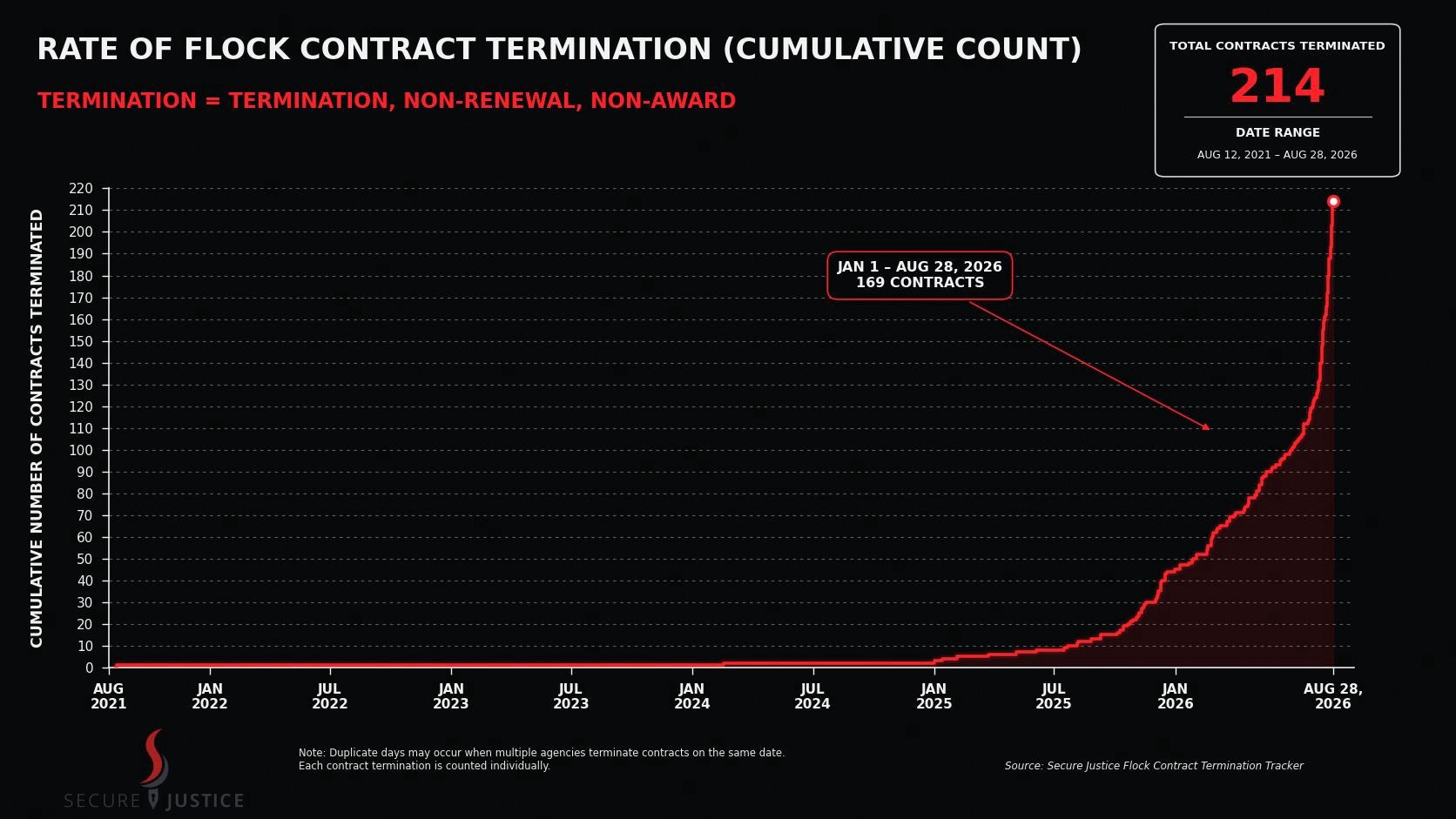
“Looking at that image, it’s gone parabolic!” Brian Hofer, the executive director of Secure Justice, told Ars.
Hofer, who until 2025 served as chair of the Oakland Privacy Advisory Commission for 10 years, recognized that while 210 remains relatively small, the momentum is growing rapidly.
“When you see that now 165 [cancellations] are just in the first almost eight months of this year… At that speed, if it goes another year, we’re talking serious money,” he said. “That number is going to get huge, fast.”
When presented with this data, Flock Safety did not express concern. “So far in 2026, new city partnerships have outpaced nonrenewals by approximately 10 to one,” emailed Courtney Terlecki, a company spokesperson. “That does not mean every community will make the same decision, and we understand that public safety technology deserves thoughtful public discussion and community engagement.”
She declined to say precisely how many new customers Flock has taken on this year, but the company has repeatedly said that its products are “trusted by over 5,000 communities.”
Criticism
After extensive criticism, Flock CEO Garrett Langley wrote in a recent blog post that Flock would reduce data retention defaults from 30 days to seven, among other privacy-minded changes.
Last Friday, Flock’s top lawyer wrote in another blog post that its newly modified terms of use “expressly prohibit customers and their users from using Flock Services to mislead, harass, stalk, or otherwise impose upon or violate the legal rights of another person.”
Those efforts have done little to quell political scrutiny.
This week, Sen. Josh Hawley (R-Mo.) announced that he was “investigating Flock Safety’s collection, retention, and dissemination of the data generated by its artificial intelligence surveillance cameras.”
Additionally, on Wednesday, after two Florida police officers were arrested for misusing Flock, Republican Gov. Ron DeSantis gave a speech in which he said that Flock cameras were “out of control” in his state.
“When I see, like, a police officer using this to track, like, an ex-girlfriend, I’m like, you know what the hell’s going on?” DeSantis said.
Even advocates who have followed the pervasive expansion of automated license plate reader (ALPR) technology—which predated Flock—are surprised.
“Maybe in the past it didn’t feel like every red light cam really meant a pair of eyes was watching you, but with AI, that’s increasingly becoming the reality,” Jake Laperruque, deputy director of the Center of Democracy and Technology’s Security and Surveillance Project, emailed Ars.
“And we’re already seeing how AI can morph ALPRs into a mass surveillance dragnet,” he added. “Flock lets its cameras be searched for keywords and people, cities are incorporating real-time facial recognition into camera networks, Border Patrol is using AI to scan ALPR data for driving patterns [and] pulling people over whenever the AI deems their driving ‘suspicious.’”
The scrutiny has become bipartisan after numerous widely reported incidents. “A Texas Sheriff’s Office used it to search for a woman who had had an abortion, and federal agents proposed using it outside gun shows,” Catherine Crump, a UC Berkeley law professor, emailed Ars.
“It definitely does not help that this is yet another Silicon Valley product that no one asked for that threatens to reshape people’s lives.”