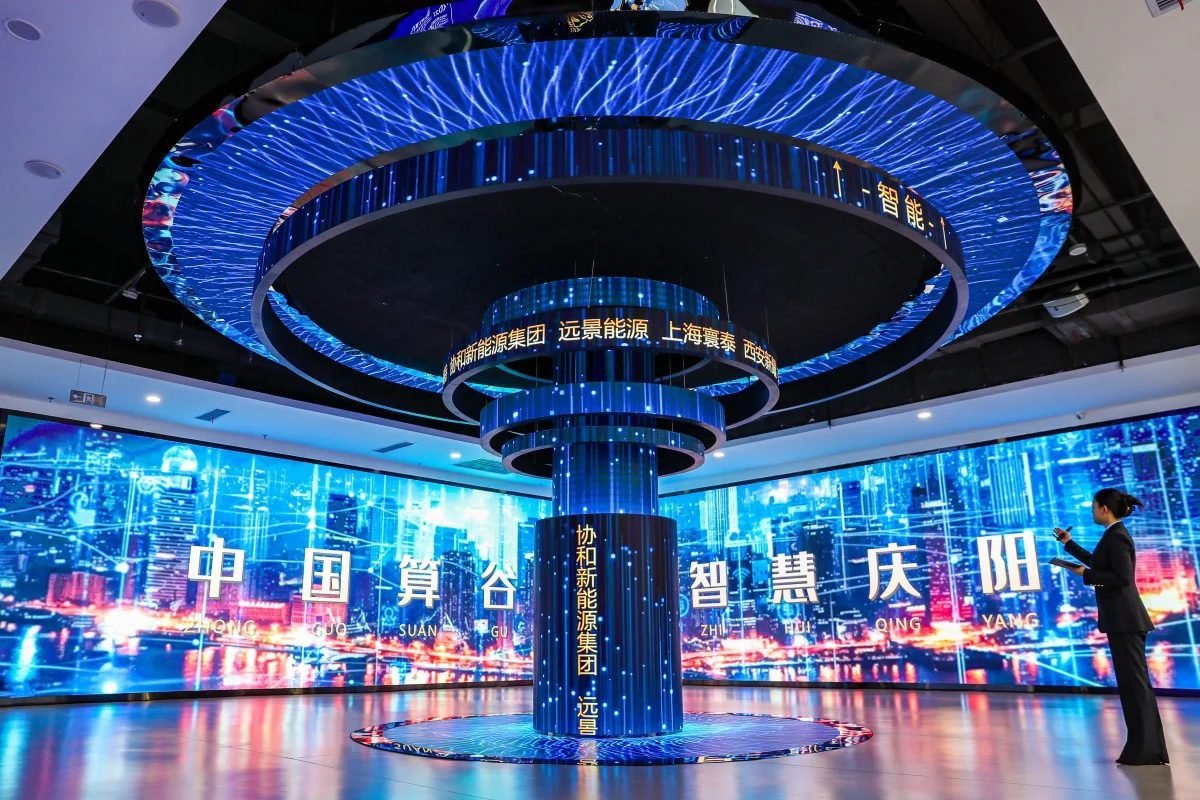
Walk through any major electronics hub in Shenzhen, Seoul or Taipei right now, and the neon glare of artificial intelligence is blinding.
It’s also intensifying: order books for advanced chips are overflowing, stock tickers are melting upward and tech executives speak with a zeal that would make dot-com CEOs blush. But step behind the glittering facade, and the underlying economy looks less like a sci-fi utopia than a rust-belt hangover.
Across East Asia, the AI boom has become an economic smoke machine. In South Korea, it’s masking weak domestic spending, runaway household debt and a fast-aging workforce. In Taiwan, AI-driven double-digit growth is eclipsing a hollowing-out of manufacturing sectors like machinery, basic metals, textiles and chemicals.
China’s industrial profit data reveal the same disconnect between AI-linked sectors and everything else. Overall profits are slowing as rising input costs squeeze margins even as revenue holds steady — up 11.2% year-on-year in July, down from 15.1% in June.
Yet amid signs that China’s US$20 trillion economy is cooling, tech-linked sectors are a glaring exception. Computer, communication and electronics equipment profits surged 110%, non-ferrous metal smelting jumped 91.8%, fiber optics rocketed 468.4%, optical cables gained 62.6% and communication systems climbed 55%.
That stands in sharp contrast to property and consumer-facing industries still battered by falling household demand.
“China Shock 2.0 threatens the foundation of all manufacturing outside of China, so that’s what we’re competing against right now,” Exiger strategist Kit Conklin told Fortune.
East Asian economies are running on a massive AI adrenaline shot. Frenzied demand for Nvidia chips and advanced memory modules is propelling growth in China, Taiwan and South Korea, and giving Japan a meaningful tailwind. A handful of semiconductor giants — Samsung and SK Hynix in Korea, TSMC in Taiwan — are minting record profits.
But beneath the surface, these economies are sputtering under real estate crises, record-low birth rates, slowing domestic demand and headwinds from US tariffs and Iran-war fallout.
It’s a split-screen: on one side, tech-crazed Asia engineers the future; on the other, empty housing showrooms, quiet shopping centers and shrinking maternity wards suggest the region is running out of steam. The AI boom is economic trick photography — using tomorrow’s promise to obscure today’s reality.
“The Asia-Pacific economy is running at two different speeds,” says Stefan Angrick, an economist at Moody’s Analytics. “The AI boom is boosting exports and production, while higher inflation and tighter policy drag on growth.”
AI, he notes, “still drives the region’s export engine.” Semiconductor demand has lifted shipments across Taiwan, South Korea, mainland China and parts of Southeast Asia. In the first half of 2026, nominal goods exports from South Korea and Taiwan topped Japan’s for the first time. But “strong exports mask trouble at home,” Angrick says.
Domestic demand across the region sits below pre-pandemic trends and global averages, and rising energy and food prices are squeezing real incomes — a dynamic that complicates policy for central banks weighing inflation against fragile growth.
This week, the Bank of Korea upgraded its 2026 growth forecast to 3.3%, up sharply from earlier projections of 2.6% and 2.0%, citing robust semiconductor exports tied to global AI infrastructure demand.
No economy dramatizes AI’s centrality to Asia better than South Korea. Six months ago, SK Hynix, Samsung, and the rest of Korea Inc. were bracing for a brutal 2026, squeezed between Trump’s trade war and China’s deflationary slide. The best case seemed to be simply staying out of the crossfire.
The same forces driving the Kospi’s 62% rally this year — the AI trade and the global data-center buildout — are lifting nearly every sector of Asia’s fourth-largest economy. SK Hynix shares are up 160% year-to-date; Samsung is up 117%.
The broader economy is along for the ride: Korea’s $1.9 trillion GDP got a direct lift in the first half of the year as AI fueled an exports jump of 48.4% year-on-year to a record $496.7 billion, driven heavily by the semiconductor boom. Exports surged another 62.8% year-on-year in July, following a 70.9% increase in June.
The question is whether it’s wise to hotwire a still-unproven technology into the center of a top-15 economy. That makes the Kospi’s wild swings more than a market curiosity — Korea has effectively become a giant leveraged bet on the AI trade, one now driving growth to new highs rather than simply riding alongside it.
After a strong first quarter, it’s easy to see why President Lee Jae-myung might view AI as the answer to Korea’s economic prayers, despite weak domestic demand, rising inflation, and considerable uncertainty.
Hyun Jung Je, an economist at the Korea Economic Institute, argues that Korea’s “exceptional export growth is likely to continue in the near term, supported by strong global demand for AI-related semiconductors and parts and components for computers and servers.”
These products, she says, should remain key drivers “as investment in digital infrastructure and AI technologies continues to expand worldwide.” Her caveat: “developments in the global energy market could moderate some of the factors that have supported export growth.”
South Korea isn’t alone. China, Japan, Malaysia, Taiwan and Vietnam are all, to varying degrees, caught up in the frenzy. “This is what an AI supercycle looks like,” says Evercore ISI analyst Amit Daryanani.
South Korea’s growing dependence on AI raises an uncomfortable question: is this a bubble rivaling the dot-com crash, or something even bigger, given the scale of money pouring into data centers? These days, Kospi swings tend to track headlines about how Nvidia and Micron are faring.
Since May, Michael Burry — of “The Big Short” fame — has warned that AI stocks are overpriced, calling the boom “just an asset bubble, plain and simple” and drawing comparisons to the dot-com era.
Nobel laureate Paul Krugman shares the unease, describing the setup as fragile: “a kind of bubble, but not in the normal sort of asset-price form. It’s more of a kind of fad, almost a social delusion.”
If AI’s meme-ification puts entire economies at risk, Asia may be the first to find out. A tech downturn could rattle Korea and Taiwan directly, with contagion risk spreading to China, Japan, Malaysia and Vietnam.
The deeper concern is how completely AI has become the defining industry across Asia’s major economies. El Salvador betting its fortunes on crypto is one thing; it’s another when South Korea and Taiwan (22nd-largest) tie their futures to a technology that hasn’t yet proven it can generate returns to match the hype.
Seoul has backed the AI pivot with more than $102 billion in tech incentives, increasingly blurring the line between the sector and the economy itself.
The catch: the AI trade rests on a handful of massive conglomerates. In South Korea, that means the family-run chaebols—already known for opacity and outsized control—are growing even more dominant.
“Any time you have narrow leadership… it just creates more fragility in markets in general,” says Matt Stucky, a portfolio manager at Northwestern Mutual Wealth Management.
Taiwan faces a similar dilemma with TSMC, whose 43% rally this year is surging the entire market — and economy — with it. Export orders jumped more than 47% in the first half of the year.
Information and communications technology and electronics exports rose 63.5% over the same period. Taiwan’s economy is expected to grow 11.05% this year, its fastest pace since 1987.
The risk, warns economist Saktiandi Supaat at Maybank, is that when AI investment slows, “it could feed relatively quickly into Taiwan’s exports, manufacturing and investment.” He cautions against extrapolating “the exceptional pace of growth this year too far ahead.”
Caroline Wong, a country risk analyst at BMI, tells CNBC that “tighter global financial conditions could deepen the pullbacks in equity markets, in turn increasing stress in private credit markets.”
For AI startups, she adds, limited refinancing options amid that stress “could lead to a slowdown in Taiwan’s investment growth” — a dynamic that could ripple outward to China, Japan, Korea, Malaysia and Vietnam as well.
Japan holds dominant positions in semiconductor manufacturing equipment and specialized components. China anchors the manufacturing ecosystem that assembles most tech hardware globally.
Malaysia has become a key hub for chip “back-end” work — testing, assembly, and packaging. Vietnam has emerged as the standout winner of the US-China trade war, serving as the go-to backup manufacturing base for multinationals seeking shelter.
What all these economies share is how thoroughly — and how fast — AI is being hotwired into Asia’s economic engines, faster than investors can track.
Follow William Pesek on X at @WilliamPesek