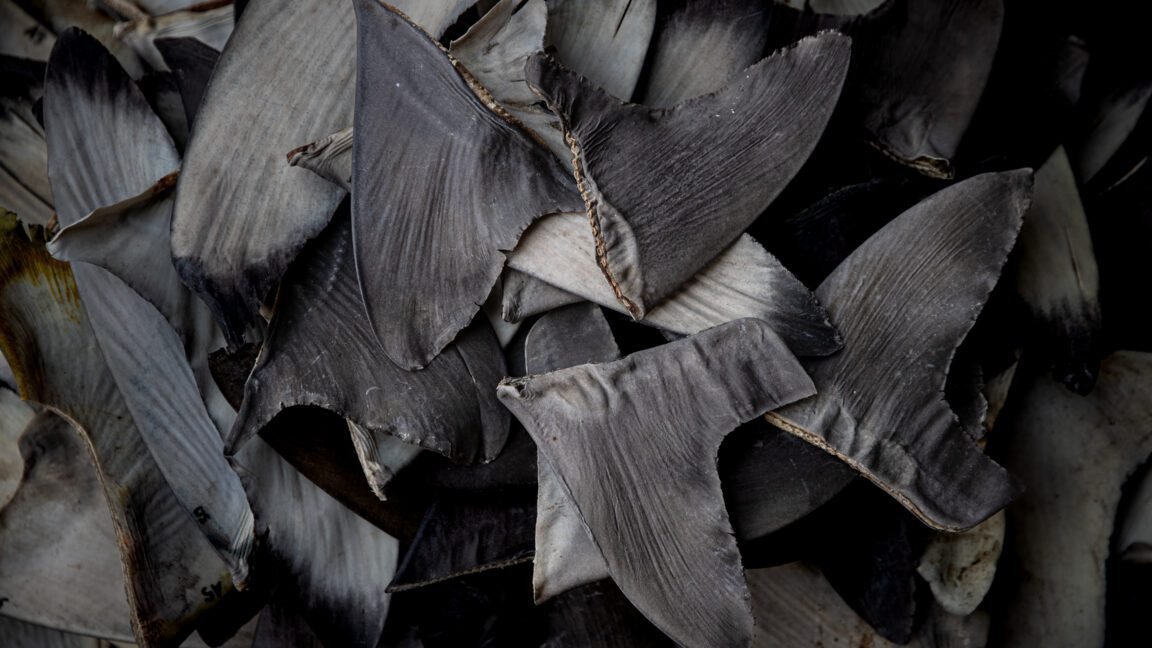
For migrant workers trapped onboard Chinese distant water fishing fleets, cutting the fins off sharks as they writhe violently on rusted decks in the Indian Ocean isn’t accidental. It’s an intentional and lucrative act that marks the start of a bloody half-a-billion-dollar offshore supply chain, tacitly supported by Beijing yet covertly concealed from port inspectors globally.
The Center for Biological Diversity, a nonprofit focused on the protection of endangered species, filed a formal petition this month requesting the U.S. government potentially sanction China for failing to meet American shark conservation standards. Shark populations have declined by more than 70 percent since 1970, with more than one-third of all shark and ray species now threatened with extinction. Yet each year, Chinese-flagged vessels catch, brutally fin, and discard thousands.
Should the National Marine Fisheries Service identify China as having violated the US Moratorium Protection Act, then President Trump could be expected to ban the import of all $1.5 billion of Chinese seafood.
“Losing sharks wouldn’t just be an ecological disaster; it would be a profound moral failure,” Alex Olivera, a senior scientist at the Center for Biological Diversity, said in an email. “Sharks have survived for hundreds of millions of years, and it would be a tragedy if they disappeared in a few decades because governments failed to enforce basic conservation rules.”
Sharks are vulnerable to overexploitation because they grow slowly, mature late, and have few offspring. Each year, however, an estimated 80 million are caught and killed either intentionally or as bycatch.
Finning—which has been outlawed in the US since 2000—sees sharks dumped back in the ocean without their fins, “leading to a slow and agonizing death,” according to the petition. While botched sharks sink slowly to their deaths, the rate of shark finning has increased in recent decades. Demand is largely driven by a growing demand for shark fin soup and traditional medicinal cures in East and Southeast Asia.
Official Chinese data shows that in 2023, more than 10,000 blue sharks and nearly 1,700 shortfin mako sharks were discarded by crews in the western and central Pacific region alone.
While the US and over 90 other jurisdictions require fishers to land whole sharks with their fins naturally attached—a standard widely recognized as the only way to prevent finning—China does not. Although the nation has technically banned the practice, it still allows many of its fisheries to remove fins so long as they do not exceed a certain percentage—usually 5 percent—of the shark’s total bodyweight upon landing.
Conservationists highlight that these ratio-based regulations are ineffective, ignore biological differences between species, and are difficult to enforce accurately.
“Once the fins are separated from the bodies, inspectors have a nightmare of a time figuring out which fin belongs to which shark, whether protected species are mixed in, or if bodies were just dumped overboard,” Olivera said. “It turns real enforcement into a math game rather than a secure chain of custody.”
The petition argues that without a “fins naturally attached” landing policy, the Chinese fleet—the largest in the world—fails to meet America’s conservation standards, and therefore fails to meet the requirements of the Moratorium Protection Act.
When asked for comment, a spokesperson for the Chinese Embassy in Washington told Inside Climate News that “China is deeply committed to science-based conservation and sustainable use of international fisheries resources.” The spokesperson said China is following international law, rigorous vessel monitoring and membership requirements of regional fisheries management organizations.
However, the spokesperson said the government was “not familiar with the specific situation” regarding the Center for Biological Diversity’s petition, and did not reference sharks, finning or the threat of seafood sanctions.
Heidy Martínez, a shark scientist and science communicator, said that shark finning “really shows how much we view these ancient, majestic animals as a commodity, as animals that are simply there to benefit us.
“It highlights many of the cruel, unsustainable and wasteful practices within the fishing industry,” she said.
While shark finning often receives the greatest attention for its shock factor, it’s important to note that the biggest threats sharks face are from overfishing and bycatch, Martínez said. One hundred percent of shark species are impacted by overfishing and for 67 percent of shark and ray species, overfishing is the only recorded threat, according to the Shark Trust.
Bycatch refers to fish and other marine animals accidentally ensnared by fishermen using huge nets or long lines baited with thousands of hooks.
Interviews by the Environmental Justice Foundation (EJF) in 2024 and 2026, however, exposed the widespread and devastating nature of China’s shark finning industry. Among crew working on board Chinese distant-water vessels in the Southwest Indian Ocean, 80 percent of those interviewed reported engaging in shark finning. Sixty percent of crew onboard Chinese squid jiggers in the Southeast Pacific Ocean said they witnessed sharks returned to the ocean without a key means of their survival.
Crews identified blue sharks, tiger sharks, pelagic threshers, and at least half a dozen other intentionally targeted species. “When sharks got entangled, they were lifted, and the fins were cut off,” said one Indonesian fisher working on a Chinese squid vessel in July 2022. “Most of [the Chinese] swallowed the bone marrow right away, while the fins were sundried.”
Another crew member described the act of throwing back blood-strewn but alive sharks as “sadistic,” while others spoke of the cat-and-mouse game of avoiding international authorities with special compartments or hidden fin freezers.
The human toll is similarly harrowing. Chinese distant water vessels that perpetrate finning are often rife with human rights abuses, according to the EJF. Forced labor, crew beatings, squalid living conditions and fatal accidents are not uncommon. Trapped at sea for months or years, crew members are forced to illegally fin sharks, harpoon seals to sell fur and fangs on the black market or catch false killer whales to be sold as souvenirs.
Addressing allegations of worker abuse, the Chinese Embassy maintained that Beijing “attaches great importance to protecting the lawful rights and interests of workers and always asks Chinese companies to abide by laws and regulations.”
Martínez said she wished the general public better understood these prehistoric animals. “Sharks fall under the class of fish, and because of this, they communicate their experience to us differently than marine mammals.” The human-like eyes and behavior of dolphins and sea lions make it easier for people to project themselves onto them, but it’s harder for people to naturally relate to sharks, Martínez said.
Harvested fins are frequently shipped to Hong Kong, a special administrative region of China that serves as the world’s largest shark fin trading hub. DNA analysis of fins imported into Hong Kong between 2014 and 2021 found the presence of at least four species on the Convention on International Trade of Endangered Species list: scalloped hammerhead, smooth hammerhead, great hammerhead, and oceanic whitetip sharks.
China’s lack of a ban on the possession, transport, and sale of shark fin products is a further violation of the US Moratorium Protection Act, according to the Center for Biological Diversity. Although there are restrictions on serving shark-fin dishes at official Chinese government events, this does not constitute a nationwide ban, the report concluded.
“If China refuses to adopt comparable protections, then the US should use the tools Congress provided, including import restrictions,” said Olivera, highlighting that the ideal outcome is for China to adopt shark conservation measures comparable to US law. “The point of the petition is to make shark conservation standards real, not optional.”
“The level of demand we place on the ocean simply cannot continue,” said Martínez, whose first live encounter was with a Great white shark in South Africa. “Shark finning is part of that larger story, a reflection of just how deeply we have exploited our oceans.”
This article originally appeared on Inside Climate News, a nonprofit, non-partisan news organization that covers climate, energy, and the environment. Sign up for their newsletter here.