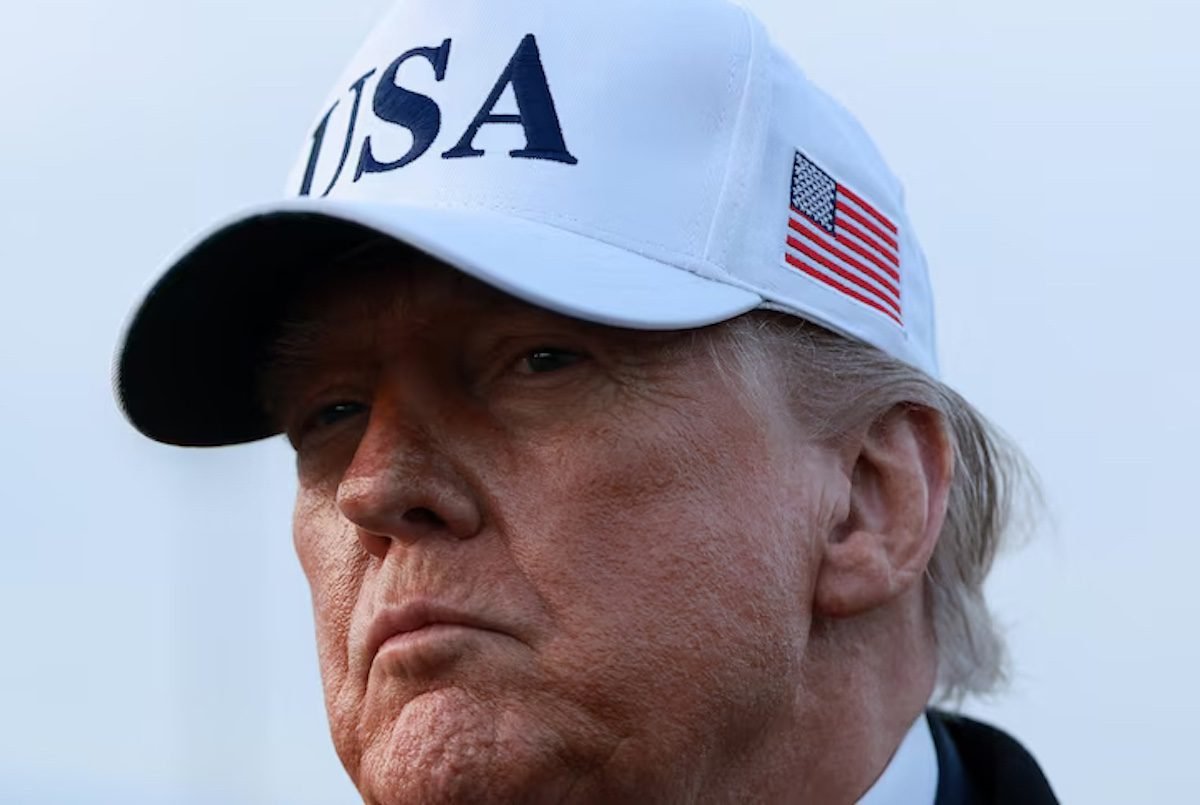
When US President Donald Trump said, “A Whole Civilization Will Die Tonight,” he hardly knew the profundity of his words. Iran, formerly Persia, has a history that goes back at least 7,000 years, and has a long list of great contributions to the world.
Among these achievements are the development of agriculture and irrigation, the invention of algebra by the Persian mathematician Khwarizmi, the development of architecture dating back to 5,000 BC, as well as banks, astronomy, batteries, pottery and ceramics, textiles and many other humanity-improving inventions.
Trump could nuke Iran, as his threat seemed to imply he is considering, and not erase the impact the Iranian civilization has already made on the world. But Trump seemed completely blind to the implications of his actions. He claims that he wants to “Make America Great Again.”
But what is greatness? In the last 80 years, the United States has fought countless wars, including stalemating or losing against China and North Korea, Vietnam, Iraq, Afghanistan and now Iran. What do those six nations have in common?
All of them are ancient civilizations, thousands of years old. China is five thousand years old. Korea is five thousand years old. Vietnam is five thousand years old. Iraq is over six thousand years old. Afghanistan is over two thousand years old. Iran is seven thousand years old.
Each of them has its own list of great achievements that contributed to the world just as Iran has. A civilization does not live thousands of years if it does not have aspects of greatness deep in its DNA. Anyone can do a simple Google search for any of those countries to see for themselves what each nation has contributed to the world.
But it goes much deeper than that. In the thousands of years of lived existence that each of these nations experienced, there were times when they were on top of the world, and times when they were down, and some might have thought they would die. But they didn’t die; each time, they somehow survived and eventually rose up again. And over time, they began to see the patterns of life.
Time runs in cycles, nations rise and fall, great empires rise up, such as the Roman Empire or later the British Empire, upon which the sun never set, and now the American Empire, the most powerful in all of human history as measured by sheer firepower. And then these seemingly great empires eventually become overextended, turn rotten, and fall.
Their comings and goings may last a few hundred years, if that. This is nothing in the grand scheme of thousands of years. We Americans have become overextended and turned rotten in under three hundred years, less than some Chinese dynasties.
These ancient civilizations see time and life very differently from the US civilization. They look at the long view of time. They see the cycles of time. They know to work with, rather than against, time and nature. They make nature and the cycles work for them, not against them.
The depth of these thousands of years of a civilization’s lived experiences filters down to the lowest level, to every single individual. As a child growing up in San Francisco as a third-generation Chinese American, even without speaking Chinese, the culture still shaped me.
As a child in the 1950’s, when movies and TV showed white actors in yellowface talking stupid English and behaving like idiots while pretending to be Chinese, and other children threw racial taunts at us, and we threw them back. None of us were ever intimidated or felt the least bit inferior to the whites.
Our parents taught us that we came from an ancient civilization that had seen worse and prevailed, and the whites knew nothing by comparison. Their taunts and racism just reinforced the image that they didn’t know anything. It actually enhanced our self-esteem. We knew that we had a proud history and that America and the West were just Johnny-come-lately civilizations.
Our parents sacrificed everything for us and taught us that to succeed, we had to work twice or three times as hard as whites, and we had every confidence that we could do so. In one generation, we Chinese Americans went from the bottom to the middle class. In this same generation, China went from one of the poorest nations on earth to a powerhouse whose economy now equals or by some measures exceeds America’s.
This was due to strategy, tactics and technology, yes. But more than that, it was due to a much deeper understanding of reality, of life, of how things actually work, and of what’s really important in the long term.
But this is only the beginning. So far, I have named only six ancient cultures: China, Korea, Vietnam, Iraq, Afghanistan and Iran. There are plenty of other ancient cultures in the world. One might think, of course, of nations such as India. But one should think even further.
One often overlooked place is Africa, particularly Black Africa. Western nations have often depicted Sub-Saharan Africa as a place of savage tribal peoples, poor and backward. The West has either forgotten or never known that some of the greatest ancient civilizations on earth were in Black Africa. Nubia, Meroe, Great Zimbabwe, Benin; these are ancient names that ring down in history, but the West has forgotten.
How great were they? Thousands of years ago, when the Anglo-Saxons in northern Europe were still barbarians wearing furs and lacking a written language, these civilizations were trading with China and India along the ancient Silk Roads that preceded the later Silk Roads to Europe.
Black Africa was home to the high civilizations of the time, rivaling those of China, India, ancient Egypt and others. Some of those civilizations survive to this day, now trading with China and the rest of the world again and gaining modern technology in the process.
Never forget that they, too, have greatness in their DNA. I feel completely confident predicting that in 50 years, Black Africa will rise just as China has. They are already in that process. There are lots of issues, including internal conflicts, to overcome, but remember the most fundamental point – they, too, have greatness in their DNA. If the West is shaken by China’s rise, just wait until Black Africa rises. China is just the tip of the iceberg.
Compared to all this, the US is just a baby culture _ and it has a lot of growing up to do. But all is not necessarily lost. Civilizations can grow up. After all, these other civilizations did. They aren’t perfect; they are human, too, but they survived and thrived.
What must America do? First of all, we must recognize that being “number one” is meaningless in the long term. Nobody is “number one” for very long. What really counts is who lives long and thrives. How did these ancient nations do it? Not by conquering the world, that’s ultimately self-defeating and is basically a form of national Russian roulette.
Rather, they each carved out a niche for themselves in the world, a niche that worked for them. Then they secured their borders and traded with the rest of the world. They sometimes fought with their neighbors, but they didn’t try to conquer the world, nor did they make fighting their primary role. They took care of their own internal affairs and traded with others.
A normal country is sustainable; a huge empire is not. They thought long-term, looking down the road to see the logical consequences of their actions. They made mistakes, but they learned from them. They worked with nature – both human nature and the natural world – in an environmentally sustainable way.
China today is the leading nation in the world in electric cars, alternative energy generation, desert greening and other environmental technologies, and it is spreading these technologies to the rest of the Global South. America can do all this. We are a large nation with very good natural resources, advanced technology, an educated workforce, and easy-to-defend borders.
If America cooperated with the rest of the world rather than trying to conquer it, and traded rather than invaded, it could solve its internal problems, become environmentally sustainable and survive and thrive far into the future. America has the physical means, but does it have the political will?
Michael Wong is a former national vice president of Veterans For Peace and currently serves on its national board. He is a co-founder of Pivot To Peace and co-chair of the Veterans For Peace China Working Group.
He has been published in the anthologies, “Veterans of War, Veterans of Peace,” edited by Maxine Hong Kingston, “A Matter of Conscience,” by William Short and Willa Seidenberg, and in “Waging Peace in Vietnam,” edited by Ron Carver, David Cortright, and Barbara Doherty. He is also featured in the documentary film, “Sir! No Sir!” about the Vietnam-era GI anti-war movement and is a retired social worker with a Master of Social Work degree.