In Tazewell County, Illinois, Michael Deppert depends on a natural pool of water beneath the sandy soils of his farm to irrigate the pumpkins, corn and soybeans growing in his fields.
So when a data center was proposed about eight miles away, he feared it would tap the same aquifer, potentially eroding crop yields and profits.
Deppert, who is also the president of the local farm bureau lobby group, says locals were also “nervous” about how a data center would affect the “good, clean drinking water.” Residents launched a fierce opposition campaign, packing city council meetings and mounting petitions. After several months, the project, led by developer Western Hospitality Partners, was scrapped.
“You just can’t lay down and let everybody do whatever they wish,” Deppert says.
It is just one of the many pockets of resistance opening up across rural America, where a backlash against the explosive growth of the infrastructure for AI and cloud computing is at its sharpest.
Data centers, once clustered around cities and towns, are moving into farm country in search of cheap land and tax incentives. According to Pew Research Center, 67 percent of planned data centers are in rural areas, while 87 percent of existing data centers are in urban ones.
“Rural communities have become a target,” says Miquel Vila, lead analyst at Data Center Watch, a research project run by AI security company 10a Labs. More than 160 new AI-focused data centers have been built across the US in the past three years, a roughly 70 percent increase on the total, according to Bloomberg data.
As the industry has expanded, public opinion has hardened against it. Pew research found that Americans are far more likely to view data centers as harmful than beneficial in terms of environmental impact, domestic energy costs and quality of life in nearby communities.
The issue is awkward for President Donald Trump and his party. Republican strategists are increasingly wary that the administration’s support for AI could trigger a backlash among key voter blocs, including farming communities, ahead of November’s midterm elections. Around 78 percent of US counties dependent on agriculture voted for him in 2024, according to analysis of election data by Investigate Midwest.
In rural areas from Illinois to West Virginia, new data center proposals have led to packed public meetings and organised opposition as residents push back. In Indiana, shots were fired at a local lawmaker’s home and a note left on his doorstep reading “no data centers.” Democratic politicians have called for tighter regulation and Republicans in several states have campaigned against new developments, reflecting the backlash.
Even in solidly Republican Texas, agriculture commissioner Sid Miller has argued that projects should be directed towards less productive land, warning that the “unchecked spread of data centers onto prime farm and ranch land is a real and growing threat to our food supply.”
But the picture is mixed for farmers. While some worry about the industrialisation of once-agrarian communities, others welcome the opportunity to cash in on soaring land prices or to generate additional income.
The debate has reverberations far beyond America’s farm belt, pitting two visions of the country’s economic development against each other. In the view of the White House and much of Big Tech, the data centers will help the US maintain its lead in AI. Expectations about the growth the infrastructure will deliver underpin everything from sky-high share valuations to state and federal tax breaks granted in the hope of new jobs and investment.
But rural communities, along with many Americans, worry about the immediate impact of data centers on water and power costs and the broader disruption they represent for people’s way of life.
Environmental groups say there is a lack of transparency. Of the four data center projects that the Sierra Club in West Virginia is tracking, none have disclosed detailed water plans and most intend to build their own gas-fired plants, raising concerns about air pollution as well as water use.
For rural communities already wary of outside development, the combination of secrecy and scale has deepened resentment. Jim Kotcon, chair of the conservation committee for the West Virginia chapter of the environmental lobby group the Sierra Club, is “not opposed to data centers per se,” but argues they must be “done right.”
Otherwise, he says, rural counties risk being left with depleted aquifers, new sources of pollution and, if the boom proves short-lived, stranded assets with no obligation on developers to clean them up.
Three hours’ drive north of Deppert’s farm in Illinois, Jamie Walters points towards a cluster of vast pale concrete buildings rising from the prairie outside the town of DeKalb. “That’s Meta,” he says. “And that’s only half built.”
Ponds for retaining cooling water, electricity substations and high-voltage lines cut across a landscape where the Walters family has farmed for five generations. Soon the farm itself will be ringed by data centers and infrastructure.
But Walters is sanguine about it. He has leased hundreds of acres for solar panels and is under contract to supply renewable power for the data centers. Where corn might net $100 an acre in a good year, he says, an acre given over to solar can generate thousands.
Although he runs a whiskey distillery—for which pure water is vital—Walters says he is “cautiously optimistic” after a second data center developer, Edged, promised to use a closed-loop system, which uses less water, to cool its servers.
“It’s change,” he says. “But I’d rather be inside the process than standing on the outside saying no.”
America’s tech giants are relying on willing farmers like Walters as they race to build the backbone of the AI revolution they believe will transform productivity and deliver big financial returns.
Data centers have already emerged as a significant driver of economic expansion in the US, accounting for 80 percent of private sector growth in the first half of 2025, according to S&P Global.
The rush for sites is beginning to reshape land markets, but often in highly specific pockets that are well connected to electricity grids. “Anywhere there’s a path to power . . . that’s where data center developers are flocking,” says Jason Bell of real estate group JLL.
He notes that land with sufficient capacity, for example in New Jersey, can sell for five to ten times more than similar land without power access but that there is a wide range of estimates.
Curt Covington, a senior director at land financing group AgAmerica, agrees that developers are often “bidding up the price” for farmland. He adds that while some farmers will not dream of selling land they have worked for generations, others take a more pragmatic view if they are situated in would-be development corridors. “If [they] can get 1.5 times what this property is worth . . . they’ll part with their land.”
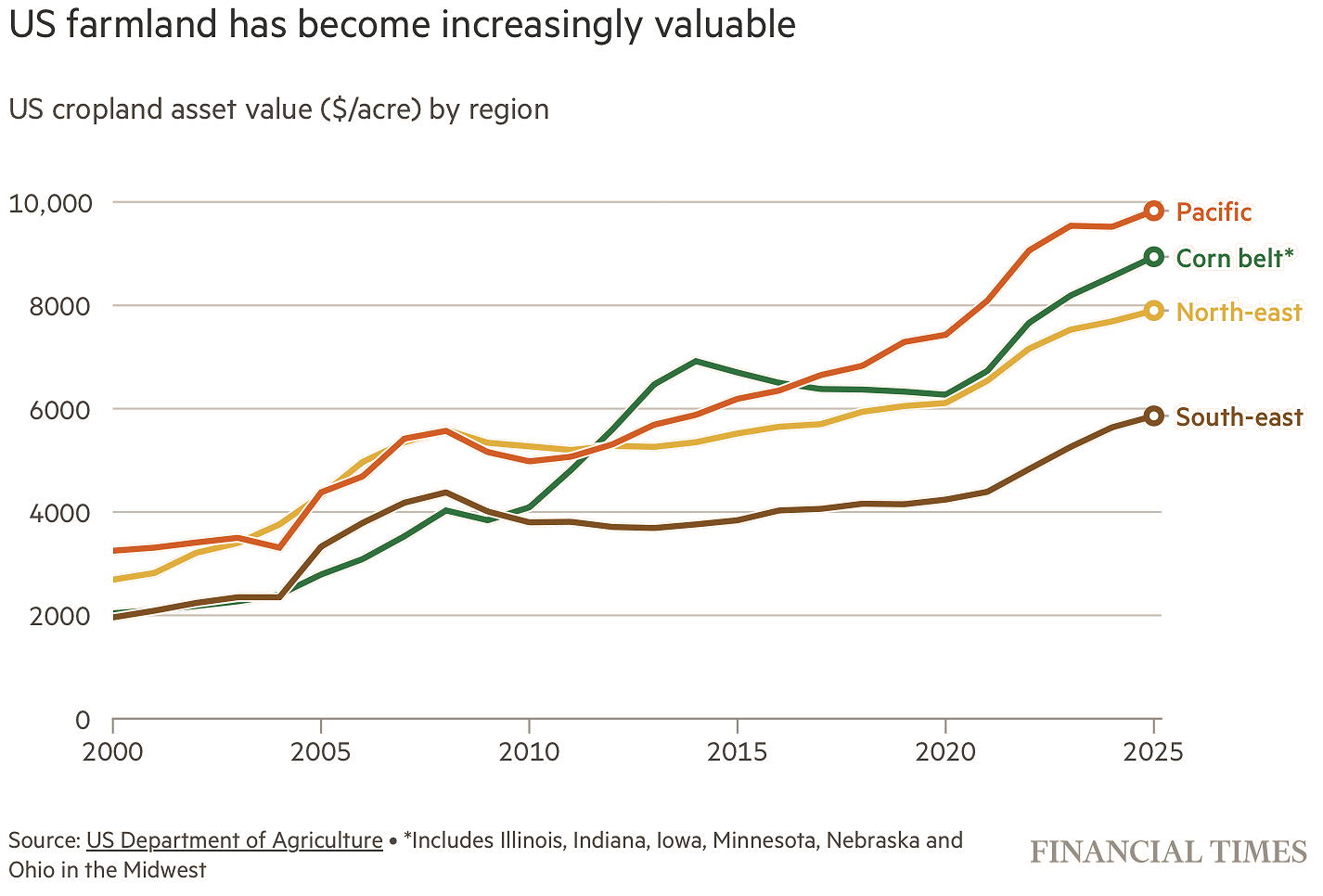
But not all farmers see the opportunity. In Yorkville, on the outskirts of Chicago, Bob Stewart, who farms corn and soybeans, says “it’s sad to see” the region’s rich black soils “get turned into development.”
Large-scale farming requires ever more acreage to remain viable, he says, as thin margins force farmers to spread rising input costs over more land. Soaring land prices driven by data center development make it harder for those who want to keep farming and expand.
“If we want to buy more [land], so that my kids can take over, we’d like farm prices to stay kind of where they’re at,” he says.
For data center developers, a vast tract of land is just the first necessity. Spare grid capacity is also vital given an up-and-running center’s energy demands.
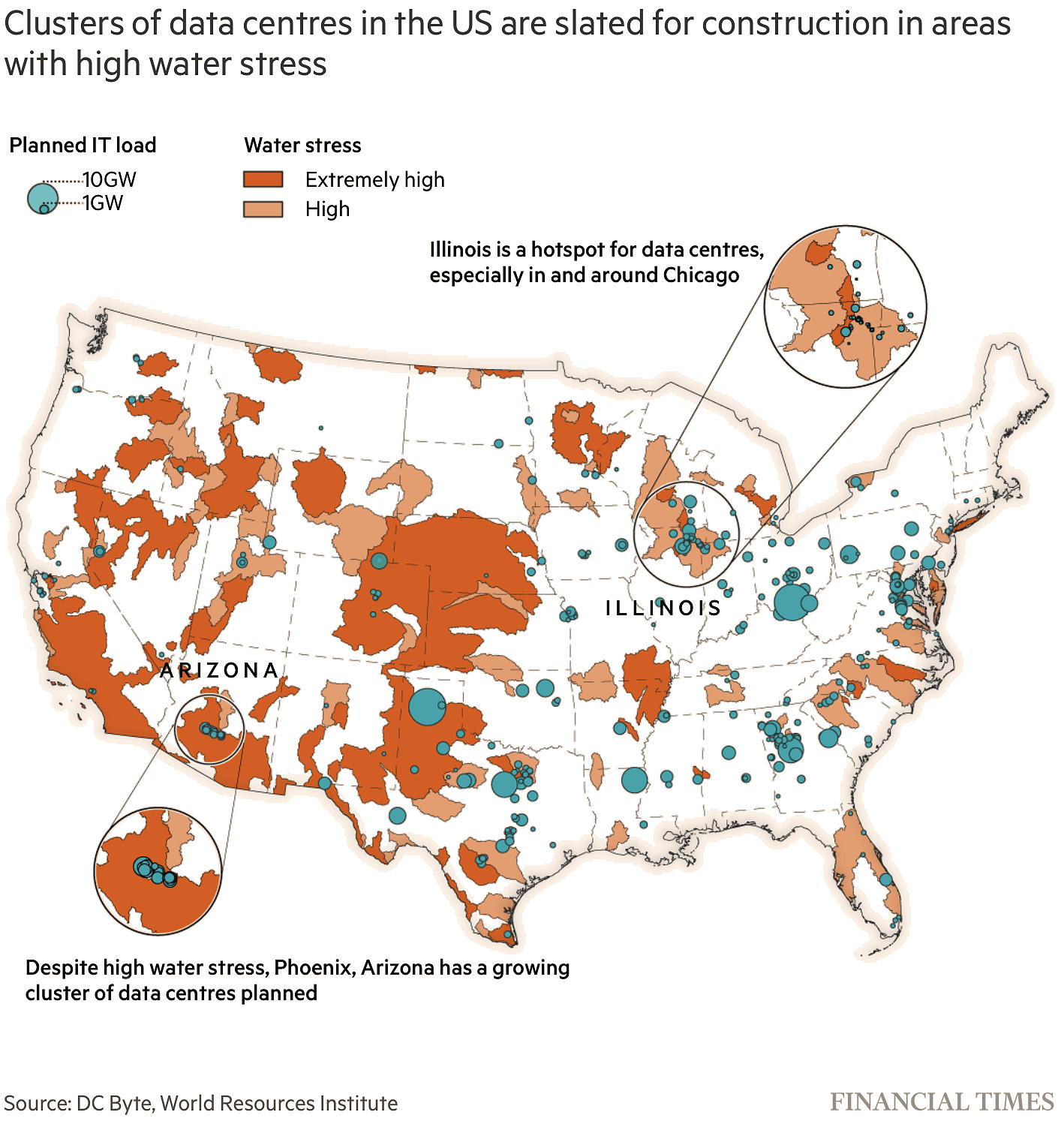
This means that many developments are being constructed in sparsely populated states that also experience periodic and severe drought, such as Arizona and Texas. Around two-fifths of all US data centers are located in areas of high water stress, according to S&P Global.
Heather Cooley, director of research at the Pacific Institute, a research group, says that energy and water consumption at data centers peaks during the summer months, just as it does in agriculture. “Adding another large load at peak capacity puts a lot of strain on the system and adds cost,” Cooley adds.
In DeKalb, a city of around 40,000 people, water demand averages just over 3 million gallons a day, rising to in excess of 4.5 million gallons at peak. The latter figure is broadly comparable to the needs of a single large AI data center.
Meta has a small data center in DeKalb and is permitted to consume 1.2 million gallons of water each day, according to a developer agreement. Meter data from the site shared with the FT shows on average it draws around 40,000 gallons each day, though this average obscures peak figures.
DeKalb’s mayor Cohen Barnes argues that Meta’s consumption is not as high as many might think. “Compare [Meta’s consumption] to a dormitory when the university is in session,” he says, noting that the tech giant’s consumption is lower than nearby Northern Illinois University’s student housing complex.
Barnes says that the Meta facility has brought broader benefits. “The data center itself pays an enormous amount of property taxes, and in the state of Illinois, our school system is funded primarily by property taxes,” he says. He adds that a $33 million elementary school was recently constructed in one of DeKalb’s most disenfranchised neighbourhoods due to funding he attributes to Meta.
But the data centers of today are not the colossal data centers planned for tomorrow. Researchers at the Lawrence Berkeley Laboratory forecast that so-called hyperscaler data centers will consume anywhere between 60 billion and 124 billion liters (16 billion and 33 billion gallons) of water on-site each year in 2028. This figure excludes the indirect water use tied to electricity generation, which the lab previously forecast could be as much as 12 times higher than direct consumption.
It is numbers like these that have people up in arms in the mountains of Tucker County, West Virginia.
There, a complex of gas-powered data centers has been proposed near the small town of Davis. Residents have filed “literally hundreds” of comment letters and petitions with state agencies, according to Kotcon of the West Virginia chapter of the Sierra Club.
Tucker County sits high on the ridge, with no rivers flowing into it and limited water storage. The town’s treatment plant can produce about 250,000 gallons a day and, Kotcon says, ran dry during a recent drought, forcing farmers to rely on the local fire department to truck in water to keep their cattle alive.
Against that backdrop, the prospect of a single large data center requiring “millions of gallons a day,” several times what the plant in Davis can produce even in optimal weather, has become a focal point for increasingly bitter opposition. “When the well runs dry, we learn the value of water,” Kotcon says.
Data center operators are pushing back against protests by stressing the growing efficiencies at their facilities.
The most frequently touted is the introduction of “closed loop” systems. These pump coolant through pipes to dissipate heat from servers rather than evaporating water as has been the case in the past. Chipmaker Nvidia says it has also developed more energy-efficient chips that require even less cooling.
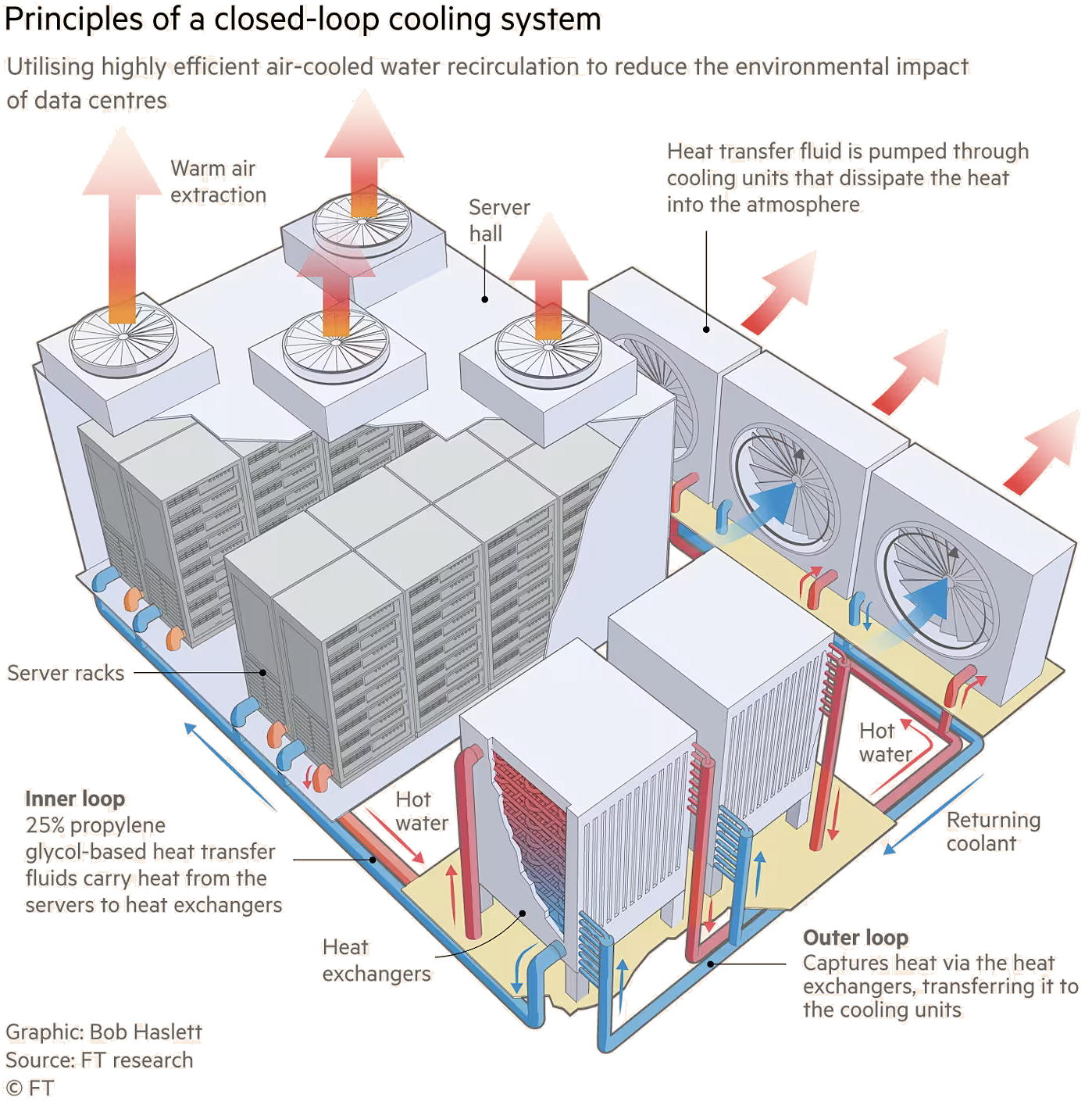
These systems are not without issues. Shaolei Ren, a researcher at the University of California, Riverside, who studies data center infrastructure, says operators using alternatives to water-based cooling use “25-35 percent more electricity” in summer, in effect shifting pressure from local water systems to regional electricity grids.
But industry executives argue that the trade-off between water and energy is often misunderstood. Doug Adams of NTT Global Data Centers, the world’s third-largest data center operator, says closed-loop systems can reduce overall energy demand. “It’s more costly to build up front but in the long run it’s more efficient to use [coolant] to evacuate heat,” he says.
OpenAI chief Sam Altman—whose start-up has committed to spend $600 billion on infrastructure by the end of 2030, according to people familiar with the matter—recently bristled at the suggestion that data centers consume huge amounts of water. Appearing at the India AI summit in February, he said that concerns about AI’s water consumption were “totally fake” arguing that evaporative cooling was a problem of the past.
Yet the sheer scale of the projects planned for the next five years by hyperscalers and others means that water consumption is expected to surge.
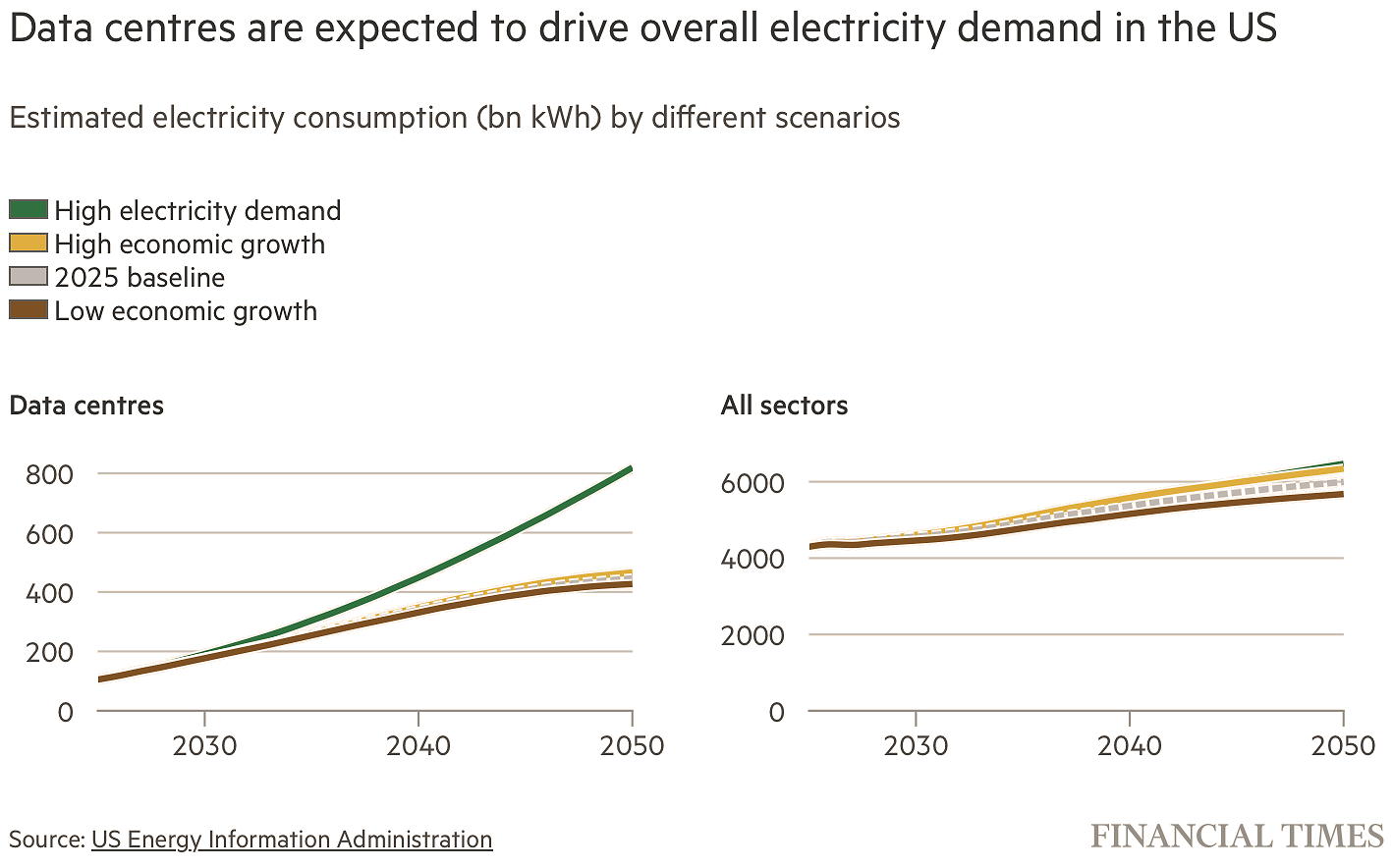
Compounding fears is a suspicion that AI facilities are driving up energy prices. On average, American bill payers—including residential, commercial and industrial customers—paid over 6 percent more for electricity year on year at the end of 2025. This increase was starkly higher in the mid-Atlantic states which house a large number of data centers such as Pennsylvania and Virginia, where bills rose by 19 and 10 percent respectively.
Of the roughly 100GW of additional electricity capacity that the US is projected to need at peak times by 2030, roughly half will be used by data centers, according to the Department of Energy.
In Illinois, Deppert says rising energy demand is feeding into already tight margins for farmers. “Everything we do is energy intensive,” he says. “If those costs keep going up, that comes straight off the bottom line.”
Tech executives have sought to allay such fears, committing last month to “build, bring or buy new-generation capacity for data centers and pay the full cost of infrastructure upgrades required to support their operations.”
Increasingly, however, popular resistance is having an impact. Amazon was forced to abandon a proposed data center project in Tucson, Arizona, after residents raised concerns over water and energy use, while Microsoft faced opposition in Caledonia, Wisconsin, over similar issues.
Small towns across the US are also skeptical of the industry’s promised economic benefits. “Technology companies talk about a sense of urgency. This is only the case because they’re in an arms race,” says Jonathan Koomey, a former project scientist at Berkeley Lab. “Is there a social urgency? I’m not sure there is one.”
© 2026 The Financial Times Ltd. All rights reserved. Not to be redistributed, copied, or modified in any way.