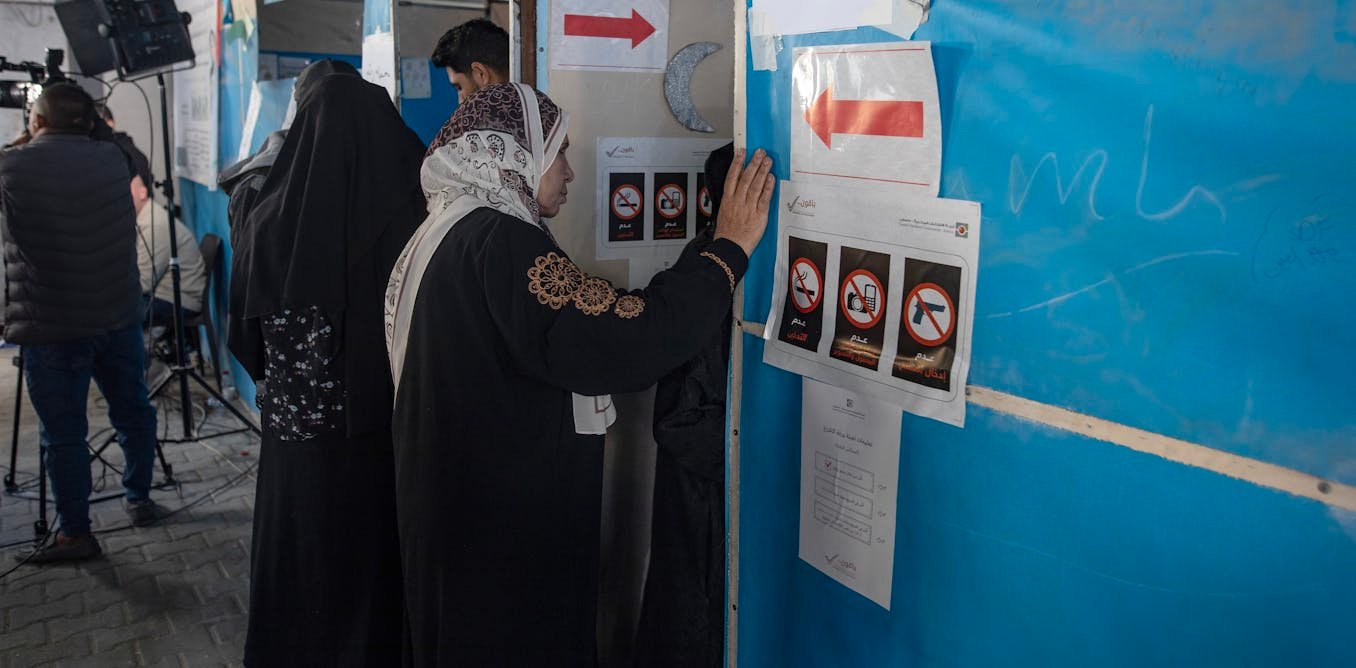
There was an election, of sorts, in Gaza at the weekend. It was a very limited vote – only people registered to vote in the central Gaza city of Deir al-Balah were able to cast a ballot. This made up a total electorate of 70,000 people, and of them, only 23% actually voted.
Hamas did not field any candidates and the municipal election has been described as a largely symbolic exercise by the Palestinian Authority (PA). The PA, which is dominated by Fatah under Palestinian president, Mahmoud Abbas, wants to link the West Bank and Gaza politically ahead of a possible presidential campaign at some stage in the future.
The low turnout in the Gaza poll was not unexpected given the continuing instability in the Strip. A joint report on Gaza published earlier this month by the UN, EU and World Bank, estimated that the Israeli military has displaced more than 1.9 million Palestinians in the last two-and-a-half years.
Less reported – but no less important – is the fact that this displacement continues, despite the ceasefire agreement announced in October 2025. The situation remains volatile, with the Israeli military having killed more than 738 Palestinians in Gaza since then.
All the signs are that this displacement will last. The Israeli army remains on the ground in more than half of the Gaza Strip, which is now divided by the so-called “yellow line” established shortly after the ceasefire. Although the line was originally announced as a temporary measure ahead of the military’s full withdrawal, there is every sign of it becoming a fixed border. Israel’s military chief of staff, Lieutenant-General Eyal Zamir appeared to confirm this when he visited Gaza in December 2025 and described the yellow line as “a new border line”.
Now virtually the entire Palestinian population of Gaza – the vast majority of whom have been forced to move at least once during the conflict, now widely recognised as a genocide – are confined to its eastern side. Any Palestinian who crosses the line risks being shot by the Israeli army.
More than 200 Palestinians have already lost their lives in this way. Most infamously, the Israeli army killed 11 members of the Abu Shaaban family, including seven children, as they were driving back to their home in the early weeks of the ceasefire.
By forcibly preventing Palestinians from returning to their homes, Israel is making the Palestinian people’s displacement permanent. And as the majority of Gaza’s Palestinians were already refugees before the Israeli assault began in October 2023, many see this policy as continuation of what they call the Nakba_ – or “catastrophe”. This began in 1948, when Zionist militias and the Israeli army displaced and expelled at least 750,000 Palestinians, leading more than 200,000 to seek refuge in Gaza.
Complicating matters further still, the Israeli military has repeatedly moved the yellow line further inward, seizing more territory in a de facto land grab. According to recent estimates, the side of the line occupied by the Israeli military now comprises more than 58% of the territory of the Gaza Strip.
This area appears to have been earmarked for US-Israeli investment, development and possible settlement, while remaining out of bounds to Palestinians.
Transfer out of Gaza
At the same time as this ongoing internal displacement, controversial schemes to transfer Palestinians out of Gaza altogether are continuing. Since 2023, both the Israeli government and the White House have discussed numerous proposals for the Palestinians’ mass relocation from Gaza. Indonesia, Libya, Sudan, Congo and Somalia have all been touted as possible destinations. The Trump administration also proposed offering Palestinians US$5,000 (£3,680) to leave Gaza “voluntarily”.

Palestinians have overwhelmingly rejected these plans. Yet despite the 20-point ceasefire agreement stating that “no one will be forced to leave Gaza” and promising that “we will encourage people to stay”, various transfer schemes have continued covertly. Over the past year, hundreds of Palestinians have been spirited out of Gaza on flights organised by a settler organisation linked to the Israeli military.
This operation came to light when 153 Palestinians were forced to spend 12 hours on an airport runway in South Africa after landing there without the required travel documents. Media investigations subsequently found that their journey had been facilitated by an organisation called Al Majd Europe, which calls itself a humanitarian agency working to evacuate Muslims from conflict zones. Palestinians pay US$2,000 upfront to Al Majd Europe which then arranges for their departure from Gaza.
As it turns out, Al Majd Europe is led by Israeli-Estonian national Tomer Jamar Lind. A report published by Israeli daily newspaper, Haaretz, has found that Al-Majd coordinates with the Israeli army’s Voluntary Emigration Bureau, which is run by Israel’s far-right finance minister, Belazel Smotrich.
Behind the scenes, the evacuation scheme is orchestrated by the organisation Ad Kan, whose leader Gilad Ach openly backed Trump’s plans for mass transfer from Gaza.
After bussing the Palestinians from Gaza to southern Israel, the organisations arrange for them to fly from Ramon airport to a range of destinations, including Indonesia, Malaysia and South Africa.
Some of the Palestinians who have been relocated in this way report not knowing where they are going. There are striking parallels with the 1970s, when the Israeli authorities tried to illicitly deport thousands of Palestinians from Gaza to Paraguay.
In effect, then, Israel is pushing Gaza’s 2 million Palestinians into a confined part of the Strip while simultaneously working to relocate them out of Palestine altogether. And with international attention largely now turned away from Gaza, there is alarmingly little to stop these plans getting considerably further – before it is too late.