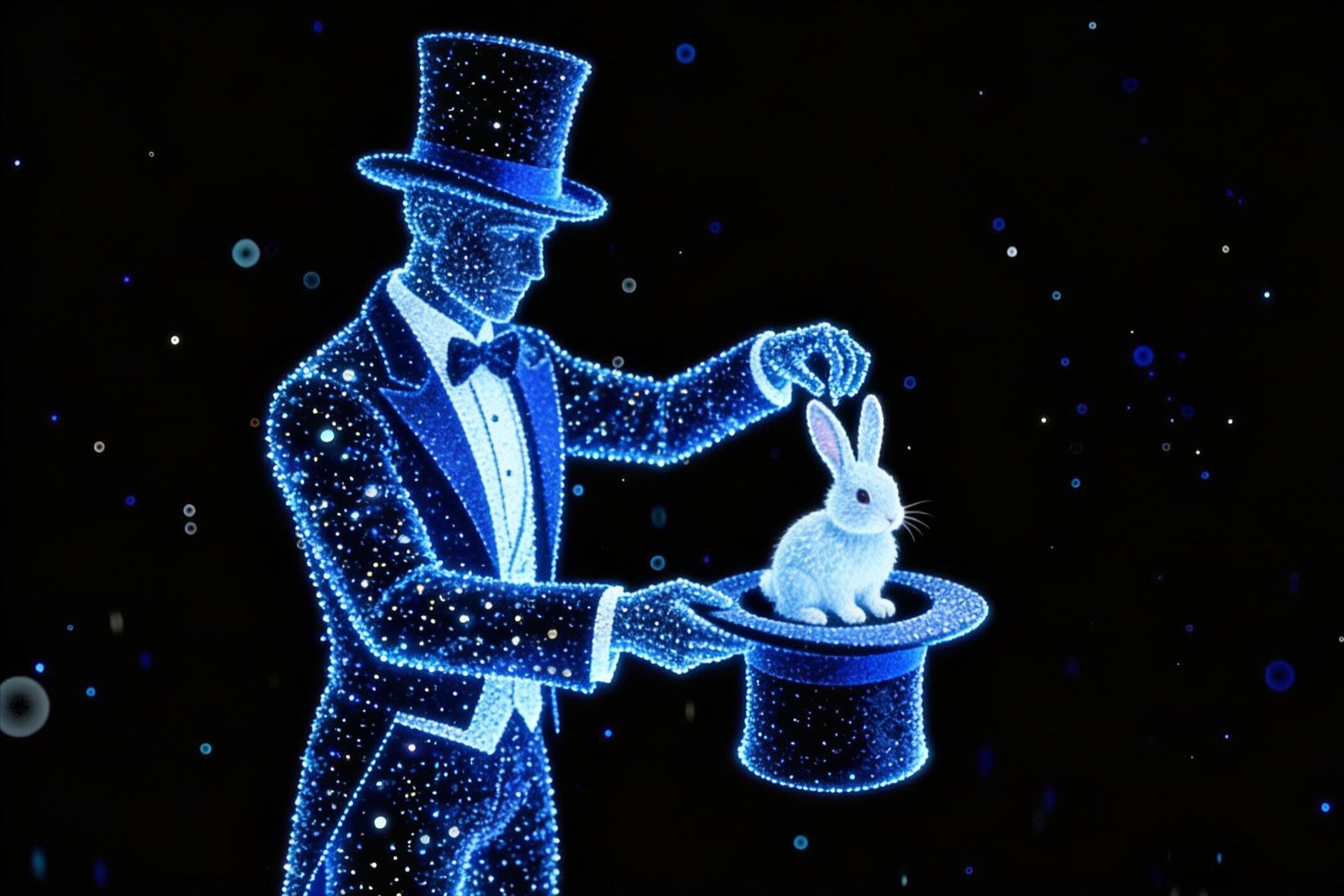
AI may not master sleight of hand anytime soon, but it could weaken the human desire to gather, watch, and wonder together
Arthur C. Clarke’s famous observation that “any sufficiently advanced technology is indistinguishable from magic” was meant as a compliment to technology. Lately, I’ve been looking at this from within magic land, and I am worried for us.
Will AI replace my job as a magician?
My journey into magic started when I was 18, a soldier in a desk job, coming home every day to practice sleight of hand for seven hours straight.
Some moves took me an entire year before I could execute them cleanly even once.
When people imagine sleight of hand, they picture objects moving so fast that the eye can’t catch them. That counts for 1% of what a magician actually does.
We actually use the hand’s micro-muscles so precisely that we can make a coin vanish, a card disappear without a trace. And it takes a lot of practice, like gymnasts who train for years on a triple flip.
So, when will AI do magic?
There are already robots in China that can dance and robots in America that do backflips. At the moment, none of them have the hands of a magician.
Moreover, none of them can actually perform for humans efficiently: adapt to a nervous volunteer, read the room, improvise a joke, and execute sleight of hand all at once. That combination of mastery, charisma, and human connection is not a feature set. It is a person. At least for now.
For AI to replace a performing magician, someone would need to build a robot that masters impossible fine motor control, reads a crowd’s energy, and makes a stranger feel something real in 60 seconds. I’m not convinced that’s Elon Musk’s first priority. So maybe I’ve got 10 years. Maybe 15.
But here’s what I actually worry about, and it’s not robots doing card tricks.
The threat isn’t that AI will perform better than magicians.
The threat is that it will train audiences to stop wanting to be in the room at all.
We all use devices that are trained to grab our attention. You are probably reading these words through one at this very second. The algorithms know how to trigger emotions, hook you in, keep you scrolling. They don’t call it doomscrolling for no reason. And it is getting better (or worse) every day.
The question that keeps me up at night isn’t “When will AI replace me?” It’s “When will people lose the impulse to leave their homes entirely?” When will the dopamine loop be so perfectly calibrated that live theater, the opera, stand-up comedy, a magic act, will feel like your mom is calling without texting first?
You might be already affected by AI taking away the job of someone you know.
Martin Niemöller, the German Lutheran pastor who became a leading clerical opponent of Hitler after initially welcoming his rise, later distilled the lesson of Nazi persecution into one of the century’s most famous warnings:
“First they came for the socialists, and I did not speak out, because I was not a socialist. Then they came for the trade unionists, and I did not speak out, because I was not a trade unionist. Then they came for the Jews, and I did not speak out, because I was not a Jew. Then they came for me, and there was no one left to speak for me.”
While AI is in many ways a Jewish invention, it’s already doing a Niemöller on so many industries. First AI came for the factory workers. Then they came for the writers and designers. Then they came for the coders. I didn’t speak out because I am not working in a factory, I am not a designer, and I am not a coder.
Will AI go after my job next?
Will AI take over all live entertainment and dominate a category of human experience that genuinely requires a human in a room? Or will we simply stop caring about going outside to see a show? Will it be too late before we all wake up?
At the moment, I feel fortunate. People still want to go out. They still want to sit in a theater and be surprised. They still want to see a human being do something that seems impossible, 2 feet away. That desire, ancient, irrational, entirely human, is the thing I perform for.
Clarke was right: Technology looks like real magic. But here is what we can all hope for: Magic, real magic, will always be about a human being choosing to look at another human being and wonder, how did he do that?
Will we still want to experience being human, when AI is so magical?