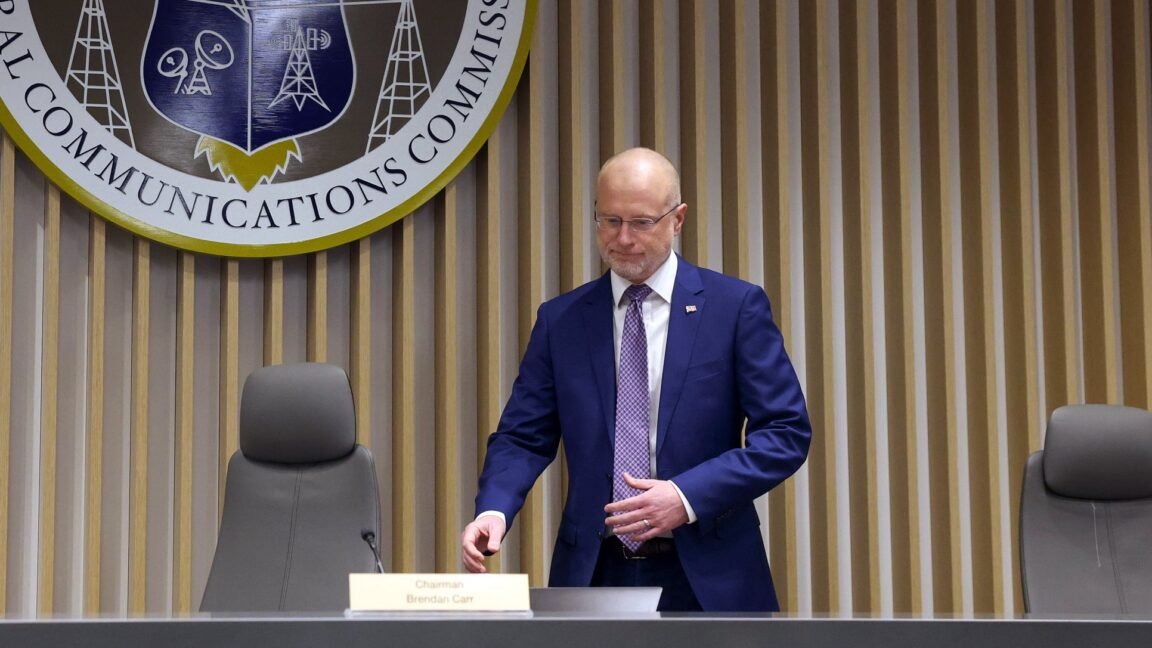
An advocacy group trying to investigate DOGE’s influence on the Federal Communications Commission accused the FCC of failing to comply with a public records request and of concealing Chairman Brendan Carr’s use of the Signal messaging service.
“The evidence clearly demonstrates that the FCC has acted in bad faith by withholding documents responsive to Plaintiffs’ FOIA [Freedom of Information Act] request,” journalist Nina Burleigh and advocacy group Frequency Forward said in a filing yesterday in US District Court for the District of Columbia. “The FCC acted in bad faith when it redefined the search criteria without notice to Plaintiffs or this Court. Further, the FCC acted in bad faith by concealing the fact that the Chairman Carr has a Signal account on a phone he uses to conduct government business.”
Burleigh and Frequency Forward sued the FCC last year, alleging that it violated the Freedom of Information Act by wrongfully withholding agency records. In August 2025, a federal judge ordered the FCC to produce documents and criticized it for a “vague and uninformative” response to the lawsuit.
The plaintiffs filed the initial FoIA request in February 2025 for an investigation into how DOGE’s activities at the FCC may have created conflicts of interest related to Elon Musk’s SpaceX and Starlink, which are seeking various FCC licenses and authorizations.
“The evidence strongly suggests that Musk bought his way into the White House and to obtain his position as the de-facto head of DOGE, and that he had used his government authority and access to information to earn huge profits for himself and his companies,” plaintiffs said yesterday. “Plaintiffs’ FoIA request seeks documents that shed light on the relationship between the FCC, Musk as regulator and Musk and his companies as regulated entities.”
Burleigh and Frequency Forward asked the court to deny an FCC motion for summary judgment, order the agency to produce all responsive documents within a week, and allow the plaintiffs to file discovery requests. Their filing accused the FCC of having “wasted a year of the Court’s time and frustrated Plaintiffs’ efforts to timely review critical records.”
The FCC “has sought to delay the production of responsive documents and obfuscate the existence of responsive records,” and “made it clear that it will not undertake a good faith effort to produce responsive documents,” the filing said. “Accordingly, discovery is required and will speed the document production process by helping the Plaintiffs identify responsive documents.”
Carr’s phone
The filing said there is evidence that Carr has Signal messaging set up on a phone he uses for FCC business. Carr’s phone number was previously disclosed in a FoIA request that turned up a November 2024 email from a Fox News producer who was confirming an interview. Entering that “number into the Signal app shows that he has an active Signal account under the username ‘Brendan Carr,’” the filing said.
A court filing submitted by the FCC on June 3 said that Carr did not have phone numbers for DOGE personnel and that “it is agency policy not to download additional messaging applications on FCC phones (e.g., Signal, WhatsApp).” Plaintiffs counter that Carr likely exchanged messages with Musk or other high-ranking DOGE officials.
“Plaintiffs do not know whether the number identified in Exs. 4 and 5 belongs to Carr’s personal phone or a government issued phone,” the filing said. “What we do know is that a phone is being used for government business and that it has a Signal account in Carr’s name. Based on information and belief Carr regularly conducts government business through text and Signal messages, communicating with journalists, industry professional and individuals who work for regulated entities, such as Musk and SpaceX.”
Plaintiffs said the FCC’s statement that Carr did not have phone numbers for DOGE personnel doesn’t settle the matter.
“It is unlikely that Carr would have communicated with individuals at that level. Carr would have communicated with Musk or other highly placed DOGE officials,” the filing said. Plaintiffs said a previous case involving DOGE showed that “DOGE personnel routinely conducted business on their personal phones using text messages, especially the Signal app.”
The filing separately accused the FCC of limiting its records search to emails with FCC, DOGE, and GSA (General Services Administration) domains, despite plaintiffs’ objections. It also said that travel documents provided by the FCC did not include anything about Carr’s visits to Starlink facilities.
We contacted the FCC today and will update this article if it provides any comment.