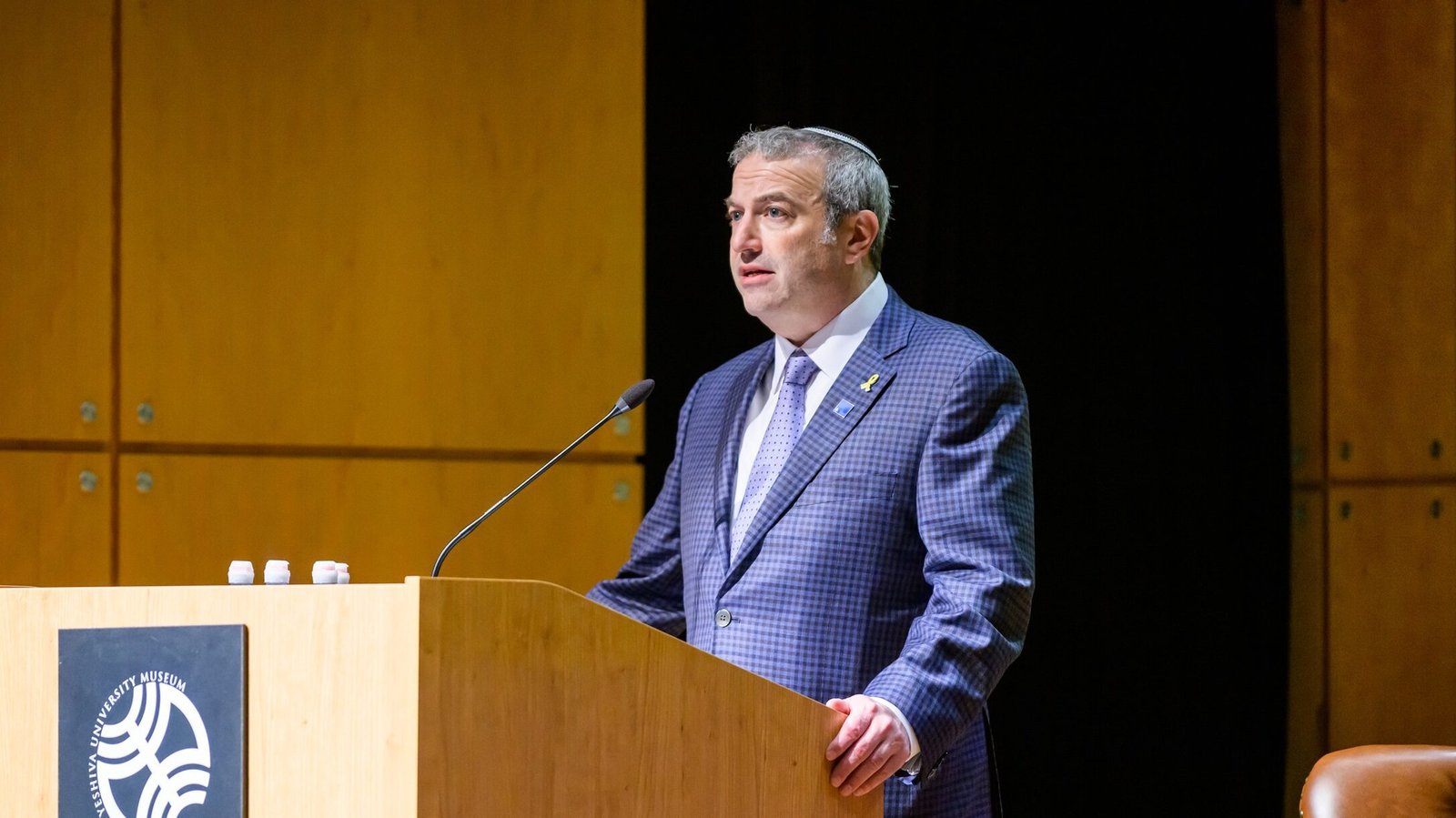
Rabbi Dr. Ari Berman says “the good AI” must beat “the bad AI” as YU expands in technology, draws students and faculty from elite universities where they felt unsupported after October 7, and answers antisemitism with “pro-semitism”
Rabbi Dr. Ari Berman does not talk like a university president under siege. At a time when antisemitism is surging, elite campuses are under scrutiny, artificial intelligence is rewriting the terms of public life, and parents are increasingly unsure what kind of world their children are inheriting, Berman sounds less alarmed than resolved. Kind in demeanor and gentle in speech, Berman nevertheless gives the impression of someone unafraid to say what he thinks—a deep thinker who comes across as authentic, genuine, and real. He speaks about turbulence the way some leaders speak about opportunity—not because he underestimates the danger, but because he believes institutions with deep roots are uniquely equipped to meet it. “We were made for this moment,” he says.
We were made for this moment
That confidence is not naïveté. Berman, now nearly nine years into the presidency of Yeshiva University (YU), says plainly that he could not have predicted what was coming. “There is no way I could have anticipated a whole host of challenges that would come, including COVID,” he says, calling the pandemic “pretty much a curveball.” YU, primarily based in New York City, was “the first university in the Northeast to actually have a student who was diagnosed with COVID.” Then came October 7 and the shock waves that rippled across campus life in America. But if the crises were unanticipated, his response to them was not. “My approach to all of the changes and challenges of these past years,” he says, “is where can you find the opportunity?”
Berman is adamant that YU’s role in this era is not simply to shield Jewish students from hostility, though that matters. It is to offer a model of moral seriousness at a time when too many institutions, in his view, have lost the will to speak plainly. He is direct on the subject of anti-Israel rhetoric. “Anti-Zionism is definitely antisemitism,” he says. He insists the reasoning is straightforward: if Israel alone is denied the right to exist as a Jewish state while Muslim and Christian states are treated as ordinary facts of international life, “that is a double standard. It is discrimination. And by definition, that is antisemitism.” The lesson he wants students to absorb is equally clear: they must learn “to have the courage to call it out and to stand for what is true.”
Anti-Zionism is definitely antisemitism
At the same time, Berman is careful not to reduce campus life to political combat alone. When controversial political figures in New York entered the broader conversation, he says YU itself has not felt a direct institutional impact. “We haven’t felt the effects of Mayor Mamdani and hasn’t had any implications for YU,” he says. But that practical distinction does not soften his larger conviction that students need moral clarity and a firm vocabulary for naming discrimination when they see it.
That phrase—moral clarity—runs through much of Berman’s vision. After October 7, as universities around the country struggled or refused to respond, he moved to organize. “Absolutely. It was very important. And it’s still very important,” he says of the effort to bring presidents and academic leaders together. His position continues to try to hold multiple truths in view at once: “We stand with Israel, with the Palestinian people who suffer under Hamas’s cruel rule in Gaza, and all people of moral conscience.” The line matters because it rejects both terrorism and the flattening habits of campus discourse, where sympathy for civilians can become a pretext for erasing moral distinctions.
Out of that effort came an alliance that Berman describes with pride. “We created a coalition of universities united against terrorism,” he says, and “we had over 100 universities who signed up to join us.” The significance of the coalition is not merely numerical. It is symbolic. “Especially when there were some universities that were silent in the face of these atrocities, it was very important for the country to know that there are good universities too,” he says. “There are presidents who know how to speak with moral clarity.”
The upheaval on campuses has also reshaped where students are choosing to study. Berman says that after October 7, YU saw “a sharp increase in transfer students.” Over time, he adds, there has been “a significant increase in the percentage of students from our feeder schools who would otherwise have gone to these elite universities” but are now choosing YU instead. He is careful to note that the University’s growth did not begin with the current crisis; he says students had already begun recognizing “the excellence of our education.” Still, he offers one figure that captures the shift: early decision applicants are up “over 70% over the past two years.” Those are, he says, “the top students who would otherwise have applied early decision to Ivy League universities.”
What is changing at YU, however, is not simply a matter of student recruitment. Berman describes a broader realignment that includes faculty as well. In fields central to the technological future, he says, professors are increasingly coming to YU after feeling exposed or unsupported elsewhere.
“It’s a story that’s not yet being told,” he says, “which is not just students who want to leave those universities and come to YU, but the faculty.” He ticks through examples: “the former chair of math at Rutgers left Rutgers,” a former chair of electrical engineering at Cooper Union is joining Yeshiva, and “we have a professor from MIT who left MIT in computer science to come to Yeshiva.” The reason, he says, is that after October 7, many discovered that “their peers at best were indifferent to who they are.”
This helps explain why Berman speaks about engineering, robotics, and artificial intelligence with such urgency. YU, he says, “just opened up an engineering track,” backed by a major donation, and is expanding aggressively into the disciplines shaping the next century. “We’re becoming experts in it,” he says of AI. He points to new faculty in math and computer science, and says YU is “at the forefront of research in AI, including in tech health fields.” For Berman, the point is not simply to keep up but to help define the field. “Being at the cutting edge of knowledge is essential,” he says.
Yet Berman does not regard artificial intelligence as merely a technical frontier. For him, it is a moral one. Students must learn to use AI “positively and ethically with values,” he says, and universities cannot afford to treat such questions as peripheral. “AI itself is obviously morally neutral,” he says. “The question is how it’s deployed, and what are the policies, and what are the innovations that we’re going to afford.” That formulation matters because it places responsibility not on the tool itself but on the people who build, regulate, and normalize it.
He is especially concerned with the role AI now plays in misinformation and social distortion. “This is going to be the key issue of the age,” he says, describing the challenge as learning “how to both separate out what’s fake and what’s real, and to be inside the conversation as AI is being formed, so that we do not actually meet a dystopian future, but one that has our values.” YU recently hosted a “hack the hate” event, he notes, that brought together innovators and policy figures, including “the chief policymaker at Meta,” to explore how AI can identify falsehood. “The good AI,” he says, must learn to beat “the bad AI.”
Still, Berman’s questions about AI reach far beyond detection tools and policy frameworks. He speaks of the subject in almost civilizational terms, which is why he has moved to place YU in global conversations about ethics and technology. About a year and a half ago, he traveled to Hiroshima “to sign on to the Rome Call of AI and Ethics.” There, he found himself in a room with faith leaders not only from monotheistic traditions but from Hindu, Sikh, Buddhist, and Shinto communities as well. What stays with him from that gathering is a scene both humorous and revealing. A Shinto priest told him that “there’s a spirit inside of everything,” including AI. Berman turned to a Buddhist monk seated nearby and asked, “Is there a Buddha in AI?” The monk answered, “Rabbi, that’s why I’m here to find out.” When Berman followed up later—had he found the answer?—the monk replied, “I need two more conferences.”

Global faith, political and industry leaders meet at the AI Ethics for Peace Conference, Hiroshima, Japan, July 2024. (IBM)
The anecdote lightens the mood, but Berman’s conclusion is serious. “You have to be in the leadership,” he says. “You have to have a seat at the table in terms of how it’s unfolding right now.” YU is now part of “a consortium of other faith-based universities right now with BYU and Notre Dame” focused on how faith is represented in AI. He sees that work as indispensable. “We don’t know where the world is going,” he says, “but YU has a seat at the table to help bring the Jewish values and the thousands of year tradition that we have in our Talmudic texts and our biblical texts to inform where the future is going to go with AI.”
For Berman, the same principle extends beyond technology into public truth itself. One of the central burdens of our times, he suggests, is not just that lies travel quickly, but that truth is often overshadowed by drama. “The truth will win out at the end,” he says. Then he sharpens the point with a line that feels almost like a creed: “one truth will spread the light that will shatter a thousand lies.”
But if truth is to prevail, it needs people willing to tell it. Berman does not believe truth is collapsing so much as being underreported. “I wouldn’t say it’s failing,” he says. “I think that what I see in the world is actually it’s spreading.” The problem, in his view, is that public attention is skewed toward hatred and conflict. “We are so intrigued by the anti,” he says, because hate and violence “always makes the news.” What is missed is what he calls “the common story,” namely, “the love and appreciation for Jews, for Israel.”
That hidden story, from his perspective, has been one of the most surprising and consequential elements of recent years. When he began organizing support after October 7, some of the first people he reached were leaders at faith-based universities. One Christian leader told him, “Ari, whatever you write, I’m going to sign. You don’t even have to show it to me. I’m with you.” Another, the president of a historically Black faith-based university, offered him a biblical image that Berman clearly treasures. “The Jews win when Moses holds his hands up,” she said, “but who is holding Moses’s hands up? It’s Aaron and Hur. Let us be your Aaron and Hur. You can lean on us.”
What these exchanges have revealed to him is not merely support in a difficult season, but the possibility of a larger coalition grounded in faith and mutual respect. “We have friends and allies in the United States and around the world,” he says. And those allies are not limited to Christians. Reflecting on the coalition, he says, “It’s not just Christians, we have Muslims and Hindus, like we have religions and people of faith all throughout the world who appreciate the Jewish tradition.” This, he argues, is the story too often left untold: “We’re so focused on antisemitism that we’re not doing the pro-semitism.”
That conviction has also shaped YU’s outreach to Christian communities eager to understand Judaism more deeply. Berman says he recognized a real search in the Christian world to understand Judaism from authentic Jewish voices and saw in that search an opening. “We should extend ourselves outward,” he says. The result has been “enormous interest” from students in the United States and abroad, including partnerships with “two Christian universities in South Korea.” YU is not only collaborating with them; “we actually have classes in Korean that we’re teaching Jewish texts in Korean.” Tying together language, technology, and theology, Berman asserts that “especially with AI, [we] have an opportunity to reach everyone in their own language and bring the world back to a time of fellowship.”

Korean delegation meets with faculty from the Revel Graduate School of Jewish Studies in a cross-cultural exchange. (Courtesy Yeshiva University)
He even sees evidence of this growing fascination with Jewish tradition in unexpected places. He notes he had “very strong positive conversations with Charlie Kirk,” whom he describes as one of the possible “harbingers” of a movement among some Christians toward Sabbath observance and a deeper engagement with Jewish ethics. Berman recalls Kirk wanting to visit YU and speaking admiringly of the university. Kirk, known for saying college is a scam, once began talking that way to one of Berman’s sons before realizing whose son he was addressing. He quickly amended his position by saying, “College is a scam except Yeshiva.” Beyond the joke, Berman says, Kirk “believed so deeply in the Jewish tradition as a basis of ethics and morality and as a means to inform the entire conversation, certainly in the United States.”
The through-line in all of this is Berman’s conviction that tradition is not a brake on modernity but a source of strength within it. He says YU’s philosophy, since its founding, has been to be “deeply rooted and forward-focused.” He sees modern instability not as proof that the old foundations have failed, but as proof of how badly those foundations are needed. “The fact that we are built on 3,000 years of tradition gives us a stability,” he says, and allows the university “to be nourished by the past generations, as opposed to being cut off from them.”
He reaches for an old rabbinic image to explain the point: “a tree without roots easily breaks in torrential winds. But a tree with roots can withstand times of great turmoil and instability.” The lesson, as he applies it to YU, is twofold. “The first step is to be deeply rooted,” he says. “But the second step is to be forward-focused.” That means “not to shy away from the technological changes and innovations, but to lean in.” For Berman, this is not a balancing act between two competing loyalties. It is a single philosophy: “rather than seeing tradition as conflicting with innovation, to see it as forming the basis that allows you to lead positive, progressive, and flourishing lives.”
This has implications not just for college students, but for younger children and the parents trying to raise them in a digitally saturated age. “Parents today are worried, and rightfully so,” Berman says. “We’ve never seen children who’ve had such exposure to what these kids have,” and they are being raised “digitally native” in an environment that can intensify “mental health and anxiety.” He says he shares those concerns, and he invokes a conversation with Jonathan Haidt to explain why he believes the answer is not simply technological regulation or educational reform. “The answer actually is rooted in tradition.”
Berman recounts Haidt’s metaphor of a world filled with toxins, in which some cities are protected by a bubble that allows families to flourish. “Those bubbles are tradition and faith,” he says. Communities with a moral center are able “to navigate and sort of filter out the bad toxins to allow the good things to come in.” Without that rootedness, modern life becomes “truly a dangerous world.” With it, students can move confidently into contemporary professions, from computer science to other cutting-edge fields, because “they’re not hiding from progress,” but are “rooted in who they are.”
If Berman’s vision sounds expansive, it is because he is already looking beyond the present moment. He mentions speaking in Dubai on Holocaust Memorial Day, being “the first as an American and Israeli to speak at the [US presidential] inauguration,” and participating in faith events more broadly, each appearance part of a wider effort to place Jewish ideas into global conversations. He is guarded about specifics but clearly energized by what he sees coming next. “We have actually a lot planned,” he says.

Rabbi Dr. Ari Berman (C), president of Yeshiva University, delivers a benediction as US President Donald Trump (L) and former US President Joe Biden (L) listen during President Trump’s inauguration ceremony in the rotunda of the Capitol in Washington, DC, USA, Jan. 20, 2025. (Shawn Thew/Pool via Reuters)
Some of those plans, he suggests, are tied to a changing geopolitical landscape. “After the Abraham Accords, we had a lot of possibilities that were a little held back after October 7, but now we’re able to lean in on,” he says. He expects “a lot of Jewish connection with countries throughout the world that otherwise, in the past, would have been very reluctant to partner with the flagship Jewish university.” He also sees YU moving further into research, not simply consuming existing knowledge but producing it. “As we grow in excellence in research, as we continue to not just study knowledge, but create knowledge, we’re finding incredible partnerships that will help society flourish deeply.”
That word—flourish—comes up often with Berman. It signals the difference between mere survival and something fuller, more ambitious. He is not only trying to protect a university or defend a community, but to argue for a larger model of human development: rooted, ethical, technologically literate, intellectually serious, and open to partnership. In a public culture that often treats faith as either private comfort or political identity, Berman is making a different case—that religious tradition, seriously lived, can be a source of institutional confidence, cultural clarity, and civic repair.
The future of Yeshiva is bright
“The future of Yeshiva is bright,” he says. It is the sort of line many university presidents might offer. But for Berman, it carries a broader aspiration. YU is not simply trying to navigate an age of fracture. It is trying to show that ancient commitments and future-facing ambition need not cancel each other out. If anything, he suggests, each may be impossible without the other. “We’re looking to build a better world for all.”