6.9 C
London
Tuesday, November 10, 2026
Home Blog

Impeachment Vote Looms for Hegseth

0
impeachment-vote-looms-for-hegseth
Impeachment Vote Looms for Hegseth


Calls for self-styled War Secretary Pete Hegseth’s ouster have grown louder on Capitol Hill as a possible impeachment vote looms this week. At the same time, Hegseth has shored up support at the White House and among MAGA faithful, according to dismayed Pentagon officials.

Rep. Thomas Massie, R-Ky., introduced articles of impeachment on the House floor Monday afternoon, charging Hegseth with “high crimes and misdemeanors.” Top Democrats have indicated a desire to join Massie’s effort since their midterm election landslide. “I am a hard yes on the Hegseth resolution,” Rep. Hakeem Jeffries of New York, who is poised to be the next House speaker, told ABC’s “This Week” on Sunday. Rep. James Comer, R-Ky., the current House Oversight Committee chair, told Newsmax on Friday it is “very possible” the votes exist to impeach Hegseth.

Rep. Yassamin Ansari, D-Ariz., one of the leading voices for Hegseth’s impeachment, agreed. “I think there’s a high chance that it will be successful,” she told The Intercept of Massie’s effort. In April, Ansari filed six articles of impeachment against Hegseth, including violations of the law of armed conflict and targeting of civilians, abuse of power, and obstructing congressional oversight. She called for a floor vote on his ouster this week.

“Hegseth has demonstrated that he is wholly incompetent. He’s committed what I believe to be war crimes in Iran and the Caribbean and he is ill-equipped for the job,” said Ansari. “My reason for introducing the articles of impeachment back in April had a lot to do with his conduct and the war crimes in Iran, including the bombing of the children’s school. But it’s refreshing to see that since then, more and more Republicans are also recognizing that his leadership has failed and that he’s putting all of us in danger.”

In the wake of a devastating election rout of the GOP that handed Democrats firm control of the House and the Senate, Congress begins a five-week lame-duck session on Monday. With dozens of Republican lawmakers ending their tenure in the House, it’s unclear how many will even show up for votes. Such absences, as well as outright defections in the GOP ranks, make it increasingly likely that Massie’s measure will pass, staffers on Capitol Hill told The Intercept.

On Sunday, GOP Rep. French Hill of Arkansas left open the possibility of backing the measure. “I want to hear the debate on it to see if it merits impeachment versus some other disciplinary action or action by the president,” he said on CBS News’s “Face the Nation.” Outgoing House speaker Mike Johnson, R-La., did not answer when asked by Politico if GOP leaders would whip the Hegseth impeachment vote. House leaders must take up the matter within two legislative days; opponents could table the resolution or refer it to committee instead of voting directly on impeachment.

After narrowly being confirmed by the Senate, which required Vice President JD Vance to break a 50-50 tie, Hegseth’s tenure has been marked by fiascos and failures beginning with Signal-gate, the sharing of secret war plans in a chat group with a journalist. In that case, according to the Pentagon’s own inspector general, “Hegseth violated security protocols and endangered U.S. troops and objectives.” Since then, Hegseth has been under perpetual fire for the unsuccessful Iran war in 2026, specifically a strike on an elementary school in Minab, Iran, that killed more than 150 civilians, most of them children. He faces pressure over his campaign of extrajudicial killings in attacks on so-called drug boats in the waters off Latin America. And questions continue to mount about his purge of top military leaders — many of them women and minorities. 

“The fact that many career officials from the department have left citing his leadership, I think, is very telling,” said Ansari. Last week, The Intercept published an exposé quoting six current and former defense officials who currently serve or served under Hegseth and called for his ouster. “He is conducting state terrorism. He is 100 percent a war criminal. He needs to be prosecuted,” said Wes J. Bryant, one of those officials and, until last year, a senior targeting adviser and policy analyst at the Pentagon who was pushed out of his job for blowing the whistle on Hegseth’s efforts to undermine protections for civilians.

As calls for his ouster have grown louder, Hegseth launched a desperate bid to whip up support at the White House, including a nakedly obsequious video seeking Trump’s support that he posted on X. It was accompanied by a coordinated campaign of social media posts by Pentagon underlings tying Hegseth’s fortunes to the president with the text “STAND. FIGHT. DEFEND THE REPUBLIC.”

Hegseth’s hand was strengthened on Friday when Trump’s chief of staff Susie Wiles stepped down and was replaced by his hard-line domestic policy adviser, raging xenophobe, and illegal boat strike proponent Stephen Miller, according to two Pentagon officials. The embattled war chief was quick to offer “Huge CONGRATS” to Miller on X, and posted a photo of himself alongside Trump’s new consigliere. The same coterie of Hegseth devotees at the Pentagon followed with similar posts featuring Miller.

Wiles had reportedly soured on Hegseth, blaming his woeful management of the Iran war for flagging Republican fortunes. A senior Trump administration official also told MS Now that Miller and Hegseth “have been extremely close since the beginning of the administration.”

If the House impeaches Hegseth, removing him from office would require a two-thirds vote in the Senate — a high bar, even when Democrats take control of the chamber in January. Neither of the two Cabinet secretaries impeached by the House — William Belknap, the secretary of war, in 1876; and Alejandro Mayorkas, the secretary of homeland security, in 2024 — were convicted by the Senate.

An Armed Services Committee staffer who spoke with The Intercept was skeptical that Senate Majority Leader John Thune, R-S.D., would bring the measure to a vote. Ansari held out hope. “Thune is very much aligned in terms of his view that Hegseth is not fit for the job,” she said, adding, “I do think that the resounding victories on Tuesday night will impact the way Republicans operate moving forward.”

Sen. Thom Tillis, R-N.C., who is retiring at the end of the year, has said for months that he regrets his vote to confirm Hegseth and rebuked the war chief for his desperate video address aimed at Trump. “[C]abinet secretaries shouldn’t be wasting taxpayer dollars on campaign style videos. Kristi Noem learned that the hard way,” he wrote on X on Friday, also laying into Hegseth for “the incompetence you’ve displayed, the bad advice you’ve given to president, and your shameful and embarrassing episodes from firing our top generals to texting war plans to reporters.” Tillis had also previously said Hegseth “needs to go.”

Massie suggested his impeachment resolution is the legislative equivalent of a mercy killing, calling it “a much gentler version” of what Democrats will do when they take control of Congress in January. Congressional committees have broad investigative powers, and Ansari said that if Hegseth survives this year’s impeachment push, there were “many ways” for Democrats to hold him accountable in the next session, specifically compelling him to testify before the American people. “I would be surprised to see him last the next two years in this administration,” she told The Intercept. “I think that he is not only one of the most incompetent members of the administration, but also the most unpopular — and it’s on a bipartisan basis. So the pressure will continue to grow for there to be some change at the Pentagon.”

Trump expressed mild “confidence” in Hegseth in a “60 Minutes” interview taped on Friday, touting the U.S. victory over Venezuela, but stopped short of praising his Pentagon chief for it. Asked if he credited Hegseth for what he considers a major victory, Trump replied: “No, but he was a part of it.” On Saturday, Trump wrote on Truth Social that calls for impeachment of administration officials amounted to “extortion at the highest level” and ordered the Justice Department to investigate those making the push.

Attorney General Todd Blanche, himself a potential target of impeachment, said on Sunday that the Justice Department would represent Hegseth during any impeachment proceedings. He added that he “would be very worried” if he were a Democrat threatening to investigate administration officials. Asked if he considered those threats to be a crime, Blanche said, “It depends on what’s said. So yes, there could be.”

The White House did not respond to questions about Trump’s support for Hegseth.

Update: November 9, 2026, 2:50 p.m. ET
The article has been updated to note that Rep. Thomas Massie, R-Ky., introduced articles of impeachment against War Secretary Pete Hegseth on Monday afternoon.

Source: Iwpost.com

Nvidia’s Huang spy scandal signals tighter US chip controls

0

<

article id=”post-952746″>

Nvidia chief executive Jensen Huang’s admission of an affair with a businesswoman suspected of spying for Beijing could strengthen Washington’s push to stop Chinese firms from renting advanced artificial intelligence (AI) chips in third countries.

Chinese commentators said Washington could turn more hawkish and tighten chip export controls as Huang’s personal ties to Alice Huang, a former executive at Singapore-based Megaspeed, raise national security concerns.

Days after Democrats won both chambers of Congress at the November 3 midterm elections, President Donald Trump named hardliner Stephen Miller to replace Susie Wiles as White House chief of staff.

Miller, best known as the architect of Trump’s immigration crackdown, has a long record of targeting China. In 2018, during Trump’s first term, he urged the president to stop issuing student visas to Chinese nationals to counter espionage. The idea was shelved after other officials warned of its economic cost.

As the Huang and Huang scandal evolves and the political tide shifts in Washington with the Democrats taking both chambers of Congress, analysts believe the Remote Access Security Act (RASA) could now be fast-tracked.

The bill, passed in the House in January and pending the Senate’s review, would extend US export controls from physical chips to cloud computing, barring Chinese firms from remotely renting servers powered by advanced Nvidia chips in third countries, such as Malaysia and Norway.

Even before the RASA becomes law, the mid-term election result favoring the Democrats, buoyed in part by rising popular backlash against AI data centers and a lack of regulation, had already sent shockwaves through the chip and data center industries.

In a letter dated November 4, the Republican chairs of three House committees asked Jensen Huang to attend a joint closed-door briefing on November 18 about his interactions with Alice Huang and see whether Beijing had influenced Nvidia’s corporate decisions or even US chip export policy.

On the same day, two things happened.

  • Nvidia tightened its rules for cloud customers. It told them to sell at least 51% of their computing capacity to companies outside China, a requirement that applies only to new contracts. It also now requires clients in Southeast Asia to join its “fleet intelligence” system, which tracks the location of their AI accelerators, before they can become official Nvidia Cloud Partners (NCPs).
  • Oracle scrapped a five-year, US$7 billion deal to lease Tencent up to 100,000 advanced AI chips in Southeast Asian data centers after US officials objected, the Financial Times reported. Chinese authorities had also questioned the arrangement and urged Tencent to use domestic chips instead. Oracle still runs several data centers in Malaysia for ByteDance, the newspaper said.

“The relevant report is unsubstantiated. It is nothing but smears against China,” Chinese Foreign Ministry spokesperson Guo Jiakun said on October 30 when asked about the New York Times report.

On November 8, Huang admitted he had been unfaithful to his wife, while Nvidia’s board launched an independent investigation.

Some Chinese pundits say the scandal will probably lead to tighter US chip export controls, as Democrats and Republicans compete to look tougher on China.

“Nvidia is caught between Washington’s demand for strict curbs on chip exports to China and the huge profits on offer in the Chinese market,” writes a Shandong-based columnist using the pen name “Fen Mu.” “When Jensen Huang says losing China would be a huge loss for Nvidia, hawkish US politicians hear it as siding with the Communists.”

“The report about Alice Huang fueled the skeptics,” he says. “As US-China decoupling in technology has moved from talk to real action with chips, AI and quantum computing becoming the main battlefields, companies like Nvidia will only face more pressure from the US government and Congress.”

“Jensen Huang may not be the last tech executive to be called in by lawmakers. Politics is now intervening in business decisions more deeply than ever. Entrepreneurs used to answer only to their shareholders, but now they must answer to politicians as well,” he says.

He adds that Huang’s closed-door briefing may look like a personal matter but reflects a wider change of the times, and that it is absurd for a technology chief to have to explain to lawmakers which executive he is close to.

“Huang’s position has become extremely unusual. He controls the computing power that the global AI industry depends on, keeps close ties with the US government and takes part directly in policy debates on US-China tech competition,” writes Xiaobai, a China-based financial columnist.

“When his personal relationships are so closely intertwined with Nvidia’s business interests and America’s technology strategy, a private scandal can trigger wider political and commercial fallout. What Congress really cares about is Huang’s growing influence on US policy and the split between the Trump administration and Congress over chip exports,” he says.

He says the Trump administration sees Nvidia as key to maintaining America’s edge in AI, while Congress argues that as Nvidia’s computing power grows, its overseas customers and internal security need closer scrutiny. He adds that this tension reflects a long-term dilemma in US tech policy toward China.

Who is Alice Huang?

Although US authorities suspect Alice Huang of spying for Beijing on Nvidia and US chip policy, Chinese news websites have been free to dig into her past. Some say she has claimed to be a former TV reporter, but no records back this up. Others note that regulators fined an investment firm where she was an executive in 2018.

A timeline of her career and of US chip export controls helps explain the whole picture:

  • In 2010, former analyst Kang Wei founded Shanghai Hexi Investment Management, where Alice Huang later became an executive director.
  • In 2018, China’s securities regulator fined Hexi 17.7 million yuan (US$2.5 million) over trading in a shell company linked to PHICOMM, whose founder was later jailed for life for illegal fundraising.
  • In 2019, Huang sold an online game business to Shenzhen 7Road Technology for 1.2 billion yuan.
  • In October 2022, Washington banned exports of Nvidia’s A100 and H100 chips to China, a month before ChatGPT’s launch.
  • In March 2023, an Alice Huang-owned company bought 7Road’s Singapore unit and renamed it Megaspeed. In November, Megaspeed became an Nvidia Cloud Partner, four days after Huang transferred it to Swiftdata, a firm set up by Singaporean Tan Yong Pong.
  • In June 2024 and May 2025, Alice Huang and Jensen Huang were photographed together in Taipei. In late 2024, the US began probing Megaspeed. From mid-2025, US intelligence agencies monitoring her communications had found she was in contact with Jensen Huang.

Before the world entered the artificial intelligence era in late 2022, Nvidia was best known only for its gaming graphics cards, while Alice Huang and Hexi invested in video game companies. The New York Times said US intelligence believes China’s Ministry of State Security recruited Alice Huang but the report did not say when or why.

“Recent reports raise significant national security concerns regarding the People’s Republic of China’s access to sensitive US technology and information,” the chairmen of the House Select Committee on China, the House Foreign Affairs Committee and the House Permanent Select Committee on Intelligence wrote on November 4. “It is vital that Congress determines the extent to which US national security has been placed at risk.”

The three chairmen asked Nvidia’s Huang to brief the committees on November 18 and to accept the invitation or propose another date by November 11.

Before the lawmakers’ request, Nvidia’s spokesperson said Megaspeed was just another of Nvidia’s regional cloud customers and that Jensen Huang’s interactions with its officials were not unusual, as he speaks with thousands of customers every year.

Trade data cited by the New York Times show that Megaspeed’s sister companies in Malaysia bought at least US$4.8 billion of Nvidia equipment, including about 136,000 GPUs, between June 2024 and February 2026.

Huang, whose job at Nvidia may now be on the line, will have to explain whether any of these chips ended up in China and who is using them in Southeast Asia’s data centers. He may also face questions over his role in persuading Trump earlier this year to let Nvidia sell its H200 chips to China.

“We would like to clarify that the article contains misleading information and incorrect insinuations, including suggestions that we may have been involved in illegal chip transfers,” Megaspeed said in a statement posted on LinkedIn on Monday, responding to an earlier Bloomberg report.

It said on-site inspections by the US Commerce Department’s Bureau of Industry and Security, Malaysia’s Ministry of Investment, Trade and Industry and Nvidia had found no evidence of any violations.

Read: Nvidia chip curbs turn Singapore into AI hub for China

Follow Jeff Pao on X at @jeffpao3

Source: Iwpost.com

Noahides From 22 Countries Gather in Jerusalem To Sign Founding Covenant and Establish Rabbinical Court

0
noahides-from-22-countries-gather-in-jerusalem-to-sign-founding-covenant-and-establish-rabbinical-court
Noahides From 22 Countries Gather in Jerusalem To Sign Founding Covenant and Establish Rabbinical Court


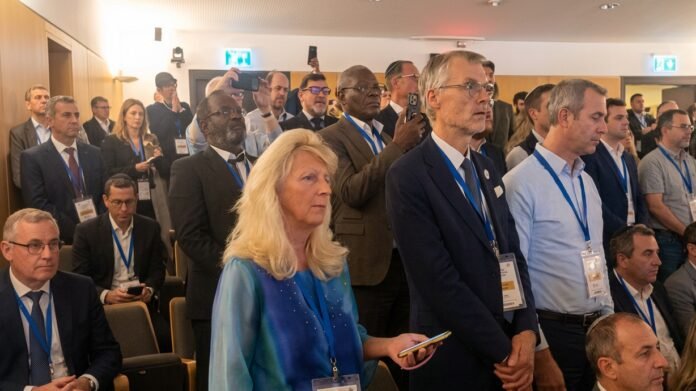
More than 60 Noahides from 22 countries gathered in Jerusalem for the First International Congress of Noahides, establishing international institutions and signing a founding covenant intended to strengthen their religious communities and ties with Israel. 

Organized by Brit Olam–The Noahide World Center, the five-day gathering, held during the week of November 8, 2026, was modeled on the First Zionist Congress convened by Theodor Herzl in Basel in 1897. 

Noahides are non-Jews who follow the biblical Seven Laws of Noah, including belief in one God, establishing courts of justice, and prohibitions against murder, theft, idolatry, sexual immorality, and eating flesh from a living animal. Thousands practice the tradition across more than 70 countries on six continents. 

At Jerusalem’s Seven Arches Hotel, overlooking the Mount of Olives, delegates signed the Megillat Bnei Noach, or Scroll of the Noahide Covenant, in the presence of Jerusalem Mayor Moshe Lion and Rabbi Oury Cherki, president of Brit Olam. 

The Hebrew document expresses the signatories’ commitment “to make a covenant with the people of Israel and its Torah.” 

Participants also established an international Beit Din, a rabbinical court providing voluntary religious guidance to Noahides. 

“Zionism achieved the material liberation of the Jewish people. Now we have to ask what comes next,” Cherki said. 

Delegates attended religious studies and workshops, visited the City of David, Shiloh and Beit El, and prayed at the Western Wall. 

President Isaac Herzog received representatives of the movement in Jerusalem and was presented with a certificate. 

Among the participants was Rod Bryant, a former evangelical pastor from Baton Rouge, Louisiana, who founded NETIV Virtual Torah Learning in Houston, Texas. 

Emilia Goritz traveled from Argentina with her son, Misael Kurtz, while Solia Centenode Baglivo represented Bolivia, where she helped expand a Noahide community from two to 40 members. 

Rabbi Chaim Goldberg, Brit Olam’s CEO, said the congress sought to connect individuals studying independently with established communities. 

The gathering received the blessings of Israel’s chief rabbis. 


Source: Iwpost.com

Man who lost $308,000 on sports bets sues Kalshi for offering illegal gambling

0
man-who-lost-$308,000-on-sports-bets-sues-kalshi-for-offering-illegal-gambling
Man who lost $308,000 on sports bets sues Kalshi for offering illegal gambling

A man who lost over $308,000 making sports wagers on Kalshi is suing the prediction market for violating the state of Washington’s ban on online gambling. He’s trying to turn those losses into an overall victory with a lawsuit seeking a payment of over $580,000.

Bellevue, Washington, resident Scott Bright’s “wagering occurred at a time when it was unlawful in Washington and when the Washington Attorney General had already sued KalshiEX LLC in this Court alleging precisely that,” said the gambler’s lawsuit filed on September 24 in King County Superior Court. Kalshi has since filed a motion to dismiss the lawsuit.

While state attorneys general throughout the US are trying to shut down Kalshi for allegedly violating state gambling laws, Bright’s case tests whether unsuccessful gamblers can obtain restitution from the company through individual lawsuits.

“Washington has prohibited Internet gambling since 2006. Washington has also provided, since long before that, a statutory cause of action permitting any person who loses money at illegal gambling to recover it from the proprietor for whose benefit the game was conducted,” Bright’s lawsuit said.

Even if Bright’s lawsuit fails, gamblers who lost on Kalshi could get money back through the lawsuits filed by state governments. For example, Washington’s lawsuit against the company said the attorney general “is entitled to recover all money Washingtonians have lost through Defendant Kalshi’s illegal gambling operation” under the state’s Recovery of Money Lost at Gambling Act. Washington already won a court order restricting the kinds of wagers Kalshi can offer in the state, but it took effect after Bright’s losses.

Kalshi says event contracts aren’t gambling

Kalshi wants Bright’s lawsuit to be moved to US District Court for the Western District of Washington, saying it must be tried in a federal court instead of a state one. In an October 30 motion to dismiss Bright’s case, Kalshi argued that he did not lose any money on “gambling.” Kalshi said he lost money on “event contracts,” which Kalshi says can only be regulated by the federal government.

“The contracts which Plaintiff mischaracterizes as gambling are event contracts offered on the Platform subject to the CEA [Commodity Exchange Act], in conformance with the rules and regulations of the CFTC [Commodity Futures Trading Commission], the federal agency which has statutory authority to oversee the CEA,” Kalshi said.

We contacted Bright’s attorney, Michael Daudt, about Kalshi’s court filings and will update this article if we get a response.

“Plaintiff alleges that his activity on the platform was gambling and that he ‘lost,’” Kalshi wrote. “He does not allege that anyone misled him about how the platform worked, what it charged, or the risk that any position might lose. Yet, he now sues KalshiEX and its parent, Kalshi Inc., to recover nearly double his own alleged net realized loss under Washington’s gambling loss-recovery statute, and a theory of unjust enrichment.”

Between June 17 and August 14, 2026, Bright transferred $315,353.94 to Kalshi in 253 separate debits from his checking account, his lawsuit said. Kalshi allegedly collected $5,589.05 in funding fees on those transfers.

Bright made numerous wagers on sporting events including professional baseball games and tennis matches. He apparently put any winnings into new bets, and alleges that “Kalshi’s platform cycled Plaintiff’s deposits through $14,396,457.30 in transactions and assessed and retained $84,062.71 in trading fees on them, equal to 26.7 percent of everything Plaintiff deposited.”

After all his bets, Bright suffered a net loss of $308,781.62, and his account was left with a balance of $983.27. Kalshi said that Bright’s “alleged losses went to counterparties rather than” to Kalshi itself and that Bright’s “positions were matched with counterparties and resolved according to the outcomes of the underlying events.”

“The Complaint does not allege that KalshiEX or Kalshi Inc. was the counterparty to any of Plaintiff’s positions,” Kalshi said.

Kalshi calls itself “a neutral exchange platform” with no financial stake in the outcome of any event. It makes revenue by collecting fees on transactions. But while Kalshi describes itself as a neutral operator and collector of transaction fees, its business model also includes a trading affiliate that places wagers on the platform.

Kalshi’s trading affiliate

Kalshi’s rulebook says its trading affiliate “participates on the Platform and provides liquidity to the Platform by placing orders on either (or both) sides of a market at competitive price levels.” Kalshi says its affiliate only has access to the same public information that other traders on the platform have.

Bright’s lawsuit alleges that Kalshi’s affiliate “took the opposite side of a substantial portion of Plaintiff’s positions,” meaning that “Kalshi and the enterprise under common ownership with it were not a neutral venue but the dealer or player winning within the meaning of [state law], in addition to being the proprietor for whose benefit the wagering was conducted.”

Bright doesn’t know for sure whether Kalshi’s affiliate was on the other side of any of his bets. “The identity of the participant on the opposite side of each of Plaintiff’s positions, and the profit each such participant realized, is information exclusively within Kalshi’s possession,” Bright’s lawsuit said.

The US Court of Appeals for the Ninth Circuit ruled in August that Nevada can regulate Kalshi under gambling laws. Although that case involved Nevada, the Ninth Circuit’s jurisdiction includes the state of Washington. Bright’s lawsuit quoted the ruling’s finding that “placing sports bets, even when called by another name, is still gambling.”

Although Bright’s lawsuit said his net loss was $308,781.62, he asked for $580,544.98 based on an “event-by-event” calculation derived from a 1950 ruling issued by the Washington Supreme Court. “Computed on the event-by-event basis required by Heitfeld, under which winnings in separate and distinct events may not be offset against losses, the sums Plaintiff lost total $580,544.98,” the lawsuit said.

Bright’s lawsuit said that if the court declines to order $580,544.98 in restitution, it should instead award “all funds Plaintiff transferred to Kalshi and the $89,651.76 in funding and trading fees Kalshi collected.” That would amount to over $405,000.

Kalshi seeks delay until Supreme Court weighs in

In addition to its motion to dismiss the case, Kalshi filed a motion to stay the proceedings at least until the US Supreme Court decides whether to take up a separate case on whether state gambling laws apply to prediction markets. “The orderly course of justice favors a stay because Supreme Court review will settle or simplify every claim and ensure uniform treatment of like suits,” Kalshi told the US district court.

Kalshi has suffered some notable losses in US appeals courts, which found that states can regulate the platform’s event contracts under gambling laws. But federal courts have not unanimously sided with states, and New Jersey asked the Supreme Court to settle the question of whether states can regulate Kalshi under gambling laws.

Kalshi’s motion for a stay in the Bright case noted that Washington government officials are “pursuing overlapping claims” against Kalshi. “The State of Washington is pursuing the same theory, and seeks the same recovery for Mr. Bright, in a case pending before the Superior Court of Washington for King County,” Kalshi wrote.

Kalshi tried to get the state’s case moved to a federal court, but it was sent back to King County Superior Court in May. Washington won a preliminary injunction against Kalshi in August, when a King County judge ordered Kalshi to implement geofencing and stop allowing many types of wagers in the state.

The county court’s order required Kalshi to stop offering or accepting event contracts “related to sports, elections, politics, entertainment, culture, tech and science, or mentions” in the state. The injunction did not affect wagers in the commodities, climate, economics, and finance categories.

Bright transferred his funds to Kalshi before the geofencing order took effect. His lawsuit claims that on September 15, he tried to access the app but received a notice that “using this app in your current location is prohibited.”

This article was updated to correct the date the lawsuit was filed.

Source: Iwpost.com

Tech giant Nvidia to investigate CEO’s affair with suspected Chinese spy

0
tech-giant-nvidia-to-investigate-ceo’s-affair-with-suspected-chinese-spy
Tech giant Nvidia to investigate CEO’s affair with suspected Chinese spy
cde.news desk · 4 min read

Nvidia CEO Jensen Huang faces a board probe into whether he was the target of a foreign intelligence effort after a media report linked him to a Chinese businesswoman accused of passing information to Beijing.

The New York Times reported last month that Huang had a relationship with Alice Huang, an unrelated former executive of ​Singapore-based company Megaspeed, who US authorities investigated and concluded was a Chinese intelligence asset.

Here is what is known about Huang’s background and his ‌pivotal role at chipmaker Nvidia as well as the US scrutiny of Megaspeed and Alice Huang.

WHO IS JENSEN HUANG?

Huang, 63, co-founded Nvidia in 1993 with Chris Malachowsky and Curtis Priem and has led the company ever since, making him one of Silicon Valley’s longest-serving founder CEOs.

Born in Taiwan and raised in the US, Huang became one of the most powerful figures in the AI revolution as he ​transformed Nvidia from a maker of video-game graphics chips into the world’s dominant supplier of AI processors.

His trademark leather jackets and high-profile product launches have ​made him one of the few corporate leaders in the world synonymous with their companies.

Huang has been married for decades to ⁠Lori Huang, whom he met while studying engineering. The couple have two children who both work at Nvidia.

Their daughter Madison Huang is a senior director of product and ​technical marketing for physical AI platforms at Nvidia, while their son Spencer Huang manages robotics software products.

Huang said on Sunday in a message to employees that he had been ​unfaithful to his wife and took “full responsibility” for his actions.

WHAT DOES NVIDIA DO?

Nvidia’s chip designs have been at the heart of major technology trends from video games to self-driving cars to cloud computing and AI.

Under Huang’s leadership, the company bet early on AI, and when ChatGPT launched in late 2022, Nvidia’s chips were already positioned at the center of a surge in demand for AI ​computing.

Nvidia has become one of the world’s most valuable businesses and a critical supplier to major technology firms, with its valuation surging from $420 billion in late 2022 ​to $4.5 trillion as of November 6.

WHO IS ALICE HUANG AND WHAT IS MEGASPEED?

The US has been investigating Megaspeed, a Singapore-based cloud computing firm and an Nvidia customer, over suspicions that it helped Beijing ‌gain access ⁠to Nvidia’s advanced AI chips that are barred from shipment to China.

The New York Times last month reported that Alice Huang, a Chinese citizen, had developed a close relationship with the Nvidia boss and allegedly fed information directly to Beijing.

Reuters could not independently verify the claims made in the report, nor could it verify Alice Huang’s current employment status with Megaspeed.

According to its website, Megaspeed is an Nvidia Cloud Partner in the Asia-Pacific region, with Nvidia’s GB200 NVL72 and HGX H100 chips on offer.

Megaspeed did not respond ​immediately to a request for comment on ​Monday, a public holiday in Singapore.

Alice ⁠Huang did not respond to the New York Times last month when it first reported her relationship with Huang, and Reuters could not determine her location to seek comment on Monday.

WHAT NATIONAL SECURITY ISSUES COULD BE INVOLVED?

Nvidia sits at the center of the ​technological rivalry between the United States and China. Washington has imposed restrictions on exports of advanced AI chips to China since ​2022.

The controversy over Huang’s ⁠contacts with Alice Huang comes at a vulnerable time for Nvidia. Investors are already fretting about the sustainability of the AI boom that helped drive the company’s rise. The board probe raises fresh questions about the future of the executive most closely associated with its success.

Senior Republicans in the US House of Representatives have already sought briefings from Huang following the ⁠New York ​Times report, citing national security concerns.

Nvidia has said its board has “no reason to believe” US national security or ​company secrets were affected, though an independent committee of directors will review all available information.

HOW WILL NVIDIA CONDUCT ITS PROBE?

The company said a committee of independent directors, assisted by outside independent counsel, will oversee the ​investigation.

Huang fully supports the review and has committed to cooperating with it, Nvidia said in a statement.

Source: Iwpost.com

Lawyers in This State Are Allowed to Ghost Clients for Years. Why Don’t More Judges Stop Them?

0
One morning in July 2025, I was the lone spectator in Judge Frank Palumbo’s courtroom in Philadelphia, watching prosecutors and public defenders haggle over the fates of defendants.

Palumbo paused the proceedings to talk to a lawyer he’d appointed to help a prisoner who had ineptly challenged his conviction. The lawyer profusely thanked the judge for the job. Then, Palumbo offered a bit of guidance: “I think I know where this is going to go. I don’t want to make it overly complicated. It’s real simple.” 

The judge said he’d pass along a brief that a different lawyer had filed arguing that there was no merit to the man’s claims in a related case. “I’m not saying plagiarize,” the judge said.

The attorney told the judge he got the message. “So it’s called a Finley letter,” he said, using the common legal term for that no-merit brief, in which an attorney can argue against the client’s claims and ask to withdraw from the case. 

“It’s looking like it’s going to be a Finley dismissal,” the judge agreed after a bit more discussion, “but every option is open.” 

I’ve spent years covering criminal justice in Pennsylvania, including the post-conviction system that allows people to argue that their lawyer had mishandled their case or to raise newly discovered evidence. That day, I left the courtroom wondering how what I’d observed squared with the state’s promise of effective legal representation in cases like this. 

That question sent me on a yearlong reporting odyssey, during which I read hundreds of Finley letters, tracked down court financial records from all 67 Pennsylvania counties, interviewed dozens of lawyers and analyzed thousands of court dockets. What I wanted to know was: Why has it become the norm for Pennsylvania’s lawyers to argue against their own clients? And who is this system serving?

I found that lax rules, low pay and heavy caseloads have compromised legal representation under the state’s Post Conviction Relief Act. Over the past year, I’ve reported on how lawyers, working under fee structures banned in other states, fell years behind on their cases. I spoke with prisoners who’d waited nearly a decade for their lawyers to file anything and others whose lawyers filed Finley letters despite compelling evidence of innocence. I also looked at three years’ worth of invoices and found that, three quarters of the time, Philly lawyers who wrote Finley letters had never spoken with their clients, contacted the trial lawyer or obtained available police files before deciding their claims had no merit. 

None of those seemingly basic steps, I was surprised to learn, is required under the law. In fact, dozens of lawyers I spoke to expressed sharply divided opinions about the extent of their obligations to these clients. 

But court-appointed lawyers are not working unsupervised. Judges are largely in charge of appointing them to cases, and those same judges are supposed to make sure they’re doing a timely and diligent job. 

I noticed that judges continued to assign lawyers more cases even after appeals courts flagged serious issues with their work. And when it came to Finley letters, judges accepted almost all of them over the three years of cases I reviewed, despite the lawyers’ minimal investigative efforts. Some of the letters they approved contained obvious factual errors or even named the wrong client.

Last fall, after Palumbo gave the lawyer a copy of a Finley letter, the lawyer followed the template. His no-merit brief said that his client’s claim could not be considered because he’d missed his filing deadline. The bulk of the document was, in fact, identical to the other lawyer’s brief. 

Palumbo, who didn’t respond to my requests for comment, accepted the Finley letter anyway, let the lawyer drop the client and dismissed the claim.

Who Judges Judges?

I thought a fair way to evaluate judges would be to look at the rulings of the Pennsylvania’s Superior Court, the state’s appeals court that hears hundreds of challenges to judges’ rulings on post-conviction matters each year.

And boy, did the Superior Court have thoughts on how judges are handling post-conviction cases. 

In one withering opinion, a judge bemoaned an “embarrassing saga” of deficient lawyering that a Berks County judge had tolerated. Another derided a Philly judge and the five attorneys she’d appointed who all missed appeals deadlines, writing, “As Hall of Fame manager Casey Stengel said of the hapless 1962 New York Mets, ‘Can’t anybody here play this game?’”

After logging hundreds of rebukes laid out in Superior Court opinions by hand, I asked some colleagues with data skills to help identify as many of these cases as possible across the last 14 years, the time frame for which opinions were reliably posted online.

A screengrab of text from a court opinion document that reads, in part, “By this Court’s count, at least five attorneys have now abandoned Sanchez. … We emphasize our disapproval of the deficient representation Sanchez has been subjected to prior to this appeal.”
In an excerpt from a court opinion, a judge mentions that at least five attorneys had abandoned a client. Obtained by ProPublica

We found that the appeals court flagged more than 250 cases in which judges didn’t intervene as lawyers provided what the court labeled ineffective representation: “sandbagging” a client at a hearing, stonewalling a petitioner who’d mailed two dozen letters to the lawyer’s office or filing boilerplate appeals so vague that they doomed their clients’ cases. In hundreds more cases, judges failed to appoint a lawyer at all, held hearings where petitioners went unrepresented or allowed a lawyer to drop a case, leaving the client stranded on appeal. More than 200 times, they oversaw lawyers who abandoned clients, tanking their appeals or stalling their cases for years.

“Judges are in a terrific position to be able to prevent these kinds of injustices,” said Marissa Boyers Bluestine, a longtime post-conviction lawyer who now works at the University of Pennsylvania’s law school.

The scathing reversals aside, the Superior Court affirms about 80% of lower-court rulings. That’s expected given the strict deadlines and complicated rules about how appeals must be filed. The appeals court is also required to defer to the lower court’s factual decisions. And when it reverses due to an error, the recourse is generally limited to ordering a do-over or, on rare occasions, instructing the lower court to explore sanctions. In one opinion, the court resorted to using boldface to call out an egregious failure: “The PCRA court did nothing in this case for 20 years.” Then, it told the lower court to try again.

A smiling bald man with a gray goatee and eyeglasses hugs a woman to his left, whose eyes are closed. Another man in a suit is to his right, and a second woman looks up at him from the bottom right corner of the image.
Marissa Boyers Bluestine leaves court with her newly exonerated client, Willie Veasy, center, in 2019. At the time, she was working for the Pennsylvania Innocence Project. She said judges have a duty to report unethical lawyering. Heather Khalifa/The Philadelphia Inquirer

Judges do have the authority — and, in fact, an obligation under state rules — to make disciplinary referrals. Because complaints are confidential, there is no way to know how often they do so. But only six lawyers in the last decade have been publicly sanctioned for work on court-appointed post-conviction cases.

Judicial discipline is even rarer. No lower-court judge in at least a decade has been publicly disciplined for mishandling a post-trial matter. Judges who, according to the Superior Court, exhibited biases, imposed vindictive sentences or improperly denied recusal requests remained on the bench. 

Even after the Superior Court raised alarms, more than 100 cases ricocheted between the appeals court and county judges two, three, four or more times, as judges repeated errors or reappointed lawyers to cases they’d already mishandled. 

One such case played out after Jefferson County’s only judge, John Foradora, sentenced a woman to up to 22 years in prison for passing two narcotics pills in prison. Her lawyer failed to object to or appeal the lengthy sentence. After she filed a PCRA, the Superior Court found that her lawyers’ inaction enabled the  “unduly harsh and clearly unreasonable” punishment to stand. But each time the Superior Court reversed, Foradora again imposed a lengthy term. After three such reversals, the woman wound up serving more than eight years. Foradora said through a court spokesperson that he was unable to comment.

Shannon McDonald, an attorney in the Philly suburbs, said that “some judges don’t consider PCRA a priority.” 

She described waiting as a petition languished on a Delaware County judge’s desk for two years, until her client had finished his sentence and been released from prison. Then, the judge finally ruled, dismissing the claim.

The Finley Problem

Like lawyers, judges I’ve spoken with seem to be divided on their obligations, especially when it comes to the no-merit letters known as Finley letters. The state Supreme Court says that when a lawyer submits a Finley letter, the judge needs to conduct a review of the merits of the case.

Attorney Rob Perkins, who leads the nonprofit Allegheny Lawyers Initiative for Justice, told me that while he’s encountered some judges who take post-conviction matters seriously, others seem to view them as a nuisance. He said several lawyers told him that they were afraid that if they litigated cases too aggressively, judges would withhold future assignments. The no-merit letter becomes the simplest path forward: “When a judge is handed a no-merit letter that sounds good, I think their inclination is to accept that the attorney did their job.”

A man in a gray suit stands with his hands crossed in front of a set of stairs in a dimly lit historic building.
Rob Perkins, an attorney and founder of Allegheny Lawyers Initiative for Justice, says some court-appointed lawyers fear that litigating post-conviction cases aggressively would be bad for business. Justin Merriman/The Philadelphia Inquirer

Superior Court opinions reflect this pattern as well. In my review, I found hundreds of cases overruling lower-court judges who accepted flawed Finley letters. The appeals court noted that lawyers claimed, incorrectly, that their clients had missed filing deadlines, rejected legitimate claims as meritless or failed to notice that their clients were serving illegal sentences.

In dozens of cases, judges approved defective Finley letters that did not fulfill basic rules, such as including a notification to the client or addressing all the claims the client wanted to raise.

Several judges told me that Finley letters serve an important purpose, in shutting down frivolous challenges that waste resources. 

“Not all [claims] have merit,” Judge John J. Mead of Erie said. “A lot of them initially you could look at and make a determination [as to] whether or not it’s going to require a hearing.” 

I’ve noticed that the system makes accepting Finley letters the simplest choice for judges. A judge who rejects a Finley letter must either find a new lawyer willing to take the case, or force the same lawyer to pursue a matter they previously deemed meritless. 

Judges who take that path risk pitting a lawyer against his own client, the Superior Court wrote in one recent case, finding the judge’s actions resulted in the denial of a man’s right to counsel. His lawyer, forced to handle a hearing after writing a Finley letter, treated it “more like a cross-examination of a witness that [he] does not believe than a direct examination of his client.”

Jon Auritt, who retired after more than 50 years as a lawyer in Delaware County, said that these failures stem from a common cause: Instead of working independently, lawyers are beholden to the local judges who appoint them. 

Even if judges are not as explicit as Palumbo was with their instructions, Auritt said, their message is often clear: “The judges are never incentivized to appoint a lawyer who might earnestly find a reason to overturn the conviction.”

Source: Iwpost.com

DCU shake-up: James Gunn and Peter Safran out post-merger

0
dcu-shake-up:-james-gunn-and-peter-safran-out-post-merger
DCU shake-up: James Gunn and Peter Safran out post-merger
It’s barely been two months since the controversial Paramount and Warner Bros. merger, and we’ve already got a shockingly unexpected ouster: Co-CEOs of the rebooted DC Universe, James Gunn and Peter Safran, are stepping down from that role despite the Hollywood rumor mill assuming that the duo would be safe.

It’s unclear whether the pair chose to resign or were forced out, or what will happen to their planned slate of projects beyond 2028’s Superman: Man of Tomorrow, which is in post-production. Producer Jeremy Latcham—a protege of Marvel’s Kevin Feige who worked with Gunn on Guardians of the Galaxy among other MCU films—will replace them. Per Gunn and Safran’s joint statement:

Four years ago, we set out to unite DC under one creative vision. In that time, we helped restore Superman to the heart of DC, while opening new doors and telling new stories in film and television with Peacemaker, Creature Commandos, Lanterns and Clayface. We’re immensely proud of the team that turned that ambition into something real, including the actors, crews and executives we had the opportunity to collaborate with. We’ve shared a creative history with Jeremy going back to Marvel, and we’re eager to see the perspective he brings to DC’s next chapter. We’re excited to return to what drew us to this job in the first place, which is telling the stories we love, including the next chapter of Clark and Lex’s journey in Man of Tomorrow.

DCU fans are mourning the news and what it could mean for the franchise. My feelings are mixed. On the one hand, I’m on record that I’ve found the rebooted DC Universe films released thus far to be enjoyable but rather forgettable, even when the positives outweigh the negatives. (I have yet to see Clayface, which debuted to good reviews and a solid box office showing.) But HBO has done right by the DCU: I loved both seasons of Peacemaker; Lanterns is a shining beacon of what is possible when someone is allowed to get really creative within the genre; and I’m very much looking forward to next year’s Jimmy Olsen (Skylar Gisondo) series The People v. Gorilla Grodd—described as a “mockumentary crime comedy superhero series.”

I also love Gunn’s more irreverent sensibility with superhero fare and his rapport with fans. At least now he will get to focus on what he does best—and Gunn seems to feel the same way, per his personal Instagram post. Gunn says he had mixed feelings about taking the job at first but “couldn’t pass up the unique opportunity,” adding that he has no regrets and is glad he took it.


View this post on Instagram


A post shared by James Gunn (@jamesgunn)

But Gunn also noted that he sometimes found the job trying, with very little time to recharge between projects; that his ADHD made it challenging to juggle so many projects at once; and that he disliked “the at-times corporate nature of the job,” thanking Safran for “taking the brunt of that.” He concluded, “I will miss being the co-caretaker of these great characters, but I’m also incredibly relieved and excited to get back to pure filmmaking.”

Into the unknown

While Gunn and Safran reported directly to Warner Bros. Discovery CEO David Zaslav—unusual for the industry—Latcham will report to Dana Goldberg and Josh Greenstein, co-chairs of the Skydance Motion Picture Group. “Jeremy brings a deep reverence for DC and its passionate fanbase, recognizing that they are the very foundation of this storied, multigenerational brand,” Goldberg and Greenstein said in a statement. “Under his leadership, every film and television show will be ushered from start to finish through the prism of the legions of fans who love and champion it. Jeremy’s track record exemplifies the excellence he will bring to building out DC and the many beloved characters within it.”

Latcham issued his own statement:

DC’s pantheon of characters is among the most iconic in American popular culture. I’ve had the privilege to help bring some of the most celebrated superhero stories to life on the big screen, and I’m excited and honored for the opportunity to now lead DC Studios into its next era. The chance to steward the incredible cast of DC characters to the screen in a way that excites lifelong fans while introducing their timeless stories to the next generation is a massive responsibility that I do not take lightly. I am grateful to Dana and Josh for putting their trust in me. I can’t wait to work night and day alongside filmmakers, comic book creators, artists and storytellers of every kind, across film, television and animation, to build something ambitious for longtime DC fans and newcomers alike.

Latcham has the superhero bona fides, having been a producer on some of Marvel’s biggest hits: Guardians, Iron Man, Iron Man 2, The Avengers, Age of Ultron, and 2017’s Spider-Man: Homecoming. He left to create his own production company, which spearheaded 2023’s Dungeons and Dragons: Honor Among Thieves and 2018’s Bad Times at the El Royale.

The DCU should be in capable hands, even if the overall vision changes. I’d like to see the DCU move away from the connected universe model and back to standalone films where the storytelling and character development aren’t beholden to setting up the next three films. But I’m not the head of a major studio.

Source: Iwpost.com

A monstrous El Niño has arrived. Here’s what it means for where you live.

0
a-monstrous-el-nino-has-arrived-here’s-what-it-means-for-where-you-live.
A monstrous El Niño has arrived. Here’s what it means for where you live.
A monster is growing in the Pacific — not the kraken, but something far scarier and deadlier. El Niño is a natural phenomenon in which a band of warm water forms every three to five years off the coast of South America. It raises ocean water temperatures by just a few extra degrees for typically nine to 12 months and ends up injecting an extraordinary amount of energy into the sky. It’s already the strongest El Niño on record, and it might not even peak for about another month or two.

“Those are actually really big changes for the ocean,” Art Miller, a climate scientist at the Scripps Institution of Oceanography, told Grist in September. “The ocean has a lot of heat content — 1,000 times more ability to hold heat than the atmosphere — so slight changes in the ocean surface temperatures can actually do a lot for the atmosphere.”

While scientists are still trying to figure out how climate change might be influencing El Niño, some research suggests that rising temperatures have led to stronger El Niño events. At the very least, we can use this event’s temporary warming to imagine what the climate will look like by default in two decades, as planetary temperatures continue to rise. 

The effects of the current El Niño will be global, and they will be severe. Scientists have estimated that the additional heat alone could kill around 450,000 people worldwide. Drought is gripping some places, like the Amazon rainforest, while extreme rainfall hits others, like the Greater Horn of Africa. And the polar vortex — another phenomenon that periodically blasts the eastern and central United States with frigid air — interacts with El Niño in ways that can scramble weather even further. El Niño, then, won’t just fire heat into the atmosphere — it will fundamentally shift weather patterns the world over.

Read Next

The atmospheric changes are so complex that different parts of the U.S. will endure vastly different impacts from El Niño. (There’s also a lot of uncertainty here: Models can predict general changes across regions, but no one can tell you what the weather will be in a given spot a month from now.) California, for example, typically sees increased rainfall and flooding. The Midwest might be relatively better off with a milder, drier winter, whereas the Southeast could get colder and wetter. 

Which is all to say: Things are going to get very weird, and often very dangerous, across the U.S. To break it all down by region, Grist spoke to state climatologists and meteorologists. Here’s what they expect in the months ahead.
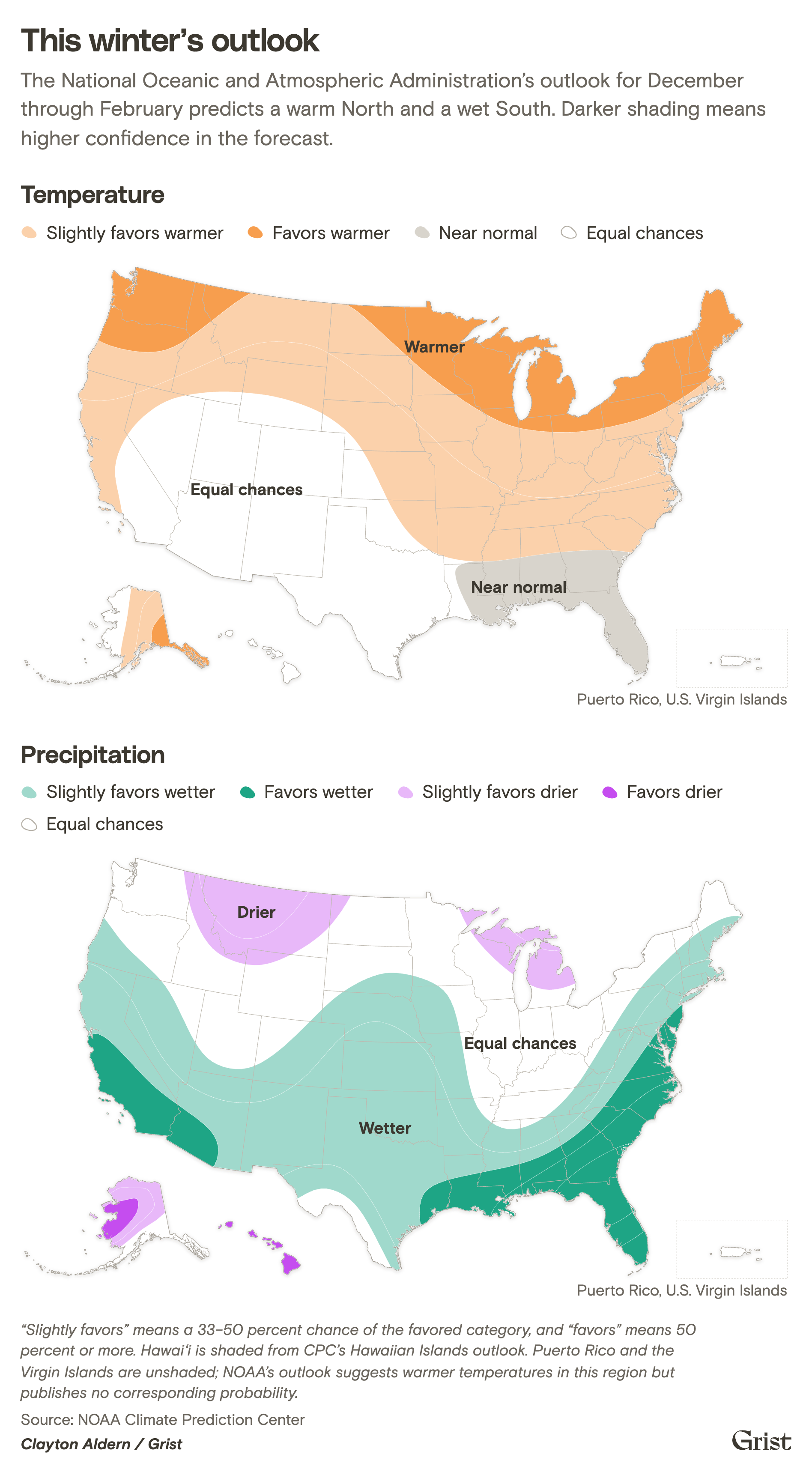
Two maps of NOAA’s outlook for December 2026 through February 2027. The temperature map favors a warmer winter across the northern US and Alaska, with a 50 percent or greater chance in Washington, the upper Midwest and the Northeast, near normal temperatures along the Gulf Coast and equal chances in the Southwest. The precipitation map favors a wetter winter across the southern US, reaching 70 to 80 percent in southeast Georgia and north Florida, with drier conditions favored in Montana, the upper Great Lakes, western Alaska and Hawaiʻi.

This winter’s outlook, region by region

The National Oceanic and Atmospheric Administration’s outlook for December through February predicts a warm North and a wet South. Darker shading means higher confidence in the forecast. Click a region to learn more.

Slightly favors warmerFavors warmerNear normalEqual chancesSlightly favors wetterFavors wetterSlightly favors drierFavors drierEqual chances

Alaska

Alaska is America’s largest state and home to all of its Arctic territory. That makes it uniquely vulnerable to the effects of climate change, which is warming the region several times faster than the rest of the planet. El Niño years add a blast of heat on top of that warming, intensifying local effects in the short term. 

A strong El Niño, like the current one, tends to strengthen the Aleutian Low, a broad area of low pressure over the North Pacific that helps shape Alaska’s winter weather. But El Niño is only one of many factors influencing the Low’s strength and location. Depending on how these conditions line up in any given year, the state could experience vastly different outcomes. That makes the effects of El Niño especially difficult to predict in Alaska, said Martin Stuefer, the state climatologist and director of the Alaska Climate Research Center at the University of Alaska Fairbanks. 

“We have to be on the lookout for more intense events, that’s for sure,” Stuefer said. “But we should be cautious about making conclusions based on what we know now.”

Evidence from previous El Niño events indicates that populated regions along the Gulf of Alaska and the state’s southeast might experience warmer winter temperatures, and precipitation may fall as rain instead of snow, Stuefer said. According to the National Weather Service, most strong El Niño years have resulted in below-average snowfall in Alaska.

Anything that intensifies warming in the state isn’t welcome news. Climate change is already melting away sea ice, leaving Alaska’s vast shorelines exposed to erosion during storms. It’s also thawing permafrost — the frozen ground found across much of Alaska — to collapse. Meanwhile, warmer waters are setting the stage for harmful algae blooms and changing the distribution of fish species that Native Alaskans have depended on for generations. A strong El Niño in the coming months could add to these pressures.

— Sachi Mulkey

Hawaiʻi and the Pacific Islands

Hawaiʻi and the Pacific have had a tough year already, and El Niño threatens to cause even more disruption. Low-pressure storms known as Kona lows and hurricanes have hit Hawaiʻi throughout the summer and fall, leading to severe flooding and power outages. Elsewhere in the region, super-typhoons like Sinlaku made landfall, causing 17 deaths in the western Pacific. 

In the coming months, Pacific islands are broadly expected to face drier conditions and stronger storms. According to the National Oceanic and Atmospheric Administration, for example, Guam and the Commonwealth of the Northern Mariana Islands are facing an above-normal typhoon season, which will build on an already destructive summer and fall period. The threat is in addition to the rising probability of storms, fueled by warming ocean waters due to climate change. 

“It only takes one storm to come over the island to cause crazy rainfall and devastation,” said Ryan Longman, who is the consortium program director at the University of Hawaiʻi at Mānoa for the Pacific Islands Climate Adaptation Science Center. 

The Pacific islands are also bracing for a drier winter and spring. In Hawaiʻi, a strong El Niño can lead to a drier wet season, which typically lasts from October to March. That could mean less water available for residential, agricultural, and commercial uses and elevated wildfire risk. 

The landscape is currently thick with grass and other vegetation from a historically wet summer. As the climate shifts toward drier conditions, those fuels on the landscape will dry up, increasing the chances of wildfires. Longman suggested that residents clear dry grasses and other fuels from their properties to reduce their risk. 

For some Pacific islands, historic patterns suggest that the worst drought effects come the year following El Niño’s onset, meaning the most severe impacts could arrive in early to mid-2027. 

— Joseph Lee

Read Next

Midwest

The Midwest may catch a break when El Niño peaks this winter. 

The cyclical climate pattern is mostly associated with milder, drier winters in the Midwest. El Niño shifts the polar jet stream — the band of fast-moving Arctic air high in the atmosphere — farther north, making it less likely that cold winds will dip into the region, resulting in warmer temperatures.

That doesn’t rule out snow and winter storms, though. It only means that average temperatures between December and February tend to be somewhat warmer. During recent strong El Niño events, winter temperatures ranged from 3 degrees Fahrenheit to more than 8 degrees F warmer than the 20th-century average, according to the U.S. Geological Survey.

The Midwest has already experienced a warmer fall this year, said Daria Kluver, a professor in the Department of Earth and Atmospheric Sciences at Central Michigan University. Average September temperatures across the region were the highest in the National Oceanic and Atmospheric Administration’s 132-year record. Illinois and Missouri had their warmest September on record; Wisconsin, Minnesota, Iowa, Indiana, and Michigan also saw above-average temperatures. 

That warmth will continue into the winter. And reduced ice cover on the Great Lakes could contribute to the warmer temperatures, Kluver said. Without as much ice, warmth stored in the lakes over the summer is likely to slowly dissipate into the surrounding air. The changes in ice cover could impact Great Lakes economies, recreation, and the ecosystems that depend on it.

Fall has been dry so far, but winter might not be. Kluver said precipitation levels will depend on other dynamics like Arctic sea-ice levels and Atlantic Ocean currents. But the El Niño typically tilts the odds toward less snowfall and more rain or ice.

“Whether you find that good or bad maybe depends on what you do for winter recreation,” Kluver said.

El Niño could also mean a reprieve from the Midwest’s record-setting tornadoes next year, according to Chris Callahan, a climate scientist and assistant professor at Indiana University Bloomington. 

“We are likely to have a relatively quiet tornado season in the spring, because those tornadoes are shifted south into [states] like Arkansas, Georgia, and so they might have a more active tornado season,” Callahan said. 

— Vivian La and Juanpablo Ramirez-Franco

Northeast

The Northeast has so far avoided El Niño’s impacts — but that’s about to change. 

Brad Pugh, a meteorologist with the National Weather Service’s extended prediction division, said the unusually strong El Niño this year gives the Northeast more than a 50 percent chance of a milder-than-normal winter. There could also be more precipitation, he added, though those odds will vary within the region.

While areas farther east are generally more likely to be wet, he said, “it’s hard to tell how much is going to be rain or snow.” 

Government outlooks don’t include snow totals because snow is difficult to predict far ahead. But the winter outlook from AccuWeather, a private forecasting company, projects fewer flakes for the Northeast. That, however, doesn’t mean the region won’t see snow, Pugh added.

“The forecast leaning on the wetter side does raise the prospects that there could be some high-impact winter storms,” he said, pointing to the I-95 corridor between New York and Boston as one area that could be hit. He suggested keeping an eye on the NWS’ eight- to 14-day forecasts to get a more accurate and timely sense of what weather may be on the way. 

Even water that falls as rain could be concerning, said Auroop Ganguly, a hydrologist and co-director of Northeastern University’s Global Resilience Institute. “If I were an urban planner, I’d plan more for the possibility of flooding in urban areas,” he said. A mix of rain, snow, and ice on the roads could also make driving dangerous. “I’d prepare for somewhat more hazardous conditions on the roads.”

Still, many in the region may welcome El Niño’s arrival, especially after last winter, which was the coldest in a decade. Milder temperatures this year could, for example, lower heating needs at a time when heating oil and electricity prices are spiking. 

As for the prospect of a warmer winter in the Northeast, said Ganguly, “Most people would say, ‘I’ll take it.’”

— Tik Root

Read Next

Northern Great Plains

There is less certainty about the total El Niño impacts for the Northern Great Plains compared to the rest of the country. Nebraska, Montana, and the Dakotas are expecting a warmer-than-average winter, but rain and snowfall forecasts across these states are less conclusive. 

In Nebraska, some of those effects may already be emerging. Earlier this fall, the eastern part of the state experienced milder temperatures and heavy rain, leading to flash flooding. Wetter-than-normal conditions are likely to continue in eastern Nebraska through winter, increasing the risk of additional floods, said Eric Hunt, a University of Nebraska-Lincoln agriculture meteorology and climate resilience extension educator. The state could still see intense winter storms, and western Nebraska could experience a wetter winter, though those forecasts are less certain.

Farther north in the Dakotas, the National Oceanic and Atmospheric Administration has forecasted a 40 percent to 60 percent chance of higher average temperatures from December to February. For North Dakota, that still means average temperatures below freezing. Winter also tends to be dry in both states, and forecasts for precipitation are variable, according to both states’ climatologists. 

In South Dakota, a snowy winter could alleviate drought, replenish surface water, and reduce fire risk in the Black Hills, said state climatologist Laura Edwards. A dry winter in the state could be a tipping point for drought conditions next spring.

In North Dakota, it’s not clear if any precipitation this winter would improve drought conditions, said Daryl Ritchison, North Dakota state climatologist and director of the North Dakota Agricultural Weather Network. One winter storm could push seasonal totals above average for precipitation for the season, but if the winter remains dry and spring rains are slow to arrive, fire risk might increase.

Montana faces much of the same uncertainty. In the Northern Rockies, the odds favor a below-average snow year — but only slightly, said Kyle Bocinsky, the director of climate extension with the Montana Climate Office. Montana has experienced four strong El Niño events in the past 40 years; three saw below-normal precipitation and snowpack, but one saw above-normal snowpack. “It’s a small sample size,” Bocinsky said, which makes it hard to definitively say what the impacts will be. “It’s still a fifty-fifty chance,” he said.

Bocinsky said warmer temperatures could make for a rainy winter similar to last year, particularly at lower elevations. Like much of the Great Plains, eastern Montana is still in drought carried over from last year’s mild winter. Farmers and ranchers are hoping snow settles on the landscape this year, but it’s just too soon to tell, he said. 

— Ellis Juhlin and Anila Yoganathan

Northwest

The Pacific Northwest typically sits in the center lane of a storm highway. Every winter, ocean storms travel across this familiar route, delivering a steady supply of the cool, drizzly weather that gives the region its gloomy charm. But El Niño is likely to reroute this storm track to the south, dumping rain onto sunny California instead. This often leaves the Northwest warmer, and sometimes drier, than usual.

That combination could be a double whammy for mountain snow, which is the main source of water for much of the Northwest, since snow can’t form if it’s too warm or too dry. “If we were to get both of those this year — both the warmer temperatures and less precipitation — that could spell trouble for our snowpack,” said Jacob Genuise, an engagement climatologist at the Washington State Climate Office. 

Climate change is also slowly chipping away at snow levels. Since the mid-20th century, snow levels in Washington’s Cascades have been steadily decreasing in both El Niño and La Niña years alike. These factors could lead to less snow stored in the mountains for next spring and summer, driving up the risk of drought or wildfires, and leaving less water available for irrigation, drinking water, or hydropower. 

Scatter plot of total winter snowfall at Snoqualmie Pass from 1950 to 2023, with each winter marked as El Niño, La Niña or neutral. El Niño winters sit low, averaging about 330 inches, while La Niña winters average about 540 and include the snowiest winter in the series, about 830 inches in 1956. Neutral winters average about 420 inches.

On the coast, El Niño can also lead to more tidal flooding. As ocean and wind patterns shift across the Pacific, seawater can get pushed toward the West Coast, raising high tide levels by several inches. This extra tidal boost could also combine with sea level rise, storm surges, or winter king tides to drive up the flood risk in Washington’s and Oregon’s coastal communities. “It’s not a huge effect,” said Genuise. “But that can mean the difference between a property getting flooded or not during these El Niño years.”

— Jesse Nichols

Southwest

El Niño often delivers rain and snow to the Southwest and could bring a glimmer of hope to a region suffering historic drought. Jon Meyer, assistant state climatologist at the Utah Climate Center, expects the weather pattern to bring “favorable storm activity” to the desert Southwest, including Arizona and New Mexico, with effects bleeding into Nevada and parts of southern Utah and southern Colorado.

But northern Utah, which is home to most of the state’s population, “is right in the bull’s-eye of being very unpredictable,” he said. Colorado’s outlook is also mixed. El Niño tends to bring more precipitation in spring and fall, but it also typically creates drier conditions for the Northern Rockies, said Peter Goble, assistant state climatologist at the Colorado Climate Center. 

“The strong El Niño, as interesting a story as it’s been,” he said, “doesn’t guarantee us anything.”

The region is in dire need of snowpack in the winter months ahead. Utah’s Great Salt Lake hovers just a few inches above eclipsing the record-low elevation it set in 2022, and its vast exposed lake bed is drying into a dust source impacting the health of the roughly 2.5 million residents living in cities near its shores. Meanwhile, Lake Mead and Lake Powell, the nation’s largest reservoirs, saw a fraction of their normal inflows from the Colorado River and set their own record lows over the fall. Around 40 million people in the West depend on water supplies delivered by the Colorado River system.

The early autumn run-up to the super El Niño has already brought downpours, sending torrents through city streets and arroyos across the region. Arizona is already facing flash flooding and could now see tornadoes and other extreme weather, according to meteorologists at AccuWeather.

More moisture would boost desiccated reservoirs and reduce sleepless nights for farmers, but experts are already repeating an all-too-familiar warning: One good year won’t solve the region’s water woes. Western states saw record-breaking snow in 2023. Today, that moisture is gone, and both the Rio Grande and Colorado River basins look more stressed than ever. Climatologists say those extreme oscillations will become more common as climate change heats up the region.

— Austin Corona and Leia Larsen

Read Next

Southeast and the U.S. Caribbean islands

For the notoriously hot and humid Southeastern U.S., El Niño typically has two main effects: It gets wetter and it can bring bouts of cold weather. In general, climate change is making the Southeast warmer and more susceptible to both drought and heavy rainfall events, and winter temperatures drop below freezing far less often. But that long-term warming trend doesn’t rule out frigid winter days and nights this year.

The wet weather comes down to the same forces that inundate the Southwest during an El Niño cycle, according to Chuck Watson, a Georgia-based disaster researcher who tracks weather impacts worldwide.

“That jet of air that’s coming across California continues on across the Gulf of Mexico and drags moisture from the Gulf and whatever was left over after it rained all over California,” he said. “It drags that across the Southeast.”

The National Oceanic and Atmospheric Administration is predicting enough rainfall between mid-October and the end of January to improve or eliminate drought conditions in several parts of the region, which has grappled with an unusual level of drought over the last year. The period from September 2025 through April 2026 was the driest in Georgia history, fueling wildfires in the spring that destroyed homes and forced evacuations; other states in the region also saw precipitation levels at or near record lows over the same period. As a result, the U.S. Department of Agriculture declared disasters due to drought in more than 200 counties in the spring. 

El Niño might also bring ice storms. The wet air moving east from California typically interacts with a flow of Arctic air high in the atmosphere, Watson said, creating the potential for colder weather. For a region that doesn’t deal with sustained temperatures too far below freezing most winters, the combination often means ice storms that people and infrastructure aren’t accustomed to.

“That’s really just a recipe that’s ripe for disaster,” Watson said. “That tends to be just bad news all around for tree limbs falling and slick roads and particularly extended power outages.”

One piece of good news for much of the Southeast is that El Niño typically suppresses hurricane formation in the Atlantic. So while Hurricane Isaias wreaked havoc when it hit the region in early October, it was also the first Atlantic hurricane this year — an incredibly rare occurrence. 

But the reprieve from tropical systems doesn’t apply equally, Watson said. El Niño’s effect on the complex upper air currents that steer hurricanes actually makes the band across South Florida and the Bahamas more likely to be hit by a hurricane, he said.

— Emily Jones

Southern Great Plains

When it rains, it pours. El Niño is expected to bring much-needed relief to the drought-stricken Southern Great Plains. The upcoming event is significant enough that the Texas Railroad Commission, a state agency that oversees oil and gas production, recently issued a notice warning operators that “this event may be outside the historical envelope” and that “past El Niño events may not be a good guide to this event.”

But unless this winter is exceptionally wet, it is unlikely to eliminate drought conditions entirely.

That’s because a wet winter won’t ease every impact at once, and different sectors may see varying effects, said Andrew Hoell, a research meteorologist with the National Oceanic and Atmospheric Administration. Depleted aquifers, for instance, may take years to return to normal levels, whereas agriculture might rebound quickly depending on when and where the rain falls. 

In Texas, El Niño tends to increase seasonal snowfall totals in the north and west, but not for the rest of the state, said state climatologist John Nielsen-Gammon. 

“Over the longer term, the warming trend in place over the past several decades is expected to continue,” said Nielsen-Gammon, referring to climate change. A 2024 report that he authored concluded that “extreme rainfall is strongly affected by increased temperatures.”

Meanwhile, El Niño’s effects in Kansas are less certain because of the state’s central U.S. location. Hoell described Kansas as a “toss-up” in a “transition zone” and emphasized that regional impacts in northern Kansas may be more pronounced. 

If the past is any indication, though, Kansas too might be in for a wetter winter. The National Weather Service in Wichita examined 11 strong to very strong El Niños since 1950 and concluded the event produced above-average precipitation across Kansas from fall through early to mid-spring.  

— Celeste Guajardo

Read Next

California

Like a camel stumbling into a desert oasis, California could soon get more water than it can possibly use all at once. El Niño can bestow the Golden State with increased rainfall — so much extra water, in fact, that Governor Gavin Newsom has declared a state of emergency to prepare the state to fight coastal flooding and erosion (partly due to an oceanic “Kelvin wave” slamming into California) and monster storms. 

The built environment wasn’t made for this. For centuries, the mantra has been to funnel rainwater into sewers and rivers as quickly as possible to keep it from flooding cities. Climate change is already making it rain harder, pushing wastewater systems to their limits. Now comes El Niño, supercharging rainfall even further. Worst case, this winter the state gets successions of the punishing storms known as atmospheric rivers, saturating soils and overwhelming sewers. That could overwhelm crops in the state’s bountiful Central Valley and dump dangerous amounts of snow in its Sierra Nevada mountains to the east. 

California has been preparing for this moment, though. Los Angeles, for example, is deploying “sponge” infrastructure like roadside gardens, which allow rainwater to soak into the ground instead of pooling on streets. (Over just a few rainy days in 2024, the city captured enough stormwater to supply 106,000 households for a year.) The state has also been working with farmers to divert rain into open spaces, where it can seep into the dirt and recharge underlying aquifers. “Essentially, the top line is: flood-safe and recharge-ready,” said Steven Springhorn, supervising engineering geologist in the California Department of Water Resources’ sustainable groundwater management office. “Flood safety and flood response is our number one priority going into a year like this.”

Counterintuitively, extreme rainfall could also prime the California landscape to burn catastrophically. More water means more plant growth, which desiccates through the summer — and this one could be extra hot if El Niño remains strong — turning into tinder. The wildfire danger could be particularly acute next fall, when intense seasonal winds can turn a spark into an inescapable blaze. With the state already cycling between extra-dry and extra-wet periods thanks to climate change, El Niño could literally add more fuel to the fire.

— Matt Simon


Source: Iwpost.com

Trump teases ‘big, beautiful agreement’ on Ukraine war and more

0
trump-teases-‘big,-beautiful-agreement’-on-ukraine-war-and-more
Trump teases ‘big, beautiful agreement’ on Ukraine war and more

<

article id=”post-952649″>

US President Donald Trump held an unscheduled meeting on Thursday, November 5, with Kirill Dmitriev, a special representative of Russian President Vladimir Putin.

Dmitriev is also the CEO of the Russian Direct Investment Fund, Russia’s sovereign wealth fund. He was in town heading the Russian delegation attending an event hosted by First Lady Melania Trump acknowledging a six-day local ceasefire around the Russian-occupied Ukrainian town of Oleshky.

Dmitriev’s attendance was a cover for ongoing high-level negotiations involving Trump, Putin, and in part  Ukrainian President Volodymyr Zelensky. It is also possible, though not directly acknowledged, that some European leaders are also engaged in the talks, though which ones aren’t clear.

The October 27 phone call between Finnish President Alexander Stubb and Norwegian Prime Minister Jonas Gahr Store with Russia’s Putin suggests these events may be linked.

Trump offered a very positive readout on his meeting with Dmitriev. He told reporters that “I can’t tell you what I discussed. But I’m just telling you, it’s going to be an agreement, it’s going to be a big agreement.”

Trump went on to say, “It’s going to involve more than Ukraine, and I could even say it might involve all of Europe,” he added, promising a “big, beautiful agreement, and everyone is going to be thrilled.”

Putin envoy Kirill Dmitriev had a message for Donald Trump. Image: X Screengrab

Abu Dhabi peace try

Negotiations are set to begin in Abu Dhabi on November 10 and 11, but it is unclear how these talks align with the alleged “big, beautiful agreement” Trump is talking about. Russia is sending presidential aide Vladimir Medinsky, Deputy Foreign Ministers Sergei Ryabkov and Mikhail Galuzin, and senior general staff officials Igor Kostyukov and Yuri Zhigarlovsky to Abu Dhabi.

The primary US delegates mediating the trilateral peace talks between Ukraine, Russia and the United States in Abu Dhabi are Steve Witkoff, US Special Presidential Envoy leading the diplomatic mediation efforts, and Jared Kushner, the US Special Presidential Envoy participating in the talks and developing the proposed post-war European security framework.

No top Pentagon civilian or military leaders are in the talks, but reports say US negotiators and defense officials have been consulting directly with NATO, US European Command (EUCOM) and Allied defense leaders in Brussels.

Kushner recently outlined five-point security principles for Europe aimed at reducing the risk of future conflict. Critical to Kushner’s outline is that Russia is a partner with NATO countries. Kushner’s five points include:

  • Permanent Security Consultations: establishing continuous dialogue channels between European nations, NATO, the EU, and regional powers;
  • Reliable Crisis Communications: institutionalizing direct communication lines to prevent accidental escalation or misunderstandings during military incidents;
  • Greater Military Transparency: increasing visibility into troop movements, exercises, and deployments across the continent;
  • Reciprocal Escalation-Reduction Measures: implementing mutual agreements to lower force postures and minimize provocative operational steps;
  • Lasting Stability Framework: Constructing a durable, multilateral architecture for post-war continental security.

Making the talks in Abu Dhabi more intriguing, Yuri Ushakov, chief foreign policy adviser to Putin, has made it clear he is managing the Russian delegation, although he will not be a delegate at the talks.

The Ukrainian delegation included Zelensky’s chief of staff Kyrylo Budanov and national security adviser Rustem Umerov. French Foreign Minister Jean-Noel Barrot confirmed that European delegations will join the US-mediated negotiations in Abu Dhabi.

Murky proposals

The White House has offered no readout on any proposals Dmitriev brought to Washington. No other American source has reported on them so far. Nor have the Russians made any comment about Dmitriev’s visit.

The singular source available so far is a Ukrainian news service, the Euromaidan Press. Euromaidan claims to be an independent news outlet, but because it operates in Ukraine, where press censorship is strict, it is reasonable to believe it is an officially sanctioned news source.

It reports that the Kremlin has conveyed to the US a proposal for a two-stage ceasefire which includes an energy truce until the New Year and preparations for a full-fledged peace agreement by spring 2027.

The Russian proposal comes with conditions. An energy truce is possible on the condition of halting Ukrainian strikes on Russian “civilian infrastructure,” primarily oil and gas facilities. Russia will also potentially agree to a territorial compromise that would preserve Ukrainian control over the unoccupied part of Donbas.

In exchange, Russia demands a reduction in the Armed Forces of Ukraine and limitations on armaments, coupled with concessions regarding the Russian language and the Russian Orthodox Church inside Ukraine. The Russians also propose withdrawing NATO infrastructure from the Baltic States and Scandinavia.

Dmitriev suggested that Russia may agree to the deployment of foreign troops in Ukraine, exclusively in the western regions of the country, provided that Russia’s demands are met.

It is difficult to be sure the Euromaidan report’s description matches what Dmitriev proposed. What stands out as entirely new is that, according to the Euromaidan report’s version, Russia would agree to a territorial arrangement in which it would accept Ukraine’s control of parts of Donbas.

In general, Ukraine still holds around 20% of Donbas, an area considered the Donbas Fortress Belt. In the center, this includes Kramatorsk, Sloviansk, Konstantnivka and Druzhkivka. In the northern sector, it includes Dobopillia, Lyman and Pokrovsk.

These areas are important road and railway transit zones, which Ukraine has been able to reinforce, making it difficult for Russia to advance on these strongholds. In fact, the Ukrainians have reversed some Russian army advances.

It isn’t clear how the legal status of Donbas would be worked out if the alleged compromise was accepted. Officially, Russia has already annexed all of Donbas.

The Euromaidan report does not discuss buffer zones, nor does it discuss an international force or other arrangement to prevent the conflict from restarting. Ukraine and Russia both want security guarantees, but they have not worked out what a security system would look like.

It is, however, clear that Russia won’t allow NATO or NATO states to be present in and around the main conflict zones.

False progress claims?

If, in fact, the territorial compromise proposal is now on the table, it would represent a serious reversal by Putin and a rejection of the arguments made by the Russian army. For the last few months, many Russian military bloggers have complained that the Russian army has been making false claims about progress in the war.

Added to that, continued reports of heavy casualties and damage to Russia’s economy, as well as acknowledged successful Ukrainian strikes on Russian refineries and storage depots, suggest that Putin no longer trusts the Russian army’s explanations or believes that Russia can win a ground war in Donbas.

But there are problems with realizing any compromise solution. One of them is Zelensky.

Notably, Zelensky and his team oppose a “Yalta 2.” The Yalta meeting in February 1945 brought US President Franklin D. Roosevelt, British Prime Minister Winston Churchill, and Soviet General Secretary Joseph Stalin together to plan the final defeat of Nazi Germany and the postwar reorganization of Europe, which they completed at Potsdam the following summer.

Zelensky fears being the odd man out, with the “great powers” deciding Ukraine’s fate.

Winston Churchill, Franklin Delano Roosevelt and Joseph Stalin pose at the start of the Conference of the Allied powers in Yalta, Crimea, on February 4, 1945.

The warning about Yalta 2 came in the wake of Dmitriev’s meeting with Trump, in an interview Zelensky gave to CNN’s Jake Tapper. It was also punctuated by more Ukrainian attacks on Russia’s oil infrastructure.

Zelensky thinks that Trump’s defeat at the polls gives him considerably more power now that the Democrats control the US House and Senate. He will likely try to drag out talks, strengthen ties with his sponsors in Europe and put pressure on Trump and his colleagues.

But Zelensky faces an uphill battle with shrinking resources to continue the fight. The Germans just told him they would not send any of their Patriot interceptors to Ukraine. The French economy is tanking, and riots continue in Paris and around the country.

American Patriot missiles won’t show up until 2030 at the earliest. And no one can be sure whether Europe is still the powerhouse Zelensky needs to continue the war.

Stephen Bryen is a former US deputy undersecretary of defense and special correspondent at Asia Times. This article was first published on his Weapons and Strategy Substack and is republished with permission.

Source: Iwpost.com

Man Stabbed at Jamie Foxx’s Halloween Party

0
man-stabbed-at-jamie-foxx’s-halloween-party
Man Stabbed at Jamie Foxx’s Halloween Party


What was supposed to be a star-studded Halloween celebration at Jamie Foxx’s California mansion took a disturbing turn Saturday night when a partygoer was reportedly stabbed in the neck, triggering a police response and a chaotic scene outside the actor’s sprawling estate.

The incident unfolded November 7 during Foxx’s annual SKVLK Fest at his home in Thousand Oaks, where hundreds of costumed guests had gathered for a night of music and entertainment.

According to TMZ, which cited law enforcement sources, a male guest suffered a superficial neck wound and was treated by paramedics at the scene. Authorities reportedly arrested a male suspect on suspicion of assault with a deadly weapon, although investigators have not publicly explained what sparked the confrontation.

Video footage obtained by TMZ captured the tense aftermath as sheriff’s deputies and security personnel worked to clear the property. Several people were seen in handcuffs, while large crowds spilled onto the surrounding streets.

In one particularly unusual moment, a handcuffed man being escorted by officers could be heard demanding that charges be filed. It remains unclear whether he was connected to the reported stabbing.

Emergency vehicles with flashing lights lined the area as security guards shouted instructions to partygoers, some of whom appeared reluctant to leave.

Adding to the disturbing circumstances, a sign at the event explicitly prohibited both real and fake weapons, including costume props.

The reported violence overshadowed what had been promoted as an elaborate Halloween festival organized by Foxx and his 18-year-old daughter, Anelise. The celebration, originally scheduled for Halloween night, had been postponed because of rainy weather.

The event featured carnival-style attractions and musical performances, with rappers including Offset and OhGeesy entertaining guests.

It remains unclear whether Foxx, 58, was present when the stabbing occurred. The Oscar-winning actor has not publicly addressed the reported incident, and his representatives had not provided a statement as of Monday.

Instead, Foxx shared upbeat footage from the festivities on Instagram, praising his daughter for organizing another successful celebration.

The festival’s official social media account also celebrated the evening, thanking attendees and expressing excitement about returning in 2027.

Saturday’s incident was not the first time trouble disrupted the actor’s annual Halloween extravaganza.

During the 2025 celebration, Foxx angrily confronted the crowd after someone reportedly threw a bottle toward rapper GloRilla while she was performing.

The visibly frustrated entertainer grabbed a microphone and scolded the audience, expressing disappointment that someone would behave that way during a free performance at his home.

The latest controversy comes during an eventful period in Foxx’s personal life. The actor recently welcomed his third child, his first with girlfriend Alyce Huckstepp. He also has two older daughters, Corinne and Anelise, from previous relationships.

Authorities have not publicly identified the injured guest or released a detailed account of what led to Saturday’s confrontation. It is also unclear whether formal criminal charges have been filed against the reported suspect.

For now, the investigation remains the focus after a celebrity Halloween celebration ended with an injured guest, a reported arrest and a large police presence outside Foxx’s mansion.

Source: Iwpost.com

0FansLike
0FollowersFollow
0FollowersFollow
0SubscribersSubscribe
- Advertisement -
Google search engine

Recent Posts