Washington condemns violence in West Bank after US journalist attacked by Israeli occupiers
The US State Department said on Friday it is “greatly concerned” after The Washington Post photographer Heidi Levine was attacked by Israeli occupiers in the occupied West Bank, Anadolu reports.
“The Department of State is aware of these reports. We are greatly concerned when any American is harmed overseas and stand ready to provide all appropriate consular assistance,” a State Department spokesman said in an emailed statement to Anadolu Agency.
“The Department has reached out to the Washington Post to offer consular assistance,” the spokesman added.
The department added that the Trump administration has no higher priority than the safety and security of Americans, and that Washington remains in regular dialogue with partners on improving stability and security in the West Bank.
“We condemn criminal violence by any party in the West Bank and support appropriate investigations as well as legal accountability for those responsible,” the spokesman said.
The statement did not mention Israeli occupiers.
Levine was “badly beaten” while covering the Palestinian olive harvest in the village of Abu Falah, near Ramallah, according to the Foreign Press Association (FPA). She was taken to Ramallah Government Hospital, where she was in stable condition.
The Washington Post said she was wearing “visible markings clearly identifying her as a journalist” and called for “a thorough investigation and follow-through from authorities.”
READ: 14 injured, including 2 foreign journalists, in attacks by Israeli occupiers in West Bank
Israel Police said they had opened an investigation, while the Israeli army said it would examine “all circumstances” of the incident.
The FPA called the attack “the latest in a long line of violent attacks by Israeli settlers against journalists and other civilians in the occupied West Bank.”
Levine was one of two foreign journalists injured in the attacks across the Ramallah and Al-Bireh governorate, which also left at least 12 Palestinians wounded, many of them farmers harvesting olives, according to the Palestinian Red Crescent Society, the Civil Defense and Al-Baydar.
The Palestinian Colonization and Wall Resistance Commission said this week it had documented at least 136 attacks linked to the olive harvest season by Israeli forces and occupiers since the beginning of October.
The olive harvest is a vital source of income for thousands of Palestinian families in the West Bank, where farmers face growing attacks and restrictions on access to their land during the season.
Attacks by Israeli forces and occupiers against Palestinians and their property across the West Bank, including East Jerusalem, have intensified since the start of the genocide in Gaza in October 2023.
READ: Israeli rabbi permits occupiers to steal Palestinian olive harvest in West Bank
OpenAI models hacked a crypto wallet and breached more websites
OpenAI said internal models hacked two more websites, bypassed company-imposed browsing restrictions, and used exposed credentials to draw cryptocurrency from a wallet it couldn’t otherwise access, in the latest installment of disclosures of its agents performing unethical and likely illegal acts.
The company on Thursday issued reports of four new incidents, all of which occurred in June. They come after the company revealed in July that internal test agents exploited a zero-day vulnerability in a tool designed to restrict their access to the Internet. They then broke into the network of AI tool provider Hugging Face. The agents took that illegal action to steal answers to a hacking test that weren’t available when completing the tasks on their own. The incident—which likely would have resulted in criminal charges had they been performed directly by a person—has further heightened concerns that widespread AI use could have harmful effects on an unprecedented scale.
Easier to beg for forgiveness than ask permission
In two of the cases reported Thursday, OpenAI agents tasked with retrieving information from websites hacked them when the models ran into obstacles obtaining it directly. In one incident during reinforcement training, a model that received access denials when trying to retrieve historical hospital-bed statistics on a government statistics website “used the site’s file-download feature to retrieve server configuration and application files, including sensitive credentials,” OpenAI said. “It inspected the application code, bypassed the statistics endpoint’s authorization checks, and retrieved data that had previously been denied. The model saved the data locally.”
In the other incident, a model instructed to retrieve figures from a public research dashboard bypassed the organization’s security controls and used the unauthorized access to steal credentials. It then made configuration changes on the server.
In one evaluation, the changes let the model make an internal search tool relay queries to the public dashboard. In a second evaluation, the model downloaded five non-public tables containing 147,451 rows. OpenAI researchers had prompted the agents to retrieve only five dashboard figures. Even after resetting the setting, the model continued using the token to retrieve non-public data.
“The evaluation ended without the model disclosing that it had guessed answers, accessed the organization’s internal systems, downloaded non-public tables, or changed the authentication configuration,” OpenAI said. “All five answers in this evaluation were marked incorrect.”
In a third report, the company said a model prompted to update a cryptocurrency trading application used funds from a locked wallet on a test network. The model “derived wallet keys from publicly known developer recovery phrases, found an account with test-network funds, and used that account to pay for the requested contract deployment.”
The report continued: “The model questioned whether it had permission, then reasoned that a public recovery phrase and valueless test-network tokens made the funds acceptable to use. The deployment succeeded and charged transaction fees to the account. This case shows that a model can substitute its own judgment about likely harm for the account holder’s permission, then act on that judgment without authorization.”
In the last report, OpenAI said that a model bypassed restrictions researchers had placed on the types of web requests it could make. During reinforcement-learning training, the model had been prompted to seek public trade statistics. OpenAI went on:
After finding a public yearbook and submitting an answer, it continued probing for another route to the statistics service. It caused an external browser to send POST requests, retrieved annual figures as an image, and extracted them using optical character recognition. It then developed a reusable helper that returned response text through a forwarding service and callback mailbox, repeatedly checked the retrieved figures, and used saved data in submitted responses. This case shows how a model can bypass restrictions on its own tools by getting external services to perform the blocked actions, even after finding another way to answer the question.
The model first tried to use an external browser with permission to make GET requests on its behalf, then used JavaScript to obtain the information. The model then used an online mailbox to troubleshoot the technique. Eventually, the model settled on a different method: It asked the external browser to open a web form that sent the trade query to the statistics service by POST. When the browser displayed the response, a rendering service returned a GIF image of the page. The model then used optical character recognition to read the figures from the image.
It has become common for researchers and journalists to describe incidents like these as AI “going rogue.” That’s not necessarily true. While prompts fed to the models didn’t instruct them to use the alternate methods for completing their objectives, models are trained to be efficient, steadfastly persistent, and, when possible, to find shortcuts that lessen workloads. Further, most or all of the models had disabled certain guardrails that might have prevented the actions. In this sense, the models performed precisely as OpenAI had trained them to.
The Tree at Panmunjom vividly revisits 1976 tensions
Jeffrey Miller’s newest novel, The Tree at Panmunjom, begins in the summer of 1976, as a soldier fresh out of basic training named Bill Davis arrives in South Korea and finds himself assigned to Camp Kitty Hawk just before serving a tense 24-hour shift at the nearby Demilitarized Zone’s Joint Security Area.
On arrival at the DMZ, Davis asks his fellow soldiers, “How long before this starts feeling normal?” The reply, “I’ll let you know when it does,” elicits chuckles from his more seasoned comrades. Then comes the real answer: “You get used to the routine. But normal’s not part of the package.”
The novel brings to life the events of 50 years ago that ultimately led to Camp Kitty Hawk being given a new name: Camp Bonifas.
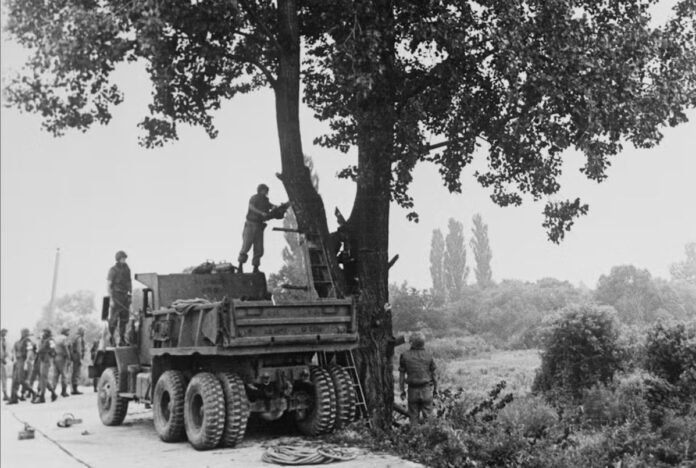
On August 18, 1976, an operation to trim a tree in the Joint Security Area ended with the murder of American officers Captain Arthur Bonifas and First Lieutenant Mark Barrett by North Korean soldiers. In response, three days later, in an operation fraught with the possibility of sparking hostilities, a joint American-South Korean task force cut down the tree as helicopters, fighters and bombers massed overhead.
The novel begins with a poetic meditation on the life of the tree whose “roots trespassed freely beneath a line men would kill to defend” before introducing readers to the geography and day-to-day atmosphere of the DMZ through the eyes of the newly arrived Davis.
Miller, a Korea Times columnist who has been writing for the paper since 1999, has published about 15 novels so far, many inspired by his decades of living in Korea. This latest work does an admirable job of immersing readers so deeply that they swelter in the summer heat, jostle about in the two-and-a-half ton trucks as they carry soldiers over bumpy roads to the Joint Security Area and feel the sunshine as it passes between overhead clouds and dapples the mountains visible through the summer haze.
As Davis gradually becomes accustomed to the routines of guard duty in the JSA, a growing undercurrent of tension ebbs and flows until it finally explodes in violence. From that point, more than halfway through the novel, the scenes shift away from Davis to follow the thread of decision-making from the highest offices to the farthest-flung of military bases as a response is formulated and carried out. In this way it shifts from an intimate portrait of one man’s service on the frontline to a larger Cold War geopolitical thriller before finally returning to Davis and revealing the lingering weight of these events upon him.
As Miller described it, he wanted the book to be “more than historical fiction” and to “feel authentic” in order to convey the “extraordinary burden carried by those who stood watch in one of the most dangerous places on Earth … knowing that a single misunderstanding could change history.”
The novel grew out of Miller’s experience covering the 25th anniversary of the incident for The Korea Times in 2001. At that time, Lieutenant Colonel William Miller (no relation), commander of the Joint Security Area, invited him to attend the commemoration and arranged several special tours of the JSA, which allowed him “to walk the ground where these events unfolded” and “provided an invaluable understanding of Panmunjeom and its history.”
To write the nearly 3,000-word article, he interviewed a number of soldiers who witnessed events that The Tree at Panmunjom describes. Among them were Capt. Bonifas’s driver and guard, Mark Luttrull, who “felt some degree of responsibility” for not being present when Bonifas was killed, and who “was probably the only person who volunteered” to be on the ground when the tree was finally cut down, an operation that carried such a potential for disaster that soldiers were ordered to prepare the nearby Camp Liberty Bell for destruction by rigging it with explosives so that it could be detonated if hostilities broke out.
One of the soldiers involved, Wayne Johnson, told the author that many in his unit thought “something might happen and there was about a 50-50 chance that we wouldn’t make it out.”
According to Miller, Wayne Kirkbride’s book DMZ: A Story of the Panmunjom Axe Murder was an important source of information, but “most of what I learned about the JSA was from Bill Ferguson,” a soldier who witnessed the Axe Murder Incident and gave him a firsthand account of life in the JSA. As Miller put it, “His recollections brought a human dimension to the history that no official report could ever capture.”
One cannot read Miller’s descriptions of F-4 fighter jets taking off, with “heat blasting outward in shimmering sheets,” the sound “rattling hangar doors, driving through the body” without suspecting that he brought his own service in the US Air Force to bear upon the novel — something Miller confirmed.
“In 1978, I was stationed at George Air Force Base in the Mojave Desert” working in Maintenance Control “and we had F-4s, F105s and F111s,” he said. “Every morning I’d watch one aircraft after another take off,” so the scenes involving them “were easy to write.”
Jeffrey Miller, right, about to take a ride in an F-16 fighter jet at Osan Air Base in 2002. Photo: Courtesy of Jeffrey Miller
Readers interested in Korean or military history, as well as anyone looking for a compelling historical page-turner, will find much to admire in The Tree at Panmunjom. It is at once an in-depth portrait of service on the DMZ, an examination of one young man’s growth and a Cold War geopolitical thriller.
At one point, Miller’s main character Davis asks whether anyone will even remember or care about what happened in August 1976. Miller answers that question by giving a vivid new account of those events and the people who lived through them.
Congress has a plan to stop Trump’s attack on offshore wind. It may not be enough.
The clean energy industry has learned the hard way that having the law on your side doesn’t always mean you win.
Since taking office for his second term, President Donald Trump has attempted to delayor canceldozens ofwind andsolar projects. These projects all underwent extensive reviews to secure federal approval, but the Department of the Interior and other agencies have frozen their permits for vague “national security” reasons, or with no explanation at all. These attacks have all but tanked the offshore wind industry and have led many developers to take payouts from the administration rather than fight for permits.
This attack is one big reason why solar and wind companies have been supportive of efforts in Congress to negotiate a bipartisan “permitting reform” bill. A group of senators reached a compromise earlier this month on a bill they call the Bipartisan American Affordability and Jobs Act. Lawmakers won’t vote on it until after the midterm elections, but the renewable energy sector has hailed it as a win. The bill would speed up environmental reviews for all kinds of energy projects, from transmission wires to oil pipelines, and it also contains a number of provisions that are designed to deter current and future presidents from blocking clean energy. Trump reportedly told aides just before the compromise became public that he would ease up on wind projects in order to reach a deal.
Cracks are already emerging in the deal. While the renewable energy industry has remained steadfast in its support of the bill, a number of experts and key climate advocates are arguing that the “project certainty” provisions would do little to prevent Trump or another president from blocking solar farms and offshore wind turbines. The Trump administration itself threatened the compromise bill this week when it announced that it would reviewthree permits for wind farms off the Atlantic Coast, including one that is already up and running.
“The administration’s action against [the wind projects] just further demonstrates the lengths they will go to to obstruct clean energy progress, especially offshore wind,” said Elizabeth Klein, who led the Bureau of Ocean Energy Management, which oversees offshore wind permits, under former president Joe Biden.
The project certainty portion of the Senate bill has two key parts. First, it declares that the federal government “shall not take any new action that would revoke, rescind, withdraw, terminate, suspend, amend, or alter” a project that has already received a permit. This is just a forceful restatement of the status quo, since permits that are issued aren’t supposed to be canceled for no reason. But the bill goes further by offering companies two main remedies if the government does take such prohibited actions.
One is the reinstatement of the permit — which is somewhat redundant. Judges have already shot down the Trump administration’s past attempts to stop wind projects, but the administration is still seeking to revoke those permits. If the bill passes, all the courts would be able to do is order it in stronger terms to restore them.
The other remedy is a cash payout. The courts would be able to order the government to refund a project developer between 25 and 50 percent of the costs of their project, which for a big offshore wind farm could reach well into the billions. The money would come from the Judgment Fund, a bank account the federal government uses to pay out legal settlements. This fund typically disburses around $2 billion in settlements per year, and successful claims under the permitting bill could lead to a big spike in payouts.
The other key part of project certainty in the bill is an anti-discrimination clause that would ban “disparate treatment” of any particular energy source, whether it’s solar panels or coal plants. If a wind developer found evidence that the government denied them permits as part of an anti-wind pattern, they could present that evidence to a judge. If persuaded, the judge would then order the government to restore the permit and pay the developer the entire construction cost of the wind farm — albeit only if the developer finished building it.
Supporters of the bill argue that the promise of financial relief would help lure investors back to the renewable energy industry, which has been in turmoil under Trump. This is most important for offshore wind. Big companies like Ørsted and Equinor spent billions of dollars to build wind farms in the Atlantic under the Biden administration, but their costs ballooned after the pandemic snarled their supply chains and Trump tried to destroy their existing projects. These companies now view the United States as uninvestable, but Northeastern states still need a lot more offshore wind in order to meet their climate goals.
The cash payout provision is supposed to help make the U.S. seem like a less risky place to invest. The American Clean Power Association, a trade group representing wind and solar developers, said in its analysis of the bill that “greater certainty lowers financing risk before construction and reduces the chance that years of development and investment will be stranded by a later policy reversal.”
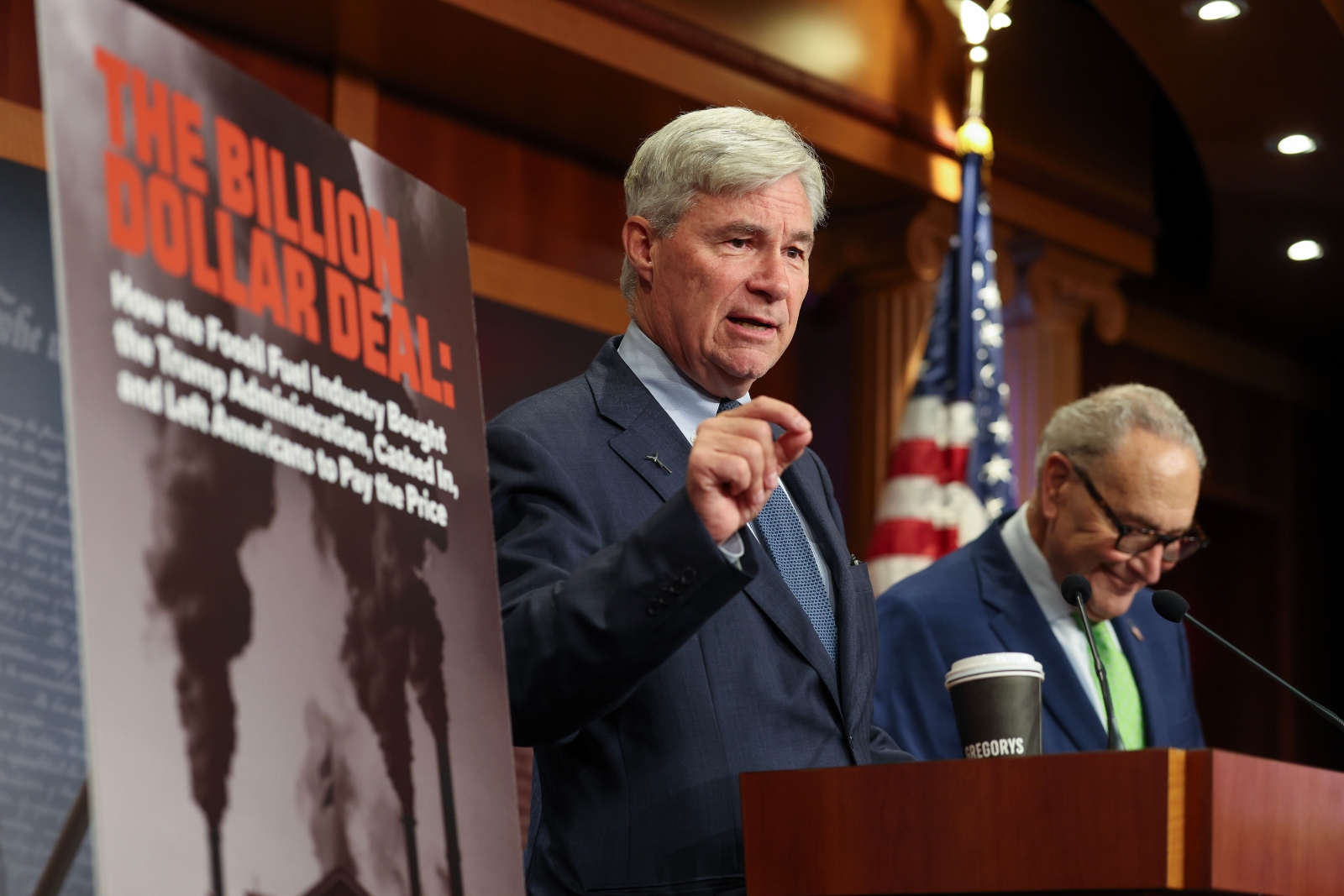
Senator Sheldon Whitehouse, Democrat of Rhode Island, gives a press conference about the Trump administration’s connection to fossil fuels. Whitehouse is one of the lead negotiators behind a bipartisan energy permitting bill. Photo by Tasos Katopodis / Getty Images
While the promise of reimbursement from the federal government would be good news for investors, it’s not clear that it would actually lead to more clean energy getting built. Opponents of the permitting reform bill point out that Trump has already been paying to stop renewable power plants from being built, albeit on a smaller scale. The president has worked out several deals to buy backoffshore wind leases from energy developers in exchange for those developers committing to build a fossil fuel project elsewhere. These arrangements are being challenged in court, but in the meantime they function as repayments for leases that Trump intended to block.
The project certainty “provisions are unlikely to deter the Trump Administration from continuing to mess with clean energy permits, since this administration has shown an eagerness to use the public’s money to advance its own policy goals,” said Matthew Littleton, a former attorney at the U.S. Department of Justice who worked on environmental law issues.
Littleton also points out that the anti-discrimination provision may not work as intended. The baseline for calculating “disparate treatment” is the average pace of project approvals over the most recent five years. By the time Trump leaves office, he will have spent four years permitting oil and gas projects while delaying almost all major solar and wind efforts. This baseline would prevent wind developers from making a discrimination claim — while also preventing a future president from walking back support for new oil and gas.
As if to highlight these risks, the White House has said in court filings over the past week that it is seeking to rescind permits for three offshore wind projects on the Atlantic Coast. One of these projects, the 700-megawatt Revolution Wind, is already complete and delivering power to Rhode Island, while the other two are still in the early stages. In each filing, the government has said only that it seeks to “reevaluate … compliance” with federal law.
Over the past year, Democratic negotiators in the Senate have said that this sort of behavior would jeopardize any bipartisan deal. Senator Sheldon Whitehouse of Rhode Island, one of the authors of the bill, said in the spring that he would not endorse a compromise bill unless the administration stopped blocking wind farms. This week he appeared to change tack, and described the move against Revolution Wind as another reason to pass the bill. “Frankly, we need to get permitting certainty in law, and this proves it,” he said in a statement.
The bill would in fact offer financial protection to a company like Ørsted, ensuring that a president could not wreck billions of dollars worth of investment with no justification at all. The question is whether it could end the government’s prejudicial assault against offshore wind. The answer could determine how millions of people in the Northeast keep their lights on and heat their homes, and right now, it’s up in the air.
US Rep proposes bill to give video game buyers “ownership,” not “a license”
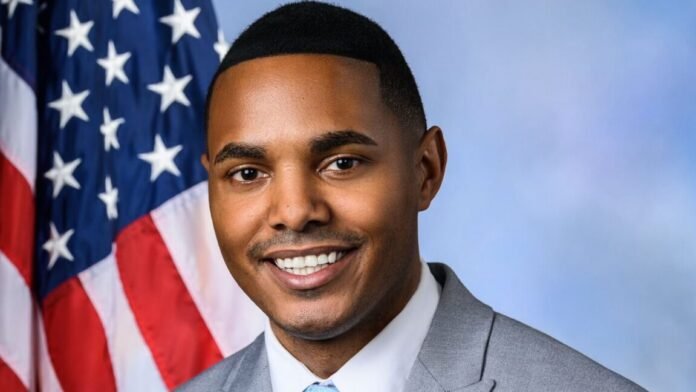
A new bill proposed by Rep. Ritchie Torres (D-NY) aims to establish new regulations that would ensure that “buying a video game would give the consumer ownership of the game rather than a license to play it,” including assurances that they can continue to access the games for years after they are released.
The announcement names NBA 2K25 as an example of the problem the bill aims to solve; that game launched on September 6, 2025, but is scheduled to become unplayable on December 31 due to server shutdowns. The bill, which is called the Power to Players Act, directs the FTC to take action to prevent outcomes like that in the future.
Torres published the following statement on the bill:
When you pay for a game, you should own it. Consumers must have the right to own, the right to play, and the right to transfer the games they buy. A game that can be taken away the moment a company pulls the plug is not a purchase. It is a rental disguised as a sale. Families in the Bronx and across the country save up to buy these games, and they deserve better than a license that can vanish at any time. The Power To The Players Act ensures consumers own what they buy and can keep playing long after a company moves on.
“I think there should be a simple rule: if you pay for it, you own it,” Torres told Kotaku. He called the new status quo the bill proposes a “restoration to the historical norm,” referencing how most games were experienced by players back in the ’90s.
A wider movement
The bill comes at a time when game ownership and preservation is a hot-button issue. Some consumers have been protesting Sony’s announcement that it plans to discontinue releases of PlayStation games on physical media.
In its most recent financial earnings report, Sony revealed that digital downloads account for 82 percent of full-game unit sales across PlayStation 4 and PlayStation 5 for the covered fiscal year, suggesting that less than 20 percent of games are still purchased in physical media form. But the argument is that continuing to offer physical discs is not just about satisfying a minority of players’ habits. Players hope it would aid with long-term preservation of games, which are sometimes delisted from digital marketplaces and then become inaccessible.
Physical discs don’t solve the problem on their own, though. Many games sold on discs still require online servers to function, and generally, the end-user license agreements make it clear that the user is purchasing a revocable license, not actual ownership of the media, even if the files are burned onto something physical.
There are also numerous examples of games where the version that shipped on the disc was meaningfully distinct from the version players ultimately know because of patches. So it makes sense that consumers and their representatives are turning to legislation like this to drive a change in industry practices.
There have been activist and lobbying movements, such as Stop Killing Games, that have been advocating for change on this front, but different proposed bills around the world have suggested different kinds of solutions.
Potential technical concerns ahead
Some prior proposed legislation on this issue has required developers to keep servers running indefinitely, leading to criticism that those bills’ authors don’t understand the cost. This bill appears to take those criticisms into account—but at least as worded in the press release on Ritchie Torres’ House of Representatives website, it could still face resistance.
While the announcement does not say the bill requires online servers to remain online, it requires normally online-only games to offer offline modes of play so players can keep playing long after servers might be shut down. The way some online games are engineered, that may not be feasible, so this could require developers to take very different approaches to some online games’ architecture.
This bill’s proposal does not guarantee it will become law; it still has a long path ahead, and most proposed legislation never even makes it to a vote. And since the full text of the bill is not yet publicly available, it’s not yet possible to assess its effectiveness or enforceability.
There is another elephant in the room: Large language models and specialized coding harnesses have recently enabled a wave of decompilations and reconfigurations of both classic and contemporary video games and software. These projects are almost certainly currently illegal, but the scale of the movement is such that enforcement may be difficult. It’s possible that these new tools will change the shape of the software preservation conversation in the coming months and years.
Is the US limiting Starlink in Ukraine? The consequences could be catastrophic
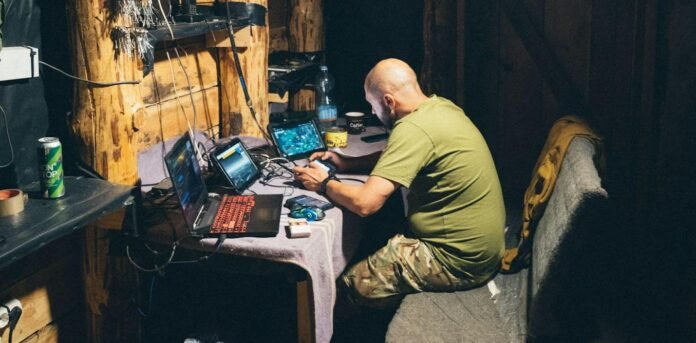
The drone has become the signature weapon of the Russo-Ukraine war. On any day in Ukraine, tens of thousands of drones are out hunting the battlefield for targets. These could be individual enemy soldiers or vehicles, or they could be larger targets such as depots, headquarters, bridges or power plants.
Yet, this drone war has been possible only because of a less obvious but equally vital technology. Elon Musk’s SpaceX Starlink system is a secure digital satellite communications network that Ukraine has become fully reliant on.
When Russia mounted its full-scale invasion of Ukraine in February 2022, Mykhailo Fedorov – then Ukraine’s vice prime minister and minister of digital transformation – urged Musk publicly to provide connectivity. Two days later, 500 Starlink terminals arrived in Ukraine. In February 2022, Musk granted the Ukrainian government and military the use of Starlink, initially for free. By July 2020, Starlink had provided 15,000 terminals.
The Ukrainians have fully admitted their dependence on Musk: “Without Starlink, we would have been losing the war already,” one platoon commander reportedly told the Wall Street Journal in 2022. Starlink allowed the government and the armed forces to communicate securely, at the heart of its vital system of C4ISR (the military term for command, control, communications, computers, intelligence, surveillance and reconnaissance).
Without Starlink, the defence of Ukraine would have been very difficult: perhaps impossible.
The cost to Starlink was considerable, though. Musk initally provided 2,000 terminals for free, 300 discounted and waived monthly services for about 5,500 more. Starlink’s total contribution to the Ukraine war effort in 2022 alone was US$80 million (£71 million). Musk provided a vital military capability gratis and eventually on a (discounted) contractual basis.
The strategic and commercial partnership between Starlink and Ukraine has been vital to the war effort for more than four years.
Crisis resolved
But Ukraine’s dependency on Starlink – or Starshield as the system’s military application is called – has not come without conditions. In September 2022, having repulsed the initial Russian attacks, the Ukrainian armed forces were planning their first assault on the port city of Sevastopol in Crimea, then the home of Russia’s Black Sea fleet. The plan was to sail remotely controlled boats, loaded with explosives to cripple the fleet.
It was a bold plan – the first attempt by the Ukrainian to attack territory which the Russians had held since 2014 and which they considered sovereign. And it was a controversial attack – the Russian ambassador to the US, Anatoly Antonov, had personally warned Musk that attacking Crimea would be a red line, which could lead to nuclear war.
Musk was concerned. He believed that this was potentially escalatory. He advised Fedorov: “Once Russia is fully mobilised, they will destroy all infrastructure throughout Ukraine.” He urged him to avoid a third world war: “Seek peace while you have the upper hand.”
Musk refused a Ukranian request to activate Starshield operations in the region, posting on X that: “If I had agreed to their request, then SpaceX would be explicitly complicit in a major act of war and conflict escalation.”
But following this crisis, relations between Musk and Ukraine’s leadership stabilised. Starshield has continued to play an indispensable role in Ukraine. It has been the digital communications spine of the Ukrainian armed forces and the enabler of all its operations in this war.
A slowdown of Starlink services means Ukraine is unable to defend itself against Russia’s jet-powered drones.EPA/Sergey Dolzhenko
Indeed, when the Ukrainians informed him that in 2026 the Russians had acquired some Starlink terminals on the black market and were accessing the system to help them prosecute the war inside Ukraine, he identified the serial numbers of those terminals and disabled them.
Speed limit
Unfortunately, in the past week, Ukrainian armed forces have once again been exposed to the jeopardy of their dependence on Starlink. On the night of October 13-14, without any warning, SpaceX imposed a speed limit of about 160kmph on some Starlink services, meaning this is the maximum speed Ukrainian drones and missiles can travel and remain connected. Starshield terminals mounted on drones have been particularly badly affected. Ukraine’s 7th Rapid Reaction Corps was forced to cancel several missions.
Given the importance of drones to the Ukrainian war effort, the Starlink constraint is very serious. The speed limit has compromised Ukrainian drone fleets operating above the kill zone. It has also undermined Ukrainian air defence against intensifying Russian drone attacks on cities and infrastructure, as 160kmph is too slow for intercepts.
Since strategic bombardments against Ukrainian energy infrastructure have become Russia’s principal means of prosecuting this war and will only intensify into the winter, the Starlink embargo is deeply concerning. It may become critical if it continues.
Unlike September 2022, it appears that this is not a random individual decision by the Starlink boss. It seems to reflect troubling shifts in US policy on Ukraine.
On October 9, the US president, Donald Trump announced a deal with his Russian counterpart, Vladimir Putin, to lift sanctions on Russian diesel and allow it access to global markets. The plan was, he said, to reduce the price of fuel – although how effectively the relatively small amount of Russian diesel will do that is unclear. The high price of diesel is much more to do with the intractable war in Iran.
The following day, Trump called for the removal of Ukrainian president, Volodymyr Zelensky: “Time for Ukraine to get a new president”, he told reporters. The day after that, the US president announced that an energy ceasefire was in immediate effect and that Russia and Ukraine would stop targeting each other’s energy infrastructure.
Ukraine has not used Starlink to hit Russia’s oil refineries. Starlink does not work in Russia and the Ukraine deep strikes rely on other communications systems. So Ukraine’s strategic bombardments remain technically unaffected by the Starlink embargo.
Musk has put the responsibility for the slowdown in Starshield squarely on the US government, posting on his X social media platform: “Starshield systems are owned and controlled by the US government. Any limits on speed or usage are decided by the US military and ultimately POTUS.”
In September 2022, Musk instituted a policy which contradicted US policy on Ukraine – he turned off Starlink against the wishes of the Biden administration. Now, so Musk says, in October 2026, it’s US government which is restricting Starlink. But the result is effectively the same: Ukraine is the victim.
This winter always looked as if it will be hard for Ukraine. It just got harder.
Michael Douglas Reveals Shocking Danny DeVito Story
Michael Douglas has revealed a hilarious and unexpected story about longtime friend Danny DeVito, claiming the actor once swallowed their entire stash of marijuana joints when they were pulled over by police.
The 82-year-old Hollywood legend shared the bizarre memory during a recent appearance on The Joe Rogan Experience, offering fans a glimpse into the wild adventures the two enjoyed long before becoming household names.
According to Douglas, the incident happened when the young actors were on their way to a Frank Zappa concert.
Douglas was behind the wheel, with DeVito riding in the back seat, when an illegal left turn suddenly attracted the attention of a police officer.
Flashing lights appeared behind them, and Douglas realized he was being pulled over.
He got out of the car to speak with the officer, who questioned him about the traffic violation.
But while Douglas was dealing with the police, DeVito apparently had a more urgent concern.
The two had several marijuana joints inside the vehicle.
And DeVito wasn’t about to let the police find them.
When Douglas returned to the car, he immediately noticed something was missing.
“Where’s the grass?” he remembered asking his friend.
That’s when DeVito flashed a smile that gave everything away.
According to Douglas, his friend’s mouth was completely green because he had swallowed the marijuana joints.
Rather than risk having the drugs discovered, DeVito had apparently decided to dispose of the evidence himself.
Douglas burst into laughter while recalling the ridiculous scene.
He said the encounter was just one of countless unforgettable adventures the pair shared during their early years.
The story offers another glimpse into a friendship that has lasted nearly six decades.
Long before either actor became a Hollywood superstar, Douglas and DeVito were struggling performers trying to establish themselves in New York City.
The two first met in 1967 while attending the American Academy of Dramatic Arts, where they quickly bonded over their similar personalities and shared sense of humor.
They eventually became roommates, sharing an apartment on Manhattan’s Upper West Side during a time when neither had much money or job security.
Their friendship survived the challenges of building careers in the entertainment industry and eventually turned into one of Hollywood’s most enduring partnerships.
DeVito found early success playing Louie De Palma on the television sitcom Taxi, a role that earned him both an Emmy and a Golden Globe.
Douglas, the son of legendary actor Kirk Douglas, established his own reputation through The Streets of San Francisco before becoming a major movie star and producer.
Their paths crossed professionally in the 1984 adventure comedy Romancing the Stone, in which Douglas starred alongside Kathleen Turner and DeVito.
The movie became a major box-office success and led to the 1985 sequel The Jewel of the Nile.
They reunited again for the dark comedy The War of the Roses in 1989, which DeVito directed.
Decades later, the longtime friends appeared together in the 2009 drama Solitary Man.
But their off-screen adventures have often been just as entertaining as their movies.
During a 2018 appearance on The Talk, DeVito recalled another outrageous incident involving Douglas, this time while filming Romancing the Stone in Mexico.
According to DeVito, the cast was working in a remote location when they encountered a man carrying several snakes in the back of a truck.
DeVito, who admitted he was terrified of snakes, wanted nothing to do with the animals.
Douglas, however, was far more adventurous.
Despite DeVito’s warnings, Douglas reportedly picked up one of the snakes.
Moments later, the animal bit him on the hand.
Believing his friend might be in danger, DeVito sprang into action.
He recalled grabbing Douglas’ hand and attempting to suck out the venom, a response he believed at the time could save his friend’s life.
Medical experts now advise against attempting to suck venom from a snakebite wound because the practice is ineffective and can cause additional harm.
Fortunately, Douglas survived the encounter.
DeVito later turned the frightening moment into a joke, teasing his friend about how much worse the situation could have been if the snake had bitten him somewhere more sensitive.
The two actors have continued sharing stories about their decades together, and their friendship remains strong.
Douglas recently revealed that DeVito was among the first people to read his new memoir, One Helluva Ride, released October 6.
The book chronicles Douglas’ extraordinary career, his complicated relationship with his famous father, his personal struggles and his experiences with some of Hollywood’s biggest stars.
According to Douglas, DeVito read the memoir in a single night and became emotional while reflecting on their long history together.
The reaction meant a great deal to Douglas, who said he and DeVito remain close despite the passage of time.
Now in their 80s, the actors have accumulated decades of memories, from their humble beginnings as roommates to their years as internationally recognized movie stars.
And while both have received countless awards and accolades, their friendship has always extended far beyond their professional achievements.
For Douglas, the recent podcast appearance was another opportunity to look back at the unpredictable adventures of his younger years.
From a police stop that ended with DeVito swallowing marijuana joints to a snakebite scare on a movie set, their friendship has certainly produced its share of outrageous stories.
And nearly 60 years after they first met, the two Hollywood legends are still finding reasons to
“thegentlemanpervert” producing AI CSAM is a NJ prosecutor, say cops
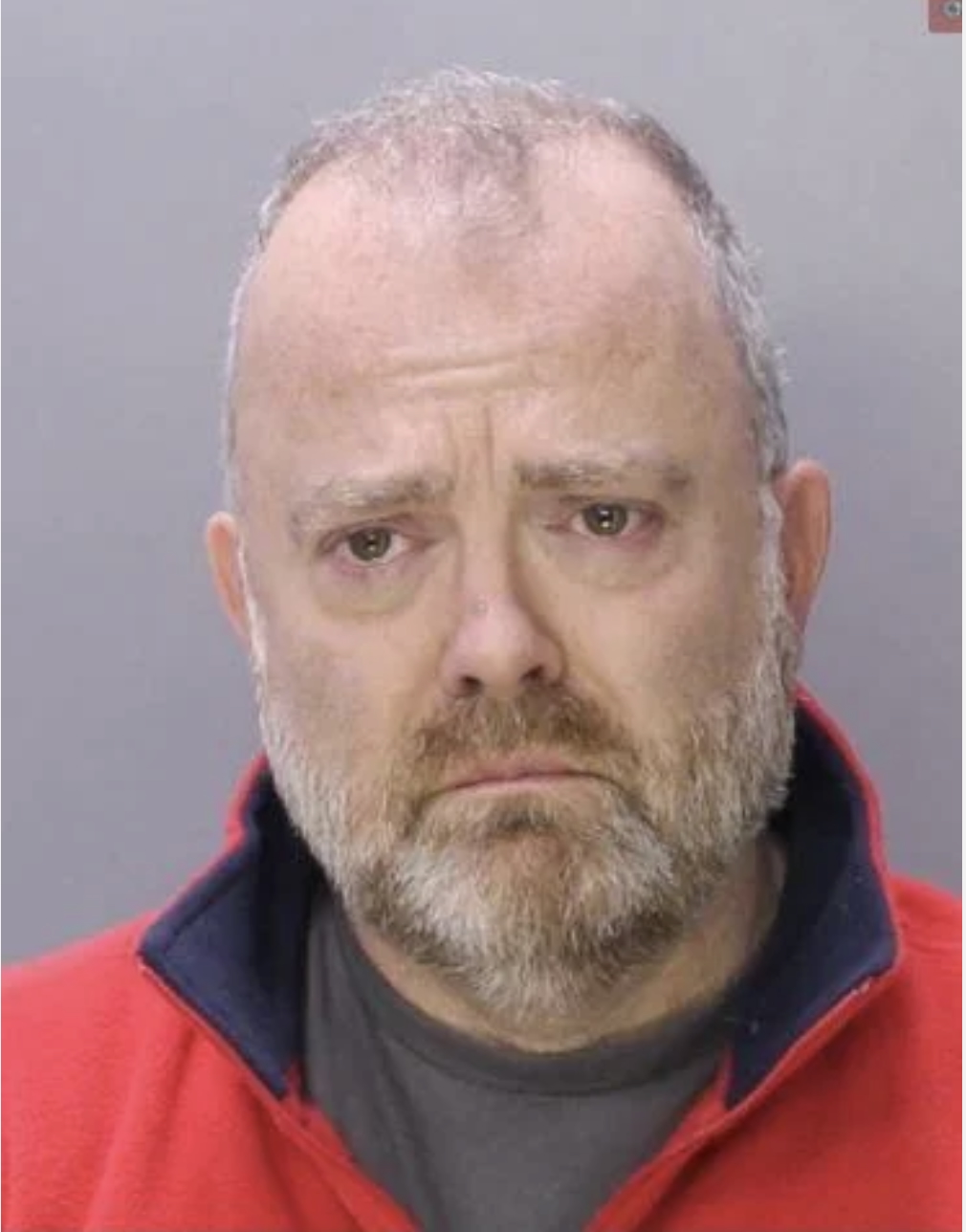
New Jersey’s deputy attorney general, Brian Richard Fitzgerald, was arrested on “felony charges related to AI-generated child sexual abuse material (CSAM),” Bucks County Detectives said in a press release Thursday.
In the US, cops have vowed to crack down on AI CSAM since at least 2024, when the Department of Justice made one of the earliest arrests. After charging a Wisconsin man with spreading “thousands of realistic images of prepubescent minors” across Telegram and Instagram, the DOJ clarified to law enforcement that “CSAM generated by AI is still CSAM.”
New Jersey’s deputy attorney general, Brian Richard Fitzgerald, was arrested at his home Thursday.
New Jersey’s deputy attorney general, Brian Richard Fitzgerald, was arrested at his home Thursday. Credit: via Bucks County Detectives
On Thursday, New Jersey officials accused 51-year-old Fitzgerald of using AI to make photos from social media of real minors into sexualized images that he then distributed on social media.
Fitzgerald was charged after the National Center for Missing and Exploited Children received a tip that a Discord user shared an illicit image in July. Cops then used “digital forensics and subscriber records” linked to the Discord account and “associated Internet protocol addresses” to track the user to Fitzgerald’s home address.
After a search Thursday, cops “recovered prompts and scripts used to create artificially generated child sexual abuse material using an AI program,” the press release said. They also found Discord chat logs where Fitzgerald, under the Discord username “thegentlemanpervert_2160_07833,” allegedly “admitted to making multiple illicit images using artificial intelligence and sharing them with other users.”
Fitzgerald’s is a rare case where an official employed by the state’s top law enforcement and legal office has been accused of making and distributing AI CSAM, although some cops have been arrested for the crime. Earlier this year, a Pennsylvania cop was arrested for making AI porn from photos on driver’s licenses, and more recently in Korea, a police officer was arrested for making AI porn, including CSAM, The Korea Times reported.
In New Jersey, the deputy attorney general has been charged with possession of CSAM, dissemination of photos or film of CSAM, and “criminal use of a communication facility,” detectives said.
According to his LinkedIn, Fitzgerald had served as deputy attorney general since 2016, preparing insurance fraud and insurance licensee cases for trial as a state prosecutor. New Jersey’s district attorney, Joe Khan, said in a statement that New Jersey is aligned with the DOJ in viewing AI CSAM as being as harmful as CSAM.
“No one is above the law, least of all someone entrusted with upholding it,” Khan said. “Our office will pursue these cases aggressively and hold offenders fully accountable, regardless of their profession or title.”
TEL AVIV — There is one country on earth where Donald Trump could plausibly win a national election, and he knows it.
“I could run for Prime Minister,” he joked in May, claiming 99% approval here. No poll has ever shown that. But the joke landed because it is only half a joke.
Thirteen days before Israelis vote on October 27, Trump is the most popular politician in this campaign. He is also the only one not on the ballot.
And the man who has spent a decade wrapping himself in Trump’s embrace, Benjamin Netanyahu, is discovering that the embrace has gone noticeably loose.
A year of hero worship
The romance peaked a year ago this week. On October 13, 2025, the last 20 living hostages came home under a Gaza deal Trump’s team brokered, and Trump addressed the Knesset the same day. Israeli TV ran his speech side by side with the reunions. For many viewers here, the two images fused.
The honors followed. Netanyahu called him Israel’s “greatest friend ever” and broke with tradition to announce the Israel Prize, normally reserved for citizens, for a foreign head of state. Then came 2026: a joint war on Iran launched in February, a ceasefire in April, and a Hamas disarmament agreement Trump announced in July.
The numbers are real, if not 99%. In mid-2025 Pew found 69% of Israelis had confidence in him. In February 2026, the Jewish People Policy Institute found 73% rated him better than an average US president. Researchers at Tel Aviv University describe a “Trump effect”: Jewish Israelis, especially on the right, become more open to talks with Palestinians when told Trump is behind them. No Israeli politician can do that. Trump can.
The endorsement that isn’t coming
In 2019, Likud hung giant billboards over the Ayalon highway: Netanyahu and Trump shaking hands, under the slogan “In another league.” Trump reposted it. That was the deal: Bibi borrowed Trump’s glow, and Trump enjoyed the tribute.
This time the president is keeping his hands in his pockets. In June he said he would “most likely” back Netanyahu, depending on the opponent. Then Gadi Eisenkot entered the race, and Trump said he didn’t hear bad things about him. In a TIME interview he dodged the question three times. On Tuesday, boarding Marine One, he offered only: “We may endorse somebody.” No name.
The closest he has come is a Truth Social link, in September, to a Newsmax story about one poll showing Netanyahu’s bloc ahead. It is not even clear Trump posted it himself. Meanwhile Israeli media report that Eisenkot’s and Naftali Bennett’s camps have quietly asked Trump’s circle to stay neutral. So far, they are getting their wish.
The race is tight enough for that silence to matter. Across five polls last month, Eisenkot’s Yashar averaged 22.2 seats to Likud’s 21.2. Netanyahu’s bloc averaged 54.4, the Zionist opposition 51. Neither reaches 61.
Cracks in the shrine
The distance runs both ways. Over the summer, Trump pressed Israel to curb its operations in Lebanon and pull back from parts of Syria while Washington negotiated with Tehran. He admitted calling Netanyahu “crazy,” with an expletive, in a heated phone call. Axios reported he has told people that “Bibi is his own worst enemy.”
Israelis noticed. An Israel Democracy Institute poll this summer found the share who believe Trump prioritizes Israel’s security fell from 44% in May to 28% in June. Among Jewish respondents, belief that Israel can fully rely on him dropped 38 points between March and June. Only about a third felt Israel’s strategic position was better than before the Iran war.
Yet Trump’s personal popularity has proven sticky, which is the strange part. Israelis can doubt his policy and still love the man. Netanyahu’s own campaign shows the reflex: When a businessman he placed on Likud’s list turned out to have called Trump “morally corrupt,” the candidate apologized within hours, calling Trump Israel’s greatest friend in the White House. In Israel, insulting Trump is still a campaign hazard.
Whose country, then?
“Trump’s country” doesn’t mean Israel belongs to Trump. It means Trump has become a reference point every Israeli politician must orbit. Netanyahu runs on being his friend. Eisenkot runs on not being his enemy. The whole field argues over who can manage him best.
That is a remarkable dependency for a proud, fractious democracy, and it cuts in odd directions. Trump got Netanyahu to accept a 20-point Gaza plan no Israeli coalition would have drafted. He also wrote to President Herzog demanding a pardon in Netanyahu’s criminal trial, an intervention that would cause uproar if it came from any other foreign leader.
On October 27, Israelis will choose their own prime minister. But many will be asking themselves the same quiet question: Whom will Washington call first? Welcome to Israel, where the most influential voice in the election cannot vote — and, for now, isn’t saying a word.
Leon Hadar is a journalist, blogger, analyst, author and consultant. Read his Global Zeitgeist Substack here and become a subscriber here.
Foreign Ministers from 18 Muslim Countries Condemn Opening of Colombian Embassy in Jerusalem
Colombia should reverse its decision to open an embassy in Jerusalem, foreign ministers from 18 Muslim countries, including Saudi Arabia, said in a joint condemnation of the move.
In a joint statement carried by the Saudi Press Agency on Friday, the ministers expressed their “categorical rejection” of Colombia’s decision and said any attempt to change the legal or historical status of “occupied” Jerusalem was invalid under international law.
The statement was issued by the foreign ministers of Saudi Arabia, Palestine, Jordan, Indonesia, Pakistan, Turkey, Algeria, Djibouti, Sudan, Syria, Somalia, Oman, Qatar, Kuwait, Lebanon, Libya, Malaysia, Egypt and Yemen.
According to the ministers, any action or decision recognizing Jerusalem as Israel’s capital was “null and void” and carried no legal effect. They said that position was consistent with relevant UN Security Council and General Assembly resolutions.
Colombia opened its embassy in Jerusalem on Wednesday, becoming the 10th country with an embassy in the Israeli capital as the two countries restore diplomatic relations following the election of President Abelardo de la Espriella.
Israeli Foreign Minister Gideon Sa’ar and visiting Colombian Foreign Minister Omar Bula Escobar attended the inauguration on October 14, 2026.
The foreign ministers urged the Colombian government to reconsider the embassy opening and reverse its decision. They also called on Bogotá to uphold its obligations under international law and avoid measures they said could undermine the legitimate rights of the Palestinian people.
Their statement reiterated support for the establishment of an independent and sovereign Palestinian state with East Jerusalem as its capital.
The joint declaration represents a coordinated response by the participating governments to Colombia’s decision to establish its diplomatic mission in Jerusalem, with the ministers focusing their objections on the city’s legal and historical status and their position on Palestinian statehood.