Earlier this year, we heard that reporter Jake Pearson planned to ask our editors at ProPublica for more than $20,000 so he could spend the NBA playoffs betting like a problem gambler.
We told him we wanted in on the action.
For 10 weeks, our documentary team at ProPublica filmed Jake as he dove ball-cap-first into DraftKings and FanDuel, the country’s largest online sportsbooks. Jake bet early, late and often, ramping up the amounts and frequency of his wagers, chasing his losses with even bigger bets. He wanted to flagrantly wave the red flags of a gambler descending into addiction. Would the apps serve up speed bumps as he careened into the red, or would they push him to keep betting?
Since 2018, the year the Supreme Court opened the door for states to legalize sports betting, the number of people staking money on games has exploded. It’s now legal in 39 states and Washington, D.C. The apps don’t just offer straight action on the outcome of a “Sunday Night Football” game — you can put money on myriad sports events and outcomes, including who will score the next point in a tense contest of Czech table tennis. Every month, millions do.
More than $600 billion has sloshed through the legal sportsbooks in wagers — and brought billions in state tax revenue — in the last eight years. But between the ever-present ads featuring celebrities from LeBron James and Charles Barkley to Kevin Hart and Kendall Jenner, cracks in the system have started to show.
About a quarter of active sportsbook account holders surveyed by the Siena Research Institute this year said that they’d lost enough on a bet that they’d have trouble meeting their financial obligations. Other studies and public health experts warn of rising cases of bankruptcy, addiction and self-harm.
ProPublica reporter Jake Pearson at a Manhattan bar this spring, testing DraftKings’ and FanDuel’s guardrails. More than a quarter of people in the U.S. say they have an active account with an online sportsbook, according to a poll by the Siena Research Institute.Gerardo del Valle/ProPublica
DraftKings and FanDuel say that they don’t want to profit off bettors who can’t control themselves, and they provide a range of what the industry calls “responsible gaming” tools to help users stay in check.
Jake received pop-up notices, reminders and emails noting his time on the app and nudging him to “take a beat” after a loss. He opted into some of the tools DraftKings makes available. But he was struck by user design choices and promotions that encouraged him to keep betting, some of which he was served right after setting limits on his play.
In a statement, DraftKings told ProPublica that it trains its more than 5,000 employees on responsible gaming and has more than 50 full-time staff dedicated to its “responsible engagement” program. A FanDuel spokesperson wrote that the company’s program is “designed to identify potential risk early and empower customers with real-time information about their play.”
Even so, regulators and lawmakers from Colorado to Massachusetts have begun to question whether sportsbooks have sufficient protections in place. Those concerns have risen with the popularization of prediction markets, which are even less regulated than sports betting apps like DraftKings.
We were behind the camera back in April when Jake opened his DraftKings account to place his first bet, a $100 Hail Mary wager for the New York Knicks to win the chip. We had no idea what a ride it would be.
Watch our new documentary that follows Jake as he intentionally descends into problem gambling — and see how the apps react.
Have you used apps like DraftKings or FanDuel to place sports bets? ProPublica is looking for at least 250 people who use these apps to share their data with us. Your transaction history will help us better understand how the apps respond to user behavior. You can also reach Jake Pearson and the reporting team at 917-512-0276 or [email protected].
Support Independent Journalism:
As a nonprofit newsroom, we rely on donations from individuals like you to fuel our work. Your support today will directly fund investigations that shine a light on urgent issues: corporations prioritizing profits over public safety, health insurers denying coverage to patients, unintended consequences of new laws and more.
Rights group files ICC complaint against Israeli medical officials over torture of Palestinian detainees
The Hind Rajab Foundation filed a complaint with the International Criminal Court (ICC) against Israeli medical officials over torture and mistreatment of Palestinian detainees, Israeli media reported Saturday, Anadolu reports.
The complaint targets the Israeli Medical Association, Health Ministry officials and medical personnel over abuses at the Sde Teiman military detention facility in southern Israel.
According to the Israeli newspaper Yedioth Ahronoth, the Brussels-based rights group submitted the complaint to the ICC prosecutor under Article 15 of the Rome Statute.
The foundation said that Israeli medical personnel and officials were involved in practices amounting to war crimes and crimes against humanity.
– Allegations of systematic mistreatment
Since October 2023, the Sde Teiman military base in Israel’s southern Negev desert has been used to hold thousands of Palestinians from the Gaza Strip, most of them civilians, including men, women, children, older people, journalists and health and humanitarian workers.
The foundation said that detainees were classified as “unlawful combatants,” a designation it described as a means of denying them basic legal protections and holding them without charge or trial.
The complaint said Israel’s Health Ministry established a medical facility at Sde Teiman shortly after Oct. 7, 2023.
According to the foundation, medical personnel were required to sign documents placing them under military police authority rather than the army’s Medical Corps.
The complaint seeks investigations into officials from Israel’s health and defense ministries, medical personnel, hospital administrators and the Israeli Medical Association.
Those named include former health ministers Moshe Arbel and Uriel Buso, association chairman Zion Hagay, director general Leah Wapner and ethics board chairman Yosef Walfisch.
– Detainees restrained during medical treatment
The foundation said a Health Ministry directive issued on Dec. 19, 2023, required medical personnel to treat detainees while they were handcuffed and blindfolded.
According to the complaint, the directive also permitted forced medical treatment without adequate safeguards.
Medical staff were allegedly instructed not to disclose their names and to sign medical records using only their professional titles.
The foundation argued that these practices obscured individual responsibility and hindered documentation of injuries.
– Amputations, surgeries without adequate pain relief
The foundation cited accounts from Israeli medical workers and former Palestinian detainees describing abuses at Sde Teiman.
According to the complaint, a doctor wrote to Israeli authorities in April 2024 that two detainees had undergone leg amputations within one week because of injuries caused by shackling.
The doctor reportedly described shackling as routine at the facility.
The foundation also cited medical workers who told the Associated Press they had witnessed surgeries performed without adequate pain relief.
One account described an elderly detainee screaming and shaking during leg surgery.
Other workers reported detainees being blindfolded, forced to wear diapers and restrained by all four limbs to hospital beds.
The foundation said at least 29 detainees had died at Sde Teiman by November 2025 because of physical violence, medical neglect or both.
– Medical association accused of complicity
The complaint accused the Israeli Medical Association of helping legitimize torture and mistreatment at the facility.
The foundation said the association responded to allegations of medical complicity with general reminders about professional ethics rather than sufficient investigative action.
It also said findings from an internal Health Ministry ethical assessment following a visit to Sde Teiman were not publicly released.
“Instead of investigating the allegations, leaders of the association publicly defended the medical care provided at Sde Teiman,” the foundation said.
Established in February 2024 and based in Brussels, the Hind Rajab Foundation has pursued legal cases in several countries against Israeli officials and military personnel over alleged violations in Gaza.
Since October 2023, Israel’s war in Gaza has killed more than 74,000 Palestinians and injured over 175,000 others, according to Palestinian figures.
AI disqualification yields new Nikon Small World in Motion winner
Credit: Nguyen Nam Nhat.
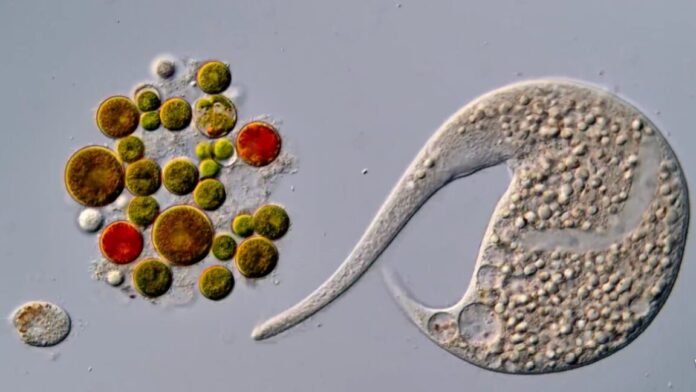
Last month we covered the winner of Nikon’s Small World in Motion video: Ning Xu of Tsinghua University in China, whose video captured tiny cilia beating in the airways of a child with a rare respiratory disorder. But allegations surfaced about Xu’s use of AI while making the video. Nikon launched an investigation and concluded that Xu’s entry did not comply with competition rules. The new winner is Nguyen Nam Nhat of Vietnam with a video of a tiny roundworm and a single-celled organism (above).
According to a BBC report, some researchers expressed concern that Xu’s video had structural abnormalities and that cell features appeared and disappeared in a way one would not see in actual cellular biology. Others spotted what looked like AI watermarks embedded within the source files. Xu said he used AI “to distinguish and visualize features in the reconstructed grayscale images”; however, he denied that AI was used “to generate the experimental movie, the cilia, or their motion.”
Founded in 2011, the Nikon Small World in Motion competition is a spinoff of the company’s Small World Photomicrography Competition, which has been around since 1974. Both are meant “to showcase the beauty and complexity of things seen through the light microscope”—one through still photographs, the other through photovideography, taking advantage of all the technological advances that now allow users to make movies or time-lapse images through the microscope.
The other winners also moved up a notch with Xu’s disqualification. Benedikt Pleyer of Bavaria, Germany, placed second with a video of jellyfish larvae suspended in water droplets; Andrew Moore of Howard Hughes Medical Institute in the US placed third with a video of synchronized cell division in neighboring cells; Patrick Hickey of Hypha Research Ltd. in Edinburgh, Scotland, placed fourth with a video of the dynamics of mitochondria and chloroplasts in Turtle Vine leaf cells; and Igor Adameyko placed fifth with a video of a tiny, colorful sea slug (Cyerce kikutarobabai) on the move.
Here is Nikon’s full statement:
After thoroughly re-evaluating the video and supporting materials and consulting with members of our judging panel, Nikon has determined that the winning video did not comply with the competition rules regarding generative AI. Nikon has adjusted the competition rankings on our website to reflect this decision.
This decision is based solely on the submitted video’s eligibility under the rules outlined for this competition. It should not be interpreted as a judgment of the entrant’s professional reputation, scientific contributions, or intent.
Advances in imaging and artificial intelligence continue to evolve rapidly, creating new challenges for organizations across many fields. This event has shown the need for Nikon Small World and Nikon Small World in Motion to revisit rules and evaluation procedures for future competition entries.
The Nikon Small World and Nikon Small World in Motion competitions celebrate excellence in imaging, both scientific and artistic in nature. We value the integrity of each image and video selected to appear in our winning galleries, and remain committed to upholding the standards of excellence that have defined this competition.
65% of Publicly Listed Company Directors Now Regard AI as a Key Issue Facing Their Boards
Artificial intelligence is rapidly moving up the boardroom agenda, raising an important question for non-executive directors: are boards equipped to oversee the transformation AI is bringing to businesses?
This and other issues will be explored at Zampa Partners’ forthcoming NED Forum, a half-day event taking place on 15 October at the Verdala Wellness Hotel in Rabat.
The forum will bring together non-executive directors, board and committee members, chairs and company secretaries for a practical programme focused on some of the key challenges facing today’s boardrooms.
AI is just one of the issues placing new demands on directors.
A survey published last April by the National Association of Corporate Directors found that 65% of directors at publicly listed companies now regard AI as one of the key issues facing their boards, up sharply from 27% just over a year earlier. Cybersecurity threats have also climbed the agenda, cited by 43% of directors.
At the same time, corporate governance expectations around AI are still developing. More than six in 10 large-cap European companies had no formal AI policy disclosed in 2025, according to Glass Lewis, a leading provider of global governance and proxy advisory services to institutional investors.
Against this backdrop, the NED Forum will examine a range of issues increasingly central to effective corporate governance. These will include directors’ responsibilities in listed companies, oversight of tax returns, the use of artificial intelligence in the boardroom, regulatory investigations, anti-money laundering obligations, cyberattacks, and the role of non-executive directors in mergers and acquisitions.
The programme will combine panel discussions with focused keynote presentations from professionals across the legal, financial, regulatory and business sectors.
“The role of the non-executive director continues to evolve, and with it comes a broader range of responsibilities and challenges,” explains Michael Agius Vadala, Partner at Zampa Partners, who will also address how directors can ensure their companies are prepared to reduce the risk of a cyberattack.
“From cyber risk and AI to regulatory scrutiny and transactions, directors are increasingly expected to understand issues that extend well beyond traditional governance. We chose these themes for our forthcoming NED Forum because they reflect the realities boards are dealing with today, and we wanted to create a practical forum where directors can exchange perspectives and gain insights that are directly relevant to their role.”
The programme reflects the changing role of the non-executive director. As boards face increasingly complex regulatory and technological risks, directors are expected not only to provide effective oversight, but also to contribute meaningfully to strategic decision-making.
IDF Officer Killed, 3 Soldiers Wounded in Humvee Rollover in Southern Lebanon
Capt. Eliav Haim Tzaflamos, 21, from Haifa, was killed Thursday when a Humvee overturned during an Israel Defense Forces (IDF) operation in the Litani River area of southern Lebanon, while three other soldiers were lightly wounded in the accident.
Tzaflamos served as a combat officer in the 603rd Battalion of the 7th Brigade. The three soldiers injured in the rollover were taken to a hospital for treatment, and their families were notified.
Two other IDF soldiers were lightly wounded in a separate operational accident in southern Lebanon earlier Thursday. A preliminary investigation indicated that improper handling of ammunition caused their injuries. Both soldiers were evacuated to a hospital, and their families were informed.
Thursday’s accidents came after several fatal operational incidents involving IDF troops in recent months.
Last month, Master Sgt. (res.) Nadav Kali, 24, from Har Halutz, and Master Sgt. (res.) Ofek Moalem, 23, from Jerusalem, were killed when an IDF drone exploded in the northern Gaza Strip. Both served in Battalion 7007 of the 16th Brigade.
An initial investigation into that incident determined that an operational malfunction involving the drone resulted in the deaths of Kali and Moalem.
Israeli Prime Minister Benjamin Netanyahu posted on X: “We are all mourning the fall of Captain Eliav Chaim Tzfalmus and praying for the recovery of three additional soldiers who were wounded in the severe accident in southern Lebanon.”
PC shipments fall 20.1 percent in “sharpest decline” since Q1 2023
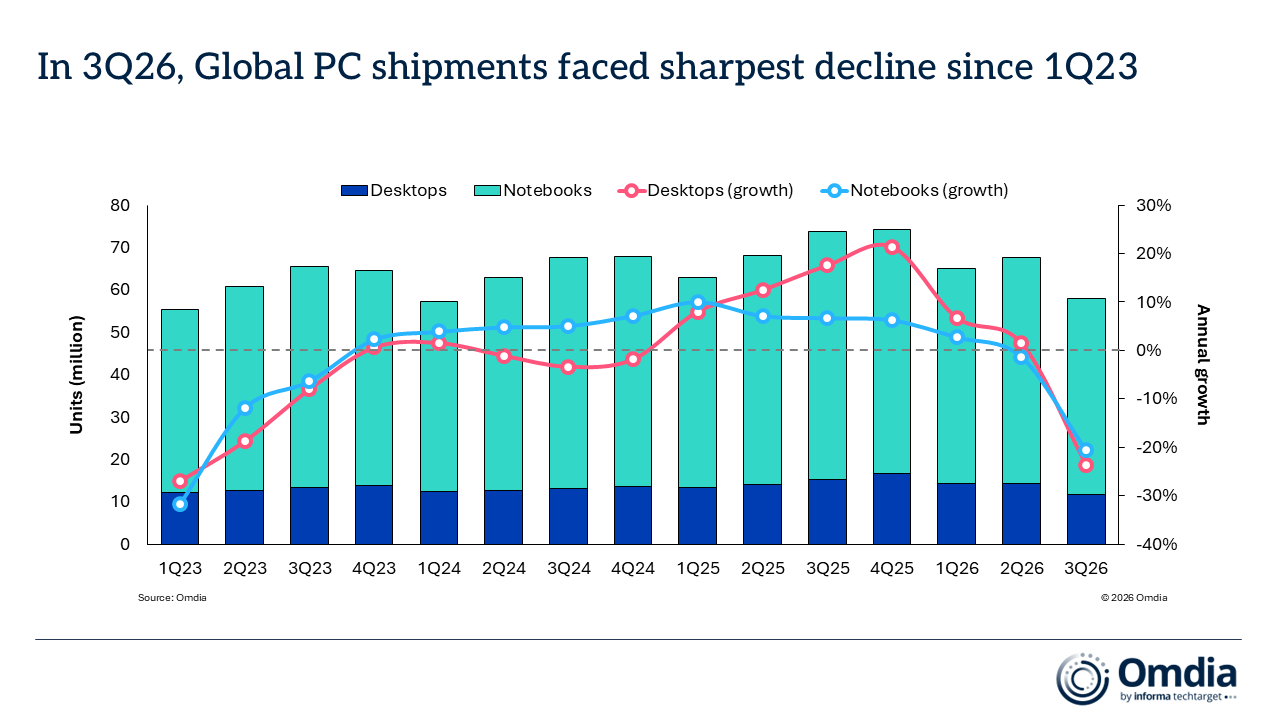
PC shipments saw a steep drop of about 20 percent in Q3 2026, analysts reported this week.
The industry saw its “sharpest decline since “Q1 2023,” Omdia said in an announcement toady. Global shipments of laptops, desktops, and workstations fell 21.2 percent year over year (YoY) to 58.1 million devices, the analyst said.
Desktop PC shipments (including desktop workstations) decreased 23.5 percent to 11.7 million units, and laptop shipments (including laptop workstations) declined 20.6 percent to 46.4 million, per Omdia.
Credit: Omdia
Credit: Omdia
IDC shared similar findings. The analyst said this week that PC shipments fell 20.1 percent YoY to 62.7 million units, compared to 78.5 million in Q3 2025.
The industry also shipped 9.1 percent fewer PCs in Q3 2026 than it did in Q2 2026, when 68.2 million units shipped, per IDC.
The 20.1 percent YoY decline is the biggest drop that the IDC has ever recorded during a year’s third quarter, the IDC said, per PCMag.
The drop in shipments is also notable considering that Q3 PC shipments usually surpass Q2’s numbers.
“If looking at all quarters, then we have seen other quarters in recent years with larger declines, such as 2022 Q4, which was -28.2 percent, and 2023 Q1, which was -28.7 percent. Both were coming off pandemic highs,” Jitesh Ubrani, research director for consumer devices at IDC, told PCMag.
In its announcement this week, IDC said that many PC vendors and sales channels stocked up on PC shipments earlier in the year in anticipation of memory price hikes. That meant minimal demand remained during Q3.
“[Sales] channels are now worried about carrying too much inventory into a market where high prices are suppressing demand,” Ubrani said in a statement.
“That could translate into promotions and some short-term relief for consumers, but we don’t expect pricing anywhere near what it was a year ago. Prices will remain elevated. With macro conditions worsening, the risk is that the outlook for the next few quarters gets worse before it gets better.”
Credit: IDC
Credit: IDC
IDC said that it expects PC prices to decrease “only modestly and briefly.”
Omdia research director Ishan Dutt said the Q3 drop “comes as no surprise.”
“The impact of upstream component cost increases has now fully worked its way through to end-market pricing, with consumers and IT decision-makers responding accordingly. On the supply side, vendors and their ODM partners began scaling back production in [Q3], while channel partners continued working through elevated inventory levels,” he said in a statement.
Since 2025, surging demand for HBM and server DRAM for AI workloads has led to limited manufacturing capacity for consumer devices, like consumer PCs, smartphones, and gaming consoles. Memory and storage now represent nearly 40 percent of the bill of materials for PC manufacturing, but it’s typically 15 percent, per Ben Yeh, principal analyst at Omdia. Meanwhile, PC prices have increased “more than fourfold,” he said, adding:
Although PC vendors have raised prices multiple times over the past few quarters, these increases have yet to fully offset the impact. These pressures are expected to persist, and the current decline may be just the beginning of a new downward cycle.
Omdia expects PC shipments to decline 24 percent YoY next quarter and then 7 percent in 2027.
Last week, executives from Micron and Samsung indicated the components shortages could continue through 2028.
“Alongside continued increases in memory and storage prices, shortages of processors, graphics cards, and numerous IC components have made supply chain and inventory management more difficult for PC vendors,” Omdia said.
‘Journey’ Rocker Rushed to Hospital Mid-Concert (Video)
Journey fans were left fearing the worst Thursday night after drummer Deen Castronovo suffered a sudden medical emergency just two songs into the legendary rock band’s concert.
The frightening incident unfolded October 8 at the BOK Center in Tulsa, Oklahoma, where the 62-year-old musician had taken the stage with Journey as part of the band’s Final Frontier farewell tour.
Castronovo made it through the opening songs “Be Good to Yourself” and “Stone in Love” before he was helped off the stage.
The concert abruptly stopped as the rest of the band disappeared backstage, leaving thousands of fans waiting for answers.
Keyboardist Jonathan Cain eventually returned and revealed that Castronovo was experiencing a medical emergency.
Cain apologized for the unexpected interruption and told the audience that the band was still trying to determine whether the concert could continue.
He then made an emotional request for fans to keep Castronovo in their prayers.
“Have your prayers ready,” Cain told the crowd. “Have your prayers ready for Deen Castronovo, everybody.”
About 10 minutes later, guitarist Neal Schon returned with a more concerning update.
Castronovo was being taken to the hospital.
Schon told fans that Journey planned to continue the performance and that Castronovo’s longtime drum technician, Steve Toomey, would take over behind the kit for the remainder of the night.
The concert ultimately resumed after an extended break, with Toomey stepping into an extremely difficult situation and helping the band finish the show.
Journey went on to perform some of its most recognizable songs, including “Lights,” “Open Arms,” “Faithfully” and the band’s signature anthem “Don’t Stop Believin’.”
Singer Arnel Pineda later offered the shaken crowd some encouraging words.
“We ask for your prayers for our brother Deen Castronovo,” Pineda said, before telling fans he believed the drummer was going to be fine.
Schon also sounded optimistic later in the evening and dedicated the concert to his hospitalized bandmate.
“This concert’s for Deen tonight,” he told the audience.
Exactly what happened to Castronovo has not yet been publicly disclosed.
As of Friday afternoon, neither a specific diagnosis nor details about the severity of the emergency had been announced. That makes speculation about what caused him to leave the stage premature, despite reassuring comments made by his bandmates during the concert.
It is also unclear whether Castronovo will be able to perform at Journey’s next scheduled stop.
The band is due to play the Frost Bank Center in San Antonio on Saturday, October 10, as its Final Frontier tour continues across North America. The tour has been billed as Journey’s farewell run and is scheduled to continue into late November.
Castronovo has a long history with the group. He originally joined Journey in 1998 and remained behind the drums until 2015. He returned to the lineup in 2021.
Over his lengthy career, the veteran drummer has also worked with acts including Bad English, Hardline and Ozzy Osbourne.
Journey itself has been a major force in American rock music for decades. Formed in San Francisco in 1973, the band became one of the biggest rock acts of the late 1970s and 1980s with songs including “Any Way You Want It,” “Open Arms,” “Faithfully” and “Don’t Stop Believin’.”
Thursday’s medical emergency put that farewell celebration on hold for several tense minutes, however, as attention inside the Tulsa arena shifted from the music to Castronovo’s health.
For now, fans are waiting for the update his bandmates were hoping for — confirmation that the longtime Journey drummer is recovering and will be able to return to the stage.
A C-Section in Shackles: A Palestinian Woman’s Harrowing Birth in Israeli Detention
Dana Joudeh was in shackles when she found out she was pregnant.
The 35-year-old from the West Bank city of Nablus was newly married and had just spent her first night in an Israeli prison. Israeli forces had arrested her without charges and put her under administrative detention, an arbitrary condition for holding Palestinians hostage. She lost consciousness in front of Israeli soldiers at Sharon Prison, a temporary detention facility in the city of Netanya, and they took her to a hospital blindfolded. There, with her hands and feet bound in chains, she was given a pregnancy test that came back positive.
Joudeh would never get to experience the joys and travails of pregnancy outside of prison. She was in Israeli custody from the moment she found out, until she gave birth.
Like Joudeh, pregnant Palestinian women arrested by Israeli security forces since October 7, 2023, are forced to endure a physically and medically complex process in conditions characterized by inadequate access to food, family visits, and medicine, as well as frequent reports of violence.
The total number of pregnancies in custody among the hundreds of women seized since October 7 is unknown, but Joudeh is only the second documented example of a woman who gave birth while under Israeli detention in nearly 17 years, according to Palestinian prisoners’ rights advocates. Many cases, advocates say, may have gone unreported.
The Intercept spoke to Joudeh through her sister, Maram, who sat with Joudeh by her side while sharing a detailed account of her sister’s six-month pregnancy, which ended in a premature cesarean section.
Corroborated by statements and reports published by the Palestinian Prisoners’ Society and the Commission of Detainees and Ex-Detainees Affairs, among others, Joudeh’s story offers a glimpse into what it’s like to go through pregnancy while locked in Israel’s prison system, where she struggled to obtain basic prenatal care and relied on other prisoners to share their already limited food.
“She went through every kind of suffering in there,” Maram said.
Israeli forces used sound grenades inside the prison, according to Joudeh’s family and her lawyer, Hassan Abbadi, who provides volunteer legal support for detained Palestinians. They said soldiers would force the women to lie face down on the floor.
“Female prisoners are subjected to all forms of violence and are deprived of the most basic rights,” said Abbadi, who regularly visits Palestinian women in Israeli prisons. He described shortages of underwear, attacks by police dogs, and strip searches, among other forms of mistreatment.
Joudeh’s pregnancy unfolded against a broader surge in Israeli arrests and violence across the occupied Palestinian territories. As of September, Israel was holding roughly 9,350 Palestinian prisoners and detainees, including 90 women and more than 350 children, according to Palestinian prisoners’ organizations. More than 3,100 of them are being held under administrative detention, without charge or trial.
For Joudeh, who was transferred to Damon Prison in Haifa soon after discovering she was pregnant, there was little effort to make accommodations for her pregnancy. According to Maram and Abbadi, the food was scarce and of poor quality, consisting usually of a slice of toast and lentils, chickpeas, or hummus. Sometimes, the prisoners received a few olives, and the other women incarcerated with Joudeh would offer a part of their own meager portions and give it to her.
In a small cell she shared with 13 other women, she discussed baby names with Manar Karaja, another detainee who was pregnant at the same time. According to Amany Sarahneh, the media director of the Palestinian Prisoners’ Society, Karaja was still pregnant and still in Israeli detention as of October 6.
As her pregnancy progressed, Joudeh grew increasingly worried about her baby. She repeatedly asked for medical tests to make sure that both she and the fetus were healthy, Maram said, but her requests were refused.
“I would reassure myself by the baby’s heartbeat, and later, when I started feeling her move,” Maram relayed on behalf of her sister, who sat next to her at Maram’s home in Ramallah. “I needed vitamins and folic acid, but they refused to give them to me.”
In response to outreach from The Intercept, a spokesperson for the Israeli military directed queries to the Israel Prison Service. An Israel Prison Service spokesperson said the agency could not comment on individual detainees’ cases, but described a detailed list of Joudeh’s experiences as “false.”
Palestinian women have faced pregnancy and childbirth inside Israeli prisons for decades, often under harsh conditions and with limited medical care. The first documented Palestinian woman to give birth in Israeli custody was Zakia Shammout, who delivered her daughter Nadia in 1972 at Neve Tirza prison in Ramla, assisted by fellow prisoners. The last documented case before the start of Israel’s ongoing genocide was Fatima al-Zaq, who gave birth to her son Youssef in prison in 2008; the 17-year-old was killed in July 2025 after an Israeli drone hit his family’s apartment on Al-Thawra Street, in central Gaza City.
In September 2025, Tahani Abu Samhan gave birth to her son Yahya while in Israeli custody. Then, a year later, there was Joudeh.
Joudeh suffered from debilitating headaches while pregnant, but basic pain relief was difficult to obtain. Prison authorities refused to give her Acamol, a common brand of acetaminophen, which is generally considered safe for use during pregnancy despite recent guidance to the contrary from health officials in the U.S.
The other women found ways to help. One prisoner would sometimes pretend that she had a headache herself, ask for a painkiller, and secretly give the tablet to Joudeh.
“She was crying most of the time,” Maram said.
By July, Joudeh had contracted scabies, a rash caused by highly contagious mites that results in severe itching and pain. The women were given single container of a topical treatment to share among the entire cell, and it wasn’t enough for everyone who was infected. They resorted to mixing the treatment with chlorine to make it stretch further, Maram said.
Months into the pregnancy, Joudeh began suffering severe pain and bleeding. She was taken to the prison clinic, where she was told that her condition was stable and that there was no need to send her to a hospital. She learned she was carrying a girl.
By then six months pregnant, Joudeh was having her first medical examination since her positive test, Maram said. World Health Organization guidelines recommend that a pregnant person would have had at least three prenatal appointments by that point, though many doctors recommend more frequent visits to monitor the development of the fetus and identify potential complications. Joudeh had received none.
In response to detailed questions from The Intercept, an Israeli Prison Service spokesperson wrote in a statement, “The allegations described are false, entirely without factual basis, and form part of a broader campaign to defame the State of Israel and its lawful institutions.”
“All prisoners and detainees held by the Israel Prison Service are held in accordance with the law and receive the rights and care to which they are entitled,” the spokesperson added, including medical care in accordance with Israeli standards. They wrote that the prison agency would not provide medical information specific to any particular detainee.
Israeli officials have shown an interest in following the most limited interpretation of the law. In an interview last week, national security minister Itamar Ben-Gvir said prisoners “will not receive a single grain more than the legal minimum.” He recalled making a monitoring visit to Ketziot prison because, he claimed, he’d heard prisoners had received two extra olives on their plates.
Outside the prisons, access to prenatal and other medical care has been pulled further out of reach for Palestinians in the occupied West Bank. By the end of 2025, the United Nations had documented 925 Israeli checkpoints, road gates, and other movement obstacles across the territory, restricting the movement of 3.4 million Palestinians and making it harder to reach health services. And in Gaza, where Israel keeps bombing despite the ceasefire announced last October, the health system has been destroyed, with severe shortages of basic necessities and a lack of functioning medical facilities making pregnancy particularly dangerous.
Around 50,000 women are pregnant in Gaza, according to UNFPA. One in 3 pregnancies are considered high-risk. Nearly 4,000 pregnancy losses were reported in the first half of 2026, three times the number recorded in the previous six months.
In the prison, Joudeh’s bleeding would not stop.
It continued for two weeks, Maram said, and Joudeh’s hemoglobin level eventually fell to 9 grams per deciliter, which the WHO classifies as anemic during pregnancy. As her condition deteriorated, she was taken to Rambam Hospital, again blindfolded and with her hands and feet shackled. There, doctors decided that the baby needed to be delivered prematurely.
“The terrorist has arrived,” she remembered the Israeli doctor saying about the fragile newborn.
On September 12, Joudeh gave birth by C-section under local anesthesia, watching the operation as it was happening. Maram said that Joudeh’s hands and feet were shackled while she was cut open, and female Israeli soldiers surrounded her with guns in the operating room, standing guard.
She saw her daughter only briefly in the first 72 hours after giving birth, Maram said, because the baby, born prematurely at around six months, needed to be cared for in a neonatal intensive care unit.
Joudeh’s doctor was Israeli, and she recalled him speaking to her in cruel, degrading terms, according to Maram. “The terrorist has arrived,” she remembered him saying about the fragile newborn. Joudeh named her Lia.
Some of the nurses caring for Joudeh were Palestinian citizens of the 1948 occupied territories, Maram said. They looked for small ways to help her, like secretly bringing the baby to Joudeh’s bedside while she remained handcuffed to the hospital bed. They dressed Lia in a pink onesie. And they asked the Israeli soldiers guarding Joudeh to remove her handcuffs so she could walk around, but the soldiers refused, Maram said.
Officials at Rambam Hospital did not respond to The Intercept’s request for comment.
Joudeh and Lia were supposed to be released on September 15, according to Maram, but on September 14, just two days after the birth, Israeli authorities took Joudeh and her newborn daughter from the hospital back to the prison to process Joudeh’s release. An ambulance was waiting outside with Joudeh’s husband, Maram said, and as soon as Joudeh and Lia were released, the baby was taken by ambulance to Hclinic Specialty hospital in Ramallah. Before they left, Lia’s pink onesie was replaced with a gray outfit.
Maram believes her sister was released a day early to prevent the family from preparing a celebration to welcome them home.
When Joudeh’s sisters were finally able to hug her, they were shocked by how frail she seemed. “She was exhausted. She had lost so much weight,” Maram said. “She was physically and psychologically devastated.”
She was still suffering from scabies, but her family embraced her anyway. “I didn’t care about anything except hugging her,” Maram said. “I had missed her so much, and I had been so worried about her.”
Joudeh is now staying with Maram at her home in Ramallah, where she’s recovering from her pregnancy and incarceration. Lia remains in the neonatal unit at Istishari Arab Hospital in Ramallah.
Sometimes, Maram said, Joudeh breaks down when she remembers the trauma of giving birth in detention. But when the mother and baby are both well, Joudeh wants to hold a small celebration, bringing relatives and loved ones together to welcome Lia. She’s already begun thinking about the food and sweets she wants to serve. Despite all she’s been through, Maram said, when the family talks about the celebration, Joudeh smiles.
One with the world? A new look at brains transformed by psychedelics.
For about a decade, the mainstream understanding has been that psychedelics cause chaos in the brain. Brain networks—the stable patterns of communication that handle vision, attention, or our sense of self, and more—loosen and start talking to each other all at once. EEG traces get noisier and more complex. “Think of the networks of the brain as highways,” says Devon Stoliker, a neuroscientist at Monash University. “Under psychedelics, these highways break down into many different directions.”
In a recent Nature study, Stoliker’s team designed an experiment to test whether these directions are truly chaotic and random. Researchers gathered 62 people who had never taken a psychedelic before, gave them 19 milligrams of psilocybin, a common psychedelic found in certain fungi, and scanned their brains. Then, they used AI to analyze the drugged and sober brain scans. What emerged was not exactly chaos.
An uninterrupted trip
Stoliker thinks chaos is not a satisfactory explanation for psychedelics’ effect on the brain. “It never really explained why an individual would have a meaningful experience, why they might have insight, why they might experience clarity, and why these might translate into positive psychological changes,” Stoliker says. To investigate if there are other explanations, he and his colleagues designed a study called PsiConnect.
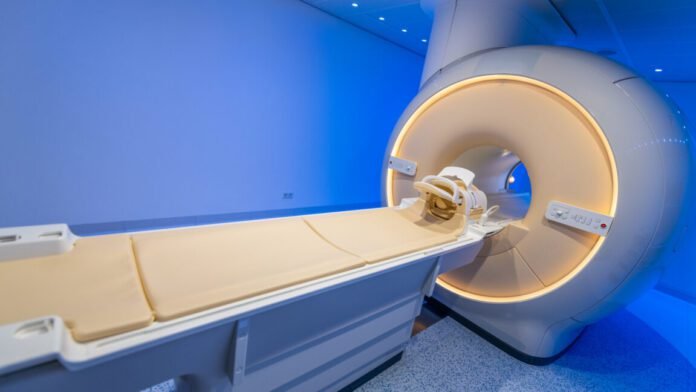
Volunteers went through the same four-part sequence twice, once sober and once on psilocybin. The sequence included putting participants in four different settings or contexts: eight minutes of lying at rest, a guided meditation, an 11-minute curated music playlist, and finally six minutes of eyes-open video of clouds moving across a sky. Each participant did all four inside an MRI scanner about 80 minutes after dosing, and again on EEG about 150 minutes after.
There were no cognitive tasks researchers routinely go for in brain studies, but there was a purpose behind this omission.
“We wanted ecological validity,” Stoliker says. “We wanted to know what the brain was like when somebody was having an authentic, uninterrupted psychedelic experience. If somebody took a psychedelic in a therapeutic setting, you wouldn’t have them completing tasks.” Stoliker also points out that there’s evidence that giving someone a task mid-trip pulls them out of the state—a phenomenon researchers sometimes call grounding. “Once you introduce these sorts of tasks, you’re actually interrupting the very phenomena you are seeking to measure.” And it worked.
Half of the participants ranked their session among the most meaningful experiences of their lives, and 24 put it in their personal top five. Stolkier and his colleagues started analyzing their brain scan data to find out why.
Blurred boundaries
Measuring global functional connectivity—how much influence each patch of cortex exerts over the rest—the team found that, when participants had their eyes closed, sensory regions lost sway while associative regions gained. “It seems like the brain’s ability to construct reality, or imagination, or our associations, our beliefs, our sense of self—these faculties had more dominance over sensory areas,” Stoliker says, stressing that the interpretation is a hypothetical. “This could help explain why people have meaningful, complex imagery experiences, why they have mystical experiences with imagery that is personally relevant to them.”
Another observation the team made was that connections within each brain network weakened, connections between networks strengthened. The brain’s modularity, a parameter that describes how cleanly neurons stay sorted into specialist teams, dropped across all four parts of the experimental sequence.
What’s more, researchers found that, when sober, activity in a brain with its eyes shut looked very different from a brain watching a movie. Under psilocybin, that difference nearly evaporated. In the visual network, the gap between eyes-open and eyes-closed connectivity shrank by 85 percent. The results from the EEG session independently confirmed that, with alpha-band activity (normally a marker of the brain gating visual input) reduced by nearly half.
“When somebody takes a psychedelic and they’re able to close their eyes and see complex imagery, there seems to be less boundary between the internal and external world than we ordinarily experience,” Stoliker says.
Regardless of these details, the results rather accurately reproduced the chaos in the brain so many researchers claimed psychedelics caused. This chaos, though, turned into order when the team processed their data in a slightly unorthodox way.
Hidden order
Scientists usually do two acts of averaging in a standard brain imaging study. The first is averaging over time. An eight-minute brain scan comprises a few hundred successive images of the whole brain. To understand how two specific regions work together, researchers conventionally average all these images down to a single number describing how well the two regions’ activity matched up across the whole eight minutes.
The problem with this analysis is that it runs the risk of missing ordered structures that appear for a brief period and then disappear into chaos.
The second analysis is averaging over people. Having produced one such number per participant, the standard approach then pools all of them into a group average, on the assumption that individual differences are noise that will be canceled out. Stoliker’s study was focused on individual experiences, so he wanted to avoid that.
Instead, the team fed the moment-by-moment activity of 332 brain regions into CEBRA, a machine-learning tool that compressed the data down to its essential structure while preserving the order of events. For each individual, it produced a trajectory—a path traced through a three-dimensional space, one point for each moment of the scan.
“When they’re not under psilocybin, the brain activity is less differentiated by context,” Stoliker says. “But under psilocybin, we see that the activity becomes organized across time and more clearly differentiated by context.” The trajectories separated into four distinct clusters corresponding to rest, meditation, music, and the movie. A classifier could read a moment of brain activity and say which one the person was in.
It turned out the performance of that classifier scaled with how profound the participants described their experience as being.
One with the world
To find out which parts of the brain were doing the work, the team replaced one network’s psilocybin activity with its sober version and checked how badly the classifier degraded. The default mode network and the visual network each accounted for over 20 percent of the effect. “The default mode network is strongly associated with the sense of self: daydreaming, mind wandering, thinking about yourself. It’s often been called the narrative self,” Stoliker explains. “On the other end of this gradient, more externally oriented, is the visual system.”
Under psilocybin, the two became less differentiated, which the team thinks explains why participants reported a subjective experience of the self and the external world becoming less separate, a state Stoliker calls “embeddedness.”
“Theoretically, we could suggest that psychedelics are temporarily altering the organization of brain networks that ordinarily help maintain this separation that we experience,” he says. “It really challenges the idea of whether the internal world and external world are separate and highlights the idea that the brain may be responsible for constructing both.”
Tuning the room
The day after the session, participants rated whether various things had shifted, like sense of connection to themselves, to others, to nature, along with peace, acceptance, and creativity, all on a scale running from –100 to 100. “For the vast majority of our participants, we found they had positive psychological changes the next day,” Stoliker says. The data from the brain reading classifier the team used for discriminating among meditation, rest, the movie, and the music tracked with the size of that shift.
In the future, Stolkier hopes to use this for therapeutic purposes. If context isn’t just mood-setting but is mechanically shaping brain organization, Stolkier argues, then the room, the playlist, and the instructions start to look like clinical variables a clinician could deliberately tune to improve therapeutic outcomes. But there are details the team must work out first.
As of now, the researchers admit that when two people report identical “embeddedness” scores, they can potentially have very different subjective experiences. Also, all the volunteers in Stoliker’s study were healthy individuals, not patients suffering from psychological or psychiatric disorders that potential therapies using psychedelics could be aimed at.
Finally, we still don’t know how exactly variables like music or visuals should be tuned. “That’s a future avenue where we need more research to determine exactly what conditions should be optimized, and for who. It’s quite possible we would want to take different approaches for each individual, or depending on what their diagnosis is,” Stoliker says. “Still, finding this level of organization hidden underneath that disorder and chaos has some really good explanatory value.”
As Trump’s Wall Closes in, DHS Intimidates a Border Tribe With Surveillance, Masked Agents and Drones
Reporting Highlights
Promising Cooperation: The Tohono O’odham Nation sued to stop a wall from being built on their land. In court, DHS gave assurances that the government would engage with the tribe in good faith.
Intimidation Tactics: ProPublica found that DHS has surveilled an ongoing border prayer ceremony and questioned tribal members outside the reservation.
Border Security: Despite steep declines in border crossings, officials describe the tribe’s land in Southern Arizona as “one of the most dangerous smuggling and trafficking corridors.”
These highlights were written by the reporters and editors who worked on this story.
At 4:59 a.m. on Aug. 25, Verlon Jose, the chairman of the Tohono O’odham Nation in Southern Arizona, received an email from the head of the U.S. Border Patrol’s Tucson Sector. Government contractors were en route to conduct soil tests for construction of a 62-mile wall along the Nation’s southern boundary, wrote acting chief patrol agent Henry N. Laxdal.
If the tribe wished to have cultural monitors observe the work, they were welcome to, but they could not interfere with the government’s operations.
The work would begin in exactly one minute.
Jose, 59, was already aware of the contractors’ arrival. An hour earlier, a tribal member had called to report a caravan heading south through the reservation, and Facebook was lighting up with similar accounts. The convoy included not only work trucks and drilling rigs, but Border Patrol vehicles as well.
Dozens of border wall contractor and Border Patrol vehicles pass the Tadai Me:i prayer camp on the morning of Aug. 27.Nate Sosa
For months, the O’odham had maneuvered to avoid such a scene, taking their case to federal court. Their homeland straddles the border, and thousands of tribal members live in Mexico. A wall would disrupt routine border crossings for ceremonies and family visits and destroy landscapes they consider their duty to protect, members and leaders say. Their lawsuit argued that the Trump administration’s efforts to build it despite their opposition constituted an historic attack on tribal sovereignty.
But administration attorneys gave assurances that the government was engaging with the O’odham in good faith, and a judge in Washington, D.C., denied the tribe’s request for a preliminary injunction. In his Aug. 25 email providing Jose a 60-second heads up, the Border Patrol chief said his agency’s willingness to accommodate cultural monitors underscored its “commitment to ongoing coordination” with the Nation.
As daylight broke, Jose learned the contractors were guarded by federal agents in masks and tactical gear, drawn from a special operations cadre that participated in citywide sweeps in Minneapolis and Chicago the previous year, which left three people dead, including two U.S. citizens. When the tribe’s chief of police tried to reach the worksite, he was stopped at a roadblock set up by the agents.
Merrian FelixDavy Cross
Border Patrol tactical team members amass around the Tadai Me:i prayer camp on Aug. 26.
Jose issued a statement on the Nation’s website declaring the incursion illegal and revealing that the Department of Homeland Security had deployed a surveillance blimp and enlisted Mexican security forces to help protect the work crews.
For a quarter-century, Tohono O’odham leaders have staved off a border wall by allowing DHS to use the reservation as a testing ground for some of the government’s most aggressive homeland security measures — from vehicle barriers on the reservation’s southern boundary, to state-of-the-art surveillance towers, to law enforcement partnerships with the Border Patrol and Immigration and Customs Enforcement.
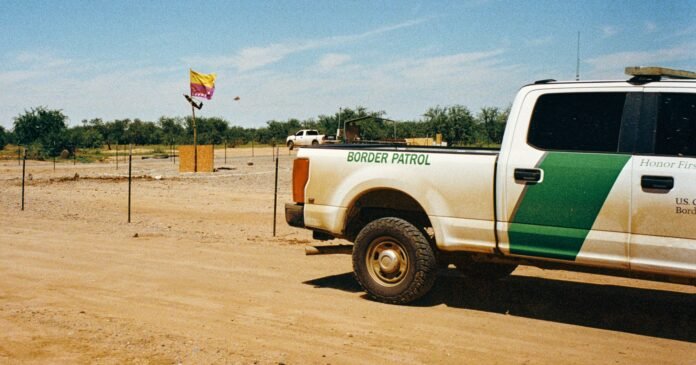
Despite the collaborations, and assurances from the Trump administration, ProPublica found that DHS has turned its vast apparatus on tribal members, with 24-hour surveillance directed at an ongoing border prayer ceremony and tribal members being questioned outside the reservation about their ceremonial activities. ProPublica’s account is based on photos, videos, court filings, interviews with tribal leadership, firsthand observations and more than 1,000 contemporaneously written observations compiled by tribal members.
The battle over a border wall on the Nation has broken along familiar partisan lines in Arizona. While GOP legislative leaders have filed briefs in support of the project, Democratic Gov. Katie Hobbs has done the same in support of the tribe.
Progressive U.S. Rep. Adelita Grijalva, whose district includes the reservation, has said she is crafting legislation to rein in the Department of Homeland Security’s sweeping powers to waive federal laws in order to expedite wall construction. The Trump administration has used those authorities to circumvent environmental and cultural preservation statutes on 60 occasions across its two terms.
For Deshane Gregg, whose vehicle was forced off the road by a convoy of contractors and federal agents, the recent show of force on the reservation has felt like a government siege, not cooperation.
“You just feel helpless. You see these people, and they’re just so aggressive. They want you to react. They want you to show them that we could be ugly too,” she said. “We’re just here doing prayer. We’re just here, not trying to bother them, but it gets to you when it’s constantly being like that.”
“The drones flying over us all day,” she added, “it’s a lot.”
A drone hovers over the Tadai Me:i camp during morning prayer songs on Aug. 27.Ryan Devereaux/ProPublica
ProPublica sent DHS, U.S. Customs and Border Protection, and the Border Patrol nearly 30 questions about the government’s surveillance and interactions with tribal members and leaders. The agencies answered none of those questions. Instead, CBP pointed to a statement Commissioner Rodney Scott made in August, in which he described the reservation’s southern boundary as “one of the most dangerous smuggling and trafficking corridors on the Southwest border” and a “remote desert that has facilitated decades of drug loads, migrant deaths, and cartel activity.”
Regarding construction of a wall, Scott said, “Congress funded this work, a Federal court has affirmed it, and CBP is carrying it out under the legal authorities that apply. Under President Trump’s leadership, we are securing the border and giving our agents the tools and support they need to protect the American people.”
A post on X from James Percival, general counsel of the Department of Homeland Security, celebrates the denial of a request for an emergency injunction against border wall construction filed by Tohono O’odham leadership in August.Screenshot of X
With no sign the White House or the O’odham government is backing down, DHS has cast off any pretense that the agency will work cooperatively with the Nation. Within hours of the judge’s denial of the emergency injunction, on Aug. 14, the department’s general counsel, James Percival, posted a celebratory meme depicting one of the cybernetic Star Trek supervillains known as “the Borg.”
“RESISTANCE IS FUTILE,” it read.
“We respect tribal sovereignty but not to the detriment of border security,” he wrote. “This wall is getting built. Our authority is beyond dispute.”
The O’odham have inhabited the Sonoran Desert, from what is now Southern Arizona to Mexico’s Sea of Cortez, for thousands of years. According to the tribe, roughly 14,000 of its 37,000 enrolled members live on tribal land west of Tucson. Approximately 3,000 more reside in Mexico. At 2.8 million acres, their reservation is the largest on the southern border by a long shot.
During President Donald Trump’s first term, Arizona saw 226 miles of border wall built, but the Nation maintained its status as the longest unwalled section in the state. Confirmation that things would be different this time came in February, when CBP informed the tribe that it planned to seal off the reservation entirely, tapping nearly $52 billion from Trump’s so-called One Big Beautiful Bill Act.
A vehicle barrier marks the U.S. border with Mexico in the Chukut Kuk District of the Tohono O’odham Nation.Cam Mackey
The tribe’s elected leaders met with DHS Secretary Markwayne Mullin in hopes of changing the administration’s mind. As an enrolled citizen of the Cherokee Nation, Mullin is the first Native American to head the department. “Maybe we can work with this guy,” Jose recalled thinking.
But Mullin’s message was clear: We want to work with you, but we’re building the wall. Justice Department attorneys were prepared to defend the project to the Supreme Court. O’odham council member Vivian Juan-Saunders, who also attended the April 21 meeting, recalls the secretary saying, “Don’t mess with me.” Mullin’s office did not respond to questions from ProPublica, including about the exchange.
The message was more direct the following month, when tribal leaders met with Scott. According to Jose, the CBP commissioner told the delegation that if they filed a lawsuit opposing the wall, the Nation could lose access to three border gates members use to travel to and from Mexico. Accessible only to tribal members, the gates are maintained at the discretion of CBP.
Juan-Saunders confirmed that CBP threatened to close the gates, as did another council member, Jesse Navarro. CBP declined to comment on the alleged threat.
In June, a $1.3 billion contract to build the wall, known as the “Tucson 5” project, was awarded to Sullivan Land Services Co., also known as SLS and SLSCO. The Texas firm has a long history of Republican political donations and was a major recipient of border wall contracts during Trump’s first term.
The O’odham filed a lawsuit to stop the project on June 16 in the U.S. District Court for the District of Columbia. The tribe contended it would reduce the size of its reservation, which can only be done by Congress — and that the wall would mark an enduring act of trespass on sovereign lands and destroy sacred cultural sites.
The administration’s plans cast aside decades of tribal cooperation with DHS, the Nation’s lawyers argued, and came at a time of record-low border crossings.
Trump and his administration have repeatedly claimed that the border is safer than ever, with CBP reporting border apprehensions 94% lower than they were during the Biden presidency, and Border Patrol “encounters” hitting their lowest levels in more than 50 years. The Nation underscored these figures as evidence that a wall is unnecessary.
The tribe’s interim chief of police, James Cook, claimed there had been a 90% drop in reports of illegal entry over the preceding year, saying in a sworn declaration that smuggling and other border-related crimes had “almost disappeared.”
Benjamin S. Hollinder, a senior Border Patrol official, argued in a sworn declaration opposing the tribe’s lawsuit that the absence of a wall on the Nation has produced a funneling effect, channeling smugglers onto the reservation, and saying that dynamic would intensify once the rest of Arizona was walled off.
“Not having a border barrier system in this particular area makes it a vulnerable and a desirable area for [transnational criminal organizations] to operate,” wrote Hollinder. “If encounters of aliens entering illegally between ports of entry increase, vulnerabilities in the area will become particularly problematic.”
The Nation sought the preliminary injunction to bar border wall activity until the litigation was resolved.
On the eve of a July 22 hearing, DHS filed a notice affirming that to accelerate the project, it was waiving, in whole or in part, more than 30 laws, including several that mandate tribal consultation.
In court filings, the government acknowledged its long history of working “cooperatively” with the tribal government while also arguing that the Nation “does not hold veto power over the United States’ sovereign duty to secure its borders.”
Trump administration attorneys contended that an injunction was premature; planning was ongoing, thus problems the Nation envisioned could still be addressed.
The government insisted construction would be limited to the Roosevelt Reservation, a 60-foot-wide zone that runs across California, Arizona and New Mexico on the U.S. side of the border, where CBP was authorized to construct barriers as it saw fit.
Riyaz Kanji, the tribe’s lead attorney, argued the Roosevelt Reservation doesn’t extend onto tribal land, and even if it did the rugged landscape would force construction to diverge far from the 60-foot boundary.
Sweeping as its powers were, Kanji contended, DHS could not override a sovereign government. The administration’s plans, he argued, constituted a “blatant and unprecedented disregard for the tribe’s rights.”
Adam R.F. Gustafson, a Justice Department attorney, countered that the tribe had already approved a barrier on its land many years ago. The question now was what kind of barrier it should be. That was for DHS to decide, he argued. The department was “committed” to consultation, he continued. “We take very seriously the tribe’s views on this,” he told the court.
The judge appeared swayed by DHS’ assurances but needed time to consider. “I don’t think the government is trying to go outside of that 60-foot strip,” he said.
Signs placed by Tohono O’odham tribal leaders warn contractors that their presence on the reservation would be considered trespassing.Cam Mackey
The O’odham suspected the government would not be as mindful as it claimed.
Two days after the meeting with Mullin, the DHS secretary, a border wall contractor had “inadvertently disturbed a cultural site” west of the reservation. The crew had bulldozed a 70-foot swath through the Las Playas Intaglio, a 200-foot long earthen etching in the shape of a fish that was at least 6,500 years old. The site was well marked and well known to area archaeologists.
Wynona P. Larson Yazzie, an O’odham tribal elder, Marine Corps veteran and former tribal police officer, had organized prayer runs that included stops at the intaglio. She’d visited the site the day before its destruction. Since then, she’d closely followed the Nation’s lawsuit.
On Aug. 6, Larson Yazzie saw a disturbing filing from the tribe’s attorneys. They’d received word that in four days government contractors would enter the reservation to conduct tests. DHS, the tribe argued, was “exploiting” the judge’s reflection period to “move forward with highly disputed actions.”
Tribal leaders erected dozens of 8-foot-wide “no trespassing” signs along the three main access roads leading through the reservation to the border.
Larson Yazzie, meanwhile, began making plans of her own.
She was joined by Amy Juan, a longtime O’odham activist. Juan, 40, had grown up riding in her grandfather’s truck over the clanking cattle guard at Ko:li Ki:jig, a traditional crossing on the U.S.-Mexico line. After 9/11, a locking gate was placed over the cattle guard. The Border Patrol built a “forward operating base” near her grandparents’ home that would eventually feature a helipad, a detention space and an endless cycle of agents. Around the reservation’s perimeter, CBP established some of the largest Border Patrol stations in the country. Checkpoints went up on roads leading north.
O’odham tribal members Daniel Oriol Figueroa Cervantes, left, from Mexico, and Amy Juan, from Arizona, visit over the border barrier at the Tadai Me:i prayer camp on Aug. 29.Ryan Devereaux/ProPublica
Human rights groups documented U.S.-born tribal members being arrested and deported, and verbal and physical abuse by Border Patrol agents. CBP did not respond when asked about the report’s allegations.
For Juan, the Nation’s collaboration with DHS had sacrificed safety and civil liberties for elusive gains. Virtually everyone on the reservation had been touched by the dark side of border smuggling. During the mid-2000s, some tribal members, enticed by a chance at life-changing money, got involved in moving people and drugs, fueling cycles of arrest and incarceration that exacerbated challenges the community was already facing.
At the same time, virtually everyone also had a story about negative interactions with the Border Patrol — a child traumatized at a checkpoint, an unlawful traffic stop or a loved one assaulted by an agent.
“We want safety and the same respect as the next person,” Juan said. “We’ve never been against keeping people safe, but at what cost?”
Larson Yazzie was similarly concerned. She worried that in the face of DHS pressure the Nation would fold and, like the intaglio, the borderlands would be lost.
A tribal member stands near the fire burning in the Tadai Me:i prayer camp in early September.Cam Mackey
Prayer fires are an important O’odham tradition, often convened in moments of communal struggle. To Larson Yazzie, the coming of a wall was such a time.
The chosen site was symbolic: the border gate at Ko:li Ki:jig. The camp had limited amenities — cots and chairs that encircled the fire, a cooler for ice, a weathered canopy for relief from the sun. They called it Tadai Me:i — roadrunner on fire.
Someone was always awake to watch the flame, which was lit on Aug. 9, as the Trump administration’s contractors were preparing to enter the reservation. The first drone sighting in the area was recorded the following night, at 11:43 p.m., documented in the first of two activity logs. Kept in spiral notebooks, the logs offered a minute-by-minute account of what participants in the ceremony saw and heard.
The handwritten observations, shared with ProPublica, span 13 days and chart a steady escalation by DHS, culminating in an elite tactical team that blocked tribal authorities from issuing trespassing citations to contractors or removing them.
The camp wasn’t a protest site like those seen in Minneapolis, Chicago or other cities over the past year. Participants didn’t shout at passing Border Patrol agents. They focused on the fire, making sure there was enough sugai — creosote bush, a fragrant desert plant — to keep it burning. They were in ceremony, concentrating on morning prayers and nightly cleanses. The atmosphere was that of a family gathering in a moment of crisis. There were jokes and levity amid the uncertainty.
Larson Yazzie knew at least one legislative council member who opposed the gathering. They feared it could lead to large groups converging on the reservation to physically block the border wall, in an occupation similar to the 10-month protest on Standing Rock Sioux land that halted construction of the Dakota Access Pipeline in 2016. The idea terrified tribal leaders. With its lethal heat and unforgiving terrain, the desert was dangerous enough without outsiders squaring off against Border Patrol.
A ceremonial fire burns on Aug. 27 at a prayer camp near the traditional Ko:li Ki:jig border crossing on the Tohono O’odham Nation.Nate Sosa
Supporters of the ceremonial fire were themselves uneasy. They knew the story of Ray Mattia, the 58-year-old who was shot and killed by the Border Patrol in 2023 while unarmed on the doorstep of his home on the reservation. Agents, who were backing tribal police on the call, claimed to have mistaken a cellphone he was holding for a gun.
“My fear is that they gonna start shooting us,” said 24-year-old camp visitor Collin Quasule. Quasule had videos on his phone of recent interactions he’d had with federal agents, including agents trailing him as he drove around the reservation, following him to his home, pulling him over without explaining why, refusing to accept his legal name and birthdate, and winking at him when he protested his detention.
Across the reservation, community members were on the lookout for large trucks traveling together with out-of-state plates. On Aug. 12, Juan received a call about a caravan: six trucks with Texas plates, following an unmarked SUV with government plates. She called the tribe’s police department. The caravan was intercepted and escorted off the land by tribal authorities. The driver of the unmarked vehicle was confirmed to be a Border Patrol agent. The interception was one of nearly a dozen tribal police recorded over a three-day period.
During the camp’s first seven days, the activity log filled with nearly 665 observations, mostly federal agents buzzing around their location.
An activity log kept by tribal members documents border wall construction and law enforcement activity on the Tohono O’odham Nation.Ryan Devereaux/ProPublica
While many would drive by without stopping, other agents would park and watch. At least one was reported snapping photos of the campers. ProPublica later obtained video of an agent doing exactly that. Mexican security forces, both military and police, were also observed conversing with Border Patrol agents over the international boundary. “It appeared that the 2 BPs were showing the Mexicans pictures on their phones,” read an Aug. 11 entry.
“Surveillance has heightened,” Juan said, days after the prayer fire was lit. “Drones, helicopters, a lot of air activity.” The choppers included both marked CBP and what appeared to be military Black Hawks. The drones were of the handheld quadcopter variety, let loose directly over the camp, at times during prayer song ceremonies.
On the fourth night, a gathering was held. Upwards of 100 people turned up, including members of distant sister tribes.
The evening was peaceful until Juan received a text from an elder couple who’d left early to return to their home near Tucson. The Border Patrol had stopped them at a checkpoint a half-mile outside the reservation, they reported. The officers said they were conducting an “immigration check” and asked to see tribal ID.
“Where you guys coming from?” the agent asked.
“Ceremony,” the couple replied.
“Oh,” the agent said, “is that the one going on down south?”
The encounter was unusual, said Juan. The checkpoint is rarely staffed. When agents are on hand, she said, “they never ask us for a tribal ID.”
When Juan shared the information with the gathering, people immediately began packing up, afraid, she surmised, of a late-night encounter with Border Patrol.
A Border Patrol agent stops to film the Tadai Me:i prayer camp on Sept. 30.Davy Cross
On Aug. 14, Judge Richard J. Leon declined the Nation’s injunction request. “I fully expect the government in the months ahead to follow through on its guarantees of consultation and cooperation with the Nation to address the Nation’s concerns regarding border wall construction!” he wrote.
Eleven days later, on Aug. 25, the Border Patrol sent the Nation its one-minute notice that the contractors were coming. Larson Yazzie jumped in her truck and raced for the border to document what was happening. An agent on foot stopped her. He’d laid a spike strip in the road ahead, he warned. Larson Yazzie filmed the contractors in the distance.
When the tribal police department’s interim chief arrived, he too was stopped at a Border Patrol roadblock. A trio of Border Patrol supervisors approached, including two from a nearby station and a third representing BORTAC, the agency’s special operations wing. The SWAT-style agents wore desert camo, masks and patterned scarves favored by U.S. military units in Iraq and Afghanistan.
It was only after promising not to interfere that the tribal police chief was permitted to record. He observed three drilling rigs manned by a handful of operators. An equal number of agents stood guard. The contractors’ heavy vehicles were all beyond the 60-foot zone that government attorneys assured the judge they would not leave.
The chief also encountered a trio of Bureau of Indian Affairs agents, who claimed to have been sent on orders from Washington, D.C. Their mission, they said, was to “preserve the peace and monitor activities.”
A Border Patrol vehicle is parked near the Tadai Me:i prayer camp on the Tohono O’odham Nation.Cam Mackey
For the prayer camp’s participants, the need to relight the flame, which they had extinguished after a seven-day ceremony, was self-evident. They began that night.
Davy Cross, a stocky 57-year-old with an intricate tattoo running down the left side of his face, was tending the fire when, at 4:33 a.m., he noticed buzzing above his head.
At first, the machines were visible. There were at least five. “I seen all the red lights,” Cross recalled. But as they got lower, the drones went dark. Cross could still hear them and feel the draft of the rotors against his skin. Then, he said, “they disappeared.”
The drones were soon replaced by an airplane and a helicopter. Shortly after 9 a.m., a caravan of Border Patrol and construction vehicles trundled into view. The work trucks continued on, but much of the Border Patrol force remained, forming a semicircle around the camp with Mexican state police closing the loop on the other side of the line.
“We got surround[ed] by over 30 vehicles,” Cross wrote in the activity log. A video of the moment spread across social media in the borderlands.
The tribe’s attorneys filed an appeal of the judge’s order allowing construction to proceed and pleaded for a halt to the government’s activities. They argued that the Trump administration was making “a mockery” of the court’s expectation of “consultation and cooperation.”
A convoy of Border Patrol and construction vehicles pass the Tadai Me:i prayer camp on Aug. 29.Ryan Devereaux/ProPublica
That night at the camp, Larson Yazzie was singing prayer songs when Juan pulled in. It was near midnight. Border Patrol agents were coming and going constantly. Some passed without stopping. Others idled at the edge of the firelight while the red lights of a surveillance blimp blinked over the mountains to the east.
Tadai Me:i wasn’t the only pocket of resistance on the border. In Texas, the Trump administration’s plans to run a wall through Big Bend National Park had brought together an unusual coalition that saw environmental nonprofits and river guides standing with hunters, ranchers and local sheriffs in opposition to the project. One week before the armed convoy rolled onto the Tohono O’odham reservation, Republican Gov. Greg Abbott announced that after speaking with the secretary of DHS, he’d secured a pause on the controversial project.
“There are technology tools that don’t include barriers,” the governor said at a press conference. “Think of drones, think of fiber optics.”
Last week, a judge granted a preliminary injunction halting construction in the Big Bend area while a lawsuit against the project proceeds.
To Juan, it was darkly ironic. For two and a half decades, the Nation had been a laboratory for the technology Abbott described. Yet when tribal leaders made that case, they were told to stand down; the wall was coming whether they accepted it or not. “What makes Texas the exception to us is very clear,” Juan said. “It’s good old boy conversations that are happening between the politicians and the CBP commissioners and Markwayne Mullin.”
Sunrise at Tadai Me:i prayer camp on Sept. 26Ryan Devereaux/ProPublica
The early fire watch that morning fell to a young Pascua Yaqui member named Nate Sosa.
At 3:28 a.m., Sosa heard a noise — a round being chambered in a weapon. A Border Patrol agent had exited his vehicle. With a long gun slung low across his back, he shined a light into Mexico. He then walked within feet of the campers asleep on their cots.
A half an hour later, a drone flew in from the north, followed by a helicopter. After that came a convoy dozens of vehicles long. At 6:02, while Larson Yazzie was leading the camp in prayer, a helicopter passed overhead. An hour later, a drone ascended above the fire.
Liz Quiroga, a 28-year-old tribal member and regular at the prayer site, sat with the camp’s logbook open in her lap. Over the next five days, the book would fill with 379 observations. Nearly two-thirds involved Border Patrol units near the fire. The arrival of Mexican authorities was documented six times. An additional 39 entries referenced unmarked vehicles and suspected “undercovers.” Whether those individuals were Border Patrol, contractors or tribal police was unclear. The logbook cataloged a dozen instances of aircraft flying over the camp, including four helicopters, three planes and five drones.
“Nobody has any idea what’s actually happening out here,” Quiroga said. “This is true dystopia.”
While its legal challenge continues, the Nation has ceased attempting to remove border wall contractors from its lands.
The camp and the surveillance that’s come with it remain.