14.4 C
London
Saturday, October 3, 2026
Home Blog

Herb Chicken & Parmesan Dumplings

0
Herb Chicken & Parmesan Dumplings with chicken, vegetables, creamy broth, and parsley-topped dumplings.
Herb Chicken & Parmesan Dumplings brings tender chicken, vegetables, and savory Parmesan-herb dumplings together in a creamy one-pot dinner.

Print Friendly, PDF & Email

Herb Chicken & Parmesan Dumplings brings tender chicken, vegetables, and fluffy homemade dumplings together in one cozy pot. The broth is creamy without becoming heavy, with onion, carrots, celery, garlic, thyme, and a little Dijon building plenty of savory flavor underneath.

The dumplings are what make this version especially good. Parmesan, parsley, and thyme go directly into the dough, so the dumplings bring their own flavor instead of simply sitting on top of the chicken filling. They steam gently with the lid closed until tender and fluffy all the way through.

A small splash of cream rounds out the broth at the end, while fresh lemon keeps everything from tasting too rich. The finished pot lands somewhere between classic chicken and dumplings and a creamy chicken stew—hearty enough for dinner, easy enough for a weeknight, and exactly the kind of meal that tastes right when the weather starts cooling down.


Herb Chicken & Parmesan Dumplings with chicken, vegetables, creamy broth, and parsley-topped dumplings.
Herb Chicken & Parmesan Dumplings brings tender chicken, vegetables, and savory Parmesan-herb dumplings together in a creamy one-pot dinner.

Recipe Yield: 6 servings

INGREDIENTS

Chicken & Broth:
1 1/2 lbs boneless skinless chicken breasts, cut into 1-inch pieces
3 medium carrots, peeled and cut into 1/2-inch pieces
2 celery ribs, sliced
1 medium yellow onion, diced
4 garlic cloves, finely minced
5 cups low-sodium chicken broth
1/2 cup heavy cream
2 tbsp olive oil
1 1/2 tsp kosher salt, divided
1/2 tsp black pepper
3 tbsp unsalted butter
1 tsp dried thyme
1/4 cup all-purpose flour
1 tsp Dijon mustard
1 tbsp fresh lemon juice
2 tbsp chopped fresh parsley, divided

Parmesan Herb Dumplings:
3 tbsp cold unsalted butter, cubed
3/4 cup whole milk
1 1/2 cups all-purpose flour
1/3 cup finely grated Parmesan cheese
2 tsp baking powder
1/2 tsp kosher salt
1/2 tsp dried thyme

INSTRUCTIONS

1. Brown the chicken:
Heat the olive oil in a large Dutch oven over medium-high heat. Season the chicken with 3/4 tsp salt and black pepper. Cook for 3–4 minutes, stirring occasionally, until lightly golden but not cooked through. Transfer the chicken to a clean plate.

2. Soften the vegetables:
Reduce the heat to medium and add the butter. Add the onion, carrots, celery, and remaining 3/4 tsp salt. Cook for 6–7 minutes, stirring occasionally, until the vegetables begin to soften.

3. Build the broth:
Add the garlic and dried thyme and cook for 30 seconds. Sprinkle 1/4 cup flour over the vegetables and cook for 1 minute, stirring constantly.

4. Simmer the filling:
Gradually stir in the chicken broth until smooth. Add the Dijon and bring to a gentle simmer. Cook uncovered for 8–10 minutes, stirring occasionally, until the vegetables are nearly tender and the broth has lightly thickened.

5. Make the dumpling dough:
Meanwhile, whisk 1 1/2 cups flour, Parmesan, baking powder, 1/2 tsp salt, dried thyme, and 1 tbsp parsley in a medium bowl. Cut in the cold butter with a pastry cutter or fingertips until small pea-size pieces remain. Stir in the milk just until a soft, shaggy dough forms.

6. Return the chicken:
Stir the chicken and any accumulated juices back into the pot. Adjust the heat so the broth maintains a gentle simmer.

7. Add the dumplings:
Drop the dough in about 2-tbsp portions over the surface, leaving a little space between each dumpling. You should have about 12 dumplings.

8. Steam until fluffy:
Cover the pot tightly and cook for 14–16 minutes, adjusting the heat as needed to maintain a gentle simmer without lifting the lid. Check a center dumpling; it should be puffed and cooked through with no wet dough remaining. The chicken should reach 165°F.

9. Finish the broth:
Remove the pot from the heat. Gently stir the heavy cream into the broth around the dumplings, followed by the lemon juice, taking care not to break the dumplings apart.

10. Serve warm:
Finish with the remaining 1 tbsp parsley and serve the chicken, vegetables, creamy broth, and Parmesan-herb dumplings together in shallow bowls.


Helpful Tips to Perfect This Recipe

  • Keep the dumpling dough shaggy: Stir only until the flour is moistened. Overmixing develops gluten and can turn fluffy dumplings dense.
  • Maintain a gentle simmer: Hard boiling can break the dumplings apart and may cause the thickened broth to catch on the bottom. Adjust the heat as needed for a steady, gentle simmer.
  • Keep the lid closed: Trapped steam cooks the tops and centers of the dumplings. Wait the full 14 minutes before checking the first one.
  • Finish the broth off the heat: Stir in the cream first, then the lemon juice. This keeps the broth smooth while adding just enough brightness to balance the richness.

Rate This Recipe

Tried this recipe? Your rating helps others and means so much.

Apple changes full-disk access permissions to curb abuse from AI agents

0
apple-changes-full-disk-access-permissions-to-curb-abuse-from-ai-agents
Apple changes full-disk access permissions to curb abuse from AI agents

Apple says it is changing its macOS privacy settings to stop third-party app developers from misusing them to access message histories.

Friday’s announcement comes two weeks after tech columnist Jason Aten said that Meta’s new general-purpose AI agent Muse sent him an unsolicited notification referencing a thread between him and a co-worker over Apple Messages. Aten said he never granted Muse permissions to read his messages and had assumed they were off-limits. Social media last week blew up with masses of people who agreed and said the incident showed that AI assistants given access to calendars, emails, messages, shopping accounts, and other resources are akin to a skill aw or other power tool. While potentially useful, they can do real damage if not used carefully.

He said/she said

Meta CTO David Singleton joined the fray with a rebuttal that appeared solid. For Muse to access Apple Messages, a user must manually give it two privileges. One is full-disk access, a macOS system-level permission. The other is to enable a Messages connector setting in Muse.

“The Messages integration in the Muse Mac app is opt in,” Singleton said. “Your Muse can only read Messages content if macOS system-level Full Disk Access is granted and the Messages connector is enabled.”

Singleton’s implication was clear. Muse could have read Aten’s Messages communications only if he had enabled both settings, and if so, the columnist had only himself—and certainly not Meta—to blame.

Earlier this week, I spoke to macOS security expert Patrick Wardle, who questioned Singleton’s denial. His reasoning: “From a technical point of view, with FDA (full-disk access), any (non-root file), is readable, browsing history, browser cookies, chats, etc etc etc.” I asked Meta how Muse couldn’t read messages when the app had full disk access, while every other app with that privilege could. Meta PR’s only response was to requote Singleton saying: “The Messages integration in the Muse Mac App is opt-in. Your Muse can only read Messages content if macOS system-level Full Disk Access is granted and the Messages connector is enabled.”

Now, Apple is setting the record straight. In explaining why it was going to make changes to the FDA permission setting, the company wrote:

Some developers are using Full Disk Access in ways that could put users at risk, exposing everything on their systems—including files, mail, messages, and even browsing history—without users’ full knowledge and understanding. For communication apps, this can also compromise the privacy of the people users are communicating with.

The statement went on:

As AI agents become increasingly capable and autonomous, the risks associated with this level of access will grow substantially. We are committed to ensuring users clearly understand these risks before granting such access, so they can make informed decisions about their own data and privacy.

Apple didn’t name Meta, Muse, or any other app or developer by name. Even though there are no known reports of other apps abusing FDA to read messages and browsing history, it’s certainly possible Friday’s statement wasn’t referring to the Muse incident. Then again, the timing of the announcement—coming on the heels of a major social media uproar—makes the possibility likely. And at a minimum, Apple’s statements seem to contradict Singleton’s denial that it’s not possible for Muse to read Messages content without the connector enabled. Meta PR didn’t respond to questions sent Friday.

Apple’s announcement came 11 days after Wardle disclosed a Muse configuration that allowed any app or code running on a Mac—including commands injected through the increasingly effective ClickFix attacks—to take full control of the AI assistant. From there, the attacker could access the same resources Muse could. It also comes after Amazon blocked Muse from its platform because, Amazon said, all such apps “should operate openly and respect service provider decisions about whether or not to participate.”

Taken together, the events suggest that Muse may not be worthy of the extraordinary access it must have to work as billed by Meta. People who use the assistant should configure permissions carefully, though as Aten’s experience suggests, that precaution only goes so far.

MEPs want stronger crisis anticipation, cross-border medical support

0
meps-want-stronger-crisis-anticipation,-cross-border-medical-support
MEPs want stronger crisis anticipation, cross-border medical support


Two European Parliament committees on Thursday adopted their position on the next version of the European Union’s civil protection mechanism for 2028-2034, the bloc’s main tool for helping countries hit by disasters such as wildfires, floods or earthquakes.

The Committee on the Environment, Climate and Food Safety and the Committee on Public Health approved the position by 61 votes to 9, with nine abstentions. It will go to a vote by the full Parliament at an upcoming plenary session. The mechanism pools voluntary resources and shares them with the country in need.

More funding

Lawmakers proposed raising funding for the mechanism to 12.42 billion euros in current prices, or 11 billion euros in 2025 constant prices, up from the 10 billion euros in the European Commission’s proposal. They want 40% earmarked for civil protection, 40% for health emergencies and 20% as a flexibility amount.

Anticipating crises

The committees want to strengthen monitoring and anticipation so EU institutions and local actors can prepare for crises rather than simply react. They proposed vulnerability mapping, an integrated EU space service to support public warning systems, and backing for forward-looking climate projections and climate risk assessments.

They also called for a dedicated framework to coordinate civil-military collaboration in crisis response and a stronger role for local and regional governments. They want EU space capabilities used for early warning systems.

Shared response and recovery

Lawmakers agreed the program should strengthen joint emergency response capacity, known as rescEU, including through an aerial forest-fire-fighting fleet available from 2028.

They proposed a recovery readiness framework to ensure EU countries have clear mandates for different levels of government, sufficient technical and human capacity, and enough data to coordinate recovery.

Citing volunteers as a first line of response, they want volunteers to have a dedicated legal status with clear insurance coverage, recognition of qualifications and exemptions from constraints related to their day jobs.

Health emergencies

The program would also help EU countries fight serious cross-border health threats, for example by stockpiling medical countermeasures such as personal protective equipment and active pharmaceutical ingredients, and by developing early warning and surveillance systems.

Lawmakers want to extend EU support to cross-border cooperation between specialized care centers, cross-border medical teams, medical surge capacity, such as analysis of intensive care unit capacity, and patient transfers between member states during overload situations.

Lawmakers’ comments

“Wildfires and floods have shown how serious the global climate emergency is,” said co-rapporteur Leire Pajín of the Socialists and Democrats group in Spain. “We want to ensure that we are better prepared to face risks ranging from climate-related to health emergencies and hybrid threats.”

Co-rapporteur Aurelijus Veryga of the European Conservatives and Reformists group in Lithuania said the report “strengthens the EU’s ability to prepare for and respond to natural disasters, health emergencies and other major crises.” He said the proposals focus on preparedness, prevention, early warning and coordination, including scenario planning and stress testing.

The legislation is part of the EU’s 2028-2034 long-term budget package. Parliament wants the budget to remain a strong investment tool that supports citizens, regions and businesses while delivering value beyond national budgets. Lawmakers propose increasing the size of the draft budget and insist on new revenue sources to fund it.

Public Radio Station Forced to Call Gulf of Mexico the “Gulf of America”

0
public-radio-station-forced-to-call-gulf-of-mexico-the-“gulf-of-america”
Public Radio Station Forced to Call Gulf of Mexico the “Gulf of America”


Seth Stern is the director of advocacy for Freedom of the Press Foundation.

Clayton Weimers is the executive director for Reporters Without Borders (RSF) North America.

Donald Trump received Chinese President Xi Jinping and the visiting Chinese press pool last week as reporters from news outlets he had banished stood outside the White House gates. At one point, Trump joked that China, the world’s leading jailer of journalists, “has the friendliest press corps.” Now, his acolytes in Alabama are taking up Trump’s cause, emulating the Chinese Communist Party’s mastery of information control at the local level by decreeing what supposedly independent public radio reporters are allowed to say. 

The Alabama legislature passed a bill in late March requiring all state and local entities to refer to the Gulf of Mexico as the “Gulf of America,” in line with one of the many executive orders Trump signed on his first day in office. The legislation does not set forth penalties for noncompliance, but its sponsor, state Rep. David Standridge, called it “an opportunity to make a patriotic statement” on the House floor in January. Alabama Gov. Kay Ivey, a Trump ally, signed the bill into law.

Birmingham public radio station WBHM told its listeners in a letter from Will Dahlberg, the station’s executive director and general manager, that due to the law, which took effect October 1, the University of Alabama at Birmingham is forcing it to use the legislature’s preferred language in its reporting. The move puts it at odds with NPR, of which it is a member station; The Associated Press, which publishes the style guide used by newsrooms across the country; and other journalistic institutions. The station is licensed to the university, making its employees both state and UAB employees. Still, WBHM’s Journalism Code of Integrity emphasizes the newsroom’s independence and states that the university “should not — and cannot — expect to exert influence on WBHM’s journalists and its independent editorial process.”

Dahlberg wrote that not implementing the new language “may result in disciplinary action or termination of employees and affect WBHM’s relationship and support from UAB.” But nothing in the law requires the university to discipline or fire anyone. In other words, the university took a toothless stunt of a law, gave it teeth, and used them to take a bite out of press freedom.

Dahlberg also announced in the letter that he is stepping down from his position and leaving the station. His resignation was supposed to be effective October 16, but he posted an update that the university told him on Monday morning that he should pack his bags immediately. We cannot say for sure whether the university hastened Dahlberg’s departure due to his message to listeners and the criticism it generated, but the timing is certainly suspicious.

So why did the University of Alabama at Birmingham choose to embarrass itself rather than stand up for journalists and the First Amendment? As ridiculous as Alabama’s Gulf of America law is, its text did not tie the university’s hands. The university would not even have needed to bring a legal challenge to contest the law — it could have just let WBHM ignore it and supported its employees. 

The university could have taken the position that the government choosing which words reporters must say is impracticable and burdensome.

The law only refers to “state and local entities” and makes no mention of media. It contains no penalties for noncompliance and limits its mandate to “when practicable,” giving a pass when complying would “impose an operational or financial burden.” Compelled speech is never practicable because it’s unconstitutional, but the operational and financial burdens of compliance are also significant. WBHM picks up national content from NPR and The Associated Press, for example. Are they expected to reject stories that say “Gulf of Mexico,” and fill that time with original reporting they haven’t budgeted or hired for? Or should they somehow intercept and edit those stories, likely in violation of their contractual obligations? 

There is also ample Supreme Court precedent for the proposition that the government cannot put words in reporters’ mouths. In a landmark 1943 case on whether the state could force students to salute the flag or recite the Pledge of Allegiance, the court wrote that “if there is any fixed star in our constitutional constellation, it is that no official, high or petty, can prescribe what shall be orthodox in politics, nationalism, religion, or other matters of opinion or force citizens to confess by word or act their faith therein.” That means neither Standridge, Ivey, nor Trump is entitled to impose their definitions of patriotism on anyone —least of all the news media.

More recently, some conservatives celebrated 2024’s NRA v. Vullo decision, which found that public officials could not “use the power of the State to punish or suppress disfavored expression.” There is no exception for radio stations that receive public funding. In 1984, the Supreme Court struck down a ban on editorializing by public broadcasters that received federal money, holding that funding a station doesn’t entitle the government to control its journalism — a principle affirmed in March when a federal judge rejected Trump’s executive order to defund NPR and PBS.

The university could have taken the position that, for one, public radio stations are not state entities, and two, the government choosing which words reporters must say is impracticable and burdensome. Last but not least, the university should have taken the stand that the First Amendment still exists to protect us all, despite Trump’s best efforts to cast it aside.

Just as law firms, news outlets, colleges, and others that have settled with Trump to stay in his good graces chose to cave when they could have easily fought back (as others successfully have), the University of Alabama at Birmingham made the cowardly choice to comply in advance.

If anything, its capitulation is worse, because there’s no indication that the state intended to, or could, put up a fight. Is the Alabama legislature really so committed to Standridge’s silly law that it would waste taxpayer money litigating likely unwinnable constitutional battles? Maybe, but the university could have at least waited to see how, or if, the state would respond.

It is worth noting that Ivey is an ex officio member of the University of Alabama System Board of Trustees. That same board published an annual freedom of speech report in August. It consists of a single identical paragraph, copy-pasted each year with the only change being the date and the number of “events” held on its campuses that year, concluding that “the requirements of the [free speech] Policies have been repeatedly satisfied without a single alleged violation, which further speaks to their effectiveness in appropriately achieving the Board’s objectives.”

One is left to wonder if, despite pressuring WBHM to echo Trump talking points, the university will once again copy-paste that conclusion next year.

US diesel crisis about to become Asia’s interest rate problem

0
us-diesel-crisis-about-to-become-asia’s-interest-rate-problem
US diesel crisis about to become Asia’s interest rate problem

High diesel prices are driving inflation across the US economy. Image: YouTube Screengrab

Diesel in the US has climbed to more than US$6.50 a gallon, up about 75% from a year ago, and Asia is likely to pay for it in the form of higher interest rates. Expensive diesel keeps American inflation elevated, which gives the Federal Reserve reason to keep raising interest rates.

Higher US rates lift the dollar and pull investment back towards America, leaving central banks across Asia deciding whether to tighten policy themselves to protect their currencies.

In the US, the fuel squeeze has turned into a political crisis. Farm-state Republicans want the White House to ban diesel exports before November’s midterms, and Donald Trump has said he’s “very seriously considering” it.

Several members of his own cabinet oppose the idea, as does the oil industry, and it’s far from clear which way he’ll go. For Asian economies, his decision matters less than it might seem, because much of the inflation damage has already been done.

Diesel powers the trucks that stock supermarkets and the tractors that work American farms. A rise this steep gets passed on to shoppers over the following months, often well after the pump price has dropped out of the news.

The Fed raised rates to between 3.75% and 4% in September, its first increase in three years. Most of its policymakers expect to move again before the end of 2026, and we agree with them.

Wednesday’s PCE figures, the Fed’s preferred inflation measure, came in softer than expected at 3.4% for the year to August, with core inflation at 3%. Some investors have taken this as a sign the Fed can relax, but we’d be wary of that reading.

The figures were published alongside changes to how several parts of the index are calculated, so it’s hard to know how much of the improvement is genuine. Even taken at face value, 3.4% is well above the 2% the Fed is aiming for, and the diesel spike still hasn’t fully fed into prices.

An export ban wouldn’t solve much. It might ease prices in some parts of the US, though officials have been warned it could raise them in regions that rely on imported fuel.

It would certainly hurt Europe, where diesel prices are at record highs and people have taken to the streets over them. The administration has also floated asking China to produce more diesel. None of this does much to calm a global fuel market under strain since the war involving Iran began seven months ago.

Meanwhile, the dollar is close to its strongest level of the year, and US 10-year yields are above 5%. Both reflect expectations that the Fed has more work to do.

Asia buys most of its oil and fuel from abroad and pays for nearly all of it in dollars.

A stronger dollar makes those imports dearer in local terms even when global oil prices go nowhere. A trucking company in India or a fishing operator in the Philippines ends up paying more for fuel largely because of decisions made at the Fed.

Treasuries paying over 5% also draw in global investors, and some of the money that would otherwise go into Asian bonds and shares will head to the US instead. Those outflows weaken regional currencies further, which pushes import costs up again.

Asian central banks have limited room to maneuver. Raising rates to support their currencies and contain imported inflation risks slowing economies already struggling with high energy costs and holding back risks a sliding currency and fuel bills that climb even higher.

We’d expect several of them to lean towards tightening over the coming months, particularly those whose currencies have already come under pressure this year.

The impact won’t be spread evenly. Exporters with dollar revenues benefit from weaker local currencies, and Asian refiners could pick up extra business if American diesel stops flowing abroad.

The economies most at risk are the big energy importers carrying a lot of dollar-denominated debt, and the Philippines tops that list.

The peso hit a record low at the end of August and has lost almost 8% since the war with Iran began in February, largely because the country relies so heavily on imported oil. A strong dollar raises its fuel bill and makes foreign-currency debt more expensive to repay at the same time.

Indonesia is in a similar position. The rupiah sank to a record low in June, weaker even than at the depths of the 1997-98 Asian financial crisis. India, one of the world’s largest oil importers, has also seen the rupee fall to record lows this year.

Investors with exposure to the region have good reason to look at how much of their portfolio sits in Asian currencies without a hedge.

The same goes for holdings in companies that have borrowed in dollars while earning in local currency. Both could come under strain if the Fed keeps tightening into next year.

Trump may or may not ban diesel exports, and the midterm politics will play out either way. The inflation pressure behind the row has already reached the Fed, and from there it’s traveling towards Asia’s central banks.

Nigel Green is founder and CEO of the de Vere Group.

Türkiye denounces Houthi strike on infrastructure serving Prophet’s Mosque

0
turkiye-denounces-houthi-strike-on-infrastructure-serving-prophet’s-mosque
Türkiye denounces Houthi strike on infrastructure serving Prophet’s Mosque

Muslims from all over the world visit Al Masjid an-Nabawi (Prophet's Mosque) before the Islamic pilgrimage season starts in Medina, Saudi Arabia on April 25, 2024. [Mohammed J. A. Alaloul - Anadolu Agency]

Muslims from all over the world visit Al Masjid an-Nabawi (Prophet’s Mosque) before the Islamic pilgrimage season starts in Medina, Saudi Arabia on April 25, 2024. [Mohammed J. A. Alaloul – Anadolu Agency]

Türkiye’s Head of Communications Burhanettin Duran on Friday condemned the attack by Yemen’s Houthi group targeting the civilian infrastructure serving the Prophet’s Mosque in Medina, Saudi Arabia, Anadolu reports.

“Any attack targeting the sanctity, peace, and security of the Two Holy Mosques is an unacceptable affront directed at the shared sensitivities of the entire Islamic world,” Duran said on US social media company X.

He expressed hope that such attacks, which threaten peace and stability in the region, will come to an end as soon as possible.

“Under the leadership of Turkish President Recep Tayyip Erdogan, Türkiye will continue to stand by Saudi Arabia,” Duran added.

It’s Easy to Start a Private School. Take Our Quiz to Find Out Where You Can Open Yours.

0
it’s-easy-to-start-a-private-school-take-our-quiz-to-find-out-where-you-can-open-yours.
It’s Easy to Start a Private School. Take Our Quiz to Find Out Where You Can Open Yours.

Ever imagine yourself as a private school operator? It’s not such a wild idea. Hundreds of new private schools have popped up all over the country in recent years, fueled by a new wave of public money for students to pay tuition.

But the rules for opening a private school vary wildly from state to state. While some states require that you check the backgrounds or certifications of the teachers you hire, some don’t. Almost none scrutinize the founders themselves. Many states invite anyone with a dream and a heartbeat to start a school. ProPublica even founded a couple this year.

Want to see what it takes to open a private school in America? Take this 10-question quiz to find out just how easy it can be.

Start quiz

Journalism That Holds Power to Account

Sign up for ProPublica’s Big Story newsletter and get our latest stories delivered straight to your inbox.

Someone got Doom in an SQL database

0
someone-got-doom-in-an-sql-database
Someone got Doom in an SQL database

“Rendering Doom in a database is obviously a bad idea,” Lukas Vogel writes in a lengthy blog post explaining how exactly he managed to render Doom using an SQL database.

OK, that’s not entirely accurate. The SQLDoom project uses a small Python client to handle input and output, drive the game’s timing, and display each frame to the screen. Behind that, a series of CedarDB tables tracks the game geometry and state, while about 1,300 lines of SQL queries spread across 89 common table expressions implement the game logic and generate 35 bitmap framebuffers per second.

In this, SQLDoom is a major improvement over Vogel’s previous DoomQL project, which last year set out to build “a multiplayer Doom-like shooter entirely in SQL.” Unfortunately, that effort ended up with raycasting-based, grayscale ASCII graphics that were more akin to the simplistic 90-degree-angled maps of Wolfenstein 3D. The newer SQLDoom, on the other hand, generates full-color 640×480 frames that look like they could have come from the original Doom executable.

It’s all just data, man

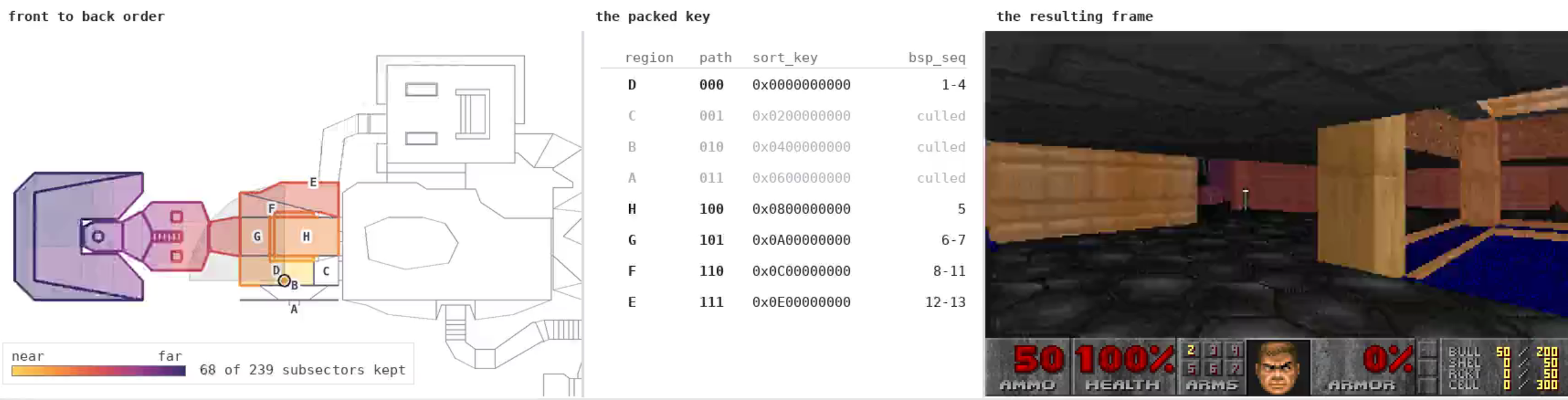
Converting Doom‘s classic WAD files to a relational database was relatively simple and straightforward, Vogel writes, because of the way the original game broke levels down into vertices, lines, sectors, and so on. Even Doom‘s famous binary-space partition trees can be broken down into SQL using a sort_key for objects that’s pre-computed for each position at load time. With this set in your table, a simple “ORDER BY” statement can determine every frame which parts of walls to display and which to ignore, vastly improving performance.

A visualization of the sorting/culling algorithm used in the SQLDoom project

A visualization of the sorting/culling algorithm used in the SQLDoom project Credit: Lukas Vogel

There were a few complications in going from SQL table to rendered first-person frames, however. Chief among these was the algorithm needed to render floors and ceilings, which can’t really make use of the elegant “visplanes” and state mutations that handle this rendering on a column-by-column basis in the original game. For SQLDoom, Vogel uses what he calls a “pretty hacky” replacement involving iterating over an ordered list of panels.

Despite the substantial additional overhead of reading and writing to SQL tables for everything, Vogel said he was able to get DoomSQL running at about 60 fps on a Ryzen 7-powered laptop, with occasional dips down to 35 fps for busy scenes. And despite the hassles of translating Doom to SQL, Vogel points out that the database’s steady “reference snapshot” of the game state, along with inherent concurrency and access handling features, offers significant benefits for running a multiplayer server. With a database, there’s “no partially applied updates, physics bugs, or disagreements over whether the rocket actually hit,” Vogel says.

If you want to run a Doomtabase on your own local machine, you can do so simply with the GitHub code, a copy of CedarDB, and a Doom WAD file. Or you can jump into a free online hosted demo match to test it out without all the setup (I got some pretty poor performance using this option, though). And when you’re done with that, maybe peruse some of the many other unlikely Doom ports that Ars has covered over the years.

California just made it legal to turn balconies into tiny power plants

0
california-just-made-it-legal-to-turn-balconies-into-tiny-power-plants
California just made it legal to turn balconies into tiny power plants

As free and abundant as sunlight may be, harnessing its power remains stubbornly difficult for homeowners. While the cost of solar energy has plummeted more than 90 percent in the last decade, panels remain a significant investment. And it’s not as easy as just slapping panels on a roof, as your home may need electrical upgrades too.

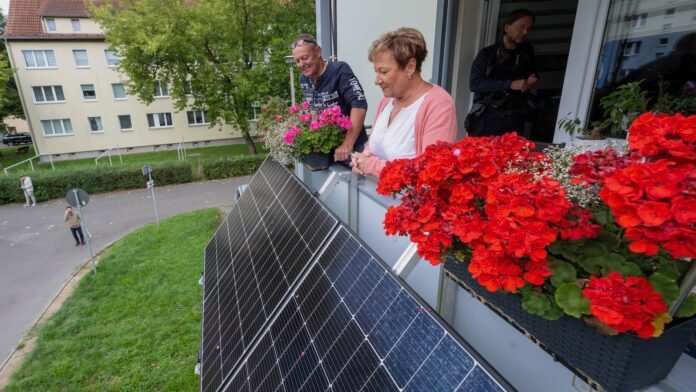
It doesn’t have to be this way. Countries like Germany have encouraged the proliferation of balcony solar, also known as plug-in solar: smaller, cheaper arrays that hook into a home’s electrical outlets. This offsets some of a residence’s energy use, saving users hundreds of dollars a year, and opens up solar energy to renters with balconies or backyards. As a bonus, the less power homes have to draw from the grid, the less stress they put on the system, especially during heat waves when everyone is running energy-hungry air conditioners.

On Wednesday, California officially got in on the balcony-solar action as Governor Gavin Newsom signed a bill allowing residents of the nation’s most populous state to adopt the technology. It joins a handful of states, like Utah and Maine, in seeing the potential of the technology to generate clean electricity and save residents money as energy costs rise.

“This technology is very important and very powerful,” state Senator Scott Wiener, who authored the legislation, said during a press conference Thursday. “And what this bill does is eliminate the massive barrier to people using plug-in solar, which is that you’d have to go and negotiate an interconnection agreement with PG&E [Pacific Gas and Electric Company] or the other utility.”

The proliferation of plug-in solar marks a fundamental shift in how the electrical grid operates. Historically, utilities have generated electricity by burning fossil fuels like coal and natural gas. When demand rose, like when people returned home at the end of the day and switched on appliances, they’d just ramp up production. This kept the system in a sort of equilibrium, a constant balance of supply and demand.

That, though, doesn’t quite work the same with renewables like wind and solar. If demand is holding steady and the sun is setting, a utility isn’t generating as much electricity with its panels. Same with wind, if the skies suddenly calm. So in addition to building out wind and solar farms, utilities are deploying huge batteries to save that energy for later use. This creates a more flexible grid that can still hum with electricity when things are dark or calm.

This transformation is turning you, the consumer, into a more active participant in the grid. For years now, homes with solar have sent excess energy back to the grid. While plug-in solar might generate a fraction of what you’d get from a roof covered in panels, it can still help make the grid more flexible. Instead of feeding the system, it reduces the amount of electricity drawn from the grid. Scaled across a whole city, these small reductions can add up, offsetting some of the growth in demand from things like AI data centers and electrification. (Think induction stoves needing electricity instead of natural gas, and EVs charging instead of burning fuel.) 

“This is one of the most immediate, concrete, tangible, real, and affordable things that we can do to start to get control of our high energy costs, but also save our planet,” Bernadette Del Chiaro, senior vice president for California at the nonprofit Environmental Working Group, said during the press conference. “So it’s really a twofer.”

Basically, plug-in solar could help reduce congestion in the system at peak times — when it’s hot out and everyone’s running their AC, there’s also plenty of sun to strike the panels. It’s turning homes and apartments into a distributed network of tiny power plants. “It’s really ideal to use renewable electricity exactly where it’s generated,” said Amanda Smith, a senior scientist focusing on the built environment at Project Drawdown, a climate solutions nonprofit. 

This increased interactivity in the grid comes as utility bills continue to skyrocket. Basic plug-in solar systems will set you back a few hundred dollars, and you can potentially make back that money with energy savings in around four years. (The higher the energy costs in your state, the quicker you’d get that return on your investment.) Still, for a lot of households, that’s a major investment, so ideally a state also provides rebates for people to adopt the technology. 

With California now aboard the plug-in solar train, your state may well follow. “The big reason this is a big deal really is because it’s the most affordable way for people to actually participate with solar PV,” Smith said. “Whatever happens in California is going to influence, I think, a lot of other future state markets. So it’s going to be a key one to watch.”


Blame AI for global bond market tremors

0
blame-ai-for-global-bond-market-tremors
Blame AI for global bond market tremors

AI spending and US Treasury yields are trending sky-high. Image: Sven Hansche / Shutterstock via The Conversation

The global bond markets are a sensitive lot. And they’ve been having a particularly tricky time lately.

Spooked by high inflation, high interest rates and high levels of government debt across the world, those markets have become less stable over the summer. The prices of government bonds – what governments sell to investors – have gone down. And yields – the amount of interest governments need to pay to those investors over a set period of time – have gone up.

This means it’s now more expensive for governments to borrow the money they need to pay for all the things governments need to pay for.

In the US for example, the interest rate that investors charge the government for a ten-year bond has risen to 5%, its highest level for almost 20 years. Ten-year borrowing costs in the UK and France are also at their highest levels since before the global financial crisis of 2008.

Some analysts blame governments themselves for this rise because of their persistent budget deficits, where spending outstrips tax revenues, forcing them to lean heavily on bond markets to plug the gap.

But budget deficits have been commonplace for years. Neither the UK nor the US has managed to run a budget surplus since 2001. So why are global financial markets only now beginning to react?

A big part of the answer lies in an imbalance between the demand for borrowing and the supply of capital available to finance it. Governments have borrowed heavily from capital markets for much of the past two decades and, until recently, faced relatively limited competition for that capital.

But the boom in AI investment is beginning to change this. Companies, particularly in the US, are borrowing heavily – to the tune of trillions of dollars – from financial markets to fund the construction of data centers and investment in AI research and development, plus the infrastructure needed to support it.

So governments are no longer the only big borrowers at the table. And while global capital markets are enormous, the pool of money available to lend is not infinite.

As governments and companies compete for that capital, investors can demand a higher return for providing it. The result is higher borrowing costs across the economy – including for governments.

Benchmarks for borrowing

The level of government bond yields provide an important benchmark for borrowing costs across the economy – for businesses and households.

For governments, higher bond yields increase the cost of servicing government debt. That can effectively reduce spending on public services as money is diverted away from education and healthcare in order to pay the interest on outstanding debt.

In the US, official forecasts predict that the government cost of paying interest on its debt will double over the coming decade. US debt interest payments already cost more than annual military spending.

This is why relatively small movements in government bond yields can matter so much. The rise in US ten-year yields from 4.3% to 5% may not sound dramatic, but when those higher borrowing costs are applied across trillions of dollars of debt, the consequences for the taxpayer can quickly become significant.

And bond markets, once provoked, can be hard to placate. With the current enormous appetite for AI investment, something will need to change.

Screen showing currency figures.
‘The name’s bond. Government bond.’ Westlight/Shutterstock via The Conversation

For years, governments have been able to rely on global financial markets to finance persistent deficits relatively cheaply. But this cannot be taken for granted. As competition for capital intensifies, governments may increasingly find that investors are no longer willing to finance ever-growing borrowing needs on such favorable terms.

Comments by the US Treasury Secretary, Scott Bessent, that the US government deficits had probably peaked ended up being a source of much derision in financial centers around the world.

Bessent has since tried to back his warm words with hard action by announcing a US$6 billion program to bring down borrowing costs by buying back bonds. But given that US government debt stands at over $40 trillion, it will have a limited effect.

Higher tax revenues or lower government spending would certainly help. And an improvement in the long-term fiscal outlook could reassure investors that government borrowing is on a more sustainable path, helping to bring borrowing costs back down.

The difficulty is that good fiscal economics can make for bad politics. Voters rarely thank governments for raising taxes or cutting public spending, particularly when the benefits may not become apparent for several years.

Politicians therefore face an uncomfortable choice. They can take difficult decisions today to reassure bond markets, or postpone them and risk paying a higher price for borrowing tomorrow.

Alex Dryden is a PhD candidate in economics at SOAS, University of London.

0FansLike
0FollowersFollow
0FollowersFollow
0SubscribersSubscribe
- Advertisement -
Google search engine

Recent Posts