A European passenger flight turned terrifying when a smaller jet suddenly dropped thousands of feet after flying into powerful “wake turbulence” reportedly left behind by an Emirates superjumbo jet nearly nine miles away.
Six people were injured in the frightening mid-air incident, including five passengers and one flight attendant, after Eurowings Flight 635 was hit by turbulence on Saturday, May 30.
The flight had taken off from Rhodes, Greece, and was headed for Cologne, Germany, when the ordinary trip suddenly turned into a nightmare in the skies.
According to FlightAware, the Eurowings plane left Rhodes Diagoras Airport around 10:30 a.m. local time. The aircraft, an Airbus A320-200, was carrying 157 passengers.
While flying over Bosnia and Herzegovina at about 36,000 feet, the crew was reportedly cleared to climb another 2,000 feet.
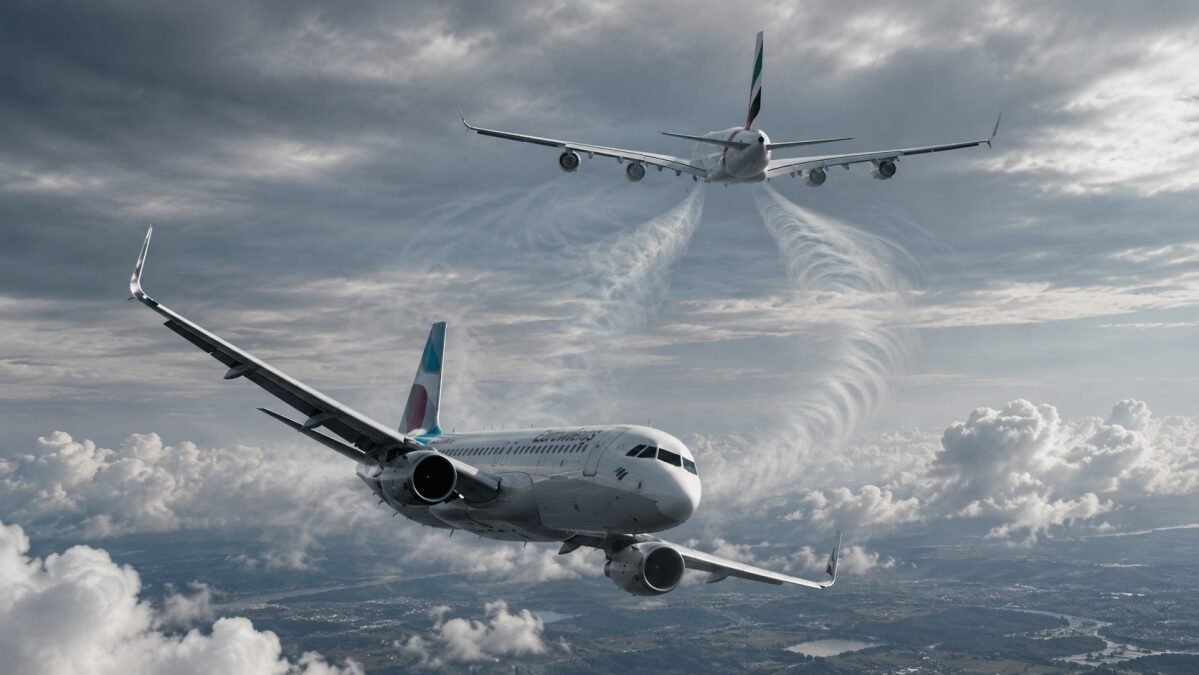
But ahead of the Eurowings jet was an Emirates Airbus A380-800, the massive double-decker plane known as the world’s largest passenger airliner.
The Emirates aircraft was flying from Dubai to London at 38,000 feet and was about 7.6 nautical miles, or roughly nine miles, in front of the Eurowings plane, according to The Aviation Herald.
Moments later, the Eurowings aircraft suddenly stopped climbing and began falling at a rate of about 3,000 feet per minute.
The plane eventually regained control at around 36,000 feet, but not before the terrifying drop left several people hurt.
A Eurowings spokesperson confirmed the incident and said the plane had encountered “brief wake turbulence.”
Wake turbulence is one of the hidden dangers of air travel. Every aircraft creates it, but larger planes can leave especially powerful invisible air currents behind them.
The Federal Aviation Administration says wake turbulence forms when strong rotating air vortices trail behind an aircraft. Those swirling forces are sometimes described as invisible tornadoes in the sky.
They can be especially dangerous for smaller aircraft flying behind a much larger jet.
The FAA says wake turbulence can cause “possible injury to occupants” of trailing aircraft and warns pilots to stay alert when flying behind another plane.
The strength of those invisible air currents depends on an aircraft’s weight, speed, wingspan, and wing shape. Planes classified as “heavy” or “super” require extra caution.
In this case, the Emirates A380 was the giant in the sky.
Even more unsettling, officials say the planes were apparently separated by more than the required minimum distance.
International Civil Aviation Organization guidelines state that aircraft should have at least seven nautical miles of lateral separation when one plane climbs or descends through the level of another.
The Eurowings aircraft was reportedly 7.6 nautical miles behind the Emirates jet.
That means the aircraft were operating within the guidelines, but the smaller plane was still shaken by the wake turbulence.
According to The Aviation Herald, one flight attendant was thrown against the cabin ceiling during the incident.
Despite the injuries, the Eurowings jet continued on to Cologne Bonn Airport.
When the plane landed, medical crews were waiting.
“The affected passengers and crew member were met and treated by medical personnel immediately after landing,” a Eurowings spokesperson said.
The airline added, “We regret the incident and wish those affected a speedy recovery.”
The German Federal Bureau of Aircraft Accident Investigation confirmed the incident has been reported. Officials said they will work with authorities in Bosnia and Herzegovina, who are expected to lead the investigation.
Emirates has not yet publicly commented on the incident.
For passengers, the ordeal was a chilling reminder that not all turbulence comes from storms.
Sometimes, the danger is invisible — and left behind by a giant aircraft miles ahead.