Choices that will define Asia’s AI future are coming into focus
We are fortunate to live at an incredible moment in history. As more and more AI applications have become available, people have turned to them to seek advice, build businesses, express ideas, learn, and improve their health and quality of life.
Nowhere is this more clear than in Asia. AI is already turbocharging small businesses here. We commissioned YouGov to survey nearly 4,000 small business owners across nine Asia-Pacific markets, and 84% told us their business already uses AI, with 58% using it at least a few times a week.
Of those using it, 76% report a positive impact on productivity and 71% on revenue or sales — against 6% reporting a negative one.
More striking is what they say it changes. The vast majority say AI lets them do things that once required significantly more money or resources, and 80% say it helps them compete with much larger companies.
It is not only the smallest firms. M1, a Singaporean telecoms operator, rebuilt its phone pre-ordering as a conversational journey on WhatsApp rather than a queue and a call center. Sales rose 55%, and the time customers spent ordering fell by more than 60%.
The same is true in science and medicine. JAMSTEC, one of the world’s leading ocean research agencies, used Meta’s open model Llama in its work monitoring how the climate is changing around Japan’s coasts. In South Korea, researchers at Seoul National University use another of our open models to interpret medical scans.
Superintelligence is the next chapter in this technology’s evolution, which brings two questions into focus. How do we spread the remarkable benefits of this technology as widely as possible? And how do we make sure it is built safely and behaves in a way that is aligned with what people want?
On spreading the benefits, Meta’s aim is for everyone to have access to an exceptionally capable agent that understands you and your goals, whoever you are, wherever you live.
That’s why we built our agent Muse, which will be available in Singapore, Japan, South Korea and Australia soon. Think of it like having a super smart sidekick working tirelessly for you, that you have complete control over.
And we want everyone to be able to use advanced AI models to create things tailored to the needs of their communities and their societies. But a technology only a few institutions can build is not going to serve everyone.
That’s the case for open models, which let developers, universities, countries, and individuals download advanced AI models for free. It’s no coincidence that JAMSTEC and Seoul National University’s medical scanning program were built on Meta’s open models.
Open models let people and institutions in Asia fine-tune on local data, run it on domestic infrastructure, and work in their own language, without building a frontier lab from scratch.
Build on an open foundation and, if that foundation disappears tomorrow, you still have what you built and can use it without anyone’s permission. Closed models offer access, not sovereignty. If an API disappears, you have nothing.
On safety, openness is an advantage rather than a concession. For most categories of risk — cybersecurity above all — the open-source record is clear: broad access lets far more people find and fix problems than any closed process can, and it puts powerful models in the hands of the defenders.
By allowing researchers, developers, and policymakers to scrutinize and improve AI models, it helps ensure they have high standards of transparency and accountability.
Every lab has both the responsibility and the incentive to train its models carefully. People will not use an agent that is misaligned with them, so trust is fast becoming the capability that separates one model from another.
That is why we delayed shipping Muse for several months to concentrate on safety and security. Other labs can do the same. And it’s why we were happy to commit – alongside other leading AI labs – to institute a set of controls to ensure we are building AI responsibly.
While some around the world are reacting to fears about AI with regulation that stifles innovation, many governments across Asia are choosing policy grounded in science rather than reaction. Japan’s AI Promotion Act rests on principles, official guidance, and voluntary cooperation rather than rigid enforcement.
South Korea has legislated, building its framework around promotion and trust, and concentrating its rules on the highest-impact systems. Singapore launched the world’s first Model AI Governance Framework for Agentic AI and is leading the development of Guides for AI Governance and Ethics at ASEAN.
We believe this future should be for everyone, with superintelligence available broadly and people building for their communities and their societies with open models. That won’t happen by accident.
The choices being made now about how to regulate this remarkable technology will be hard to unmake. Policymakers should meet this extraordinary moment with optimism. Demand openness, demand responsibility, and demand access for everyone.
Joel Kaplan is Meta’s chief global affairs officer. He will be speaking at the 2026 Milken Institute Asia Summit.
Judge weighs if Trump can charge $100K for early access to Truth Social posts
Likely in the next few weeks, a federal judge will decide if Donald Trump can become the first president to personally profit from selling early access to government information in his social media posts.
At a hearing Wednesday, Department of Justice civil attorney Brantley Mayers argued that there was no conflict whatsoever with Trump charging up to $100,000 monthly for instant API access to Truth Social posts that often break news from his administration.
Trump is the largest stakeholder and majority owner of Trump Media & Technology Group, the parent company that owns Truth Social, and the value of the API access comes largely from Trump’s role as president.
News groups suing have argued that Trump’s exorbitant API fees violate the First Amendment and the Presidential Records Act by creating tiers of access to government information in social media posts that Trump doesn’t technically own. Additionally, Trump’s exorbitant API fees undermine the Fifth Amendment. That prohibits the government from “charging unreasonable sums that cannot be justified to offset the cost of the government benefit, and granting preferential access to crucial government information for arbitrary and irrational reasons,” news groups argued.
However, Mayers likened Trump’s Truth Social posts—which have announced military strikes, ceasefires, tariffs, immigration policies, and major changes in his administration—to Franklin D. Roosevelt’s evening radio addresses known as “fireside chats,” Courthouse News reported. His personal feed acts as an unvarnished public service, not a greedy profit grab, the DOJ argued.
It’s clear, though, that Trump could potentially make $1.2 million per subscriber annually by selling government information that is not Trump’s property. Before Mayers could proceed, US District Judge Paul Oetken “cut him off,” Courthouse News reported.
“Well, President Roosevelt didn’t charge money for his fireside chats, did he?” Oetken asked.
Responding, Mayers suggested that although Roosevelt didn’t charge for his broadcasts, there were similar “barriers to entry” keeping every American from tuning in. Just as some news groups today can’t afford to pay $60,000 to $100,000 for Truth’s API, some Americans in the ‘30s and ‘40s couldn’t afford radios, he argued.
Nikhel Sus, chief counsel for a group representing news plaintiffs called the Citizens for Responsibility and Ethics in Washington (CREW), told Ars that the judge was right to push back on the DOJ’s comparison. During the hearing, the judge acknowledged that the Truth API could be discriminatory by creating “two classes of people,” Courthouse News reported. Sue said that he also clearly recognized the “symbiotic relationship” between Trump and Truth Social.
Criticizing the comparison to FDR’s fireside chats, Sus told Ars that the DOJ “can throw out these hypotheticals that have absolutely nothing to do with this situation until the cows come home, but they’re not persuasive.”
Judge asks if a second of delay is “negligible”
At the hearing, Oetken asked “tough questions” of both sides, Sus told Ars. No elected official has ever owned a media company where they can profit off presidential announcements, and the judge took time to remark that “there hasn’t really been anything like this case.”
Talking to Ars, Sus argued that the lack of precedent should trigger alarm bells, not excuse the conduct, as the DOJ has suggested. “Just because no prior president had the gall to try to do something so flagrantly corrupt and illegal doesn’t mean that it is legal,” he said.
Initially, Oetken approached claims that the API scheme violated the First Amendment with skepticism, Courthouse News reported. At one point, he wondered if Trump delaying the general public’s access to information by potentially as little as a fraction of a second would meaningfully harm the free press. Although it’s easy to see how an algorithmic trader would benefit from getting information just a little bit sooner, “It’s a negligible delay to a human being,” Oetken suggested.
But the conflict isn’t only about timing, nonprofit news organizations have argued. TMTG has confirmed that large news groups are already in talks to buy API access because there is immense value in the service that goes beyond getting instant access to Truth Social posts. For example, the API “provides a machine-readable feed and a historic archive of all of President Trump’s Truth Social posts,” Sus told Ars. With that access, even if Trump deletes posts—which he frequently does—any news group can maintain a more reliable log of all posts.
“It is absolutely worth something,” Sus told Ars. “And it’s not just the algorithmic traders. News outlets use APIs too.”
The judge sees the case as complex and did not rule from the bench, instead promising a written ruling on whether to enjoin Trump from selling API access while he’s in office at a later date. Sus told Ars that courts typically treat requests for preliminary injunctions urgently and that he expects a decision in the next few weeks.
Until then, news groups remain optimistic that the court’s ruling will swing their way, Sus said.
“All we’re asking for is that when the president chooses to make government information available to the public, he has to do so on equal terms,” Sus said. “He cannot discriminate based on who’s willing to pay the president’s personal company hundreds of thousands of dollars. That is obscenely corrupt and unconstitutional.”
API gives news orgs a “direct advantage”
Defending Trump’s scheme, Mayers asked the judge to look at Trump’s interests as wholly separate from the media group that bears his name. He claimed Trump had nothing to do with the decision to charge for API access to his posts, branding them as a “completely private commercial decision” made exclusively by TMTG.
Nonprofit news groups suing, however, have argued that the expensive API pricing is “corrupt,” ignoring America’s long history of providing equal access to presidential records. On Wednesday, David Schulz, an attorney representing The Intercept, argued that the scheme gives a “direct advantage” to newsrooms that can pay the high price for previously free access.
“Trump Media specifically is courting the largest news organizations in the country to get them to subscribe to Truth API,” Sus told Ars.
If Trump’s gamble pays off and the judge approves the API sales, Sus warned that the press would suffer, as more politicians could follow his lead and access to even more government information would be delayed behind paywalls.
“If the president is allowed to do this, it sets a very dangerous precedent for enabling public officials to profit off of their office and specifically profit off of government information,” Sus told Ars.
France’s Student Protests: What’s Behind the Unrest
The movement: Since late September, students across France have protested education underfunding and blockaded many lycées (high schools for 15-18-year-olds). Hundreds of students, teachers and police have been injured, and thousands have been arrested, including an unknown number of outside troublemakers.
Staff shortages: Students complain of teachers being absent for weeks without replacement. OECD data shows France’s shortages are acute but no worse than elsewhere, and actually milder by some measures, though French teachers are relatively poorly paid.
Dilapidated facilities: Protesters point to run-down buildings, such as classrooms that were “boiling hot” during recent heat waves. The OECD says France spends more per lycée (high school) student than the EU average.
Long school days: Some students resent days lasting until 18:00 and getting home by 19:00 with no time to sleep or study. This stems mostly from long lunch breaks and complex timetables, and it has long been a feature of French school life, so it can’t explain the current eruption.
Other grievances: Some students are also upset about mobile phone bans.
Parcoursup (France’s national university-placement platform) and higher education: The platform is widely seen as opaque. About 80% of each cohort passes the baccalauréat (the school-leaving exam), creating a scramble for desirable courses. Yet 80-90% secondary completion and competition for places are common across Europe, so this doesn’t fully explain the movement either.
Unprecedented scale: Interior Minister Laurent Nuñez called the movement “unprecedented” in the number of schools, pupils and degree of violence. Underfunding and anxiety about the future don’t by themselves account for this.
Considerable risks: Blockading schools is illegal and draws in police and casseurs (vandals). Pupils have been caught in often heavy-handed crowd control, with about 500 arrests during Tuesday’s unrest. PM Sébastien Lecornu insists forces are not ordered to “confront high-school students.”
A tradition of street power: In France, power has often resided on the street as much as in elected bodies, and students know it.
Past student victories:
1990: after a rape at a school in Seine-Saint-Denis (an area north of Paris), mass rallies won roughly €1.2bn (in today’s money) for lycées (high schools).
1998: 500,000 pupils marched, resulting in almost €1bn for school renovation and 14,000 extra staff.
1986 and 1994: protests defeated a university overhaul and a lower youth minimum wage.
2006: weeks of blockades forced the withdrawal of a youth hire-and-fire law, even after it had been passed and signed.
Adult precedent: The 2018-2019 gilets jaunes (yellow vests) uprising led the government to drop a fuel tax rise and approve €10bn in spending.
Limits of the street: The street doesn’t always win. The 1968 student uprising was ended by an election, though lycéens (high-school students) still inherit a culture in which protesters compete with elected officials to be seen as the people’s legitimate voice.
Public support: A BFMTV poll finds 72% of French people consider the demands legitimate and 55% support the movement. Teachers, unions and left-wing politicians back the protesters, and another rally is planned for Thursday afternoon.
A weak government: Macron is an unpopular lame duck, barred from the presidential election in six months. His snap election in June 2024 produced a gridlocked assembly, and Lecornu calls himself the “weakest prime minister” in living memory.
Financial constraints: With a deficit of 5.4% of GDP, rising borrowing costs and public debt at its highest since the 1940s, Lecornu has little room to spend. Unlike past leaders facing street pressure, he has nothing to give, which may be his one asset in the standoff.
Pete Hegseth’s Military of the Future: Defined by AI and an Utter Lack of Oversight
In his “state of the force” address last week, self-styled War Secretary Pete Hegseth coupled his usual attacks on the press, the Ivy League, and “beardos” and “weirdos” with new initiatives that have the potential to reshape the U.S. military for decades: an Autonomous Warfare Command, and an effort to map out the future of warfare called “Project Meridian.” The former, a combatant command devoted to AI-enabled robotic warfare, will have purchasing powers specifically designed to thwart effective oversight. The latter puts defense contractors, tech titans, and weapons merchants in charge of planning the military’s future — producing innumerable conflicts of interest.
The Pentagon has revealed few details about the command or the commission beyond barebones descriptions and Hegseth memorandums. The four-paragraph document that authorizes Project Meridian, for example, says little beyond a decree that the U.S. must “dominate” in “new domains, new ways of fighting” centered on “artificial intelligence, autonomy, directed energy, robotics, [and] biotechnology, among other critical high-tech areas.”
While billed as efforts to promote blue-sky thinking and catapult the Pentagon into the future, former defense officials as well as experts on government contracting say both initiatives are ripe for out-of-control spending as well as waste, fraud, and abuse.
One former official asked how Hegseth’s Pentagon would “plan for future wars when they didn’t plan for the current one,” referencing the failed war with Iran. A second former official foresaw tough sailing for both of Hegseth’s efforts due to institutional intransigence, inertia, and roadblocks that even Hegseth’s repeated purges of top brass would not help overcome.
I, Robot
AUTOWARCOM will be “a new four-star combatant command … built to scale autonomous and robotic capabilities across the joint force,” Hegseth said in a wide-ranging speech rife with Pentagon jargon and juvenile insults. The new command is scheduled to be formally established by October 1, 2027, according to a memo released following Hegseth’s speech at Marine Base Quantico, Virginia.
“The pace of war is changing faster than the processes to support it. Cheap computing, Super Intelligence, and advanced commercial manufacturing have enabled the proliferation of low-cost, high precision strike,” Hegseth explained, using President Donald Trump’s preferred and incorrect term for artificial intelligence before offering up a thunderstorm analogy. “We need bolts of lightning … our existing high-end kill chains,” he said, emphasizing the need for traditional and expensive weapons systems, like the Tomahawk missiles that leveled an elementary school in Minab, Iran. “We also need steady wind and rain: mass drones and other autonomous attritable systems that flip the cost exchange and impose unrelenting pressure on an adversary on the battlefield.”
A money pit in the making, according to the first former Pentagon official, AUTOWARCOM will — according to Hegseth — possess “directed manpower, budget, acquisition authorities and create dedicated military career pathways for Officers and Enlisted personnel.” Hegseth suggested weapons would be tested on battlefields whenever feasible. That former official, who spoke to The Intercept on the condition of anonymity due to his current employment, said to “expect a fiasco financially.”
This was echoed by Gabe Murphy, a policy analyst with Taxpayers for Common Sense. “By Secretary Hegseth’s own admission, the purpose of this combatant command is to cut out the oversight that autonomous systems so desperately need by deploying untested autonomous weapons in combat,” he told The Intercept. “That approach promises to waste a tremendous amount of taxpayer dollars while also endangering service members and threatening the missions they’re tasked with carrying out.”
Hegseth said he anticipated internal resistance within the military to the creation of AUTOWARCOM. Both former defense officials agreed it was a certainty.
Hegseth said that Owen West, who led the Pentagon’s Defense Innovation Unit, and Max Strasiser, a Navy SEAL senior chief and a test pilot, will run the Direct Reporting Portfolio Manager for Unmanned Systems (DRPM-UxS) “under a unique CEO-COO partnership.”
Their “culminating mission” will, said Hegseth, “take place over the course of months, clearing the path for Autonomous Warfare Command.” This will be conducted under a new moniker, Project Agincourt, a nod to a 1415 battle in which outnumbered English forces used longbows to defeat a larger French army, offered no quarter for a time during combat, and then massacred prisoners. (Hegseth has also advocated for offering no quarter to enemies, now a war crime.)
Project Agincourt will set up AUTOWARCOM while it simultaneously “prototype[s] a new construct called Warfighting Acquisition.” Hegseth laid out a move-fast-and-break-things vision for the new command. “This model fuses operators with entrepreneurs in rapid adaptation cycles, while distributing decisions and dollars closer to frontline units and the combatant commands,” he explained. “By removing unnecessary layers, reducing the distance between our warfighters and our world-leading innovators, and then giving the right people the authority to act — Project Agincourt will pilot innovation at the edge, in a way that only Americans can do.”
Both former officials said such an arrangement was likely to lead to both contracting fraud and technological failures.
(Armed) Conflicts of Interest
Hegseth also announced the formation of Project Meridian, an effort to study the future of warfare which he claimed would be “co-led by three of our nation’s best minds,” before clarifying that it would instead be run by Elon Musk, Newt Gingrich, and Palmer Luckey, the founder of the virtual reality firm Oculus Rift and defense contractor Anduril Industries. Assisted by War Department chief technology officer, Emil Michael, the three Trump boosters are tasked with ensuring “America’s long-term military superiority by identifying the capabilities required to achieve absolute technological dominance on the next-generation battlefield.” Hegseth said the project would be completed within 120 days, at which time the group would issue a final public report with a classified annex.
A Republican fundraising bundler partial to Hawaiian shirts and cargo shorts, Luckey fancies himself a techno-war futurist and believes tomorrow’s conflicts will be fought in a “subterranean domain,” with “weapons that move through the crust of the earth.” He says that “Anduril has working prototypes of subterranean systems that can deliver a variety of kinetic, electronic, and other effects.” Luckey also envisions the moon as a future battlespace. He said lunar warfare would resemble that of Robert Heinlein’s 1966 science fiction novel “The Moon Is a Harsh Mistress,” which includes subterranean combat and an electromagnetic catapult that lobs lunar boulders, with the kinetic force of atomic blasts, at the earth.
Anduril has been cleaning up on Pentagon contracts, inking a deal this year with the Army for commercial information technology potentially worth $20 billion. Anduril is also leading a contractor consortium, including the weapons-tech company Palantir — whose Maven Smart System contributed to the Minab school strike — helping build Trump’s “Golden Dome” missile defense system, which is predicted to be a trillion-dollar boondoggle.
Luckey joins Musk, whose firm SpaceX has been awarded billions for a key role in the Golden Dome project, as a defense contractor with a clear conflict of interest in mapping out the future of U.S. warfare. Musk, who donated more than a quarter of a billion dollars to getting Trump elected in 2024 and is providing at least $100 million to help Republican candidates during this election cycle, is returning to government service after flaming out last year as the head of the so-called Department of Government Efficiency. A cost-cutting agency that promised to save Americans trillions of dollars by eliminating waste, fraud, and abuse, DOGE failed to deliver on that promise, wasted taxpayer money, repeatedly misled the public about supposed savings, and may have played a role in hundreds of thousands of deaths.
“There is a genuine need for government reform and modernization, but we saw how Musk’s approach worked out with DOGE,” Murphy told The Intercept. “It failed spectacularly, creating disruptions, payouts for workers not working, firings and rehiring, and a pittance of the savings taxpayers were promised.”
“Project Meridian is an unveiled effort to outsource our future military strategies to individuals and companies that stand to profit most from a hypermilitarized future.”
Luckey and Musk will be joined at the helm of Project Meridian by the 83-year-old Gingrich, who resigned as House speaker in 1998 after admitting that he broke congressional rules and “brought down on the people’s house a controversy which could weaken the faith people have in their government.”
Hegseth announced that a meeting between “a small group” was to take place just after his Wednesday speech in a sensitive compartmented information facility at Quantico. Pentagon propaganda photos from the first meeting show 11 grim-looking men, including Musk, Gingrich, and Luckey, seated around a table as Hegseth holds forth.
The nonprofit MITRE Corporation, which conducts independent research for federal government agencies, announced that it will be coordinating Project Meridian and named 17 current board members beyond the Big Three, including Francis J. “Bing” West, a Vietnam War veteran, who served as the assistant secretary of defense for international security affairs under President Ronald Reagan from 1981 to 1983, and is the father of DRPM-UxS CEO Owen West; Rick Smith, the CEO of Axon, the manufacturer of Taser stun guns, which saw nine of 13 members of its ethics advisory board resign in 2022 over plans for a Taser-equipped drone project (which was then shelved); Joe Lonsdale, a co-founder of Palantir; and Safra Catz, former CEO of Oracle.
“Project Meridian is an unveiled effort to outsource our future military strategies to individuals and companies that stand to profit most from a hypermilitarized future,” said Murphy. “Their security solutions will predictably entail vast expenditures of taxpayer resources on unproven military systems that rely on the AI models and software these companies control.”
Hegseth’s office did not respond to questions about Project Meridian and AUTOWARCOM.
The New 1 Percent
Hegseth made the announcements of both AUTOWARCOM and Project Meridian in front of more than 500 junior officers and enlisted troops at the site where, a year before, he had ranted at generals about fitness and grooming standards, while promoting both Christianity and violence.
In this year’s diatribe, Hegseth touted his overhaul of the military, which has included firings of many top brass and an overwhelming emphasis on physical appearance, masculinity, and troops’ testosterone levels. “We are no longer the Woke Department or the Weak Department. Simple translation of that: No fatties. No trannies. No beardos. No weirdos. No wimps. No radicals,” Hegseth announced. “The ideological clowns are out. The patriotic cowboys are in — with testosterone testing on top.”
Despite laying out a future in which artificial, not human, intelligence will be ever more central to war-making, Hegseth ended his rant by nonetheless praising the troops, casting them as members of a violent and lethal warrior elite that are superior to civilians.
“See, the Ivy League faculty lounges, they’ll never understand you, and that’s OK, because they could never, ever do what you do. The media will mischaracterize you, and that’s OK. Because deep down they know you’re the real reason they live free. They envy you because you do real things every single day,” said Hegseth, an Ivy League-educated war chief who used to work for Fox News.
“You feel comfortable inside the violence. … Lethality is your calling card and victory your only acceptable end-state. The outside world can’t understand this, so stay true to this department. You don’t want to look like civilians, because you are different, you are set apart. You are warriors.” He added: “You are the real 1 percent.”
What Happened: Bipartisan leaders from the powerful House Energy and Commerce Committee launched an inquiry on Wednesday into the Amateur Athletic Union, criticizing the sprawling youth sports organization for its handling of child sexual abuse allegations and demanding answers, citing reporting by ProPublica and The Washington Post.
What They Said: “It is unacceptable that AAU is failing to implement standard reforms to protect child athletes, and is misleading the public, parents, and athletes about preventative measures in place within AAU sports,” the letter reads.
The committee chair, Kentucky Republican Brett Guthrie, called ProPublica and The Post’s reporting “deeply disturbing” in a statement on Thursday, saying it “raises serious questions about the organization’s actions over the past decade.”
“Our Committee is seeking information on how the AAU’s policies have potentially fallen short, and what needs to be done in order to protect young athletes,” Guthrie said.”
The members of the committee, which in 2018 investigated systemic failures surrounding sexual abuse by former USA Gymnastics doctor Larry Nassar and others, said in the letter that they were “seeing parallels” between its past investigation and “what is being uncovered within the AAU today.”
The letter is addressed to Jo Mirza, the AAU’s president, and asks detailed questions about the organization’s operations, taking the extra step of demanding a briefing from Mirza to the committee by Oct. 21. Among questions about its safety policies and coach training, the committee asks Mirza to lay out how many sexual abuse allegations the nonprofit receives each year and how many coaches it disciplines, information that has long been shrouded in secrecy. The AAU declined to provide the data to ProPublica and The Post. The AAU does not publish a list of banned coaches like many other youth sports groups do, and ProPublica and The Post found that it has used confidential arbitration clauses to keep lawsuits from child sexual abuse victims from being heard in open court.
The letter is signed by Guthrie, ranking Democrat Frank Pallone Jr. from New Jersey and representatives in charge of oversight and investigations.
Read More
Background: ProPublica and The Post found that the AAU, which has some 760,000 athletes and coaches nationwide, is failing on nearly every level to adequately protect young athletes from sexual abuse — breaking pledges it made in the wake of a 2011 sexual abuse scandal involving its CEO and young basketball players.
The investigation found that the AAU has become a haven for coaches suspected of abuse, according to a review of public disciplinary lists and interviews with current and former executives from six national sports governing bodies and other key stakeholders.
The AAU, the investigation found, does not offer child abuse prevention training, though it claims to the public that it does. And ProPublica and The Post found that it has suppressed allegations of sexual misconduct, including against another top executive in 2018.
Why It Matters: The committee is one of the key congressional groups charged with overseeing the federal youth sports safety system. It has the power to push for changes in child safety law — and to force transparency from organizations like the AAU, which has repeatedly failed to deliver on past promises of reform.
In 2018, in the wake of the allegations against Nassar, scrutiny from Congress led to the passage of a law known as the Safe Sport Act. It created the U.S. Center for SafeSport, an oversight group, to investigate allegations of sexual misconduct and gave it the power to suspend or ban coaches for life.
But SafeSport has jurisdiction only over national sports governing bodies, like USA Gymnastics and USA Volleyball, that are overseen by the Olympic and Paralympic Committee — meaning much of the law does not apply to the AAU.
The law does require “all amateur sports organizations” — not just governing bodies — to “offer and provide consistent training to all adult members … regarding prevention and reporting of child abuse.” The Energy and Commerce Committee’s letter cites that provision of the law and demands that the AAU explain how it complies.
Response: In a statement, the AAU said, “As always, we will cooperate fully and respond appropriately to any questions or requests from congressional committees or U.S. government agencies.”
Previously, the AAU told ProPublica and The Post that it is “committed to protecting its athletes through comprehensive protection policies overseen by our Compliance Department,” and said it has an “ongoing commitment to providing a safe, secure, supportive, and trusted environment where athletes can thrive.”
Indonesia should count the real cost of its mineral incentives
Every year, the Indonesian government forgoes taxes it could collect. Through tax holidays, rate cuts and exemptions, it courts investment while easing the burden on households and small businesses.
Economists call this “tax expenditure” because giving up revenue is another way of spending public money. The Ministry of Finance expects it to reach 564 trillion rupiah (US$31.5 billion) in 2026, nearly double the 293 trillion rupiah of 2021.
The ministry is now reviewing its tax holidays, which makes this a good moment to ask a simple question about one of Indonesia’s biggest industrial bets: what have tax incentives for processing nickel and bauxite actually bought?
Indonesia banned exports of raw nickel ore in 2020 and of raw bauxite in 2023. The aim has been to force companies to process these minerals at home, a policy known in Indonesia as downstreaming. To attract the capital needed to develop value-adding smelters and refineries, the government offered generous support, mostly taken up by Chinese investors.
Large investors can receive a corporate income tax holiday of up to 20 years. Companies in special economic zones, meanwhile, can avoid import duties and value-added tax on equipment.
A less visible subsidy sits alongside these. Because miners cannot export raw ore, they must sell it to local smelters, often at prices well below the prevailing global market price. The gap transfers wealth from Indonesian miners and regions to smelter owners while appearing nowhere in the national budget. Below-market-price ore also means lower royalties and tax collection for the state.
What does all this cost the nation? Nobody can say precisely, and that is the problem. No official figure combines the tax holidays, duty exemptions, cheap ore, cheap land and public infrastructure that nickel and bauxite processing receive. Indonesia is paying a bill it has never fully added up.
The results of those holidays, exemptions and subsidies to mostly foreign investors are mixed. Nickel has drawn heavy investment, and the energy minister says the industry has brought in $47.36 billion and created 180,600 jobs.
A World Bank study found that an earlier version of the bans increased the value Indonesia added to its exports, but also attracted small, inefficient firms. Much of the output remains in nickel pig iron, a low-value input for stainless steel.
This year, the government even proposed a new export levy on such products to push companies toward higher-value goods, an implicit admission that earlier incentives failed to steer investment where the country needed it most.
Bauxite illustrates a different risk. When the export ban on raw bauxite ore took effect in 2023, Indonesia’s refineries could process about 13.9 million tonnes of it a year, while its mines produced around 30 million. Some miners had to halt operations and sit on piles of unsold ore. Support without a clear plan does not build an industry.
None of this means the government incentives are misguided. Smelters and battery plants are costly and risky to build, and almost every country that has industrialized has helped its firms along the way.
But in the successful cases, such as South Korea, help came with duties. Firms that received support had to export, invest and learn, and those that failed lost it. Indonesia should adopt the same rule: when the state helps a company, the company owes something in return. That requires four changes.
First, count the cost. Each year, the government should publish the full price of its support for nickel and bauxite processing, including tax holidays, duty exemptions and the gap between local and world ore prices. Citizens should be able to see what each large project receives and what it has delivered in return.
Second, attach clear conditions. Support should depend on hiring and training Indonesian workers, from engineers to managers; buying from local suppliers; and bringing research and technology into the country. It should also require compliance with strict pollution and safety standards. Every agreement should set verifiable targets with firm dates.
Third, reward the higher rungs of the value chain. Support should flow to battery materials, battery cells and recycling, not to more low-value pig iron. Fourth, claw back support when promises are broken. A tax holiday should end, or be repaid, if a company fails to deliver what it agreed to.
Another reason to act now is the global minimum tax, which Indonesia has applied since 2025. It requires large multinationals to pay at least 15% tax in every country where they operate. If Indonesia grants such a company a long tax holiday, another country can collect the tax Indonesia forgoes.
That means some tax holidays may now de facto hand Indonesian revenue to foreign treasuries. The Ministry of Finance is already moving toward support that is timely, targeted and temporary. That shift should begin with nickel and bauxite.
Indonesia need not choose between attracting investors and protecting public money. It can do both, provided every rupiah of support brings a clear return to the people who fund it. Such a smarter system would also be fairer to the miners, workers and regions that bear much of the cost uncompensated today.
Bhima Yudhistira Adhinegara is the executive director of the Center of Economic and Law Studies (CELIOS), a Jakarta-based think tank. Muhammad Zulfikar Rakhmat is the director of the China-Indonesia and MENA-Indonesia desks at CELIOS.
SpaceX calls for better coordination in orbit after near-misses with Starlink
Space has plenty of room for more megaconstellations, but only if all operators are willing to share information about where their satellites are and where they’re going, a top executive at SpaceX and its AI subsidiary said this week.
Michael Nicolls, SpaceX’s vice president for Starlink and president of Elon Musk’s artificial intelligence company, xAI, used a presentation Tuesday at the International Astronautical Congress in Turkey as a clarion call for improved data-sharing among satellite operators.
SpaceX’s Starlink constellation now has more than 11,000 satellites, about two-thirds of all active spacecraft in low-Earth orbit. Radars and telescopes routinely track thousands more pieces of space junk.
Starlink is, by far, the largest satellite constellation in operation today. But if you buy the buzz, Starlink is just the tip of the iceberg. SpaceX has revealed plans to launch up to a million satellites for a new constellation, called Starmind, to deploy AI computing capacity in low-Earth orbit. Amazon is in the early stages of launching a network of thousands of satellites to compete with Starlink, and two Chinese megaconstellations are now in full-scale deployment.
Law of large numbers
All of this raises the question of how to mitigate the risk of a collision in orbit, an event that could create thousands more pieces of space junk, potentially triggering a self-perpetuating cycle of debris generation. The risk of a collision on any given day is fantastically low. Space is vast and empty, and low-Earth orbit is a long way from filling up. SpaceX and most other Western operators de-orbit their rockets and satellites at the end of their missions to prevent additional debris in orbit.
“That said, the law of large numbers says that if it can happen, it will happen,” Nicolls said.
There’s still a long way to go to improve tracking, awareness, and coordination in orbit. This is sometimes called space traffic management. No global treaties or regulations require satellites to broadcast their locations and maneuvers or mandate coordination among satellite operators. Without rules of the road, it is up to governments and companies to set norms of behavior.
“Once you can track this debris, and if you can track it well, these are like obstacles on a road. If you can measure them, you can predict where they’re going to be, and you can avoid them,” Nicolls said. “What you can’t avoid is other operators who maneuver without telling you where they’re going to go. We have many examples of this on Starlink, unfortunately.”
Nicolls presented several examples of satellites from other operators closely approaching Starlink satellites as they zip around the Earth at 5 miles per second. The examples did not suggest nefarious intent, such as spying or an attempt at striking a Starlink in orbit. Instead, the other satellites conducted maneuvers and changed their trajectories without their owners informing anyone.
“Either they were not publishing their ephemeris to us, or they were not considering the ephemeris of others when they were maneuvering, and these led to conjunctions of tens of meters to hundreds of meters,” Nicolls said. “Way too close to comfort.”
Michael Nicolls, senior vice president of Starlink at SpaceX and president of xAI, speaks at the International Astronautical Congress in Antalya, Turkey, on Tuesday, October 6.
Credit: International Astronautical Federation
Michael Nicolls, senior vice president of Starlink at SpaceX and president of xAI, speaks at the International Astronautical Congress in Antalya, Turkey, on Tuesday, October 6. Credit: International Astronautical Federation
An ephemeris contains information about a satellite’s location and movement. Some operators may not want to share this information, believing secrecy might provide a competitive or strategic advantage. But if spaceflight is to be sustainable, it is vital to err on the side of openness rather than secrecy.
“The minimum standard in low-Earth orbit needs to be that you know where your satellite is, and you know where it’s going. You need to be able to predict where your trajectory is, and that prediction needs to be reliable,” Nicolls said.
SpaceX lauds itself as the benchmark for orbital stewardship. It pretty much has to be, with so many Starlinks in orbit and so much of its business relying on space.
The company has lowered the altitude of the entire active Starlink constellation below 500 kilometers (310 miles), an adjustment that provides three benefits. It moved the network away from other heavily trafficked regions in low-Earth orbit, expedited reentry for any failed Starlink satellites, and improved service for Starlink customers. All of SpaceX’s new-generation Starlink V3 satellites, which began launching on the company’s Starship rocket last month, will fly even lower, at about 350 kilometers (217 miles).
SpaceX also publishes ephemeris data for its Starlink satellites and has asked other operators to share their data, too. Without ephemeris sharing, operators rely on tracking data or their own satellites’ collision avoidance capabilities.
A camera onboard a Starlink satellite captured this view showing a close encounter with another satellite in orbit.
Credit: SpaceX
A camera onboard a Starlink satellite captured this view showing a close encounter with another satellite in orbit. Credit: SpaceX
Starlink satellites, for example, use onboard navigation cameras to detect other objects in orbit. SpaceX calls the system Stargaze, and it now tracks about 90 percent of maneuvering satellites that intersect Starlink orbits, Nicolls said.
That is good, but it would be better if all operators agreed to be more open about what their satellites are doing. It is now a “fairly common occurrence” that Starlink satellites detect an upcoming close encounter and autonomously maneuver out of the way, Nicolls said. If there’s not enough to steer away from a close encounter, Starlink satellites can hunker down at the time of greatest danger. These “ducking maneuvers” involve pointing the satellite to minimize the chance of a collision, Nicolls said.
Starlink satellites perform about 1,000 collision avoidance maneuvers per day to get out of the way of functioning satellites or bits of space debris. In the last few months, Nicolls said Starlink satellites have steered clear of about 650 active satellites from other operators. Only half of those 650 come from operators that participate in ephemeris sharing with SpaceX, he said.
What about China?
“In particular, it’s been very challenging to share data with international operators,” Nicolls said. “There has been good progress here. There have been some good stories here on how we’ve begun to share data. For example, we share data closely with the Chinese space station as well as some other Chinese satellite operators, but there are many that we do not, and we have no information about where those satellites are or where they’re going.”
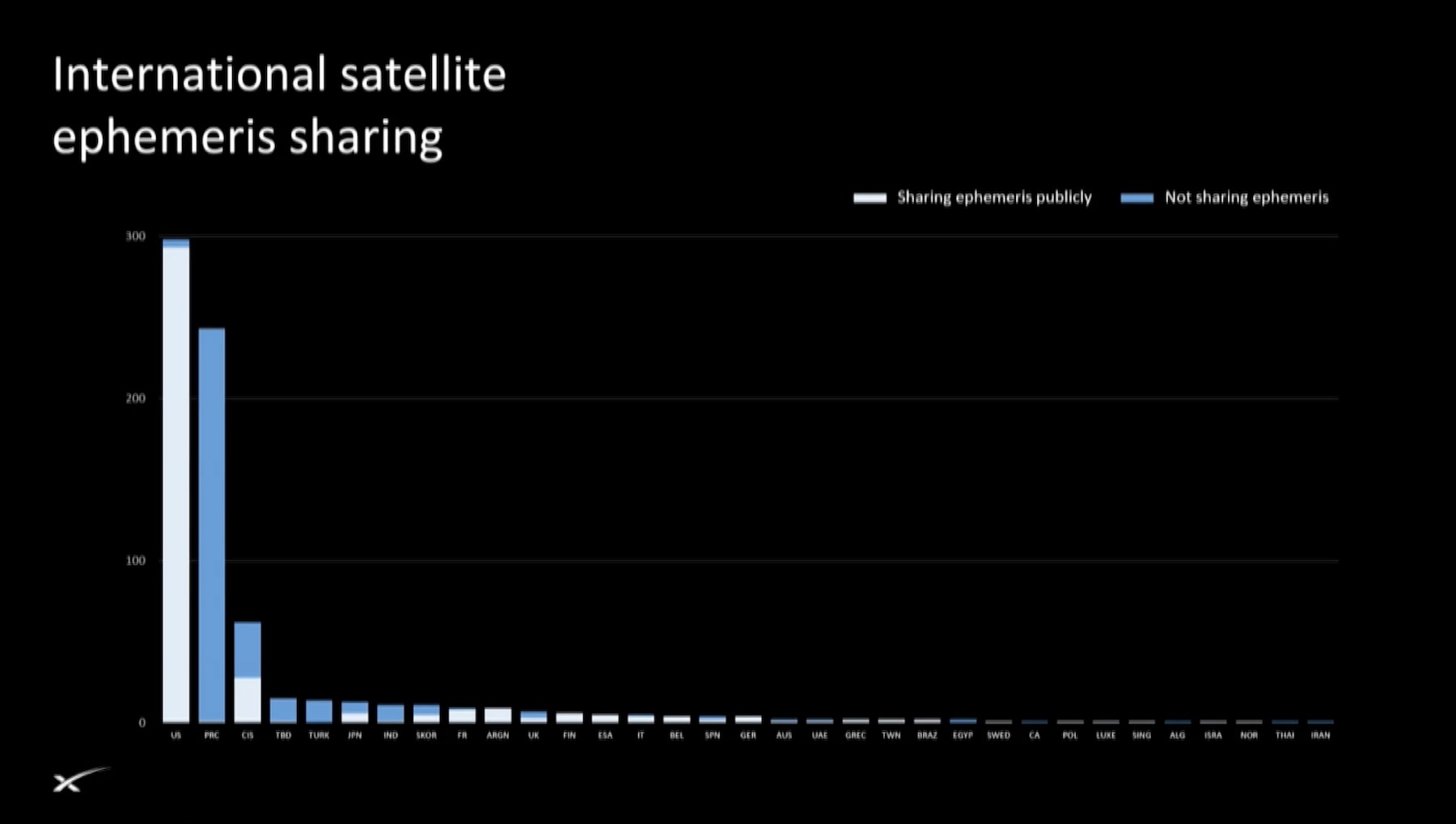
A chart in Nicolls’ presentation suggested the problem largely lies with Chinese and Russian satellites. But some in the United States, Europe, and Japan also decline to share.
“My fundamental ask here is that we need to make headway here and begin sharing data across all vehicles, from whatever country you are, with us and with others, to promote a safe operating environment,” Nicolls said.
Nearly all Chinese satellite operators decline to publicly share their satellite ephemeris data.
Credit: SpaceX
Nearly all Chinese satellite operators decline to publicly share their satellite ephemeris data. Credit: SpaceX
What do SpaceX’s competitors think? Ars asked the head of Amazon Leo, Rajeev Badyal, about coordinating with Starlink, his chief competitor in the satellite broadband market. Amazon has 396 satellites in orbit today, with hundreds more awaiting launch when their rockets are ready to take them to orbit.
“Space safety is paramount to us as well,” Badyal said. “Every launch we do, we actually coordinate with SpaceX. We coordinate with others who have satellites. We let them know where we’re going to drop them off, how we’re going to orbit raise, etc. So we have regular meetings with companies like SpaceX to exchange data.
“So, for us, sharing ephemeris or sharing the information necessary for space safety is a non-issue,” Badyal said. “We’re big proponents of making sure that all of us operate in this domain in space in a coordinated fashion because [the] consequences of not doing so are significant for everybody, and there’s no reason not to.”
Amazon Leo’s first-generation constellation will consist of 3,232 satellites, and the Federal Communications Commission in February approved Amazon’s request for a 4,504-satellite second-generation network. Amazon has filed for FCC approval for an additional 5,105 satellites for direct-to-device connectivity, but the company is still far from matching the size of the Starlink fleet.
“Obviously, SpaceX is the largest constellation out there,” Badyal said. “We work with them hand in hand. In terms of China and adversaries, that’s something I can’t comment on at the moment. At some point, we will have to coordinate, or it’ll end up being a negative thing for everybody, especially if they get to scale.”
The bipartisan energy bill tearing the climate movement apart
In order to solve climate change, you have to do two things — stop burning fossil fuels, and build clean energy to replace them. The last few decades in the United States have witnessed a long back-and-forth over which of the two goals is more important, and over how to achieve either of them. Is it more important to pass a carbon tax, or subsidize electric vehicles? To block a new oil pipeline, or build a lot of solar and wind?
On this question, the coalition known as the climate movement has fractured into two broad groups. On one side, there are activists, lawyers, and environmentalists, who tend to focus on blocking and reducing fossil fuel use. On the other, there are renewable energy companies and policy wonks, who tend to focus on building more clean energy.
These factions have clashed in the past, but over the past week a kind of civil war has erupted between the different elements of the climate movement. The inciting incident was the release of the Bipartisan American Affordability and Jobs Act, or BAAJA, a long-awaited Senate bill that is designed to enable the construction of more power plants, transmission lines, and gas pipelines. The bill does this by weakening some of the nation’s bedrock environmental laws, speeding up the timeline for government agencies to issue permits, and making it harder to cancel projects that have already gotten federal approval.
For climate-conscious supporters of the bill, it’s better for the planet to build a lot of clean energy even if it means some fossil fuels get built as well, and even if they cause some damage to the environment on the way. Supporters of the effort argue that if the U.S. builds out new clean capacity, it will be easier to wean off fossil fuels, which are the primary cause of global warming and all its myriad consequences. Opponents say that’s a Faustian bargain, one that will jeopardize tribal nations, other marginalized communities, and endangered species.
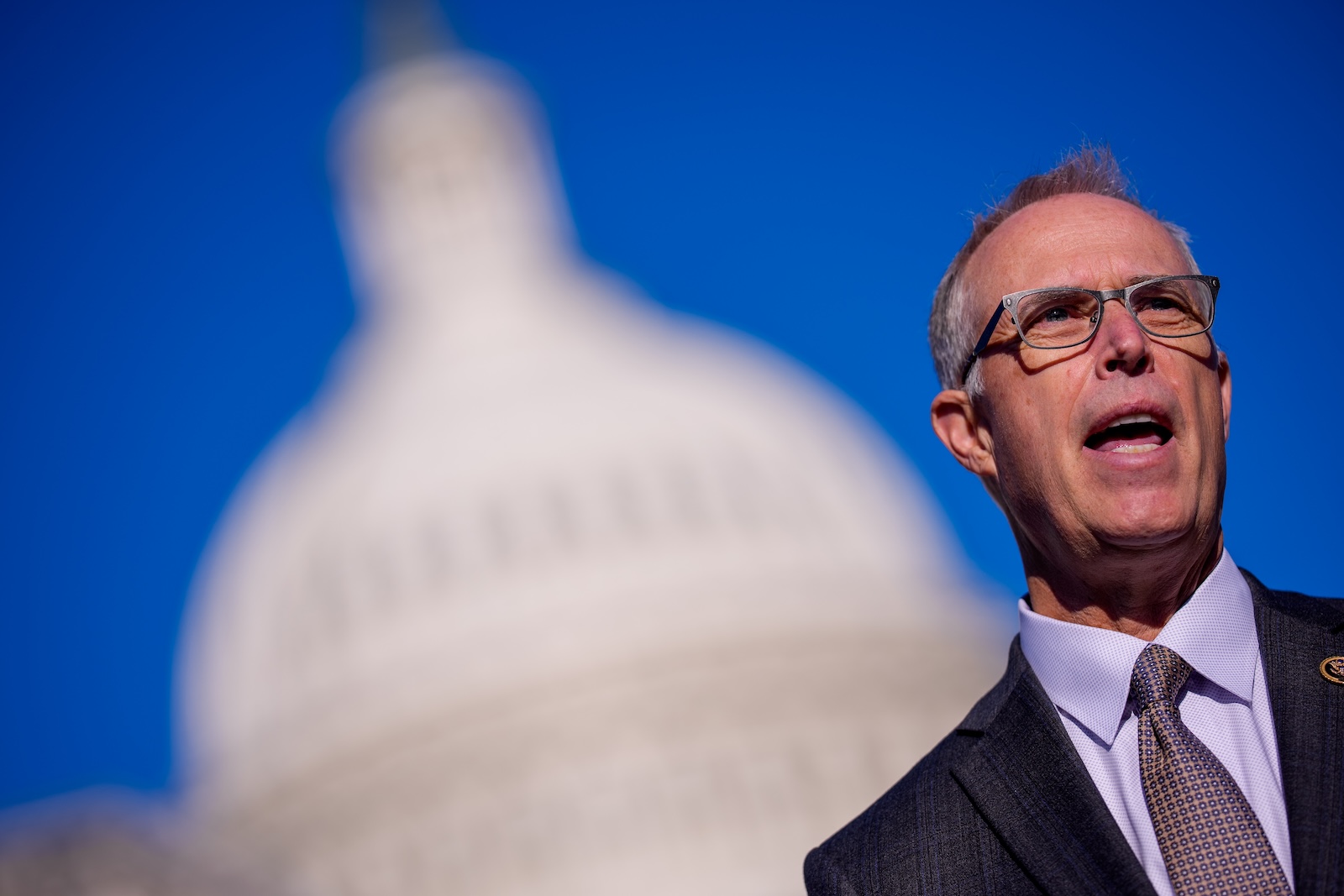
“It is definitely exposing a potential fault line between the environmental community and clean energy interests,” said Representative Jared Huffman, a Democrat who represents Northern California, in an interview with Grist.
Representative Jared Huffman, a Democrat from California, is skeptical of the Senate permitting reform bill. Photo by Andrew Harnik / Getty Images
BAAJA is the product of months of bipartisan negotiation between four members of the Senate committees focused on energy and the environment. The two Democrats in the talks were Sheldon Whitehouse of Rhode Island and Martin Heinrich of New Mexico, who are both climate hawks and clean energy advocates. The Republicans were Mike Lee of Utah and Shelley Moore Capito of West Virginia, who are advocates of fossil fuels and critics of environmental regulation. Despite their ideological differences, the four senators managed to reach a compromise on a sprawling 400-page bill with hundreds of individual provisions.
The so-called “four corners” reached a deal just before Congress left for its fall recess, and the Senate will not return to take up the bill until after the midterm elections. The bill has not even made it through committee yet, and it also faces an uncertain fate in the House of Representatives. The next few weeks will see a scramble of lobbying as supporters and opponents of the bill try to sway senators and representatives for or away from the bill.
So far, at least, the builders seem to have more influence than the blockers, at least within the climate movement. President Donald Trump has spent the last two years repealingmostfederalclimate policy and blocking the development of new clean energy, and many climate advocates seem willing to accept an imperfect deal rather than hold out hope of fixing Trump’s damage after he leaves office.
“It’s a lot easier to prevent things from being built than to build things, and that applies both to fossil fuels and to renewables,” said Zeke Hausfather, a climate expert at the science nonprofit Berkeley Earth, who also directs climate research for the tech company Stripe. “I don’t want us to run roughshod over any community, but we also can’t give everyone a veto for an issue as important as climate change. So ultimately, we need to strike a balance there.”
The case in favor: Build more
A big challenge with building clean energy is that it takes up a lot of space. Solar farms and wind farms can cover thousands of acres of land, and the transmission lines that carry their power to cities can extend for hundreds of miles, covering far more territory than coal and natural gas plants do. This large footprint makes these projects more likely to touch federal lands or waters, which triggers a series of obligations under the National Environmental Policy Act, the foundational environmental protection law also known as NEPA, and other laws that protect endangered species and historical artifacts. Under NEPA, federal agencies must carry out an extensive analysis of a project’s environmental impacts before issuing or denying a permit for it.
That review process often inspires time-consuming litigation. Opponents can bring lawsuits against an agency even years after a review is complete, arguing the review wasn’t comprehensive enough, and they can ask courts to halt the project until the agency redoes the analysis. A 2025 study found that 64 percent of solar projects, 38 percent of wind projects, and 31 percent of transmission line projects face NEPA lawsuits.
This litigation can come from almost anyone, and can cover almost any conceivable impact from a project. On one end of the spectrum, a coalition of tribes and environmental groups sued the developer of the SunZia transmission line. The line carries much-needed wind power to Arizona and California, but the plaintiffs wanted the developer to reroute the wires away from a holy cultural site, an effort that was ultimately unsuccessful. On the other hand, opponents of a wind project in California delayed development for years by suing on the grounds that a federal agency had failed to consider pseudoscientific theories about wind turbines creating dangerous electromagnetic fields. Both projects were ultimately completed, but years behind schedule.
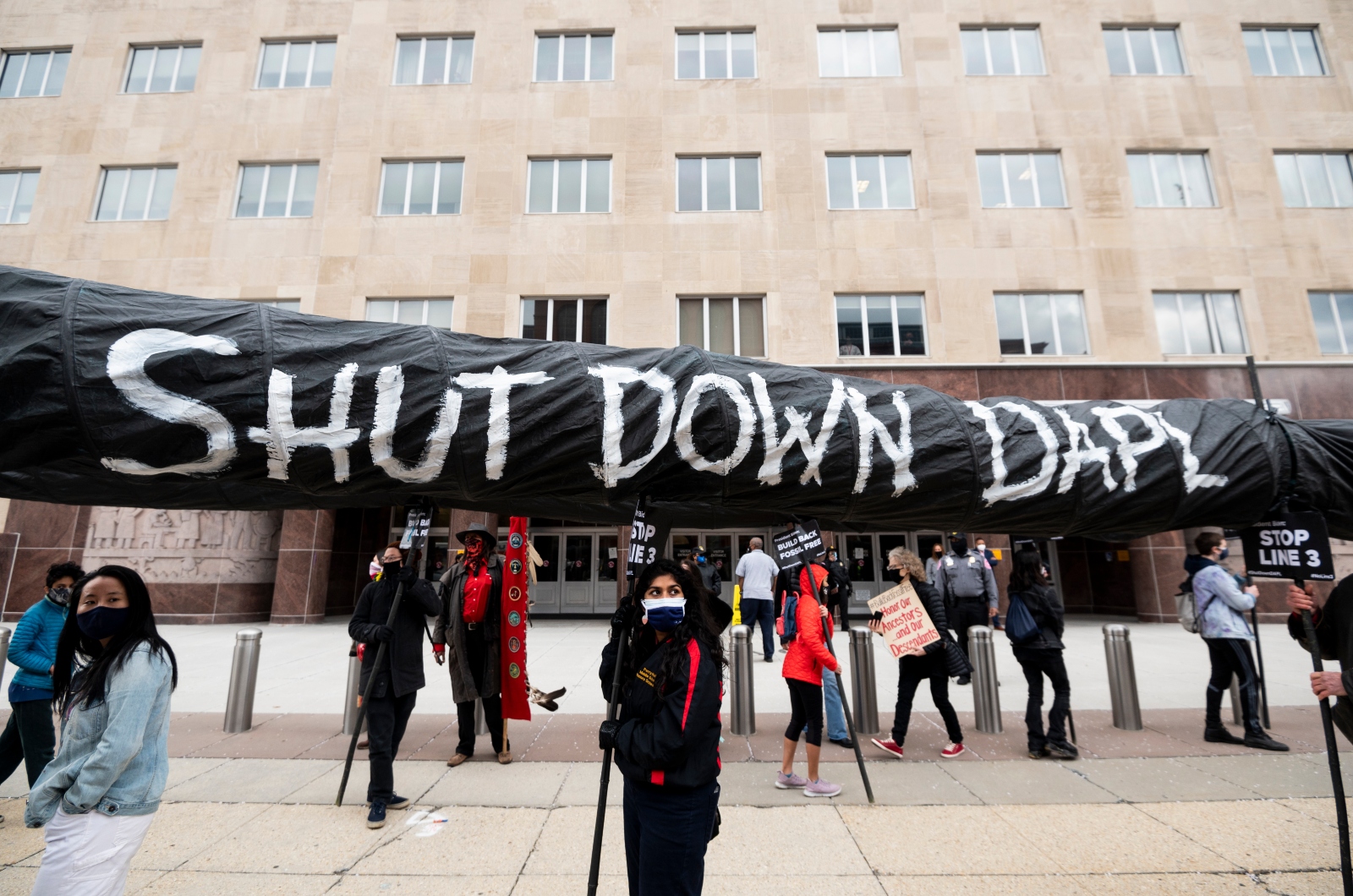
block the Keystone XL oil pipeline and to pause the construction of new liquefied-natural gas terminals on the Gulf Coast, while Democrats have watched the second Trump administration use dubious executive authorities to halt the construction of solar and wind farms on federal lands and waters. One provision in the bill would help developers seek compensation if they can establish that the government has discriminated against a specific project type, like offshore wind, through delayed and canceled permits.
“This president has found ways to skirt the edges of every law that we have, and his attacks will continue,” said Kris Ohleth, executive director of Special Initiative on Offshore Wind, a pro-offshore wind nonprofit research group. “But at least if developers know they can recoup some of their development costs, as this bill might allow, it’s more appealing for them to return to the market.”
What’s arguably the most important thing in the bill doesn’t have to do with permitting per se. It’s about the massive transmission lines that carry electricity from region to region. The United States has built very few of these interstate lines in recent years. This dearth of new wires has made it infeasible for developers to build more solar and wind.
“Historically, it didn’t matter too much where power plants were located, so we built them close to where the power was needed,” said Chirag Lala, vice president of research and chief economist at the Center for Public Enterprise, a think tank. “But we don’t have that same luxury with clean energy, which can be very location-specific. If you’re going to rely on those resources, you have to ship the power over long distances.”
High-voltage transmission lines run through the Central Valley of California. The bipartisan permitting bill would overhaul federal rules for transmission, requiring utilities to plan for more lines that move clean energy around the country. Photo by Jay L. Clendenin / Getty Images
BAAJA would force utilities and regional grid operators to plan for interregional transmission lines, and would let private developers (like the one behind SunZia) come in and build lines themselves if utilities don’t build enough. The bill would also clear away a number of procedural roadblocks that have allowed utilities to block interregional transmission.
The Democrats who negotiated the bill and the climate experts who support it see these provisions as a sea change for clean energy. If the bill passes, it could unleash solar in Nevada and wind in the Dakotas, and then bring that power to places like Appalachia that have little solar or wind potential of their own.
The case against: Stop the damage
But while the clean energy industry has celebrated the bill’s effort to speed up permitting for new power plants, many environmental groups have condemned it. These groups argue that the changes would allow for a surge of new development near disadvantaged communities, and will leave residents with no legal recourse to stop that development.
These groups argue, in essence, that the bill sacrifices many communities in places like the Gulf South in order to achieve an overall nationwide increase in the supply of clean energy.
“That battle between fossil fuels and renewables is not going to necessarily go well for the people of our region, especially if you take those regular protections that we’ve relied on for years away,” said Liz Zepeda, the director of federal policy at the Southern Environmental Law Center, an environmental law group that represents six states in the Southeast.
The permitting changes have also drawn intense criticism from Indigenous groups, who say that the narrowing of historic preservation law would deprive tribal nations of a voice in development decisions. By the time that tribes learned about a company’s plans for a new transmission line or solar farm, it could be too late for them to protect culturally important sites.
“These changes will reduce opportunities for Tribal Nations to learn that an infrastructure project is occurring or to participate before decisions are made, all but guaranteeing that construction or other activities affecting sacred places can proceed without meaningful Tribal involvement,” said Valerie Grussing, the executive director of the National Association of Tribal Historic Preservation Officers, a group representing tribal officials who advise federal agencies on protecting Indigenous historic sites during project development.
The bill would constrain litigation on behalf of endangered species and would also weaken states’ power to stop development under the Clean Water Act. This latter state power has been used in the past to take down old hydropower dams, like the ones on the Klamath River, and that would now be harder.
BAAJA would also allow mines on public lands to unload excavated rock and waste materials on adjacent land. Mining is essential for clean energy development — solar panels, wind turbines, and EV batteries all need metals and minerals — but some environmental groups worry about the impact on local ecosystems.
Builders vs. blockers
BAAJA’s fate is far from guaranteed. In addition to the opposition from influential groups like the Center for Biological Diversity, there are a number of House members who have expressed uncertainty about the bill. At least one senior Republican, Brett Guthrie, has said he opposes the effort to force new transmission lines, and major utilities will likely oppose that provision as well. On the Democratic side, Huffman, the representative from California, told Grist that he thinks Democrats can likely get a better deal after the midterms.
“The idea that this is this once-in-a-lifetime great opportunity that will never come again and has to be accepted without any scrutiny or questions is pretty silly,” he told Grist. Huffman said he believes the bill is a “Trojan horse” with “giveaways” for the fossil fuel industry, and said he believes he could negotiate a bill without significant environmental rollbacks should the Democrats take control of the House.
But even if Democrats retake the House and the Senate, they will need some Republican votes to pass a major transmission reform, so some kind of compromise is inevitable. Many supporters say they doubt that Republicans would negotiate a bill when in the minority, or that Trump would sign a Democratically-led bill.
For now, the bill seems to have split the climate movement down the middle. While hundreds of small environmental groups signed a letter urging Democratic senators not to pass the bill, most major green groups did not sign. The list of absences includes the Sierra Club, the Environmental Defense Fund, the Nature Conservancy, and the Natural Resources Defense Council, arguably the nation’s most influential climate nonprofit, whose leader said in a public statement the bill raises “hard questions” but could be “good for clean energy — really good. ” Others, like Citizen’s Climate Lobby, have offered their unequivocal support. Even the environmental opponents seem somewhat fractured — when a group of opposing nonprofits held a Zoom call to coordinate their strategy, someone leaked the transcript to Punchbowl News.
The fact that the bill has a chance of passing with some support from green groups and climate hawks like Whitehouse reflects a shift in the American climate movement. The movement took off during the fracking boom with protests against pipeline projects like Keystone XL, but efforts to phase out fossil fuels have been stymied by courtdecisions and administration changes. During that time, solar and wind have both experienced dramatic growth as they’ve gotten cheaper to build, but they are now hitting bottlenecks thanks to transmission constraints and environmental review.
The fact that Whitehouse and Heinrich came to the table with Republicans, and that so many green groups aren’t fighting their compromise, may be a sign about how climate advocates have come to see fossil fuels: If you can’t beat ‘em, build something that can replace ‘em.
The Israeli army said Thursday that one of its soldiers was killed and three others wounded in southern Lebanon as Tel Aviv continues to attack southern Lebanese towns despite a framework deal with Beirut, Anadolu reports.
Those wounded were taken to the hospital, the army said in a statement.
Israel has continued attacks on Lebanon since March 2, killing more than 4,380 victims and injuring over 12,410, according to Lebanese authorities.
Beirut and Tel Aviv signed a US-sponsored framework agreement on June 26 in Washington providing for a gradual Israeli withdrawal from Lebanese territory and the deployment of the Lebanese army in areas vacated by Israeli forces.
Israel has continued attacks on southern Lebanon despite the agreement, and remains in control of areas in Lebanese territory, some occupied for decades and others seized during more recent wars and military operations.
READ: Lebanon looks to EU support for state control of weapons, end to Israeli occupation
At Israel’s October 7 Memorials, Remembering the Dead Means Asking What Failed
At Reichman University, experts focused on preventing another October 7. At the national civilian memorial, tens of thousands heard calls for an investigation into why the massacre was not prevented.
“Mutual responsibility alone is not enough,” Omri Shifroni told tens of thousands of Israelis gathered in Tel Aviv’s Yarkon Park on Wednesday for the October 7 memorial ceremony. Three years after four members of his family were murdered in Kibbutz Be’eri, Shifroni stood before an event organized by families and volunteers and returned to an issue that remains unresolved. “To rebuild trust, we also need the truth. We must know what happened. Without investigating the truth, we cannot fix things, and we cannot make sure it never happens again.” The appeal drew applause from a crowd of about 50,000.
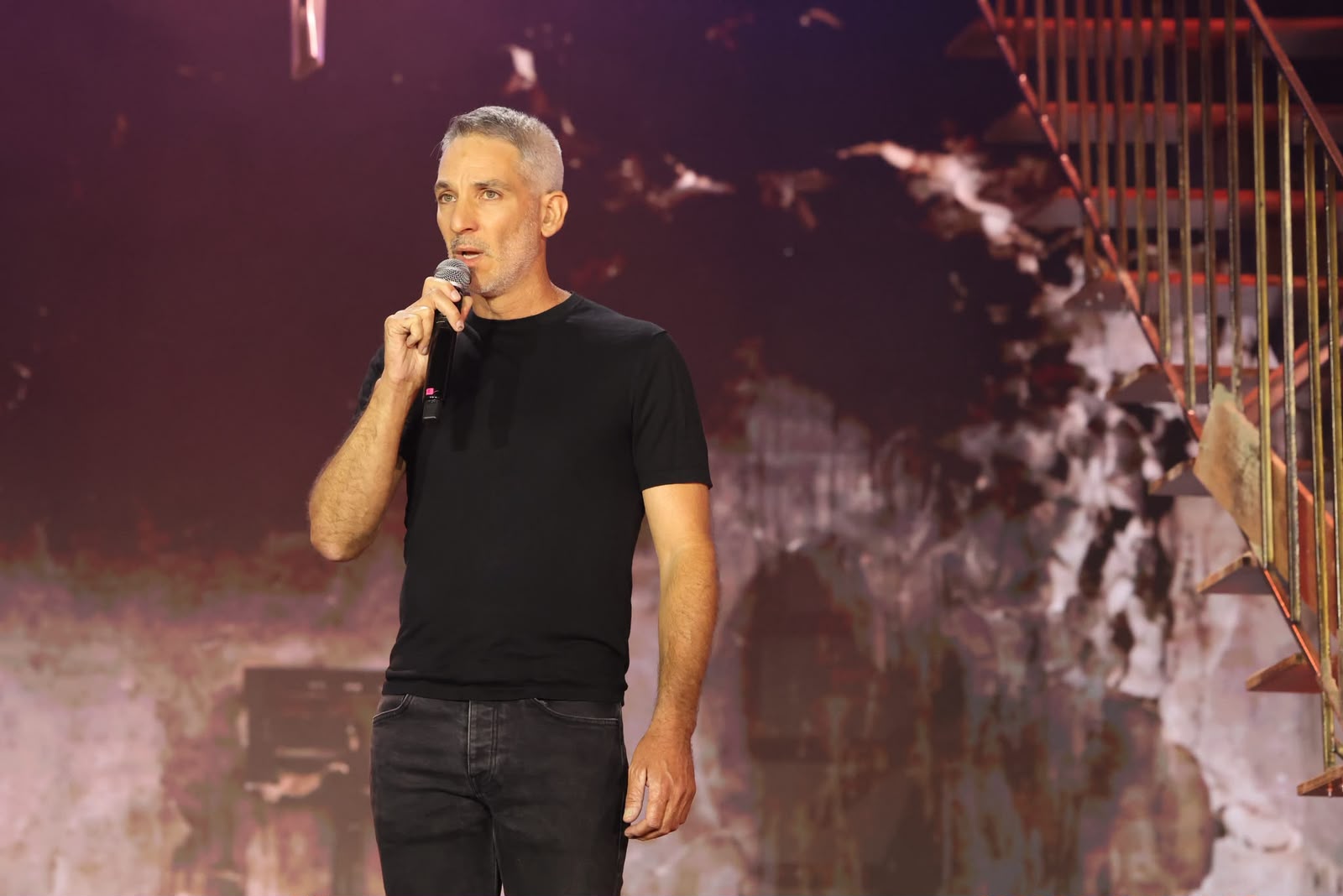
Omri Shifroni. (Benny Rotlevy)
On the same day, a few miles away at Reichman University, counterterrorism experts, former security officials, and practitioners were discussing how to prevent the next mass-casualty attack. The gatherings approached October 7 from different directions: the families demanded answers about the failures that enabled it, while the experts considered the threats that might come next.
Three years after the massacre, Israel still lacks a state commission of inquiry into the failures surrounding the attack. Prime Minister Benjamin Netanyahu’s government has resisted establishing one.
At Reichman, the connection between remembrance and prevention was built into the calendar itself. Prof. Boaz Ganor, president of Reichman University and founder of its International Institute for Counter-Terrorism, told The Media Line that the institute permanently moved its annual international conference from September 11 to October 7 after the massacre. The dates, once associated within the counterterrorism community primarily with the attacks in the United States, would now also serve as a working reminder of what Israel failed to stop.
Ganor described the Oct 7 assault as forcing experts to reconsider the scale of attacks that armed organizations controlling territory could carry out. The conference addressed emerging threats that included drones, aviation attacks, artificial intelligence, and the possibility that future attacks may not resemble October 7 even if they seek to produce similarly devastating results.
Eyal Hulata, Israel’s former national security adviser and former head of the National Security Council, now a senior international fellow at the Foundation for Defense of Democracies, echoed that concern. He told The Media Line that Israel’s enemies are currently less capable of carrying out the same kind of assault but that military degradation should not be confused with having learned the lessons of the disaster. Hamas is substantially weaker, he said, as are Hezbollah and Iran, but they could recover while other forms of attack emerge. His larger concern was what Israel has not yet done internally.
Liam Spielman, Professor Uriel Reichman, Ron Carmeli, Boaz Ganor. (Gabriel Colodro)
The basic feeling that “we have not learned enough the lessons from October 7th” remains, Hulata said, pointing in part to the absence of a state commission of inquiry. Israel, he said, has spent much of the past three years fighting and moving between wars and ceasefires without fully stopping to examine what happened. For Hulata, the danger is not limited to whether another attack can be launched across the same border in the same way. Explosive drones, aviation threats, weapons smuggling, and other scenarios could become the next test.
The memorial held during the conference gave that discussion a more personal dimension. Reichman honored 19 students and alumni killed on October 7 and during the war that followed. Outside the hall, roughly 1,000 ceramic red anemones formed a memorial installation. Ganor told the audience that he had asked for one yellow flower to be placed among them, intending eventually to cut it down and give it to Idan Shtivi, the university’s only student held hostage in Gaza, when he returned to his studies. At the time, Ganor said, he still believed Shtivi was alive, but he was subsequently confirmed dead. When his remains were recovered in August 2025, Israeli authorities said he had been killed on October 7 while helping others escape the Nova festival and that his body had been taken to Gaza.
The Yarkon Park ceremony was organized by Kumu, an Israeli civic movement founded by families affected by the October 7 attacks, together with other October 7 families. It was not a government ceremony and did not present itself as a political gathering.
The government neither participated nor sent an official representative. Opposition leaders and members of the Knesset did attend, but as individuals, seated among the public rather than as a formal delegation. The atmosphere was one of shared mourning with songs, prayers and testimony from bereaved families, survivors, and people who fought or rescued others during the attack.
Yet keeping politics entirely outside the event was nearly impossible. Three years after the massacre, the question of who was responsible for the failures of October 7 and how those failures should be investigated remains unresolved at the national level. In that setting, a demand for an inquiry was not simply a policy argument. For families who have spent three years waiting for answers, it was part of the act of remembrance itself.
Park Hayarkon. (Omri Silver)
Shifroni, one of Kumu’s founders and a member of Kibbutz Be’eri’s security squad, spoke as both an organizer and a bereaved relative. His niece and nephew, Liel and Yanai, and his aunt and uncle, Ayala and Avia Hetzroni, were murdered in Be’eri. “That morning, the systems collapsed and the state failed to function,” he said. He also remembered the soldiers who pushed toward the fighting and the civilians who responded when formal systems failed, describing the extraordinary mutual responsibility Israelis displayed during the attack. But, he told the crowd, courage after a collapse cannot substitute for understanding why the collapse occurred.
That theme ran through the ceremony without turning it into a conventional political event. Ido Yakir, a member of Kibbutz Magen’s rapid-response team, recited Yizkor, the Jewish memorial prayer for the dead, after members of his community were remembered for fighting to prevent terrorists from entering the kibbutz. Aviva Chana, sister of Israel Chana, spoke about her brother, who left his home in Ofakim with a pistol and a single magazine and was killed fighting attackers. “Everyone talks about the hero you were that morning,” she said. “But I miss, above all, the brother you were during all the days before that.”
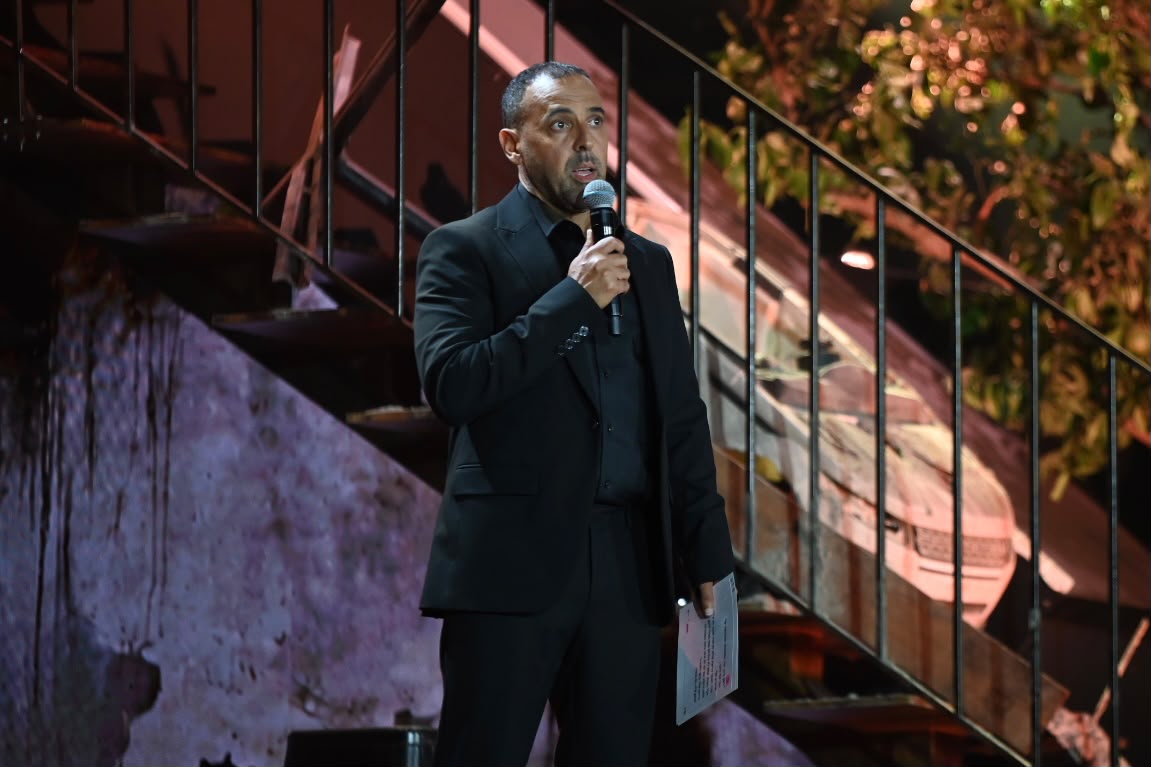
Eli Sharabi. (Oshrit Zinger)
Adi Marciano, whose daughter, IDF surveillance soldier Noa Marciano, was kidnapped on October 7 and did not return alive, spoke about the torment of knowing her daughter had survived the initial attack but remained beyond her reach. “Forgive us for all the days of suffering. For the fear. For the pain. For the final days of your life,” she said. “For failing to save you. We tried everything.”
Co-host Eli Sharabi returned to Shifroni’s demand in his closing remarks, urging Israelis to remember what happened, investigate how it happened, and refuse to let time blur the truth. The crowd then rose for Hatikvah, Israel’s national anthem, led by Ofri Rahum, sister of Nitzan Rahum, who was murdered at the Re’im festival site.









 block the Keystone XL oil pipeline and to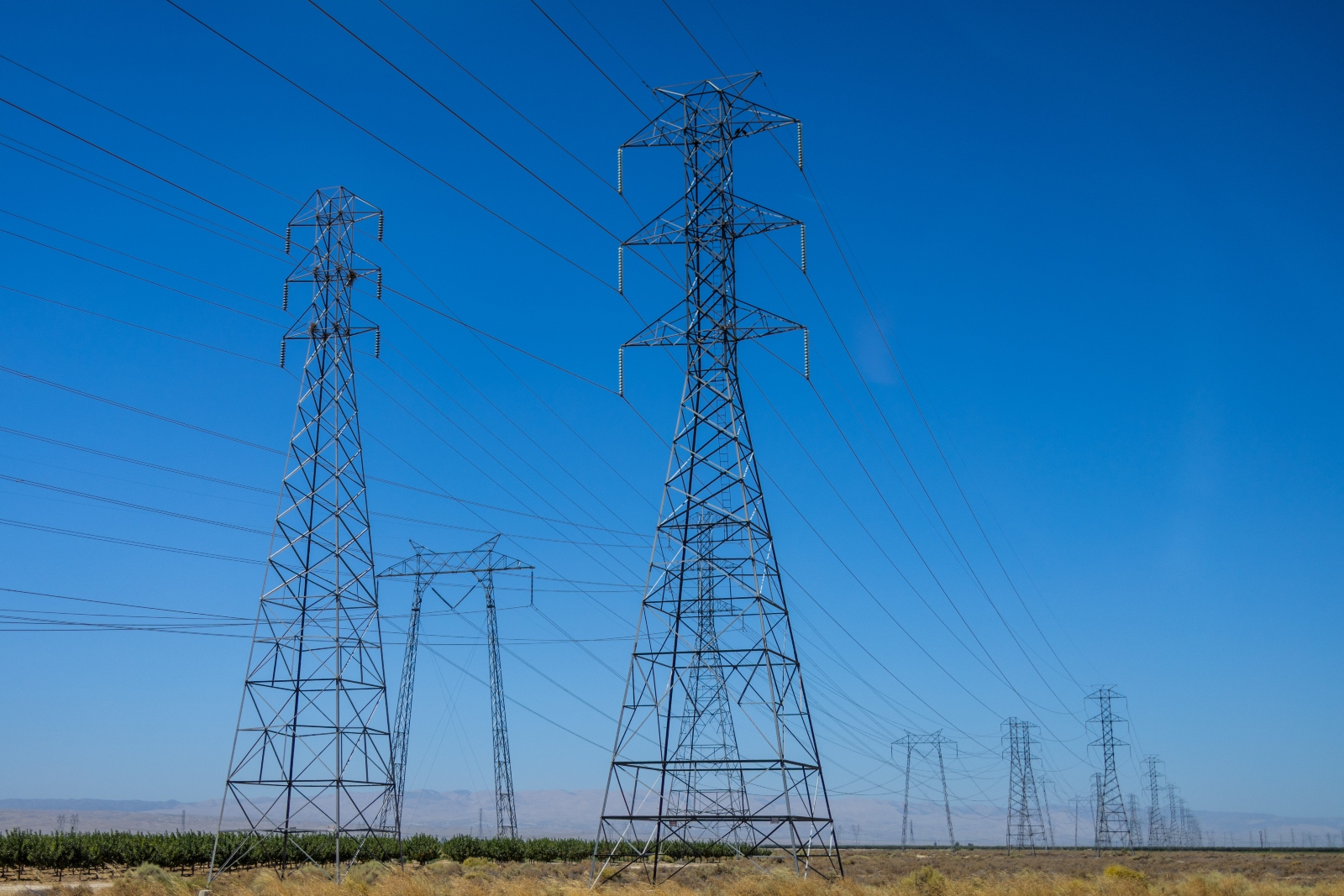
 Builders vs. blockers