Space has plenty of room for more megaconstellations, but only if all operators are willing to share information about where their satellites are and where they’re going, a top executive at SpaceX and its AI subsidiary said this week.
Michael Nicolls, SpaceX’s vice president for Starlink and president of Elon Musk’s artificial intelligence company, xAI, used a presentation Tuesday at the International Astronautical Congress in Turkey as a clarion call for improved data-sharing among satellite operators.
SpaceX’s Starlink constellation now has more than 11,000 satellites, about two-thirds of all active spacecraft in low-Earth orbit. Radars and telescopes routinely track thousands more pieces of space junk.
Starlink is, by far, the largest satellite constellation in operation today. But if you buy the buzz, Starlink is just the tip of the iceberg. SpaceX has revealed plans to launch up to a million satellites for a new constellation, called Starmind, to deploy AI computing capacity in low-Earth orbit. Amazon is in the early stages of launching a network of thousands of satellites to compete with Starlink, and two Chinese megaconstellations are now in full-scale deployment.
Law of large numbers
All of this raises the question of how to mitigate the risk of a collision in orbit, an event that could create thousands more pieces of space junk, potentially triggering a self-perpetuating cycle of debris generation. The risk of a collision on any given day is fantastically low. Space is vast and empty, and low-Earth orbit is a long way from filling up. SpaceX and most other Western operators de-orbit their rockets and satellites at the end of their missions to prevent additional debris in orbit.
“That said, the law of large numbers says that if it can happen, it will happen,” Nicolls said.
There’s still a long way to go to improve tracking, awareness, and coordination in orbit. This is sometimes called space traffic management. No global treaties or regulations require satellites to broadcast their locations and maneuvers or mandate coordination among satellite operators. Without rules of the road, it is up to governments and companies to set norms of behavior.
“Once you can track this debris, and if you can track it well, these are like obstacles on a road. If you can measure them, you can predict where they’re going to be, and you can avoid them,” Nicolls said. “What you can’t avoid is other operators who maneuver without telling you where they’re going to go. We have many examples of this on Starlink, unfortunately.”
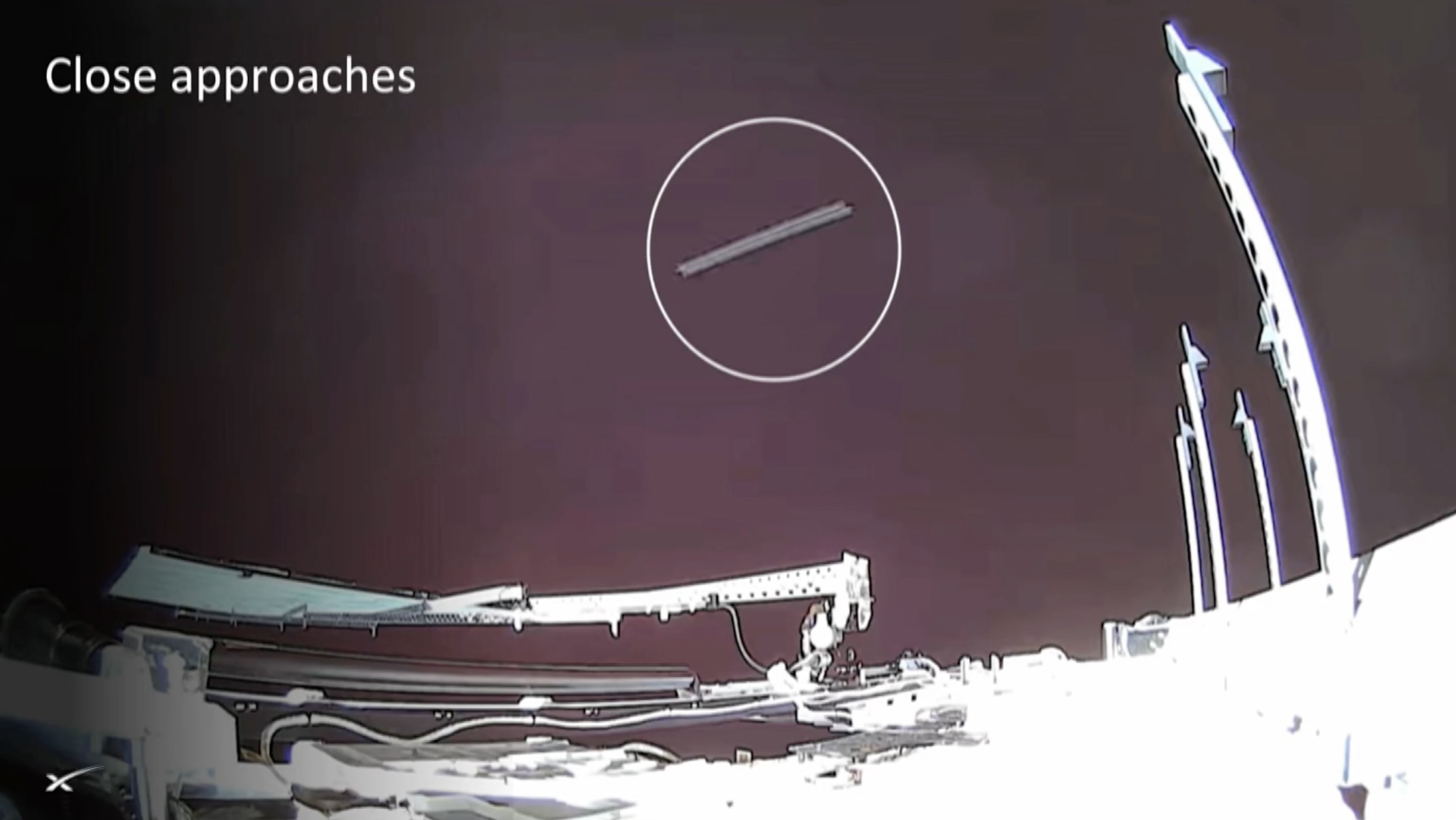
Nicolls presented several examples of satellites from other operators closely approaching Starlink satellites as they zip around the Earth at 5 miles per second. The examples did not suggest nefarious intent, such as spying or an attempt at striking a Starlink in orbit. Instead, the other satellites conducted maneuvers and changed their trajectories without their owners informing anyone.
“Either they were not publishing their ephemeris to us, or they were not considering the ephemeris of others when they were maneuvering, and these led to conjunctions of tens of meters to hundreds of meters,” Nicolls said. “Way too close to comfort.”

An ephemeris contains information about a satellite’s location and movement. Some operators may not want to share this information, believing secrecy might provide a competitive or strategic advantage. But if spaceflight is to be sustainable, it is vital to err on the side of openness rather than secrecy.
“The minimum standard in low-Earth orbit needs to be that you know where your satellite is, and you know where it’s going. You need to be able to predict where your trajectory is, and that prediction needs to be reliable,” Nicolls said.
SpaceX lauds itself as the benchmark for orbital stewardship. It pretty much has to be, with so many Starlinks in orbit and so much of its business relying on space.
The company has lowered the altitude of the entire active Starlink constellation below 500 kilometers (310 miles), an adjustment that provides three benefits. It moved the network away from other heavily trafficked regions in low-Earth orbit, expedited reentry for any failed Starlink satellites, and improved service for Starlink customers. All of SpaceX’s new-generation Starlink V3 satellites, which began launching on the company’s Starship rocket last month, will fly even lower, at about 350 kilometers (217 miles).
SpaceX also publishes ephemeris data for its Starlink satellites and has asked other operators to share their data, too. Without ephemeris sharing, operators rely on tracking data or their own satellites’ collision avoidance capabilities.
Starlink satellites, for example, use onboard navigation cameras to detect other objects in orbit. SpaceX calls the system Stargaze, and it now tracks about 90 percent of maneuvering satellites that intersect Starlink orbits, Nicolls said.
That is good, but it would be better if all operators agreed to be more open about what their satellites are doing. It is now a “fairly common occurrence” that Starlink satellites detect an upcoming close encounter and autonomously maneuver out of the way, Nicolls said. If there’s not enough to steer away from a close encounter, Starlink satellites can hunker down at the time of greatest danger. These “ducking maneuvers” involve pointing the satellite to minimize the chance of a collision, Nicolls said.
Starlink satellites perform about 1,000 collision avoidance maneuvers per day to get out of the way of functioning satellites or bits of space debris. In the last few months, Nicolls said Starlink satellites have steered clear of about 650 active satellites from other operators. Only half of those 650 come from operators that participate in ephemeris sharing with SpaceX, he said.
What about China?
“In particular, it’s been very challenging to share data with international operators,” Nicolls said. “There has been good progress here. There have been some good stories here on how we’ve begun to share data. For example, we share data closely with the Chinese space station as well as some other Chinese satellite operators, but there are many that we do not, and we have no information about where those satellites are or where they’re going.”
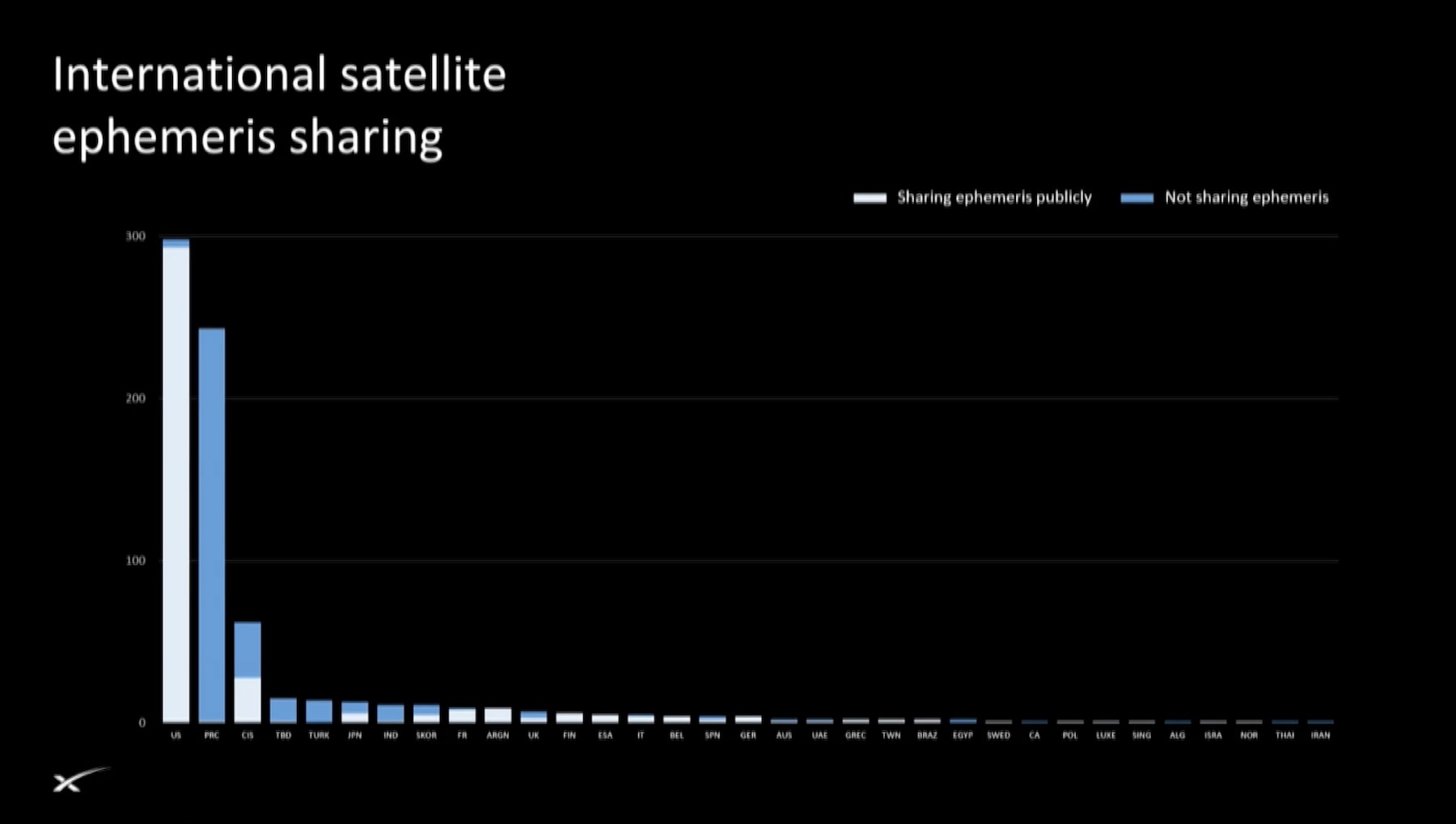
A chart in Nicolls’ presentation suggested the problem largely lies with Chinese and Russian satellites. But some in the United States, Europe, and Japan also decline to share.
“My fundamental ask here is that we need to make headway here and begin sharing data across all vehicles, from whatever country you are, with us and with others, to promote a safe operating environment,” Nicolls said.
What do SpaceX’s competitors think? Ars asked the head of Amazon Leo, Rajeev Badyal, about coordinating with Starlink, his chief competitor in the satellite broadband market. Amazon has 396 satellites in orbit today, with hundreds more awaiting launch when their rockets are ready to take them to orbit.
“Space safety is paramount to us as well,” Badyal said. “Every launch we do, we actually coordinate with SpaceX. We coordinate with others who have satellites. We let them know where we’re going to drop them off, how we’re going to orbit raise, etc. So we have regular meetings with companies like SpaceX to exchange data.
“So, for us, sharing ephemeris or sharing the information necessary for space safety is a non-issue,” Badyal said. “We’re big proponents of making sure that all of us operate in this domain in space in a coordinated fashion because [the] consequences of not doing so are significant for everybody, and there’s no reason not to.”
Amazon Leo’s first-generation constellation will consist of 3,232 satellites, and the Federal Communications Commission in February approved Amazon’s request for a 4,504-satellite second-generation network. Amazon has filed for FCC approval for an additional 5,105 satellites for direct-to-device connectivity, but the company is still far from matching the size of the Starlink fleet.
“Obviously, SpaceX is the largest constellation out there,” Badyal said. “We work with them hand in hand. In terms of China and adversaries, that’s something I can’t comment on at the moment. At some point, we will have to coordinate, or it’ll end up being a negative thing for everybody, especially if they get to scale.”