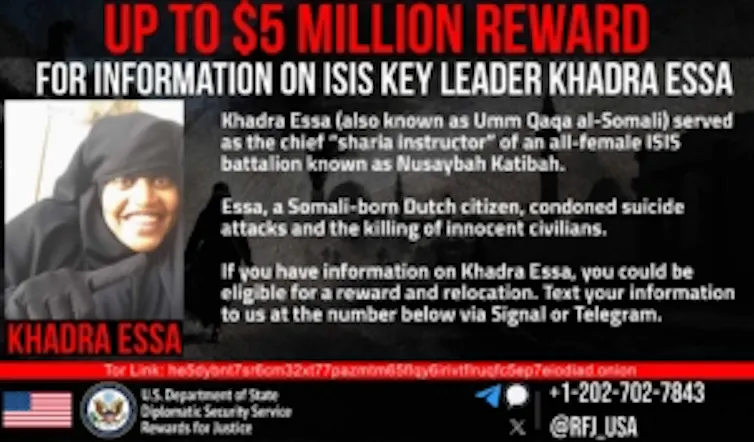
Khadra Essa, a Somali-born Dutch citizen operating in Syria under the name Umm Qaqa al-Somali, is a wanted woman.
On Sept. 14, 2026, the U.S. State Department again publicized its offer of up to US$5 million for information about her whereabouts, having first offered a reward in April 2025.
The notice describes Essa as the chief sharia instructor of Khatiba Nusaybah, or ISIS-NK, an all-female Islamic State combat battalion formed in Raqqa, Syria, in 2016 to recruit, organize and train female fighters.
The United States alleges she received formal training in weapons, explosives and suicide operations. The State Department notice claims Essa “taught ISIS extremist ideology that justified suicide operations and killing of civilians,” recruited members, made orders that resulted in assaults and murder, and “led a group that violently enforced sharia law against women.” There is a separate State Department notice for information leading to the location and return of two American children allegedly taken by Essa after the death of their mother – an Islamic State group recruit – in 2019.
As a terrorism researcher who studies how militant groups organize and adapt, I’ve examined U.S. and European court records, sanctions and reward notices, as well as jihadi groups’ own Arabic-language publications, to trace how women’s roles inside armed movements have evolved.
For as long as modern terrorism has existed, women have been known to fight and carry out attacks. But I’ve observed a newer development whereby women’s organizational authority in jihadi groups has been increasingly formalized. Indeed, women are occupying defined roles in which they train, recruit, discipline or direct other members, or manage functions on which the organization depends.
Learning from secular groups
Two decades ago, the political scientist Brigitte Nacos surveyed how women in armed groups were understood. Women had long been leaders and chief ideologues in secular movements – such as in the Weather Underground in the United States, Italy’s Red Brigades, Germany’s Red Army Faction and the Basque separatist group ETA.
In jihadi movements, by contrast, women were rarely presented as people with formal authority over other members or organizational functions. Rather, such groups, exploiting the perception of women as less of a security threat, primarily saw women’s active role in offensive operations as that of a conveyor of bombs.
It was a tactic that had already taken hold in secular militant movements. The Syrian Social Nationalist Party used Sana’a Mehaidli in a suicide attack in Lebanon in 1985; in 1991, a female Liberation Tigers of Tamil Eelam operative known as Dhanu assassinated Indian Prime Minister Rajiv Gandhi; and the Kurdistan Workers’ Party began deploying female bombers in the 1990s.
By the early 2000s, Palestinian militant groups, including jihadists, were also using female suicide bombers. In January 2002, Wafa Idris died in Jerusalem while killing one man and wounding about 50 people. She is widely remembered as the first Palestinian woman to carry out a suicide bombing, although accounts indicate that the device may have detonated unexpectedly. Four more female suicide bombings followed within months of that attack.
The Palestinian militant group Hamas initially resisted using women in suicide attacks but relented in 2004.
Its spiritual leader, Ahmed Yassin, explained the change in tactical terms: “It could be that a man would not be able to reach the target, and that’s why they had to use a woman.”
Beyond the bomber
Within a few years, jihadi groups in Iraq, Jordan and Pakistan were also using female suicide bombers.
But it was the Nigerian-based Boko Haram that has scaled the practice beyond any precedent. Research by the Combating Terrorism Center identified 434 bombers across 238 suicide attacks between April 2011 and June 2017 – at least 56% of them women.
These cases largely placed women at the operational end of the process. Women carried the bomb or reached the target, but they were far less visible in positions that selected personnel, supplied doctrine, trained operatives or managed the organization itself.
That conservative position initially guided groups such as al-Qaida.
In December 2009, Umayma al-Zawahiri, wife of al-Qaida’s then deputy leader, published a “Letter to My Muslim Sisters.” It allowed women to fund operations, gather information and, in principle, carry out a suicide operation, while insisting their principal role was to raise fighters’ children, manage their homes and keep their secrets.
But jihadi propaganda began to stretch the language used for women.
In 2014, the Swahili-language magazine Al-Ghurabaa – aligned with al-Shabaab in Somalia – published an article titled “Mujahidah Leaders.” Translated and analyzed by Caleb Weiss, a researcher focused on jihadism in Africa, the magazine declared that “we sisters too have our own leaders.” It presented Aafia Siddiqui – a Pakistani neuroscientist convicted in 2010 of attempting to kill U.S. military and law enforcement personnel – and suspected mass murderer Samantha Lewthwaite as women to emulate.
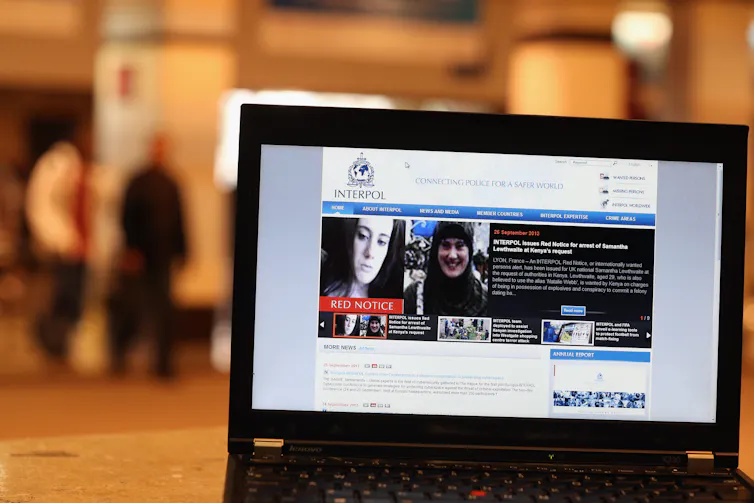
The rhetoric reflected a broader reality: Women in al-Shabaab had already served as recruiters, financiers, couriers and intelligence collectors, even if the movement rarely placed them in formal command positions.
Expanding women’s roles
The Islamic State group, meanwhile, was beginning to give some women a more concrete form of authority.
In February 2014 it announced the formation of the all-female al-Khansaa Brigade in Syria. The unit emerged partly from a practical security problem: Men disguised in women’s clothing had carried out attacks against Islamic State group commanders, creating a need for women who could search women at checkpoints. Its responsibilities expanded into intelligence gathering, law enforcement, recruitment and policing other women.
They could detain and punish other women, but their authority stopped there.
The brigade occupied an “authoritative position” while remaining unable to challenge Islamic State group policy.
That authority coexisted with a doctrine that still placed women primarily in the home. A 2015 ISIS manifesto permitted women to fight only in exceptional circumstances, principally when Muslim territory was under attack and there were not enough men to defend it.
As Islamic State group territory came under growing pressure, that justification widened. In December 2016 the group’s Arabic newsletter al-Naba published an article titled “I Will Die While Islam Is Glorious,” arguing that jihad was as necessary for a woman as for a man.
By July 2017 the group’s magazine Rumiyah was calling on women to rise “with courage and sacrifice in this war.”
The article turned to the 14th-century figure of Nusaybah bint Ka’ab for justification. Also known as Umm Umara, the companion of prophet Muhammad took up arms at the Battle of Uhud. Uhud was a defensive battle, making Nusayba a useful precedent for movements that otherwise restricted women’s participation in combat.
Becoming named authorities
The next development came with a different all-female unit. In late 2016 the Islamic State group approved the formation of Khatiba Nusaybah, a military battalion composed of female members.
Allison Fluke-Ekren, a former Kansas resident who had already organized an Islamic State group women’s center in Raqqa, became the battalion’s leader and organizer. She trained more than 100 women and girls in the use of automatic rifles, grenades and suicide belts, according to the U.S. Justice Department. After being apprehended in Syria, she was transferred to FBI custody in January 2022. She pleaded guilty that June and was sentenced in federal court in Virginia to 20 years in prison.
Whereas al-Khansaa had exercised coercive authority over other women as an enforcement and security unit, Khatiba Nusaybah was organized as a female military battalion. That distinction marked a further shift.
Women have also moved into specialized organizational functions beyond combat.
In January 2024 the Treasury Department designated Egyptian national Sarah Jamal Muhammad al-Sayyid for materially supporting the Islamic State group through her work with the Electronic Horizons Foundation, the group’s cybersecurity and operational security arm. Treasury says she recruited Islamic State members into the organization, procured web servers for its platforms and helped with logistical management and cryptocurrency support.
Devorah Margolin, a terrorism researcher who specializes in women and gender in violent extremism, has shown how such groups have expanded women’s roles to include financing and recruitment, often out of organizational necessity rather than principle.
Taken together, the Fluke-Ekren, Essa and al-Sayyid cases show women moving from auxiliary participation in jihadi groups into defined organizational functions carrying greater authority and responsibility.
The women who carry out violence have long been visible. Increasingly, so are the women who train recruits, enforce rules, supply doctrine and sustain the systems behind it.