Tons of fishing gear and plastic are washing up on Seychelles beaches. We tracked where it was coming from
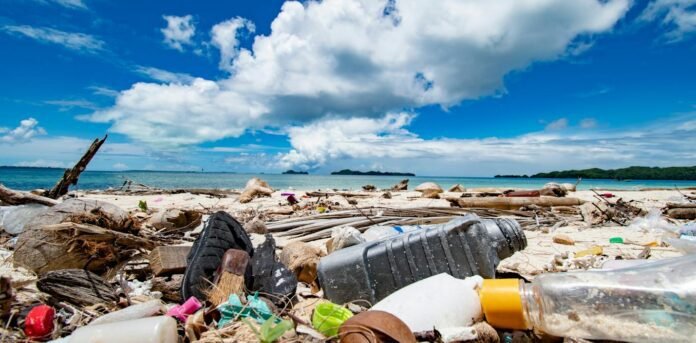
Vast quantities of plastic and fishing gear are washing up along the shores of the Seychelles, destroying fragile ecosystems and causing significant economic problems.
Aldabra Atoll, a Unesco world heritage site in this archipelago nation of 115 islands, is estimated to have accumulated more than 500 tonnes of plastic on its shores alone. Most of this plastic debris continues to pile up along its beaches today. It was estimated that removing it would cost approximately US$4.68 million (£3.46 million) and would require 18,000 hours of labour.
Small island developing states are particularly vulnerable to plastic debris on their beaches. It can damage tourism and fishing in these coastal communities, which is essential to their economies. Clean-up costs can be prohibitive.
Fish and other marine life can also be killed by getting entangled with or ingesting plastic debris.
It is impossible to tackle this growing problem without knowing where this pollution is coming from and who is responsible. We investigated this in our recent study using computer simulations and observations, focusing on pollution in the western Indian Ocean from fisheries and shipping.
To do this, we used satellite tracking data from fishing and shipping vessels over five years (from 2018 to 2022) to estimate activity across the region. Using this map, we simulated the drift of billions of virtual pollution fragments and followed where they ended up.
A map showing debris fishing gear.Author’s own.
From this we built a map showing how likely a given vessel location is to pose a risk to the Seychelles’ islands. We did this separately for fishing and shipping.
Our research shows, based on previous fishing activity, that most fishing gear that is swept up on the beaches of the Seychelles comes from fishing within its own exclusive economic zone. These are the waters, extending 200 nautical miles (370km) offshore, over which a state has exclusive control over marine resources, including fisheries.
These waters are full of tuna, and the Seychelles’ economy leans heavily on industrial fishing, both as an employer and as a large source of foreign currency.
Where does the waste come from?
It is likely that some of the gear and plastic waste is coming from EU vessels. The Seychelles’ waters are heavily fished by two types of European fishing boats, purse-seiners and longliners. This falls under a longstanding agreement between the EU and the Seychelles granting them the right to fish here. Purse-seiners circle around tuna schools with a large net, and longliners trail baited hooks over many kilometres.
Indeed, a report presented to the Indian Ocean Tuna Commission found that 76% of 214 of the drifting fish aggregating devices used by tuna fisheries to attract shoals of fish in the Seychelles’ exclusive economic zone were from Spanish-owned vessels. This is an industry making significant profits, while leaving behind environmental damage.
A turtle on the Aldabra Atoll next to lost fishing gear and plastic.April Burt and Seychelles Islands Foundation
Recently, the Seychelles–EU fishing agreement was renewed for 2026–30 at €5,750,000 per year (£4.89 million), allowing 38 EU fishing vessels to operate in these waters. The Seychelles government is believed to have pushed for a 30% rise in this annual payment from the EU but it is believed they settled on 7%, according to some reports.
Given that the cost associated with cleaning up a single island already runs into millions, the Seychelles-EU deal is small compared to the indirect damages imposed on the nation.
Other proposed solutions
International shipping creates other issues. Our study suggests that more than 90% of plastic being swept up on the Seychelles’ coast from shipping comes from just five lanes crossing the western Indian Ocean. The origin and destination ports of these lanes line up with the countries named on labels of plastic bottles washed ashore on Aldabra.
Debris from international shipping lanes requires a different solution. Unlike the tuna fleets fishing under the agreement between the Seychelles and the EU, this is international traffic passing by. A solution to the plastic waste coming from these ships would be more rigorous enforcement of existing international rules against dumping waste at sea, and bilateral cooperation between the Seychelles and the many nations whose ships use these routes.
Even simple measures could cut litter. For instance, ensuring vessels carry enough safe drinking water to reduce the use of plastic bottles should cut some debris found on Aldabra.
The true cost of cleaning up this huge level of plastic pollution tends not to fall on those who have left it there. The Seychelles needs to work out the cost of the damage being done by these mountains of waste to get a better deal in future negotiations with the EU.
That should help fund clean ups and repair the fragile ecosystems of the islands, helping to preserve them for the future.
2026 Hyundai Ioniq 5: Here’s what we still like, here’s what annoys us
When we first drove the Hyundai Ioniq 5 at the end of 2021, it didn’t take much exposure to the angular electric vehicle to find much about it appealing. Back then, an 800 V architecture had only really been seen in expensive high-end EVs from Porsche, but here was a mainstream model with that same technology—and even faster fast-charging, taking just 18 minutes to go from 10–80 percent. The retro looks didn’t hurt either, channeling the boxy hatches styled by Giorgetto Giugiaro in the 1970s and ’80s. But five years is a long time in the car world, and the compact electric crossover segment is far more competitive than it was when the Ioniq 5 debuted. We figured it was worth spending some more time with one to see how it still stacks up.
Although the Ioniq 5 range starts at $35,000 for the standard range model, our test car was a 2026 Ioniq 5 AWD Limited, which has an 84 kWh battery pack—part of the lifecycle refresh in early 2025 that also swapped in a NACS (J3400) charge port in place of the CCS1 port you’d find on earlier cars. Among the other additions that arrived as part of the 2025 refresh was a rear windshield wiper, which was sorely needed at launch.
This range-topping trim starts at $45,075, with an extra $3,900 for the addition of the front electric motor that gives the AWD version a combined output of 320 hp (239 kW) and 446 lb-ft (605 Nm). The added traction of AWD (when you have grip) is desired by many, but you do trade something for it: efficiency. The AWD version has an EPA range of 269 miles (432 km) versus 318 miles (512 km) for the rear-wheel drive variant.
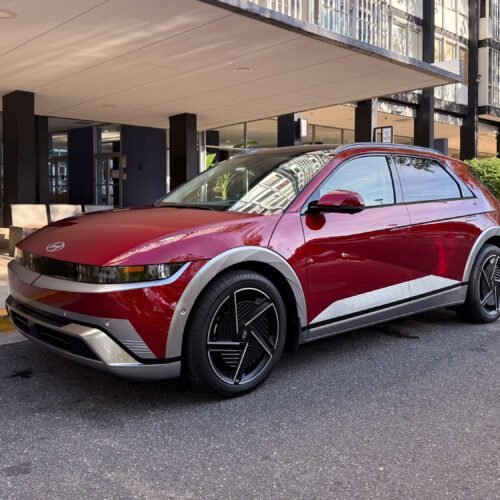
The “Ultimate Red” paint is a $500 option I might eschew.
Jonathan Gitlin
The “Ultimate Red” paint is a $500 option I might eschew. Jonathan Gitlin
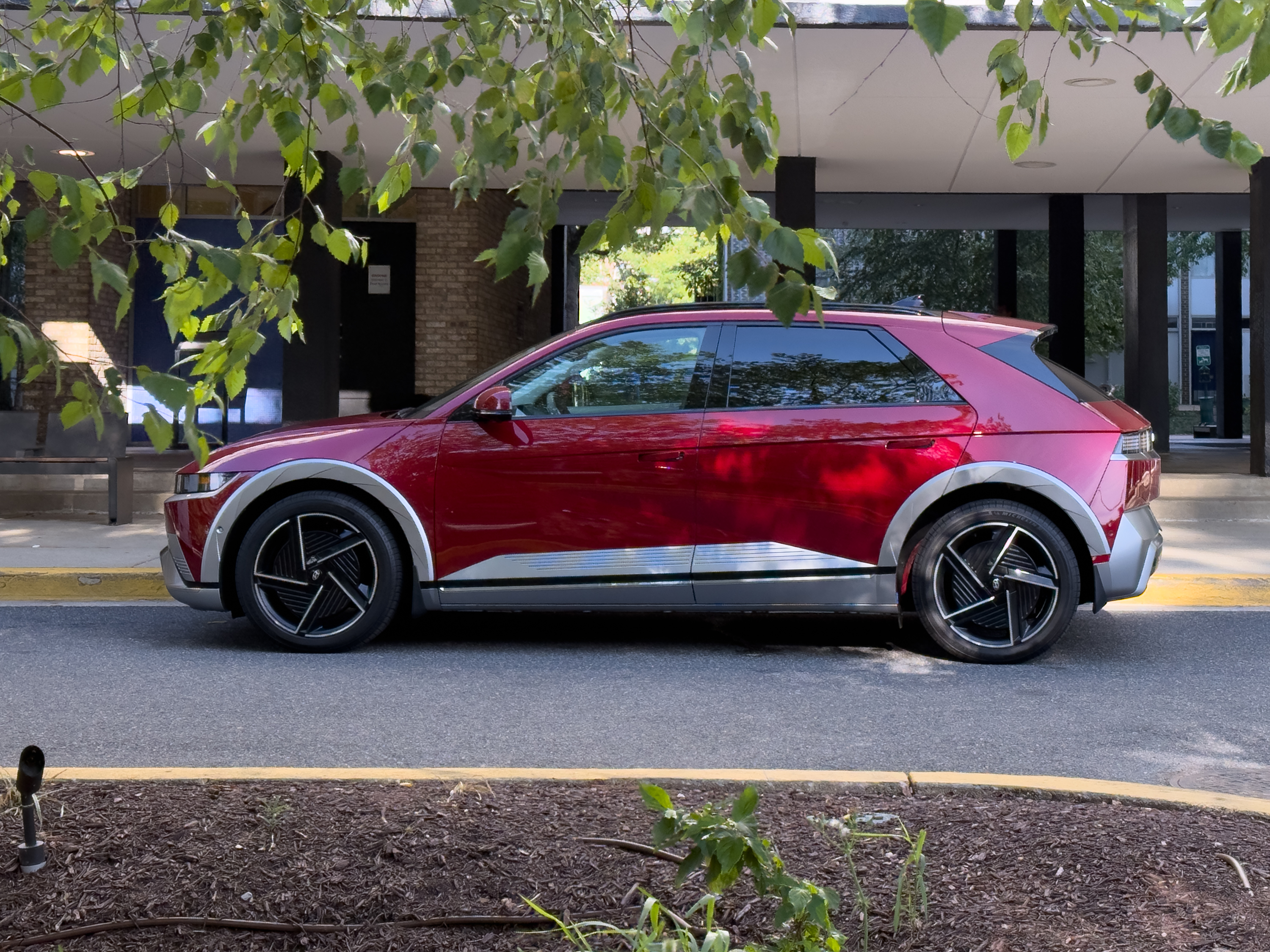
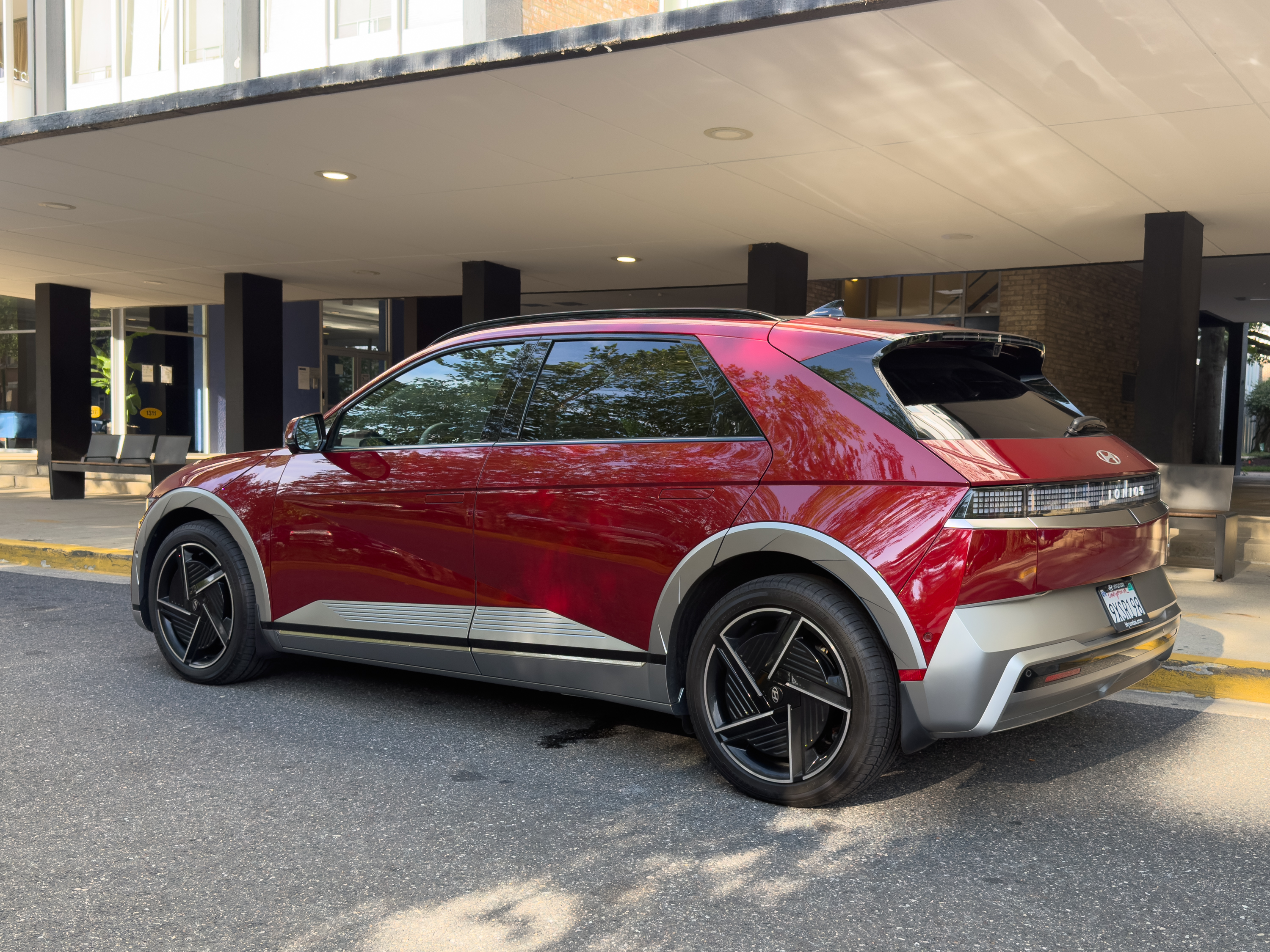
The shape still looks fresh in 2026
Jonathan Gitlin
The shape still looks fresh in 2026 Jonathan Gitlin
The “Ultimate Red” paint is a $500 option I might eschew. Jonathan Gitlin
The shape still looks fresh in 2026 Jonathan Gitlin
Single-motor Ioniq 5s should easily be capable of 4 miles/kWh (15.5 kWh/100 km) or more. But with both axles powered, even in Eco mode, you can expect closer to 3.4 miles/kWh (18.3 kWh/100 km). Having 49 miles (79 km) more range would, of course, mean a little longer behind the wheel between charging stops, should one happen to be on a road trip or dependent upon public fast-chargers, but even with a larger pack, the 2026 Ioniq 5 still fast-charges plenty fast. The native NACS port means the Ioniq 5 can charge at Tesla Superchargers as well as other networks, like IONNA and Electrify America.
In practice, the ubiquity of Tesla’s charging locations is offset by the fact that most of those Superchargers are the older V3 units. These feature shorter cables that can be a pain to use with non-Tesla EVs, but also top out at just 250 kW, meaning longer charge times than the 20 minutes from 10–80 percent that you might expect if you used a 350 kW charger from EA or one of IONNA’s 400 kW units—peak draw from an 800 V charger like these should be in the region of 265 kW. But fast-charging should probably be a small percentage of most EV drivers’ charging sessions, at least for those who can reliably plug in either at home or work, particularly given the cost of most DC fast-charging networks. A 240 V level 2 AC charger should take 7 hours and 20 minutes to charge from 10–100 percent.
Yeah, or meh?
One of the Limited’s features that I rather like is the blind spot view monitor. This makes use of the cameras that are embedded in the corner of each wing mirror to show you a view of the relevant blind spot when you use a turn signal. While it’s not a necessity, it does make checking for traffic on protected bike lanes and the like a lot easier.
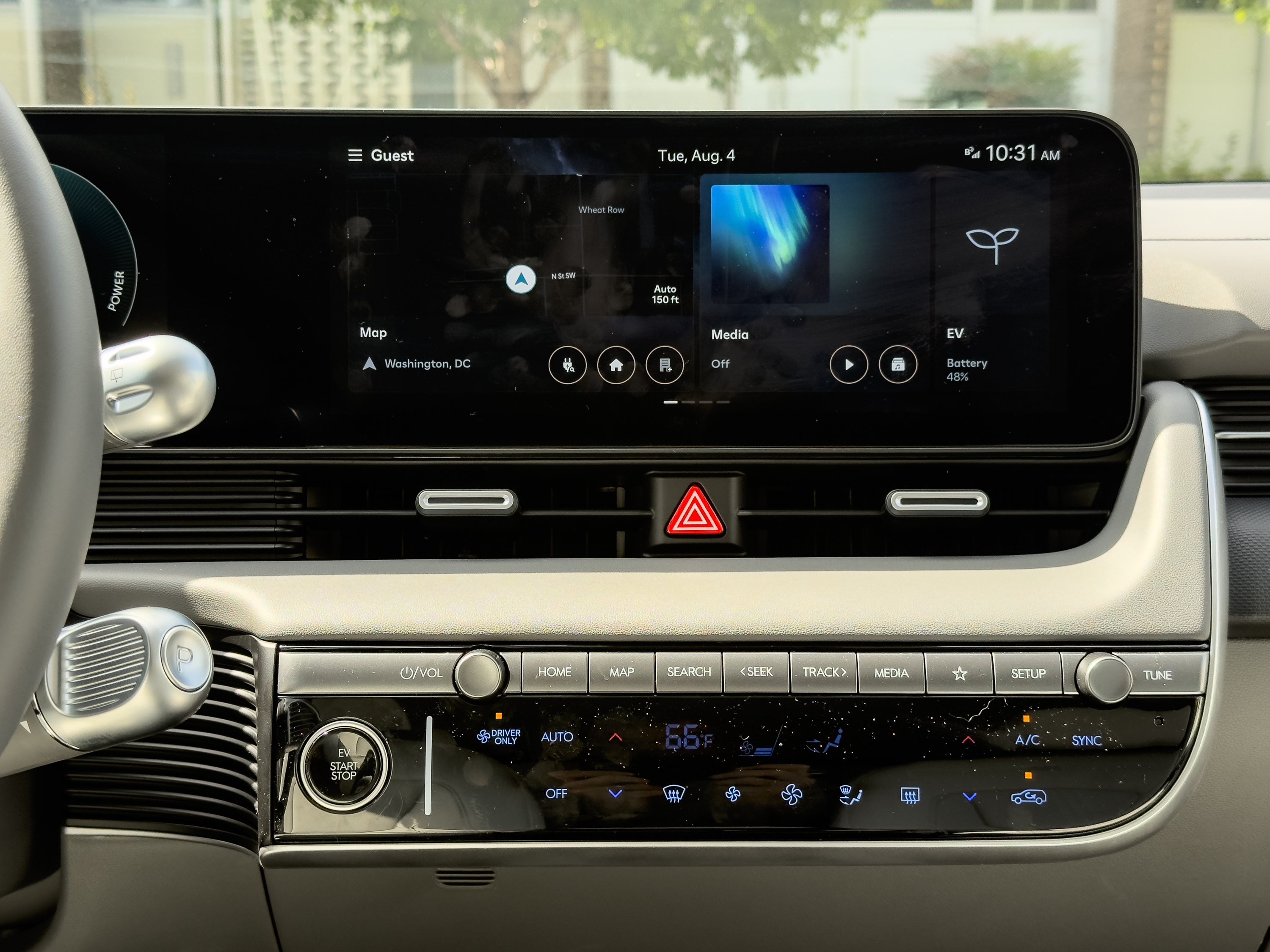
On the other hand, I am definitely going on record as not liking the Ioniq 5’s climate controls. These are set in a touch-sensitive panel below the air vents (and a row of real buttons for other controls) with weak backlighting that can be hard to see in bright sunlight. The fact that the panel is touch sensitive also means it’s hard to develop muscle memory, and finally you can see from the photograph just how much dust it attracts.
But the Ioniq 5’s biggest problem is the potential specter of an Integrated Charging Controller Unit failure. The ICCU is what allows the Ioniq 5’s 800 V traction battery to charge the 12 V accessories battery. But if the metal-oxide semiconductor field-effect transistor inside the ICCU is subjected to an overvoltage at the start and end of the battery charging cycle, or gets too hot during charging or driving, it can fail. And in some cases, that has resulted in cars rolling to a stop on the highway.
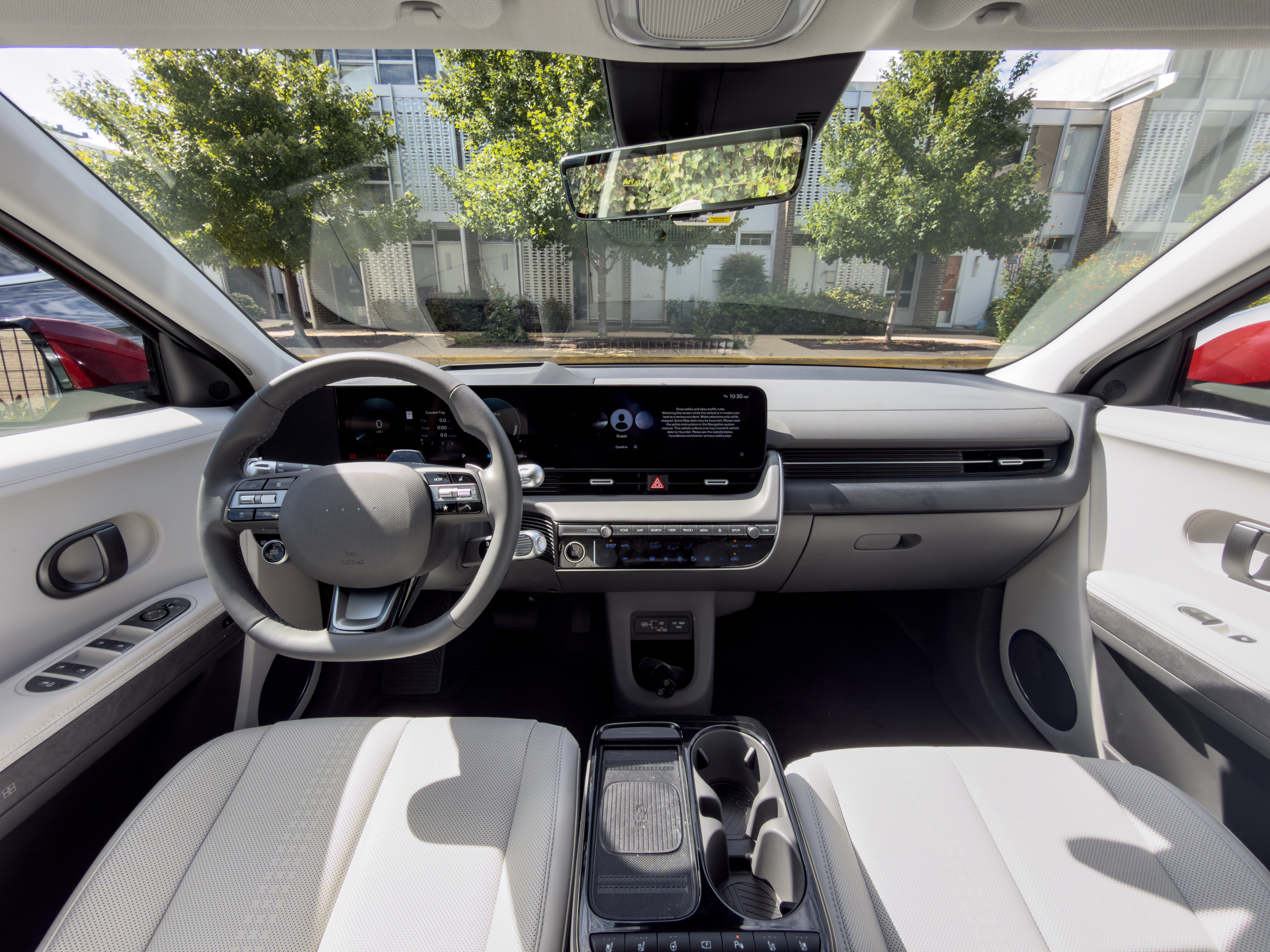
The mostly good cockpit.
Jonathan Gitlin
The mostly good cockpit. Jonathan Gitlin
No sir, I don’t like it.
Jonathan Gitlin
No sir, I don’t like it. Jonathan Gitlin
There always seems to be a huge amount of legroom back here.
Jonathan Gitlin
There always seems to be a huge amount of legroom back here. Jonathan Gitlin
No sir, I don’t like it. Jonathan Gitlin
There always seems to be a huge amount of legroom back here. Jonathan Gitlin
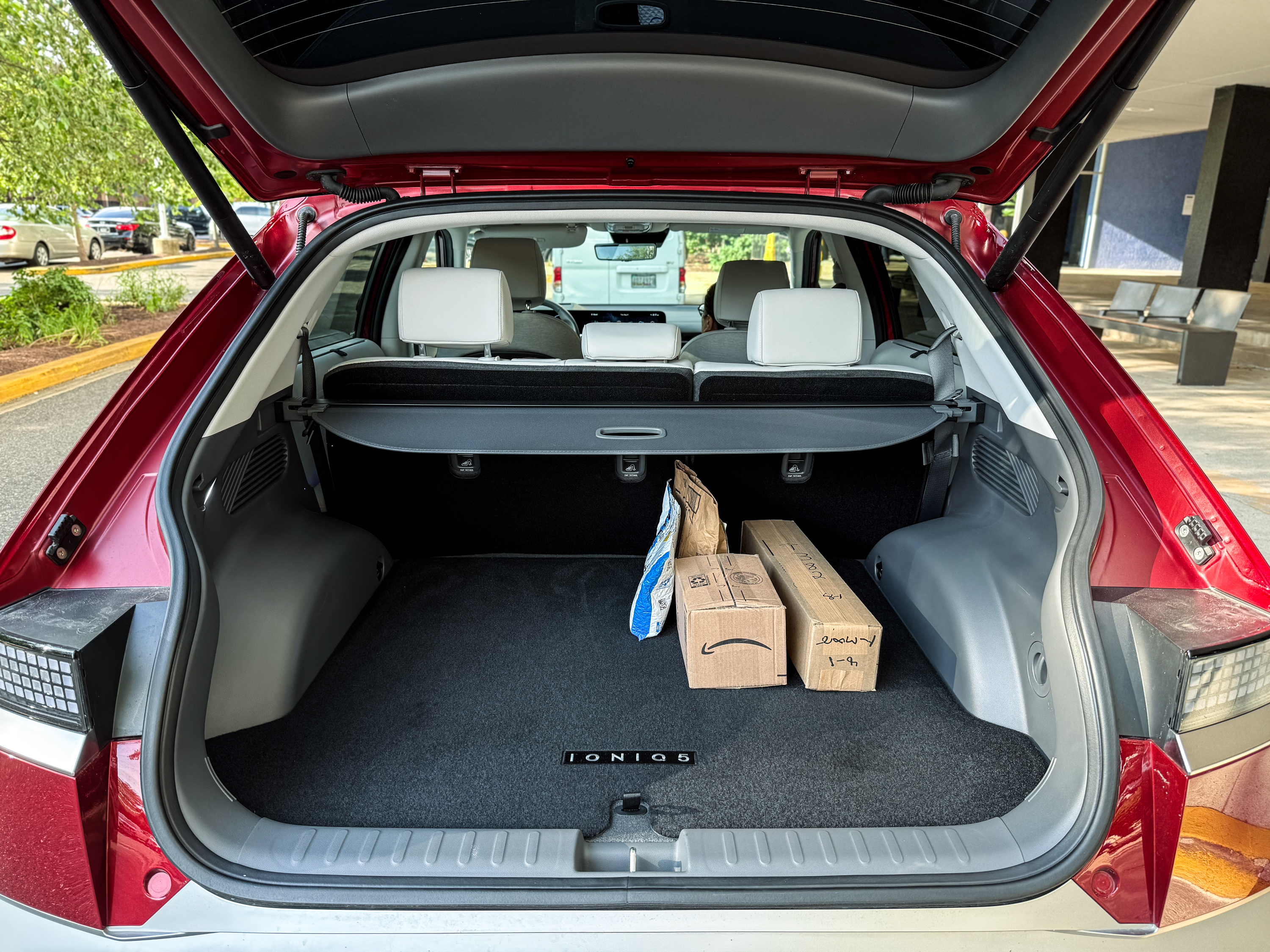
The cargo area is as spacious as the rear seat.
Jonathan Gitlin
3.4 miles/kWh isn’t bad for an all-wheel drive EV on big wheels.
Jonathan Gitlin
My range with half a battery.
Jonathan Gitlin
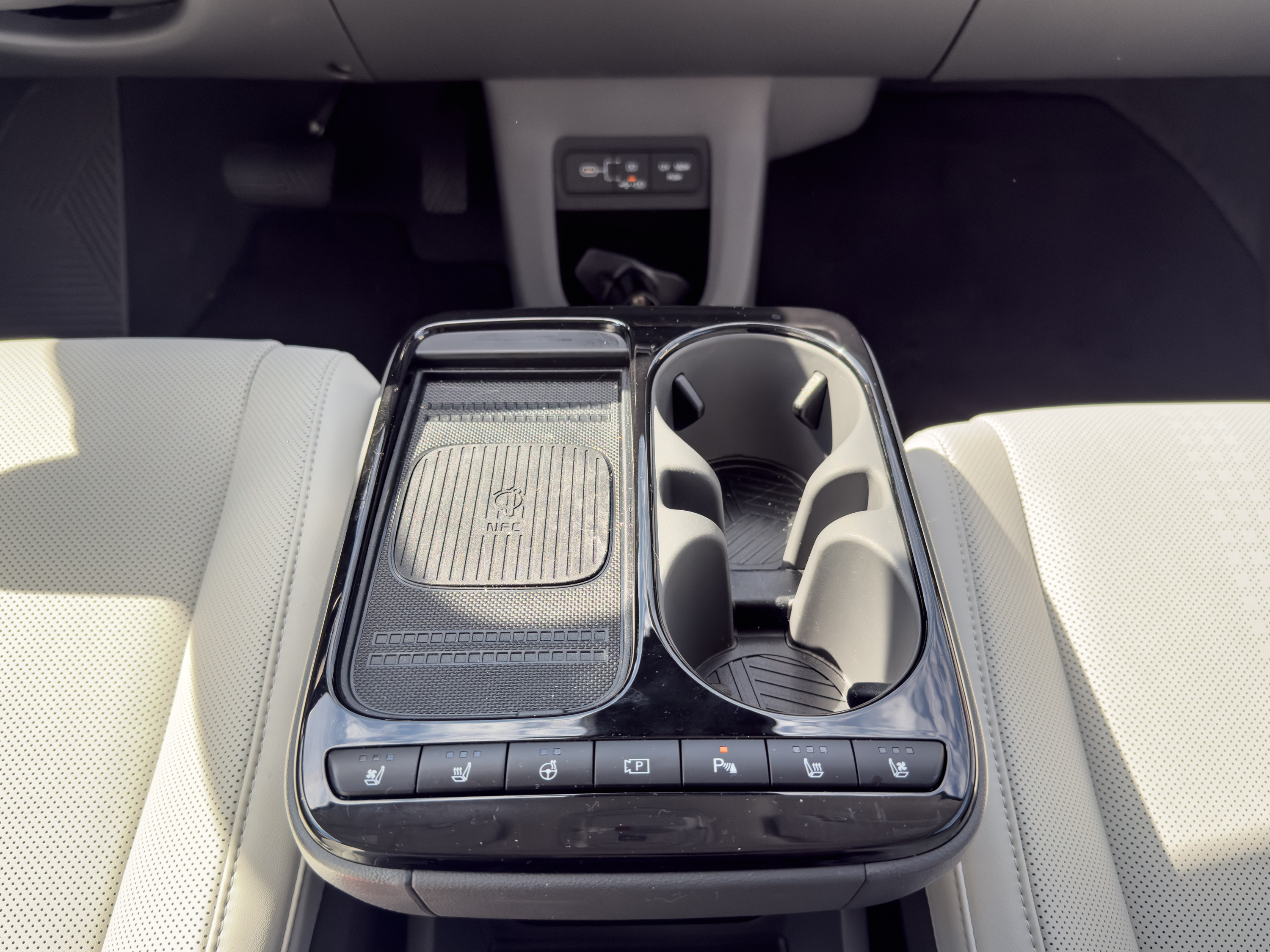
Wireless charging and cupholders. In the Limited, this whole console slides fore and aft.
Jonathan Gitlin
Hyundai issued a recall in December 2024, and at the time said that 1 percent of vehicles were likely affected. But Consumer Reports says its survey data shows the incidence is between 2–10 percent for EVs that use the E-GMP platform, including the Ioniq 5. While an ICCU failure would undoubtedly be very annoying, we should note that Hyundai USA recently increased the warranty on the ICCU to 15 years or 180,000 miles, meaning any affected car will be covered for most of its lifespan. Anecdotally, none of the Ioniq 5 (or related E-GMP EV) owners I know have suffered an ICCU failure, but since that’s only eight individuals, it’s still too small a sample size should the problem only occur in 2 percent of cars.
Which version?
There is also the rugged XRT to consider: This is the most expensive Ioniq 5 variant (other than the bonkers 5 N), at $46,275, and features lifted suspension and beefy bodywork that’s meant to protect it off-road. You give up another 10 miles (16 km) of range compared to the AWD Limited, which will preclude the more rational car buyer from considering the XRT, but the all-black interior is hard-wearing. And while the softer suspension might have been optimized for driving on dirt roads, it also copes most ably with potholes and road construction. Plus the protective cladding works as well in the Costco parking lot as it does when there are rocks around.
But were I buying my own Ioniq 5, I’d probably stick with RWD and benefit from the extra range, and then rely on winter tires when it gets cold and icy. I’m not sure I’d splurge for the Limited trim versus the $39,800 SEL either, even though I do like that blind spot camera and the better headlights. I’m not much for panoramic glass roofs, which is another feature that comes with the Limited. Beyond that, most of the equipment you find in the Limited is standard in the SEL, too.
Hegseth’s Theology and the Question: What Would Jesus Do?
There is a question Christians have been asking for generations: What would Jesus do?
It is a deceptively simple question that is printed on bracelets and bumper stickers, taught to children in Sunday schools, and invoked when Christians are discerning how faith should shape public life. The question becomes considerably more demanding when the decisions at stake concern war, immigration, poverty, political power, and the use of military force.
In addition to the recent attention about his military strategy, social and political beliefs, and leadership style, Pete Hegseth’s public theology deserves serious attention from those unfamiliar and disinterested in religion as well as adherents of Christianity.
As secretary of defense, Hegseth has increasingly spoken about American power in explicitly Christian language. He has hosted Christian worship at the Pentagon, invoked Scripture in connection with military service, emphasized the Christian foundations of the United States, and described some Trump administration policies — including border enforcement — as “biblical.” Indeed, speaking at a Christian media convention last February, Hegseth connected the health and founding of the United States with Christianity and characterized border and immigration policies as mandated in the Bible.
The question about Hegseth’s faith and religious practice, however, cannot simply be whether he is sincere. The question is more fundamental: What kind of Christianity is being proclaimed when the language of Jesus is attached to military power? Or perhaps a simpler but harder question: In the face of war, authoritarianism, economic, environmental, and political crises: What would Jesus do?
A Christianity of Power
The Christian faith has always contained competing visions of what it means to follow Jesus. There is a Christianity that blesses kings, armies, empires, and national ambitions. There is another Christianity that remembers a Palestinian Jewish leader who was unhoused and a migrant and was executed by an imperial power after heralding the arrival of a radically different kingdom. This distinction matters a great deal.
Hegseth routinely emphasizes strength, warriors, national identity, borders, enemies, and divine blessing. And joining forces with Israel to prosecute the war with Iran has only heightened the stakes of his rhetoric. Early in the conflict, Hegseth cited Psalm 144, including its language about God training hands for war and fingers for battle.
There is nothing inherently un-Christian about a person in the military having a sincere religious faith. People of faith serve in the armed forces for many reasons. Generations of religious scholars and adherents have considered war and conflict as it relates to the faith through theories and practices of religious pacifism, “just war,” defensive war, theologies of self-defense, conceptions of the last days, and the ethical limits of violence in humanitarian conflicts, among others. The theological problem arises, however, when the power of the state begins to present itself as an instrument of God’s purposes.
That is a very old temptation.
Empires have long claimed divine sanction. Kings have declared their wars holy. Nations have wrapped their ambitions in sacred language. And Christians have at times sought to confuse the interests of the nation with the kingdom of God. But Jesus does something profoundly disruptive to this arrangement: He refuses to identify God with Caesar.
The People at the Margins
Consider where Jesus directs our attention. Throughout the Bible, Jesus embraces people whom those with power, military might, and wealth have pushed aside: the poor, the sick, the imprisoned, immigrants, women, children, tax collectors, and those treated as religious outsiders.
In Matthew 25, one of the most famous Bible passages — sometimes called the “Last Judgment” — Jesus identifies with the hungry, the stranger, the naked, the sick, and the imprisoned. “Whatever you did for one of the least of these,” he teaches, “you did for me.”
That is not an incidental teaching. It is a political and theological reorientation. And it is directed at nations, not simply individuals or religious congregations.
Jesus asks: How has your nation treated the most vulnerable among you?
The question Jesus asks his followers is not first, “How strong is your nation?” It is not, “How effectively have you defeated your enemies?” It is not even, “How faithfully have you defended your borders?” Instead, he asks: How has your nation treated the most vulnerable among you? This matters enormously when Christian language is used to justify violent and exclusionary immigration policy or when it is used to promote cutting off families from food or lifesaving healthcare.
If we claim that border enforcement is “biblical,” then Christians must practice the Bible’s extraordinary insistence on welcoming the other. After all, Scripture commands God’s people to remember that they, too, were once strangers in a foreign land, and the way to honor and worship God is by welcoming the immigrant neighbor. If Matthew 25 means what Christians have traditionally claimed, Christ is encountered precisely among the hungry, the unhoused, the incarcerated — and that as long as anyone is unfree and impoverished, it is the responsibility of the nation to do something about it.
Theology of the Enemy
There is another problem with a Christianity centered on military strength: its understanding of the enemy. Christianity does not teach that some people become less human because they are someone’s adversaries. It does not profess that God blesses battleships nor justifies genocide (even if Hegseth’s spiritual adviser claims it does).
Jesus does not say, “Love your friends and destroy your enemies.”
Jesus’s command to love one’s enemies may be among the most difficult teachings in the entire New Testament. It is also one of the clearest.
Jesus does not say, “Love your friends and destroy your enemies.” He says, “Love your enemies and pray for those who persecute you.”
Jesus does not say, “Blessed are the powerful because they shall dominate.” He says, “Blessed are the peacemakers for they shall be called the descendants of God,” and “Blessed are the poor for they shall be first under God’s reign.”
That does not mean that people of faith must be naïve about violence. It does not mean governments face no genuine security threats. It does not erase the moral complexity of protecting human beings from violence. But it does mean that people who call themselves Christians should be extraordinarily cautious whenever military violence is described as holy, righteous, inevitable, or divinely ordained.
Christian tradition contains a long history of wrestling with war. It also contains an even deeper tradition of martyrs, peacemakers, conscientious objectors, abolitionists, human rights activists, and nonviolent movements that have insisted that human beings cannot be reduced to enemies.
On “Christ Is King”
One phrase that increasingly appears in Hegseth’s public religious rhetoric is “Christ is King.” On the surface, this is an ancient Christian confession. But Christians should be careful about what happens when it is fused with nationalism. If Christ is King, then Caesar is not. If Christ is King, then the nation cannot be God. If Christ is King, then military might cannot be the ultimate measure of righteousness. And if Christ is King, then Christians must remember what kind of king Jesus was.
Jesus did not arrive in Jerusalem on a tank. He did not establish his kingdom through an air campaign. He did not recruit an army to seize the Roman state. Jesus entered the city on a donkey. He washed his disciples’ feet. He touched people considered untouchable. He fed hungry crowds. He stood with the condemned. And when his disciples reached for weapons, Jesus told them to put them away. This is not weakness; it is a different conception of power and a different idea of violence, military and force. And it stands worlds away from the Hegseth’s professed belief in a conquering Christ.
Christian nationalism raises the question of who counts as part of the nation — and, implicitly, who counts as part of the Christian community. Hegseth’s religious politics have attracted scrutiny because of his association with a conservative Reformed Christian milieu and his willingness to amplify figures and institutions associated with Christian nationalist ideas. That should concern Christians not because Christianity should be banished from public life, but because Christianity is too important to be reduced to a tribal identity. There is no nationalism in the Sermon on the Mount; there is no exceptionalism in the Last Judgment.
Christianity offers an alternative to nationalism that does not require Christians to abandon love of country, but it begins by refusing to worship their nation.
Jesus did not teach his followers to build communities divided by race, citizenship status, wealth, or political loyalty. The early Christian proclamation was astonishing precisely because it created a community in which Jew and Greek, slave and free, male and female could belong together.
Christianity becomes spiritually dangerous when it is transformed from a call to discipleship into a badge of national membership, and a cross becomes something very different when it is used to sanctify exclusion, violence, and war, especially against the poor and marginalized.
So, What Would Jesus Do?
Let’s stop treating “What would Jesus do?” as a sentimental slogan. Instead, ask the question concretely.
What would Jesus do when a family fleeing poverty and violence arrives at the border?
What would Jesus do when a child is separated from a parent?
What would Jesus do when a nation considers going to war?
What would Jesus do when military personnel are asked to kill (and the nation suggests canceling student debt to those who sign up to do that killing)?
What would Jesus do when poor communities are abandoned while enormous resources flow into weapons?
What would Jesus do when a government claims God has blessed its political program?
And what would Jesus do when Christians begin to believe that their nation has a special claim on God?
The Gospels give us clues. Jesus runs toward suffering rather than away from it. Jesus challenges religious authorities who use God to legitimize their own power. Jesus feeds people rather than lecturing them. Jesus welcomes the stranger. Jesus stands with those society declares expendable. And Jesus tells his followers that greatness consists not in domination but in liberation. That is a radically different theology of power.
Another Christian Patriotism
Christianity offers an alternative to nationalism that does not require Christians to abandon love of country, but it begins by refusing to worship their nation. It means loving one’s neighbors, including neighbors who have crossed a border. It means seeking peace rather than glorifying war. It means protecting human life rather than measuring success by military superiority. It means asking whether public resources are being used to ensure that every person has food, housing, healthcare, education, dignity, and a meaningful opportunity to flourish.
And it means remembering that the Bible’s central story is not the triumph of one nation over all others. It is the liberation of an oppressed people. It is the insistence that Pharaoh does not have the final word. That is why the question “What would Jesus do?” cannot be separated from the question raised by Florence Reece’s popular song written in 1931 in Harlan County, Kentucky, during the union organizing drive of the United Mine Workers: “Which side are you on?”
Christian faith does not ask us to look down from the Pentagon, the White House, or any other seat of power and decide which people deserve compassion. Instead, Jesus teaches us to love God, love your neighbor, love even your enemy — and recognize Christ in the people that those in power tell you to hate and fear.
When Christian nationalism asks its followers to choose between faith and the stranger, between military might and peacemaking, between national supremacy and human solidarity, Christians — including the Christians in the highest reaches of power — should ask a different question. Not “How can we make America powerful enough to win?” But: What would Jesus do?
The answer begins where the Gospel always has: feeding the hungry, welcoming the immigrant, freeing the oppressed, and telling the people at the bottom that God has not forgotten them. That is not a weak Christianity. It is Christianity’s most dangerous claim about power: The last shall be first. The mighty shall be brought down. And the kingdom of God belongs not to those who dominate, but to those who serve.
South Korea is the stark future of super-aged societies
In December 2024, the share of South Koreans ages 65 and older surpassed 20% for the first time, making it what demographers like us call a “super-aged society.” By August 2026 that share had risen further, to 22.1%.
That label can sound like a diagnosis, but population aging is not inherently a problem. In part, it reflects demographic progress: Fewer people are dying prematurely, and people are living longer due to improved living conditions. Thus, an older population can simply be a sign of society having grown safer, healthier and demographically more mature.
The central concern, then, is not simply that a population is aging, but how quickly it is aging and whether society is prepared for it. South Korea moved from an aging society, meaning 7%-13% of a population is over 64, to a super-aged society in about 24 years.
This transition was considerably faster than Japan, where it took 35 years. In the United States, older adults are projected to make up 23.4% of the population by 2060.
By 2060, about 41% of South Koreans are projected to be 65 or older, which would place the country to become the oldest. The country will face growing pressure on pensions, healthcare, workplaces and caregiving systems, but will have relatively little time to adapt.
We researchpopulation health and aging. In our most recent study, published in July 2026, we examined how South Korea is dealing with its aging population. South Korea is not the first country to become a super-aged society, but the pace of its demographic transition has been exceptionally rapid. We believe its experience offers an early view of the choices many societies will soon face.
Changing family life
In the 1990s, the largest age groups were those between 15 and 34.
Now, more than 30 years later, the youngest of these are more than 45 years old, and the oldest have already reached retirement age, which in South Korea is 60. Notably, the share of people ages 30 and younger is shrinking.
South Korea’s aging is also connected to a broader shift in fertility, family formation and family life. As people gain greater individual autonomy in deciding how to organize their lives, there is a demographic transition toward sustained low fertility, later marriage and parenthood, and more diverse family arrangements.
South Korea is still wrestling with the financial implications of being a super-aged society.
The country’s retirement system relies mainly on the National Pension Service, a pension fund financed by contributions from workers, employers and the self-employed, and the Basic Pension, a separate, tax-funded benefit for lower-income adults ages 65 and older.
But unless something changes, the national pension fund is projected to be depleted by 2054. Many older adults have incomplete pension contribution histories and receive only modest benefits. Among those born before 1950, poverty rates are higher due to limited access to pensions and limited wealth accumulation.
According to the latest Organization for Economic Cooperation and Development, data, South Korea has the highest old-age income poverty rate among the OECD’s 38 member countries: 39.7% of people ages 66 and older live on less than half the national median household disposable income, compared with the OECD average of 14.8%.
Because many older adults are asset rich but cash poor – with more than 80% of their assets in real estate but only 12.4% in savings – many are pairing the Basic Pension with reverse mortgages to turn their assets into disposable income.
Raising the retirement age
Because pensions fall short for so many, South Korea has a high employment rate among older adults.
In fact, the average age at which South Korean older adults leave the workforce is higher than that in any of the other OECD countries. While men typically leave their longest-held job at about age 51, they continue to work until around age 72. Many spend those years in lower-paying, less secure “second careers.
Simply raising the retirement age is insufficient. South Korea is currently debating whether to gradually raise the statutory retirement age from 60 to 65. This would allow workers to remain in their primary careers longer, in order to narrow the gap between retirement and pension benefit eligibility.
For now, South Korea has already begun making changes to both pension financing and late career employment. A 2025 pension reform will gradually raise the national pension contribution rate from 9% to 13% by 2033 and set the target replacement rate – that is, the share of preretirement income that the pension is designed to replace – at 43%.
In addition to attending to its older citizens’ physical health, South Korea is also looking at ways to address loneliness and mental health among the elderly. Plan Shooting 2/Imazins via Getty Images via The Conversation
New healthcare needs
One of the biggest challenges for South Korea’s rapidly aging society is healthcare.
In 2008, South Korea introduced long term care insurance, which supports home care, nursing, rehabilitation, daycare, assistive devices and residential care for people with physical or cognitive needs. The program is financed through National Health Insurance, government funding and user copays.
Adults ages 65 and older can qualify if they are assessed as having difficulty performing daily activities or have specific age-related conditions, such as dementia or cerebrovascular disease. Eligibility is not income-based, although lower-income beneficiaries pay reduced or no copays.
Demand for services is rising rapidly. In 2024, 10.8% of people 65 and older and 31.9% of those at least 80 were certified for benefits, and these percentages are expected to increase.
But the program isn’t perfect: Families still provide substantial care, the care workforce is concentrated among older women in economically insecure jobs, and rural areas have fewer services and limited infrastructure to address the growing needs. It also doesn’t help that many older South Koreans worry about becoming a burden on their families.
Staying connected
Mental health and social connection have also become important components of South Korea’s response to population aging. South Korea has the highest suicide rate in the OECD, and the suicide rate among adults 65 and older was higher than in other age groups.
Social isolation is another growing concern. According to the 2023 National Survey of Older Koreans, 6.6% of adults 65 and older reported having no one they could turn to for help when they were sick, feeling discouraged or depressed, or facing an urgent financial need. The share rose from 4.6% among those between 65 and 69 to 12.9% among those 85 and older.
The same national survey documented that 4.8% of older adults reported physical, sexual or emotional abuse in the previous year, while 26.3% reported age discrimination in at least one everyday setting. These vulnerabilities can intersect with access to care, particularly among older adults with low incomes or functional limitations.
Risks and vulnerabilities are especially high for people living alone, those in poor health and rural residents. Visits, phone calls and community programs help, but these cannot replace adequate income, transportation, healthcare, housing or sustained social and family relationships.
Takeaways for other countries
When our team compared South Korea’s experience to that of other aging societies at different stages of demographic transition, it became clear that South Korea’s policies cannot simply be copied and implemented elsewhere.
What travels more easily are the broader lessons South Korea can offer societies that are earlier in their demographic transitions and therefore have more time to prepare.
South Korea highlights the need to build long-term care capacity before existing systems become overwhelmed. It also demonstrates why policymakers need to coordinate pension reforms with employment policy, rather than attempting to fix just one or the other. South Korea also underscores the need to design programs for older adults to reach rural and disadvantaged communities.
But the strongest lesson from South Korea is about timing: Aging societies have more options when they act before fiscal pressure, labor shortages and unmet care needs become severe.
South Korea has created important institutions and continues to adapt the system as needs change, especially in long-term care, but its experience also shows the costs of allowing policy and public attitudes to lag behind demographic reality.
Jeongmin Park is a PhD candidate at the Health and Human Development, Penn State and Alexis R. Santos is associate professor of human development and family studies, demography and public policy, Penn State
Thousands will die if EPA repeals power plant climate rules, lawsuit says
Days after finalizing a rule that would eliminate climate rules for power plants, the Environmental Protection Agency (EPA) was sued by groups who say the EPA’s repeal was shockingly short-sighted and risked leaving the country’s single largest source of industrial climate pollution unchecked.
On Thursday, the American Lung Association, the American Public Health Association (APHA), the Clean Air Council, Clean Wisconsin, the Environmental Defense Fund, and the Natural Resources Defense Council (NRDC) filed a petition requesting that the US Court of Appeals for the DC Circuit review if the EPA’s action conflicts with the Clean Air Act.
“Clean air is a basic human right,” APHA CEO Georges C. Benjamin said.
A physician and long-time public health policy leader, Benjamin warned that the EPA was “weakening” “life-saving standards” and stripping away “vital protections for all, and especially for children, pregnant people and communities already overburdened by pollution.” The lawsuit alleges that the rule change could cause thousands of premature deaths.
In the EPA’s announcement of the proposed repeal, the agency claimed that its action was based on “the best reading of the Clean Air Act.” Benjamin disagrees.
“Power plant pollution threatens the health of millions of Americans and fuels climate change, worsening extreme heat, poor air quality, and other serious health risks,” Benjamin said. He urged the court to recognize that the “EPA must maintain strong clean air and climate standards so every community can live a healthy life.”
The EPA may struggle to defend the rule given that its core mission is “to protect human health and the environment.” Meredith Hankins, NRDC’s federal climate legal director, accused the EPA of abdicating its legal responsibilities. She appeared confident that the EPA repeal will not survive court scrutiny.
“The Clean Air Act and Supreme Court precedent demand that the EPA address climate pollution from the largest industrial source in the nation,” Hankins said. “The EPA’s legal reasoning is fatally flawed, so we are going to court.”
“Devastating consequences” of EPA’s rollback
So far, the EPA has not acknowledged any potential harms of the rule change. Instead, the agency proposed rescinding all remaining greenhouse gas emissions requirements for power plants, claiming that the restrictions produce “virtually no benefits.”
Rather than meaningfully addressing the risks that advocacy groups describe, the EPA relied on an argument that anyone who’s ever monitored a climate lawsuit will recognize: that climate change is global and “public health harms are too uncertain, conjectural, remote, and convoluted to tie specifically to the US power sector.”
Overall, the agency appears more focused on claiming to have delivered $310 billion in savings on utilities for Americans, while saying that the repeal is “expected to unleash the full potential of America’s vast energy resources, including coal and natural gas.” The announcement also said the power plants will “save an additional $370 million in direct compliance costs.”
Advocacy groups say the EPA is turning a blind eye to a wide range of harms that could be easily addressed by maintaining the status quo. Lawrence Hafetz, the legal director of the Pennsylvania-based Clean Air Council, warned that the “EPA is senselessly discarding readily attainable carbon standards for power plants mere weeks after the UN showed the world on a trajectory to exceed the heating limit needed to avoid severe levels of economic, ecological, and social disruption.”
Impacts will be felt throughout the US, groups forecasted. For example, Brett Korte, a senior staff attorney for Clean Wisconsin, said he is bracing for “devastating consequences” if the rollback is allowed to stand.
“Here in Wisconsin, we’re experiencing warmer winters with less snow and ice cover, more exceedingly hot days in summer, and more frequent extreme weather events, like flooding and tornadoes, due to climate change,” Korte said. “On top of that, Wisconsin has the ninth-highest death rate from particulate matter pollution from fossil fuel combustion. EPA abandoning its responsibility to regulate carbon pollution would only make these problems worse.”
The EPA’s timing is terrible, and communities will experience unnecessary deaths if the court does not intervene, said Vickie Patton, who serves as general counsel for the Environmental Defense Fund.
“More Americans than ever are suffering from the dangerous heat and more powerful storms caused by that pollution and are facing the ensuing skyrocketing insurance bills and health costs,” Patton said. By increasing power plant climate pollution in this moment, the EPA rule change “will cause thousands of premature deaths and billions of dollars in additional health costs,” she predicted.
“We are taking action in the court of law to ensure [the] EPA carries out its responsibilities under our nation’s clean air laws to protect the American people from this harmful pollution and to address the health risks and financial costs for people across the country,” Patton said.
Thousands of Americans have submitted comments on the rule change so far, and the EPA continues to seek public input. At the end of this month, the EPA will hold a public hearing on the proposed repeal, an a public comment period extends through October.
Nato is concerned about the threat from Russia. But it isn’t panicking – yet
Over the past few weeks, a striking theme has emerged in discussions surrounding Nato. Senior political figures and former Nato officials have raised the possibility of invoking article 5 in response to severe cyber-attacks.
Military leaders have warned that Russia may seek opportunities to test the alliance’s resolve. These developments have prompted an obvious question: is Nato worried about being drawn into a wider European conflict?
The short answer is no. Nato isn’t panicking. But it is certainly having to confront a set of challenges more complicated than the prospect of a conventional war alone.
The real concern inside the alliance is not simply what Russia might do. It is whether Nato can maintain the unity and credibility needed to deter Russia while dealing with the growing political and strategic uncertainty among its members.
Much of the current discussion actually revolves around what are called “hybrid” activities. These tend to involve things such as cyber-attacks, sabotage, disinformation campaigns, airspace violations, GPS disruption and drone incursions. On September 15, jets deployed to the Nato air defence mission shot down what is alleged to have been a Russian drone violating Lithuanian airspace. Meanwhile, Denmark accused the Russian navy of firing flares at one of its helicopters operating in the Baltic Sea.
Such actions fall into the grey area between peace and war. They create uncertainty, impose costs and test political resolve, but without triggering an immediate military response. This presents Nato with a dilemma. The alliance was designed to deter major military aggression. It is less clear how it should respond to actions that are provocative but ambiguous.
Some western officials argue that Russia’s objective may not be to start a war with Nato at all. It may instead be to probe for weaknesses and identify areas where allies disagree over what constitutes an appropriate response, allowing for Moscow to play a longer game than some in eastern Europe would suspect.
In that sense, deterrence is no longer merely about tanks and missiles. It is about maintaining political unity in the face of continuous low-level pressure.
The article 5 problem
At the heart of Nato’s mission lies article 5, the commitment that an attack on one member will be treated as an attack on all. The difficulty is that article 5 derives its power not from legal wording but from credibility. Adversaries must believe that alliance members would actually follow through on their commitments if tested.
Analysts examining Nato’s eastern flank increasingly emphasise that deterrence rests on perceptions of allied willingness and political resolve as much as military capability.
If a hostile state caused widespread disruption to electrical grids, banking systems or communications infrastructure, would that justify collective military action? The answer is not always clear. For Nato planners, uncertainty itself can become a vulnerability.
Much of today’s anxiety is linked to the US. For 75 years, the alliance’s credibility has rested heavily on the assumption that Washington would lead any major response to aggression in Europe. That assumption has not disappeared. But it has become less straightforward than many European leaders would like.
Recent policy debates have increasingly focused on shifting responsibility for conventional defence towards European allies. Discussions about reducing US military commitments in Europe, reviewing troop deployments and encouraging greater European self-reliance have become central features of transatlantic security debates.
This does not mean the US is abandoning Nato. But it does mean alliance planners must consider scenarios in which American resources are stretched across multiple theatres and political attention is divided among competing priorities.
The Trump administration has signalled a shift in policy which will require Nato’s European members to be more self-reliant.EPA/Yuri Gripas
The challenge for Europe is therefore not replacing the US, but adapting to a future in which Washington expects allies to carry a greater share of the burden. The latest Nato concept to help achieve this is termed “multi-domain operations”, whereby Nato aspires to orchestrate military activities across all operating domains and environments and to be synchronised with non-military activities and organisations.
Politics matter as much as military power
A second challenge lies within Nato itself. The alliance often appears unified when confronted by major crises. Yet beneath that unity remain substantial differences in strategic outlook. Poland and the Baltic states naturally view Russia as the central threat. Southern European members frequently devote more attention to instability in North Africa and the Mediterranean. Larger powers bring global interests that smaller allies do not necessarily share.
At the same time, political shifts across Europe are creating additional complexity. The rise of nationalist and populist parties in Europe, such as the recent election of the AfD in regional elections in Germany, does not automatically weaken Nato. In some countries, these movements support higher defence spending and tougher policies towards Russia. In others, they are more sceptical of international commitments and multilateral institutions.
The consequence is not necessarily division, but increased diversity in how security threats are perceived and prioritised. Research on alliance cohesion consistently identifies differing threat perceptions and domestic political interests as potential sources of tension within Nato decision-making.
Concern, not panic
The temptation is to interpret recent statements and proposals as evidence that Nato fears war. A better interpretation is that Nato fears uncertainty.
The alliance faces an adversary willing to employ hybrid tactics below the threshold of open conflict and must adapt to a transatlantic relationship in which European allies are expected to take greater responsibility for their own defence. And it must preserve political cohesion among 32 states with increasingly diverse domestic politics and strategic priorities.
Bab al-Mandeb Strait’s shipping traffic comes to halt amid conflict in Yemen
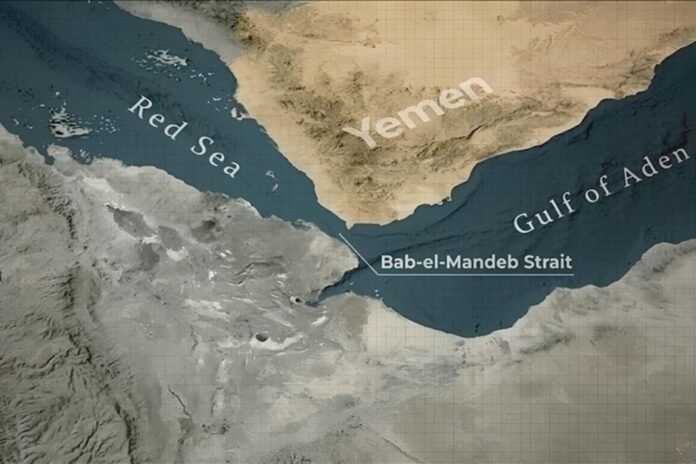
Escalating conflict off Yemen’s western coast brought shipping traffic through the Bab el-Mandeb Strait to a standstill, threatening a critical chokepoint for global logistics, Anadolu reports.
The waterway is facing its quietest days ever, coupled with the crisis in global trade and energy supply due to the blockade of the Strait of Hormuz.
The Bab el-Mandeb Strait carries 10% of global maritime trade and accounts for 12% of crude oil shipments. It has become a weak point in the global supply chain due to the military developments in the region.
The resurgence of conflict in Yemen since July altered the map of control of the region, as the Houthis secured the entire province of Hodeidah and advanced westward to Taiz, seizing Red Sea coastal cities like Mokha and the routes providing access to the Bab el-Mandeb Strait.
After taking over Mokha, the Houthis captured the Hanish archipelago, the Mayun island, and the town of Dhubab, all located around the Bab el-Mandeb Strait.
The capture of the Mayun island, located at the entrance to the western channel, raised security risks to the highest level.
An average of 33 ships transit the waterway each day, but traffic fell 88%, with only four vessels passing through in the past 24 hours, according to International Monetary Fund (IMF) PortWatch data.
READ: Houthis deny threat to Mecca from Yemen
The passage of oil and chemical tankers fell 91%, while only one ship passed in the last 24 hours.
Container ship traffic declined 86% below the average at the same time.
The few ships that were able to transit the waterway were flying the flags of Panama, Singapore, Liberia, and Ethiopia.
The Bab al-Mandeb Strait serves as the most critical southern gateway for goods and oil traveling from Asia to Europe via the Suez Canal, as well as for commodities bound for Asia.
Global shippers and energy firms are losing this safe passage amid escalating military tensions and continue to reroute their vessels around the southern tip of Africa’s Cape of Good Hope.
Circumventing the African continent extends voyage durations by weeks and causes freight and insurance costs to surge.
The Houthi’s intensifying pressure on the strait could lead to a new wave of global oil shocks, analysts say.
The bottleneck in the region is affecting alternative bypass plans for global energy routes.
Saudi Arabia is able to transport its crude oil directly to Red Sea ports by relying on its East-West Crude Pipeline, bypassing the Strait of Hormuz, but oil tankers loading cargo at these ports and heading south toward global markets have to transit the Bab al-Mandeb Strait.
Blockading the strait would threaten the viability of the route that bypasses the already conflict-ridden Strait of Hormuz.
Data of 700 European Revolut customers compromised in hack, attackers demand $3m ransom
The public prosecutor’s office in Reggio Calabria has opened an investigation into a case involving the banking services company Revolut, founded in London, which is now reportedly being blackmailed.
A group of hackers requested sensitive data from the bank using a compromised institutional email account belonging to the Reggio Calabria prefecture.
The digital bank has confirmed that data belonging to around 680 European customers has been affected, but that their funds have not been touched.
According to the Financial Times, which contacted the cybercriminals via Telegram, the group calls itself “iamnotavillain” and posted on its website on Wednesday afternoon a ransom demand for 3 million dollars, equivalent to 2.61 million euros.
If they do not receive the money within 24 hours, the hackers are threatening to sell the sensitive data to other criminal organisations.
The National Anti-Mafia and Counter-Terrorism Directorate is also working on the case, as it concerns a government body. The cybercrime division of the police says it was a highly sophisticated operation, but several points still need to be clarified. An unusual ransom demand
The group posted the ransom demand on its site on the dark web. The Financial Times (source in Italian) notes that making such a demand public is unusual; typically, ransom and extortion attempts are made privately at first and only made public if the targets refuse to pay.
In this case, however, the British newspaper received a message demanding that Revolut transfer “6,000 XMR / 3,000,000 $… otherwise all the data will be sold and you will have blood on your hands”.
XMR is the ticker symbol for the cryptocurrency Monero, often used in illegal contexts because it is difficult to trace.
The criminal group also told the newspaper that this was the first time it had used its site for a ransom demand and that it had not yet contacted the bank to open negotiations.
After making the ransom demand public, the hackers sent the Financial Times a 60-second screen recording showing an unidentified user scrolling through a collection of documents, possibly belonging to Revolut.
The information contained in the documents taken from Revolut is said to include passport details, driving licence data, other identity documents and photographs. The hackers claim to hold a total of 147 gigabytes of data. How far the investigation has progressed
Prosecutors are considering the offence of intrusion into an IT system of public interest. An initial report from the cybercrime police indicates that the operation, which lasted for months, was highly sophisticated, and it is still not certain whether a computer at the Reggio Calabria prefecture or at Italy’s Interior Ministry was compromised.
Experts are also trying to establish whether the institutional email account from which the requests originated was infiltrated or cloned.
Alongside the national Anti-Mafia and Counter-Terrorism Prosecutor’s Office, the Italian data protection authority has also stepped in, immediately launching checks for possible security breaches at Italian banks and urging data-protection officers to carry out a “prompt review” and, if any vulnerabilities are found, to notify the authority immediately.
The Italian privacy watchdog has also contacted its counterpart in Lithuania, where Revolut’s registered office is located, starting an exchange of information to strengthen efforts to counter the threat.
The investigation will determine how the offence was carried out and whether other public bodies were also affected.
High School Football Player Dies After Suffering In-Game Injury
A North Carolina high school football community is mourning the heartbreaking death of a 15-year-old player who died just days after being injured during a game.
Davion Fewell, a junior varsity football player at Page High School in Greensboro, was injured Thursday, Sept. 10, during a home game against rival Grimsley High School.
Fewell was taken to a hospital following the injury but died Sunday, Sept. 13, according to his family and local reports.
Exactly what happened to the teenager during the game has not been publicly disclosed.
Guilford County Schools confirmed that Fewell suffered an injury while playing and was later hospitalized, but officials have not revealed the specific nature of the injury or his official cause of death.
The circumstances surrounding what happened are still being examined, according to local station WFMY.
“Guilford County Schools is saddened by the loss to our school community,” the district said in a statement. “Our thoughts are with their family, teammates, coaches and classmates.”
The devastating news has shaken students, coaches and families throughout the Greensboro school community.
Page Pirates Football announced that a candlelight vigil will be held at the school’s stadium Thursday, Sept. 17, at 7:30 p.m. to remember the young athlete.
The team described Fewell as “truly a great kid” and encouraged the community to fill the stadium in his honor.
“We hope to see a packed stadium celebrating a beautiful life,” the team said.
Guilford County Schools has also activated its crisis-response team to provide grief counseling and other support to students and staff at Page High School following Fewell’s death.
Help is also coming from a familiar name in the football world.
The D.J. Reader Foundation has offered to help Fewell’s family with funeral and burial expenses, according to the school district. Reader, an NFL defensive lineman and former Grimsley High School player, has maintained ties to the Greensboro community through his foundation.
Greensboro Police also publicly offered condolences to Fewell’s family, friends, classmates, coaches and school staff.
Fewell’s death has hit particularly hard because the injury occurred during a junior varsity matchup between two longtime Greensboro-area high school rivals.
Page High School sits just north of downtown Greensboro and fields its teams as the Page Pirates. The Sept. 10 game was against nearby Grimsley High School.
For now, major questions remain about exactly what happened on the field.
Officials have not announced the type of injury Fewell suffered, and no official cause of death has been made public.
As the community waits for more answers, Page High School is preparing to gather Thursday night to remember a 15-year-old athlete whose life ended far too soon.
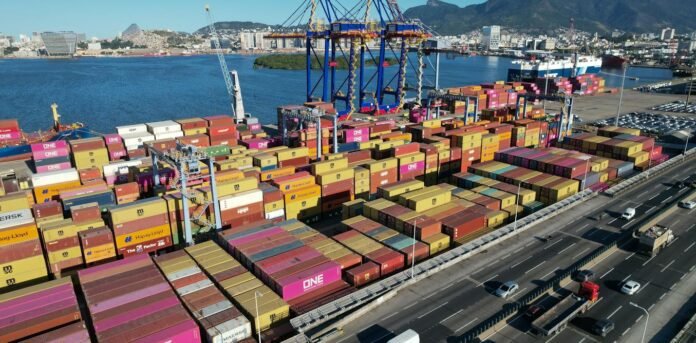
Here the imbalance goes the other way. U.S. exports to South America’s biggest economy have exceeded its imports for years. In 2025, American companies exported about US$54 billion in goods to Brazil, mainly refined fuel, aircraft parts, industrial machinery, fertilizer and electronics. They imported about $40 billion in Brazilian goods, mostly crude oil, semi-finished steel, coffee, orange juice, wood pulp, beef and passenger jets built by Embraer, the world’s third-largest aircraft maker.
In total, the U.S. ran a $14 billion trade surplus with Brazil.
Trump is discouraging Brazilian imports anyway. And this is his second attempt to do so. He announced a 50% tariff on Brazilian goods in July 2025, which the U.S. Supreme Court struck down in February 2026, along with most of his other tariffs.
As scholars of international political economy who study U.S. trade policy and Brazil’s trade negotiations, we are researching why the U.S. imposed tariffs on Brazil despite Brazil’s trade deficit with the U.S., and how Brazil is responding.
In our view, this dispute was never really about trade. It began with Trump’s objections to a criminal case against former President Jair Bolsonaro – his political ally in Brazil. Today, with Brazil on the verge of a presidential election, standing up to Washington could prove a winning argument for the incumbent, President Luiz Inácio Lula da Silva.
Making many exceptions
The administration spared 471 Brazilian products from the tariffs, among them coffee, wood and wood products, crude oil, natural gas, fertilizer, orange juice and pig iron. Most of the exempted goods are commodities and industrial inputs that American buyers would have trouble replacing quickly.
What stayed on the list is mostly manufactured: shoes, clothing, furniture, machinery and ethanol, the sugarcane-based motor fuel. Brazilian footwear and apparel, which compete on price in American stores, received no exemption at all.
The U.S. is making exceptions for some Brazilian exports, including coffee, for which it would be hard to find replacements.Pablo Porciuncula/AFP via Getty Images
Landing on American companies
Goods worth a total of $94 billion moved between the two countries in 2025, far below the volume of U.S. trade with Canada, Mexico, China or the European Union. But Brazil ranks among the 17 biggest trading partners of the United States in terms of the flow of goods, ahead of Spain, Australia and Saudi Arabia.
The goods still facing tariffs are largely industrial inputs rather than shelf-ready products. So the cost of Trump’s tariffs is mainly landing on U.S. companies, which are the ones that pay when the goods arrive at the border.
Trump’s ability to use tariffs to push Brazil to change policies his administration objects to is limited because Washington’s trade-related leverage over Brazil has been shrinking for years. China surpassed the U.S. as Brazil’s largest trading partner in 2009 and has widened its lead since then. In 2025, China bought roughly 29% of Brazil’s exports and the United States only 11%.
The erosion of Brazil’s reliance on the U.S. market limits what Trump’s tariffs can accomplish. It helps explain why, when Washington slapped tariffs on imports from the whole world in 2025, Brazilian exporters could largely sell their wares elsewhere.
The pressure may be self-defeating. In August 2026, White House adviser Peter Navarro and Treasury Secretary Scott Bessent published a report accusing about 40 economies, including Brazil, of helping China route goods around U.S. tariffs. Yet the more Washington restricts Brazilian access to the American market, the more attractive China becomes as a buyer of what Brazil’s selling.
A United Airlines Embraer 175 plane, owned by Republic Airways, lands at LaGuardia Airport on June 3, 2026. Brazil’s Embraer is the world’s third-largest aircraft manufacturer.Al Drago/Getty Images)
Why Trump is targeting Brazil
Trump didn’t emphasize trade-related concerns when he announced the 50% tariff in July 2025. Instead, he criticized the criminal prosecution of former President Jair Bolsonaro, a Trump ally, which Trump has called a “witch hunt.” The U.S. government also accused Brazil’s Supreme Court of censoring American social media platforms within the South American country’s borders.
Bolsonaro, who once aligned Brasília with Washington, cannot run again because he is serving a 27-year sentence for plotting a coup. But his son, Sen. Flávio Bolsonaro, is on the ballot.
Flávio Bolsonaro says he urged Trump not to impose tariffs. But his brother Eduardo, a Brazilian congressman, spent months in Washington lobbying the Trump administration to punish Brazilian officials over their father’s prosecution and welcomed the tariffs.
After the U.S. Supreme Court struck down the Trump administration’s first round of tariffs, it tried using a different legal tool: Section 301 of the Trade Act of 1974. That law lets a president retaliate against foreign practices it deems unfair.
In the second trade investigation, the U.S. placed additional tariffs on Brazil and 59 other countries, which the Trump administration said had to do with the alleged use of forced labor in their supply chains.
Brazil initially lacked the means to respond to either round of U.S. tariffs.
But in 2025, Brazil’s Congress passed a new “economic reciprocity” law that borrows Section 301’s logic. It allows the executive branch to determine whether a measure taken by a foreign country harms Brazilian competitiveness. If it does, the government may impose tariffs as countermeasures or suspend intellectual property obligations.
To be sure, launching a case does not guarantee that Brazil will retaliate. The procedure runs through seven administrative stages that together can take more than six months.
Brazil is also working on a slower, multilateral strategy. It has taken the dispute to the World Trade Organization, the Geneva-based body that writes and enforces global trade rules. The first stage of any WTO case is a round of formal talks called consultations, which the two governments are required to attempt before the dispute can go further.
Because the consultations with Washington ended in August without agreement, Brazil says it will request a formal WTO dispute panel, which would rule on whether the U.S. tariffs break the organization’s rules.
China has also joined that complaint, with India, Indonesia, South Africa, Colombia and Egypt signing on as interested parties.
Brazilian President Luiz Inacio Lula da Silva, left, confers with Finance Minister Dario Durigan on Aug. 5, 2026, about two months before voters cast their ballots.Evaristo Sa/AFP via Getty Image
Why Brazil may not hit back
We consider any official acts of retaliation against the U.S. by Brazil to be unlikely, due to the inherent power imbalance.
The U.S. consumer market is much larger than Brazil’s, and there are other asymmetries. The dollar-based financial system and Washington’s control over critical technologies give the United States ways to escalate trade battles that Brazil can’t counter. A trade fight could migrate to areas where Brazil has no way to respond in kind.
Canada’s situation shows what the alternative looks like. After its trade talks with Washington collapsed, Ottawa answered U.S. tariffs in August 2026 with tariffs of up to 50% on hundreds of U.S. goods, deepening a trade war between two countries that had been among the world’s closest trading partners. Canada sends roughly three-quarters of its exports to the United States, which gives its retaliation real bite – even if those tariffs may jeopardize its own economy. Brazil lacks that leverage.
Even if Brazil never retaliates, the steps it’s taking in that direction let the government show voters that it is doing something.
And whether Brazil ever activates its version of Section 301 to address what it sees as unfair trade practices may depend on who wins Brazil’s presidential election.