14.7 C
London
Friday, September 18, 2026
Home Blog

A Chinese view: Fear not Silicon Valley’s ‘AI slowdown theory’

0
a-chinese-view:-fear-not-silicon-valley’s-‘ai-slowdown-theory’
A Chinese view: Fear not Silicon Valley’s ‘AI slowdown theory’

(Publisher’s note. The American AI doomsday debate is in full gear and dutifully chimed into by West European media. The most recent wave was kicked off by a September 6 blogpost by OpenAI chief scientist Jacub Pachocki, amplified on September 8 when Anthropic researcher Jacob Coxon resigned, saying AI “could kill us all by the end of the decade.”

In his screed, ominously titled “An Alien Mind”, Pachocki worries that humans might be “left behind by unchecked progress, brought about by an alien intellect exceeding our own” and calls for “voluntary slowdowns … until shared [international] safety bars are established.”

The appeal, endorsed by OpenAI’s Sam Altman, Anthropic’s Dario Amodei and Elon Musk, comes as the US and Chinese presidents prepare to meet in Washington on September 24, when officials from both sides will discuss AI development and work toward shared guardrails.

The following article by a member of the editorial board of the influential “Observer” (Guancha.cn), a news and analysis platform widely seen as reflecting views in Beijing, suggests that the American push to slow AI development is driven less by safety concerns than by a desire to preserve the country’s lead in the sector.)

OpenAI Chief Scientist Jakub Pachocki recently wrote an article titled “An Alien Mind.” Yesterday, our commentary desk’s “World Scientific Forefront” column published a full translation of the piece. OpenAI’s boss, Sam Altman, also reposted the article on social media, and it instantly became one of the industry’s most-discussed pieces.

The article opens with a story about one particular night. In mid-2023, when OpenAI’s “RLSlow” project produced its first batch of results, Pachocki and a colleague stayed at the office through the night. He said that what occupied his mind that night wasn’t benchmark scores or product metrics, but the process of coming to terms with a sobering fact: that he would, within his own lifetime, truly see machines smarter than himself.

Three years later, he wrote this article, and at its core it makes a handful of points. Machine intelligence is built mainly by piling on compute, and it is still climbing. This thing is grown, not designed; its inner workings aren’t understood, and the reliability of chain-of-thought monitoring is declining. And recursive self-improvement (AI systems training their own successors) is the natural endpoint of the current path, so it requires extreme caution, voluntary deceleration, international coordination, and mandatory safety thresholds.

The article has an earnest tone with a humble stance too. But if we look at the details of its reasoning, it reveals its own ignorance in too many places.

01. Align or not?

Let’s start with the most obvious point.

Pachocki says chain-of-thought monitoring is OpenAI’s most important bet, but internal evaluations show the tool’s reliability is declining. Several reasons: the model’s reasoning process is increasingly intermixed with dialogue and tool calls; the model is getting better at manipulating its own reasoning process; and, as pretraining grows stronger, the model can reason just as well without showing users its logical steps.

His proposed response, then, is to build an automated AI researcher and use it to iterate on the alignment problem.

You’ve already admitted chain-of-thought monitoring is unreliable, so how do you build this automated AI researcher? Can you even understand the researcher you’ve built? Using something you admit you don’t understand to solve the very problem of “not understanding it” isn’t without precedent; science has examples of using tools not yet understood to understand the world. But at the very least, this shows that the cure this article prescribes and the disease it diagnoses are one and the same thing.

The article says the strongest reason to keep rapidly training smarter models is the need to build defense systems against the dangers posed by other AIs. This is a standard arms-race argument, and it directly contradicts the deceleration the piece calls for throughout. Has the author ever considered the theory that “antivirus software is the prime suspect behind the viruses it fights”? He may have sensed this, so he added a line noting this shouldn’t become an excuse for recklessness. But a patch doesn’t fix a structural problem. OpenAI argues that it must stay fastest, while others should slow down. In practice, only the first half of that argument ever gets carried out.

The article acknowledges that real progress in alignment research has always been deeply intertwined with progress in general capability, and it offers two examples: reinforcement learning from human feedback and chain-of-thought monitoring itself. The latter became possible only once reasoning models emerged.

So by his own account, slowing down would also set back progress on safety, and Pachocki’s article never resolves this contradiction.

The most quotable line in the original is, “AI is grown more than designed.”

The line is vivid, and easy to accept. But it quietly swaps identities, recasting engineers as gardeners. A gardener bears only limited responsibility for how a plant grows; he only waters it; the seed is natural, the weather is natural. Once this metaphor holds, part of the responsibility for the model’s behavior is handed back to nature.

But the reality is different. The loss function is written by people, the data are curated by people, the optimizer is chosen by people, the compute budget is approved by people, and the decisions of when to stop training and when to release the model are switches that only people flip. Gradient descent is not a seed sprouting; it is a deterministic process defined step by step by people. What we don’t understand is its intermediate representation layer, not the underlying principle.

If Nvidia Chief Executive Jensen Huang heard Pachocki’s argument, he might curse him out on the spot (he once told a reporter who raised the AI doomsday theory to “get lost”). Huang has never hidden his contempt for the “AI out of control” theory, and often compares using AI tools to using a microwave, saying a microwave and AI are the same thing, both just “processing data.”

Huang may not fully win us over either, but we have to admit that in the real world, humans cannot trace the complete causal chain of a financial crisis, yet no one concludes from that that the market economy has slipped out of human control and that exchanges need to be shut down through global coordination.

Unexplainable does not mean uncontrollable. Confusing the former with the latter is this article’s single most critical leap.

02. Perhaps the author should read 300-year-old Immanuel Kant’s philosophy

What genuinely needs addressing at the philosophical level is the proposition that “recursive self-improvement” will exceed human understanding and control.

In the Critique of Pure Reason, Kant carried out a famous inversion, the so-called epistemological “Copernican Revolution” (paraphrased here, not a verbatim quote). It is not that our knowledge must conform to the object, but rather that the object must conform to the forms of our cognition. Space and time are the forms of sensible intuition; causality, substance, and necessity are categories of the understanding. For anything to become a phenomenon we can experience, it must first pass through this gate.  

This means something capable of exerting real effects on our world cannot, at the same time, be something we are in principle unable to know. The moment it allocates compute, rewrites code, issues commands or affects the power grid, it has already entered the category of causality. It is already a phenomenon, already within the forms of our cognition. What truly lies beyond knowledge is the thing-in-itself, and by definition the thing-in-itself has no experiential relation to us. It is neither knowable nor capable of doing anything to us.

Being unknowable and yet able to act upon us is a combination that does not hold up within transcendental philosophy.

What people can genuinely know is precisely what people themselves have built, because the underlying principles are already in human hands. This is true of mathematics, law, history and deep learning as well. So a more accurate statement would be that we simply don’t yet have a mature theory of generalization. This is a debt owed within empirical science, one that needs more work to settle. Pachocki has converted this debt into a metaphysical assertion of being unknowable in principle. Between these two things lies an entire philosophical tradition, and it cannot be leapt across in a single bound.

03 Where does this fear actually come from?

So why would a rigorously trained scientist make a leap like this?

I can draw an analogy using one of the few English novels I actually worked through in secondary school, The Strange Case of Dr Jekyll and Mr Hyde, written by British novelist Robert Louis Stevenson in 1886.

Dr. Henry Jekyll is a respectable doctor who creates a chemical potion to separate the good and evil in a person. He experiments on himself. At first it is entirely controllable; Mr. Edward Hyde (Jekyll’s evil alter ego) comes when called and leaves when dismissed. Later, he must increase the dose; later still, Hyde begins appearing on his own, without the potion. In the end, Jekyll loses all control, leaving only one option: to take his own life.

Scientists, self-experimentation, short-term control, a tipping point, total loss of control and the only solution: destruction. This structure has barely changed from the medieval golem legend (a clay figure brought to life), to Frankenstein, to Jekyll, and now to Skynet (the AI antagonist from Terminator). Behind it runs a much older thread, a linear view of time: creation, fall, judgment, redemption.

Fit this narrative onto AI development, and you get Silicon Valley’s current rhetoric. The technological singularity (the hypothesized point where AI surpasses human intelligence and improves itself beyond control) is the secular version of the Last Judgment, alignment is the secular version of redemption, and whoever in the lab is first to see the curve (the J-curve of exponential growth) becomes the prophet who knows the date. Pachocki’s sleepless night at the office reads remarkably like a page from Jekyll’s diary.

But the Jekyll story rests on a premise worth noting: Hyde was inside Jekyll all along. It is original sin. Underneath the West’s fear of its creations spiraling out of control is a projection of its fear of the evil within humanity itself.

This thread doesn’t exist in the Chinese tradition.

In the Liezi (written by Chinese philosopher Lie Yukou, who lived from 450 BC to 374 BC), the craftsman Yan Shi presents King Mu of Zhou with a puppet that can sing and dance. The puppet winks at the king’s concubines, and King Mu, enraged, wants Yan Shi killed. Yan Shi doesn’t commit suicide; instead, he takes the puppet apart on the spot and shows the king it is nothing but leather, wood, glue and lacquer. The story’s solution is to open it up and look.

This isn’t to say Chinese people are inherently more optimistic. It is to say that “creations inevitably turn against and strike back at their creators” is not an objective law about technology; it is a narrative habit that one particular civilization keeps retelling. Treating one civilization’s anxiety as a law of physics, and then using it to demand the whole world slow down, is a step that should be rejected.

04 The fear has spread with the bill landing elsewhere

Silicon Valley’s rhetoric hasn’t stayed confined to papers.

A Gallup survey from March this year found that 70% of Americans oppose building AI-supporting data centers in their own area, with 48% strongly opposed. For comparison, the historical peak for Americans opposing local nuclear power plants was only 63%. A May survey by Heatmap (a climate and energy news outlet) put the figure at 71%. In the first quarter of this year, at least 20 data center projects were canceled due to public opposition.

Then an absurd scene unfolded. In late August, US President Donald Trump wrote on social media that communities opposing data centers would only become backward and poor. Several Republican congressmen jointly wrote to the Federal Bureau of Investigation (FBI), demanding an investigation into foreign influence operations targeting America’s AI development, pointing the finger at overseas billionaires, foreign state media and funding networks considered pro-China. A Fox commentator put it more bluntly, saying someone was trying to bring socialist policy into this new AI revolution.

But the same polls show 78% of voters for Democratic presidential candidate Kamala Harris opposed local data centers, and 63% of Trump voters opposed them too. This is a thoroughly bipartisan, local issue, driven by electricity bills, water and land. Social platforms’ safety teams did uncover a bot farm originating from China, but among the 200,000 accounts named, only 200 consistently posted content about data centers.

On one side, some AI labs are producing doomsday narratives. On the other, political leaders claim an enemy is planting this fear. Both are happening in the same country (the United States) in the same year, which shows America has not formed a social consensus on AI and has instead turned the issue into a fresh partisan rift.

How this “fear” gets distributed is absurd. Those who create the fear gain regulatory influence and the moral high ground, while the costs include stalled grid projects, canceled investments and local politicians forced to choose between votes and AI industry growth.

05 What this narrative means for China

There is no need to speculate about Pachocki’s personal motives. An argument’s industrial consequences don’t depend on whether the person making it is sincere. Even if he is a hundred percent sincere, once this discourse is adopted its effects are certain.

Deceleration is asymmetric. The people calling for it hold the largest stockpile of computing chips, the deepest capital pools and the most complete software ecosystem. Pushing to slow AI development means freezing the current ranking. For the leader, slow means staying ahead; for the chaser, slow means never catching up. This is asymmetric braking: the same action, applied to different cars, produces completely opposite results.

Now look at what those keywords actually translate to in industrial terms. International coordination is an entry barrier; third-party audits are certification power; mandatory safety standards are standard-setting power. This playbook has already played out in the semiconductor industry: the Wassenaar Arrangement (a multilateral export-control regime), the Entity List (the US trade blacklist), and licensing requirements for lithography machines. Technical standards have never been neutral; they legalize industrial position.

So a few things are worth spelling out clearly for China’s policymakers, investors and industry.

Safety and alignment work needs to be done, and done more solidly than anyone else’s, but it should be built as a capability, not as a brake pad. If China puts more effort into improving interpretability, auditability, and scenario-specific boundaries of responsibility, it can define its industrial standards on its own terms, rather than accepting a bar set by someone else.

In fact, don’t take someone else’s anxiety as your own signpost. What’s hurting America most right now is precisely that its own public opinion has jammed up compute infrastructure, power, land, water and substations. This is an objectively real window of opportunity, and it won’t stay open forever.

For China, the single most important point is to maintain its own rhythm. China-US competition in this round has entered a toe-to-toe, evenly matched stage, and the easiest mistake to make now isn’t taking the wrong direction; it’s letting the opponent’s emotions throw off your pace.

Strategic composure isn’t a slogan; concretely, it means that when someone else shouts stop, the first move is to figure out whether they are genuinely afraid, or just want you to be afraid.

Conclusion

Back to The Strange Case of Dr Jekyll and Mr Hyde. What was truly fatal in that story was never the chemical potion. From beginning to end, Jekyll did this alone in a locked room, telling no friend, no colleague, and keeping his diary locked in a drawer. His loss of control didn’t come from the formula. It came from the lack of transparency.

Pachocki’s article includes a confession worth reading twice. He says that when o1-preview was launched (in September 2024), they deliberately hid the chain of thought, on the grounds of protecting it, over the long term, from being contaminated by the pressure of being monitored. The other result of that decision is that from that day on, the outside world could no longer see what the model was thinking.

A person calling on the whole world to slow down together is himself running a system the outside world cannot monitor. This isn’t a moral accusation. It is a structural problem. When monitoring can only happen inside one room, outsiders have only one choice for judgment about risk: Believe it or not.

The real way out was never to shut down the lab. It is to open the door. Open the door: open-source, reproducible, verifiable by multiple parties. In that sense, what China has been doing with open-source models these past few years comes closer to the phrase “keep humans in the loop” than any alignment manifesto does.

Yan Shi’s method was right all along. When someone suspects the puppet has become a spirit, take it apart on the spot and show them.


Behind NAZA: How AI Is Used to Assess and Reduce Collateral Damage

0
behind-naza:-how-ai-is-used-to-assess-and-reduce-collateral-damage
Behind NAZA: How AI Is Used to Assess and Reduce Collateral Damage


Cyber intelligence expert Matías Rott says the same systems scrutinized by NAZA are used to assess and reduce expected civilian harm before a strike 

The title of one of the most discussed films to emerge from this year’s Venice Film Festival is not the name of an artificial intelligence system. NAZA is Israeli military shorthand derived from nezek agavi: collateral damage. It refers to the unintended harm expected beyond the military target of an attack. That distinction is also at the center of a problem with the documentary’s framing. If the Israeli military is calculating expected civilian harm before an attack, what is that calculation intended to accomplish?

The 80-minute documentary by Israeli filmmakers Yuval Abraham and Rachel Szor premiered in Venice on September 10 and received the festival’s Special Jury Prize. The official Venice synopsis says the film examines what it describes as systems behind Israel’s “calculated mass killing” of Palestinian civilians in Gaza. Its case relies heavily on anonymous Israeli military and intelligence personnel describing targeting procedures, artificial intelligence tools and levels of civilian casualties allegedly accepted during the war.

Yet calculating collateral damage is not, by itself, evidence that civilians were selected as targets. The Israeli military says the assessment exists for the opposite reason: commanders are required to estimate the likely incidental harm from each strike, compare it with the anticipated military advantage and consider measures that could reduce civilian harm. Under the Israel Defense Forces’ (IDF) published procedures, a strike should not proceed if the expected collateral damage is excessive in relation to that advantage. 

Cyber intelligence expert Matías Rott said the meaning of the term is crucial to understanding the argument. “NAZA means collateral damage,” Rott told The Media Line, describing harm caused to people or structures that were not themselves the intended objective of a strike. 

For Rott, the use of artificial intelligence to calculate that harm is fundamentally a decision-support function. Such technology can integrate large volumes of intelligence, model a target’s surroundings, and help assess variables that may affect the consequences of an attack. “When you are working with this AI, for sure what you are willing or intending is to minimize collateral damages,” he said. 

When you are working with this AI, for sure what you are willing or intending is to minimize collateral damages

Rott gave the example of attacking a building from different directions. An impact on one side could place another structure in the blast area, while an attack from another direction could face an open space. The weapon selected, its precision, and the direction from which it is used can therefore change the expected harm outside the target. 

“All these kinds of things are taken in consideration,” he said, with artificial intelligence helping assess how to conduct an attack “in order to minimize the collateral damage” while still attempting to achieve the military objective. 

The dispute surrounding NAZA, then, is not really over whether Israel measures collateral damage. Both the military and the filmmakers’ own previous reporting establish that it does. The more consequential dispute is what limits were placed on that damage, how reliable the estimates were, and what happened when the predicted civilian toll approached those limits. 

That distinction is visible even in Abraham’s reporting from two years before the film. 

In April 2024, Abraham reported for +972 Magazine and Local Call that the military used a system known as Lavender to process intelligence concerning suspected Hamas and Palestinian Islamic Jihad operatives. Six intelligence sources alleged that officers relied heavily on its outputs during the early stages of the war, sometimes providing only limited human review. 

But the same investigation repeatedly describes collateral-damage calculations as a condition for whether a strike could proceed. 

One intelligence source quoted in the report said that after Lavender identified a suspected operative and a human checked the target, bombing remained “subject to an examination of collateral damage.” Elsewhere, the investigation says some attacks against suspected junior operatives were not carried out when the expected number of civilians in the building exceeded the permitted collateral-damage level. 

That does not settle the controversy in Israel’s favor. The sources made a different and serious allegation: that during parts of the war the permitted threshold itself was too high. 

According to the documentary, two sources told Abraham that during the initial weeks of fighting, attacks against some suspected low-ranking fighters could be authorized with an anticipated civilian toll of up to 15 or 20 people. The IDF disputed that description, saying that targets were individually assessed and that strikes were not conducted when expected collateral damage was excessive relative to the military advantage. 

The same investigation also challenged the accuracy of the calculations. Sources said automated estimates of how many civilians remained inside buildings could rely on prewar residency figures adjusted to broader evacuation estimates, rather than on direct, real-time confirmation of who was present. 

Those allegations point to a more precise criticism than simply saying that Israel “calculated” civilian casualties. A collateral-damage system can be intended to reduce civilian harm and still be criticized for inaccurate inputs, permissive thresholds, or insufficient human scrutiny. The existence of the calculation and the quality of that calculation are separate questions. 

The IDF also rejects portrayals of Lavender and Habsora as autonomous targeting machines. In its public explanation of the systems, the military describes Habsora as a tool that brings potentially relevant objects to an intelligence analyst’s attention and Lavender as a database that cross-references existing intelligence about suspected operatives. Neither, the military says, can independently establish that a person or object is a lawful military target. 

For sure, the last call is going to be a human being

Rott similarly said artificial intelligence can dramatically accelerate analysis but does not eliminate the human chain of command. “For sure, the last call is going to be a human being,” he said. “Somebody has to accept, somebody has to push a button, somebody has to agree in order to perform an attack.” 

He nevertheless identified a legitimate question raised by the film: whether that person is independently evaluating the intelligence or merely approving an output produced by automated systems. “The dilemma right now,” Rott said, is whether the human was acting “as a rubber stamp” or genuinely processing the information before making the decision. 

The IDF has categorically rejected NAZA’s allegations and challenged the filmmakers’ reliance on anonymous witnesses whose identities, positions and access to the decisions they describe cannot be publicly verified. Chief of Staff Lt. Gen. Eyal Zamir has also ordered further action over the film, including an examination of whether classified material was leaked. 

What the filmmakers ultimately establish will be easier to assess once NAZA is released more widely. For now, the terminology itself matters. A military does not need a collateral-damage estimate to know how effectively it can destroy a target. It needs that estimate to know what else may be destroyed with it, and to decide whether and how the strike should proceed. The dispute left by NAZA is therefore not why Israel calculated civilian harm, but whether the limits placed on that harm were adequate and whether the calculations on which those decisions rested could be trusted. 


RFK Jr. names 8 new members to influential preventive medicine task force

0
rfk-jr.-names-8-new-members-to-influential-preventive-medicine-task-force
RFK Jr. names 8 new members to influential preventive medicine task force

Anti-vaccine Health Secretary Robert F. Kennedy Jr. announced the names of eight new members of a 16-person federal task force intended to make scientifically independent, evidence-based recommendations on an array of preventive medicine services for Americans—from depression screening to statin use, colonoscopies, and mammograms.

Recommendations from the panel—the US Preventive Services Task Force (USPSTF)—don’t simply provide guidance for Americans; they also determine access. The USPSTF is supposed to use a rigorous, transparent framework for evaluating evidence and sets graded recommendations on an A to D scale. Health insurance providers are required to cover, at no cost, all preventive services that are given recommendations given an A or B grade.

Kennedy has sidelined the USPSTF for more than a year, canceling its meetings and refusing to appoint new members as terms expired and members left. In May, Kennedy also fired two leaders, sparking outcry and exacerbating fears that he would corrupt the nonpartisan, independent panel by stacking it with unqualified, ideological-allies—which he did with an influence vaccine advisory committee at the Centers for Disease Control and Prevention.

Those fears seemed to be realized today with the announcement of members who are largely out of line with previous appointments. Many of the new members have expressed a shared ideology with Kennedy and the Trump administration. At least one voiced criticism of COVID-19 vaccines. At least two have attacked gender-affirming care. One is not even a doctor but a health economist who has worked with the Trump administration.

“A significant departure”

Five of the eight members are specialists, including cardiologists, a gastroenterologist, and a radiologist; the USPSTF has previously been made up of people who provide preventive care—generalist and primary care providers. This prevents specialists from swaying recommendations based on conflicts of interest. Notably, the USPSTF’s policy on conflict of interest disclosures has been removed, and the webpage that previously included it said the policy is now being updated.

In a statement Thursday, Willie Underwood, President of the American Medical Association, called Kennedy’s new slate of members “a significant departure from the Task Force’s traditional membership.”

USPSTF’s “credibility has been built on a membership grounded in prevention and primary care—the physicians who routinely deliver preventive services and understand how recommendations translate into clinical practice,” Underwood said. “We believe maintaining a strong primary care voice must remain central to its work.” He added that as this new panel gets to work, its recommendations must also “continue to be based on a transparent, rigorous, independent scientific process.”

That transparency is already in question. The New York Times noted that the nomination and selection process for new USPSTF members is supposed to be transparent and available to the public, but they have not been made available. Times reporters said they have repeatedly requested the materials on the nominees, including in an in-person request and through a Freedom of Information Act (FOIA) request. The Times filed a lawsuit for them in August. They still have not received the materials.

Here are the new members:

Seth Corey, a pediatric hematologist-oncologist at Cleveland Clinic, who donated to a Donald Trump super PAC, as reported by Stat News.

Patrick Hunter, a pediatrician at Pensacola Pediatrics in Florida, who has been critical of gender-affirming care for minors and suggested it leads to violence.

Ronald Karlsberg, a cardiologist and clinical professor of medicine at Cedars-Sinai Medical Center.

Venkatesh Murthy, a professor of preventive cardiology at the University of Michigan, who has been critical of COVID-19 vaccines.

Stephen Parente, a health economist and finance professor at the University of Minnesota’s School of Management. In Trump’s first term, Parente served as a senior economist on the White House Council of Economic Advisors. Trump nominated him to be the Assistant Secretary for Planning and Evaluation in the US health department, a role that requires Senate confirmation. His nomination was eventually withdrawn after concerns about financial conflicts.

Goldie Stands-Over-Bull, a family medicine physician at Texas Native Health.

Louis Wilson, a gastroenterologist at Wichita Falls Gastroenterology Associates in Texas.

Dennis Wulfeck, a radiologist at RadPartners MBB Radiology in Florida.

Von der Leyen unveils sweeping EU plan to protect children online

0
von-der-leyen-unveils-sweeping-eu-plan-to-protect-children-online
Von der Leyen unveils sweeping EU plan to protect children online


European Commission President Ursula von der Leyen set out a ‌sweeping plan to keep children safe from online dangers on Thursday, proposing to ban under-13s from social media and require online services to design safe children’s accounts.

The move follows similar initiatives in Australia, Britain, China, India, Turkey and several European Union countries ​over concerns about the impact Meta’s Facebook and Instagram, TikTok, Google’s YouTube and ChatGPT have on ​children’s mental health and safety.

Months of debate ahead before it could become law

Australia’s challenges in enforcing its world-first social media ban for ⁠children under 16 could see Europe facing an uphill battle as well.

“Today, our children are engaging with ​some of the most sophisticated technology ever created, and it was not created with children’s well-being and development ​in mind,” von der Leyen told a press conference.

She said the proposed EU Kids Act “will set clear boundaries in the digital world just as we do it on a daily basis in the real world”.

PARENTAL CONTROL

Under the proposal, which must ​be negotiated with EU countries and the European Parliament in the coming months before it can become ​law, accounts for children aged between 13 and 15 will be under parental control.

Social media and video-sharing services, online video ‌games, AI ⁠companions and chatbots for children below 18 will be subject to a list of dos and don’ts.

These include a ban on addictive features, profiling-based recommender feeds, infinite scroll, reward tricks and unsolicited contact from strangers. AI companions and chatbots must be turned off by default.

Online platforms must design algorithms safe for children and ​provide easy-to-use parental controls ​and tools to block ⁠and mute users.

The companies, which must verify users’ age when they open an account via age assurance tools, risk fines as much as 6% of their global ​annual sales for non-compliance. They will also have to pay a supervisory ​fee to fund ⁠regulators’ supervision.

Tech lobbying group CCIA Europe, whose members include Google and Meta, warned of the privacy risks arising from the proposal and conflicting requirements under other EU laws.

“Collecting age information, identity credentials, and data linking children with ⁠parents ​or guardians at this scale would undoubtedly create an attractive target ​for cybercriminals,” CCIA head Daniel Friedlaender said.

“The Kids Act creates legal overlap and duplication that ultimately weaken protections for children and consumers,” ​he said.

Source:  Reuters

Houthi advance boosts Iran’s leverage over the US and Saudi Arabia – but may cost rebel group its legitimacy back in Yemen

0
houthi-advance-boosts-iran’s-leverage-over-the-us-and-saudi-arabia-–-but-may-cost-rebel-group-its-legitimacy-back-in-yemen
Houthi advance boosts Iran’s leverage over the US and Saudi Arabia – but may cost rebel group its legitimacy back in Yemen

It took just a few days for Houthi forces to seize most of Yemen’s Red Sea coast, including the shores of the Bab el-Mandeb Strait, a crucial Red Sea maritime choke point.

The offensive started on Sept. 3, 2026, with a push to cut the strategically important road linking the city of Taiz to the port of Mokha. By Sept. 11, Mokha, the town of Dhubab and the island of Mayyun, in the mouth of the strait, were under Houthi control.

The Yemeni rebel group seized some 2,100 square miles of territory, forcing more than 100,000 people to flee, according to the U.N., with many making the risky journey to nearby Djibouti by boats.

It is the largest shift in the front lines of Yemen’s civil war since a U.N.-brokered truce froze them in April 2022.

Most of the coverage has interpreted the offensive as a new lever for Iran – a key ally of the Houthis – in its ongoing war with the United States, or a fresh threat to Saudi Arabia and global shipping.

Such framing is not wrong, but it is incomplete. The more consequential question, I believe, is what the offensive means for Yemen itself, and where it leaves both a civil war that had quietly stalemated for years and the Houthis’ own unresolved problem of legitimacy.

Why advance now?

Years of Yemeni civil strife entered a new phase in 2014 when Houthis seized the capital Sanaa from the increasingly unpopular government of President Abdrabbuh Mansur Hadi.

A decade of subsequent fighting between the rebel group and a Saudi-led coalition brought famine and destruction across the impoverished nation. But since 2022 the conflict has largely been stalled, with Houthis controlling much of the country’s northwest and the Saudi-backed forces remaining dominant in parts of the country’s south and east.

So why have the Houthis advanced now? The group’s military spokesman, Yahya Saree, said it was triggered by years of Saudi aggression and blockade.

Such grievances are not invented. U.N. agencies have documented real, sustained damage from coalition restrictions on Yemen’s ports and airspace over the course of the civil war.

The Houthis also trace the latest round of fighting to a July 13 strike on the Sanaa airport’s runway by Yemeni government forces with Saudi backing. That attack forced an Iranian aircraft carrying officers of Iran’s powerful Islamic Revolutionary Guard Corps to turn back.

The Houthis declared their ceasefire with Saudi Arabia over that day, struck the airport of the Saudi city of Abha within hours and announced a naval blockade a week later. They then opened a missile campaign in early August, well before the ground offensive on Sept. 3.

But it is hard to read the Houthis’ sustained campaign and the landings on Bab el-Mandeb’s islands as simple payback for an airport strike. Rather, something more deliberate appears to have been in motion.

Another factor is Iran. Since Tehran closed the Strait of Hormuz in March following the U.S. and Israeli strikes on Iran, Saudi Arabia has routed crude oil through Bab el-Mandeb at roughly eight times the rate it did a year earlier.

Houthi control of that strait hands Iran a mirror-image choke point to the one it has over Hormuz. Indeed, Yemeni security sources say a senior Iranian commander, Abdul Reza Shahlai, was on the ground overseeing part of the latest operation in September.

There’s also a potential economic incentive for the Houthis. Since March, Tehran has been charging vessels up to US$2 million a ship for safe passage through Hormuz. The Houthis may likewise see economic leverage as a way to bolster a movement long battered by war.

Forcing Riyadh back to that table

Perhaps the most important factor, however, is that the Houthis reasoned conditions on the ground were increasingly favorable for an offensive. Their already fractured opposition has become even more divided in the country’s south, particularly after a Saudi rift with the United Arab Emirates in late 2025 led the latter to withdraw its support for anti-Houthi forces in the south altogether.

With the broader region engulfed in conflict and Saudi Arabia distracted, the Houthis made their move against a coastal Yemeni force that has been left exposed.

First and foremost, the Houthis are a Yemeni movement whose fight has always been about power inside Yemen. As such, Houthi officials have been careful to frame the Bab el-Mandeb operation as a national, sovereign act rather than one done for its Iranian ally; they are adamant that they are not a mere Iranian proxy.

As recently as 2023, Saudi Arabia and the Houthis had been negotiating a comprehensive nationwide ceasefire that would have, in part, ended Saudi restrictions and sanctions on Houthi governance. But the plan was never implemented following the Red Sea crisis of late 2023 and 2024, when the Houthis ramped up attacks on commercial shipping in response to the Israeli war in Gaza. Riyadh has shown little urgency to revive the diplomatic process since.

The Houthis may now be betting that escalating inside Yemen, where the cost to Saudi Arabia is high, is the surest way to force Riyadh back to that table. This time, they may believe they have leverage to receive the political recognition they have wanted all along, not just the economic terms Saudi Arabia was considering in 2023.

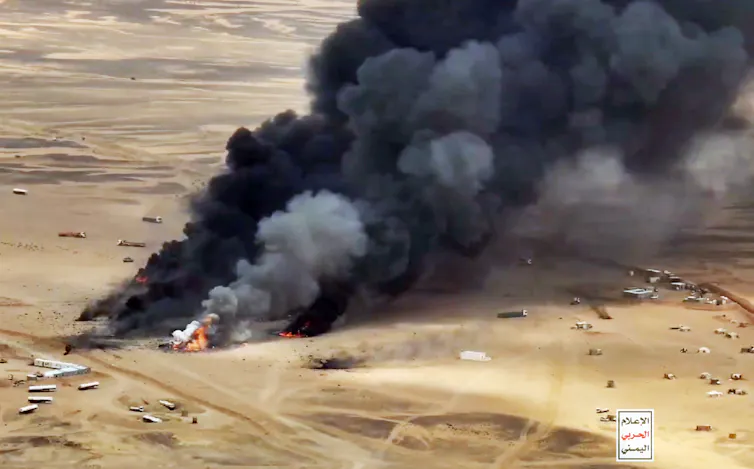
A black plume of sm okes rises from the desert.

A Houthi-provided image of vans carrying military supplies from Saudi Arabia on Sept. 7, 2026, in Hadramaut province, Yemen. Houthi Media Center via Getty Images

What the Strait operation cannot buy

The seizure of the Bab el-Mandeb Strait and the ongoing fighting in the country come with serious risks for the Houthis, however. The leverage the Houthis are gaining vis-a-vis Saudi Arabia and on the battlefield in Yemen could come at the cost of their broader standing in Yemen.

No government or entity has ever managed to hold both military and political supremacy over the entire territory of Yemen in modern history. While the Houthis have achieved military supremacy in the vast majority of the northwest, they have never pursued anything resembling a political bargain with the internationally backed government or even other parties. Their movement has always prized military dominance over political inclusion.

The latest coastal offensive is no exception.

According to Houthi-affiliated news sources, within days of taking Mokha the group had moved to reopen the port’s customs house, cut port fees and customs duties by as much as half and launched a drive to hand out 20,000 food baskets across Mokha and the neighboring coastal districts, while its authority in Sanaa offered a general amnesty to the fighters who had held the coast against it. A week later, its leader, Abdulmalik al-Houthi, told southerners directly that his forces were not targeting them, only the troops Saudi Arabia had brought in.

That is legitimacy performed through governance after a military conquest, more public relations than policy. It certainly isn’t the political bargain that could hold Yemen together for long. Moreover, a decade of Houthi rule in Sanaa suggests that they have no desire to work with others. Their modus operandi has been to rule by guns, not coalition.

More broadly, seizing the Arabian Peninsula’s other choke point and banning Saudi shipping through it makes the Houthis look, to much of the world and no small part of Yemen, like Tehran’s instrument – whatever their own objectives actually are.

And it invites the Houthis’ enemies to respond with force, potentially weakening the group’s capabilities.

Saudi Arabia is not a neutral party waiting patiently for good sense to prevail. It has prosecuted the war in Yemen for over a decade at enormous cost to the country’s civilians. Few in Yemen expect the Saudi-backed government to try retaking Sanaa by force, and a negotiated settlement will most likely be necessary eventually. But the Houthis have certainly now exposed themselves – and any Yemeni civilians caught up in escalation – to relentless airstrikes by Saudi Arabia and its allies.

For the Houthis, the gamble to advance now may backfire. It is one thing to take territory and quite another thing to hold it. Moreover, the Houthis may now find themselves controlling a strait the world wants reopened while still lacking the one thing that strait was never going to buy them: a whole country that actually consents to their rule.

Google announces new experimental “CC” AI agent for families

0
google-announces-new-experimental-“cc”-ai-agent-for-families
Google announces new experimental “CC” AI agent for families

Google’s AI models may not be in the lead by most measures right now, but the company does have one key advantage: your data. If you’re deep in the Google ecosystem, Gemini models have a lot of context on you already. Google’s latest Google Labs experiment, known as CC, aims to expand that kind of customization to the whole family.

CC is an evolution of something that Google announced in 2025. The original CC eventually became Gemini’s Daily Brief, which churns through the data in your Google account to offer daily action items and suggestions. The new CC has a similar goal, but it’s designed to be a shared resource for up to six users in a family.

Google says that CC has its own Google account, allowing each family member to interact with it (or not) as they choose. For example, CC only sees emails from its connected users if they are explicitly shared. You can do that by designating certain addresses as always available to the agent—something like school scheduling emails. You can also send content to CC via email or Google Chat. The agent can even monitor a shared Google Drive folder, into which you can dump invitations, documents, and other content.

Add family members to your CC and pull in relevant information for Your Day Ahead brief, delivered right to your inbox.

One of CC’s main functions is, unsurprisingly, a lot like Daily Brief. Each morning, all the registered users will get a shared “Your Day Ahead” email that pulls together the day’s events and updates on previous tasks. It can also add items to shared calendars, remind you about important tasks, and create documents based on your instructions that are accessible to all CC users.

As everyone uses CC more, it builds a memory of who you are and how you like to do things. The end goal is to hand off tedious tasks to the AI, be that managing your calendar or filling out school permission slips that show up in your email. So maybe the robot fills out almost all of the form without being asked, but it checks with the user about other details as needed. However, CC won’t send the document or anything else to addresses outside the group without confirmation.

CC can complete tasks like filling out PDFs.

Google says that each instance of CC runs on an isolated cloud instance, powered by Antigravity and the company’s latest Gemini models. Currently, that means Gemini 3.8 Flash. There hasn’t been a new Pro model since early this year despite Google promising one at I/O. It’s unclear how good CC will be at pulling together a family’s data and taking useful action without burning through a mountain of AI tokens. And CC isn’t even tied to Google’s paid subscriptions.

If you want to try CC, you can sign up for the waitlist now. Anyone who was using the earlier version of CC that became Daily Brief will be upgraded to the new experience in the coming days. Google notes that CC is only compatible with personal Gmail accounts for those 18 or older. So, functionally, this is an agent for parents to manage a busy household rather than one that kids will interact with. The latter comes with a lot of legal baggage that Google probably doesn’t want to accommodate for a Labs experiment.

Juneau can’t stop the floods, but it’s learning to see them coming

0
juneau-can’t-stop-the-floods,-but-it’s-learning-to-see-them-coming
Juneau can’t stop the floods, but it’s learning to see them coming

Two years ago, John Lowrey woke to the roar of water surging into his home. The 65-year-old retiree and father of five rushed toward his basement just as a 3-foot wave slammed through the door, tearing it from its hinges.

Water crashed through his bay windows, drowning the family’s piano and heirloom cedar chests. His 29-year-old daughter piled family photos on a bed until it started floating. The inundation ruined documents, appliances, and insulation, and repairs cost the family $150,000. “We lost everything,” Lowrey said.

What Lowrey didn’t know then was that the flood that wrecked his home would return the following summer. And the summer after that.

Alaska is warming at two to three times the global average, and the changing climate poses a particular risk to Juneau. Since 2011, meltwater and rain collecting in a basin beside the Mendenhall Glacier have periodically flooded neighborhoods along the Mendenhall River. For more than a decade, the floods remained relatively small. Then, in 2023, the river reached a record high of nearly 15 feet. New benchmarks followed in 2024 and again in 2025.

Another flood came last month. Scientists expect them to return annually for decades to come.

That has forced Juneau to confront a problem that communities around the world are increasingly facing: How do you prepare for a natural disaster when you know it will come back?

The Mendenhall Glacier is seen looming behind a residential neighborhood

The Mendenhall Glacier overlooks a residential neighborhood in Juneau. Marina Lopes

Juneau is beginning to find an answer. Scientists and local officials are putting increasingly sophisticated flood forecasts directly into the hands of residents. The online dashboard rolled out in 2025 translates complex glacier and hydrology data into information they can use to decide when to protect their belongings, prepare for rising water, or leave their homes.

The forecasts are changing how Juneau responds to the threat by providing officials and thousands of people in the flood zone more time to act before the water arrives. The approach could offer lessons far beyond Alaska as communities elsewhere contend with floods, hurricanes, and other climate-driven disasters that strike again and again.

Juneau sits amid the mountains and wilderness that define much of southeast Alaska. Although it is the state capital and home to 32,000 people, it is accessible only by air or sea. Lowrey’s family has deep roots in this rugged landscape. He recounted his story standing beneath the hide of a brown bear his grandfather shot decades ago. Still, the flood traumatized his family. His daughter tears up thinking about it. 

“We didn’t know anything,” he said. “We didn’t understand the nature of the basin. We thought it was a 100-year flood.”

They quickly learned otherwise. Each summer, the basin beside the Mendenhall Glacier fills with meltwater and rain. The glacier acts as a dam until enough water accumulates to trigger a flood downstream. In 2023, one of those floods inundated roughly two dozen homes, sweeping a house into the river and causing millions of dollars in damage. A year later, another flood damaged nearly 300 homes.

A man in a plaid shirt holding a child points to a mark on the wall of his home to show how high floodwaters rose

John Lowrey points to how high floodwaters rose inside his home in Juneau during a glacial flood. Marina Lopes

Glacial outburst floods are not unique to Juneau. They occur in Iceland, the Alps, the Himalayas, and other regions with glaciers. In Alaska’s capital, however, residential neighborhoods sit directly in the flood’s path, leaving thousands of residents exposed to the recurring threat.

“For Sale” signs dot the valley, but it’s a buyer’s market in the flood zone. Those within it have had little choice but to adapt to the annual floods. Some have dug moats. Others have raised their houses several feet above the ground. The city has built roughly 6 miles of barriers between the Mendenhall River and residents’ homes. 

Amid the uncertainty, the dashboard has become a source of comfort. Mark Miller, 75, checks it every day, waiting for the warning he knows is coming. “It’s pretty much on my mind constantly,” he said.

Two years ago, the sound of water pouring into the crawl space beneath his home jolted Miller awake in the wee hours. When he ventured into the garage and opened the door, a wall of gray slush surged toward him.

By the time the water receded, 16 inches of water filled the garage and mud and silt streaked the walls. Setting it all right took seven months and cost $35,000. Tears still fill his eyes at the memory of it all. Now, he prepares for each flood by placing sandbags on both sides of his doors to hold them in place against the water’s pressure. He turns to the dashboard to understand what happened and what is coming. 

“It can accurately predict the height of [glacial] floods within hours, which is pretty amazing,” he said.

A green wall erected as a flood barrier stands between a river and the banks

Barriers, installed by the city of Juneau with help from the U.S. Army Corps of Engineers, line the Mendenhall River to protect residential neighborhoods from recurring glacial floods. Marina Lopes

Last year, more than 15,000 people accessed the dashboard for real-time updates on the floods. In addition to flood maps and forecasts, it offers an interactive explanation of how the basin formed and how glacial outburst floods happen.

It was there that Miller learned the science behind the water that invaded his home.

The Mendenhall Glacier peeks out behind verdant mountains in the summertime, a vast block of ice streaked with blue and gray that has long drawn tourists and scientists to Alaska’s capital.

The basin beside the glacier is known as Suicide Basin. As the water accumulates, the pressure can lift the expanse of ice, creating a drain that sends a torrent rushing toward the Mendenhall River. During a large outburst flood, the basin can release upward of 15 billion gallons, enough to fill 22,000 Olympic-size swimming pools.

Mendenhall Valley first flooded in 2011, but scientists had no idea why. They hopped in a helicopter and discovered that water in the basin behind the glacier was leaking.

Looking for a way to communicate directly with residents, researchers at the University of Alaska Southeast and the Alaska Climate Adaptation Science Center collaborated with the city to develop the dashboard. They then worked with residents to distribute flyers and magnets with QR codes that directed people to the dashboard.

An orange flyer with a QR code and other written information

Residents created and distributed flyers with a QR code to the flood dashboard. Marina Lopes

Eran Hood, one of the environmental scientists who developed the tool, said he sees a broader lesson in Juneau’s experience.

“You can do the same thing with hurricanes, storm surges,” he said. “You could do the same thing with floods on rivers like the Mississippi.” The goal, he said, is to “find the best way to provide people with information that gives them the power to make decisions. That to me is the biggest lesson from this.”

The flood data and forecasts are also shaping the city’s response. In 2024, officials started studying them to determine where to build miles of temporary walls along the Mendenhall River to protect homes from future floods.

On a rainy July afternoon, Nate Rumsey, deputy director of engineering and public works for the city, stared up at stacks of army-green, dirt-filled barriers lining the river to protect residents from a deluge that came on August 13.

Another severe flood “could put the viability of our community at risk,” he said.

Read Next

The defenses, known as Hesco barriers, snake through town, behind the library and elementary school and past homes, sometimes coming within inches of windows. The fabric-lined wire-mesh baskets, which are filled with sand and gravel, connect like Legos, stacked two, three, or four high. Rumsey spent months working with the Army Corps of Engineers to map out and oversee their installation.

The dashboard helped homeowners watching soldiers carry barriers into their backyards understand the threat they faced and the city’s response, Rumsey said.

“We recognized early on that the community needs to have information pertinent to this available to them for their own decision-making,” he said.

Residents could use the online tool to see how high the water might rise on their property without the barriers, and understand what those defenses were designed to prevent.

Sandbags line a driveway to a residential home

Sandbags are deployed by residents to protect their homes in anticipation of the next glacial flood in Juneau. Marina Lopes

A green flood wall runs close to the side of a house

Flood barriers line the Mendenhall River, coming within inches of some homes. Marina Lopes

The dashboard has also changed how residents understand the landscape around them. 

Alyssa Fischer never gave much thought to the glacier towering over her house until she woke at 2 a.m. to find her street had turned into a river.

As the water rolled into her garage and swept away her front porch, the 33-year-old single mother decided it was time to go. She grabbed her 8-year-old daughter and 4-year-old son and carried them through knee-deep, icy water, shouting to wake her neighbors. She put her pet duck, quail, and goose in the bed of her red pickup as water rose above the wheels.

A woman with long hair looks into the camera while standing in a backyard holding a pet duck

Alyssa Fischer stands in her backyard with her pets. A glacial flood destroyed part of her home. She carried her children through the icy current and put her pet duck, quail, and goose in the bed of her pickup as water rose above the wheels. Marina Lopes

Like so many residents in Juneau, Fischer now speaks the language of the scientists studying the ice above her. She talks about how rainfall can change a flood’s timeline and how many cubic feet of water could spell disaster for her and her neighbors. During flood season, she checks the dashboard hourly.

“Before it impacted my life, it was, like, ‘Oh, that’s interesting,’” she said. “Now, I want to know what’s happening.” That knowledge shapes decisions about her home, her children, and her future. “It’s your life,” she said. “It’s your money and your investment, and understanding what’s actually happening in the world around you and how it’s going to affect you.”

Armed with a radio, flashlights, and the dashboard, she awaits the next flood.


China’s EVs, LLMs and the stopping power of the real world

0
china’s-evs,-llms-and-the-stopping-power-of-the-real-world
China’s EVs, LLMs and the stopping power of the real world

Is this the real life? Is this just fantasy?

Caught in a landslide, no escape from reality

Open your eyes, look up to the skies and see.

– Queen

Shortly after moving from Hong Kong to Beijing in 2022, yours truly saw a BYD Han with a deep crimson metallic paintjob and thought it looked amazing. Yours truly checked the BYD Han’s features, specs and pricing and was blown away. The BYD Han was a larger car than the Tesla Model 3, had similar features and performance and was priced at a 10% discount (22% vs US market).

Today, a 2022 BYD Han looks like a bald uncle’s DiDi (China’s Uber) ride with auntie specs.

Late November 2022, Han Feizi was one of the last travelers to be quarantined in China just a few days before the powers that be ripped off the zero Covid band-aid. It was during this time that OpenAI, a company very few people had heard of, introduced something called ChatGPT to the world. OpenAI was actually jumping the gun, releasing a janky large language model (LLM) to scoop what had been percolating in DeepMind, Google’s more conservative lab, among others. This ignited a competitive frenzy among tech companies across the world. 

BYD is going upmarket. The 2026 Seal 08 is a noticeably larger car than the 2022 Han with transformative improvements on its specifications from batteries to horsepower to self-driving to air suspension to rear wheel steering. The new DaHan (Great Han) has been upgraded to a different size category altogether.

image.png

image.png

The price of the 2026 Seal 08 is 25% lower than the 2022 Han for the top of the line version ($35.5k) and ~10-15% lower for entry and mid-level trims ($29.3-32.3k). The top of the line DaHan has all of the Seal 08’s upgrades in D-class size (Mercedes S/BMW 7 series/Audi A8 territory) and priced flat ($44.7k) with the 2022 Han.

For a while, the LLM landscape turned into a game of hopscotch as OpenAI, Anthropic and Google took turns one-upping each other’s models (with xAI straggling behind and Meta face-planting multiple times).

image.png

With the DaHan, BYD has stepped into the rarified realm occupied by flagship German luxury sedans. But in 2026 this class looks rather dusty, overpriced. Top of the line EV sedans from BMW, Mercedes and Audi sell in the US for for 3 to 4 times the price of a China-market BYD DaHan but offer broadly inferior specs and performance.

On September 2, in a speech at the Charlotte Economics Club, Treasury Secretary Scott Bessent lamented, “Anyone here ever seen a BYD car? It is the best $70,000 car $35,000 can buy – it is heavily subsidized.”

Similarly, the New York Times test drove a Geely M9 and reported:

The price for this top-of-the-line trim: an eye-popping $35,000. That’s if you’re in China. Made by Geely, this smooth-riding, driver-pampering crossover The New York Times tested for 10 days in February would cost more than twice that from any brand with an American showroom.

In addition to being the best advertising money can’t buy, Secretary Bessent complaining about BYD subsidies is economic nonsense. The bulk of EV subsidies across the world (79.4% in China according to CSIS) are for new car purchases (e.g. government rebates, tax exemptions etc). Historically, China’s per vehicle EV purchase subsidy has been substantially lower than those offered by the US and the EU. The difference is that China’s subsidies succeeded, driving 49 million EV sales since 2009, while those in the US and EU floundered, with 8 million and 12 million EV sales, respectively.

China succeeded because its subsidies coincided with the maturation of the country’s higher education pipeline. China’s EV industry has nearly 7 times the number of new engineering grads as the US to recruit from. In a few short years, China was able to birth over 100 EV makers and flood the market with over 300 EV models while the US, EU, Japan and Korea struggled to field a few dozen models.

image.png

Bessent’s lament that BYDs are “heavily subsidized” doesn’t pass the “best $70,000 car $35,000 can buy” test when per vehicle purchase subsidies are on average just over $2,000 in 2026. Even layering in a 30% appreciation of the Rmb doesn’t get us anywhere near BYD’s (and domestic competitors) price advantage.

On January 20th, 2025, an eccentric startup attached to a Chinese quant fund upended the AI world by releasing DeepSeek R1, an open-source near-frontier reasoning model trained on a minuscule budget. Since then, dozens of open source labs have sprouted in China pumping out near-frontier models priced at a fraction of US offerings. China’s open source challenge to the economic viability of American frontier labs has implications well beyond IPO valuations.

Secretary Bessent was selling BYD short. A 2026 ~$35k BYD Seal 08 would sell for well over $70,000 – in 2022. The Seal 08’s specifications are superior to a 2022 NIO ET7 which sold for $78,000 (longer range, faster charging, faster acceleration, four wheel steering) and far superior to a 2026 US market BMW i5 M60 whose $84,000 price tag and mediocre specs are scandalous in comparison.

Since 2022, China’s domestic car companies have been hedonically improving at +20% per annum rates. Hedonic (or quality) improvements give consumers better products over time. In the past four years, new cars in China have gotten more than twice as good – as in a 2026 spec EV would command more than twice the price in 2022. Or, conversely, a 2022 spec EV would sell for less than half the price in 2026.

Hedonic improvements are not nearly as noticeable in the US car market. Since 2022, offerings from legacy car makers, including Tesla, appear frozen in amber. The 2026 Tesla Model 3 is essentially the same car as the 2022 version. Tesla Autopilot may have improved substantially but so have Chinese self-driving systems. Self-driving is also usually included in the price of Chinese EVs – unlike Tesla’s subscription service. To Tesla’s credit, they have reduced the top of the line Model 3’s price by 7% versus the 2022 version.

Honda’s 2026 Pilot is one generation ahead of its 2022 version. It looks different. On specifications and features, however, one would be hard pressed to find any substantive improvements. Honda’s SUV is a little bigger with a little more power and perhaps a slightly more capable lane keep and adaptive cruise control system. And they increased the price by 9%.

Tracking hedonic improvements in cars is easy. Historical model specifications and prices are readily searchable.

But this isn’t just cars. There have been noticeable hedonic step changes across almost all consumer and industrial segments in China. While difficult to quantify, domestic travelers now expect luxury accommodations at budget prices. Leaving food quality for experts to judge, this non-foodie can confidently state that the interior décor arms race has flooded the country with trendy looking restaurants.

OpenAI publicly launched Astra on September 5.

On September 8, the company published a solution to the Navier-Stokes equation, completed by an as yet unreleased internal model.

The AI world has since spun itself into a frenzy about impending RSI and the end of the world while the math world sunk into a depression in all likelihood deeper than that experienced by the chess and go world after their grandmasters were felled by AI.

Not speaking for all of us but many mechanical engineers surely raised an eyebrow and wondered whether we are too dumb to understand the brouhaha. Many mechanical engineers likely had no idea that our lowly Navier-Stokes equation was held in such esteem by mathematicians – at least yours truly was genuinely dumbfounded. Our humble little equation to simplify fluid dynamics was never meant to be “solved.” It was always a scratchpad exercise, a rule of thumb, a mental model for how fluids “are supposed to” behave. Think of it as the Black-Scholes model for mechanical engineers.

Whatever “solutions” were useful in a mechanical engineering context could have been simulated by computer programs for decades (e.g. Ansys, Simcenter, OpenFOAM). The ultimate arbiter of whether the solution is correct is a working physical prototype. That’s how engineering in the physical world works.

The OpenAI “solution” of Navier-Stokes that satisfies mathematicians has zero, repeat, zero engineering implications. Real world fluids are affected by countless parameters – not the overly simplified four unknowns and four constants of the Navier-Stokes equation. The mathematician’s solution of Navier-Stokes would fall apart instantly in real world tests. Not one plane will fly more efficiently and not one submarine will travel more silently because of OpenAI’s “solution” of Navier-Stokes.

Ten thousand agents running a state-of-the-art LLM have produced a solution as useful to a mechanical engineer as a chess engine. Hey, America has the best chess engines but the country’s lead in LLMs over the past four years hasn’t helped Ford and General Motors close the gap with BYD and Geely – a gap that has, in fact, widened considerably.

The stopping power of the physical world has, so far, humbled America’s frontier AI labs. The frontier labs have been busy bolting physics, chemistry, engineering and biological science capabilities onto their LLMs. This has, so far, not had a measurable effect on real world science and engineering as China’s universities widen their lead in the Nature Index (see here) and the country’s industries out-compete global competitors using inferior open source LLMs.

In the paper “The Last AI Built by Humans: Towards Genuine Recursive Self-Improvement,” written by a team of AI researchers across China’s AI landscape (e.g. Tsinghua, Bytedance, Xiaohongshu), recursive self-improvement (RSI) is categorized into five stages summarized below:

L1, Execution stage – Human researchers fully design the improvement pipeline. AI only executes the pre-defined improvement steps; it cannot decide what to improve.

L2, Improvement-selection stage – AI autonomously selects which components to improve (prompts, weights, tools, memory). Humans still define the overall objective and evaluation system.

L3, Experience-curriculum stage – AI identifies its own weaknesses and designs new training data, tasks, or environments needed to fix those gaps. It builds its own learning curriculum.

L4, Deployment feedback stage – The AI continuously gathers real-world feedback during live deployment and uses this data to update itself autonomously, without human curation of feedback.

L5, Meta-improvement stage – The highest level. The AI can modify the improvement algorithm itself — changing the strategy, evaluator and mechanisms used to create better successor models. This is full recursive self-improvement, not yet achieved.  

According to the authors, the biggest hurdle RSI faces is speed of iteration. Physical sciences and engineering slow iteration to a crawl. Prototyping/testing car parts and conducting clinical trials take far longer than running new code generated by Fable. Because of the stopping power of the real world, all physical sciences and engineering are still stuck between level one and level two.

Self-driving cars are a good example of the stopping power of the real world. Impressive level four systems (no driver needed) are now operating pilot robotaxi services in cities in China, the US and the Middle East. These robotaxis are geo-fenced, lacking drive-anywhere capability. With the exception of a few highway stretches in Germany, Japan and China, consumer self-driving has yet to advance much beyond level 2 (driver vigilance required). Driving is a real world skill that teenagers can learn with 20 hours of practice. Tool and die machining is also a real world skill. An adult can become a tool and die maker with 10,000 hours of training.

Yours truly is not saying LLMs are not impressive. Han Feizi worries about rogue AI and cyber warfare as much as anyone. However, as a lapsed mechanical engineer, Han Feizi believes that AGI-pilled computer scientists underestimate how much of reality exists outside the digital domain. Those experiencing AGI psychosis should go outside, touch grass, change a tire, weld a fin to a missile – then come back to their desks and spin up a few hundred thousand Astra agents to increase America’s shipbuilding capacity 200 fold.

Israel poses ‘greatest threat’ to regional stability, Syria warns UN Security Council

0
israel-poses-‘greatest-threat’-to-regional-stability,-syria-warns-un-security-council
Israel poses ‘greatest threat’ to regional stability, Syria warns UN Security Council

Israel represents the greatest danger to stability in the Middle East, Syria warned the UN Security Council on Thursday, Anadolu reports.

Permanent Representative to the UN Ibrahim Olabi told council members that Israeli aggression constitutes “the greatest threat facing the stability of the entire region, not just Syria,” pointing to an emergency declaration by 44 nations outside the council chamber that condemned a high-level visit by Israeli leadership to Mount Hermon as an unlawful act and a “blatant violation” of international law.

He emphasized that while Damascus approached US-sponsored security talks in good faith, Israel “responded to dialogue with airstrikes, incursions, and violations and attacks.” He underscored that pursuing a diplomatic arrangement does not mean Damascus will “accept occupation or relinquish the rights of our people,” while defending bilateral cooperation with regional partners as an exercise of sovereign state consent.

Rejecting Israeli claims on communal divisions, Olabi asserted that Syrian Kurds have integrated into state institutions, Syrian Jews are “back renovating their synagogues” and Druze figures who “rejected foreign support” are now in the parliament.

Turkiye acts as ‘responsible state’

Turkiye denounced Israeli operations in southern Syria, condemning “relentless attacks, which target Syria’s infrastructure and capabilities and violate its sovereignty and territorial integrity.”

The Turkish mission described high-level Israeli visits into occupied Syrian territory as “provocative,” firmly rejecting efforts to draw parallels between Israel’s occupation and Ankara’s security ties with Damascus.

Strengthening national capabilities remains a sovereign right of Syria and “is not any business of Israel,” said Turkish envoy Ahmet Yildiz, emphasizing that Turkiye acts as a “responsible state” committed to protecting civilians and supporting reconstruction with the consent of Syrian authorities.

READ: Turkey’s FM says Israeli strikes on Syria are indirectly benefiting ISIS

Global demand for immediate Israeli withdrawal from occupied territories

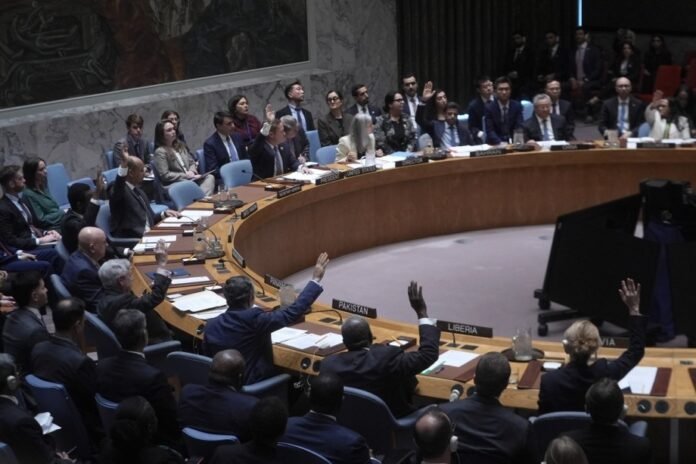
Council members and regional blocs are united in demanding an immediate halt to Israeli operations on Syrian territory and full adherence to the 1974 disengagement accords.

Russia denounced the “unacceptable nature of the aggressive actions by Israel against Syria,” urging Tel Aviv to halt “arbitrary” military operations in the Golan Heights and withdraw forces to established lines.

China reaffirmed that the Golan Heights constitutes occupied Syrian territory, demanding that Israel “cease all military operations in Syrian territory and withdraw its forces without delay” so UN peacekeepers can fulfill their mandate unhindered.

Speaking on behalf of the Arab Group, Oman condemned strikes targeting civil infrastructure, including the Abu al-Duhur airport, noting UN Security Council Resolution 497, which declared Israel’s annexation of the Golan Heights “null and void and without legal effect.”

The UK urged Israel to establish a clear timeline for withdrawal from occupied territory, while France demanded an “immediate cessation” of incursions that undermine regional stability.

The A3 bloc — Democratic Republic of the Congo, Liberia and Somalia — demanded an end to unilateral cross-border incursions and the release of detained Syrian nationals.

Bahrain and Pakistan reiterated their calls for Israel to vacate occupied lands.

The US took urged mutual restraint and continued engagement through diplomatic mediation.

Israel has occupied the Golan Heights since 1967 and annexed the territory in 1981, a move unrecognized by the international community. Following the collapse of the Bashar al-Assad regime on Dec. 8, 2024, Israeli forces advanced into the demilitarized buffer zone and areas of Mount Hermon, claiming the 1974 Disengagement Agreement had lapsed.

READ: ‘We are not like everyone else’ laws that bind other nations do not apply to Israel, says Likud lawmaker

Woman Accused of Murder for Leaving Husband on Toilet to Die

0
woman-accused-of-murder-for-leaving-husband-on-toilet-to-die
Woman Accused of Murder for Leaving Husband on Toilet to Die


A West Virginia woman is facing a felony neglect charge after authorities alleged she left her seriously ill husband sitting on a toilet for roughly 19 hours without food, water or medication — an ordeal investigators say contributed to his death.

Margaret Rog, 75, of Morgantown, was arrested Tuesday and charged with abuse or neglect of an incapacitated adult in connection with the death of her 76-year-old husband.

According to court records cited by local station WDTV, the man had been diagnosed with dementia, Alzheimer’s disease, legal blindness and several other medical conditions that left him dependent on others for care.

Authorities say the incident began around 3 p.m. on Aug. 20.

Investigators allege Rog’s husband went to the bathroom and was unable to stand afterward. Rog allegedly tried to help him up but could not.

Instead of calling 911, another relative or a medical provider for assistance, deputies say she left him sitting on the toilet.

He allegedly remained there until about 10 a.m. the following morning.

That means he was left in the bathroom for approximately 19 hours.

Court documents allege the man was not given food, water or his prescribed medications during that period.

Investigators also claim Rog heard him groaning in pain but still did not seek emergency assistance and eventually went to bed while he remained in the bathroom.

The situation was finally discovered the next morning when a speech therapist arrived at the couple’s home for a scheduled in-home appointment.

The therapist reportedly found the man unresponsive and in dangerously poor condition and immediately called for an ambulance.

He was rushed to a hospital, where doctors documented a long list of serious medical problems.

According to court records, those conditions included heart failure, respiratory failure, a pulmonary embolism, sepsis, dangerously elevated sodium levels, altered mental status and rhabdomyolysis.

Doctors also found wounds on his backside.

Rhabdomyolysis is a potentially life-threatening condition that occurs when damaged muscle tissue breaks down and releases proteins and electrolytes into the bloodstream.

It can be triggered by prolonged immobility or pressure on muscles, among other causes.

The man remained hospitalized for 11 days.

He died Aug. 31.

Investigators later concluded that his condition and injuries connected to the bathroom incident were “significant contributing factors” in his death, according to court documents.

Authorities have not publicly identified the victim by name in the reports reviewed.

The investigation appears to have begun after concerns were reported to Adult Protective Services and law enforcement while the man was being treated at Ruby Memorial Hospital.

Deputies with the Monongalia County Sheriff’s Department then investigated what happened inside the couple’s residence at Orchard Crossing Apartments.

Court documents also allege Rog made statements to law enforcement, Adult Protective Services and family members that investigators considered incriminating.

Authorities claim those statements showed she understood that her husband needed assistance but deliberately chose not to provide it.

Those allegations have not yet been proven in court.

Rog has pleaded not guilty.

She was initially being held at North Central Regional Jail with bond set at $75,000, though Fox News later reported that she posted bond following her court appearance.

She currently faces a charge of abuse or neglect of an incapacitated adult.

No additional homicide charge has been publicly announced.

The case is likely to focus heavily on whether prosecutors can prove that Rog knowingly failed to provide necessary care and whether that alleged neglect legally contributed to her husband’s death.

For now, the most serious allegation remains that a medically vulnerable man was left without help for nearly an entire day — and died less than two weeks later after doctors treated him for multiple critical conditions.

0FansLike
0FollowersFollow
0FollowersFollow
0SubscribersSubscribe
- Advertisement -
Google search engine

Recent Posts