Is this the real life? Is this just fantasy?
Caught in a landslide, no escape from reality
Open your eyes, look up to the skies and see.
– Queen
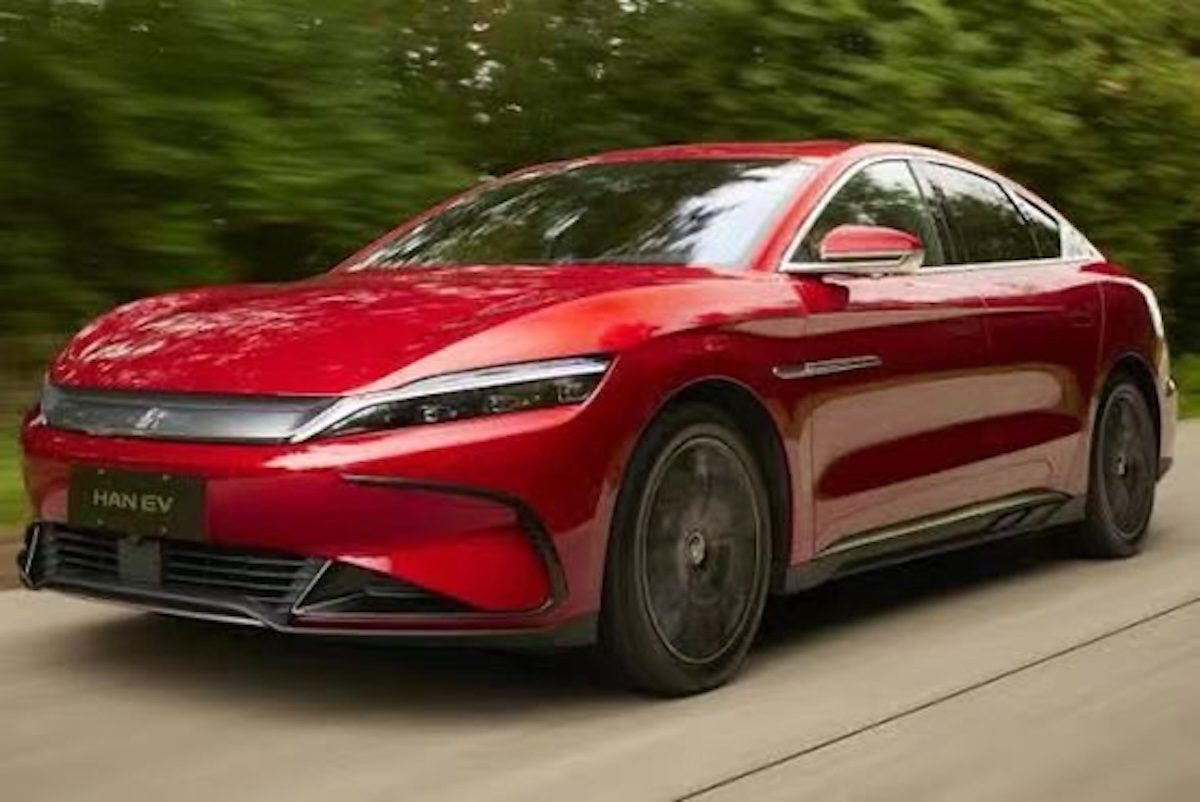
Shortly after moving from Hong Kong to Beijing in 2022, yours truly saw a BYD Han with a deep crimson metallic paintjob and thought it looked amazing. Yours truly checked the BYD Han’s features, specs and pricing and was blown away. The BYD Han was a larger car than the Tesla Model 3, had similar features and performance and was priced at a 10% discount (22% vs US market).
Today, a 2022 BYD Han looks like a bald uncle’s DiDi (China’s Uber) ride with auntie specs.
Late November 2022, Han Feizi was one of the last travelers to be quarantined in China just a few days before the powers that be ripped off the zero Covid band-aid. It was during this time that OpenAI, a company very few people had heard of, introduced something called ChatGPT to the world. OpenAI was actually jumping the gun, releasing a janky large language model (LLM) to scoop what had been percolating in DeepMind, Google’s more conservative lab, among others. This ignited a competitive frenzy among tech companies across the world.
BYD is going upmarket. The 2026 Seal 08 is a noticeably larger car than the 2022 Han with transformative improvements on its specifications from batteries to horsepower to self-driving to air suspension to rear wheel steering. The new DaHan (Great Han) has been upgraded to a different size category altogether.
The price of the 2026 Seal 08 is 25% lower than the 2022 Han for the top of the line version ($35.5k) and ~10-15% lower for entry and mid-level trims ($29.3-32.3k). The top of the line DaHan has all of the Seal 08’s upgrades in D-class size (Mercedes S/BMW 7 series/Audi A8 territory) and priced flat ($44.7k) with the 2022 Han.

For a while, the LLM landscape turned into a game of hopscotch as OpenAI, Anthropic and Google took turns one-upping each other’s models (with xAI straggling behind and Meta face-planting multiple times).
With the DaHan, BYD has stepped into the rarified realm occupied by flagship German luxury sedans. But in 2026 this class looks rather dusty, overpriced. Top of the line EV sedans from BMW, Mercedes and Audi sell in the US for for 3 to 4 times the price of a China-market BYD DaHan but offer broadly inferior specs and performance.

On September 2, in a speech at the Charlotte Economics Club, Treasury Secretary Scott Bessent lamented, “Anyone here ever seen a BYD car? It is the best $70,000 car $35,000 can buy – it is heavily subsidized.”
Similarly, the New York Times test drove a Geely M9 and reported:
The price for this top-of-the-line trim: an eye-popping $35,000. That’s if you’re in China. Made by Geely, this smooth-riding, driver-pampering crossover The New York Times tested for 10 days in February would cost more than twice that from any brand with an American showroom.
In addition to being the best advertising money can’t buy, Secretary Bessent complaining about BYD subsidies is economic nonsense. The bulk of EV subsidies across the world (79.4% in China according to CSIS) are for new car purchases (e.g. government rebates, tax exemptions etc). Historically, China’s per vehicle EV purchase subsidy has been substantially lower than those offered by the US and the EU. The difference is that China’s subsidies succeeded, driving 49 million EV sales since 2009, while those in the US and EU floundered, with 8 million and 12 million EV sales, respectively.
China succeeded because its subsidies coincided with the maturation of the country’s higher education pipeline. China’s EV industry has nearly 7 times the number of new engineering grads as the US to recruit from. In a few short years, China was able to birth over 100 EV makers and flood the market with over 300 EV models while the US, EU, Japan and Korea struggled to field a few dozen models.
Bessent’s lament that BYDs are “heavily subsidized” doesn’t pass the “best $70,000 car $35,000 can buy” test when per vehicle purchase subsidies are on average just over $2,000 in 2026. Even layering in a 30% appreciation of the Rmb doesn’t get us anywhere near BYD’s (and domestic competitors) price advantage.
On January 20th, 2025, an eccentric startup attached to a Chinese quant fund upended the AI world by releasing DeepSeek R1, an open-source near-frontier reasoning model trained on a minuscule budget. Since then, dozens of open source labs have sprouted in China pumping out near-frontier models priced at a fraction of US offerings. China’s open source challenge to the economic viability of American frontier labs has implications well beyond IPO valuations.
Secretary Bessent was selling BYD short. A 2026 ~$35k BYD Seal 08 would sell for well over $70,000 – in 2022. The Seal 08’s specifications are superior to a 2022 NIO ET7 which sold for $78,000 (longer range, faster charging, faster acceleration, four wheel steering) and far superior to a 2026 US market BMW i5 M60 whose $84,000 price tag and mediocre specs are scandalous in comparison.

Since 2022, China’s domestic car companies have been hedonically improving at +20% per annum rates. Hedonic (or quality) improvements give consumers better products over time. In the past four years, new cars in China have gotten more than twice as good – as in a 2026 spec EV would command more than twice the price in 2022. Or, conversely, a 2022 spec EV would sell for less than half the price in 2026.
Hedonic improvements are not nearly as noticeable in the US car market. Since 2022, offerings from legacy car makers, including Tesla, appear frozen in amber. The 2026 Tesla Model 3 is essentially the same car as the 2022 version. Tesla Autopilot may have improved substantially but so have Chinese self-driving systems. Self-driving is also usually included in the price of Chinese EVs – unlike Tesla’s subscription service. To Tesla’s credit, they have reduced the top of the line Model 3’s price by 7% versus the 2022 version.
Honda’s 2026 Pilot is one generation ahead of its 2022 version. It looks different. On specifications and features, however, one would be hard pressed to find any substantive improvements. Honda’s SUV is a little bigger with a little more power and perhaps a slightly more capable lane keep and adaptive cruise control system. And they increased the price by 9%.


Tracking hedonic improvements in cars is easy. Historical model specifications and prices are readily searchable.
But this isn’t just cars. There have been noticeable hedonic step changes across almost all consumer and industrial segments in China. While difficult to quantify, domestic travelers now expect luxury accommodations at budget prices. Leaving food quality for experts to judge, this non-foodie can confidently state that the interior décor arms race has flooded the country with trendy looking restaurants.
OpenAI publicly launched Astra on September 5.
On September 8, the company published a solution to the Navier-Stokes equation, completed by an as yet unreleased internal model.
The AI world has since spun itself into a frenzy about impending RSI and the end of the world while the math world sunk into a depression in all likelihood deeper than that experienced by the chess and go world after their grandmasters were felled by AI.
Not speaking for all of us but many mechanical engineers surely raised an eyebrow and wondered whether we are too dumb to understand the brouhaha. Many mechanical engineers likely had no idea that our lowly Navier-Stokes equation was held in such esteem by mathematicians – at least yours truly was genuinely dumbfounded. Our humble little equation to simplify fluid dynamics was never meant to be “solved.” It was always a scratchpad exercise, a rule of thumb, a mental model for how fluids “are supposed to” behave. Think of it as the Black-Scholes model for mechanical engineers.
Whatever “solutions” were useful in a mechanical engineering context could have been simulated by computer programs for decades (e.g. Ansys, Simcenter, OpenFOAM). The ultimate arbiter of whether the solution is correct is a working physical prototype. That’s how engineering in the physical world works.
The OpenAI “solution” of Navier-Stokes that satisfies mathematicians has zero, repeat, zero engineering implications. Real world fluids are affected by countless parameters – not the overly simplified four unknowns and four constants of the Navier-Stokes equation. The mathematician’s solution of Navier-Stokes would fall apart instantly in real world tests. Not one plane will fly more efficiently and not one submarine will travel more silently because of OpenAI’s “solution” of Navier-Stokes.
Ten thousand agents running a state-of-the-art LLM have produced a solution as useful to a mechanical engineer as a chess engine. Hey, America has the best chess engines but the country’s lead in LLMs over the past four years hasn’t helped Ford and General Motors close the gap with BYD and Geely – a gap that has, in fact, widened considerably.
The stopping power of the physical world has, so far, humbled America’s frontier AI labs. The frontier labs have been busy bolting physics, chemistry, engineering and biological science capabilities onto their LLMs. This has, so far, not had a measurable effect on real world science and engineering as China’s universities widen their lead in the Nature Index (see here) and the country’s industries out-compete global competitors using inferior open source LLMs.
In the paper “The Last AI Built by Humans: Towards Genuine Recursive Self-Improvement,” written by a team of AI researchers across China’s AI landscape (e.g. Tsinghua, Bytedance, Xiaohongshu), recursive self-improvement (RSI) is categorized into five stages summarized below:
L1, Execution stage – Human researchers fully design the improvement pipeline. AI only executes the pre-defined improvement steps; it cannot decide what to improve.
L2, Improvement-selection stage – AI autonomously selects which components to improve (prompts, weights, tools, memory). Humans still define the overall objective and evaluation system.
L3, Experience-curriculum stage – AI identifies its own weaknesses and designs new training data, tasks, or environments needed to fix those gaps. It builds its own learning curriculum.
L4, Deployment feedback stage – The AI continuously gathers real-world feedback during live deployment and uses this data to update itself autonomously, without human curation of feedback.
L5, Meta-improvement stage – The highest level. The AI can modify the improvement algorithm itself — changing the strategy, evaluator and mechanisms used to create better successor models. This is full recursive self-improvement, not yet achieved.
According to the authors, the biggest hurdle RSI faces is speed of iteration. Physical sciences and engineering slow iteration to a crawl. Prototyping/testing car parts and conducting clinical trials take far longer than running new code generated by Fable. Because of the stopping power of the real world, all physical sciences and engineering are still stuck between level one and level two.
Self-driving cars are a good example of the stopping power of the real world. Impressive level four systems (no driver needed) are now operating pilot robotaxi services in cities in China, the US and the Middle East. These robotaxis are geo-fenced, lacking drive-anywhere capability. With the exception of a few highway stretches in Germany, Japan and China, consumer self-driving has yet to advance much beyond level 2 (driver vigilance required). Driving is a real world skill that teenagers can learn with 20 hours of practice. Tool and die machining is also a real world skill. An adult can become a tool and die maker with 10,000 hours of training.
Yours truly is not saying LLMs are not impressive. Han Feizi worries about rogue AI and cyber warfare as much as anyone. However, as a lapsed mechanical engineer, Han Feizi believes that AGI-pilled computer scientists underestimate how much of reality exists outside the digital domain. Those experiencing AGI psychosis should go outside, touch grass, change a tire, weld a fin to a missile – then come back to their desks and spin up a few hundred thousand Astra agents to increase America’s shipbuilding capacity 200 fold.