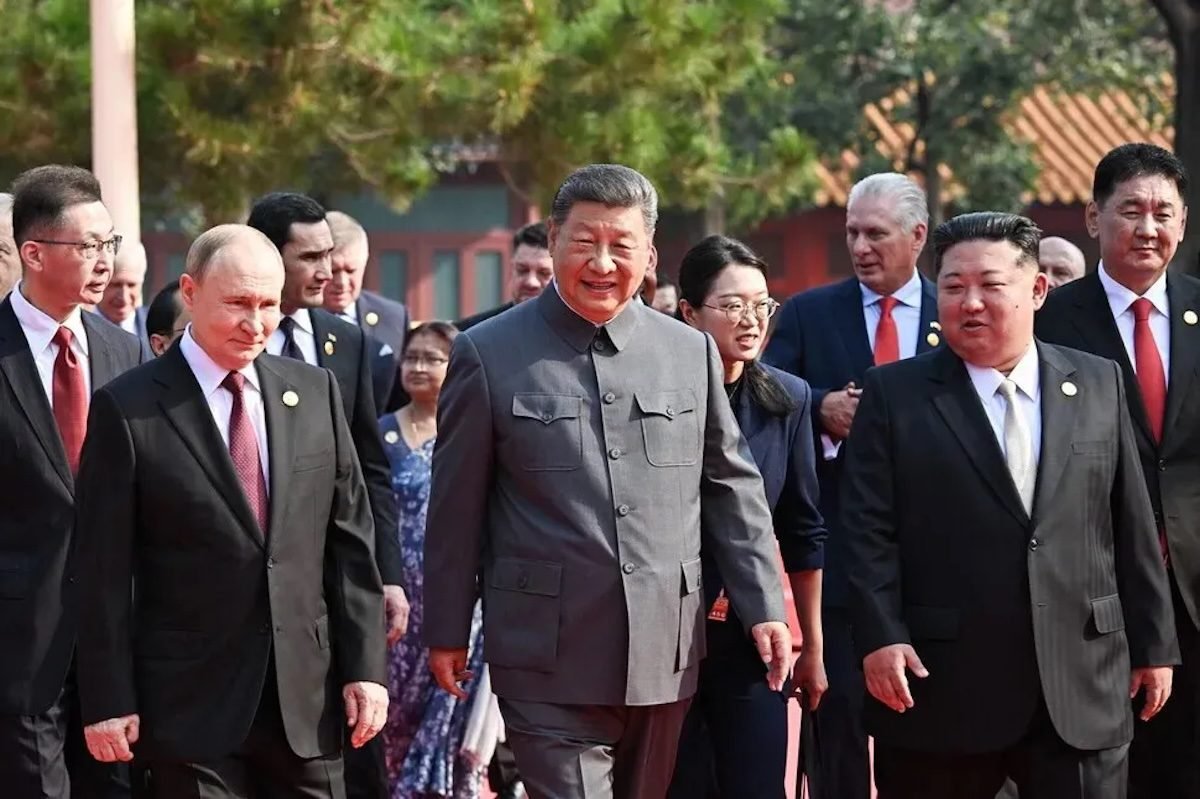
This update focuses on the role of allies in the Russo-Ukraine War (which was the fascinating and distressing story of the last week).
Ukraine’s allies (I use that word knowing it is loaded) should have helped Ukraine win the war by now. They are much richer, more technologically advanced, and, one would think, actually invested in Ukrainian victory – at least from a European perspective. And yet Ukraine’s allies have always tried to finesse their help, to limit it in certain perplexing ways that have forced Ukraine to fight a war that it did not wish to fight and that, right now, have left Ukraine extremely vulnerable in one area.
Russia’s allies, on the other hand, have actually offered support that has allowed Russia to fight the war that Russia has wanted to fight. They have offered things such as Iranian drone technology (the Shahed which is the foundation of the Russian Geran), massive Chinese purchases of Russian oil and increasingly critical component supplies, and of course North Korean mass supplies of artillery shells, front line soldiers and now ballistic missile forces.
These North Korean forces show that one does not have to have a large economy or wide technological base to be an extremely helpful ally. North Korea is providing effective forces to actually fight for Russia – which is far more than any of Ukraine’s partners have done.

This brings up the question of what exactly is the USA in this war? This week we got a very clear answer to that question. The US is using its leverage over Ukraine to help Russia. It does not have to do this, it chooses to.
Finally, the Ukrainians made a specific announcement about how much territory they have liberated over the last few months, and it is worthy of note, even as the reporting of the war has gone back to being quite pessimistic about Ukraine.
Russia’s allies are more helpful than Ukraine’s
Reports have increasingly come in about North Korea’s plan to help Russia by deploying a significant ballistic missile strike force to aid Russia in its ranged bombardment of Ukraine. Ukrainian intelligence was most specific about the plan on August 5, when it named the location of the unit and the type of missiles that were being sent. Their specific claim was that the first North Korean ballistic missile forces being sent would deploy near Voronezh and contain 120 ballistic missiles and six launchers.
President Zelensky from that point on added more to that discussion and expanded on what the Russians were expecting from the North Koreans – saying that in the end 30,000 or even 50,000 additional North Korean troops and their supplies could be on their way to help Russia.
Note that Zelensky did not provide a source for these latter claims or a list of the kinds of units that would be sent.
Then, the next day, Zelensky was more explicit when he actually ascribed a specific ballistic missile attack to North Korean forces. He said that the previous day’s Russian missile assault on Zaporizhzhia had been at least partially undertaken by North Korean missile forces. This attack killed 9 people.
The Ukrainians are a little stupefied at how their partners, particularly in Europe but also in Asia, are trying not to engage in this story. To them it is an extraordinary development that serving North Korean units and their North Korean missiles will now take part in an assault on Ukrainian cities and civilians. They were hoping that this would lead to a major European response.
The Ukrainians are a little stupefied at how their partners, particularly in Europe but also in Asia, are trying not to engage in this story. To them it is an extraordinary development that serving North Korean units and their North Korean missiles will now take part in an assault on Ukrainian cities and civilians. They were hoping that this would lead to a major European response.
When it comes to Asian countries, specifically South Korea and Japan – the ones most threatened by North Korea – the Ukrainians were hoping that they would get more support. Zelensky indeed tied up together what he saw as the European and Asian interest in helping Ukraine oppose this move, during his evening address on August 10. Apologies for the long excerpt.
This is the first time in Russia’s history that they no longer have a secure strategic rear. For the first time, they cannot wage war without reinforcements from North Korea. They are now preparing to deploy an additional North Korean contingent on their territory. They have received, just imagine, additional ballistic missiles from North Korea. And everyone around the world must understand what this means.
This is not only about the lives of people in Ukraine, and not only about the threats we face. North Korea’s ballistic missiles and their other weapons are being improved through its collaboration with Russia. The more North Korean strikes there are here in Ukraine, in Europe, the more their missiles and soldiers are used, the more they correct their shortcomings and blind spots, the greater the danger will later be for Japan, the Republic of Korea, the Philippines, and other countries in the region.
Depressingly, of course, the response by Ukraine’s partners has been to downplay or even not engage at all with this question. South Korea had one official who (reportedly) said that this would be an illegal move by North Korea – but who also made no concrete pledges of aid. Everyone else just remained quiet.
In some ways, of course, this should not be a surprise. North Korea, like Iran, provides Russia what it can in direct military aid with no strings attached. Russia’s allies want it to win and believe that their military support should be used how Russia wants it to be used. That has extended to the thousands of North Korean forces who actually fought and died under Russian command retaking parts of Kursk Oblast.
And, in exchange, such allies get a great deal back. Russia has been a major support to Iran during its war with the USA (helping Iranian targeting of US forces) and Russia has, reportedly, provided a great deal of technological help to North Korea to improve its missile forces.
You can see the benefits in such an alliance. North Korea helps Russia by sending troops in 2024, Russia helps North Korea improve its missiles. North Korea deploys some of those improved missile forces to Russia to attack Ukraine.
Rinse and repeat.
We can also say that Russia has accrued great benefit from all its support for Iran – in helping waste amazing amounts of US ordnance, force US forces to pull back from the Persian Gulf and overall weaken the US presence in the Middle East.
The contrast with what Ukraine’s allies do could not be more stark. They have constantly tried to limit what Ukraine gets and even how it uses what it has(more on that). They have used aid not only to help, but also to try and control and limit Ukraine. In doing this, they have helped transform this war into a longer, bloodier affair than it needed to be.
And they have done this by completely misreading the situation. They always wonder whether Russia will get hurt too much, whether what they give might actually be so effective that Putin will get angry, that arming Ukraine effectively might, weirdly, make reaching a “peace” deal more difficult.
Russia’s allies, on the other hand, give what they can and get what they can and let Russia fight its war. It has been brutally effective.
Actually, the USA is quite a good ally for Russia
When I write, as I often do, that Trump has aligned the USA with Putin and is helping the Russian war effort, one of the regular retorts is that this cannot be true because the USA is still selling (very small) amounts of weapons to Ukraine through the Prioritized Ukraine Requirements List (PURL). How could the USA allow any weapons to go to Ukraine, it was said, if it was more set on helping Putin?
This past week, I hope, the answer to that question was made very, very clear – even to the greatest of skeptics. The USA has kept dribbling small amounts of military support for Ukraine because it gives the USA a great deal of leverage, the ability to both shape how Ukraine fights its war and even how European states prepare.
For instance, by continuing to provide a small number of Patriot interceptors to Ukraine through Europe, the Trump administration forces the Ukrainians to dance more to the US tune (and regrettably has slowed down the process of European states developing a European-only advanced air defense system). As long as there is no replacement, Ukraine will bend over backwards for even the prospect of more Patriots.
And we just had a brutally efficient example of what the US can do with that leverage. The Ukrainians for much of the last year have waged a ranged air-sea campaign against Russia’s ability to export oil through the Black Sea port of Novorossiysk (also the main Russian naval base on the Black Sea now that the Ukrainians have isolated Sevastopol). The USA, however, decided that they wanted that campaign weakened.
At the start of August, according to the FT, Vice President JD Vance asked Zelensky to halt all Ukrainian campaigns on non-Russian tankers using the port and much of the infrastructure. Here was how another story summarized the move.
Washington was concerned that Ukraine could further destabilize oil markets and harm US companies by striking tankers carrying oil transported by pipeline from Kazakhstan to the Caspian Pipeline Consortium (CPC) terminal at the Russian port of Novorossiysk.
Vance asked President Volodymyr Zelenskyy to halt the attacks during a phone call on 31 July.
Since then, Ukraine has not struck tankers near the CPC terminal.
The officials said Ukraine has agreed not to strike CPC infrastructure facilities or non-Russian vessels, provided that the vessels are not subject to Ukrainian sanctions and are not carrying Russian oil or other Russian cargo.
The “non-Russian” designation is meaningless, as the shadow tanker fleet that the Russians are using to move their oil is deliberately non-Russian-flagged, to avoid sanctions. So, the USA was basically telling the Ukrainians to stop what had been a very effective campaign to help Russia.

The oil price argument is also really unconvincing. The Americans could have done this before had they really cared about the price of oil. They are doing it now, in my humble opinion, because Putin desperately needs money.
And the Ukrainians clearly felt that there was no alternative but to agree to this very pro-Putin request by the US Government. You can even see the way Patriot supplies might have been part of this process. On August 8, Zelensky made his announcement that Ukraine had been offered a very small monthly supply of Patriot interceptors going forward – while admitting that the number was grossly insufficient for Ukrainian needs.
The USA keeping Ukraine dependent on Patriots means that even a small number gives the US leverage, and in this case that leverage can be used to do a massive favor for Vladimir Putin – a favor that the Ukrainians were sadly forced to start giving right away.
If the US really cared about the global price of commodities, it might urge the Russians to stop attacking Ukrainian grain shipments in and out of Odesa, which is an effective and growing Russian campaign. As the New York Times, recently reported, this campaign could affect food prices worldwide very soon – leading to a real cost spike to consumers.
Coming at the start of the harvest season, the Russian campaign in Ukraine, which is a major producer of grains like wheat, corn and barley, could throw global food supply chains into turmoil. In 2022, during the first months of the full-scale war, Russia established a blockade of Ukrainian ports, causing a spike in global food prices and placing an estimated 70 million people at increased risk of acute food insecurity.
Thus Russian-caused inflation seems fine for the USA these days. However, Ukrainian-caused inflation gets an official request for a Ukrainian retreat.
Too often the Trump administration can be dismissed as bumbling incompetents. However, when it comes to helping Russia they can be brutally effective – as we have seen over the last few days. The US has achieved major leverage over Ukraine through a brutal rationing of access to Patriot interceptors. If they cut that off entirely it would actually have been worse for Russia.
Ukraine is slowly but steadily liberating territory
We are now more than halfway through the summer season, and in the past this was often a time when reports about the successes of Russia’s summer offensive would be heating up in the Western press. This was, for instance, when the stories about the imminent fall of Pokrovsk started circulating in 2024 (it actually took the Russians another year to take the city). And last summer at this time the reporting was all about the manpower crisis that Ukraine was facing, which was going to lead to even greater Russian advances.
I say that because this year, the focus of the reports is not steady Russian advances, but actually some Ukrainian ones. Three days ago, the Ukrainian high command gave an update on its offensive actions so far in 2026. Zelensky summarized these in his evening address on August 12.
The offensive operation, which lasted from January through August of this year, was carried out by warriors of the Airborne Assault Forces and other units involved. Its main objective was to disrupt the Russian occupiers’ plans for further advances and push Russian forces beyond the administrative border of the Dnipro region.
Thanks to the active operations of Ukrainian defenders, significant losses were inflicted on the occupation contingent. Russian losses amount to at least 9,550 killed and more than 6,600 wounded. Ukraine’s “exchange fund” was also replenished.
Over the course of the operation, 745 square kilometers of territory were liberated, and 26 villages in the Dnipro, Donetsk, and Zaporizhzhia regions were returned to Ukrainian control.

Note: The Institute for The Study of War claims using a very conservative estimate that Ukraine has liberated between 600-700 square kilometres—which is not that much lower.
How Ukraine has done this will only be made completely clear later – but it seems a sign that their growth of using highly trained and motivated soldiers in small numbers, with strong technological support, is working.
They can find short windows when Russian drones are either disabled or not in an area. They can provide their own soldiers with constant support and intelligence updates so that they will not be surprised or caught unprepared. And they can methodically work their way into Russian lines, take small amounts of territory, and remain safe.
This was something I went into in detail about with General Havrylov in December 2025. Here is a podcast with us both:
And here is a written piece with a description of Ukrainian tactics to try and take the initiative—the ones that seem to have been working over the last few months.
Now, these areas being liberated are still relatively small. However, the Ukrainians seem to be able to do this now and not suffer the kinds of casualties that would have been incurred before. That is worth acknowledging.
Phillips O’Brien is a professor of strategic studies at the University of St. Andrew. This article is his free weekly update. To read more of his work you can subscribe to Phillips’s Newsletter, a reader-supported publication.







. Ukraine’s allies (I)