19.4 C
London
Wednesday, September 23, 2026
Home Blog

New Anthropic, OpenAI models make same promise: A little more for a lot less money

0
new-anthropic,-openai-models-make-same-promise:-a-little-more-for-a-lot-less-money
New Anthropic, OpenAI models make same promise: A little more for a lot less money

OpenAI and Anthropic both recently released new models aimed at lowering costs. Anthropic announced Opus 5.5, the latest version of its main mass-market workhorse model, used for tasks like coding and other complex knowledge work.

And OpenAI announced GPT-6 Sol and Luna, the latest versions of its middle-of-the-road or smaller models focused on efficiency and speed.

These new releases are not about groundbreaking new capabilities. Rather, they’re about efficiency. As both OpenAI and Anthropic target enterprise customers, they’re racing to compete with open-weight models as organizations have explored changing their practices and using model routers to use these pricey, frontier models less in favor of cheaper alternatives.

Anthropic and OpenAI argue that these new releases push the envelope at the frontier (albeit mostly in modest ways), while bringing costs substantially down.

Opus 5.5: A more affordable, more competitive flagship

Opus 5.5 is at the higher end of the models announced today, but the wider context here is that Anthropic is playing a bit of catch-up in its race with OpenAI. OpenAI earlier this month released GPT-6 Astra, which has sometimes been modestly beating Opus 5 in benchmarks and user sentiment. (By price and capability, Astra is competing with both Opus and Fable.)

Benchmarks by Anthropic and its partners now show Opus 5.5 performing better at coding and knowledge work than GPT-6 Astra in some cases, albeit modestly.

The real story here is cost. From Anthropic’s announcement: “Input and output tokens are $4 and $20 per million, 20% less than Opus 5. Cache reads (which make up the majority of agentic and coding work costs) are $0.20 per million tokens, 60% less than Opus 5. Opus 5.5 also generates output more than 30% faster than Opus 5.”

Anthropic further claims that the savings are closer to 40 percent compared to Opus 5 for typical workloads at default settings, because in addition to the cost of tokens going down, Opus 5.5 also uses fewer tokens when completing tasks.

Opus 5.5 is said to be notably capable in “high risk areas” like cybersecurity and biology, so the same protections that applied to Fable 5.1 will also apply here—your requests might be automatically and transparently routed to an older model if they get flagged as treading into protected territory.

GPT-6 Sol and Luna: A modest, cost-focused upgrade

The release of OpenAI’s GPT-6 Sol and Luna is an iterative step forward. Not long ago, the company introduced its Sol, Terra, Luna naming convention for its GPT-5.6 family of models. And more recently (just this month), it introduced GPT-6 Astra, which has been both its most advanced and most powerful model.

It may not be obvious what those names mean, so here’s the quick rundown. Astra is the most aggressively powerful (and pricey) model, meant for heavy-duty coding, research, and so on. Sol is a capable but more efficient and affordable alternative—meant to be the sort of daily driver for tasks like that. Terra is the balanced, general-use model. And Luna is the fast, cheap option.

You could reasonably and roughly position Astra against Anthropic’s Fable, Sol against Opus, Terra against Sonnet, and Luna against Haiku, but it would be an imperfect mapping, especially for the higher-end models.

OpenAI says GPT-6 Sol and Luna were trained with similar methods to those used to train GPT-6 Astra. Depending on the benchmark, they’re sometimes a few percentage points more capable than their predecessors at certain tasks, but they cost half as much to use.

GPT-6 Sol’s API pricing is $2 per 1 million input tokens and $10 per 1 million output tokens. For Luna, it’s $0.10 and $0.50, respectively.

Opinion: The devil is in the dollars

The discourse around frontier models is chaotic. You have people on social media declaring that it’s possible to one-shot complex 3D video games with models like GPT-6 Astra, but you also have news of security breaches and other alignment issues, calls for slowdowns and regulation, and so on.

Some of that is worthy of serious attention, while some of it is noise—and some of it is serious, but being spun or exaggerated for commercial positioning.

Further, there’s a growing recognition that the models—be they Anthropic’s, OpenAI’s, Alibaba’s, or any other big player’s—are not the only important engines of progress and results in recent months. The orchestration and harnesses for those models are at least as important.

The frontier is still moving forward, and today’s models are apparently more capable and aligned than those from a few months ago. But some developers and enterprises are a little less focused on the frontier and more focused on exactly how to operationalize all this and keep it cost-effective.

So while we’re seeing AI leaders calling for a slowdown ostensibly or partially for safety reasons, there’s also a practical and economic reality: The models we have now are good enough to do a lot of helpful things, but they require sophisticated contextualization and operationalization by human beings—whether in the runtime and harnesses or in organizational practices—to be put to use. As a result, some of these companies’ customers may be increasingly less focused on demanding better performance. They’re looking for predictable deployments and, most of all, reasonable costs.

That has the potential to be a natural slowdown of its own, and these models are both being positioned for that new, on-the-ground reality.

Another U.S. Soldier Is Dead as Iran War Casualties Rise

0
another-us.-soldier-is-dead-as-iran-war-casualties-rise
Another U.S. Soldier Is Dead as Iran War Casualties Rise


The U.S. toll of the Iran war continues to climb as the military stumbles toward a breakdown and the Trump administration struggles to find an exit ramp.

Another U.S. soldier died this month, according to newly released Pentagon statistics that classify the death as “non-hostile.” A female soldier was on a military flight headed to Saudi Arabia when she suffered an undisclosed “medical incident,” a defense official told The Intercept. Another 66 U.S. personnel have also been wounded in action just this month, according to that official. This has pushed the official count of war casualties above 850. Almost half the total — 419 wounded or dead — have occurred since Iran stepped up attacks in early July.

The Pentagon’s official total of dead and wounded personnel, as documented over almost six months of reporting by The Intercept, has been a gross undercount, stemming from what one U.S. official previously called a “casualty cover-up.”

Since the beginning of the Trump administration’s war with Iran, the War Department has posted the official count of military casualties on the website of the Defense Casualty Analysis System, or DCAS, which tracks “deceased, wounded, ill or injured” service members for Congress and the White House. Casualties were initially tallied under Operation Epic Fury. Since July 7, they are now counted separately on a webpage with a generic title: “Overseas Operations.” 

Prior reporting by The Intercept found DCAS is missing hundreds of wounded or dead personnel from the Iran war. The Pentagon’s list of the names of the dead is, for example, missing Maj. Sorffly Davius, a signals and communication officer with the New York Army National Guard who was assigned to the headquarters of the 42nd Infantry Division and reportedly died while on duty in Camp Buehring, Kuwait, on March 6. Davius’s death was widely acknowledged even as it was excluded from the official count. Gen. Dan Caine, the chair of the Joint Chiefs of Staff, for example, recognized Davius while “honoring our fallen.” 

Three U.S. contractors based in the region have also died during the conflict, according to an official who spoke with the Washington Post

For months, The Intercept has found anomalies with the counts offered on the DCAS website. On April 21, for example, the number of wounded-in-action troops declined by 15 without public acknowledgment by the War Department. Despite repeated questions for months, the Pentagon has not commented on the disparities in its casualty count.

A U.S. government official previously told The Intercept that scores of casualties added to DCAS last month was “an accounting trick” designed to dampen depressing statistics. That official accused the Pentagon of “slow-walking” the total for weeks. “They wanted the heat on them to slow down after the really devastating attacks,” that source told The Intercept, referencing attacks on U.S. bases in July that exposed the vulnerability of U.S. troops to Iranian attacks. Official statistics now show that the Pentagon admits that 352 personnel were wounded or killed in July and none died or were injured in August.

DCAS counts 11 hostile deaths in 2026, all resulting from the Iran war. This is the highest total of military personnel killed in action since 2021. Including non-hostile deaths, DCAS counts 19 dead due to the Iran war, but fails to count Davius. Also missing is Sgt. Devin Seibel who died in Irbil, Iraq, on May 31 in a training accident, according to a military press release.

More than 580 military personnel have died this year, across the world, according to Pentagon statistics. The War Department lists 114 as accidental and 14 as homicides. As of September 21, there are also eight personnel whose deaths are listed as “undetermined.”

The female soldier who died this month has yet to be identified but was over 35 years old, according to DCAS information.

Deputy Pentagon Press Secretary Joel Valdez did not reply to repeated requests for comment or clarification for this article.

Qatari emir wants ‘regional system of collective security’

0
qatari-emir-wants-‘regional-system-of-collective-security’
Qatari emir wants ‘regional system of collective security’

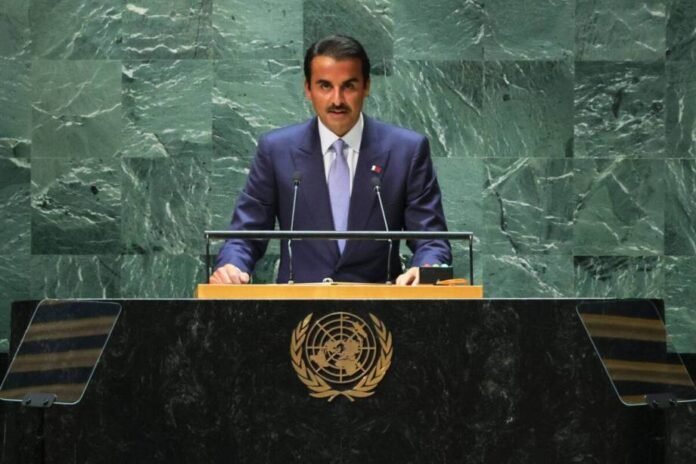
Qatari Emir Sheikh Tamim bin Hamad Al-Thani urged a “regional system of collective security” on Wednesday, arguing that its absence lies “at the heart of the dangerous situation” facing the region, Anadolu reports.

In an address to the 81st session of the UN General Assembly, Al-Thani said the crisis in the Gulf region can be resolved diplomatically by reopening the Strait of Hormuz and returning to talks to avert war and ensure regional security “for the entire region, including Iran.”

Al Thani said Qatar has always sought to resolve disputes through dialogue and negotiations. “This remains our position in the aftermath of the wars we’ve been witnessing,” he said.

Unresolved conflicts only grow more costly without just settlements, he stressed.

READ: Turkish president calls on UN member state to pressure Israel for Gaza reconstruction

The Qatari emir said what has taken place in the Gaza Strip “is genocide in every sense of the word,” calling it “the stain of shame on the conscience of humanity as a whole.”

“There can be no talk of a just international order as long as Palestine remains a blind spot within it,” Al Thani added.

Condemning the Israeli escalation in the occupied West Bank, he said the “aggression” has expanded to neighboring countries, threatening the security of the region as a whole.

The emir also condemned Israeli attacks in Lebanon and Syria, noting that Tel Aviv acts as though it “maintains tutelage over the countries in the region.”

READ: Qatar PM calls for Gulf security framework with Iran, says war must be ‘wake-up call’

Meloni ally urges EU to prepare for possible Le Pen Presidency

0
meloni-ally-urges-eu-to-prepare-for-possible-le-pen-presidency
Meloni ally urges EU to prepare for possible Le Pen Presidency


The European Union should be prepared to work with Marine Le Pen if she wins France’s presidential election next April, according to Nicola Procaccini, a senior ally of Italian Prime Minister Giorgia Meloni. Procaccini, leader of the European Conservatives and Reformists group, said EU institutions and the centre-right European People’s Party should be willing to engage with Le Pen’s National Rally and its European allies rather than seek to isolate them.

He argued that an informal “cordon sanitaire” could not be applied to France and described Le Pen and Jordan Bardella as pragmatic politicians who would defend French interests without seeking to take the country out of the EU. Procaccini pointed to Meloni’s experience since becoming Italy’s prime minister in 2022, when Brussels sought to establish working relations with her government.

He said he hoped Le Pen would adopt a similarly pragmatic approach towards the European Commission, while acknowledging that the French right has historically been less pro-European than Meloni’s political movement. EPP vice-president Siegfried Mureșan offered a contrasting view, saying Le Pen’s party could become more radical under her leadership.

via Politico

Houthis choking the life out of Asia’s gasping energy supplies

0
houthis-choking-the-life-out-of-asia’s-gasping-energy-supplies
Houthis choking the life out of Asia’s gasping energy supplies

In late July, two tankers loaded with Saudi crude for Asia left the Red Sea port of Yanbu and headed south toward Bab al-Mandeb. Then they stopped and turned around. The Rodos and the Xin Long Yang were carrying a combined 2.8 million barrels when they reversed course, hours after Yemen’s Houthis announced a blockade of Saudi ports.

The detour was short but exposed a bigger problem. For six months, Asia’s answer to a closed Strait of Hormuz has been to reroute. Saudi Arabia pipes crude across the desert to the Red Sea, and tankers carry it onward. That workaround is now under attack, and Asia has no credible second alternative.

Hormuz has been largely shut since the US-Israeli war on Iran began, so the Red Sea became the pressure valve. Experts say about 6 million barrels a day bound for Asia pass through Bab al-Mandeb and are now at risk.

Bypass under fire

In September, that risk became real. The Houthis completed a push to control Yemen’s Red Sea coastline, and strikes shut Saudi Arabia’s East-West pipeline. On September 19, firefighters battled a blaze at an Aramco fuel depot near Riyadh’s airport as the Houthis claimed attacks on Yanbu itself.

The exposure of Asia’s biggest buyers is stark. Saudi crude made up 34.1% of South Korea’s imports in July, 27.3% of Japan’s, 14.9% of China’s and 10.2% of India’s. Yanbu had taken over the large majority of Saudi exports that once left through the Gulf.

The Houthis do not need to sink ships to control the waterway. Bab al-Mandeb is only around 30 kilometers wide at its narrowest point, and the threat of an attack can be enough to send insurers and shipowners elsewhere. The same analysis notes that Iran gains leverage cheaply: it keeps its distance while the Houthis impose the costs.

Reuters reported in July that the Houthis were weighing fees on ships transiting the strait, with Iranian advisers reportedly helping set up a regulating authority. The Houthis denied the plan.

Yemen’s foreign minister-designate said the group was seeking to copy the Iranian model, a reference to Tehran’s own efforts to charge ships passing through Hormuz. Whether tolls materialize or not, the direction is clear: control of a chokepoint is becoming something that can be monetized as well as weaponized.

The alternative route is logistically punishing. Reuters calculated that sending Saudi crude to Asia around Africa would add 10,000 nautical miles.

Costs, meanwhile, are compounding. Physical Dated Brent stood at $125.42 a barrel on September 18, and tanker charter rates have reportedly topped $1 million a day. Analysts estimate the twin closure adds millions of dollars to a single voyage once diversions, war-risk insurance and delays are counted.

The Red Sea–Suez corridor normally carries around 15% of global maritime trade by volume. When it closes, ships take the Cape of Good Hope, adding at least 10 days. This was never a purely regional problem. Attacks had largely subsided after a 2025 ceasefire, but traffic barely recovered before the Iran war renewed the fear.

UNCTAD warned in April that the Hormuz shock was feeding through trade, prices and finance, leaving developing economies with weaker currencies and higher borrowing costs.

The most exposed

Four countries, namely China, India, Japan and South Korea, accounted for 75% of oil and 59% of LNG flows through Hormuz before the Iran war. But their vulnerability differs. Imported fossil fuels supply 87% of Japan’s energy and 81% of South Korea’s, against 20% for China and 35% for India.

To be sure, East Asia has buffers, but they are thinning fast. China holds large crude stockpiles, yet crude inventories elsewhere in Asia have already fallen 13% and gas is harder to store. Japan, South Korea and Taiwan import more than 95% of their natural gas.

Southeast Asia sources roughly half its crude from the Middle East. Reserves are built for short disruptions and are running dangerously thin as the conflict enters its seventh month.

Asia’s early response shows the weakness. In the first week of the war, Thailand suspended fuel exports, while China ordered its largest refineries to halt diesel and petrol exports. Governments protected their own supply, which is understandable, leaving neighbors competing for what remained. A region that has long depended on the same waterways for its energy security is now mutually vulnerable as they close.

Pakistan shows how fast the shock is reaching households. A large share of its oil comes from Saudi Arabia. With Hormuz closed, its alternative route through the Red Sea has also been disrupted. By September 20, petrol stood at 389.14 rupees a liter and diesel at 424 rupees, up 68 rupees and 57 rupees respectively since July 22.

A Pakistani petroleum official has said that with Hormuz closed, Bab al-Mandeb is the only route currently available for importing petroleum products. Losing it would push Islamabad toward suppliers as far away as Nigeria and the United States, raising freight costs. The government has introduced a relief scheme worth about $270 million for motorcycle and small-car users, after petrol rose 24% and diesel 28% since July 1.

Pakistan’s exposure is also strategic. Its defense pact with Saudi Arabia and Turkey has drawn a direct Houthi warning against intervening in Yemen. The country that needs the Red Sea route open is also a country the group that threatens it has singled out.

What Asia can do

The region cannot wait for someone else to secure its supply. Washington has declined direct strikes on the Houthis, though it is providing intelligence and targeting help.

Even Washington’s choices about Iran turn on Gulf energy: Trump held off major attacks in August after Saudi Arabia and Qatar warned Iran could retaliate against Saudi oil and gas infrastructure. The same pipelines Asia relies on now shape Washington’s war decision-making.

Three steps could help. First, importers should treat every bypass as a chokepoint in its own right. A single pipeline, port or terminal now decides how much oil reaches Seoul, Tokyo or Karachi, so governments and refiners should map these points of failure and plan around them.

Second, Asian buyers should coordinate reserve releases, shipping insurance and naval protection instead of bidding against each other. The March export bans showed the cost of going alone.

Third, Asia should use its diplomatic weight. China buys more than 80% of Iran’s oil, according to Kpler. Iran says it is passing its terms to Washington through Qatar and Pakistan, and that it wants the Saudi-Yemen fighting to end. The states that suffer most from this crisis also have influence over how it ends.

Asia built its rise on oceans it assumed would stay open. The past six months show that assumption no longer holds, and that even seemingly secure workarounds can be hit. The two tankers that turned around in July were an early warning.

The question for Asian capitals is who will protect the next route and whether they can coordinate quickly enough to take decisive collective action.

Mansoor Qaisar is an independent writer based in Islamabad, writing on foreign and public policy and social issues shaping Pakistan and the region. He can be reached at mansoor.qaisar@gmail.com and is on X at @MansorQaisar.

Inside an Israeli High School Mock Election Where National Politics Comes to the Classroom

0
inside-an-israeli-high-school-mock-election-where-national-politics-comes-to-the-classroom
Inside an Israeli High School Mock Election Where National Politics Comes to the Classroom


At Blich High School in Ramat Gan, teenagers campaigned for national parties, questioned politicians, and cast ballots in a decades-old civic tradition

Teenagers in black ‘RAK BNGVIR’ shirts pushed through the crowd toward National Security Minister Itamar Ben-Gvir, hundreds of phones raised for selfies. At an Otzma Yehudit stand nearby, students handed out miniature Ben-Gvir figures carrying pistols and pistol-shaped bottle openers printed with his face and the slogan “Guns save lives.” By later in the day, party flyers covered large stretches of the floor.

The scene was not a party convention or campaign rally, but a high school.

Blich High School in Ramat Gan held its traditional election exercise Thursday, bringing Israel’s national campaign inside a school of 1,793 students. Eleventh- and 12th-graders cast ballots after weeks during which politicians visited the campus, students organized party teams, read platforms, campaigned among their classmates and questioned candidates and lawmakers. Most of those voting will still be too young to participate when Israel elects its next parliament on Oct. 27.

The result gave Gadi Eisenkot’s Yashar party 32.2% of the vote, well ahead of former Prime Minister Naftali Bennett’s B’Yachad at 22.4%. Prime Minister Benjamin Netanyahu’s Likud finished third with 15.5%, followed by Ben-Gvir’s Otzma Yehudit at 9.4% and the Democrats at 7.1%. Yisrael Beitenu received 4.8%, Amcha Yisrael 3.6%, the joint Reservists-Economic Party list of Yoaz Hendel and Yaron Zelekha 2.8%, the Religious Zionism–Zehut party 1.6%, Ra’am 0.4%, and Blue and White 0.2%. Shas, United Torah Judaism and the Joint List received no votes in the displayed results.

Blich’s election has drawn national attention for decades, partly because students there anticipated the Likud’s historic 1977 victory and Yitzhak Rabin’s return to power in 1992. The exercise dates back at least to 1969, although later Blich votes have frequently diverged from the eventual national result. It is not a scientific opinion poll, and school officials describe its purpose as civic education rather than prediction.

Crowd of students. (Gabriel Colodro / The Media Line)

Principal Hila Romesh, herself a Blich graduate, told The Media Line that the voting day is only the final stage of a much longer process. Politicians from across the spectrum are invited to speak. Students form groups representing parties, recruit classmates and study party platforms, while teachers discuss the election in civics, history, and other subjects. “The message is no violence, respectful discourse,” Romesh said. “It doesn’t matter, left or right, you are friends. You are friends in the same class.”

She said listening to political positions that students reject is as important as hearing those they support. “Knowledge is power,” Romesh said, adding that a high school should not simply send students out with matriculation certificates but should produce “good citizens, involved, asking questions and critical.”

Ramat Gan Mayor Carmel Shama-Hacohen described the exercise as particularly significant at a time when public confidence in democracy and state institutions has become a national issue.

The students, he told The Media Line, go through “an internal, organized, open, pluralistic process” in which everyone is given a platform and difficult questions are not avoided. “That is how we want to see our next generation,” he said.

The cordial language used by school officials was repeatedly tested throughout the day.

Ben-Gvir’s arrival produced one of its most chaotic moments. Hundreds of students surrounded the Otzma Yehudit leader as he crossed the school, many trying to photograph themselves with a politician whose short-form social media presence has made him highly recognizable among teenagers.

Student supporters had adopted “RAK BNGVIR,” or “Only Ben-Gvir,” for their black shirts, a play on the “FCK BNGVIR” shirts worn by some of his opponents at anti-government demonstrations.

Itamar Ben-Gvir. (Gabriel Colodro /The Media Line)

Once onstage, Ben-Gvir focused heavily on his record as national security minister. He described conditions he said Palestinian security prisoners had enjoyed before he took office, including ping-pong, large quantities of food, including jam and chocolate, and said he had ended those privileges. “For 40 years, nobody touched it,” he said, arguing that previous governments, including Likud-led governments, had failed to go far enough. “You talk. I do.”

Otzma Yehudit lawmaker Yitzhak Kroizer told The Media Line that politicians should not assume students can be won over simply with slogans.

This is a smart, intelligent generation that knows what it wants

“This is a smart, intelligent generation that knows what it wants,” Kroizer said. He argued that young Israelis had become increasingly attentive to politics through major national disputes, including the fight over changes to the judiciary. Students, he said, “know very well what you said, they know very well what you did in the Knesset, and they demand results.”

Not every confrontation remained verbal. During a speech by B’Yachad lawmaker Merav Ben Ari, students associated with Otzma Yehudit threw a plastic cup toward the stage and later a black “RAK BNGVIR” shirt. Ben Ari stopped and addressed the students directly. “You are not going to throw cups,” she said before continuing her speech.

At least two female students supporting the Democrats said they had been hit in the crowd by Otzma Yehudit supporters. The Media Line did not independently establish the circumstances of those alleged incidents.

Ayala Garb – Student – Democrats. (Gabriel Colodro / The Media Line)

Ayala Garb, a 16-year-old 11th-grader campaigning for the Democrats, described the broader experience as one she believed students elsewhere should have.

“I think it is an incredibly important event,” she told The Media Line. Garb said the previous two weeks had given her opportunities she would not normally have had, including contacting political parties, organizing campaign activity and working alongside students who shared her political outlook.

Garb said she had been politically active since 2022 and that the upheavals of the past several years had made politics difficult for teenagers to treat as something belonging only to adults. She cited security, housing, and the cost of living among issues that would determine whether young Israelis could build their futures in the country.

A 16-year-old B’Yachad supporter, Eitan Tzameret, also said he had seen violence and spitting during the event and found it particularly disturbing because the day was supposed to be “a celebration of democracy.”

At the same time, Tzameret said the campaign had energized the school. “The whole school was really on its feet,” he told The Media Line. His own decision to campaign for Bennett, he added, came from concern about the country he would enter as a soldier and later as a young adult trying to afford a home.

Military service was one of the most persistent themes across otherwise sharply divided parties.

The thing that interests them most is the question of the army, of enlistment

Einat Wilf, who appeared at the stand of Hendel and Zelekha’s Reservists-Economic Party, said enlistment was the issue she heard about most from students. “The thing that interests them most is the question of the army, of enlistment, that everyone should enlist,” Wilf, currently number three on the party list, told The Media Line. She said students also raised the cost of living and Israel’s international standing. Social media mattered as well: Wilf said students repeatedly asked whether economist Yaron Zelekha, whom she described as a TikTok star among young followers, would appear.

Einat Wilf. (Gabriel Colodro / The Media Line)

Mirroring the interest in military issues, Hendel invoked his own reserve service in his speech and called for a government in which military or national service would carry both obligations and benefits. He urged the students, regardless of how they eventually vote, to serve, become officers, and take responsibility for the country.

Yisrael Beitenu lawmaker Oded Forer also centered his remarks on political participation and military service but told The Media Line that Blich’s final numbers were less important than what students did before reaching the ballot box.

“Political education and civics education should be brought into schools,” Forer said. Even when the discussion is shallow or driven by headlines, he said, the exercise has value if it prompts students to read party platforms and examine positions for themselves. “If there are two more students here who opened the internet and went to read party platforms,” he said, “we did our job.”

If there are two more students here who opened the internet and went to read party platforms, we did our job

The Likud had its own stand at the school, but no candidate on Prime Minister Netanyahu’s parliamentary slate appeared at the voting-day event observed by The Media Line. Hadar Muchtar addressed the students instead. Muchtar, who had publicly sought a place in Likud’s electoral contest, later became a leader of the party’s youth campaign.

In her speech, Muchtar framed the national race as a choice between a Netanyahu-led government and one reliant on left-wing and Arab parties. She repeatedly urged students to vote when they become eligible and described them as Israel’s future political generation. After leaving the stage, Muchtar declined an interview request from The Media Line.

Yosef Hadad. (Gabriel Colodro / The Media Line)

Another campaign performance came from Yoseph Haddad, the Arab Israeli activist running with Ofer Winter’s Amcha Yisrael party. Haddad arrived in a shirt bearing the slogan “FCK HMS” and made the anti-Hamas message part of both his stage appearance and his interview.

He told The Media Line that the reception he received from students who disagreed with some of his politics demonstrated something important to him about Israeli political life.

“Even among the kids who do not 100% align with my political views, I’m still welcomed here with such respect and honor, and love,” Haddad said.

Even among the kids who do not 100% align with my political views, I’m still welcomed here with such respect and honor, and love

He then pointed to the different party shirts around him and argued that national security could still provide common ground across political camps. The interview ended with Haddad and a crowd of students chanting “F*ck Hamas.”

Representatives of Yashar, which ultimately won the school vote, included former minister Chili Tropper and Ramat Gan Deputy Mayor Israel Zari. Their message onstage focused on Eisenkot’s effort to position the party outside the traditional left-right confrontation and on keeping young Israelis invested in remaining in the country.

B’Yachad brought Ben Ari, Naor Shiri, and 23-year-old candidate Yonatan Shalev. Shiri, looking at the noisy stands and campaign material around him, told The Media Line that students were living through the same events as adults and were not detached from the country’s political arguments. “They are not stones sitting outside the event,” Shiri said. “They are completely inside the State of Israel, and they will influence the State of Israel.”

The vote count will mean nothing on Oct. 27. But long before they can legally cast a ballot, the students at Blich had already done the harder part—arguing, campaigning, and choosing, in full view of the politicians asking for their support.

Woman’s brain worm infection confirmed after eggs grow tails in lab test

0
woman’s-brain-worm-infection-confirmed-after-eggs-grow-tails-in-lab-test
Woman’s brain worm infection confirmed after eggs grow tails in lab test

Out of nowhere, a woman’s right arm and leg started shaking uncontrollably. In the moments leading up to the experience, she seemed well; she had no headache, confusion, or weakness. But for about a minute, half of her body juddered.

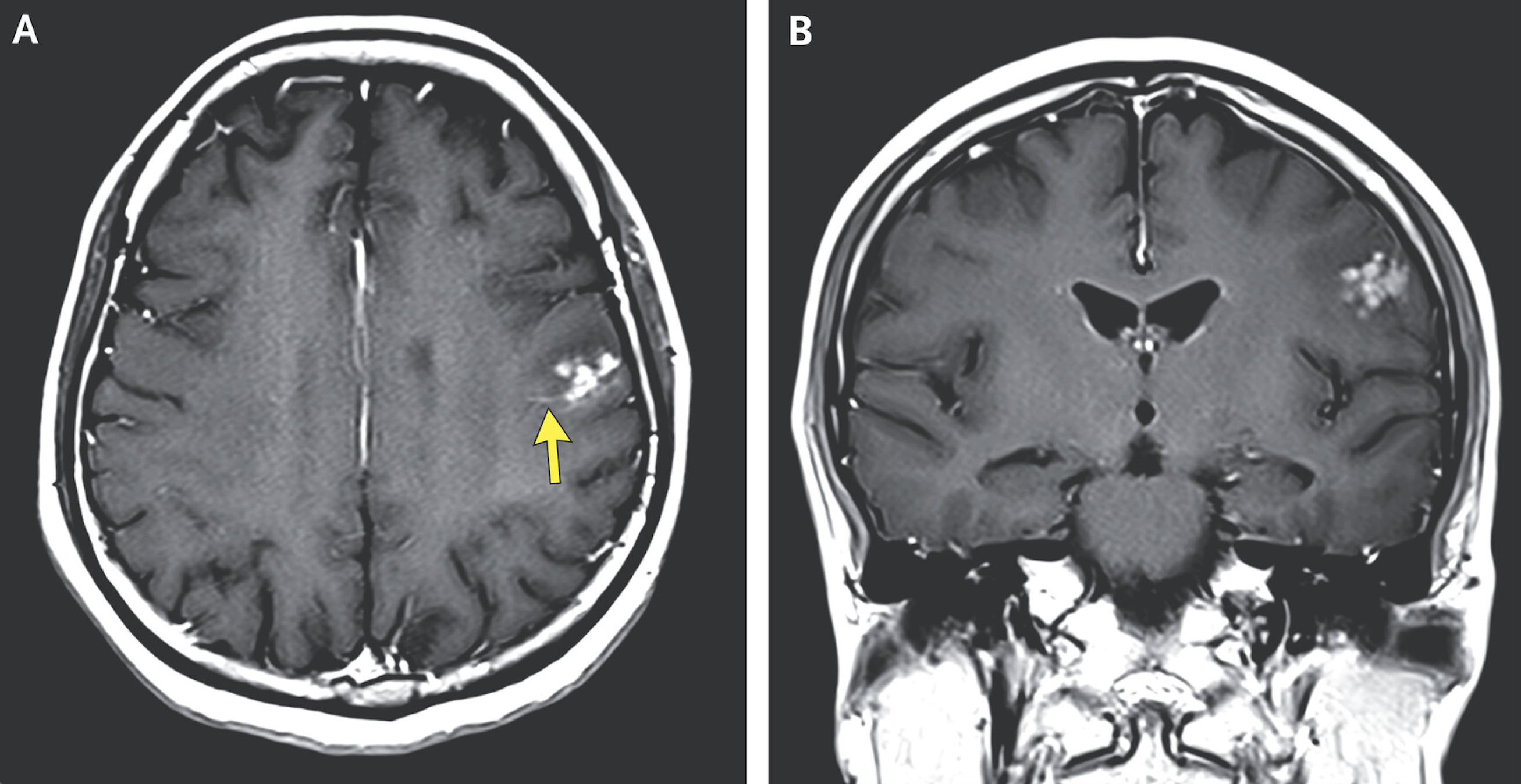
The woman, a rice farmer in the Philippines, headed to the emergency department. There, doctors gave her a physical exam and found nothing out of the ordinary. Then they took a look at her brain. Magnetic resonance imaging revealed a bright cluster of nodules surrounded by fluid in her left frontal lobe. The doctors had an immediate guess as to what they were: worm eggs.

An MRI of the woman’s brain showing nodules.

An MRI of the woman’s brain showing nodules. Credit: NEJM, 2026

In a case report published in the latest issue of the New England Journal of Medicine, doctors write that they suspected the woman had neuroschistosomiasis, an uncommon complication of an infection with a Schistosoma parasitic worm, aka a blood fluke. In the Philippines, the most common fluke is S. japonicum. It’s also found in China and part of Indonesia; despite its name, it has been eliminated from Japan.

An unfortunate fluke

S. japonicum, like its relatives, has a diabolical life cycle, which starts with its eggs being shed in the urine or feces of various animals, including humans. When conditions are right, the eggs hatch into a free-swimming larval form. These seek out specific types of aquatic snails, which they bore into and inhabit to go through two life stages. Late-stage larvae then burst out, grow a forked tail, and swim to find an animal host. These tailed larvae, called cercariae, have the ability to tunnel through intact skin and take a trip through the vascular system—visiting the lungs, heart, and then liver, where they develop into adults.

The adult male and female worms live paired together with the slender female worm tucked into a groove within the thicker male. Adult worms typically move to large blood vessels in the abdomen connecting the liver to the intestines. From there, the cuddly couples spew out eggs that make their way into feces and urine.

Adult worms often go undetected in blood vessels, producing no noticeable symptoms, allowing the infection to become chronic. It’s the eggs that typically cause problems and give the worms’ presence away. They can spur inflammation, fibrosis, and organ-specific complications.

Ectopic eggs

On rare occasions, S. japonicum eggs reach the central nervous system and cause problems. It’s not entirely clear how this happens; medical experts speculate that it may happen when either the adults or eggs get diverted into an unusual place, possibly due to a heavy infestation or vascular damage. However it happens, when eggs get lodged in the brain, they’re often linked to seizures or specific neurological problems.

The possibility of S. japonicum eggs in the woman’s brain seemed like it could explain her abrupt seizure, so her doctors began diagnostic tests. There is no single go-to test for schistosomiasis, and doctors often do various tests to confirm an infection. The woman’s doctors first turned to an old-school lab test called the circumoval precipitin test, which was developed in the 1950s. In this test, doctors obtain a reference sample of S. japonicum eggs and flood them with a patient’s serum. If the patient has an infection, their serum will contain antibodies that can target the egg. In this event, the antibodies can grab onto molecules dangling off the outside of the egg as well as molecules secreted by the egg. In the test, this leads to a tail-like structure of bound antibodies forming on the outside of the egg.

The result of a circumoval precipitin test for Schistosoma japonicum showing tail-like formation (asterisk).

The result of a circumoval precipitin test for Schistosoma japonicum showing tail-like formation (asterisk). Credit: NEJM, 2026

This test doesn’t always work, but in the woman’s case, it produced a clear result: test eggs grew weird tails, indicating an S. japonicum infection. Another test also found a lot of S. japonicum eggs in the woman’s stool: 190 eggs per gram of feces, to be precise. Together with the MRI result suggesting the presence of eggs, they diagnosed her with cerebral schistosomiasis that caused a focal seizure.

The doctors prescribed her an anti-parasitic drug, an anti-inflammatory drug, and an anti-seizure medication. Three months later, the woman told doctors she had no additional seizures. A follow-up MRI showed the worm eggs were gone.

Russia-Ukraine war is accelerating the dangerous race toward fully autonomous drones

0
russia-ukraine-war-is-accelerating-the-dangerous-race-toward-fully-autonomous-drones
Russia-Ukraine war is accelerating the dangerous race toward fully autonomous drones

A battlefield dominated by fully autonomous drones capable of selecting and engaging targets without human intervention sounds like a dystopian sci-fi plot. And while that scenario has not yet arrived, the conflict between Russia and Ukraine has moved modern warfare a notch down that road.

In recent years, both nations have deployed semi-autonomous drones in combat and are rapidly racing toward fully autonomous unmanned aerial vehicles.

Given these developments and the pace of Russian and Ukrainian drone production, a battlefield with hundreds to thousands of fully autonomous drones operating is plausible within the next few years. Yet, the technology underpinning autonomous warfare risks outpacing the Russian and Ukrainian frameworks for maintaining some degree of human control over weapons.

As an expert on weapons technology, I worry that the battlefield incentives to deploy more autonomous drones will completely push aside human targeting decisions related to using proportional force, avoiding strikes on non-combatants and limiting collateral damage.

The creeping drone war

Both Ukraine and Russia have increasingly prioritized the use and production of drones since the war began in February 2022. Unable to produce large numbers of one-way attack drones at first, Russia turned to Tehran for technological assistance – and has steadily developed its own capacity. Ukraine had a nascent drone industry and has grown it using private defense firms and technological innovation.

Smoke bellows from a building

Flames engulf a building in Dnipro, Ukraine, hit by a Russian drone on Sept. 19, 2026. Danyil Nikolaenko/Suspilne Ukraine/Global Images Ukraine via Getty Images

As the war has progressed, both sides have added autonomous features to existing drones, as well as developed new drones with autonomous capabilities. Specifically, both Russia and Ukraine have deployed drones with autonomous functions using AI on the battlefield to recognize targets, navigate and self-guide to targets.

In November 2025, a Ukrainian first-person-view drone used an AI-assisted guidance system to strike a probable Russian tank after the drone’s communications link with its operator was disrupted. A human operator selected the target, but the drone itself guided the final stages of the attack.

Reliable estimates of the numbers of these drones on the battlefield are unavailable. However, reports on their usage suggest they represent only a small percentage of the millions of drones both sides have deployed to date.

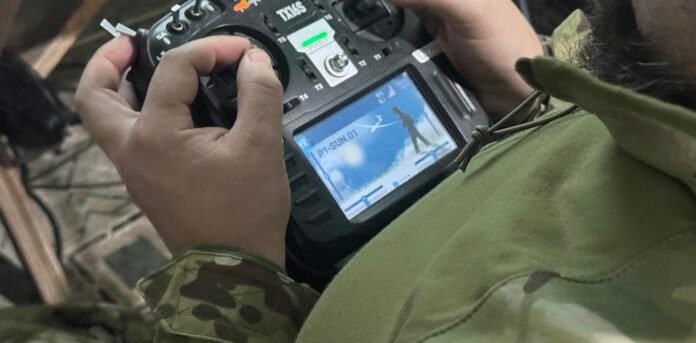
At the advanced end of the spectrum, Russia reportedly fielded at least one model of a fully autonomous unmanned aerial vehicle in early 2025. Ukrainian analysis of recovered Russian V2U drones revealed a small Nvidia computer designed to run AI-enabled decision-making software. Variants recovered in late 2025 no longer contained the external communications systems suggestive of operator control.

Autonomous targeting

The V2U’s technical systems are configured to enable autonomous selection and engagement of targets without operator intervention following launch.

Human operators have generally selected intended targets or target areas for moral reasons, highlighting the significance of the V2U’s ability to carry out these missions autonomously.

The onboard AI utilizes computer vision, allowing the drone to analyze images from its onboard sensors. It can autonomously recognize objects, track them, navigate and select potential targets.

In July, Russia employed a different AI-enabled drone in combat that demonstrated a less comprehensive form of autonomous targeting. The strike, on a gas station in Zaporizhzhia, killed three Ukrainian civilians. Human operators selected the gas station as the target area, while onboard software independently picked the final aim point.

Russia is also integrating versions of a similar technology into its Geran series unmanned aerial vehicles, which are based on Iran’s delta-wing Shaheed-136 attack drone. Some Gerans include a seeker guidance package that allows the onboard computer to guide the drone in the final flight phase, after a human operator initially selects the target.

Ukraine, for its part, has focused on modular AI-driven packages, including chips with embedded software and sometimes cameras, that it can install widely across drone and other platforms. It has fielded drones that use onboard AI to identify targets and guide them in their final flight phase.

One such module tracks targets and guides the drone the final 500 meters to them. The company that makes the computer advertises more advanced modules, which it claims will provide additional and even full autonomy.

Ukraine claims to have used more advanced autonomous drones on the battlefield as well. Former Defense Minister Mykhailo Fedorov said in July that Ukraine used a drone that autonomously chooses targets with no radio connection to a human pilot in strikes in Russian-occupied Crimea at an unspecified date. He added that Ukraine has not mass-produced this drone.

Ukraine also reportedly employed what have been dubbed fully autonomous quadcopter drones two years ago against Russian forces near Bakhmut, Ukraine, killing Russian soldiers. However, reports that the drones were preprogrammed raise questions about whether the drones independently selected the targets.

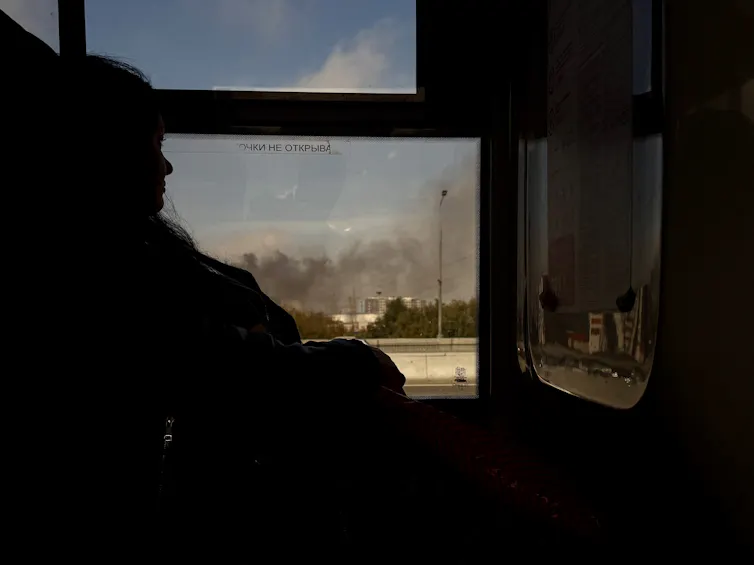
A woman looks out a window at smoke billowing from a building in the distance.

Smoke rises from Russian oil producer Gazprom Neft’s Moscow oil refinery on Sept. 20, 2026, after a drone attack. AFP via Getty Images

Battlefield advantages, ethical concerns

Russian and Ukrainian drones with autonomous capabilities already have had battlefield impact, even though Kyiv and Moscow have not yet deployed the most advanced systems in large numbers.

The benefits of deployment are clear. Drones with autonomous functions reduce their dependence on communications links and can continue despite jamming and other forms of electronic warfare. These capabilities help enable strikes deep into each other’s territory.

Autonomous navigation and guidance in the final portion of flight can also improve drones’ ability to engage moving targets. Deployment of fully autonomous drones at scale could reduce the personnel required to operate large numbers.

But autonomous drones come with serious ethical concerns.

A major risk is that the development and employment of this technology leapfrogs the ability of Russia and Ukraine to maintain some type of human control over autonomous weapons. Ukrainian Ministry of Defense rules require keeping humans in the loop for “combat” decisions, meaning that humans verify targets in the “final stages of interception.”

In contrast, Russia’s arms control positions provide insights into its views on human control. Russian officials highlight “human control,” with a focus on the ability to alter the system, deactivate it or provide limitations, such as on the types of targets that it can engage. But Moscow does not stress that a human has to be in the loop for verifying targets before they strike them.

As worrying as that sounds now, the next step in AI drone warfare is even more concerning: Swarming drones that can hunt in packs of a few to thousands and autonomously alter their behavior based on communicating with one another present a frightening challenge to maintaining human control.

Trump is backing a diesel export ban. How much would that do?

0
trump-is-backing-a-diesel-export-ban.-how-much-would-that-do?
Trump is backing a diesel export ban. How much would that do?

Diesel prices have hit a record high nearly every day this month, with a national average on Tuesday at $6.52 a gallon, according to AAA. That is driving a growing call to combat this climb by banning the export of the fuel, a move President Donald Trump endorsed today.

“I’ve said let’s not send out the diesel,” Trump said from the sidelines of the United Nations General Assembly in New York. As to a ban, “ I’ve called for it. I’ve called for it within my people.”

Although relatively few Americans fill their cars with diesel, it’s a backbone of the U.S. economy. It powers the trucks, ships and trains that move goods across the country, and it is used throughout the agricultural sector. That means everyone is feeling the effect of fuel prices that have climbed almost 80 percent since the United States and Israel launched a war against Iran earlier this year. They have risen almost $1 per gallon in September alone. 

“If our govt can embargo chips to China it can embargo diesel to help American farmers & truckers,” wrote Senator Chuck Grassley, a Democrat from Iowa, on X. Representative Ashley Hinson, a Republican from Iowa, posted Monday on X. Senator majority leader John Thune, of South Dakota, has expressed interest as well. “If that would take pressure off of prices,” he said, “I’m open to exploring it.”

An online dashboard that has been tracking the impact of rising diesel prices since the war started shows that the ongoing increase has cost American households nearly $400 each — or more than $51 billion overall. Jeff Colgan, a Brown University political scientist who helped build the tracker, explained that banning exports would boost the supply and therefore lower the price. 

“It could make a huge difference,” he said, though others disagree. Patrick De Haan, head of petroleum analysis for GasBuddy, wrote on X, “U.S. diesel prices are determined not by a U.S. supply and demand balance, but a global one. Keeping distillates and diesel home does not change the world price.”

The idea isn’t new. In 1975, after OPEC stopped shipping oil to the U.S., Congress passed the Energy Policy and Conservation Act, which included what ended up being an effective ban on crude oil exports. It continued until President Barack Obama lifted it four-decades later. Since then, oil companies have made billions exporting their products and oppose reviving any limits on where they can sell them. 

Read Next

The American Fuel & Petrochemical Manufacturers association has said that such a ban would make the problem worse. “Export bans do not create more fuel for Americans,” the organization wrote in a press release. “They reduce U.S. fuel production, put upward pressure on prices, weaken energy security and hand market share to foreign competitors.”

Some Republicans, including within the administration, also expressed concern about a ban. Republican Senator John Cornyn of Texas, which is the country’s biggest oil-producing state, told The Hill that a ban would be a “gimmick.” Interior Secretary Doug Burgum told CNBC that “it could actually hurt Americans.

Democrats have, in the past, called for export bans on oil products, including earlier this year and in 2021 when President Joe Biden was in office. So far they have been largely quiet on the diesel debate. “Trump is all smoke and mirrors,” said Senator Peter Welch, of Vermont, when Grist asked about the export ban. “If he’s serious about lowering prices of oil, gas, and home heating oil, he needs to end his illegal war with Iran.”

Before the president offered his thoughts on a ban, a White House official told Grist that the administration was not considering an export ban. It’s unclear if President Trump’s statements change that and how he might advance the issue — or whether Congress can build bipartisan will for legislation. But, regardless, Tyson Slocum, the energy program director at Public Citizen, a non-profit consumer advocacy organization, would like to see a more nuanced discussion of the way forward. 

“The debate is so absurdly simplistic. People are like either total unfettered, unregulated exports or zero exports,” he said. There are many options in-between, he added, including how much diesel gets shipped overseas rather than cutting off that supply entirely. 

“It could be very significant,” he said of even partial measures. “You would absolutely see a significant short-term drop in diesel prices.”


The deal Trump and Xi should artfully make

0
the-deal-trump-and-xi-should-artfully-make
The deal Trump and Xi should artfully make

In July 1971, Henry Kissinger, then American national security adviser, had arrived in Pakistan on an official trip but suddenly developed a convenient case of “Delhi belly.”

The top envoy was supposedly too ill to continue his itinerary. Instead, under cover, Kissinger slipped onto a secret aircraft and flew to Beijing. There, behind the curtain of the Cold War, he met Premier Zhou Enlai and laid the foundations for Sino-US rapprochement.

The deception was audacious. The objective was even more so: to turn two ideological adversaries of the Cold War into strategic partners against a common rival, the Soviet Union. The secret mission eventually produced President Richard Nixon’s historic week-long visit to China that came to be known as the “week that changed the world.”

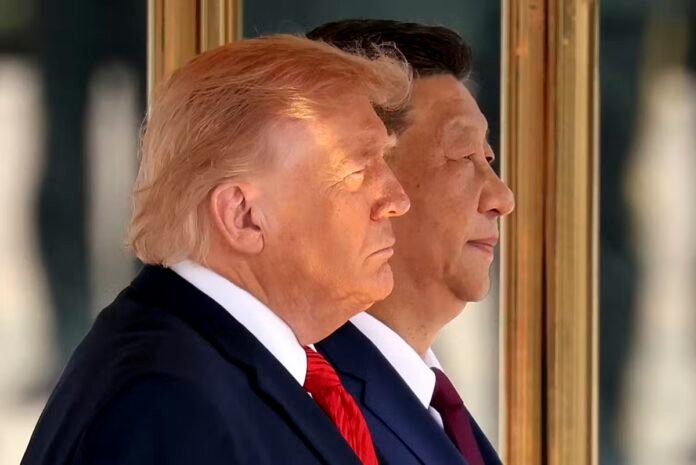
Fifty-five years later, history has reversed its choreography but not its stakes. After their May 2026 meeting in Beijing, where they had agreed on ensuring “constructive strategic stability“, Donald Trump and Xi Jinping will meet at White House on September 24, not behind any curtains of the Cold War but beneath the full glare of world media, with no secret channels or common enemy to justify their encounter.

Yet, the question hanging over their summits remains disquietingly similar to the one that had haunted Kissinger on his covert flight to Beijing: can these two rivals build a durable peace without ever pretending to like one another?

Weaponized interdependence

For most of the Trump era, the world has come to see US-China relations through a single, blunt vocabulary: tariffs. But that vocabulary is now dangerously inadequate. Their relationship has since mutated into a contest over mushrooming new chokepoints.

But the most revealing weapon is one most Americans had barely heard of until recently: rare earths. China’s dominance over refining and supply is so complete that even a limited stock of rare earths mined in California is sent to China for processing.

China’s dominance in processing can be weaponized, holding US industrial applications from aerospace and semiconductors to high-temperature coatings hostage to Beijing’s strategic calculus.

China’s recent export restrictions have exposed vulnerabilities in US industrial supply chains and demonstrated how something buried deep inside a supply chain can suddenly acquire geopolitical significance. This mutual weaponization of their asymmetric economic interdependence represents the new geoeconomics of their great-power politics.

Washington also possesses formidable leverage: tariffs, advanced semiconductors, investment restrictions, financial power, sanctions and access to cutting-edge technology, including cutting-edge AI chips. Beijing possesses a different arsenal: manufacturing scale, supply chains, rare earths, critical minerals, processing capacity and access to one of the world’s largest markets.

Political scientists Robert Keohane and Joseph Nye once described this as “complex interdependence”, i.e., the recognition that mutual dependence generates both constraint and leverage.

But what is unfolding between Beijing and Washington is the darker, harder version of that insight. US-China interdependence has become increasingly securitized.

Rival philosophies

Trump’s instinct is transactional and immediate — leverage converted swiftly into visible, measurable concession – the kind that can be announced, photographed, and claimed as victory before the news cycle turns.

Xi’s instinct runs on an entirely different clock. His tradition favors incrementalism, sequencing and calculated ambiguity — a patient accumulation of strategic space, careful never to concede anything that might later bind one’s hands.

Washington wants greater predictability in Chinese rare-earth supplies and restraint on practices considered economically or strategically damaging. Beijing wants relief from technology restrictions, tariffs and a durable framework of engagement.

Their Board of Trade created last May aims to cut tariffs on non-sensitive commodity exports up to $30 billion per annum — a modest institutional scaffolding for an otherwise volatile relationship.

But beneath these economic negotiations lurks a deeper security dilemma. Taiwan remains their most dangerous fault line. In their May meeting in Beijing, Xi warned Trump that mishandling Taiwan could push bilateral relations into “a very dangerous place.”

AI is another layer of intensifying complexity. The two sides are racing to dominate AI, yet neither can manage it alone. Measures intended to increase security by one — export controls, technology restrictions, military deployments, supply-chain diversification — can be interpreted as preparation for containment by the other.

It’s unclear whether the US-China Dialogue mechanism, agreed in advance of the Trump-Xi summit to flag rogue AI developments, will actually be established and used in the heat of the competitive moment.

None of this needs to trigger war, but these escalating tensions on so many fronts make them vulnerable to other exogenous forces. This is where the Trump-Xi summit is larger than just US-China relations. The wider world is no idle spectator, and its incremental assertion should also shape the summit’s agenda and outcomes.

The world out there

Wars in Ukraine and Iran have revealed the hard limitations of great powers. At the same time, India, ASEAN, Europe, Japan, South Korea, Australia, the Gulf states and much of the Global South have gradually enhanced their bargaining power.

They may depend on China for manufacturing, on America for technology and finance, on the Gulf for energy and on one another for markets and connectivity, yet most of them do not wish to choose between Washington and Beijing.

India’s emphasis on strategic autonomy and multi-alignment fits this pattern. So is ASEAN’s seasoned resistance to making binary great power choices. European governments want resilience without rupture, i.e., economic security without severing ties to Beijing. Gulf states are quietly demonstrating how partnership with Washington need not preclude a parallel courtship of China.

The most consequential question hovering over the summit is not which of the two will have greater leverage. It is whether their rivalry leaves enough oxygen — enough strategic space — for everyone else. A US-China condominium would alarm much of the world.

A full-blown confrontation would be equally unacceptable. A carefully managed rivalry could permit other powers to retain agency while these two giants fine-tune their equilibrium: not friendship, not trust, not even reconciliation — just managed coexistence.

What coexistence requires

The summit should therefore be judged not by its optics but by whether Trump and Xi can construct some modest but durable guardrails.

The first would be economic predictability. Businesses cannot reorganize global supply chains every time Washington or Beijing reaches for a new trade war weapon. The second would be strategic communication. Hotlines and military-to-military contacts are not guarantors of trust, but they are proven mechanisms for preventing accidents from becoming crises.

The third would be selective cooperation. Climate, public health, financial stability and AI safety all require urgent collaboration that can happen before settling their geopolitical differences. The fourth would be bounded competition. Great powers have always competed. The problem is when competition becomes uncontrolled and results in conflict.

Finally, both sides will have to accept something psychologically harder: the other is not disappearing anytime soon. America will remain a formidable technological, financial and military power. China will remain a formidable industrial, commercial and geopolitical power. That is the reality from which a sustainable relationship must begin.

In 1971, Kissinger’s secret flight to Beijing helped demonstrate that yesterday’s adversary can become tomorrow’s partner. In 2026, Trump and Xi face the opposite challenge: demonstrating that an adversary need not become an enemy.

Nixon and Mao sought a strategic opening because the Cold War demanded it. Trump and Xi need a strategic ceiling — a limit beyond which rivalry can slip into catastrophe.

This week’s Trump-Xi summit will not determine whether the US or China dominates the 21st century. But it could yield something more consequential: whether these two can compete peacefully without making the rest of the world pay the price for their competition.

Swaran Singh is a former professor of diplomacy and disarmament at the School of International Studies, Jawaharlal Nehru University, New Delhi.

0FansLike
0FollowersFollow
0FollowersFollow
0SubscribersSubscribe
- Advertisement -
Google search engine

Recent Posts