In late July, two tankers loaded with Saudi crude for Asia left the Red Sea port of Yanbu and headed south toward Bab al-Mandeb. Then they stopped and turned around. The Rodos and the Xin Long Yang were carrying a combined 2.8 million barrels when they reversed course, hours after Yemen’s Houthis announced a blockade of Saudi ports.
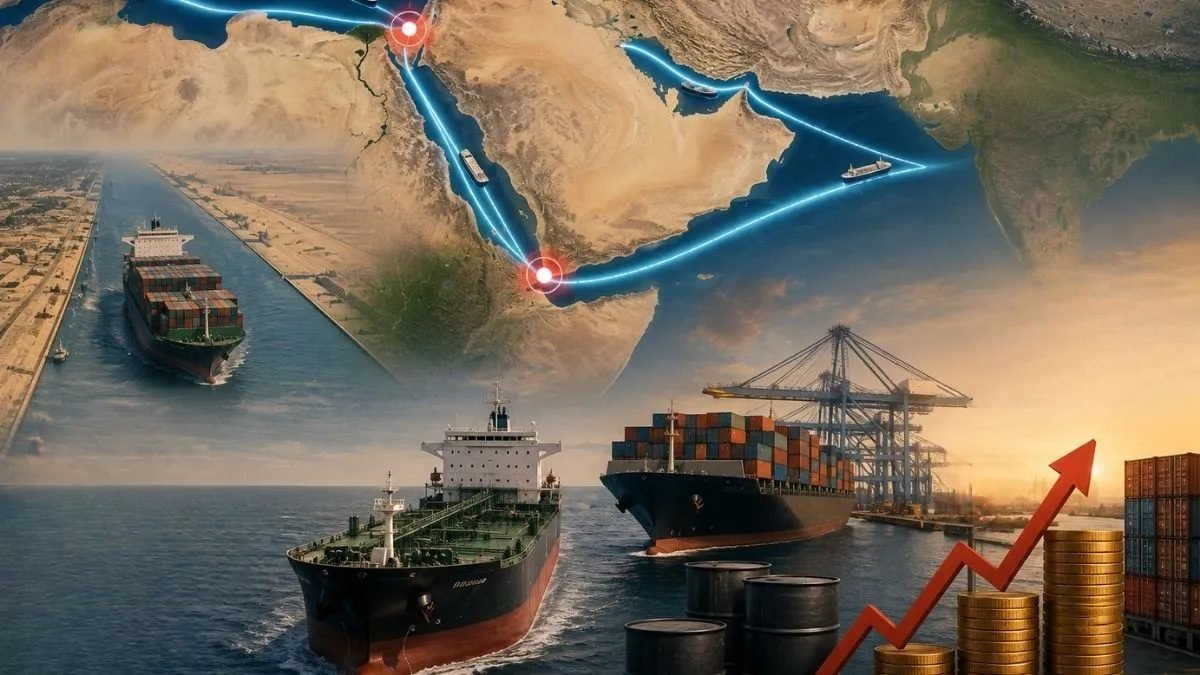
The detour was short but exposed a bigger problem. For six months, Asia’s answer to a closed Strait of Hormuz has been to reroute. Saudi Arabia pipes crude across the desert to the Red Sea, and tankers carry it onward. That workaround is now under attack, and Asia has no credible second alternative.
Hormuz has been largely shut since the US-Israeli war on Iran began, so the Red Sea became the pressure valve. Experts say about 6 million barrels a day bound for Asia pass through Bab al-Mandeb and are now at risk.
Bypass under fire
In September, that risk became real. The Houthis completed a push to control Yemen’s Red Sea coastline, and strikes shut Saudi Arabia’s East-West pipeline. On September 19, firefighters battled a blaze at an Aramco fuel depot near Riyadh’s airport as the Houthis claimed attacks on Yanbu itself.
The exposure of Asia’s biggest buyers is stark. Saudi crude made up 34.1% of South Korea’s imports in July, 27.3% of Japan’s, 14.9% of China’s and 10.2% of India’s. Yanbu had taken over the large majority of Saudi exports that once left through the Gulf.
The Houthis do not need to sink ships to control the waterway. Bab al-Mandeb is only around 30 kilometers wide at its narrowest point, and the threat of an attack can be enough to send insurers and shipowners elsewhere. The same analysis notes that Iran gains leverage cheaply: it keeps its distance while the Houthis impose the costs.
Reuters reported in July that the Houthis were weighing fees on ships transiting the strait, with Iranian advisers reportedly helping set up a regulating authority. The Houthis denied the plan.
Yemen’s foreign minister-designate said the group was seeking to copy the Iranian model, a reference to Tehran’s own efforts to charge ships passing through Hormuz. Whether tolls materialize or not, the direction is clear: control of a chokepoint is becoming something that can be monetized as well as weaponized.
The alternative route is logistically punishing. Reuters calculated that sending Saudi crude to Asia around Africa would add 10,000 nautical miles.
Costs, meanwhile, are compounding. Physical Dated Brent stood at $125.42 a barrel on September 18, and tanker charter rates have reportedly topped $1 million a day. Analysts estimate the twin closure adds millions of dollars to a single voyage once diversions, war-risk insurance and delays are counted.
The Red Sea–Suez corridor normally carries around 15% of global maritime trade by volume. When it closes, ships take the Cape of Good Hope, adding at least 10 days. This was never a purely regional problem. Attacks had largely subsided after a 2025 ceasefire, but traffic barely recovered before the Iran war renewed the fear.
UNCTAD warned in April that the Hormuz shock was feeding through trade, prices and finance, leaving developing economies with weaker currencies and higher borrowing costs.
The most exposed
Four countries, namely China, India, Japan and South Korea, accounted for 75% of oil and 59% of LNG flows through Hormuz before the Iran war. But their vulnerability differs. Imported fossil fuels supply 87% of Japan’s energy and 81% of South Korea’s, against 20% for China and 35% for India.
To be sure, East Asia has buffers, but they are thinning fast. China holds large crude stockpiles, yet crude inventories elsewhere in Asia have already fallen 13% and gas is harder to store. Japan, South Korea and Taiwan import more than 95% of their natural gas.
Southeast Asia sources roughly half its crude from the Middle East. Reserves are built for short disruptions and are running dangerously thin as the conflict enters its seventh month.
Asia’s early response shows the weakness. In the first week of the war, Thailand suspended fuel exports, while China ordered its largest refineries to halt diesel and petrol exports. Governments protected their own supply, which is understandable, leaving neighbors competing for what remained. A region that has long depended on the same waterways for its energy security is now mutually vulnerable as they close.
Pakistan shows how fast the shock is reaching households. A large share of its oil comes from Saudi Arabia. With Hormuz closed, its alternative route through the Red Sea has also been disrupted. By September 20, petrol stood at 389.14 rupees a liter and diesel at 424 rupees, up 68 rupees and 57 rupees respectively since July 22.
A Pakistani petroleum official has said that with Hormuz closed, Bab al-Mandeb is the only route currently available for importing petroleum products. Losing it would push Islamabad toward suppliers as far away as Nigeria and the United States, raising freight costs. The government has introduced a relief scheme worth about $270 million for motorcycle and small-car users, after petrol rose 24% and diesel 28% since July 1.
Pakistan’s exposure is also strategic. Its defense pact with Saudi Arabia and Turkey has drawn a direct Houthi warning against intervening in Yemen. The country that needs the Red Sea route open is also a country the group that threatens it has singled out.
What Asia can do
The region cannot wait for someone else to secure its supply. Washington has declined direct strikes on the Houthis, though it is providing intelligence and targeting help.
Even Washington’s choices about Iran turn on Gulf energy: Trump held off major attacks in August after Saudi Arabia and Qatar warned Iran could retaliate against Saudi oil and gas infrastructure. The same pipelines Asia relies on now shape Washington’s war decision-making.
Three steps could help. First, importers should treat every bypass as a chokepoint in its own right. A single pipeline, port or terminal now decides how much oil reaches Seoul, Tokyo or Karachi, so governments and refiners should map these points of failure and plan around them.
Second, Asian buyers should coordinate reserve releases, shipping insurance and naval protection instead of bidding against each other. The March export bans showed the cost of going alone.
Third, Asia should use its diplomatic weight. China buys more than 80% of Iran’s oil, according to Kpler. Iran says it is passing its terms to Washington through Qatar and Pakistan, and that it wants the Saudi-Yemen fighting to end. The states that suffer most from this crisis also have influence over how it ends.
Asia built its rise on oceans it assumed would stay open. The past six months show that assumption no longer holds, and that even seemingly secure workarounds can be hit. The two tankers that turned around in July were an early warning.
The question for Asian capitals is who will protect the next route and whether they can coordinate quickly enough to take decisive collective action.
Mansoor Qaisar is an independent writer based in Islamabad, writing on foreign and public policy and social issues shaping Pakistan and the region. He can be reached at mansoor.qaisar@gmail.com and is on X at @MansorQaisar.