Lebanese President Joseph Aoun asked Greece on Monday to put pressure Israel to fully honor a US-brokered agreement meant to end hostilities between the two countries, hours after Athens signed a multibillion-dollar arms deal with Israel.
Meeting Greek President Konstantinos Tasoulas, Aoun said the framework “must be implemented by both sides, not selectively, but in full,” and appealed for Athens’ help in ending Israel’s presence in south Lebanon. “We request Greece’s assistance as much as possible to help Lebanon,” he said, adding that Lebanon and its people “are tired of wars.”
The visit came the same day Greece and Israel signed the “Achilles Shield” agreement, a roughly $3.5 billion deal, and the largest defense arrangement in the two countries’ history. Under the agreement, Israeli firms Rafael and Israel Aerospace Industries will build Athens a multilayered air-defense network using the David’s Sling, SPYDER and Barak MX systems.
Lebanon and Israel struck their framework deal in June, calling for Hezbollah’s disarmament, a phased Israeli withdrawal from southern Lebanon, and deployment of the Lebanese army in “pilot zones.” Implementation has stalled: Israel has kept troops in a buffer zone covering an area Israeli and Lebanese sources estimate at roughly 6% to 10% of Lebanese territory, while Hezbollah has rejected the deal because it sets no timetable for an Israeli pullout.
Aoun said Israeli strikes since fighting escalated in March have killed more than 4,300 people in Lebanon, wounded over 12,000, and destroyed dozens of villages. “Solving the problem by military force will not succeed,” he cautioned.
Greek Prime Minister Kyriakos Mitsotakis affirmed his country’s support for “the sovereignty, independence and unity of Lebanon.” Aoun also asked for Greek backing at the United Nations, where Lebanon is pushing to renew the mandate of the UNIFIL peacekeeping force, which expires at year’s end and which Washington and Israel oppose extending. A seventh round of Lebanon-Israel talks concluded earlier this month, with an eighth round expected in September.
Here’s our first look—and drive—of the 2027 Range Rover Electric
Jaguar Land Rover was one of the first automakers to announce a transition away from combustion engines. That transition timeline might have slipped somewhat—pesky things like pandemics, supply chains, and revanchism have all been barriers to more rapid electrification—but it’s still underway, and today is the debut of the Range Rover Electric, a new battery-electric vehicle variant that sits alongside the internal combustion and plug-in hybrid Range Rovers.
Until now, the only way to get a fully electric Range Rover was by going the restomod route. But classic Range Rovers drive like classic cars, with all their inherent faults, and the price tag can be eye-watering. No Range Rover is exactly cheap, but with a starting price of $138,000, the 2027 Range Rover Electric is about half the cost of one of those restomods and benefits from 21st century safety systems like airbags, advanced driver assistance systems, modern crash protection standards, plus the support and warranty of a major OEM. And there’s evidently demand: JLR told us that it already has 80,000 hand-raisers—half from North America—70 percent of whom are new to the brand, with 20 percent already owning an EV. (Obviously, only some fraction of those will translate to sales.)
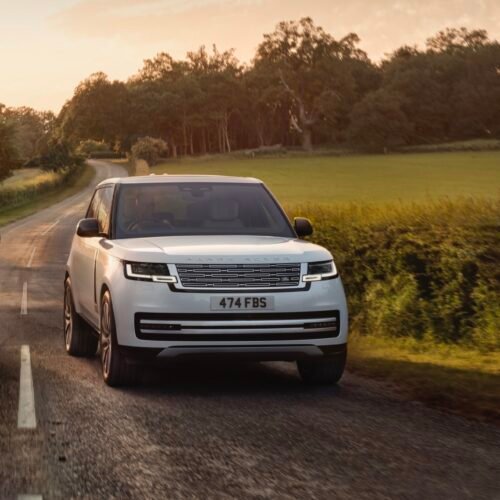
The smooth front grille is one of the only ways to spot a Range Rover Electric.
Credit: Range Rover
The smooth front grille is one of the only ways to spot a Range Rover Electric. Credit: Range Rover
Because the idea was to make the Range Rover Electric a Range Rover first and an EV second, it looks virtually identical to the other versions, albeit with a slightly more aerodynamic front grille and more aero-efficient wheels that together conspire to shave off a fraction of the vehicle’s drag coefficient. The lack of tailpipes at the back is probably the biggest giveaway that you’re looking at the electric one. There’s also a flat underbody, but hopefully you’ll never need to look at that.
The powertrain
The current Range Rover uses JLR’s MLA architecture, which was designed over a decade ago to be powertrain agnostic. The BEV actually only weighs 165 lbs (75 kg) more than the V8; getting rid of the front, center, and rear differentials plus all their driveshafts saves almost as much weight as the battery and drive units add back. The front and rear drive units are identical permanent-magnet synchronous motors with an output of 349 hp (260 kW); a front-induction motor was considered but dropped due to heat management concerns. Combined output is 542 hp (404 kW) and 627 lb-ft (850 Nm).
The motors are 24 percent more efficient than the ones you would find in an I-Pace, with 50 ms response times, far faster than a conventional powertrain. The motors use copper hairpins (144 per motor) with 0.008-inch (0.2 mm) laminations and a 0.03-inch (0.7 mm) air gap between the rotor and stator. Like many other high-end EVs, the drive units use silicon-carbide inverters that can respond in less than a millisecond.
The battery pack and drive units mounted to the chassis.
Range Rover
The battery pack and drive units mounted to the chassis. Range Rover
The battery pack has a smooth underfloor.
Range Rover
The battery pack has a smooth underfloor. Range Rover
The battery pack and drive units mounted to the chassis. Range Rover
The battery pack has a smooth underfloor. Range Rover
In a nice bit of packaging, the power electronics are fitted to what would be the transmission tunnel in a conventionally powered Range Rover. The 118.5 kWh net battery is a double stack of cells, arranged in 10 modules. The cells use a nickel-manganese-cobalt chemistry from AESC, with aerogel spacers between the cells. The pack operates at 800 V, with two virtual twins that help the active battery management calculate performance. The powertrain also recaptures waste energy; the ThermAssist heat management system boosts range by 7 percent and reduces the amount of energy needed to heat the car by 40 percent.
On a full charge, the Range Rover Electric should be good for at least 333 miles (536 km) under the EPA test cycle, sufficient for 97 percent of owners’ daily needs. For US market cars, there is a native NACS port (with Supercharger access) and ISO15118 plug-and-charge support. DC fast charging tops out at 350 kW, which adds 125 miles (201 km) in 10 minutes, with a 10-80 percent time of 22 minutes. The Range Rover Electric is capable of providing up to 3.6 kW of AC power via its vehicle-to-load (V2L) functionality, with vehicle-to-grid (V2G) support planned for the future.
On and off-road
Thanks to the battery pack, the Range Rover Electric enjoys a center of gravity that’s 3.4 inches (85 mm) lower than the V8. It rides on standard air suspension with twin valve dampers, and the chassis is 56 percent stiffer thanks to the aluminum battery pack frame, which increases rigidity.
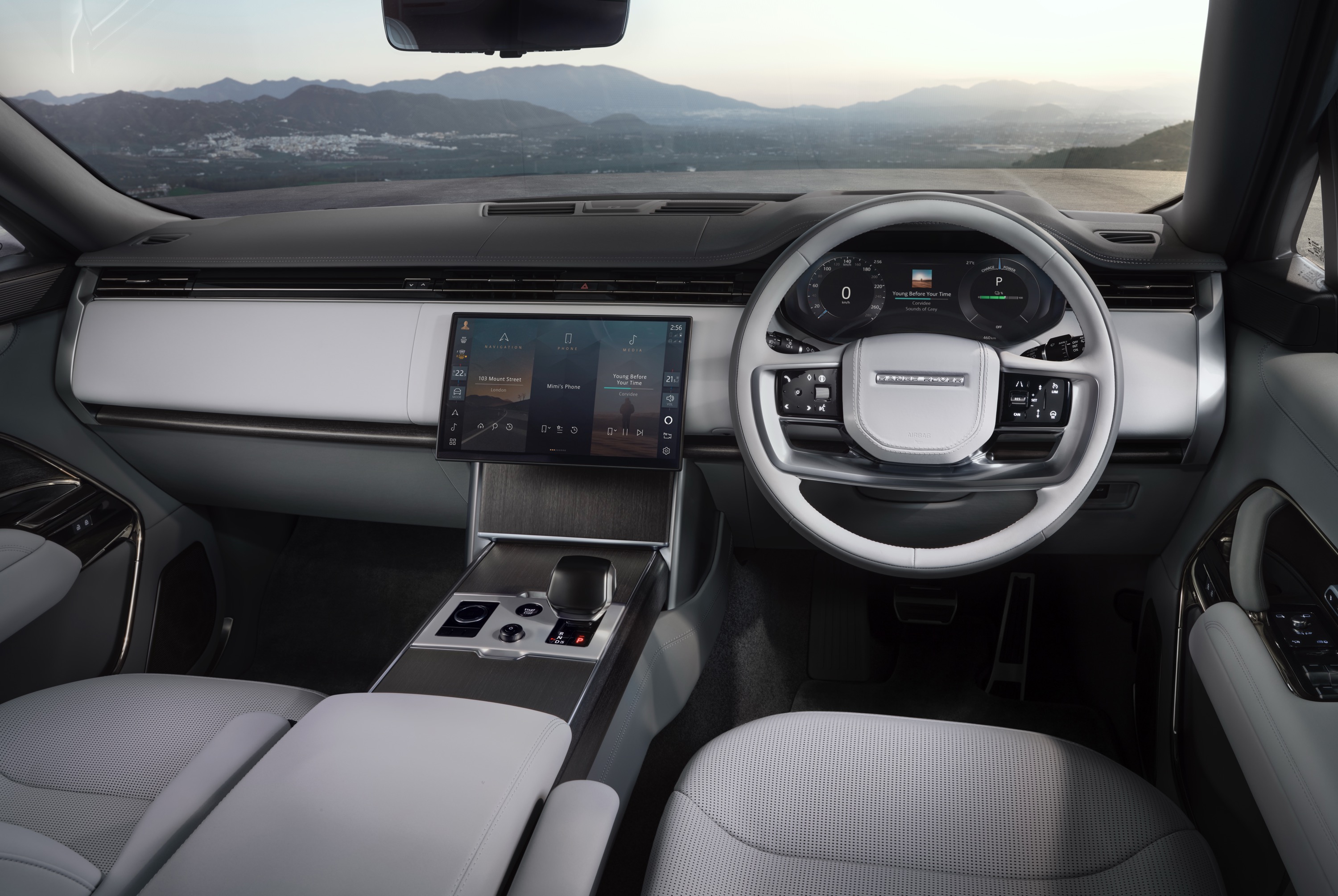
The interior is even more tranquil now that there’s no V8 to add NVH.
Range Rover
The interior is even more tranquil now that there’s no V8 to add NVH. Range Rover
The puddle lights remind you it’s an EV in case you forgot.
Range Rover
The puddle lights remind you it’s an EV in case you forgot. Range Rover
The interior is even more tranquil now that there’s no V8 to add NVH. Range Rover
The puddle lights remind you it’s an EV in case you forgot. Range Rover
An inherent advantage of electric propulsion is the better noise, vibration, and harshness; the motors are smooth and quiet, and as a result, the Range Rover Electric is 7 decibels quieter than the V8. JLR told us it needed to add some extra isolation to the front drive unit and that it had to pay attention to the HV cables, which can conduct noise and vibration into the cabin. But there’s also an active noise cancellation system that uses the new, very thin membrane speakers that JLR developed together with Warwick Audio that are mounted in the seat headrests.
With 7.3 degrees of rear steering, it’s more nimble than you might expect. A proper first drive is planned, but while at Gaydon, we had an opportunity to spend 15 minutes behind the wheel of the Range Rover Electric. Performance was benchmarked against the V8, with a 0-60 mph (0-97 km/h) time of 4.3 seconds. One-pedal driving is optional and, if engaged, will regenerate braking at up to 0.2 G. On asphalt, the ride is as smooth as you might expect, with the air suspension easily handling the 6,195 lb (2,810 kg) curb weight.
Forty percent of Range Rover owners say they go off-road, so ensuring the BEV can handle getting dirty or muddy was vital to ensuring it’s a real Range Rover, even if the brand’s analytics say it’s more like 10 percent that venture off the beaten path. Ground clearance is up to 10.3 inches (262 mm), which is 1.2 inches (29 mm) less than the V8, thanks to the rear drive unit, which sits a bit lower than the rear differential in the gas-burning version.
Its off-road ability is not compromised by electrification.
Credit: Range Rover
Its off-road ability is not compromised by electrification. Credit: Range Rover
Unlike the V8, there’s no center diff or locking differentials for the drive units, but the integrated torque management system means they’re not needed, as the car’s electronic brain is able to constantly manage the front and rear axles by sensing the available grip. As for why there’s no quad-motor layout like Rivian uses for its top-spec R1, JLR told Ars it experimented with a four-motor system back in the ’90s but rejected it for the first electric Range Rover as being too heavy. On the off-road course at Gaydon, we tested out the SUV’s ability to crawl over rocks, handle mud ruts, and ford water up to 36 inches (900 mm) deep. The throttle mapping in off-road modes made modulating the power delivery very simple, and other than the slightly lower ground clearance, this electric one can go anywhere that any other Range Rover can.
President Donald Trump on Tuesday issued yet another threat to all but wipe out Iran as the US military restarted its bombing campaign.
In a Truth Social post, the president warned Iran against striking back at the US shortly after American forces began bombing Islamic Revolutionary Guard Corps (IRGC) targets in the country.
“If the failed Nation of Iran retaliates for this very justified attack, they will be hit again at a much harder and higher level,” Trump wrote, then added that “it will not be the biggest attack of them all, that is waiting in the wings and, when it is over, there will be very little left of the Islamic Republic of Iran!”
Iran appeared undeterred by Trump’s saber-rattling, however, as The Associated Press reported on Tuesday that the country retaliated by launching missiles and drones shortly after the US attack.
On Monday, a reporter in the Oval Office asked the president if he would consider using nuclear weapons against Iran, and he appeared to rule it out.
“There’s no reason for it,” Trump said. “What a stupid question that is, actually. Here they are, they’re totally defeated militarily, so now I defeat them and now I should use a nuclear weapon on top of them?”
In April, Trump issued a similarly threat, warning that “a whole civilization will die tonight, never to be brought back again” unless Iran surrendered to the US. Trump backed down from that threat hours later and agreed to a since-expired ceasefire agreement with Iran.
Brett Erickson, managing partner at Obsidian Risk Advisors, warned in a Tuesday social media post that the president’s threats should not be dismissed simply because he hasn’t followed through on them in the past. “Throughout this entire war, I have been incredibly skeptical of any claims that President Trump is so much as DISCUSSING the use of nuclear weapons,” Erickson wrote. “This reads to me clear as day that they are on the table now.”
US MQ9 drone shot down in central Iran, reports Iranian media
A US MQ9-type drone was shot down on Tuesday over the skies of Iran’s central city of Khomein in Markazi province, semi-official Tasnim news agency reports.
The drone was shot down by Iranian defense systems, it said, without providing further details.
The report came after the US Central Command announced that American forces began striking IRGC targets in Iran.
Tensions between Tehran and Washington have remained high since the war began with strikes on Iran in late February.
A framework deal was signed in June through Pakistani and Qatari mediation.
The US began a two-week bombing campaign in July and reimposed a naval blockade after differences over navigation in the strait.
READ: Trump says US launches ‘large and powerful’ strikes near Strait of Hormuz
A newborn and child reportedly died of measles; CDC isn’t counting them
The Centers for Disease Control and Prevention is excluding two measles deaths reported by Pennsylvania health officials last week from its latest update of national measles data. The move publicly challenges the accuracy of the state’s death determinations in an extraordinary move that breaks precedent that states are the arbiters of case and death determinations, not the CDC.
The New York Times reported Monday that the CDC’s new director, Erica Schwartz, is behind the decision. Schwartz—less than a month into the job—reportedly ordered CDC staff to add an unusual statement onto the CDC’s website for measles surveillance data. The statement notes that the update will not include the deaths reported by Pennsylvania and continues: “At this time, available information does not establish whether measles caused or contributed to the deaths or whether the individuals died from other causes while infected with measles.”
The Washington Post reported Monday that the CDC had actually changed the information provided on that page multiple times over the weekend. On August 29 at 2:33 pm ET, the website listed the total measles deaths for 2026 as “0” in a chart. On August 30 at 12:09 pm ET, the chart was updated to list the total deaths for 2026 as “2.” There was also a note underneath the chart that read: “Health departments make determinations about measles-associated deaths and share relevant information with CDC.” By 3:23 pm ET on August 30, the chart was changed again to delete the two deaths, replacing them with an asterisk as a reference to the unusual statement about the deaths not being included. The asterisk and statement remain as of Tuesday.
The move comes after anti-vaccine Health Secretary Robert F. Kennedy Jr. got into a public spat with Pennsylvania Governor Josh Shapiro over Kennedy’s anti-vaccine rhetoric. Kennedy then shared measles misinformation on social media amid news of the deaths, then suggested without evidence that the state may have “fabricated” the deaths and that the governor announced them with “giddy delight.”
State health officials initially refused to release information about the two people who died, including their ages, citing privacy concerns. But news has since trickled out that one of the people who died was a newborn and, according to reporting Tuesday by the Times, the other was a child. Both were unvaccinated and from Lancaster County. Outside medical experts have criticized the lack of information provided by health officials, leaving more space for doubt and misinformation.
What we know about the deaths
Controversy about the deaths flared after Lancaster County Coroner Stephen Diamantoni, a Republican first elected coroner in 2007, claimed that a pathologist determined that the newborn died of a ruptured spleen and didn’t believe measles played a role. The baby was born infected with the virus, according to testing, and had evidence of a measles infection in lung tissue. The newborn’s mother was severely ill from measles at the time of birth, according to reporting from The Atlantic, which spoke with the baby’s parents amid the uproar.
The parents, who are Amish, were not aware that their baby’s death was in the national news and a source of contention. They believed without question that their baby died of measles. The mother said she contracted the virus amid the ongoing local outbreak and after several of her other children had fallen ill. She became so ill she couldn’t speak above a whisper and “didn’t have a single piece of energy” as she went into labor. The baby was born with a pulse, but was not breathing. The baby, a boy, was declared dead less than a half-hour later, after paramedics had been called and attempted to give the newborn oxygen and chest compressions, the parents said.
Measles can cause a baby’s spleen to enlarge and the fibrous tissue around the organ to thin. In such a vulnerable state, the spleen can rupture during birth. Diamantoni has claimed that the pathologist who examined the newborn didn’t report an enlarged spleen. But after a spleen ruptures, it can be difficult to determine whether it was previously enlarged or not, according to Paul Offit, a vaccine and pediatric infectious disease expert at Children’s Hospital of Philadelphia. Overall, a ruptured spleen is extremely rare in newborns, he says.
Offit told reporters that he has been in touch with state officials and learned enough about the two deaths to say that “these patients would not have died were it not for measles.” He has publicly called for the coroner to provide an alternative explanation for the baby’s ruptured spleen if it was not from measles.
Far less is publicly known about the second death, which was reported as being in a child as of Tuesday. Although Diamantoni is the coroner for Lancaster County, where both the deceased baby and child lived, the county does not have its own local health department and gets information from the state health department. Diamantoni told The Washington Post late Monday that he had only recently received information about the second death and that his office is still working to determine the cause of death. It’s unclear on what grounds they are challenging the state’s determination that it was caused by measles without having the information previously.
Kennedy’s anti-vaccine agenda
Last week, amid Kennedy’s comments, the CDC said on social media that “CDC is working to determine what actually occurred” and claimed that the “Governor’s Office has not provided CDC with information relevant to the outbreak and has declined our offers of assistance.”
The state’s health department officials said they reported the deaths to CDC staff on August 25 prior to their public announcement and met with CDC officials the next day.
As a spokesperson for the state health department told the Times, “Every reported measles case is thoroughly reviewed to confirm it meets the Centers for Disease Control and Prevention’s (CDC) case definition for a measles case. To date, [the state health department] has provided all required epidemiological data to the CDC.”
As an ardent anti-vaccine activist, Kennedy has a long history of spreading vaccine misinformation and disinformation, downplaying the severity and risks of vaccine-preventable diseases and spreading doubt and misinformation about vaccine-preventable deaths. Amid the pandemic, Kennedy and like-minded allies similarly assailed reports of deaths from COVID-19, arguing that they were deaths “with” the deadly virus and not “from” it. While Kennedy’s pattern is clear, outside experts have raised concerns about whether new CDC director Schwartz—who has championed the use of vaccines in the past—would stand up to Kennedy’s anti-vaccine agenda.
The CDC’s decision to challenge the death determinations of Pennsylvania health officials appears to confirm those fears and stand to exacerbate the flagging public health systems in the US, experts say. “This is a moment for the CDC director to speak publicly about the outbreak,” Debra Houry, CDC’s former chief medical officer, told the Times. “Delays in reporting of data further erode trust and create confusion.”
Iceland to seek new security partnerships after voters reject EU accession talks
Iceland needs to find new ways to strengthen its security after voters rejected restarting accession talks with the EU, the country’s foreign minister told Reuters, including by seeking bilateral cooperation and deepening ties with the bloc. The comments came after Icelanders on Saturday voted to reject a government push to reopen EU membership talks. U.S. President Donald Trump, who has repeatedly said he wants to acquire neighbouring Greenland and has cast doubt on Washington’s commitment to NATO, has sharpened the security debate in Iceland in recent months. “We didn’t vote away the geopolitical situation, it’s still there and we will have to find other ways to increase our security,” Thorgerdur Gunnarsdottir told Reuters in parliament after meeting the foreign affairs committee. In rejecting EU membership talks voters brushed aside government warnings that EU membership could bolster its security. “The EU is still a very important partner for Iceland, and we need to strengthen our cooperation further. We will look at bilateral agreements, we already have such agreements with Finland and Norway,” she said, also mentioning Japan and Canada as important partners. Iceland, an Arctic island of 400,000 people, is a NATO member but has no standing army of its own. Its defence is based on a bilateral defence agreement with the United States from 1951 and NATO membership. In Saturday’s referendum, 52.8% of ballots cast were against the government’s proposal to hold negotiations with Brussels, 47.2% were in favour, with 82.5% of eligible voters taking part. Iceland has been part of the European Economic Area since 1994, an agreement with the EU that grants Iceland access to the EU’s single market but without being a full member. “We will have to strengthen cooperation within the EEA. A very positive outcome of the referendum is that all Icelandic parties are now united behind the EEA agreement,” she said.
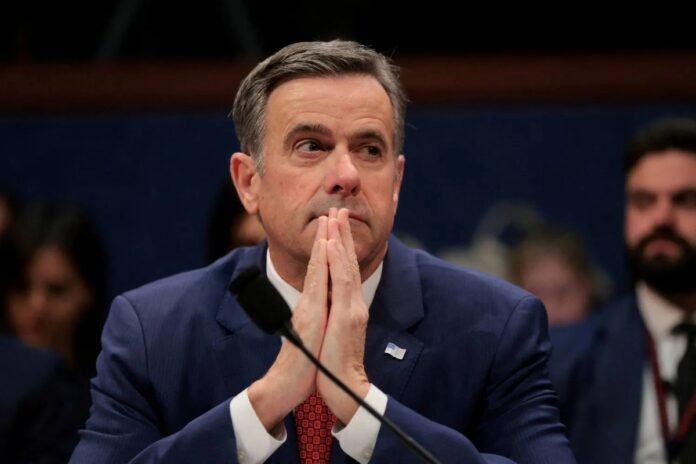
Mystery continues about the strange visit by CIA Director John Ratcliffe to Moscow, flying there in a massive C-17 Globemaster, a military airlifter.
While the Globemaster has a specially designed secure roll off and roll on module for top officials, keeping them harnessed to Washington and the President, the choice of aircraft, instead of a much smaller VIP aircraft, helps us understand this was a highly sensitive but visible, urgent mission.
Rumors are swirling all over Europe that the Russians are planning to attack some NATO members. Lithuania has been mentioned. The rumors are not in a vacuum and don’t depend on statements by Russian leaders, especially their anger with the UK sending long range drones and cruise missiles for Ukraine to attack Russian territory.
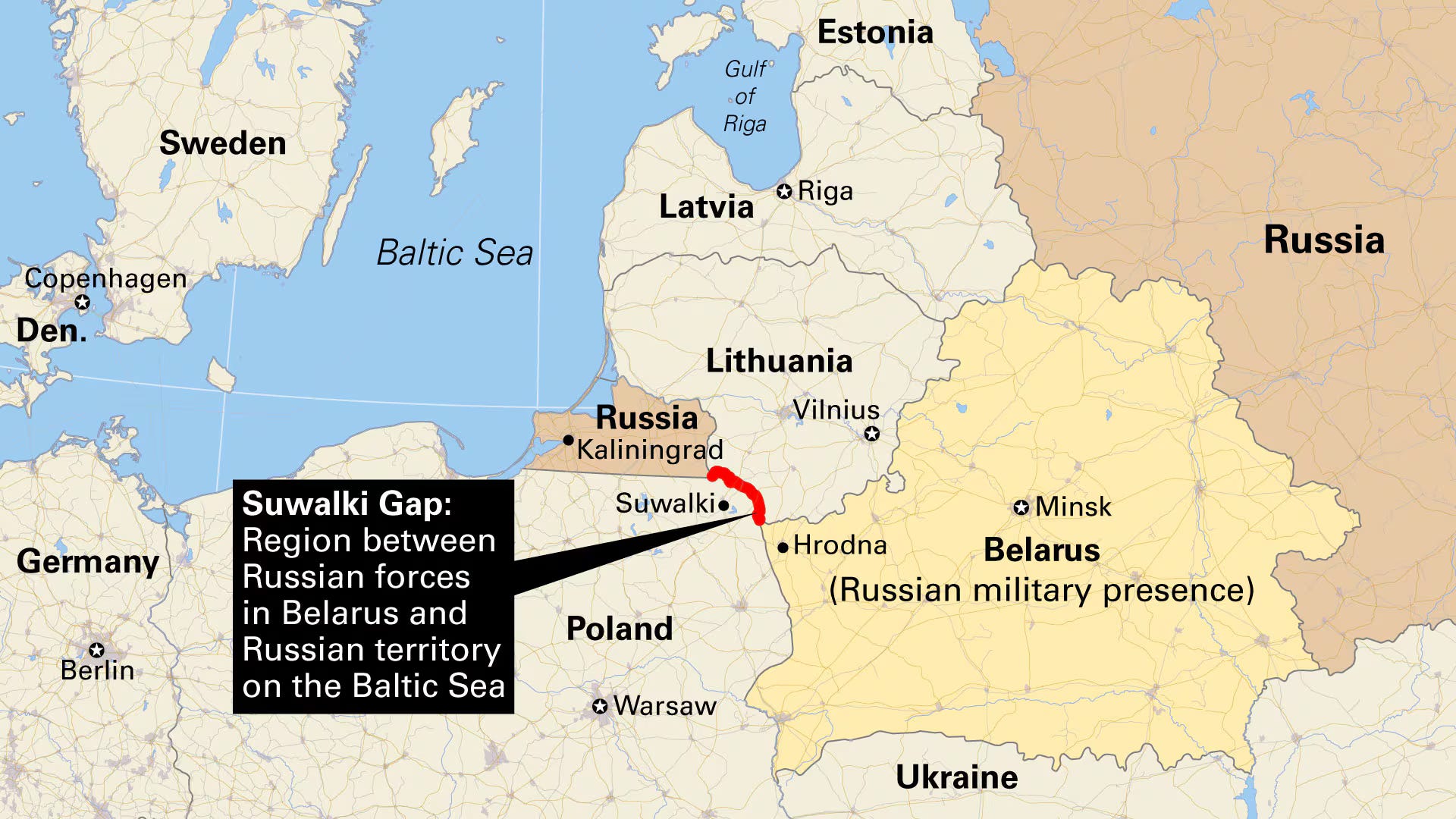
The immediate focus is Kaliningrad. Kaliningrad, back when it was part of Prussia, was known as Konigsberg. It is a strategic Russian enclave on the Baltic Sea, but it is not physically connected to Russian territory or to Russian controlled lands. It was awarded to Russia in 1945 at Potsdam as part of the postwar settlement.
During the Cold War, Kaliningrad was surrounded by communist Poland and communist Lithuania, both then Warsaw pact members. But today both Poland and Lithuania are independent, NATO members and significantly hostile to Russia.
For Russia to support Kaliningrad it relies on land and rail access from Belarus across the Suwalki corridor, which has been recently fraught by attempted blockages and closures initiated by Poland and Lithuania. Kaliningrad can also be supported by sea, but the Russians have lost significant leverage in the Baltic, especially after once-neutral Sweden and Finland joined NATO.
Kaliningrad also has an air terminal that appears well defended by air defense systems including the S-400 air and missile defense system, and Pantsir which is a short range system useful for knocking down drones and cruise missiles.
Recently a heavy concentration of specialized NATO aircraft are operating in international airspace near Kaliningrad, a clearly provocative move by NATO.
The deployment featured a simultaneous flight of E-3 AWACS airborne early warning and control planes, an American EA-37B Compass Call II electronic warfare aircraft, an ARTEMIS II reconnaissance platform and American, Norwegian and Polish fighter units.
The advanced EA-37B is a powerful intelligence-gathering and electronic warfare platform, suggesting preparations for a NATO strike launched at Kaliningrad.
One of the main strategic assets of Kaliningrad Oblast is the port at Baltiys.
Responding to the NATO operations, Russia’s Baltic Fleet has conducted tactical air-defense exercises simulating enemy air raids against the Baltiysk naval base. These drills involved Su-30 multirole fighters, Mi-24 combat helicopters and unmanned aerial vehicles acting as hostile elements.
The Baltiysk Naval Base is situated on the Vistula Spit, Russia’s main ice-free base on the Baltic. It includes surface combatants, diesel-electric submarines, naval aviation, and coastal defense missile systems (such as the Bastion and Bal systems) designed to project power across the Baltic approaches and enforce anti-access/area-denial (A2/AD) coverage over neighboring NATO airspace.
These mutual operations have raised tension levels very high between NATO and Russia. While the US has supported the military operation around Kaliningrad, Washington also is concerned that there is a growing risk that actual fighting could break out that might involve Russian attacks on Poland and Lithuania – or, even farther back, NATO bases in Germany and the UK.
There is no public evidence beyond what has been seen around Baltiysk, but there is growing preparation by the Russians including moving nuclear weapons to Belarus. At the tail end of August (27 to 29) Belarusian President Alexander Lukashenko held a working meeting with Russian Prime Minister Mikhail Mishustin in Moscow, followed by official talks with President Vladimir Putin at his Novo-Ogaryovo residence outside Moscow. The Kyiv Post reported that the Lukashenko-Putin meeting focused on security coordination and strategic cooperation.
Neither NATO, the US nor the Russians have reported any troop movements related to the Baltics or Eastern Europe. While NATO claims the Russians are preparing a major mobilization, the Russians deny that, and even the Ukrainians, including the GUR (military intelligence) do not think that is the case.
There have been a number of other provocations such as attacks on manufacturing and supply facilities in Italy, Bulgaria, Estonia and Slovakia, alongside a thwarted attack involving an explosives-packed drone discovered near a cargo plane at Leipzig/Halle Airport in Germany.
Similarly there have been a number of disruptions of underseas cables in the Baltic Sea and elsewhere, attributed by NATO to operations conducted by the Russia-backed “shadow fleet” of tankers and container ships. While not all the provocations were of Russian origin, there is a growing list of incidents that point back to Moscow.
Underlying all the military activity, there is a growing sense that the Ukraine war is reaching a crisis moment. Kyrylo Budanov, the former head of Ukraine’s military intelligence (GUR) and now advisor to Zelensky, recently said that Ukraine cannot afford not to mobilize at least 30,000 personnel per month just to maintain its current defensive capabilities and force structure on the front lines.
In other words, Ukraine is losing up to 30,000 front line soldiers each month and cannot replace them. While Russian losses no doubt are also high, the Russians have a large pool of active duty soldiers available, although there are rumors that young people are leaving Russia to avoid a bigger mobilization.
But young people cannot leave Ukraine, and there are fewer and fewer willing to go to war, leaving Ukraine in a crisis. Recently the Ukrainians are talking about drafting large numbers of women for combat duties.
That manpower crisis is compounded by the short supply of critical weapons, so much so that Ukraine’s artillery lacks ammunition and artillery tubes and weapons are in short supply. Milbloggers (including Ukrainians) also report field shortages of drones, which Ukraine uses in massive numbers.
Compounding the mess, key air defense systems and interceptors, especially Patriot, have practically disappeared. The Russians carried out a deadly attack on August 29 in the Bucha district west of Kyiv that destroyed a warehouse where some of the few remaining Patriots and other weapons were stored.
The ammunition in the warehouse in a civilian district exploded, killing 37 people (perhaps more), and that sparked a political crisis in Ukraine as it became clear that the Ukrainian army was hiding ammunition in populated areas.
The attack was bad enough that President Zelensky accepted responsibility and launched an investigation.
Recalling that Zelensky recently fired his defense minister – as well as his army commander, Oleksandr Syrsky – it is not clear how much longer the Ukrainians can stay in the fight.
From a strategic point of view this raises the question of whether NATO can come to the rescue, but doing so would require a consensus that does not currently exist, and a military capability that is weak and ill equipped and poorly supported.
For the US, which no longer considers itself to be a key backer of Ukraine and is increasingly wobbly on NATO, a war in Europe would be a political and military disaster, and physical involvement in Ukraine would be just as bad.
Like Ukraine, the US is very short on warfighting material including air defense systems, ammunition, and smart weapons.
In the past year or longer, US intelligence (based mostly on UK and NATO assessments) focused on the idea of damaging Russia enough to force Putin and his army out of the war. That explains the drone war against Russia, along with sabotage operations deep inside Russian territory, and multiple assassinations, especially of Russian military officers.
But the CIA-MI6-NATO strategy, backed by a major propaganda effort, seems to have fallen short of its goal. There is little or no evidence that Russia is ready to make major concessions or to pull out of Ukraine.
It is interesting that Elon Musk has refused the use of his Starlink system for Ukrainian strikes on Russian territory, explaining that Musk could not see how these attacks would bring an end to the war.
The fact that now the propaganda has shifted to the Russian “threat to Europe” suggests that US and NATO intelligence are trying to jack up support to continue the war in Ukraine in order to avoid a bigger war in Europe. While the logic here is, sadly, murky, it represents a growing angst that Ukraine is about to implode.
In the midst of all this, and arriving on a huge military transport, CIA Director Ratcliffe apparently hoped to speak directly to Putin. But Putin was not ready for any meeting and left it to the head of the SVR (Russia’s Foreign Intelligence Service), Ratcliffe’s opposite number, Sergey Naryshkin. The message from Ratcliffe was a proposal of how to end the Ukraine war.
Various reports claim to be authoritative, but none report directly from the meeting in Moscow, which may have lasted eight or nine hours. If Ratcliffe just wanted a ceasefire, or for Russia to pull out of Ukraine, that would take ten minutes of his time and ten minutes for translation. Even the Russian reply could have been brief. But the long meeting implies a lot more was on the table.
The Ukrainians, who have back channels to the Russians (after all, their service was created by Russia and trained over the years by Russian operatives), say that the US offered to pull all US troops out of Europe in exchange for freezing the war in Ukraine.
If the Ukrainian report is true, it would open the door to a wide-ranging discussion between the US and Russia. Getting the US out of NATO would be a major Russian victory, an historic one since NATO grew out of the Cold War.
On July 1, 1991, in Prague the Warsaw Pact was officially disbanded after 36 years (founded in 1955). It was Russia’s answer to NATO (founded in 1949). Unlike the disbanding of the Warsaw Pact, and no longer facing an opposing alliance, NATO began a huge territorial expansion, which the Russians saw, and still regard, as threatening.
Of course, pulling US troops out of Europe would not end US participation in NATO, but it would be a huge strategic shift. Russia’s focus, as far as it can be understood, is to avoid being surrounded by hostile states, backed by the US. So if this was the offer by the US side, it was highly significant.
But what does “freezing” the war in Ukraine mean in practical terms? The Russians are skeptical that Zelensky would accept a real freeze, and Russia believes Zelensky will agree only to a time-limited ceasefire under which he could rebuild his army and recruit adequate manpower.
Some reports indicate that the Russians may have suggested removing the Zelensky government completely and replacing it with an internationally backed administration for Ukraine. Such a government might pave the way for the two adversaries to reconcile differences and sort out territorial, military, political and cultural conflicts.
With Europe’s current crop of political leaders and their strong commitment to Zelensky, any deal as discussed in Moscow would fail to get support in Europe. However, European leadership is on the cusp of change in the UK, France and Germany (perhaps also Italy), meaning that a new crop of European leaders may take a more flexible approach in future.
At the same time, the US commitment to NATO has increasingly wobbly support in Washington, where there is no desire to keep supporting Ukraine or backing up the alliance. The White House unhappiness with the European response on Iran has simply made things worse.
It isn’t clear whether Ratcliffe’s mission has changed anything, but it may have set in motion a process that could help end the Ukraine conflict.
Stephen Bryen is a former US deputy under secretary of defense. You can read this article and many more in his newsletter Weapons and Strategy.
This fall, 54 million K-12 students are headed back to the classroom for another year of lessons in all the classic subjects: math, English, history, biology. But there’s another subject that’s been sneaking into school curricula: plastics.
A new report from the nonprofit Plastic Pollution Coalition documents the many ways the plastics industry has been inserting its agenda into classrooms across the U.S. — including through lesson plans and worksheets, hands-on science experiments, and a program called “PlastiVan” that travels from city to city teaching students about “the contribution plastics make to modern life.”
Industry interests offer these resources to teachers for free or for cheap, according to the report. The materials tend to highlight the necessity of plastics while downplaying their significant downsides to human health and the environment.
“When that information is provided to kids, it obfuscates the true impacts of plastic pollution,” said Madison Dennis, senior policy and advocacy manager for Plastic Pollution Coalition and one of the report’s main authors. Besides harming marine life, plastics can expose people to hazardous chemicals, clog storm drains and contribute to flooding, and release planet-warming greenhouse gases. Dennis’ organization is calling for stricter school policies against the use of industry-sponsored learning materials.
The report lays out four case studies of plastics industry “propaganda” for schoolkids. One involves the Society of Plastics Engineers, or SPE, a trade group that recently became a division of the Plastics Industry Association. SPE’s lesson plans include activities like a “plastic scavenger hunt,” which aims for students to “understand that plastics are ubiquitous and their importance to society and their personal life.” A video titled “Your Bottle Means Jobs” explains how plastics recycling supports local employment.
Another case study highlights the American Association of Chemistry Teachers, an initiative of the Dow Chemical Company. One of the association’s lesson plans teaches elementary and middle school students how to compare the strength of various types of plastic bags that can be found in a grocery store. After a brief experiment, the lesson invites them to “pretend [they] are an employee for Dow Chemical Company” and are designing a plastic bag for a customer.
9 percent of all plastics are recycled worldwide, and scientists have repeatedly warned that recycling will be unable to keep up with projected growth in plastic production. Investigativereporting has shown that industry groups knew this decades ago, but promoted recycling anyway in order to defuse growing concern over plastic pollution.
Wendy Johnson, a science education specialist at the National Center for Science Education, said the industry’s lesson plans and worksheets don’t reflect good pedagogy. Materials claiming to be aligned with state-level STEM standards don’t say which standards they support, or how they’re aligned. Lesson plans instruct students to read teachers’ notes, or list industry-specific vocab terms like “stretch blow molding” or “thermosetting.”
“By using all of these technical terms, it’s tricking people into thinking … that they’re doing science,” Johnson told Grist. What the materials really teach, she said, is “ideological perspectives about the economy,” like the desirability of cheap consumer goods.
“It’s so clear that the purpose isn’t to make really clear, easy-to-use materials,” Johnson added. “The idea isn’t to teach,” but to get industry talking points into classrooms. The report documents plastics propaganda finding its way into schools since at least the 2000s. Between 2009 and 2011, for example, a plastics trade group lobbied the California Department of Education to add a section on “The Advantages of Shopping Bags” to the state’s high school textbooks. The PlastiVan initiative has been ongoing since 2011, and SPE claims it’s reached over 132,000 students in total.
Plastic Pollution Coalition suggests that the problem is particularly significant in schools located near petrochemical facilities. In Beaver County, Pennsylvania, for example, Shell operates a 386-acre plastics production complex and has invested millions of dollars in the development of plastics-related curricula and recycling programs, both for grade schoolers and for community college students. It has also donated hundreds of backpacks filled with school supplies, and bought one school a basketball court — seemingly in exchange for incorporating plastics recycling into the curriculum.
Shell didn’t respond to Grist’s request for comment. Neither did SPE, the American Association of Chemistry Teachers, nor the school district in Beaver County.
The report hints at a broader problem with STEM education in U.S. public schools. Teachers often lack the time and money needed to design their own curricula, or to buy high-quality materials and lesson plans needed for in-class labs or science projects. When vested interests come along offering support — whether it’s the tobacco industry, the junk food industry, the pesticide industry, or the fossil fuel industry — it can be hard to say no.
Read Next
“As a teacher, I’m always looking for free stuff,” said Suzie Hicks, a K-8 environmental educator in California who consulted on the Plastic Pollution Coalition report. Hicks said their education and background make them comfortable vetting materials for greenwashing — but that’s likely not the case with most teachers.
Dennis recommended that school boards adopt policies banning educational materials sponsored by the chemical, fossil fuel, and plastics industries. She also emphasized the need for better school funding more generally, so that teachers and districts aren’t so desperate for ready-made learning materials.
One way to achieve this would be to eliminate tax breaks for petrochemical processing and plastics production facilities, which deprive communities of much-needed cash.
Katie Allen, executive director of Algalita, a California-based environmental nonprofit that develops educational materials on plastic pollution, pushed back against the idea that schools should ban all industry-sponsored content.
“Once you start banning one thing, where does it end? What I want to do is give educators the benefit of the doubt and allow them to make their own decisions,” she told Grist. She argued that teachers should be trusted to properly contextualize industry materials — and that they could even use them to teach critical-thinking skills.
That said, there are plenty of educational materials on plastics that are developed by non-industry sources. Algalita, for instance, offers free lesson plans on topics like plastic garbage patches in the oceans and biomagnification — the phenomenon where plastics build up inside sea creatures as you move up the food chain. The Story of Stuff, another nonprofit, offers a broader high school curriculum focused on the costs and consequences of producing consumer goods — including those made from plastics.
Those learning materials still come from organizations with an agenda. But Hicks argued they’re more trustworthy, since nonprofits usually aren’t trying to sell something.
Another option is for teachers to simply design their own curricula. That’s what Jacqueline Omania, a recently retired elementary school teacher in Berkeley, California, did in 2015. She turned her classroom into a zero-waste laboratory, and each year for 11 years, Omania and her students developed a set of zero-waste classroom agreements, vowing to minimize their plastics use — by swapping individual glue sticks for a communal tub of glue, for example — while also advocating for more systemic change, like by campaigning for a policy requiring Berkeley restaurants to stop giving out single-use plastic foodware.
“There are so many challenges in the world, but plastic is something tangible,” Omania said. “It’s right there in front of them, and they can see the difference that they’re actually making through their actions.”
King Charles is facing fresh questions over royal money and family favoritism after it was reported that Queen Camilla’s younger sister is now being paid for consultancy work by one of his flagship charities.
Annabel Elliot is reportedly working for the King’s Foundation on “branding” and “retail” matters, according to Britain’s Sunday Times.
Exactly how much she is being paid has not been disclosed.
But the arrangement is already raising eyebrows because Elliot previously earned hundreds of thousands of pounds over roughly two decades while advising Charles on interior design projects connected to the Duchy of Cornwall.
That lucrative relationship ended after Prince William inherited control of the Duchy when Charles became king.
William reportedly removed Elliot from the payroll soon after taking over.
Now, critics are questioning how Elliot ended up with another paid role connected to Charles — this time through the King’s Foundation.
There has been no suggestion that Elliot is unqualified for the work. Instead, the controversy centers on appearances, transparency and whether proper safeguards were followed when a close member of the royal family was brought in as a paid consultant.
The development also comes as Charles continues to face criticism over his handling of another deeply personal royal headache: Prince Harry.
According to critics of the King, Charles has repeatedly ignored advisers urging him to take a tougher or more cautious approach toward his estranged younger son.
Harry and Meghan Markle remain deeply unpopular with significant sections of the British public, particularly following years of explosive interviews, accusations against the Royal Family and the release of Harry’s memoir, Spare.
Yet Charles has appeared determined to keep the door open to his son.
For some royal watchers, the Elliot controversy fits into a much larger pattern surrounding the 77-year-old monarch — one in which Charles listens to advice but ultimately does what he wants.
Those critics argue that aides have spent years attempting to protect the King from controversies involving money, family and public perception, only to see their warnings brushed aside.
That approach may have been easier when Charles was Prince of Wales.
As King, however, every decision involving royal relatives, charities and money is likely to receive far greater scrutiny.
And with the monarchy already under pressure to prove it operates transparently, Charles may soon discover that ignoring uncomfortable warnings comes with a much steeper price.
For more than a year now, I’ve been investigating how youth sports organizations have failed to protect kids from sexual abuse, and the gaps in the system that have allowed coaches banned for misconduct to keep working with young athletes.
So far, I’ve shown that one major nonprofit sports organization, the Amateur Athletic Union, has become a haven for coaches accused of abuse. I identified eight coaches who are still working with kids under the AAU despite having been banned by SafeSport, a center created by Congress to protect kids from abuse in sports that has a public list anyone can check. The AAU has said it does not comment on individual cases but in a statement said that it is “committed to protecting its athletes through comprehensive protection policies overseen by our Compliance Department.”
I also told the story of a Texas volleyball coach named Ryan Richardson, who continued coaching despite having been banned by SafeSport and is now under investigation by the Department of Homeland Security. Richardson did not respond to multiple requests for comment on ProPublica and The Washington Post’s reporting, or an email seeking comment about the Homeland Security investigation. When he was first suspended in 2024, Richardson told the local news website MyRGV that complaints about him were an effort to “retaliate and defame someone’s character,” and he said he “would never do anything to risk the physical or mental wellbeing of these strong young ladies.”
I’m still reporting, and I want to hear from you.
I know these are sensitive topics that can be difficult to discuss. I also know how important these stories are. If you know about a coach on the SafeSport list who is still working with kids, or you have other experiences with how youth sports organizations have handled abuse allegations, please fill out our brief questionnaire.
I’m particularly interested in:
Finding instances of coaches who are continuing to work with kids after being banned by SafeSport.
Better understanding how abusive coaches manipulate and deceive parents.
Learning about coaching abuse, safety and misconduct in basketball, in which SafeSport has far less influence compared with many other popular youth sports.
We take your privacy seriously and will contact you if we wish to publish any part of your story.














 9 percent of all plastics are recycled worldwide, and scientists have repeatedly warned that recycling will be unable to keep up with projected growth in plastic production.