19.3 C
London
Friday, August 28, 2026
Home Blog

US transshipment claims in Southeast Asia rest on thin data

0
us-transshipment-claims-in-southeast-asia-rest-on-thin-data
US transshipment claims in Southeast Asia rest on thin data

Washington’s August 13 report, The Great Transshipment Scam, puts Southeast Asia at the center of a widening US campaign against tariff evasion worldwide. Indonesia, Malaysia, Thailand and Vietnam are all placed in the report’s Tier 2, a category the White House says combines significant transshipment volumes with deep integration into China-linked supply chains.

Indonesia has rejected Washington’s characterization, while Vietnam has stressed both its opposition to origin fraud and its willingness to address US concerns. The dispute now extends beyond customs enforcement as Washington writes anti-evasion commitments into new trade arrangements with ASEAN economies. That was seen in its February agreement with Indonesia.

The United States has a legitimate problem to solve: tariff differentials create incentives to reroute goods, alter paperwork or perform only minimal processing in lower-tariff jurisdictions, often to make goods made in China appear as though they were produced in Southeast Asia.  

US Customs and Border Protection has already documented such conduct involving Indonesia. In 2024, it found substantial evidence that Chinese-origin xanthan gum had been transshipped through the country and entered the US without the applicable antidumping duties.

The EAPA determination provides a concrete benchmark: a specific product and importer, a shipment trail, evidence on production capacity and origin claims, and a final administrative finding.

However, a single proven case involving one product and importer does not validate or justify the report’s broader country classifications. The case is useful for flagging risk, but less persuasive as proof that illegal transshipment is systemic in any particular country.

The US Council of Economic Advisers screens products subject to Section 301 tariffs for which China’s share of US imports falls, China’s share of a third country’s imports rises and that country’s share of US imports also rises.

The pattern warrants scrutiny, but it does not by itself establish that the same goods merely passed through and were not significantly produced in the third country. A factory can expand production, import Chinese intermediate inputs, add domestic value and export a legally transformed product to the US while producing exactly the same statistical pattern.

The report itself notes that the post-2018 shift in sourcing does not establish that all displaced Chinese trade was illegally transshipped; some reflects legitimate changes in production, investment and sourcing.

Its five estimates range from roughly $40 billion to $303 billion and are explicitly described as not directly comparable. Yet its language becomes firmer when countries are grouped into tiers.

The report describes Tier 2 as combining “significant illegal transshipment volumes” with deeper China-linked economic integration, although it does not disclose a numerical threshold, country score, weighting formula or Indonesia-specific estimate that would allow an outside reader to reproduce that classification.

Moreover, the estimate changes sharply with the unit of analysis. Research on Vietnam using eight-digit product data found that 16.5% of US-bound Vietnamese exports in 2021 appeared to be rerouted at the national product level.

The estimate fell to 6.5% when flows were matched within provinces and to 1.7% when they were matched within individual firms. The firm-level measure may undercount coordinated rerouting, but the result shows how aggregation can mistake legitimate production by one company for rerouting by another.

The report also applies a more granular test. The US Commerce Department’s Office of Trade and Economic Analysis uses transaction-level data to flag an exact HS8 product imported from China and exported to the US from the same local region in the same quarter. Matching the product, place and timing provides a stronger signal, but the published estimate covers Mexico, India and Vietnam, not Indonesia.

For Indonesia, the report highlights the Bekasi-Batam corridor and plastic packaging under HS 392310. But the public document does not disclose a firm-level shipment trail, evidence of local value added, details of the manufacturing process or proof of a false origin claim sufficient to turn that corridor-level risk signal into a proven violation.

US origin rules focus on what happened to the product, not simply where its inputs came from. When goods contain inputs from multiple countries, country of origin can depend on whether they undergo substantial transformation: a fundamental change in form, character or use through meaningful processing or manufacturing.

Repackaging normally does not qualify; assembly sometimes does, depending on its complexity. Chinese components, ownership, financing or supplier relationships may therefore justify scrutiny, but none automatically makes a finished ASEAN product a Chinese-origin one.

A 2025 IMF working paper separates rerouting from reallocation across six Asian connector economies using domestic and Chinese value added, foreign investment and counterfactual trade patterns.

Its findings are inconclusive for five economies, including Indonesia, while Vietnam shows increased domestic content consistent with production reallocation rather than significant one-stop transshipment.

That does not prove ASEAN is clean. Rather, it shows why bilateral trade correlations are not enough to sufficiently determine transshipment. ASEAN governments would thus be wise to answer Washington with evidence rather than blanket denials.

In 2025, officials from Indonesia’s trade ministry, customs authorities and Batam administration accompanied US CBP investigators to five factories producing solar cells, solar panels and cryptocurrency mining equipment to examine claims of Indonesian origin.

That model should become routine for high-risk products across the region, with auditable records of imported inputs, production capacity, domestic processing and certificates of origin. Washington, in turn, should make its country tiers reproducible.

If they influence enforcement priorities or future tariff treatment, the US should publish the thresholds behind each tier, distinguish statistical exposure from verified evasion, disclose validation rates for proprietary screening tools where security permits and reserve country-level findings of illegality for evidence that connects products, firms and origin determinations.

ASEAN governments, meanwhile, can standardize origin records and share targeted customs data without exposing confidential business information. Credible enforcement should identify genuine tariff evasion quickly and clear legitimate shipments just as quickly.

That would protect US tariff policy without allowing integration with Chinese supply chains to substitute for evidence of origin and transshipment.

Irvan Maulana is a Jakarta-based independent policy analyst.

Karoline Leavitt Headed to ‘The View’ After Shocking White House Exit?

0
karoline-leavitt-headed-to-‘the-view’-after-shocking-white-house-exit?
Karoline Leavitt Headed to ‘The View’ After Shocking White House Exit?


Karoline Leavitt may be trading the White House briefing room for one of the most famously combative tables on daytime television.

The former White House press secretary, who recently announced she was stepping away from the Trump administration to spend more time with her growing family, is reportedly being courted for an appearance on ABC’s The View.

And some reports suggest that appearance could potentially turn into something much bigger.

According to the Daily Mail, producers have reportedly invited the 29-year-old Republican firebrand to appear as a guest on the daytime talk show. Speculation is already swirling that the guest spot could serve as an unofficial audition for a permanent seat at the table.

No formal negotiations for a full-time role have been announced, and other insiders have pushed back on the rumors, saying producers are happy with the show’s current lineup and are not actively searching for another co-host.

Still, the mere idea of Leavitt sitting across from The View’s outspoken panel has already sparked a frenzy online.

“Now THAT would be must-see TV,” one person wrote on X, predicting explosive political debates and plenty of fireworks.

Another said they would start watching the show if Leavitt joined.

Others weren’t nearly as enthusiastic.

One supporter argued that becoming a permanent co-host could actually hurt Leavitt’s standing with conservatives, saying many of her fans would rather see her use her profile somewhere else.

Another critic called an appearance on the show a “waste of her time,” arguing that Leavitt’s political voice would be better suited to a bigger platform.

The speculation comes just weeks after President Donald Trump announced that Leavitt would be leaving the White House at the end of the month.

Trump praised his outgoing press secretary in a Truth Social post, calling her one of his “most trusted aides” and saying he understood her decision to spend more time with her children.

He also made clear that Leavitt is not disappearing from his political orbit.

Trump said she would become one of his top outside advisers and remain an influential Republican voice as the party focuses on the midterm elections.

Leavitt made history as the youngest person ever to serve as White House press secretary and became one of the administration’s most visible defenders during her time behind the podium.

But she said the demands of the job became increasingly difficult after welcoming her second child.

Leavitt is now the mother of a 2-year-old son and a newborn daughter with her husband, Nicholas Riccio, 60.

In a statement announcing her departure, Leavitt described balancing motherhood with one of the most demanding jobs in Washington as both rewarding and difficult.

“Being a mother and welcoming a new baby while working in one of the most demanding jobs in the world has been the most rewarding yet challenging season of my life, to say the least,” she wrote.

Leavitt said that after returning to work following the birth of her daughter, she realized she could no longer give both her children and the White House position the attention they deserved.

She called leaving the administration a “bittersweet decision” and said she was ready to begin a new chapter.

Whether that next chapter includes a seat on The View remains unclear.

But if Leavitt does end up sitting down with the famously opinionated panel, one thing seems certain: viewers can probably expect sparks to fly.

What Will Happen If Iran, Egypt, or Bangladesh Joins the Mecca Pact?  

0
what-will-happen-if-iran,-egypt,-or-bangladesh-joins-the-mecca-pact?  
What Will Happen If Iran, Egypt, or Bangladesh Joins the Mecca Pact?  


Ofir Winter, senior researcher at INSS told TML: “There are many open questions, especially whether this defense alliance is directed against anyone, and if so, against whom. Is it supposed to deter Israel, Iran, or both?” 

Less than three weeks after Saudi Arabia, Turkey, and Pakistan signed the Mecca Joint Defense Agreement, attention is shifting from the pact’s collective defense pledge to a more consequential question: Who else might join it? 

Bangladesh has publicly expressed interest, Egypt says it is studying the prospect, and Iran, arguably the most consequential possible addition, has found itself at the center of conflicting reports. An Iranian parliamentary media official said Tehran had received an invitation, but the Foreign Ministry later said no official invitation had been delivered. 

The uncertainty is significant because enlargement could determine whether the Aug. 7 agreement remains a trilateral security arrangement linking three major Muslim powers or develops into something broader, stretching from the Eastern Mediterranean through the Gulf and into the Indian Ocean and South Asia. 

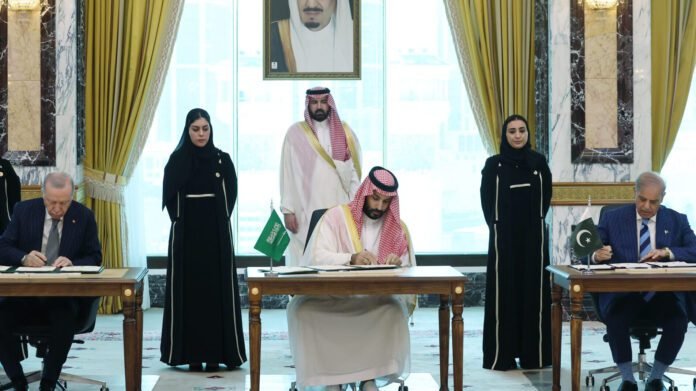
Signed in Mecca by Saudi Crown Prince Mohammed bin Salman, Turkish President Recep Tayyip Erdogan, and Pakistani Prime Minister Shehbaz Sharif, the agreement states that an armed attack against any one of the three countries would be regarded as an attack against all. Its stated goal is to strengthen collective deterrence and expand defense cooperation. 

The three governments have repeatedly insisted that the agreement is defensive and is not directed against any specific country. Turkish and Pakistani officials have also made clear that the framework is open to other states. Erdoğan said at the time of signing that countries seeking regional peace and stability could participate, and Turkish Foreign Minister Hakan Fidan subsequently described the three existing members as the core of a structure that could expand further. 

But beyond the collective defense language, much remains unresolved. The initial joint statement did not specify what military response would be required following an attack, and it was unclear to what extent members would be bound to undertake military action on one another’s behalf. 

That distinction also complicates comparisons with NATO. NATO’s Article 5 considers an attack against one ally an attack against all, but it does not automatically require every ally to deploy troops; each member takes the action it considers necessary. The Mecca agreement is newer, far less institutionalized, and has yet to be tested in a crisis. 

For Mohammad Ali Zafar, a research scholar at the University of Oxford, the importance of the pact is not limited to whether it eventually replicates NATO’s military architecture. 

“The idea of a Muslim NATO-style structure under the Mecca Agreement appears to be gaining momentum among states that want to improve their security arrangements and become better aligned when it comes to a joint response to external aggression,” Zafar told The Media Line. 

“With the Trump administration distancing itself from providing security guarantees to its Middle Eastern partners, with Israel being the main exception, the likely response has been a greater effort among Muslim states to rely on one another for security commitments and develop a comprehensive plan involving diplomatic coordination, the sharing of military expertise, joint defense initiatives and potentially joint defense action,” he said. 

The first potential expansion could come not from another Middle Eastern power, but from South Asia. 

Bangladesh’s State Minister for Foreign Affairs Humayun Kabir said this week that Dhaka had expressed interest in the agreement and was viewing participation positively. 

Adding Bangladesh would bring another major Muslim-majority country to the grouping, while pushing its geographic reach deeper into the Indian Ocean region. But it would also introduce another layer of South Asian competition into an arrangement already containing Pakistan. 

Considering the recent turmoil the country has faced, it seems less likely that Bangladesh would make such a decision immediately

“Bangladesh is an important potential partner for the current members of the Mecca Agreement,” Zafar said. “However, considering the recent turmoil the country has faced, it seems less likely that Bangladesh would make such a decision immediately.” 

In his view, Bangladesh’s entry into an alliance such as the Mecca Agreement could also unsettle India. New Delhi would be wary of Dhaka aligning with Pakistan in a future conflict, especially under a mutual-defense clause that treats an attack on one member as an attack on them all. 

Zafar also questioned whether Dhaka currently has sufficient strategic reason to assume obligations tied to conflicts far from South Asia. “It makes little sense for Dhaka to involve itself directly in these conflicts by joining the Mecca Agreement at the current stage. However, if there is a possibility of Iran and other countries joining the agreement, Bangladesh may reassess the strategic value of becoming a member.” he said. 

Iran is precisely where the enlargement debate becomes more complicated.

Reports over the weekend cited Mehdi Rahimi, head of the Iranian parliament’s news agency, as saying that Tehran had been invited to join and that the proposal was under consideration. But on Aug. 24, Iranian Foreign Ministry spokesperson Esmaeil Baghaei publicly denied that Tehran had received an official invitation. The claim, therefore, remains unconfirmed.

Iranian membership would be qualitatively different from the possible admission of Bangladesh or Egypt. 

The founding governments have insisted that the agreement is not aimed at Tehran. Yet its creation came amid a regional security environment transformed by direct Iranian attacks on Gulf countries and by the wider US-Israel confrontation with Iran. The three founding states share concerns about both Iran’s increasingly assertive military posture and Israel’s regional actions, while officials have rejected portraying the agreement as either an anti-Iranian axis or anti-Israel per se. 

Ali Hosseini, (a pseudonym used to protect his identity), is a researcher at the Iranian Institute for BRI Studies. He argues that Iranian participation would nevertheless run contrary to Tehran’s strategic interests. 

Joining the Mecca Defense Pact is not merely illogical … such a move would paradoxically transform Iran into a more conspicuous and vulnerable target

“Joining the Mecca Defense Pact is not merely illogical; it constitutes a profound strategic miscalculation. Far from generating credible deterrence against Israel, such a move would paradoxically transform Iran into a more conspicuous and vulnerable target,” Hosseini told The Media Line. 

His reading of the agreement differs sharply from the official position of its signatories. While Ankara, Riyadh and Islamabad say the pact targets no particular country, Hosseini views its underlying security logic as substantially shaped by concerns about Iran. 

“The strategic architecture of the Mecca Pact was explicitly conceived as a containment mechanism against Iranian military power,” he said. “For Iran to seek accession to this framework is tantamount to aligning with a coalition structurally predicated on curtailing its own strategic interests.” 

For Hosseini, the fundamental question is not simply whether Tehran would be accepted, but what membership would do to Iran’s freedom to maneuver between competing powers. 

“Iran’s enduring strategic power lies in its multi-vector autonomy—the capacity to navigate between [the] Eastern [Russia and China] and Western blocs while maintaining independent crisis-management leverage,” he said. 

He argued instead that Tehran could benefit from keeping the question of membership diplomatically alive without becoming militarily integrated. “The prudent course of action is to treat the overture regarding this pact as a tactical diplomatic maneuver—an opportunity to test regional reactions, exacerbate intra-Arab divisions, and project an image of openness to dialogue, without ever committing to operational integration,” he argued. 

Zafar reaches a different conclusion. He sees potential Iranian participation as capable of transforming the pact from a narrower security grouping into a significantly broader Muslim framework—but only if major political and strategic differences can first be addressed. 

“Iran joining the agreement would be a positive development,” he said. “However, that would also mean that the Organization of Islamic Cooperation would be a better platform for Muslim states to showcase a joint response to any aggression against Muslim states in the Middle East.”  

Zafar argued that Tehran would need to provide substantial reassurance before existing members accepted the risks associated with collective defense. 

The current members of the Mecca Agreement would prefer not to find themselves drawn into a conflict with the United States over the issue of Iran

“The current members of the Mecca Agreement would prefer not to find themselves drawn into a conflict with the United States over the issue of Iran,” he said. “Therefore, while Iranian membership could fundamentally change the character of the agreement, it would require considerable reassurance from Tehran before the existing members would be comfortable with such an arrangement.” 

That tension illustrates the pact’s central contradiction. Enlargement could increase its strategic weight, but every additional member also introduces new adversaries, obligations, and competing relationships. 

Egypt presents perhaps the clearest example. Egyptian Foreign Minister Badr Abdelatty has confirmed that Cairo is seriously studying membership, saying the issue requires a comprehensive review of Egypt’s constitutional and legal obligations. 

Ofir Winter, a senior researcher at the Institute for National Security Studies (INSS) and Tel Aviv University, said Egypt’s hesitation reflects unanswered questions about precisely whom the agreement is supposed to deter and what military commitments membership would create. “Egypt is still considering whether to join and is looking at the real significance of the agreement and what commitments it would entail,” Winter told The Media Line. 

“There are many open questions, especially whether this defense alliance is directed against anyone, and if so, against whom. Is it supposed to deter Israel, Iran, or both? There are also questions about what military commitments are included in the alliance,” he added. 

Cairo must balance particularly complex relationships. It maintains a peace treaty with Israel, increasingly important ties with Turkey, long-standing connections with Saudi Arabia and the UAE, and strategic relations with countries including India. 

Egypt does not want to choose one regional camp at the expense of another

Winter said that this helps explain Egypt’s preference for diplomatic coordination without automatically translating that cooperation into a military bloc. “Egypt does not want to choose one regional camp at the expense of another,” he said. “It wants to maintain its own neutral position and preserve good relations not only with Israel, but also with Greece and Cyprus, without becoming too closely aligned with Turkey.” 

There is also a legal dimension. Article VI of the 1979 Egypt-Israel peace treaty states that neither party should enter obligations conflicting with the treaty and that, subject to the UN Charter, treaty obligations prevail where a conflict with other obligations arises.

Winter argued that Egyptian officials would therefore have to examine carefully whether a new collective defense commitment could theoretically oblige Cairo to act against Israel in a conflict involving another Mecca Pact member. 

From Israel’s perspective, Winter said, Turkey remains the most important variable. “I think the main Israeli concern is Turkey, because we hear the discourse and declarations of President Erdogan, his traditional support for the Muslim Brotherhood, and Turkey’s close relations with the new Syrian regime, which has its own Islamist and jihadist roots,” he said. 

“When Turkey becomes part of a regional alliance, this naturally creates concerns in Israel,” he noted. 


When Turkey becomes part of a regional alliance, this naturally creates concerns in Israel

But Winter also identified a broader risk for Israel: that tensions with Israel could become one of the few issues capable of drawing otherwise competing regional actors closer together. “I think Israel is following the consolidation of these new regional axes and looking at how they could affect its own security, since it is the opposite of what the Abraham Accords stood for.” 

For Pakistan, meanwhile, enlargement offers a different opportunity. 

Islamabad already sits geographically outside the traditional Middle East while maintaining deep military ties with Saudi Arabia, close defense relations with Turkey, and diplomatic channels with Iran. Zafar sees that position as potentially transforming Pakistan from a primarily South Asian power into a cross-regional actor. “The broader objective, in my view, is not simply military cooperation, but greater strategic agency and influence across South Asia and the Middle East,” he said, adding that Pakistan is increasingly positioning itself as a middle power capable of engaging multiple, often competing, centers of power.” 

From Zafar’s perspective, the pact could simultaneously be read differently in Beijing and Washington. “China and the US may both welcome greater security cooperation among regional partners, although for different reasons. China is likely to see this as contributing to a more multipolar regional order, while Washington may value greater regional burden-sharing but remain cautious about any arrangement that reduces its strategic leverage.” 

That interpretation broadly fits one important aspect of current US policy. President Trump has consistently demanded greater defense burden-sharing from American allies, and the White House has described its evolving NATO strategy as one of greater allied self-reliance. The administration has also explicitly made increasing its partners’ ability to meet defense requirements without sustained US support part of its foreign military sales policy. 

President Trump welcomed the Mecca agreement on Aug. 17, portraying it as a step toward regional countries becoming better able to defend themselves. 

That does not necessarily mean Washington wants to withdraw from Middle Eastern security entirely. The United States retains military bases, defense partnerships, and major arms relationships across the region. But the agreement fits a broader push for partners to assume greater responsibility while the United States retains influence through arms sales, intelligence, diplomacy and strategic partnerships. 

“The Mecca Agreement is broadly the kind of arrangement that the Trump administration has been encouraging Middle Eastern states to develop,” Zafar said. “I therefore see the agreement as something that could be supported—or at least encouraged—by Washington, particularly if it allows regional states to take greater responsibility for their own security while reducing the burden on the United States.” 

For now, the Mecca Pact remains more an emerging architecture than a mature alliance. 

Winter remains cautious about assuming that the political declaration will automatically translate into military action. “But if countries such as Egypt, or other regional powers, join this alliance, and if there is any further escalation with Turkey or with other members that could eventually be included, such as Syria, that could have complex implications for regional dynamics and for Israel especially,” he said. 

That may ultimately be the most important challenge surrounding the agreement. 

If enlargement stops with states already broadly aligned with Saudi Arabia, Turkey and Pakistan, the pact could consolidate a new but relatively flexible regional security network. If countries such as Bangladesh and Egypt join, its geography and diplomatic reach would expand substantially. 

Iranian accession would represent something more profound: it could blur the lines between rival camps and turn what many currently interpret as a balancing mechanism into a broader regional collective-security project. But the contradictory reports from Tehran, continuing mistrust among regional actors, and uncertainty surrounding the pact’s actual military obligations show how distant that scenario remains. 

For now, the Mecca Pact’s significance lies as much in the interest it is generating as in the commitments already written into it. Its first real test may therefore not be an external attack, but whether three states with different threat perceptions can expand their alliance without importing so many competing interests that collective defense becomes harder, rather than easier, to define. 



Anthropic’s new hardware standard lets AI agents control the physical world

0
anthropic’s-new-hardware-standard-lets-ai-agents-control-the-physical-world
Anthropic’s new hardware standard lets AI agents control the physical world

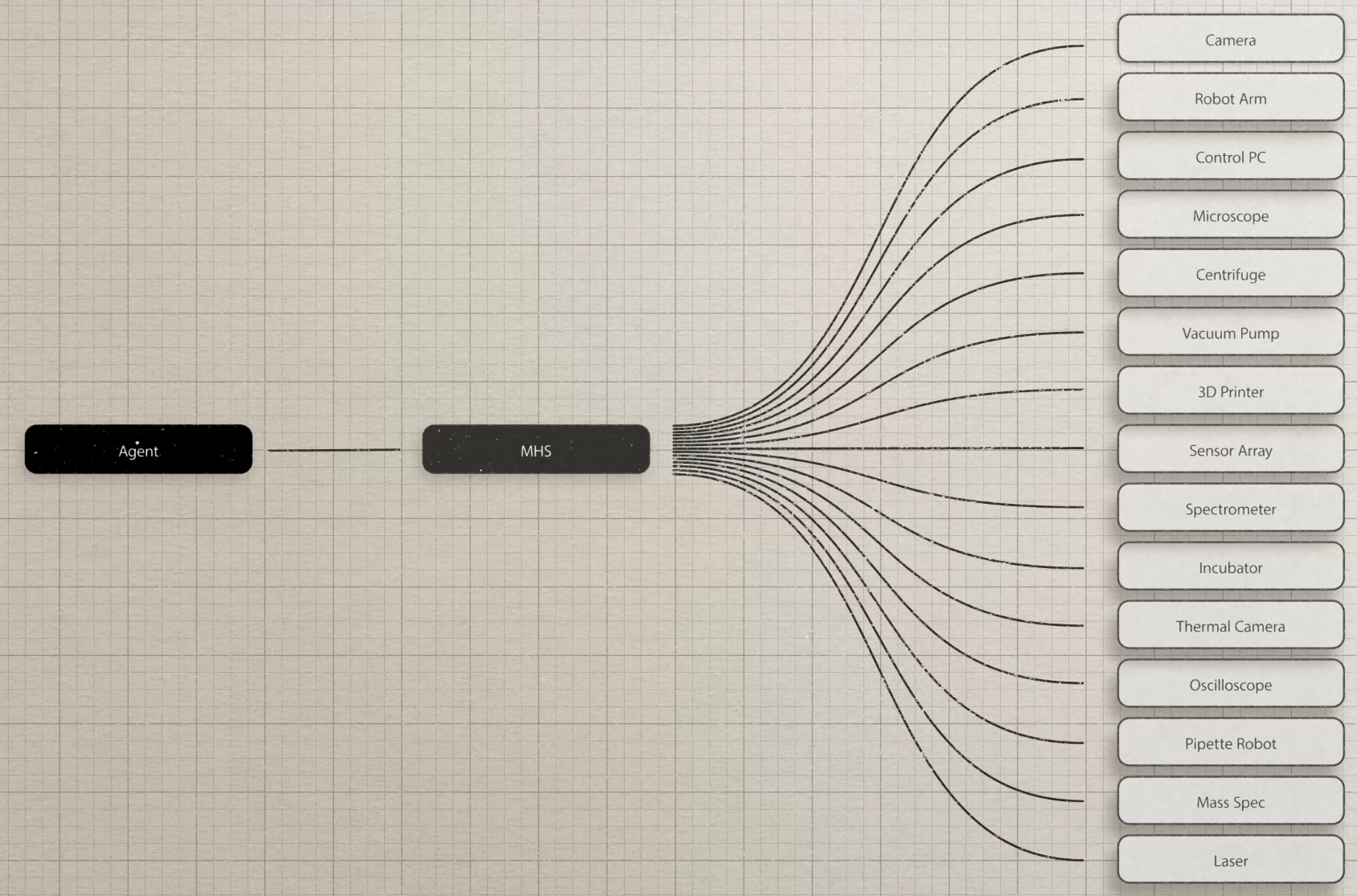
For all the interest in and uptake of agentic AI systems over the past year or so, the world of automated AI has thus far been primarily limited to text, images, code, and other data and actions that take place inside a computer. Anthropic is now aiming to change that somewhat with what it’s calling the Model Hardware Standard (MHS), a set of standardized drivers designed to let AI agents easily interface with and control arbitrary devices.

For now, the “research preview” of the MHS effort is being sold mainly as a way to help scientists streamline the arduous process of creating the custom software integrations that are often needed to get disparate components of an experiment working in concert. MHS can provide a common interface and common format for data sharing between these devices, Anthropic says, allowing them to talk to each other across a network “without needing a bespoke ‘translator’ program in between.” The standardized system could reduce weeks or months of exacting experimental setup down to “hours or minutes,” Anthropic writes.

An Anthropic graphic illustrating how MHS serves as a “translation” layer between AI agents and multiple types of devices.

An Anthropic graphic illustrating how MHS serves as a “translation” layer between AI agents and multiple types of devices. Credit: Anthropic

In a video posted alongside the announcement, Anthropic Technical Staffer Alek Kemeny says the MHS effort was inspired by observing neuroscientist Arco Bast work through an experiment on memory formation in the brain at the HHMI Janelia Research Campus in Ashburn, Virginia. Kemeny said Bast had worked out an interface to get the rotating laser beams, microscopes, cameras, and myriad other components of the experiment to coordinate through a common interface. “This idea could be used to have AI run any science experiment in the world,” Kemeny recalls thinking at the time.

Your new robotic lab assistant?

There’s nothing about a common machine interface language that requires the use of AI models, of course. And Anthropic says MHS devices can be controlled directly in real time via command-line prompts and API code files. But integrating an MHS system with an AI model through the Model Context Protocol lets scientists interact with devices using natural language, and lets models “reason through each step in an experiment, update parameters in real time, and, in some cases, recover from hardware errors without intervention,” Anthropic writes.

Anthropic gave the example of a model like Claude adjusting a laser, checking the results via a separate camera, then repeating the process to automatically calibrate the whole system. MHS could also allow an AI model to focus a microscope, analyze the results, decide what part needs more observation, then automatically move the microscope to the relevant section to continue the experiment.

In a video, Anthropic also showed Claude reasoning how to get a robotic arm to pick up an aluminum can even though it had not been specifically trained on the required steps. And rather than reasoning through each step each time, Anthropic says MHS-enabled models can sequence steps across instruments by writing API scripts and adjusting them as conditions require.

Anthropic introduces MHS in a promo video

Anthropic says MHS also includes a standardized tagging system to describe hardware’s real-world constraints for models that may have been trained more in the virtual world. That includes encoded information about the hardware’s physical characteristics (e.g., the weight and range of a robot arm) as well as its adjustable parameters, measurement options, and enforced safety limits. These tags can then be integrated into a reference file that can quickly provide an AI model with crucial information about a device it has no previous training experience with.

For now, Anthropic says it is working with “a first group of scientific research labs and advanced manufacturers” during an MHS preview period, including Amazon Web Services (Strands Robots), Hugging Face (LeRobot), Raspberry Pi, Automata, and Universal Robots. These partners will help Anthropic “build safety evaluations and develop best practices for AI systems operating physical equipment,” the company writes. After that, the plan is for MHS to eventually become an open source and “agent agnostic” standard for integrating AI and physical systems.

In early testing with scientific partners over the last year, Anthropic says it “saw MHS reduce the time it took to integrate devices, mak[ing] it possible to iterate faster in a variety of experimental settings.”

“If you can test hypotheses faster, you could create general technologies faster,” Kemeny said in a promo video alongside the announcement. “This is how a century of progress can condense into a decade.”

USS Abraham Lincoln fiasco demands a congressional probe

0
uss-abraham-lincoln-fiasco-demands-a-congressional-probe
USS Abraham Lincoln fiasco demands a congressional probe

The USS Abraham Lincoln is coming home from the Iran war. Image: X Screengrab

The USS Abraham Lincoln is on its way home. This is welcome news after hearing of its abhorrent conditions.

Yet, the situation lived by sailors and Marines aboard the carrier over the last nine months, the continued threats that troops still deployed in this unpopular war face, and the unpatriotic negligence both the president and members of his own party have demonstrated paint a grim, but unsurprising picture of how service members are treated under this administration.

Donald Trump is the most hostile president to troops and veterans in modern American history. Look no further than his comments about the service members who have been at sea for more than 250 days—that they have not been deployed “nearly long enough”—or House Republicans parroting that line back to reporters. That’s how this administration treats its military members, and it should be a wake-up call for every American.

Yes, the USS Abraham Lincoln is on its way home, but with the USS George Washington replacing it, how many more troops must suffer until we end this forever war? That is why veterans of Common Defense, like myself, are demanding a full-scale congressional investigation into this case. More than 4,000 of our members and their families agree: This can never happen again, and the war against Iran needs to end.

The war these carriers are supporting has already killed at least 18 US service members and wounded roughly 500 more, alongside thousands of Iranian civilians killed. As an Iraq veteran, I’ve come to understand the costs of war begin long before the first shot is fired. Diplomacy is what keeps the world safe, and certainly not bombs that pad shareholder value at the expense of service members and military families, who have everything to lose.

The USS Lincoln is carrying 5,000 sailors and Marines, 5,000 souls who have touched communities far and wide throughout our nation. They’ve played in our little leagues, attended school dances, walked college campuses and have full lives waiting for them at home.

Whatever reason each of them had for raising their right hand, that oath reflects a rare kind of commitment — to a mission, and to a country they intend to keep giving back to. War is the price many military families pay, and veterans carry its scars, visible and invisible, long after they take off the uniform. It is time for this administration to uphold its end of that bargain.

Instead, this White House has gutted the Department of Veterans Affairs (VA); sent troops to a highly unpopular, illegal, unjust war; and used the military as a political prop. None of that improves troops’ or veterans’ lives. What would actually improve their lives? Ending the war, investigating what happened on the USS Lincoln, expanding the VA instead of hollowing it out, and making sure military and working families can actually thrive.

As the USS Lincoln returns home, it’s worth remembering what most Americans already sense: War doesn’t accomplish what makes a life worth living. It doesn’t keep your family safe, cover your healthcare, give you a good-paying job, or protect the freedoms our Constitution promises.

That’s why most Americans oppose the war with Iran. Yet, we’re all paying for it—in a cost of living already at historic highs, in gas prices, and in the roughly $1,000 per household experts say Trump’s decision to go to war has cost every one of us.

The more hawkish members of his party will argue that this is part of the mission: to spread freedom and to contain Iran’s power. So ask them if a foreign adversary starved its own troops, kept them at sea for nearly a year, and left them in cramped showers and broken toilets, how would Washington react?

We already know the answer. These very politicians would be first in line, demanding that America intervene. What our service members experienced on the USS Lincoln is abysmal and should infuriate every single American whose tax dollars are funding Donald Trump’s war.

Let’s not forget this was a choice made by Trump’s hostile administration and enabled by its congressional allies. Lawmakers must demand a full-scale investigation into what happened aboard the USS Abraham Lincoln, so it never happens again.

Veterans and military families see clearly how failed leaders and politicians who carry every whim of the president’s disastrous war put our troops in danger. We must demand an investigation now — and we won’t stop until this country ends its forever wars.

Naveed Shah is a US Army veteran who served in Iraq and political director of the veterans organization Common Defense.

– Common Dreams

GOP heads to Supreme Court after losing case over TV election ad prices

0
gop-heads-to-supreme-court-after-losing-case-over-tv-election-ad-prices
GOP heads to Supreme Court after losing case over TV election ad prices

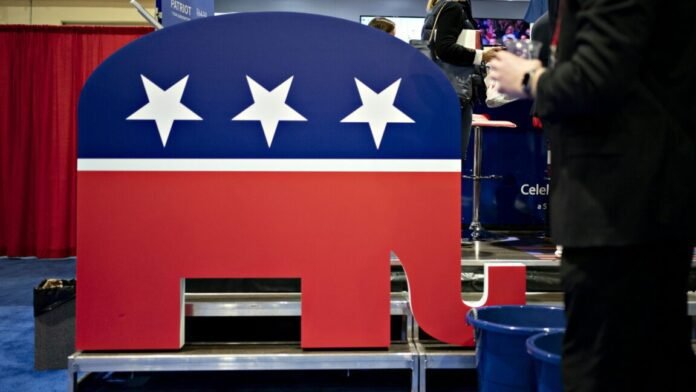
Republican campaign committees want the Supreme Court to mandate lower prices for election commercials on broadcast TV stations. If the court agrees, broadcasters would be forced to offer their lowest ad prices to political parties and joint fundraising committees.

For a more thorough description of the legal issues in the dispute, see this article that Ars published yesterday. In short, US law requires broadcasters to offer individual candidates the “lowest unit charge,” or LUC, during the 60 days before an election. The law helps level the playing field somewhat by letting candidates make their cases to voters who watch broadcast TV without needing to raise exorbitant sums of money.

The Trump administration, acting through the Federal Communications Commission, ordered broadcast TV stations to also give these discounts to political parties and joint fundraising committees, which face fewer limits on how much money they can raise and spend. Four Democratic candidates appealed, and a judges’ panel at the US Court of Appeals for the 4th Circuit ruled that the FCC order cannot be enforced because it contradicts the plain language of US law.

The National Republican Congressional Committee and National Republican Senatorial Committee, which intervened in the case to support the FCC’s position, told the 4th Circuit court yesterday that they intend to appeal to the Supreme Court.

GOP seeks quick rulings

The committees submitted an emergency motion for a stay and asked the 4th Circuit to rule on that motion immediately so they can file a petition to the Supreme Court. “Intervenors respectfully request that the Court rule on this stay motion as soon as possible—whether by expediting or waiving response briefs—to permit Intervenors to seek emergency relief at the Supreme Court,” Republican committees told the court.

The court responded quickly, issuing an order today to deny the Republican committee’s motion and to immediately issue a mandate that can be appealed to the Supreme Court. Republicans will now seek swift action from the Supreme Court in an attempt to overturn the 4th Circuit ruling before the 60-day discount period starts on September 4.

“Candidates and committees are currently drafting, negotiating, and signing contracts with broadcasters for the coming weeks,” the motion said. “In fact, candidates and committees are currently creating the advertisements for the contracts that they’ve already signed with broadcasters. The parties need certainty on those contracts to move forward and conduct effective campaigns.”

In another recent case filed by the National Republican Senatorial Committee, the Supreme Court ruled that federal limits on how much a political party can spend in coordination with candidates violates the First Amendment. The elimination of those limits could fuel a bigger onslaught of election ads if broadcasters are forced to offer their lowest ad rates to parties and committees.

“Flood of coordinated campaign money” into TV ads

Anna Gomez, the only Democrat on the FCC, said the agency “is unleashing a flood of coordinated campaign money into broadcast advertising, just as the Supreme Court has cleared the way for unlimited coordinated spending between parties and candidates.” Gomez also said that forcing broadcast stations to offer deep discounts on their most valuable ad inventory will worsen the stations’ financial problems, contradicting the Trump FCC’s stated goal of helping broadcasters compete against Big Tech and streaming.

FCC Chairman Brendan Carr has pushed for bigger broadcast mergers, claiming they are needed to help stations invest in local news. To accomplish that goal, he led a vote to eliminate a rule prohibiting any single broadcast station owner from reaching more than 39 percent of all TV households in the US. The FCC repealed this ownership rule even though the 39 percent figure was specified by Congress in a 2004 law, paving the way for another court battle over the limits of FCC authority.

From a legal perspective, all the cases are decided based on interpretations of what Congress meant when it put specific words and phrases into US law. In the law related to the TV advertisement case, the sides disagree over the meaning of “the use of any broadcasting station by any person who is a legally qualified candidate for any public office in connection with his campaign.”

The legal question is whether “use… by” a candidate can refer to ad time purchased on a candidate’s behalf by parties and joint fundraising committees. In the 4th Circuit case, two judges appointed by Democratic presidents ruled that the FCC’s interpretation of the law was wrong, and one judge appointed by a Republican president said the FCC got it right.

GOP has reason for optimism

A potential problem for Republicans is that the FCC position contradicts agency guidance from 1991 and a statement made to the Supreme Court last year by the Trump administration’s own solicitor general. In the recent Supreme Court case over spending limits, US Solicitor General John Sauer wrote in a filing that the “rules require broadcasters to charge low rates for candidate spending, but not for party spending—whether coordinated or independent.”

But Republicans have reason for optimism given the conservative makeup of the Supreme Court and the 4th Circuit dissent from Judge J. Harvie Wilkinson III, a Reagan appointee who argued that the FCC offered a “natural and plausible” interpretation of the law’s reference to “use… by” a candidate. The FCC welcomed the dissent, issuing a statement praising “Wilkinson’s sound and thoughtful analysis.”

Republicans further argue that courts have no jurisdiction yet because the FCC hasn’t made a “final” decision. The 4th Circuit judges decided they have jurisdiction because the FCC’s failure to act on a petition filed by Democratic candidates amounted to a “constructive denial.”

Wilkinson disagreed on that count, too, saying the FCC guidance is not a final order because the FCC is still reviewing the candidates’ application. If the Supreme Court does act quickly in the GOP’s favor, it could stay the 4th Circuit court mandate on the grounds that the FCC order isn’t final and can’t be appealed yet.

The Republican committees told the 4th Circuit to be wary of recent Supreme Court guidance. “Just two days ago, the Supreme Court reminded lower courts that they should not interfere with agency decision-making before it is final,” they wrote, referring to a ruling in Trump’s favor on vote-by-mail restrictions. “This Court should heed that instruction, and stay its order (or the mandate) pending a writ of certiorari to the Supreme Court.”

Samsung Ordered to Pay $11.6m to Swatch Over Smartwatch Apps

0
samsung-ordered-to-pay-$11.6m-to-swatch-over-smartwatch-apps
Samsung Ordered to Pay $11.6m to Swatch Over Smartwatch Apps


Samsung has been ordered to pay Swatch Group $11.6 million after London’s High Court found that digital watch faces available through its app store infringed trademarks belonging to the Swiss watchmaker.

The case involved apps that mimicked designs associated with brands including Omega, Longines, Tissot, Breguet and Blancpain. Swatch had sought around $170 million in damages, while Samsung argued that compensation should be limited to a nominal $300.

Most of the award, amounting to $10 million, related to the display of Swatch brand names on Samsung’s Galaxy app store. The judge said the availability of low-cost or free digital copies was damaging to the value and exclusivity of the luxury brands, comparing the app store to a physical retailer displaying copycat products on its shelves.

The apps were created by third-party developers and downloaded around 160,000 times in the UK and EU. However, Samsung was found liable because it controlled the app review process and promoted smartwatch faces.

Samsung said it was considering all possible countermeasures, including an appeal. Swatch said the ruling recognised the scale and significance of the infringements. Separate proceedings in the United States remain on hold pending developments in England.

via FT

Climate disasters are ravaging government budgets – aid works best when paid upfront

0
climate-disasters-are-ravaging-government-budgets-–-aid-works-best-when-paid-upfront
Climate disasters are ravaging government budgets – aid works best when paid upfront

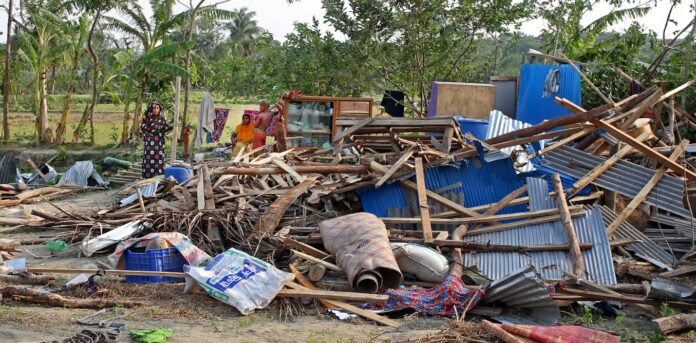
When a cyclone destroyed Chompa Munda’s home in coastal Bangladesh in 2019, she and her son went days without food. When the next one came in 2024, her phone lit up hours before it made landfall.

A US$43 (£31) transfer was sent straight to her bank account because a weather forecast had crossed an agreed threshold. She bought food, drinking water and candles, and left for a storm shelter.

Cyclone Remal still flooded her house, but the money had already arrived. The leftover funds helped her rebuild. Funding was released a day before the storm hit, meaning 150,000 people had cash in hand. No appeal, no assessment, no waiting for anyone to decide.

The same idea is now being tried with entire national budgets.


Read more: Climate disasters will send many countries into a debt spiral – but there’s a way out


Jamaica has been through the same two-storm sequence. Hurricane Beryl struck in July 2024, causing damage worth 1.9% of GDP. It was the third most destructive storm to hit the island in 25 years. The country had prepared, with a catastrophe bond, insurance and loans. The insurance paid out to the tune of US$26.9 million. The bond paid nothing at all. Had Beryl run 15km further north, it would have released US$45 million in bonds, but the storm passed just south and the threshold went unmet.

Sixteen months later came Hurricane Melissa, the strongest ever recorded to hit Jamaica, hitting more than 40% of GDP. Within days, the government mobilised US$662 million in liquidity from national reserve funds, Caribbean parametric insurance, a catastrophe bond plus contingent facilities from the World Bank and the Inter-American Development Bank, arranged long beforehand. The difference between Beryl and Melissa was disaster risk finance working in a system at scale. Melissa was severe enough to trigger all of it at once.


Read more: Nepal-Tibet floods: when disaster strikes before communities recover from previous climate extremes, crisis escalates


Why disasters get more expensive

Climate damage destroys capital and cuts labour productivity, so tax revenue falls at exactly the moment recovery spending rises. That threatens debt sustainability. Lenders respond the way banks do to any risky borrower, by charging more.

Using vulnerability indices of the kind I helped build with Jeff Schlegelmilch, director of the US National Center for Disaster Preparedness, researchers have found that as a country’s exposure rises, so does the interest it pays. Investing in resilience brings that cost back down.

The obstacle is politics. As University of Oxford economists articulated in a 2016 book, ministers who plan ahead get no credit for it. There is also a trade-off: thresholds are absolute, so a storm falling just below the line pays nothing. And it works far better for floods and cyclones, which arrive on a timetable, than for droughts.

Recent flash floods on the Nepal-Tibet border, which killed dozens and left hundreds missing, appear to have been triggered by an avalanche of ice and rock rather than by rain. A cyclone can be forecast. For a landslide or glacial collapse on a mountainside, forecasting is more complex; it is tricky to design a threshold for this to move money quickly. Though, there have been calls for stronger early-warning systems.

family of four bangladeshi people holding bags escaping cyclone

A family escape to a temporary storm shelter in Bagerhat, Bangladesh in November 2019 as Cyclone Bulbul nears the coast. Sk Hasan Ali/Shutterstock

What preparation buys

Post-hurricane Melissa, Jamaica secured US$6.7 billion for reconstruction on concessional terms. The Jamaica Red Cross became the first national society in the Americas to release money before landfall through a disaster fund. Moody’s (a global financial and risk assessment company) upgraded Jamaica’s sovereign rating in the months after the hurricane, citing the country’s institutional strength and its disaster financing. Public debt in small states typically rises by 6% of GDP after a disaster; Jamaica went the other way.

The Philippines is the world’s most disaster-exposed country. In late 2024, six cyclones struck within a month. This triggered the first activation of its forecast-based financing system, releasing funds within minutes of the thresholds being met, and 72 hours before landfall. This system was written into law.

In September 2025, the Philippines passed a state of imminent disaster law, a world first in legislating anticipatory action. Two months later, three days before Typhoon Uwan made landfall, the threshold was met, and the system worked. The decision was not political. It didn’t depend on a minister’s judgment call as the storm approached. A total of 42,100 families received cash before the typhoon made landfall and the number of casualties remained low.

Pricing a disaster that didn’t happen

Damage is counted directly. After Hurricane Melissa, assessors tallied roofs, hospitals and ruined farmland. Damage is easy to count. Avoided loss is not. It is the gap between what happened and what would have happened had the money come later, or not at all. Economists call the missing comparison a “counterfactual”. This is a central problem in economics.

When Bangladesh moved from responding 100 days after a flood to acting 48 hours before, at half the cost, that was a comparable before-and-after. The fiscal and financial counterfactual is far harder, because no country is hit by the same storm twice.

Jamaica’s credit upgrade is suggestive rather than conclusive. Beryl and Melissa were different storms, 16 months apart. Most avoided-loss figures are modelled rather than observed. The best we have is counting returns on adaptation investment. Adaptation, put simply, is preparing for and adapting to the expected impacts of climate change. According to research from the London School of Economics, that is more cost effective, at around five dollars for every dollar spent in lower-income countries.

The evidence we have stops too early. Household studies of early action are rigorous but short – the largest review found none following families beyond six months. Fiscal returns take longer to show up. It can be three years before benefits exceed costs, with effects on borrowing continuing until 2050. Between early action and fiscal analysis lies a window for climate resilience that nobody measures. That’s the focus of my work and doctoral studies.

This explains why pre-arranged financing (finance paid in advance) was only 1.2% of all crisis financing in 2023 according to the Centre for Disaster Protection.

The Sevilla Platform for Action is a campaign to reform how lenders treat climate-vulnerable countries aims to scale pre-arranged financing to 20% of total disaster financing by 2035.

When governments meet at the UN’s climate summit in Turkiye this November, a core debate will be about how large the climate finance pot should be and when that money should arrive.

Galápagos corals show El Niño events are more extreme now than in past 1,000 years – here’s how my team made the discovery

0
galapagos-corals-show-el-nino-events-are-more-extreme-now-than-in-past-1,000-years-–-here’s-how-my-team-made-the-discovery
Galápagos corals show El Niño events are more extreme now than in past 1,000 years – here’s how my team made the discovery

Temperatures have warmed dramatically across the equatorial Pacific Ocean in 2026, signaling the onset of a strong and potentially historic El Niño. These events can affect weather around the world, and the intensity of recent El Niño events is raising alarm that, as global temperatures rise, they are becoming stronger and more destructive.

To understand how these climate patterns are changing, we need to understand what happened during El Niño events in the past, but observations go back only a few decades. So, my colleagues and I went to the Galápagos Islands – at the heart of the El Niño pattern – to find answers from some of nature’s best record keepers: corals.

In records preserved by living and ancient fossil corals, we found that, on average, El Niño events have been stronger in the past 40 years than at any time in the past millennium, with higher temperatures that lead to more powerful effects on weather.

That intensification also coincides with human-caused global warming.

Our results, just published in the journal Science, suggest that the 1982-83 and 1997-98 El Niños – two of the strongest in recent memory – may be harbingers of more extreme events to come as the planet warms.

A chart shows rising global temperatures and El Niño conditions over time.

Our World in Data, CC BY

El Niño comes for the Galapagos

One of the strongest El Niños hit in 1982, with devastating consequences for the Galápagos Islands. It triggered a marine heat wave that reverberated through one of the most distinctive and unspoiled ecosystems on the planet.

Exceptionally warm surface water blocked the usual upwelling of cool, nutrient-rich water that fuels the food chain for marine life. The result ravaged communities that rely on the ocean – fish, birds, marine mammals, and people who fish for their livelihoods throughout the eastern tropical Pacific. In the extraordinary heat, more than 95% of Galápagos corals died.

The heat wave was caused by an exceptionally strong El Niño event, part of a climate pattern that begins in the eastern tropical Pacific Ocean, around the Galápagos Islands, as the trade winds shift. El Niño’s warm ocean water alters the atmospheric circulation above, diverting storm tracks and changing patterns of floods, droughts and tropical storms around the globe.

Fish swim over a expanses of corals.

The Galápagos Islands are known for their astounding marine biodiversity, a result of high nutrients and the mixing of cool and warm waters. Greg Asner/DivePhoto.org

The 1982-83 El Niño contributed to climate extremes worldwide, from flooding in Kenya and Peru to drought in Indonesia and Brazil, costing the global economy as much as US$4 trillion by some estimates. A similarly strong El Niño in 1997-98 resulted in 23,000 deaths from disease and climate disasters.

But we wanted to know: Are such powerful El Niño events unusual in the context of history?

Even in 1983, scientists were surprised to find that such a strong event had been underway. Historical records of El Niño are sparse before the era of satellite observations. Fortunately, long-lived corals growing in the tropical Pacific can provide a history of El Niño that extends our view into the past.

How corals record history

As corals grow, they preserve a record of local ocean temperatures over time. In the Galápagos, because of their location, that record reveals the history of El Niño events and of their cooler counterpart, La Niña.

Like trees that produce annual growth rings, corals add skeletal layers of calcium carbonate year after year. The alternating bands of higher and lower density reveal changes in the coral’s growth rate during each year and can serve as a timekeeper. The history of the ocean temperature is embedded in the chemical composition of the skeleton itself.

To track the history of water temperatures, we measured two chemical parameters – the ratio of heavy to light oxygen isotopes and the ratio of strontium to calcium – both of which reflect the seawater temperature in which the coral grew.

Three maps showing temperature differences in the difference phases: neutral, El Niño and La Niña

Three sea surface temperature maps show how Pacific Ocean temperatures change between El Niño, La Niña and neutral patterns. The Galápagos Islands are within the small black circle. During El Niño, trade winds weaken, suppressing the upwelling of cool water and allowing temperatures to rise. Temperatures are in Celsius. NOAA

In the Galápagos, because of the islands’ location, the sea surface temperature swings between warm El Niño years and colder La Niña years, when upwelling of nutrients is stronger.

Illustration shows upwelling

The Galápagos Islands sit in a region of strong upwelling, where nutrient-rich deep waters rise to the surface. This upwelling results from a combination of the local trade winds and the surfacing of a deep current as it collides with the islands’ mass. The nutrients fuel phytoplankton blooms that provide food for fish, birds and other marine life. Julia Cole, based on original illustration by the Woods Hole Oceanographic Institution

Two maps show very low phytoplankton activity at the end of an El Niño and high again during La Niña.

Satellite images of phytoplankton around the Galápagos Islands show how exceptionally warm El Niño events, left, reduce the upwelling of nutrients that phytoplankton need, compared to more normal conditions, right, a few months later. NOAA Climate.gov, based on SeaWiFS data provided by Norm Kuring, NASA GSFC

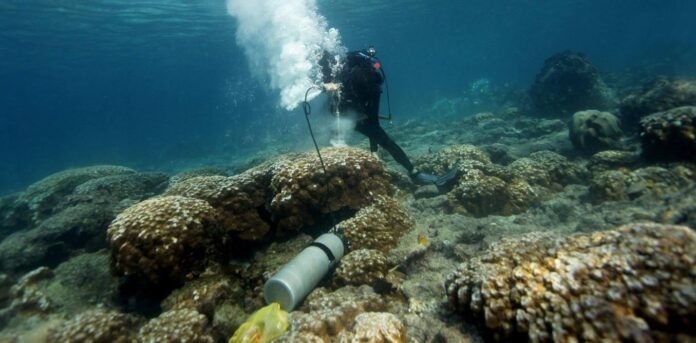
The largest living corals in the Galápagos grow in the northern islands of Wolf and Darwin, in water 20 to 50 feet deep. To study their history, we dived down and took core samples from long-lived corals, some 8 to 10 feet tall.

Every core we drilled from a living coral showed evidence in its calcified skeleton that the coral had suffered during the 1982-83 El Niño event. We saw obvious “death horizons” – dense layers of calcified material produced by other reef organisms such as algae, gastropods and barnacles interrupting the lattice of the skeleton.

A CT image, left, and photo, right, of a section of coral from Wolf Island shows the ‘death horizon,’ when extreme heat bleached and then killed the corals living there. The coral colony later regrew over the dead surface.

We also took samples of fossil corals around the archipelago – mostly dead coral boulders found along the islands’ shorelines. Radiometric dating told us that these fossil corals were up to 4,500 years old. Those samples provide an even deeper view of El Niño’s history.

Back in the lab, we sliced the coral cores lengthwise into slabs and used a drill to extract powdered samples, each representing about one month’s growth, along a path from youngest to oldest. We analyzed the geochemistry of each sample. In the chemical ratios from thousands of samples, we found seasonal cycles spanning many decades and exceptional warm and cold years that revealed a unique history of El Niño and La Niña events.

A large fossil on land.

The Galápagos Islands have many large fossil corals that preserve temperature histories going back millennia. Gerald and Buff Corsi © California Academy of Sciences

A flat surface that looks like rock with clear growth bands that look like tree rings.

A fossil coral in the field shows annual growth bands. Julia Cole

A history of ENSO through time emerges

Our data show clearly that the strength of the El Niño-Southern Oscillation has intensified as global temperatures have warmed.

The chemistry of the corals revealed that El Niño events from the past 40 years were stronger than at any other time sampled in the past millennium.

The coral data aligns with ocean temperatures measured from thermometers over the past century. But the coral records extend much further back in time, providing long-term context to show that modern El Niño events are more extreme than before the industrial era began.

A line chart shows El Niño and La Niña strength changes over time.

The study found that the strength of El Niño or La Niña paralleled global temperature change over the past millennium. The strength, measured by coral geochemistry, is indicated by the colored circles and triangles: The colors denote the island location, and the shape indicates the type of geochemistry used. Triangles show results derived from the ratio of strontium to calcium, and circles show results from the ratio of oxygen isotopes. The red line indicates the global temperature estimated from other paleoclimate data. Coral data is plotted as the standard deviation of reconstructed Galápagos temperature on left axis, and global temperature data is plotted as deviations from the 1961-1990 average on the right axis. Julia Cole

The El Niño intensification we observed, starting in the mid- to late 20th century, is also greater than what nearly all climate models suggest would result from natural causes. It appears to be closely connected to human-caused global warming – a conclusion in line with expectations from most climate models.

Not all models anticipate El Niños strengthening as the climate warms, but our data shows that unusual strengthening has accompanied recent warming – an association that may allow scientists to identify models that most closely track observations.

Looking ahead

A stronger El Niño-Southern Oscillation means more intense and damaging climate extremes across the globe. If humanity can anticipate those hazards, we can prepare and perhaps avoid the worst damage.

Fortunately, scientists understand enough about El Niño and La Niña events today to be able to forecast them up to a year in advance. But such predictions depend on continuous, careful climate measurements from satellites and buoys across the remote tropical Pacific, coupled with continuous improvements in climate modeling and forecasting capabilities.

Those capabilities are now more important than ever as global warming accelerates.

‘Starwashing’: The new space race has an environmental problem

0
‘starwashing’:-the-new-space-race-has-an-environmental-problem
‘Starwashing’: The new space race has an environmental problem

As artificial intelligence devours more land and electricity, a new breed of tech companies promises that outer space holds the solutions to our problems on Earth. If data centers are so hard to find a place for down here, why not put them hundreds of miles above the planet instead? Since power demand surges in the evening, why not send tens of thousands of mirrors into orbit to shine sunlight down on demand, powering solar farms after sunset? 

These ideas might sound far-fetched, but they are real proposals from Elon Musk, Jeff Bezos, and start-ups in the space industry. As private industry drives the new “space race,” now launching more rockets than countries do, even the cosmos is starting to feel a bit crowded. A growing amount of so-called “space junk” has led to concerns that all the metal could collide, creating a destructive layer of debris that anything launching into orbit would have to contend with. Earlier this month, part of a discarded SpaceX rocket unintentionally slammed into the moon at 5,400 miles per hour, blasting a new crater.

As Musk’s SpaceX, Bezos’ Blue Origin, and other companies expand into space, they risk causing more problems for Earth in the process: air pollution, climate effects, and light pollution. The practice of downplaying these negative consequences while trumpeting the message that space operations can make life better on Earth has a new name: “starwashing,” a term the space researcher Melissa E. Yingling helped popularize in an article published in The Conversation earlier this month. 

It’s a play on the term “greenwashing,” used to critique companies that highlight small sustainable investments to divert attention from the pollution their businesses cause. Space companies are appealing to a sense of “cosmic wonder” and making promises to benefit humankind, along with promoting their environmental bona fides, Yingling wrote.

For example, Blue Origin says its mission is “to restore and sustain Earth” as it sends rockets and lunar landers up into space, touting reusable rockets, cleaner-burning fuel, and the development of carbon-neutral technologies. Reflect Orbital, the California start-up behind the plan to send 50,000 space mirrors into orbit to provide sunlight on demand, promises “abundant energy” and “a healthier planet.”

All the emphasis these companies place on technological progress is a distraction from dealing with the climate crisis, said Gregers Andersen, a postdoctoral researcher at the University of Southern Denmark who has written a forthcoming book about Silicon Valley overpromising tech solutions to climate change. “The problem is, of course, that it takes attention away from actually solving the problems that are here on Earth,” he said. “And I think that’s also what’s meant by the term of ‘starwashing.’”

Whether or not the term catches on, experts say that companies’ optimistic marketing does obscure real environmental risks. Magali Delmas, a professor of management at UCLA’s Institute of the Environment and Sustainability, thinks of the “new frontier” of space as something akin to the Gold Rush. “They were only seeing the positive — they were not seeing the negative impact on the environment of mining,” she said. “This optimism [about space] is really downplaying some of the challenges.”

The growing space industry could wind up polluting the layers of atmosphere in ways that scientists are just beginning to understand, altering Earth’s climate. Rocket engines release soot into the stratosphere, where it can damage the ozone layer that protects us from ultraviolet radiation. They also release water vapor, which absorbs heat radiated from Earth and amplifies the warming caused by greenhouse gases. Research has found that as satellites disintegrate, they could alter the chemistry of the upper atmosphere, releasing aluminum oxide dust that can lead to warming, the scattering of sunlight, and changes in atmospheric circulation.

Beyond changes to the atmosphere, space expansion has other environmental effects, including the loss of dark sky as satellites reflect sunlight and damage to wildlife habitats around launch sites. That’s not to mention the enormous greenhouse gas emissions involved in building and launching satellites.

Delmas said that some of the companies’ promises are worth considering, and can’t be easily dismissed as greenwashing or starwashing: “Some of it’s actually true — there are these new technologies that are developed that can be just amazing.” There have been some environmental benefits from going up into space: Methane-detecting satellites have uncovered leaks from oil and gas operations in recent years that dramatically exceeded what had been reported, important information for reining in emissions of the powerful greenhouse gas. Astronauts have been shocked by how fragile and delicate Earth’s atmosphere looks from space, and this so-called “overview effect” has turned a surprising number of them into climate advocates.

Read Next

Andersen, however, warned against falling for tech moguls’ narratives of “progress.” He thinks they’re trying to manipulate the public into being optimistic about the future, even as scientists show we’re headed toward an even hotter, more disaster-ridden world. He has a different vision of what should be considered “progress” — not establishing colonies in space, where people would live limited lives, but ensuring that humans can thrive on Earth long-term. 

“I think the common human project should be to create a sustainable civilization within the planetary boundaries,” Andersen said. “And I think the narratives that they are presenting are just basically derailing us from that mission.”


0FansLike
0FollowersFollow
0FollowersFollow
0SubscribersSubscribe
- Advertisement -
Google search engine

Recent Posts