Ofir Winter, senior researcher at INSS told TML: “There are many open questions, especially whether this defense alliance is directed against anyone, and if so, against whom. Is it supposed to deter Israel, Iran, or both?”
Less than three weeks after Saudi Arabia, Turkey, and Pakistan signed the Mecca Joint Defense Agreement, attention is shifting from the pact’s collective defense pledge to a more consequential question: Who else might join it?
Bangladesh has publicly expressed interest, Egypt says it is studying the prospect, and Iran, arguably the most consequential possible addition, has found itself at the center of conflicting reports. An Iranian parliamentary media official said Tehran had received an invitation, but the Foreign Ministry later said no official invitation had been delivered.
The uncertainty is significant because enlargement could determine whether the Aug. 7 agreement remains a trilateral security arrangement linking three major Muslim powers or develops into something broader, stretching from the Eastern Mediterranean through the Gulf and into the Indian Ocean and South Asia.
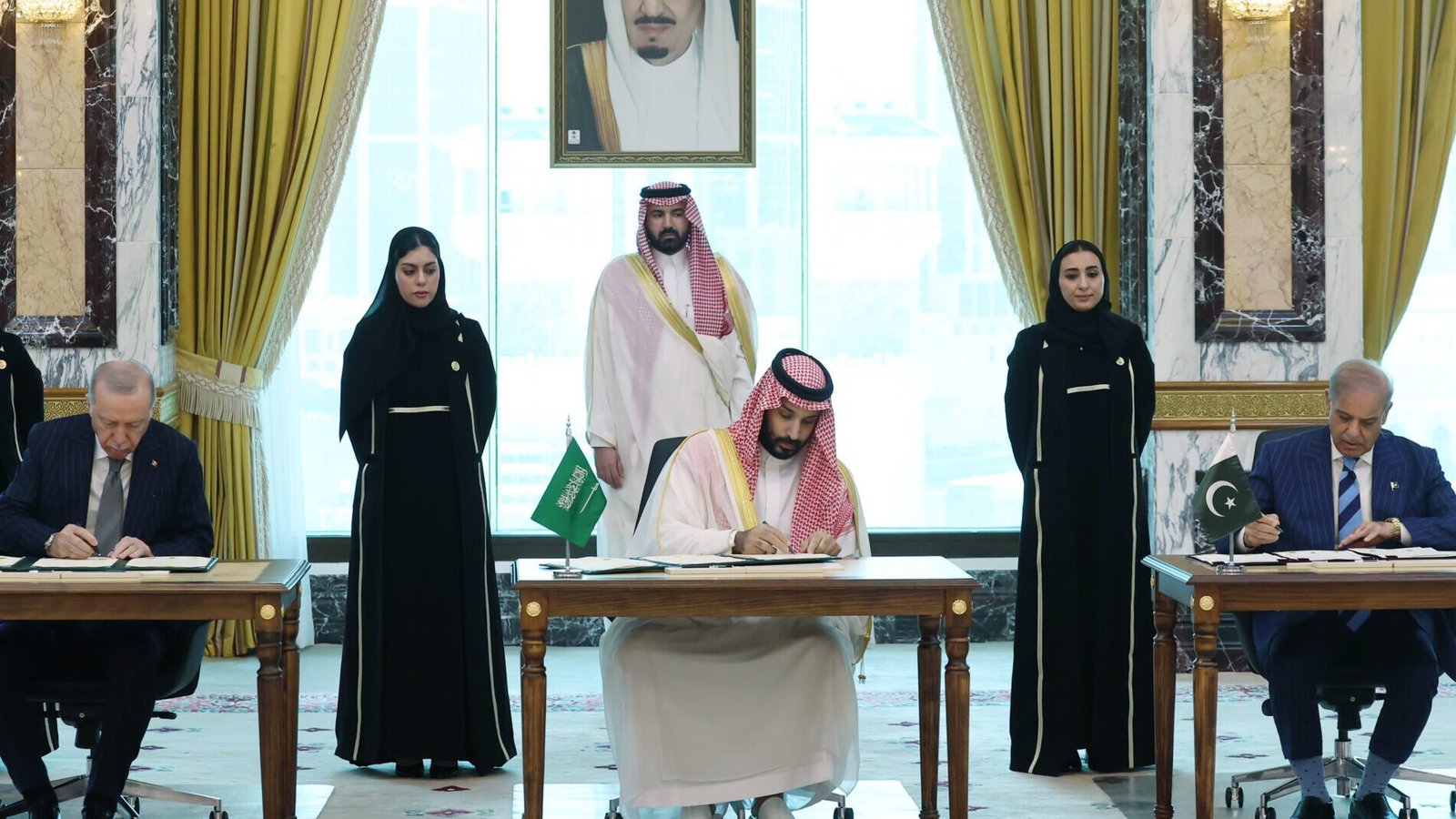
Signed in Mecca by Saudi Crown Prince Mohammed bin Salman, Turkish President Recep Tayyip Erdogan, and Pakistani Prime Minister Shehbaz Sharif, the agreement states that an armed attack against any one of the three countries would be regarded as an attack against all. Its stated goal is to strengthen collective deterrence and expand defense cooperation.
The three governments have repeatedly insisted that the agreement is defensive and is not directed against any specific country. Turkish and Pakistani officials have also made clear that the framework is open to other states. Erdoğan said at the time of signing that countries seeking regional peace and stability could participate, and Turkish Foreign Minister Hakan Fidan subsequently described the three existing members as the core of a structure that could expand further.
But beyond the collective defense language, much remains unresolved. The initial joint statement did not specify what military response would be required following an attack, and it was unclear to what extent members would be bound to undertake military action on one another’s behalf.
That distinction also complicates comparisons with NATO. NATO’s Article 5 considers an attack against one ally an attack against all, but it does not automatically require every ally to deploy troops; each member takes the action it considers necessary. The Mecca agreement is newer, far less institutionalized, and has yet to be tested in a crisis.
For Mohammad Ali Zafar, a research scholar at the University of Oxford, the importance of the pact is not limited to whether it eventually replicates NATO’s military architecture.
“The idea of a Muslim NATO-style structure under the Mecca Agreement appears to be gaining momentum among states that want to improve their security arrangements and become better aligned when it comes to a joint response to external aggression,” Zafar told The Media Line.
“With the Trump administration distancing itself from providing security guarantees to its Middle Eastern partners, with Israel being the main exception, the likely response has been a greater effort among Muslim states to rely on one another for security commitments and develop a comprehensive plan involving diplomatic coordination, the sharing of military expertise, joint defense initiatives and potentially joint defense action,” he said.
The first potential expansion could come not from another Middle Eastern power, but from South Asia.
Bangladesh’s State Minister for Foreign Affairs Humayun Kabir said this week that Dhaka had expressed interest in the agreement and was viewing participation positively.
Adding Bangladesh would bring another major Muslim-majority country to the grouping, while pushing its geographic reach deeper into the Indian Ocean region. But it would also introduce another layer of South Asian competition into an arrangement already containing Pakistan.
Considering the recent turmoil the country has faced, it seems less likely that Bangladesh would make such a decision immediately
“Bangladesh is an important potential partner for the current members of the Mecca Agreement,” Zafar said. “However, considering the recent turmoil the country has faced, it seems less likely that Bangladesh would make such a decision immediately.”
In his view, Bangladesh’s entry into an alliance such as the Mecca Agreement could also unsettle India. New Delhi would be wary of Dhaka aligning with Pakistan in a future conflict, especially under a mutual-defense clause that treats an attack on one member as an attack on them all.
Zafar also questioned whether Dhaka currently has sufficient strategic reason to assume obligations tied to conflicts far from South Asia. “It makes little sense for Dhaka to involve itself directly in these conflicts by joining the Mecca Agreement at the current stage. However, if there is a possibility of Iran and other countries joining the agreement, Bangladesh may reassess the strategic value of becoming a member.” he said.
Iran is precisely where the enlargement debate becomes more complicated.
Reports over the weekend cited Mehdi Rahimi, head of the Iranian parliament’s news agency, as saying that Tehran had been invited to join and that the proposal was under consideration. But on Aug. 24, Iranian Foreign Ministry spokesperson Esmaeil Baghaei publicly denied that Tehran had received an official invitation. The claim, therefore, remains unconfirmed.
Iranian membership would be qualitatively different from the possible admission of Bangladesh or Egypt.
The founding governments have insisted that the agreement is not aimed at Tehran. Yet its creation came amid a regional security environment transformed by direct Iranian attacks on Gulf countries and by the wider US-Israel confrontation with Iran. The three founding states share concerns about both Iran’s increasingly assertive military posture and Israel’s regional actions, while officials have rejected portraying the agreement as either an anti-Iranian axis or anti-Israel per se.
Ali Hosseini, (a pseudonym used to protect his identity), is a researcher at the Iranian Institute for BRI Studies. He argues that Iranian participation would nevertheless run contrary to Tehran’s strategic interests.
Joining the Mecca Defense Pact is not merely illogical … such a move would paradoxically transform Iran into a more conspicuous and vulnerable target
“Joining the Mecca Defense Pact is not merely illogical; it constitutes a profound strategic miscalculation. Far from generating credible deterrence against Israel, such a move would paradoxically transform Iran into a more conspicuous and vulnerable target,” Hosseini told The Media Line.
His reading of the agreement differs sharply from the official position of its signatories. While Ankara, Riyadh and Islamabad say the pact targets no particular country, Hosseini views its underlying security logic as substantially shaped by concerns about Iran.
“The strategic architecture of the Mecca Pact was explicitly conceived as a containment mechanism against Iranian military power,” he said. “For Iran to seek accession to this framework is tantamount to aligning with a coalition structurally predicated on curtailing its own strategic interests.”
For Hosseini, the fundamental question is not simply whether Tehran would be accepted, but what membership would do to Iran’s freedom to maneuver between competing powers.
“Iran’s enduring strategic power lies in its multi-vector autonomy—the capacity to navigate between [the] Eastern [Russia and China] and Western blocs while maintaining independent crisis-management leverage,” he said.
He argued instead that Tehran could benefit from keeping the question of membership diplomatically alive without becoming militarily integrated. “The prudent course of action is to treat the overture regarding this pact as a tactical diplomatic maneuver—an opportunity to test regional reactions, exacerbate intra-Arab divisions, and project an image of openness to dialogue, without ever committing to operational integration,” he argued.
Zafar reaches a different conclusion. He sees potential Iranian participation as capable of transforming the pact from a narrower security grouping into a significantly broader Muslim framework—but only if major political and strategic differences can first be addressed.
“Iran joining the agreement would be a positive development,” he said. “However, that would also mean that the Organization of Islamic Cooperation would be a better platform for Muslim states to showcase a joint response to any aggression against Muslim states in the Middle East.”
Zafar argued that Tehran would need to provide substantial reassurance before existing members accepted the risks associated with collective defense.
The current members of the Mecca Agreement would prefer not to find themselves drawn into a conflict with the United States over the issue of Iran
“The current members of the Mecca Agreement would prefer not to find themselves drawn into a conflict with the United States over the issue of Iran,” he said. “Therefore, while Iranian membership could fundamentally change the character of the agreement, it would require considerable reassurance from Tehran before the existing members would be comfortable with such an arrangement.”
That tension illustrates the pact’s central contradiction. Enlargement could increase its strategic weight, but every additional member also introduces new adversaries, obligations, and competing relationships.
Egypt presents perhaps the clearest example. Egyptian Foreign Minister Badr Abdelatty has confirmed that Cairo is seriously studying membership, saying the issue requires a comprehensive review of Egypt’s constitutional and legal obligations.
Ofir Winter, a senior researcher at the Institute for National Security Studies (INSS) and Tel Aviv University, said Egypt’s hesitation reflects unanswered questions about precisely whom the agreement is supposed to deter and what military commitments membership would create. “Egypt is still considering whether to join and is looking at the real significance of the agreement and what commitments it would entail,” Winter told The Media Line.
“There are many open questions, especially whether this defense alliance is directed against anyone, and if so, against whom. Is it supposed to deter Israel, Iran, or both? There are also questions about what military commitments are included in the alliance,” he added.
Cairo must balance particularly complex relationships. It maintains a peace treaty with Israel, increasingly important ties with Turkey, long-standing connections with Saudi Arabia and the UAE, and strategic relations with countries including India.
Egypt does not want to choose one regional camp at the expense of another
Winter said that this helps explain Egypt’s preference for diplomatic coordination without automatically translating that cooperation into a military bloc. “Egypt does not want to choose one regional camp at the expense of another,” he said. “It wants to maintain its own neutral position and preserve good relations not only with Israel, but also with Greece and Cyprus, without becoming too closely aligned with Turkey.”
There is also a legal dimension. Article VI of the 1979 Egypt-Israel peace treaty states that neither party should enter obligations conflicting with the treaty and that, subject to the UN Charter, treaty obligations prevail where a conflict with other obligations arises.
Winter argued that Egyptian officials would therefore have to examine carefully whether a new collective defense commitment could theoretically oblige Cairo to act against Israel in a conflict involving another Mecca Pact member.
From Israel’s perspective, Winter said, Turkey remains the most important variable. “I think the main Israeli concern is Turkey, because we hear the discourse and declarations of President Erdogan, his traditional support for the Muslim Brotherhood, and Turkey’s close relations with the new Syrian regime, which has its own Islamist and jihadist roots,” he said.
“When Turkey becomes part of a regional alliance, this naturally creates concerns in Israel,” he noted.
When Turkey becomes part of a regional alliance, this naturally creates concerns in Israel
But Winter also identified a broader risk for Israel: that tensions with Israel could become one of the few issues capable of drawing otherwise competing regional actors closer together. “I think Israel is following the consolidation of these new regional axes and looking at how they could affect its own security, since it is the opposite of what the Abraham Accords stood for.”
For Pakistan, meanwhile, enlargement offers a different opportunity.
Islamabad already sits geographically outside the traditional Middle East while maintaining deep military ties with Saudi Arabia, close defense relations with Turkey, and diplomatic channels with Iran. Zafar sees that position as potentially transforming Pakistan from a primarily South Asian power into a cross-regional actor. “The broader objective, in my view, is not simply military cooperation, but greater strategic agency and influence across South Asia and the Middle East,” he said, adding that Pakistan is increasingly positioning itself as a middle power capable of engaging multiple, often competing, centers of power.”
From Zafar’s perspective, the pact could simultaneously be read differently in Beijing and Washington. “China and the US may both welcome greater security cooperation among regional partners, although for different reasons. China is likely to see this as contributing to a more multipolar regional order, while Washington may value greater regional burden-sharing but remain cautious about any arrangement that reduces its strategic leverage.”
That interpretation broadly fits one important aspect of current US policy. President Trump has consistently demanded greater defense burden-sharing from American allies, and the White House has described its evolving NATO strategy as one of greater allied self-reliance. The administration has also explicitly made increasing its partners’ ability to meet defense requirements without sustained US support part of its foreign military sales policy.
President Trump welcomed the Mecca agreement on Aug. 17, portraying it as a step toward regional countries becoming better able to defend themselves.
That does not necessarily mean Washington wants to withdraw from Middle Eastern security entirely. The United States retains military bases, defense partnerships, and major arms relationships across the region. But the agreement fits a broader push for partners to assume greater responsibility while the United States retains influence through arms sales, intelligence, diplomacy and strategic partnerships.
“The Mecca Agreement is broadly the kind of arrangement that the Trump administration has been encouraging Middle Eastern states to develop,” Zafar said. “I therefore see the agreement as something that could be supported—or at least encouraged—by Washington, particularly if it allows regional states to take greater responsibility for their own security while reducing the burden on the United States.”
For now, the Mecca Pact remains more an emerging architecture than a mature alliance.
Winter remains cautious about assuming that the political declaration will automatically translate into military action. “But if countries such as Egypt, or other regional powers, join this alliance, and if there is any further escalation with Turkey or with other members that could eventually be included, such as Syria, that could have complex implications for regional dynamics and for Israel especially,” he said.
That may ultimately be the most important challenge surrounding the agreement.
If enlargement stops with states already broadly aligned with Saudi Arabia, Turkey and Pakistan, the pact could consolidate a new but relatively flexible regional security network. If countries such as Bangladesh and Egypt join, its geography and diplomatic reach would expand substantially.
Iranian accession would represent something more profound: it could blur the lines between rival camps and turn what many currently interpret as a balancing mechanism into a broader regional collective-security project. But the contradictory reports from Tehran, continuing mistrust among regional actors, and uncertainty surrounding the pact’s actual military obligations show how distant that scenario remains.
For now, the Mecca Pact’s significance lies as much in the interest it is generating as in the commitments already written into it. Its first real test may therefore not be an external attack, but whether three states with different threat perceptions can expand their alliance without importing so many competing interests that collective defense becomes harder, rather than easier, to define.