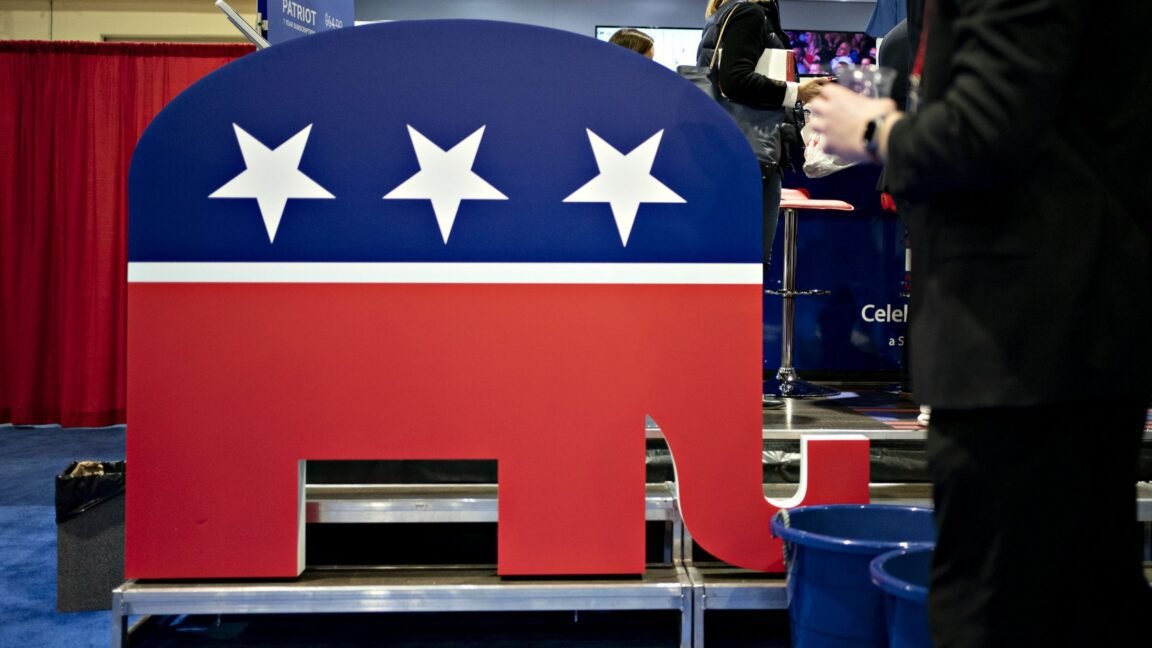
Republican campaign committees want the Supreme Court to mandate lower prices for election commercials on broadcast TV stations. If the court agrees, broadcasters would be forced to offer their lowest ad prices to political parties and joint fundraising committees.
For a more thorough description of the legal issues in the dispute, see this article that Ars published yesterday. In short, US law requires broadcasters to offer individual candidates the “lowest unit charge,” or LUC, during the 60 days before an election. The law helps level the playing field somewhat by letting candidates make their cases to voters who watch broadcast TV without needing to raise exorbitant sums of money.
The Trump administration, acting through the Federal Communications Commission, ordered broadcast TV stations to also give these discounts to political parties and joint fundraising committees, which face fewer limits on how much money they can raise and spend. Four Democratic candidates appealed, and a judges’ panel at the US Court of Appeals for the 4th Circuit ruled that the FCC order cannot be enforced because it contradicts the plain language of US law.
The National Republican Congressional Committee and National Republican Senatorial Committee, which intervened in the case to support the FCC’s position, told the 4th Circuit court yesterday that they intend to appeal to the Supreme Court.
GOP seeks quick rulings
The committees submitted an emergency motion for a stay and asked the 4th Circuit to rule on that motion immediately so they can file a petition to the Supreme Court. “Intervenors respectfully request that the Court rule on this stay motion as soon as possible—whether by expediting or waiving response briefs—to permit Intervenors to seek emergency relief at the Supreme Court,” Republican committees told the court.
The court responded quickly, issuing an order today to deny the Republican committee’s motion and to immediately issue a mandate that can be appealed to the Supreme Court. Republicans will now seek swift action from the Supreme Court in an attempt to overturn the 4th Circuit ruling before the 60-day discount period starts on September 4.
“Candidates and committees are currently drafting, negotiating, and signing contracts with broadcasters for the coming weeks,” the motion said. “In fact, candidates and committees are currently creating the advertisements for the contracts that they’ve already signed with broadcasters. The parties need certainty on those contracts to move forward and conduct effective campaigns.”
In another recent case filed by the National Republican Senatorial Committee, the Supreme Court ruled that federal limits on how much a political party can spend in coordination with candidates violates the First Amendment. The elimination of those limits could fuel a bigger onslaught of election ads if broadcasters are forced to offer their lowest ad rates to parties and committees.
“Flood of coordinated campaign money” into TV ads
Anna Gomez, the only Democrat on the FCC, said the agency “is unleashing a flood of coordinated campaign money into broadcast advertising, just as the Supreme Court has cleared the way for unlimited coordinated spending between parties and candidates.” Gomez also said that forcing broadcast stations to offer deep discounts on their most valuable ad inventory will worsen the stations’ financial problems, contradicting the Trump FCC’s stated goal of helping broadcasters compete against Big Tech and streaming.
FCC Chairman Brendan Carr has pushed for bigger broadcast mergers, claiming they are needed to help stations invest in local news. To accomplish that goal, he led a vote to eliminate a rule prohibiting any single broadcast station owner from reaching more than 39 percent of all TV households in the US. The FCC repealed this ownership rule even though the 39 percent figure was specified by Congress in a 2004 law, paving the way for another court battle over the limits of FCC authority.
From a legal perspective, all the cases are decided based on interpretations of what Congress meant when it put specific words and phrases into US law. In the law related to the TV advertisement case, the sides disagree over the meaning of “the use of any broadcasting station by any person who is a legally qualified candidate for any public office in connection with his campaign.”
The legal question is whether “use… by” a candidate can refer to ad time purchased on a candidate’s behalf by parties and joint fundraising committees. In the 4th Circuit case, two judges appointed by Democratic presidents ruled that the FCC’s interpretation of the law was wrong, and one judge appointed by a Republican president said the FCC got it right.
GOP has reason for optimism
A potential problem for Republicans is that the FCC position contradicts agency guidance from 1991 and a statement made to the Supreme Court last year by the Trump administration’s own solicitor general. In the recent Supreme Court case over spending limits, US Solicitor General John Sauer wrote in a filing that the “rules require broadcasters to charge low rates for candidate spending, but not for party spending—whether coordinated or independent.”
But Republicans have reason for optimism given the conservative makeup of the Supreme Court and the 4th Circuit dissent from Judge J. Harvie Wilkinson III, a Reagan appointee who argued that the FCC offered a “natural and plausible” interpretation of the law’s reference to “use… by” a candidate. The FCC welcomed the dissent, issuing a statement praising “Wilkinson’s sound and thoughtful analysis.”
Republicans further argue that courts have no jurisdiction yet because the FCC hasn’t made a “final” decision. The 4th Circuit judges decided they have jurisdiction because the FCC’s failure to act on a petition filed by Democratic candidates amounted to a “constructive denial.”
Wilkinson disagreed on that count, too, saying the FCC guidance is not a final order because the FCC is still reviewing the candidates’ application. If the Supreme Court does act quickly in the GOP’s favor, it could stay the 4th Circuit court mandate on the grounds that the FCC order isn’t final and can’t be appealed yet.
The Republican committees told the 4th Circuit to be wary of recent Supreme Court guidance. “Just two days ago, the Supreme Court reminded lower courts that they should not interfere with agency decision-making before it is final,” they wrote, referring to a ruling in Trump’s favor on vote-by-mail restrictions. “This Court should heed that instruction, and stay its order (or the mandate) pending a writ of certiorari to the Supreme Court.”