Reporting Highlights
- Death After Death: Almost every year since 2015, Idaho children in a faith-healing sect have died of treatable conditions such as pneumonia and bacterial infections that turned to sepsis.
- Church Doctrine: Former members of the Followers of Christ sect say parents are pressured to follow doctrine that forbids medical care. Those who stray risk shunning, they said.
- No Legal Pressure: Oregon officials say after the state put legal boundaries on faith healing, more parents sought care for kids. Idaho, by contrast, has kept its faith-healing protections.
These highlights were written by the reporters and editors who worked on this story.
A sheriff’s deputy opens the door of an Idaho farmhouse where a newborn baby has just died. It’s almost 10 p.m., but the house is filled with adults and children seated anywhere they can find a spot: in reclining chairs, on the wood-stove hearth, on a chest of drawers. Some of the women hold babies in their laps.
“Sorry,” the deputy whispers as the door creaks.
No one greets the officer. No one speaks or even looks at anyone else, casting their eyes instead at the floor or around the room.
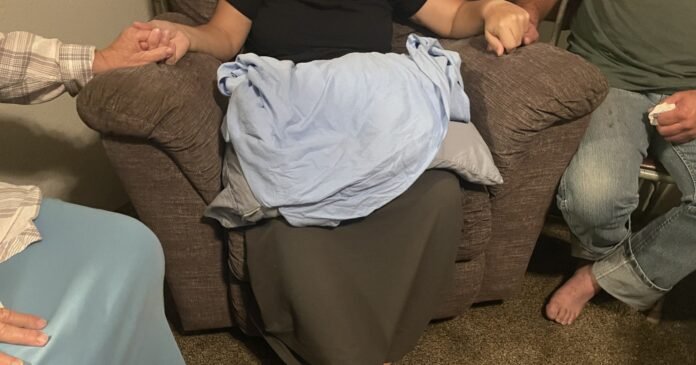
The deputy’s video camera records as he walks through the front room and past a bedroom door adorned with children’s artwork. Inside the bedroom, newborn Malachi’s mother sits in a recliner. His body lies in her lap, covered by a blue blanket.
As people in uniform ask Malachi’s parents about his birth, death and the two days in between, members of the family’s church — one of at least four Followers of Christ churches in Idaho — watch from folding chairs. People come and go from the bedroom; one woman cradles a sleeping toddler.
Malachi died from pneumonia and bleeding lungs, according to an autopsy.
It would have been treatable with antibiotics and newborn care in a hospital, said doctors who reviewed his death records for ProPublica.
But Malachi’s parents belong to a faith-healing sect that doesn’t believe in medical care, based on a literal interpretation of several Bible verses. The Followers of Christ sect believes that God heals the faithful and that life and death must be left to God’s divine will.
When the coroner’s deputy lifted Malachi’s body to take it away that night in October 2023, there was no wailing or sobbing from his parents. Malachi’s father stood quietly as his mother hung her head and rested it in her hand.
A pediatrician who reviewed Malachi’s death records said a baby in his condition would have been gasping for air, turning blue from lack of oxygen and breathing so hard that the outline of his rib cage was visible.
It was the first time the coroner and sheriff sent their deputies out to that house, to interview those parents and document the slow suffocation of a newborn boy.
The next time was 13 months later, when their next newborn, Liam, died from the same treatable condition that killed his brother Malachi.
“This Is Needless”
In any Idaho household not steeped in faith-healing, those two deaths would be investigated as crimes. Idaho law says parents can’t endanger, injure or neglect their children or let them suffer. To do so is a crime, and if the child dies as a result, the parent could be charged with manslaughter.
But those laws do not apply to children like Malachi and Liam. Since the 1970s, Idaho’s criminal and civil laws have allowed parents who belong to Followers of Christ and the state’s other faith-healing sects to pray rather than seek medical care as their children die.
Lawmakers in Oregon, where the same religious groups exist, removed the state’s faith-healing exception to child abuse laws nearly 30 years ago, countering the overwhelming pressure former Followers say parents face from their congregations. More parents chose to get medical care for their children after the change, Oregon prosecutors and detectives said.
Idaho lawmakers have chosen a different path.
Since 2014, they have rejected repeated efforts to dial back Idaho’s faith-healing exemption, instead crafting legislation to further limit the role of anyone but a parent when it comes to children’s health and safety. The state has codified “parental rights,” banned vaccine requirements in schools and childcare centers, and made parental consent a prerequisite for medical care of minors. Legislators also have tried to narrow the definition of “medical neglect” for all families to only the most life-threatening situations, but those attempts have failed.
Local and national media outlets have reported on deaths among Followers of Christ families in Idaho. ProPublica went further, enlisting the help of experts to determine which of those deaths could have been prevented.
ProPublica gathered death records from coroners and police in five Idaho counties and shared them with more than a dozen pediatricians and birthing specialists.
At least 15 babies and children from the faith-healing sect died between 2015 and 2025 from illnesses that doctors could have successfully treated, the experts concluded.
The estimate of preventable deaths is almost certainly an undercount. The experts could not evaluate six more deaths because coroner records were incomplete or unavailable. In another four cases, they couldn’t say with confidence whether medical care would have changed the outcome.
Separately, the experts identified numerous preventable losses of babies who died during birth or in utero very close to their due dates, cases that coroners labeled as stillbirths.
For some families like Liam and Malachi’s, the death of a child wasn’t a one-time tragedy: Records show at least five sets of parents have lost multiple children, a phenomenon that has not previously been reported.
None of the parents responded to letters or text messages from ProPublica, and one declined to comment during a brief phone call. (ProPublica is choosing not to identify them or use the children’s full names out of respect for their privacy.)
But Nathan Kangas, a patriarch in the sect’s Caldwell, Idaho, church, defended faith healing and its legal protection during an interview with ProPublica.
Children and babies can’t make their own decision to rely on faith healing. Kangas said their parents must keep them away from the doctor to set an example, so the young ones won’t be cursed later in life by turning to medicine.
Kangas lost his own wife and their last child during labor 23 years ago. Three of his 65 grandchildren also have died.
Asked why God would not want children to live full and healthy lives, Kangas said he had no answer but quoted a verse from the Book of Psalms: “Precious in the eyes of the Lord are the death of His saints.” The Followers believe that life on Earth is “a preparing ground,” Kangas said. He pointed to the Book of James, which tells people to “be afflicted and mourn and weep” and “let your laughter be turned to mourning.”
“It isn’t necessarily that we’re supposed to have a joyous life here,” Kangas said. “It’s actually quite the opposite.”

Some outsiders take a very different view.
Canyon County Sheriff Kieran Donahue, one of the most vocal opponents of Idaho’s faith-healing laws, has sent deputies to follow up on the deaths of at least 10 Followers’ children and infants since he took office in 2013.
“This is needless,” Donahue said. “This shouldn’t be happening.”
David Peterman, a retired Idaho pediatrician, reviewed the deaths of 18 infants and children at ProPublica’s request.
Peterman saw patients for 40 years and did his residency at a center that offered special training in child abuse and neglect. He said the vast majority of the deaths he reviewed for ProPublica “are the result of neglect and unequivocally preventable.” (He couldn’t tell whether a few deaths were preventable, and he surmised that one infant had a fatal, untreatable chromosomal defect.) He said it is “beyond comprehension” that the Idaho Legislature has refused to change the law.
“How is this tolerable?” he said. “I don’t understand how there could be an exception in Idaho law that allows for these children to die.”
The Deaths
Maicy was 16 years old but the size of a third grader: 62 pounds and just shy of 4 feet tall. She had suffered from a constellation of ailments: stomach irritation, severe anemia, erratic menstrual periods, a blocked artery, thickened aorta and thinning hair. An autopsy after she died on New Year’s Day 2019 traced it all back to a benign, treatable pituitary tumor.
Doctors who reviewed her death records said her stunted growth would have been obvious earlier in childhood, when her tumor could have been diagnosed and treated. Instead, it sent her body into a hormonal tailspin that destroyed her organs. She died in bed, lying on a towel and absorbent pad, wearing a diaper under her sweatpants and a T-shirt that read “LOVE.”
“I don’t understand how there could be an exception in Idaho law that allows for these children to die.”
David Peterman, retired Idaho pediatrician
Some of the children who died preventable deaths over a decade were sick for hours or days; others endured months or — in Maicy’s case — years of disease. Most died in their parents’ arms. Many would have experienced pain and distress from their untreated conditions, the healthcare professionals consulted by ProPublica said.
“I don’t know how to come to terms with that,” said Beth Hartman, an Idaho midwife and former chair of the state’s midwifery licensing board. “Because when you see respiratory distress, and when you have seen a person pass, it’s not pretty. They don’t just close their eyes.”
In America at large, the risk that a child will die is highest during the first year of life. The vast majority of Followers’ children who died were infants. But nationally, fatalities in this age group tend to follow premature birth or profound congenital disorders. The deaths among Followers’ infants came from ailments that rarely take children’s lives.
At least three children died from sepsis caused by common infections that antibiotics can easily stop. Camden died in 2024. Weston died in 2025. They were brothers. Stanley, a newborn whose parents said he was “alert and happy” for his first 36 hours, spent the next 29 getting darker in color, coughing up phlegm and clenching his limbs in convulsions. He died in 2017.
The deaths almost never came without warning.

In the case of Malachi, the police and coroner reports don’t say how long before his death his parents first noticed him breathing fast, making a gurgling noise “like stuff was in his throat or chest.” Nor do the documents say what the parents did in the interim other than that they “chose not to perform life saving measures.”
But when they noticed their next newborn, Liam, was struggling to breathe and his “color was not good,” they again did not call for help, and he died over the course of at least 12 hours. While he was dying, members of their church came to see the baby and pray for him. Ten people were in the room when the boy died, and more had gathered outside the room, Liam’s father told police.
It’s rare in developed countries for children to die from pneumonia as Liam and Malachi did, wrote Barton Adrian, a retired Idaho pediatrician who reviewed the death records for ProPublica. The annual pneumonia-related death rate in the U.S. for infants is 1 in every 30,000 to 40,000, according to federal data. Adrian wrote that with a total of 12 children in Malachi and Liam’s family, the death rate was 1 in 6, “equivalent to third-world countries.”
Several healthcare professionals who reviewed the death records for Malachi and Liam suspected their problems originated from a birth-related strep infection so dangerous that expectant mothers in the U.S. are routinely screened for it. Women who test positive get antibiotics to keep the baby safe. In cases where a full-term newborn does become infected, almost all who receive treatment survive.
Dallas, a 2-year-old, was sick for six weeks with an untreated bacterial infection that settled into a valve in his heart and slowly destroyed it. He had fevers, abdominal pain, vomiting and swelling that started in his feet, then spread to his hands and finally to his face. He died in his father’s arms in 2020. Although an autopsy found Dallas was born with a heart condition that made him susceptible to infections, doctors who reviewed the document for ProPublica said the condition was treatable and antibiotics would have halted the infection.
Had his parents taken him to a doctor at any point during the six weeks they knew he was sick, Dallas could have been saved, the doctors said.
“Normal Still Isn’t Normal”
Whenever a child dies in the Followers of Christ, the scene is unlike anything police see in deaths outside the sect.
Police describe what seems to be a phone tree the church members use to call on the congregation to pray and go to the family’s home — sometimes before the death, sometimes after. A church elder or family member calls the coroner directly, instead of calling 911.
The sheriff’s deputies and local police who accompany the coroner’s team to the death scene have learned what to expect. There won’t be an ambulance parked outside. There won’t be a frantic, inconsolable parent. There won’t be children’s ibuprofen in the medicine cabinet or a pediatrician’s phone number to call for medical records. All the police will find is a crowd sitting in silent vigil and a bottle of olive oil for anointing the ill.
There is little for police to do besides offer condolences, ask questions and carry out their legal duty to confirm the parents did nothing that constitutes a crime in Idaho.
Yet some of these cases are etched into officers’ memories.
For Chuck Gentry, a captain in the Canyon County Sheriff’s Office, it was a baby girl named Jolene who died at 3 months old from a congenital heart defect. Some doctors told ProPublica that a cardiologist’s care could have saved her, although some suspected she also had a chromosomal defect that only 10% of babies survive past their first year.
What haunts Gentry was the lack of medical attention for the baby’s cleft palate, which he recalls was severe.
She died at an address that’s become familiar to local police because children from four Followers families have died there since 2017.
(Jolene’s father, reached by phone, declined to talk with ProPublica.)
Gentry echoed what other investigators told ProPublica: By the time detectives arrive, the congregation has already assembled. Dozens of people, Gentry said. So many vehicles that he’d sometimes struggle to find a place to park his patrol car.
“It isn’t necessarily that we’re supposed to have a joyous life here. It’s actually quite the opposite.”
Nathan Kangas, an unordained elder in the Caldwell, Idaho, Followers of Christ congregation
Once he’d get inside, he said, the grandparents of a dead child would make it hard for him to get the child’s parents alone to ask them questions. “They’re very hover-y. They don’t want you to separate them off,” he said. “They kind of seem overprotective of what they might say.”
(Kangas, the Caldwell church elder, said the congregation’s presence at a dead child’s home isn’t meant as intimidation. “They’re not there to keep from saying anything. That’s absolutely false,” he said. “We, as a people, when somebody suffers, we go there to suffer with them.”)
Gentry said it wasn’t until he got the parents alone in another room that their grief would spill out. “You see the mom crying. You see the dad kind of pacing,” he said. “It’s normal behavior for someone who has lost a child,” but the death itself and the scene that follows it are “so bizarre that normal still isn’t normal.”
Jolene was her parents’ first child to die, they told police. Other investigators arrived at the scene for the next, the couple’s toddler son, Malone, in 2021.
Written reports from a pathologist and death investigators describe the body that detectives saw: arms and legs skinny from malnourishment, a belly swollen to the size of a basketball.
Malone never had normal bowel movements in his 16 months of life, his parents would later tell investigators. His belly would swell, then he’d have an enormous poop, and the cycle would repeat. As his condition worsened, his mother brought him to his grandparents’ house on a busy country road. She held him while he died.
An autopsy determined that the boy’s bowels had compressed his lungs and heart, which stopped beating. His rib cage had grown outward to accommodate his backed-up intestines, and his lungs were so cramped they’d stayed the size of a newborn’s.
One detective wrote that Malone’s abdomen was “distorted to the extent of nothing like I’ve ever seen before.”
The underlying problem was an intestinal condition that doctors can fix with a routine, minimally invasive surgery, experts who reviewed Malone’s death records said.
The day Malone died, investigators arrived to find dozens of family and friends at the house. Malone’s mother sat in the front room, in a chair holding the child’s covered body in her lap. Malone’s father knelt beside them.
A detective asked the parents questions in a quiet voice, according to audio recordings from the scene. Did Malone have trouble going to the bathroom? Had he been to a doctor? Did they have any other children? Where was Malone when he died? They gave brief answers, volunteering few details. The entire interaction took about 10 minutes.
The paperwork wrapped up, and the case was closed.
Disciples of a New Religion
The Followers of Christ sparked curiosity in Idaho from the time they arrived in 1899. Two “wayfarers from Oklahoma” appeared in a mining town near what is now Sun Valley, calling themselves “the disciples of a new religion.” They said God sent them to spread their gospel, according to reporting from the time in the Idaho Statesman.
“One was tall and dark, about 30 years of age, and wore a pair of greasy overalls, black, baggy sweater and flaring yellow mackinaw coat,” a reporter wrote. That man went by “Brother Charley.” He was “decidedly illiterate” and preached that education wasn’t necessary but had an impressive knowledge of Scripture, able to recite entire books of the Bible by memory, the reporter wrote.
They held their first worship service a week later in a schoolhouse.
Over time, Followers of Christ formed congregations across southern Idaho. It went on to become the state’s largest faith-healing religion and later spread into Oregon.
The first few generations of holy men who led Idaho’s congregations died, and no one took their place. Each church was left with, at most, a loose hierarchy and leadership structure. Each operates independently, with subtle differences in how it interprets doctrine. Although congregations have elders, families are the main conduit for ritual and belief.
The religion also breaks with most Christian denominations in that it does not recruit or proselytize. Other than on the rare occasion an outsider marries in, the sect grows only through existing families. This insularity causes the same surnames to show up over and over in public records from Followers communities in Idaho, and, just as happened in the faith’s earlier generations, the sprawling Followers families tend to intermarry.
Linda Martin, a former Follower who traced her genealogy, calls her family tree “a trunk.”
When the Followers began, healthcare on the Western frontier was primitive, unsanitary and riddled with con artists peddling fake cures. Hospitals and medical practitioners could treat many ailments and save lives, but medications like insulin for diabetes and antibiotics for bacterial pneumonia didn’t exist.
Like other faith-healing sects, the Followers sought answers elsewhere. They looked to Bible verses such as in the Book of James: “Is any sick among you? let him call for the elders of the church; and let them pray over him, anointing him with oil in the name of the Lord. And the prayer of faith shall save the sick, and the Lord shall raise him up.”
Kangas said “the whole Scripture” informs faith-healing doctrine and that no one went to the doctor in Christ’s time.
“It was a matter of trusting in God to heal them,” he said.
When someone dies despite fervent prayers, the Followers believe it is God’s will. When someone sees a doctor, the Followers see it as a sin. When someone recovers without medication or surgery or a 911 call, it seems to validate the sect’s doctrine.
No mainstream Christian denomination today accepts this interpretation of the Bible.

“I think over time, it’s kind of morphed into, ‘This is one of the things that separates us from all other faiths or religions, is that we don’t go to the doctor,’” said Laren Eells, who left one of Idaho’s Followers of Christ churches about a decade ago. He now believes that because of cherry-picked passages of biblical Scripture, “my eyes were completely clouded with presupposition.”
As a child, Eells watched his father endure what Eells believes was a burst appendix. The man was bedridden for over a month and had foul waste coming out of his mouth, but he emerged alive.
As an adult, though, Eells watched his younger brother die of an ear infection that spread to his blood. He sat by his brother’s side around the clock, “praying and wringing my hands,” he said. “An infection that some antibiotics could have probably taken care of, relatively simple, but we just say, ‘Well, we trust God with our life.’”
By the time Followers are grown, the idea that they could lose their own children isn’t foreign. They may have been present for their own siblings’ or cousins’ deaths. Their parents have likely taken them for vigils at other congregants’ houses.
The possibility of being isolated from their congregation can be a concern for Followers because of how much their lives revolve around extended family and church.
Former members say that someone who visits a doctor might be shunned, reprimanded or simply left out of social events — although Kangas said only “a few people here and there” in his church would go that far.
Kangas believes some ex-Followers perceive condemnation where none exists because of a guilty conscience. A single doctor’s visit can be chalked up to fear or weakness that “people can be forgiven of,” Kangas said.
What matters, he said, is that the person repents and never goes again.