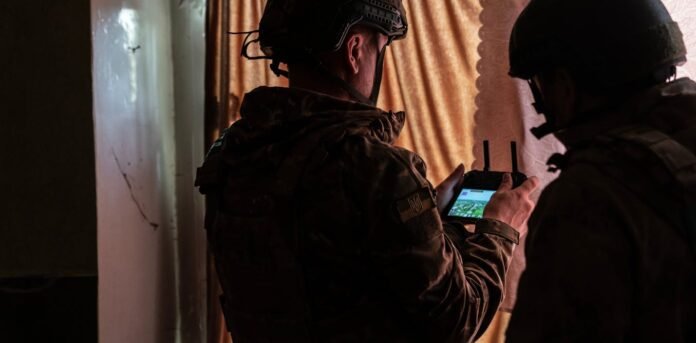
Where can you score 12 points for killing a Russian soldier in a drone attack, 20 for damaging a tank and up to 50 for destroying a mobile rocket system? Not on the latest video game, but rather through Ukraine’s Army of Drones Bonus (ADB) programme.
Launched shortly after Russia’s full-scale invasion began in 2022, before being revamped in 2025, the ADB programme is where points win prizes. Military units can use the points and virtual tokens they have accrued to buy drones and other frontline equipment to use in the conflict from the Ukrainian government’s Brave1 website.
By August 2025, military equipment worth over US$5 million (£3.7 million) had been delivered via this marketplace as digital rewards for “playing” ADB. The scheme has since extended to reconnaissance and logistics operations, while capturing a Russian soldier now grants ten times more points than killing one.
The ADB programme is an example of what researchers call the “gamification” of war – where video game-like features are integrated into military training and combat operations. Ukraine’s former defence minister, Mykhailo Fedorov, who was removed from his post in July, has said “motivation” is a key rationale for the ADB programme.
“When we change the point values, we can see how motivation changes,” he stated in 2025. Ukraine’s government has described the ADB programme as “delivering results”, with submitted video evidence confirming nearly 820,000 Russian targets were hit in 2025. Increased numbers of Ukrainian military units are also now participating in the competition.
Other schemes in this conflict have also used elements of video game design. These include Play for Ukraine. Developed by Ukrainian IT specialists in 2022, this scheme is designed in the form of a numerical puzzle game where every move a player makes helps stage a cyberattack against Russian government and media websites.
As players make moves in the game, Play for Ukraine sends requests to targeted Russian servers. They eventually become overwhelmed, causing websites to slow down or crash. Play for Ukraine’s developers say 2,048 players had helped attack more than 200 Russian websites in the first month of the scheme alone.
The ADB programme is linked with the Brave1 online store, where Ukrainian military units can exchange e-points for drones and other frontline equipment.Brave1 Marketplace
Gamification is neither exclusive to Ukraine or war. Our own research on the gamification of citizenship shows how mobile apps use digital rewards, points and leaderboards to incentivise good civic behaviour, such as picking up litter, recycling and community volunteering.
For example, since launching in the UK in 2021, over 10 million items of litter have been logged as binned through the LitterLotto app. Every time a person takes a photo of themselves binning litter, they earn entries into cash prize draws. The Equiwatt app also encourages UK citizens to reduce their energy usage at peak times in exchange for gift vouchers and points while competing on leaderboards.
Gamification is a popular feature of many other mobile apps too, such as Duolingo and other digital learning platforms. These apps commonly use streaks to maintain user consistency, as well as points to help users climb weekly leaderboards and progress to higher levels. The point scoring used in modern digitised warfare is a darker side to this trend.
Whose lives count?
As well as helping entrench video game features on the battlefield, the ADB programme highlights the role of foreign fighters in the Ukraine conflict and the complexities of whose lives “count”. It is well known that both Russia and Ukraine have been recruiting foreign nationals to fight in the war.
This has sometimes been state sponsored. Ukraine’s president, Volodymyr Zelensky, recently warned that the North Korean government was sending as many as 50,000 soldiers to fight with Russian forces in Ukraine. Foreign fighters have also been recruited by more unofficial means.
Russia has set up a global network for recruiting foreign nationals, targeting economically, socially, legally vulnerable people from countries such as Bangladesh, Nepal, Cuba and Kenya. The means used to recruit these people have ranged from enticement through high salaries to deceit and coercion.
So the “Russian” personnel worth 12 points for Ukrainian troops are not always Russian. Foreign fighters are also often the ones who are used as human shields, as one Bangladeshi recruit described it in a 2026 interview with DW, a German broadcaster, or pushed to the front while the Russian troops stay behind. Even in a warzone where lives are not valued, some remain less valued than others and are therefore more likely to be killed.
The theme of gamification has continued despite these extreme conditions. Some Bangladeshi soldiers fighting in Ukraine have created huge online followings, ranging from several hundred thousand people to around 1 million, by vlogging from the frontlines. They share live videos of combat from a first-person point of view, narrating everyday life in battle and providing often dramatic footage of drone attacks and near misses.
Warfare itself is clearly changing. But whether gamified or not, the lives that are lost are very much real.
China is shaping the future of open-source technology – including AI
As you read this article on your computer or smartphone, you are almost certainly using open-source technology in some way. It forms the foundation of the global digital economy, from operating systems and web servers to databases and encryption protocols.
While the United States and Europe have led the development of open-source technology, China is championing its own alternatives. The Chinese government has made open-source development part of its national technology strategy. Chinese companies and institutions have been active in redefining how open-source technology is being developed, licensed and deployed.
China’s open-source strategy could influence products and services used by people around the world, particularly as artificial intelligence becomes an everyday technology.
The success of China’s efforts may depend on building global trust, however. Chinese companies, backed by the government, have long been known to acquire advanced technology through intellectual property theft and by applying pressure in joint ventures and licensing agreements.
Open-source technology is increasingly becoming an arena of strategic competition between countries. As a China expert and open-source researcher, I believe the countries that lead the technical and legal standards governing open-source technology will gain a competitive edge for decades to come.
China’s long road to open-source
The open-source movement has taken various forms, from collaborations aimed at bypassing corporate monopolies to business strategies for developing products quickly. Open-source software has allowed developers around the world to reuse and improve on shared code.
Linux, the core software powering Android phones and most of the internet, is an open-source technology. RISC-V, an emerging alternative to Intel and Arm chip designs, and next-generation mobile network interfaces are also open-source.
Early Chinese engagements with open-source aimed to develop technologies that were free from foreign control. A government-run software institute developed Red Flag Linux as an alternative to Microsoft’s Windows operating system, which the government saw as costly to maintain and vulnerable to foreign intelligence gathering. A Chinese military university later created Kylin, an operating system for the People’s Liberation Army and other government organizations.
AI could be a source of tension between U.S. President Donald Trump and Chinese President Xi Jinping when they meet in September.China Pool via Getty Images
In recent years, Chinese tech companies have embraced open-source technology as a way around sanctions and export controls. After the U.S. government blacklisted the telecom giant Huawei for its ties to the Chinese military, Google revoked the company’s access to licensed services and apps. But Huawei used Android’s open-source code to maintain its smartphone operating system. Eventually, Huawei developed an alternative called HarmonyOS NEXT and released its own open-source version as OpenHarmony.
China is also positioning itself as an indispensable player in setting global standards for open-source hardware. For example, its work on RISC-V allows Chinese technology companies to reduce dependence on foreign intellectual property in semiconductors. Open hardware standards make Chinese companies less vulnerable to export controls and bans.
China’s strategy of “overtaking on a turn,” or closely following and then passing the front-runner, appears to be paying off. Chinese telecommunications companies, already leaders in 5G mobile network technology, are working with an international alliance to shape 6G, the next-generation standard for mobile communications. The Open-RAN standard the alliance is developing has complex implications for cybersecurity and strategic competition.
Open-source AI: With Chinese characteristics?
The contest over AI has moved beyond export controls of AI chips toward who leads open-source AI development. Xi is expected to discuss AI with U.S. President Donald Trump on his visit to the U.S. in September.
Major Chinese AI models such as Qwen, DeepSeek, Kimi and GLM are generally open-weight, not open-source, meaning that the model software and its final parameters are made available, but not the training data and methodology. AI companies often offer models in proprietary, open-weight and smaller open-source versions.
Users of Chinese AI face risks that are not widely understood. Chinese open-weight models are designed to align with government censorship and propaganda. While Chinese models are often distributed under standard licenses, such as MIT and Apache 2.0, some impose additional compliance obligations.
Moonshot’s Kimi K3 model license, for example, requires licensees exceeding specific revenue or user thresholds to “prominently” display the Kimi model name. MiniMax M3’s community license lists uses prohibited by “applicable laws or regulations,” raising questions over which jurisdictions apply.
Head of US travel association sounds alarm on potential expansion of visa bond program
The U.S. Travel Association said it is concerned the Trump administration’s visa bond program could be broadened beyond the dozens of countries currently covered, a move it says would have a detrimental impact on the travel industry and economy.
The U.S. Department of State this month made permanent a visa bond program first launched as a pilot in August 2025, allowing consular officers to require certain tourist and business visa applicants from 50 countries to post refundable bonds of up to $20,000.
“There are already rumblings of expanding this program to additional countries where visas are required, perhaps all countries where visas are required,” U.S. Travel Association President Geoff Freeman told Reuters. “That would have an extraordinarily detrimental effect on the U.S. economy, on the travel industry.”
The State Department did not immediately respond to a request for comment.
The administration said visa issuances in the pilot countries fell 83% during the program’s first 10 months, while overstays from those countries dropped from 45,488 in fiscal 2024 to fewer than 50 during the pilot period.
The 50 countries covered by the program are predominantly in Africa, with a smaller number in Asia, the Caribbean, Central Asia and Latin America. The administration said the program is aimed at reducing visa overstays from nationals of countries with high overstay rates or deficiencies in information-sharing, vetting and document security. New countries can be added to the list with 15 days’ notice, the State Department said.
Under the rule, the bond can be forfeited if a traveler overstays or violates other conditions of their status.
Freeman said that while the countries currently covered by the program account for less than 2% of visitors to the United States, the U.S. travel industry is already nursing a 25% decline in travel from Canada, while travel from Asia is 50% of what it was in 2019.
Total overseas travel to the U.S. declined 4.3% year-to-date as of June, according to preliminary data from the National Travel and Tourism Office, including a 1.8% fall in June during the soccer World Cup.
Freeman said the industry had hoped policymakers would use lessons from the World Cup to encourage international visitation rather than adopt policies that discourage travel.
“If we can’t have year-over-year increases in travelers during the World Cup, which we didn’t, what the heck are we going to do in an average September?”
Myanmar’s junta wants to cancel the diplomatic test it can’t pass
“No longer necessary.” That was Min Aung Hlaing’s foreign ministry on August 8, on the office of the Association of Southeast Asian Nations (ASEAN) Chair’s Special Envoy on Myanmar.
He had flown home from a state visit to Thailand 48 hours earlier, which invited the easy reading: a man cashing in his winnings too fast. It wasn’t that, though. It was the last step in a sequence that began in Manila three weeks before Bangkok.
Start with what the statement actually says, because most coverage compressed it. It does not repudiate the sitting envoy, Philippine Foreign Secretary Ma Theresa Lazaro; Naypyitaw will keep cooperating with her through the Philippine chairmanship.
What it rejects is a new envoy and the role in future — which is to say, from Singapore’s 2027 chairmanship onward. It also refuses ASEAN’s August 7 request that Lazaro be allowed to meet Aung San Suu Kyi, already refused once in late June.
So accept the person, deny the access, abolish the office prospectively — three moves, not one tantrum.
The least-quoted passage is the sharpest. Naypyitaw warned of “appropriate countermeasures, on a case-by-case basis” against “unconstructive and discriminatory treatment” by ASEAN “or any of its member states.”
That last clause is aimed not at the bloc but at individual capitals — a pre-emptive threat to any government thinking of acting alone.
Diplomatic test
It has already been tested, and it failed. In February, Timor-Leste opened legal proceedings against Min Aung Hlaing for war crimes and crimes against humanity, the first ASEAN member ever to do so.
Naypyitaw retaliated by expelling Dili’s senior diplomat. Timor-Leste did not withdraw the case. ASEAN’s newest and smallest member has shown the countermeasures are survivable.
On July 12, Thailand hosted an informal discussion in Bangkok that put Myanmar’s foreign minister in a room with a group of ASEAN counterparts, and Naypyitaw read it as momentum. Nine days later, the momentum stopped.
At the 59th ASEAN Foreign Ministers’ Meeting in Manila on July 21, Myanmar was seated only at the level of the permanent secretary of its foreign ministry, under ASEAN’s standing policy of non-political representation at ministerial and summit meetings.
The ministers then moved further the other way. They agreed to develop benchmarks for measuring progress on the Five-Point Consensus and began discussing a longer-term special envoy in place of the annually rotating post. Days later, Lazaro said Myanmar’s return to summits remained “far off.”
Read August 8 against that, and it stops looking like arrogance. Manila handed the regime a scoring system it cannot pass and an envoy it cannot outlast. Eighteen days later, it moved to abolish the office. Min Aung Hlaing is not disputing the grade – he is trying to cancel the exam.
Here, Myanmar’s democratic opposition has to be careful because the junta is recycling an argument that originated with its opponents.
ASEAN’s Five-Point Consensus has been called inadequate since the day it was adopted in Jakarta in April 2021, with Min Aung Hlaing in the room and the National Unity Government (NUG) excluded.
The NUG rejected its first point — that “all parties shall exercise utmost restraint” — because it flattened perpetrator and victim into symmetrical combatants. In 2022, Scot Marciel, US ambassador to Myanmar from 2016 to 2020, called the five points “not appropriate for the situation in Myanmar” and said, “it is a mistake to dwell on the Five-Point Consensus.”
Both are correct. Neither supports what Naypyitaw is asking for, and the difference is the whole argument. The NUG and Marciel say the standard is too weak. Min Aung Hlaing says delete the standard.
Because whatever the Consensus has failed to achieve as a peace plan — and it has failed comprehensively for five years — it functions as the reference against which Myanmar is measured.
It is why Min Aung Hlaing has been barred from ASEAN’s political-level meetings since 2021, and why ASEAN stripped Myanmar of the 2026 chairmanship. Remove the benchmark, and you remove the exclusion resting on it.
Engagement without recognition
Bangkok was not isolated. Three ASEAN foreign ministers visited Naypyitaw between April and June, including Indonesia’s Sugiono, whose trip was Jakarta’s first at ministerial level since the coup.
But Indonesia still has not recognized the election that installed Min Aung Hlaing as president in April, and Joanne Lin of the ISEAS–Yusof Ishak Institute warned that such engagement “could be perceived as conferring legitimacy on the military leadership without corresponding progress on the ground.”
It is a narrow ledge, and it is where ASEAN is standing.
Moving ahead, there two dates worth marking. The first is 2028. Singapore chairs ASEAN in 2027, Thailand in 2028. Bangkok, which used the joint statement to endorse Myanmar’s “full and equal participation in ASEAN mechanisms,” will be the friendliest chair he is likely to get. He may not be trying to defeat ASEAN. He may be outwaiting it.
But that bet is less safe than it looks because the host paid for those two days. A People’s Party legislator shouted “For peace! For humanity!” at Min Aung Hlaing inside the Thai parliament and was ejected; students at three Bangkok universities protested on August 7; Thai commentary called the welcome a low point for the country’s diplomacy.
Prime Minister Anutin Charnvirakul absorbed that for a two-day visit. A chairmanship lasts 12 months.
The second date is next month. On February 3, Belarus, Iran, North Korea, Myanmar, and Russia jointly authored a statement launching consultations toward a “Eurasian Charter of Diversity and Multipolarity in the XXI Century.”
The negotiating process opens in September during the 81st session of the UN General Assembly — the same session at which Myanmar’s credentials fall due. Naypyitaw will appear in New York as co-author of a Russian Belarusian instrument precisely when the Credentials Committee considers who represents Myanmar. That is positioning, not coincidence.
It is also a poor trade. Four of the five co-authors are among the most heavily sanctioned states on earth, and China — the partner that actually matters — is not a founder. Beijing wants a multipolar order it leads, not one drafted in Minsk.
None of this rests on a strong hand. Myanmar has approved roughly US$94 billion in cumulative foreign investment and received US$83 million in actual inflows in 2025. The military fully controls around a fifth of national territory. This is a government whose external strategy substitutes for domestic capacity rather than expressing it.
Which is why the benchmark process agreed in Manila matters more than any summit photograph — and why it needs filling with evidence on airstrikes, obstructed humanitarian access and detentions, supplied to ASEAN missions, parliamentary committees, and the envoy’s office. A standard is only as strong as the documentation behind it, and whoever supplies it writes the scorecard.
ASEAN’s task is not to grade Min Aung Hlaing more generously. It is to keep the test on the calendar.
James Shwe is an independent Myanmar-American policy analyst and writer based in California.
Google reveals 2026 hardware lineup: Pixel 11, Pixel Watch 5, and Pixel Tag
Google has revealed its Pixel phone hardware for 2026, and you won’t be surprised. The Pixel 11 series looks a lot like last year’s lineup, featuring an evolution of the design Google adopted with the Pixel 9. There are some minor tweaks, a few new hardware goodies, and yes, even more Gemini-powered AI. The new phones are joined by an updated Pixel Watch 5 with much the same story, as well as Google’s first in-house tracker device, the Pixel Tag. And you can place orders for all of Google’s new hardware today.
The Pixel 11 series is clearly the star of the show—you might even call it the highlight… erm, sorry, HiLight. Just as the leaks predicted, Google’s most notable hardware innovation for the 2026 Pixel phones is the return of the notification LED (sort of).
HiLight is available on the Pro phones, so the base model Pixel will remain unilluminated. HiLight consists of a ring of RGB LEDs inside the flash assembly on the back of the phone. It lights up when you’re talking to Gemini, so you don’t have to look at the screen of your phone to know you’ve been heard or that the AI is working. Thus, it makes the most sense when the phone is lying face down.
The multicolored LEDs can also alert you to an incoming call from specific contacts. This works for both standard phone calls and voice calls in WhatsApp. But it’s only those apps. It sounds like you can’t use HiLight for any other kind of notification for other apps—not even for a text in Google Messages. Notification LEDs can be useful, but the ones we had years back were infinitely more configurable. HiLight is locked down in modern Google fashion, and I wouldn’t be surprised if we see more HiLight features drip-fed in future Pixel Drops.
Specs at a glance: Google Pixel 11 series
Pixel 11 ($899)
Pixel 11 Pro ($1,099)
Pixel 11 Pro XL ($1,299)
Pixel 11 Pro Fold ($1,899)
SoC
Google Tensor G6
Google Tensor G6
Google Tensor G6
Google Tensor G6
Memory
12 GB
12 / 16 GB
12 / 16 GB
16 GB
Storage
256 GB / 512 GB
256 GB / 512 GB / 1 TB
256 GB / 512 GB / 1 TB
256 GB / 512 GB / 1 TB
Display
6.3-inch 1080×2424 OLED, 60-120Hz, up to 3000 nits peak
6.3-inch 1280×2856 LTPO OLED, 1-120Hz, up to 3600 nits peak
6.8-inch 1344×2992 LTPO OLED, 1-120Hz, up to 3600 nits peak
External: 6.5-inch 1080 x 2342 OLED, 1-120Hz, up to 3600 nits peak; Internal: 8-inch 2076×2152 OLED, 1-120Hz, up to 3600 nits peak
4,985 mAh, up to 30W wired charging, Pixelsnap wireless charging up to 25W
4,850 mAh, up to 30W wired charging, Pixelsnap wireless charging up to 25W
5,115 mAh, up to 45W wired charging, Pixelsnap wireless charging up to 25W
4,806 mAh, up to 30W wired charging, Pixelsnap wireless charging up to 25W
Connectivity
Wi-Fi 6E, NFC, Bluetooth v6, sub-6 GHz and mmWave 5G, USB-C 3.2
Wi-Fi 7, NFC, Bluetooth v6, Ultra-Wideband, sub-6 GHz and mmWave 5G, USB-C 3.2
Wi-Fi 7, NFC, Bluetooth v6, Ultra-Wideband, sub-6 GHz and mmWave 5G, USB-C 3.2
Wi-Fi 7, NFC, Bluetooth v6, Ultra-Wideband, sub-6 GHz and mmWave 5G, USB-C 3.2
Measurements
152.4 mm height×71.1 mm width×7.6 mm depth, 195.6 g
152.4 mm height×71.1 mm width×7.6 mm depth, 204.1 g
162.6 mm height×76.2 mm width×7.6 mm depth, 226.8 g
Folded: 155.2 mm height×76.0 mm width×10.1 mm depth; Unfolded: 155.2 mm height×150.4 mm width×5.0 mm depth; 239 g
Colors
Frost, Pistachio, Hibiscus, Obsidian
Canyon, Olive, Fog, Obsidian (matte)
Canyon, Olive, Fog, Obsidian (matte)
Olive, Obsidian
You may also notice the camera bars are a bit different this year. Google is keeping this distinctive design element, but the bar has shrunk considerably on the base model. The Pixel 11’s bar now rises just a couple of millimeters above the back of the phone, making it a bit less awkward to drop in your pocket. All the bars now have edge-to-edge glass, dropping the metal inlay that previously housed the flash and thermometer. The latter, unsurprisingly, is gone this year.
The Pixel 11 series and Pixel Watch 5 come in some fun new colors.
Credit: Google
The Pixel 11 series and Pixel Watch 5 come in some fun new colors. Credit: Google
The displays on this year’s Pixel phones are brighter. While the base model remains at 3,000 nits, the Pro phones have all risen to 3,600 nits. Google also says it has new glass on the phones that is twice as resistant to scratching.
It’s not all upgrades, though. For the past few years, Google’s battery capacity has been inching upward, but the Pixel 11 series bizarrely reverses that trend. The three flat phones all have slightly lower capacity. It’s not a huge difference—under 100 mAh for each—but that’s still moving in the wrong direction when one of the primary complaints about Pixel phones is the middling battery life. The Pixel 11 Pro Fold is even stranger, dropping a full 200 mAh of capacity to land at 4,806 mAh. However, it is a little lighter and thinner.
For what it’s worth, Google is claiming the same “24+ hours” of total battery life on the new phones. There is at least a new “Extreme Charging Mode” that keeps charging wattage higher for longer. This generates more heat, but the chipset will slow down to compensate so you don’t overheat.
Google probably figured it could get away with smaller batteries because the new Tensor G6 uses less juice. The company claims a 20 percent boost in power efficiency, along with 25 percent faster browsing and 15 percent faster app loading. However, this is really all Google is saying about Tensor G6—there are no official chip specs. Based on leaks, Tensor G6 is most likely a custom seven-core Arm chip, which has one fewer CPU core than the Tensor G5 had.
The Pixel Tag is Google’s first Bluetooth tracker.
Credit: Google
The Pixel Tag is Google’s first Bluetooth tracker. Credit: Google
Google’s Pro phones continue to have an ultra-wideband radio, and Google finally has a product that can take advantage of it with the $29 Pixel Tag. It’s a location tracker like the Apple AirTag or any number of similar but less popular products on the Android side. This Bluetooth beacon uses the Find Hub network of Android phones to report its location, which has been slow to improve compared to Apple’s network. Devices with ultra-wideband, like the Pro Pixels, can use that signal for more precise finding when the tag is nearby.
The new Google phones will run Android 17 with the customary seven years of updates (not that Google likes to talk about versions much anymore)—it’s much more interested in talking about all the things Gemini can do on Android. Google has expanded the slate of apps that support automation, allowing you to task Gemini with things like ordering a ride or shopping. Gemini can also place calls to businesses on the Pixel 11, and you’ll get a transcript of the conversation to keep tabs on the robot.
The Pixel 11 Pro Fold is slightly thinner and lighter than its predecessor, but the battery is smaller, too.
Credit: Google
The Pixel 11 Pro Fold is slightly thinner and lighter than its predecessor, but the battery is smaller, too. Credit: Google
Rambler, which Google announced a few months ago, will be front and center on the Pixel 11. This voice-to-text feature is steeped in generative AI. It doesn’t directly transcribe your words, but rather will summarize to clean up repetitions, streamline corrections, and remove the occasional “um” or “uh.”
The camera experience is where Pixels really shine, and Google has paid some attention to that with the 2026 lineup. The Pixel 11 and the Pixel 11 Pro Fold have a new primary sensor. It’s the same resolution at 48 MP, but it’s slightly larger to collect more light. Google also expanded digital zoom on those phones to 30x. The Pro versions have been boosted to 120x digital zoom.
There are some new software camera features, too. Magic Capture takes the guesswork out of when to press the shutter button. When activated, this mode will automatically take a video and a high-quality still photo at the right moment, leveraging the phone’s image processing to crop and remove blur. The Pro phones also lean on the Tensor G6’s enhanced AI processing to power Instant Night Sight. It’s not clear how “instant” it will be, but the gist is that low-light photos will be faster.
The new phones still support Pixelsnap accessories (Pixel 11 Pro pictured).
Credit: Google
The new phones still support Pixelsnap accessories (Pixel 11 Pro pictured). Credit: Google
Camera Looks is probably the most interesting addition to the Pixel camera. Google’s HDR+ processing is generally great, but Pixels don’t include many customization options. Camera Looks will allow you to create styles that change the aesthetics of your photos. There will be some pre-crafted looks on the phone, and you can create your own. These aren’t just filters applied to the photos after processing—Camera Looks are implemented in the HDR+ processing pipeline. Google also notes that Camera Looks still support Real Tone, so no one’s skin will look out of whack even with highly stylized looks.
You’ll pay a little more for the new Google phones, but that’s par for the course in 2026. The prices are up $100 across the board, starting at $899 for the Pixel 11 and going up to $1,899 for the Pixel 11 Pro Fold. You can preorder now, and phones will ship on August 20. The Pixel Tag won’t launch until November 11.
Pixel Watch 5: More AI and health tracking
Google’s new wearable isn’t reinventing the wheel, either. It looks identical, and the battery capacity is just a smidge larger. The dimensions are identical, the charger is unchanged (thankfully), and it still comes in both 41 mm and 45 mm sizes with domed “Actual 360” OLED screens.
The watches run the Qualcomm Snapdragon W5 Gen 2 Accelerated, which is similar to the non-accelerated version from last year’s watches. Google says the new watches are about 20 percent faster, and, unsurprisingly, it’s using that extra speed to do more on-device AI processing.
The Pixel Watch has looked essentially the same for five generations, but this is the latest one.
Credit: Google
The Pixel Watch has looked essentially the same for five generations, but this is the latest one. Credit: Google
Google is leaning into proactive insights with the Pixel Watch 5, which can suggest actions or content based on the notifications that arrive. The watch might suggest locations or reminders based on messages. Some of the new watch faces can also display Gemini-powered content, like flight info or arrival times based on your data. You can also use Gemini offline to manage basics like timers and workout tracking by voice.
Google also promises a big improvement to health and fitness tracking with the Pixel Watch 5. The wearable can track more than 50 types of exercise, and it can provide audio and visual cues to help you through a planned routine. GPS is also improved for better reliability in dense urban environments.
There aren’t any new health sensors on the watches, but Google says it has found new ways to use them to offer wellness insights. Google has developed an AI model that uses pulse and movement data to estimate your blood pressure. While noting that this is not a replacement for real medical equipment, the company claims this can reveal important trends in your blood pressure. Similarly, the watch can estimate your insulin sensitivity on a monthly basis using pulse, movement, and sleep data. These features aren’t exclusive to the new watches, though. Insulin resistance and blood pressure trends will be rolled out to the Pixel Watch 3, Pixel Watch 4, and Fitbit Air this fall.
Pixel Watch 5 pricing starts at $399 for the 41 mm and $429 for the 45 mm, which is $50 and $30 higher than last year, respectively. If you want LTE, add $100 to those prices. It ships on August 20 as well.
Political Assassinations: Libya’s Yesterday and Today
The killing of Libyan journalist and BBC broadcaster Mohamed Mustafa Ramadan outside London’s Central Mosque in 1980, and the recent assassination of Major General Fawzi al‑Mansouri, head of military intelligence in eastern Libya, as he left a mosque in Benghazi, are separated by nearly half a century. Yet the architecture of eliminating opponents has barely changed. The mindset that governs political violence in Libya remains stubbornly intact, as if frozen in time.
Ramadan was a journalist whose voice challenged Muammar Gaddafi’s authoritarianism from London’s airwaves, becoming a familiar presence to Arabic‑speaking audiences. Al‑Mansouri, by contrast, operated within a far more fragmented and combustible landscape: a Libya split between east and west, where rivalry is no longer ideological but existential—rooted in competing claims to resources, legitimacy, and power.
What binds the two murders, despite the gulf in time and context, is a chilling symmetry: both men were killed moments after leaving a house of worship. It is a stark reminder that Libya’s political history has not moved forward. The era of Gaddafi and the era that followed his death are twins in their reliance on elimination as a political tool.
To understand this continuity, one must look at what analysts at Chatham House describe as Libya’s “violent deep state.” The security institutions inherited from Gaddafi were never rebuilt on professional foundations. They remained networks of personal and tribal loyalty, where violence is not an aberration but a structural feature. As one study notes, regimes that rely on informal power networks tend to reproduce violence even after the ruler falls.
Ramadan’s assassination in London and al‑Mansouri’s killing in Benghazi are not isolated episodes; they are chapters in a book Libya has never managed to close—a book written in the language of fear.
The repetition of such scenes is not a coincidence. It reflects the reality that today’s political and military elites—east and west alike—are modernised versions of the old system. Warlords and militias have resurrected the “Gaddafi operating manual” with remarkable fidelity: dissent is erased, and political or military disagreement is translated into bullets or explosive devices. Gaddafi may have left the stage physically, but his philosophy of rule—through intimidation and destruction—remains embedded in the minds of those who inherited the vacuum.
For years, authorities in eastern Libya projected an image of relative stability compared to the armed chaos in the west. The assassination of al‑Mansouri shattered that illusion. It exposed the fragility of the supposed calm and underscored how deeply violence is woven into Libya’s political fabric.
International Crisis Group analyses describe Libya today as an “economy of violence,” where assassination is part of the mechanism through which resources are allocated. Violence is not merely a tool to silence rivals; it is a way of reshaping the balance of power within networks of influence. A 2023 report notes that militias use force not only to secure political gains but to guarantee continued access to Libya’s vast rent‑based economy.
READ: Libyan leaders discuss advancing political process to end transitional phases
In this sense, al‑Mansouri’s killing is not just a security breach—it is a political and economic message. Those who control the means of violence control the flow of oil, and by extension, the state itself. Assassination becomes an extension of the spoils system, not a criminal anomaly.
Libya today is governed by two rival administrations: the Government of National Unity in Tripoli, led by Abdulhamid Dbeibah, and the eastern government appointed by the House of Representatives, led by Osama Hamad. The United Nations mission has spent years attempting—and failing—to broker a settlement that could restore a sense of direction to a country floating atop immense reserves of oil and gas.
The core of Libya’s crisis is structural. The struggle between east and west has never been about building a national project or constructing state institutions. It has always been a competition over power and access to rent.
The “spoils economy” has replaced citizenship. The ongoing division provides a convenient smokescreen for corruption, the entrenchment of armed elites, and the protection of their interests.
As long as this stalemate persists, Libya’s rulers will continue operating in the “grey zones” where the state is absent, the law is suspended, and oil revenues cloak every abuse.
Western scholarship on democratic transitions—particularly research from Carnegie—describes Libya as a textbook case of a “broken transition.” The old state collapsed, but no new one emerged. The absence of a national project after 2011 allowed armed actors to fill the void, turning Libya into a battleground of competing authorities.
In such an environment, assassination becomes part of the political landscape. When judicial and security institutions fail to monopolise force, killing becomes a language understood by all parties. Al‑Mansouri’s assassination is a symptom of this failure: a country without institutions, authorities without legitimacy, and a society without protection.
The crisis goes beyond administrative dysfunction. It strikes at the very idea of the nation‑state. While factions divide the spoils and trade accusations, millions of Libyans remain the only true victims—trapped between two governments, two geographies, and two imagined states, with no access to stability or justice.
Al‑Mansouri’s killing is not a passing criminal incident. It is an alarm bell that exposes the myth of “cautious calm” and confirms that Libya’s culture of political assassination did not die with Gaddafi. It merely splintered into multiple centres of power.
As research from Columbia University on divided states argues, assassination becomes a tool of governance when the state fails to monopolise violence. That is precisely Libya’s condition: the state is absent, violence is present, and armed actors are the ones writing the country’s political script.
From London in 1980 to Benghazi today, death remains the most consistent vocabulary in Libya’s political dictionary. And the state remains the missing word.
OPINION: Fear: The new tax on power
The views expressed in this article belong to the author and do not necessarily reflect the editorial policy of Middle East Monitor.
Ready, Fire, Aim: In a rushed process exempted from normal rules, the Army hired General Dynamics, which brought on a Turkish subcontractor with little vetting, to make artillery shells.
Money for Nothing: Despite being paid $533 million, General Dynamics did not produce a single usable shell at its new factory — and has not been held publicly accountable.
Wages of Failure: Since the Army halted two production lines at the factory, the General Dynamics unit responsible for the debacle has received contract awards totaling $2.5 billion.
These highlights were written by the reporters and editors who worked on this story.
A robot was on fire. Again.
It was the summer of 2024, and the cutting-edge robots inside General Dynamics’ sweltering artillery factory near Dallas were catching fire with startling regularity, according to four former workers there. This wasn’t ideal, as the plant was supposed to be churning out urgently needed artillery shells for Ukraine. The robots, giant metal arms with clamps for hands, would end up drenched in oil, which would then — no surprise — combust as they moved steel blocks heated to 1,800 degrees into and out of a machine that periodically erupted columns of fire. One blaze that summer melted a robot’s cables, putting it out of commission for a week.
Only weeks earlier, defense officials and executives had touted the factory’s innovative new machinery, imported from Turkey, at a gala opening ceremony. But employees were already used to spectacular mishaps, fiery and otherwise. “After the second, third, fourth time, it just became almost normal,” one former worker said. “It got to the point where I was not surprised by anything that happened there.”
Instead of producing shells in an efficient and streamlined fashion, the pricey machines kept failing in bizarre ways. The robot arms would swing out of control, smashing into carefully calibrated equipment, and sometimes they would unexpectedly drop hunks of steel 5 feet down to the floor. The factory’s signature device, meant to precisely stretch the steel for the artillery shells, instead often cracked it beyond repair. Then there were the giant press machines, which required regular pounding with a sledgehammer to function properly but still botched the shaping of nearly every shell. “We really didn’t have any standardized practice,” said Quantel White, a former employee. “It was just a bunch of guys taking turns going at the machine with a sledgehammer every night.” To workers, even the factory buildings themselves came to feel doomed, with acrid smoke hanging in 100-degree heat over foundations seemingly sinking into the earth.
A press machine at the General Dynamics artillery factory near DallasObtained by ProPublica
The situation never improved. The U.S. Army, which funded the factory, ordered work halted on two of its three production lines in August 2025. By then, General Dynamics had blown eight deadlines. Work on the third production line continued, but the facility never produced a single usable shell, according to a report from the Department of Defense’s inspector general in July.
The fiasco has cost American taxpayers $533 million, according to the Army. But the Army has not held General Dynamics or a key Turkish subcontractor — which provided the factory’s much-hyped but little-proven equipment — publicly accountable for the failures. Nor has it made General Dynamics pay a penny back.
Just the opposite: General Dynamics, one of the world’s largest defense companies, has been showered with new contracts, continuing its track record as one of the greatest beneficiaries of Pentagon spending. The company is still in charge of the factory. It recently announced that it will fix things there by bringing in another much-hyped but little-proven technology.
“It’s an absolute disaster,” said one former official in an Army office supervising the project. “The Army should’ve gone after recovering money from General Dynamics,” added the official, who, like others interviewed for this story, spoke on the condition of anonymity.
Publicly, the Army has been tight-lipped about what, exactly, went wrong at the factory, located in a sprawling suburb called Mesquite. The inspector general report described the failure but offered few specifics. It didn’t name the companies involved, much less any of the individuals responsible. The report’s recommendations were tepid: The Army should determine whether the contract was “appropriately issued,” how “the money was spent” and whether it can recoup any of it. It should also “identify and implement a solution” for producing more artillery. Army officials deflected blame, telling the inspector general that they didn’t do anything wrong.
In a detailed statement to ProPublica, the Army said it will recover funding for the project by getting unspecified discounts from General Dynamics on production orders. “The Army is exercising rigorous oversight to ensure every dollar invested delivers capability to the warfighter,” the statement read. “Where vendors fail to meet contract specifications, as seen at the Mesquite facility, we are evaluating contract performance, seeking recoupment of funds, and pivoting resources.”
As for General Dynamics, it has given no public explanation whatsoever. The company has said that it “met or exceeded requirements,” according to the inspector general report. General Dynamics declined an interview request from ProPublica. Company spokesperson Jeff Davis said ProPublica’s reporting “fundamentally mischaracterizes the circumstances and falsely impugns our record of employee safety and truthfulness with our customer.” He continued: “An article based on this foundation would be a materially false and misleading hit piece.” Davis did not respond to ProPublica’s request that he specify the alleged errors.
ProPublica reconstructed how the project went awry through interviews with 36 current and former employees of General Dynamics, the Army, the Pentagon and the White House. ProPublica also reviewed internal company documents as well as photographs and videos taken inside the factory.
Those involved described a project that was rushed and ill considered from the start. Congress paved the way, removing government contracting guardrails — meant to ensure taxpayer money isn’t wasted — so that Ukraine-related defense projects could be funded quickly. The Army took advantage, handing General Dynamics lucrative no-bid awards without knowing whether the machines it planned to use could perform the desired work. The Army’s due diligence was inadequate, four former Army and General Dynamics officials told ProPublica.
Compared to the multibillion-dollar budgets of other DOD projects, the financial cost of the Texas debacle is small. But the lack of consequences for the companies involved, in the view of defense-spending critics, is symptomatic of a larger problem: a deep-rooted culture at the Pentagon and in Congress in which expensive failures lead only to more spending. Such critics fear that extreme cases like this one could become more common if the Trump administration succeeds in boosting the defense budget from $1 trillion to $1.5 trillion. The administration is also seeking tens of billions of dollars for its war against Iran and pressuring defense companies to quickly ramp up weapons production.
“Too often the contractors have no accountability for their mistakes,” defense budget researcher William Hartung said. The Texas failure, he said, “is a foreshadow of what’s to come if the Trump administration gets the budget it asked for.”
The Pitch
Russia’s invasion of Ukraine in February 2022 felt like an emergency to the Biden administration. For General Dynamics, it was an opportunity. And Firat Gezen was ready with a pitch.
In six years running General Dynamics’ Ordnance and Tactical Systems business, Gezen had earned a reputation as a deft strategist and salesman. At 50, he wasn’t an engineer, and he had no experience running factories. He had spent decades working on the financial side of the weapons business. With a ready smile and a delivery as smooth as his perfectly bald head, he knew how to woo corporate leaders and Pentagon arms buyers alike.
Gezen was also shrewd. In 2020, after the Army sought to diversify its artillery supplier base by contracting with a small Pennsylvania company, Gezen swooped in and bought that company. That allowed General Dynamics to maintain its stranglehold over the production of metal bodies for the standard American artillery shell, referred to by its caliber: 155 mm. “Firat throws his arm around you and talks to you nicely,” one former Army official said. “But he’s got, like, five things that he’s the sole provider of, and it’s exclusive. He’s got you locked up forever.”
Firat Gezen, former president of General Dynamics Ordnance and Tactical SystemsU.S. Army photo by PFC Brandon L. Perry
That put General Dynamics in an ideal position. Russia and Ukraine were firing thousands of shells back and forth each day. The United States was a key supplier to Ukraine, but decades of disinvestment had left the U.S. artillery industry emaciated. In March 2022, Congress passed the first in a series of bills allocating billions of dollars for Ukraine-related causes, including boosting artillery production. The next month, President Joe Biden pledged to send shells to Ukraine, and he wanted to move fast. But first someone had to make them.
The 155 mm shell has been a military workhorse for a century, owing to its simple, lethal power. Packed with TNT, the 33-inch cylinder can travel 10 miles when shot out of the barrel of a howitzer and send fragments flying hundreds of feet upon impact. But decades of asymmetric warfare in the Middle East, in which the United States relied largely on drones and bombs, had led some to believe the days of artillery battles were waning. By 2022, General Dynamics was the only producer of 155 mm metal shell bodies in the country, mainly in a century-old facility in Scranton, Pennsylvania.
Given that, the company was an obvious candidate to meet the sudden new demand. General Dynamics could simply replicate Scranton’s traditional manufacturing method, which dated back to the time of the Korean War. But in meetings with Pentagon officials in the fall of 2022, Gezen proposed an alternative: What if the Army funded a state-of-the-art production line that used a promising new technique?
A soldier attends to 155 mm shells in Ukraine in March 2025.Dmytro Smolienko/Urinform/NurPhoto/Getty Images
Central to this proposal was a virtual unknown in the world of American defense: Repkon. The company had been operating in its home country of Turkey for decades, providing “turnkey production facilities in the metal forming industry.” (Coincidentally, Gezen himself was born to Turkish parents in the United States.)
But Repkon had never received a Pentagon contract, and certainly not for its signature metalworking process called “flow-forming.” Whereas the Scranton method mainly involves molding ultrahot steel in giant forging presses, Repkon added a step in which a fast-spinning machine squeezes and rolls out the metal like clay on a potter’s wheel. The advantage, Gezen told defense officials, is that the same equipment could produce shells of various calibers. Most important, Repkon had a production line already available, meaning General Dynamics could start making shells faster than if it had to procure traditional equipment piece by piece.
Warning signs abounded. Army officials learned that the production line that Repkon wanted to sell had been designed to produce an older, simpler model of 155 mm shells, which was made with different steel. It wasn’t clear that the Turkish equipment could even work with the steel used to make the newer 155 mm model, as the equipment had never actually produced it, according to four former General Dynamics and Army officials. Repkon said other countries were using the machines to produce the older model. But the Army and General Dynamics could not inspect those active production lines, Repkon told them, citing customer privacy.
The Army could have balked at all of this and insisted on learning more about the capacity of the Repkon machines to perform the desired work. But learning more would’ve taken time, and time seemed in short supply. “There was incredible pressure to go fast,” a former Army official said. Everybody moved forward.
In November 2022, the Army raced to give General Dynamics the first in a series of contract awards for the project that would ultimately be worth nearly $600 million if carried to completion. The next month, Congress granted the DOD extraordinary powers to award money for Ukraine-related causes without the usual contracting safeguards, dropping competitive bidding requirements and restrictions on so-called undefinitized contracting actions. UCAs allow a company to begin work even before finalizing the terms of its contract with the government. One defense executive compared them to “building the airplane as you’re flying it.”
The Army made the most of its expanded powers, awarding General Dynamics a number of UCAs without considering alternate proposals in a competitive bidding process. (The Army told ProPublica it selected the company because of its unique artillery production experience.)
In fact, the Army was so enamored with the proposal that it decided to order even more than Gezen had pitched. Instead of contracting for one Repkon production line, the Army signed up to buy three. Without knowing whether any of them would work.
Gezen had never overseen a project this ambitious. Until then, he had mainly presided over smaller expansions of existing factories that used traditional methods.But he was optimistic it would work.“He’s extremely aggressive, willing to take risks,” one former colleague said.
Some of the Army’s scrutiny of the proposal occurred only after it began awarding contracts for it. The service and General Dynamics sent staffers to Turkey to inspect Repkon’s machinery, but they never inspected a full production line in action and there weren’t enough experts who could spot potential defects in the equipment, four former General Dynamics and Army officials said. Crucially, before greenlighting the deal, the Army did not require General Dynamics to demonstrate that it could use the Repkon equipment to complete the entire production process and make shells that met the Army’s specifications. (The Army told ProPublica that “formal testing could not occur prior to full machinery installation.”)
If the typical contracting safeguards had been in place, perhaps everything that followed could have been prevented. If the Pentagon had been forced to open the project to competitive bidding, it would have had to consider other proposals in a painstaking review process. If restrictions on UCAs had been in effect, the Pentagon would have had to slow down and finalize the terms of the deal before allowing it to proceed, which might have surfaced its fatal flaws.
But one man’s due diligence is another man’s red tape. Soon, Repkon’s flow-forming machines were sailing across the Atlantic, heading eventually for Mesquite.
“This Is Actually Hell”
On May 29, 2024, the mood in Mesquite was triumphant. After two short years of planning, the factory was opening, and defense officials and executives gathered there to celebrate.
Former Army Secretary Christine Wormuth at the opening of General Dynamics’ artillery factorySgt.1st Class Nicole Mejia/U.S. Army
“Our nation’s defense relies not only on our soldiers and other servicemembers in uniform but on production facilities like this one,” then-Army Secretary Christine Wormuth told seated dignitaries. She stood at a podium branded with the General Dynamics logo, with two howitzers posed behind her. She thanked the company’s CEO, Phebe Novakovic, and Gezen by name. “It’s a pleasure to highlight the fantastic work you all have done,” she said.
But everything was not as fantastic as it appeared. Artillery shells displayed around the plant that day had been shipped in from elsewhere, three former workers told ProPublica. A worker picked one up and was startled to discover it was fake — seemingly made of plastic. General Dynamics had already failed to perform a scheduled first article test, meant to demonstrate the facility could produce shells that met the Army’s specifications. The facility was supposed to start cranking out shells soon, but machines were barely functioning.
Soon problems seemed to explode out of every corner, according to interviews with 12 former factory workers. For one thing, the flaming robot arms also kept smashing into things. They slammed into computer numerical control machines, breaking their windows and bending their doors. They knocked over shells. They bashed into safety fences. Workers talked about the arms going “rogue” and began calling one of them “Johnny 5” after a sentient military robot from a 1980s movie.
Even simple equipment failed with slapstick regularity, six workers said. Conveyor belts broke down. Automated carts got lost. Safety gates meant to shut down machines when workers approached did not shut down machines when workers approached. A pipe exploded, spraying water up to the ceiling. Parts on Repkon machines deformed, leading a worker to discover that they were made with Chinese steel, possibly in violation of federal regulations. (The Army said it has no evidence of such violations.)
Artillery shells at various stages of production were displayed at the factory in Mesquite when it opened.Desiree Rios
Smoke hung in the air; it rolled off the press machines when robots sprayed them with lubricant. Workers could feel the smoke in their lungs. When they blew their noses after shifts, their mucus was black. A worker complained to the Occupational Safety and Health Administration about a “respirable hazard” at the factory, according to an OSHA record and spokesperson. The agency opened an investigation in October 2024, and an inspector visited the facility. The smoke-spewing press machines were scheduled to be operating on the day of the visit, but for some reason they weren’t running during the inspection, according to four former workers. OSHA issued no penalties, the agency told ProPublica. Staffers started to think it wasn’t just Repkon’s faulty equipment to blame for problems at the factory — it was General Dynamics’ management, too.
The plant could reach Sahara Desert temperatures when the furnaces or presses were on. “This is actually hell,”one worker thought to himself. It was hotter still inside cabinets containing drives that controlled critical machines, where it was regularly 140 degrees, two former workers told ProPublica. An outside inspector warned in an email reviewed by ProPublica that, at that temperature, “you would not only have drives failing but also human lives failing.”
Every day seemed to bring more of the same: another machine broken, another frantic effort to repair it, another batch of misshapen shells tossed into the discard pile. As 2024 became 2025, little seemed to get better.
With so few shells passing inspection stations along the production line, many workers had nothing to do. A cat-and-mouse game ensued. Bored staffers spent endless hours gazing at their phones, leading supervisors to restrict phone use. So workers began bringing crossword books. Managers nixed those. Some workers were seen sleeping, so supervisors took away chairs.
“We sat around twiddling our thumbs, trying to find work, trying to figure out what was going on,” said Natashia Passmore, a former production technician in the plant. “It was a waste of government money, and it was a waste of our time.”
The Dumpster Fire
Tension rose between the Americans hired by General Dynamics and Turkish workers sent over by Repkon. The Repkon team was there to install the equipment, but it seemed equally flummoxed by the problems. General Dynamics workers found them evasive. They would give curt responses to questions in English but then be seen holding long, animated conversations in Turkish outside during frequent smoking breaks. A carelessly discarded cigarette butt sparked a real-life dumpster fire, three former workers said.
Repkon was especially secretive about the flow-forming machines, refusing to answer most questions about their operations. General Dynamics workers could tell when Repkon was testing one of them, because they would find metal shards scattered on the floor around it later. The shards looked like alligator teeth. “Oh, the tooth fairy was here,” one worker would think to himself.
Paranoia set in. Repkon refused to share passwords needed to control important equipment, according to five former General Dynamics employees. Sometimes workers would be startled by the sight of a machine moving by itself and realize it was being controlled by someone in Turkey. Spooked, General Dynamics workers tore out hardware to cut off remote access to the machines, two former workers said.
Rumors swirled among the Americans that the Turks were purposefully sabotaging machinery — or perhaps even engaged in some convoluted form of espionage. “It was astonishing how little progress we would make, month after month, year after year,” one former General Dynamics worker said. “People started speculating, ‘I wonder if they’re spying on us.’” General Dynamics assigned someone to shadow the Repkon workers in the factory, two former staffers said. (The Army said it has no evidence of sabotage or spying.)
Even the buildings themselves — a trio of vast, anonymous boxes tucked into the crook of two freeways — were plagued with problems. Walls cracked, and daylight became visible around window frames. Doors began dragging on concrete floors. When it rained, water would flood in — “like a tsunami,” one former worker said. The foundations appeared to be shifting or sinking, six former employees said. It was as if the whole dysfunctional factory — its fires and smoke, its idle workers and haywire machines — was being slowly sucked down into the earth.
Faced with the kaleidoscopic array of problems, the response from General Dynamics managers always seemed to be to plow forward. “Every single time they opened their mouths, it was: ‘We need to get into production,’” one former worker said. “Production is the only thing that mattered.”
“Nobody Wins”
As the situation at the factory deteriorated, General Dynamics and the Army told a very different story to the public.
In April 2024, General Dynamics CEO Novakovic told investors: “In the U.S., we are rapidly increasing ammunition production with the opening of our Texas facility.” General Dynamics failed to conduct a scheduled first article test in Mesquite that same month.
That July, two months after the opening ceremony, Novakovic told investors that “thefirst line is running and producing as we anticipated.” In fact, the first line was not producing any usable shells, six former plant workers told ProPublica.
In September Doug Bush, then the Army’s acquisition czar and a key figure overseeing the project, said “there have been no major delays” to the Army’s goal of producing 100,000 artillery shells each month — a goal for which the Mesquite factory was critical. “Any delays you’ve had have been measured in, I would call them weeks, not months, certainly not years,” Bush told reporters. He downplayed the problems, describing them as merely a matter of adjusting a machine “so that it puts out shells just so, versus a little bit off.”
The next day, a laborer in Mesquite photographed the work of a machine meant to begin giving the shells perfectly smooth noses; it had instead mangled the metal into something that resembled the swirl of soft-serve ice cream.
A machine at the factory sometimes mangled artillery shells, meant to be perfectly smooth, into swirls that looked like soft serve.Obtained by ProPublica
Also in September, Secretary Wormuth touted the Army’s artillery ramp-up at a conference, saying, “part of what’s enabling that are things like the brand-new plant that we opened up in Mesquite.” One month later, an Army contracting officer sent General Dynamics a letter of concern about its performance at the facility. The company missed the Army’s deadline for completing the first production line one month after that. (Wormuth declined to comment.)
Despite it all, Gezen remained optimistic through the fall of 2024. The issues in Mesquite were mere delays, he thought, and there were plans in place to fix them, according to a person familiar with his thinking. “If Firat’s guilty of something, it’s not wanting to see the truth in the matter,” a former colleague said. He “has a tendency to not want to listen to bad news.” General Dynamics announced Gezen’s retirement in January 2025. Some industry insiders believe he was pushed out in part over Mesquite. (Gezen denied that but declined to sit for an on-the-record interview.)
The split screen of blown deadlines and rosy public comments continued into the second administration of President Donald Trump. In April 2025, General Dynamics missed the completion date for the second production line. That same month, Novakovic told investors, once again: “We are rapidly increasing munitions capacity and production with the opening of our projectile facility in Texas.” The company missed another first article test two months later.
As the failures mounted, a sinking feeling took hold in Army offices. The service assembled a team to assess the situation in the factory, which produced a report that gave little confidence the problems could be fixed. Finally, in June 2025, the Army told General Dynamics it was considering terminating the contract awards for the plant, a defense trade publication reported at the time. Two months later, the service ordered work halted on two of the factory’s three production lines.
But the Army did not unilaterally terminate the contract awards. “A termination for default would’ve taken years through the legal system, because General Dynamics wasn’t going to accept that,” a former Army official told ProPublica. “Nobody wins except the lawyers.”
This would not be the last act of generosity from the Trump administration to General Dynamics. In December 2025, according to the inspector general’s report, the government paid the company $26.3 million in “progress payments” for the second and third production lines in Mesquite, although neither line had ever produced a usable shell.
General Dynamics’ factory in Mesquite, photographed in AugustDesiree Rios for ProPublica
A Novel Solution
Two months ago, General Dynamics made an announcement that conjured a sense of déjà vu. To fix the problems at the factory, the company would team up with yet another unheard-of partner promising technological innovation. The solution this time? Artificial intelligence.
A news release from General Dynamics and the new company, Deterrence, was filled with techno-business jargon. “AI-enabled capabilities” and “intelligence and connectivity” would be added at Mesquite and other General Dynamics factories, the companies wrote. “AI transforms production facilities into strategic assets,” Deterrence’s CEO said in the release. “We’re building autonomous manufacturing systems that learn, adapt, and scale in real time.”
These pronouncements have baffled former Mesquite workers. “What are they talking about? There’s nothing to learn or adapt or scale,” one said. “It’s all broken.”
General Dynamics is doing this even as it replaces most of the Repkon equipment with traditional machines like those used in Scranton. How AI will wrest miracles from decades-old technology is unclear. But General Dynamics told investors it expects to be in production next year, and the Army told the inspector general that’ll amount to 20,000 shells a month.
Compared with Repkon, Deterrence is perhaps an even less conventional choice. Deterrence was established just three years ago and has never received a DOD contract. Its website gives no indication it has ever helped to manufacture anything. Its three founders have no prior defense experience. One of them worked at Tesla; the other two created a startup that enabled people to lock and unlock buildings with smartphones. Deterrence did not respond to a request for comment.
General Dynamics also pledged to put $200 million into the project. That’s a small sum for a company that generated more than $50 billion in revenue last year and gave CEO Novakovic a compensation package worth more than $25 million. (Meanwhile, the company furloughed or laid off most of the Mesquite workers.)
The Army says it won’t spend any more money on the project, but it has hardly blackballed General Dynamics. Since the Army shut down work on two production lines in Mesquite one year ago, General Dynamics Ordnance and Tactical Systems has received contract awards totaling $2.5 billion, the Army told ProPublica. (The service said this was for “distinct production lines and critical national defense requirements” unrelated to Mesquite.)
Repkon’s American offshoot is now at work setting up a TNT factory after receiving a no-bid contract from the Army worth $435 million. TNT is the primary explosive fill in 155 mm shells. Repkon Turkey’s CEO co-founded the American company, which was originally named Repkon USA. In March, it changed its name to Paligen Technologies. Some interpreted this as an effort to create distance from the Mesquite disaster. Paligen told ProPublica that it and Repkon are “different and wholly separate companies.” Repkon Turkey did not respond to requests for comment.
The one thing that key decision-makers appear to agree on is that they are absolutely not to blame. Gezen, the former General Dynamics executive, told ProPublica that the company and the Army did nothing wrong. In a brief conversation at his apartment door in a ritzy section of Washington, D.C., in May, Gezen maintained his sunny optimism. The Repkon equipment was a good option, and it may still be a good option, he said, holding an iced coffee in one hand and restraining a large dog with his other. In any case, he added, “it was the fastest option available.”
Bush, the Army’s former acquisition chief who had assured reporters there were “no major delays” to increasing artillery production, also declined to be interviewed. In a terse conversation in May, peering out from his half-closed front door in Northern Virginia, he told ProPublica: “All of this was done through appropriate procedures.”
Others who were involved, speaking on the condition of anonymity, engaged in mutual finger-pointing: The White House demanded too much too fast, Repkon and General Dynamics overpromised, the Army didn’t perform due diligence and Congress underwrote the whole thing.
The United States still is not close to producing the promised 100,000 shells per month, a former Army official told ProPublica in June,although otherinvestments to increase 155 mm production have turned out better. Ukraine still needs those shells, the official said, but attention has once again shifted. In the Middle East, it’s other munitions that the Trump administration has rapidly burned through during its war with Iran. Trump officials are now calling for ramping up production in those areas — and fast.
“Conventional ammo is back on the back burner,” the official said. “Everything now is about interceptors, missiles.”
Feces fueled a flurry of evolution during the Cambrian, study suggests
The Cambrian explosion may have been fueled by poop.
The first animals on Earth emerged about 600 million years ago, and 60 million years later, those simple early animals evolved into wildly different directions, branching out into a diverse menagerie of complicated new forms and conquering new ecological niches. Known as the Cambrian Explosion, this flurry of rapid evolution produced most of the animal phyla and ecosystems we see around us today.
And it may have taken off because some of those early animals evolved a bizarre new ability: pooping. According to a recent study, the first poo pellets helped spread nutrients to deeper parts of the ocean, fueling the evolution of bigger animals in more diverse ecosystems.
Powered (partly) by poop: The ocean’s biological pump
Karlsruhe Institute of Technology paleontologist Julien Kimming and Flinders University paleobiologist Russell Bicknell recently dug through the scientific literature for every fossilized digestive system and Cambrian-period coprolite (fossilized fecal matter) they could find, plotting how digestive tracts and feces evolved over time. They also examined the nutrient cycles that support life in today’s oceans and compared them with what—based on simulations and geological evidence—the oceans’ chemical makeup would have been 540 million years ago. All that data pointed to something we’ve overlooked: the raw nutrients that fed the ancestors of today’s animal phyla may have reached the ocean depths thanks to feces.
In today’s oceans, the water is chock-full of poop from everything from zooplankton to blue whales, and it’s a key part of a system called a biological pump, which moves nutrients like carbon, iron, nitrogen, and phosphorus around the ocean. Without that biological pump, the deeper reaches of the ocean would be much less habitable than they are now. And “less habitable” was pretty much the case before about 540 million years ago, toward the end of what’s called the Ediacaran Period. Kimming and Bicknell argue that when animals evolved the first digestive systems, they sent the first poop drifting down through the depths, which gave the early biological pump a sort of kickstart.
“The advent of fecal pellets,” wrote Kimming and Bicknell, “provided an additional source of organic carbon, as well as iron, nitrogen, and phosphorus, to deeper waters. … In this framework, fecal pellets significantly boosted support for marine animal life and possibly supported the diversification and increased Cambrian biomass.”
This coprolite still contains remnants of an unlucky trilobite, dating to somewhere between 520 and 506 million years ago in what’s now Australia.
Kimming and Bicknell 2026
This coprolite still contains remnants of an unlucky trilobite, dating to somewhere between 520 and 506 million years ago in what’s now Australia. Kimming and Bicknell 2026
This 520-506-million-year-old coprolite from what’s now Greenland contains some shell fragments. All things shall pass.
John Peel
This 520-506-million-year-old coprolite from what’s now Greenland contains some shell fragments. All things shall pass. John Peel
Macroscopic coprolite preserving shell fragments and organic matter from the Wulongqing Formation (Cambrian Series 2, Stage 4) Yunnan Province, South China. YPM IP 421925.
Kimming and Bicknell 2026
Macroscopic coprolite preserving shell fragments and organic matter from the Wulongqing Formation (Cambrian Series 2, Stage 4) Yunnan Province, South China. YPM IP 421925. Kimming and Bicknell 2026
This 520-506-million-year-old coprolite from what’s now Greenland contains some shell fragments. All things shall pass. John Peel
Macroscopic coprolite preserving shell fragments and organic matter from the Wulongqing Formation (Cambrian Series 2, Stage 4) Yunnan Province, South China. YPM IP 421925. Kimming and Bicknell 2026
This 520-506-million-year-old coprolite from what’s now Nevada looks more like familiar, modern poop, with a distinctive pellet shape.
Kimming and Bicknell 2026
Macroscopic coprolite preserving unidentified organic matter from the Paseky Shale Member, Holšiny-Hořice Formation (Cambrian Series 2, Stage 4), Czech Republic. I261.
Petr Kraft
These coprolites are arrayed around the exit of a burrow at the Raven’s Throat River site, suggesting they may have been the work of the burrowing creature.
Kimming and Bicknell 2026
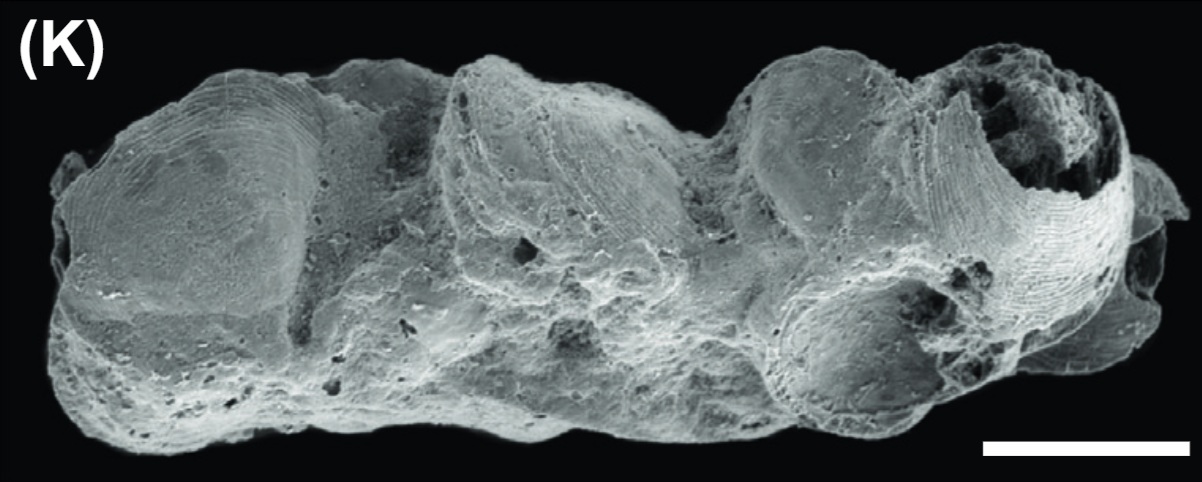
These microscopic pellets of poo are rich in phosphate. They were dropped by an unknown defecator 520-506 million years ago in what’s now Greenland.
John Peel
More phosphate-rich fecal pellets, this time from what’s now China, seen under an electron microscope.
Xi-guang Zhang
This phosphate-rich microscopic poop from Cambrian China is made up mostly of bits of shell.
Xi-guang Zhang
This pair of carbon-rich coprolites came from what’s now Canada. Note the difference in shape, suggesting they came from creatures with very different digestive tracts and probably different diets.
Tom Harvey
How defecation changed the world
The first animals on Earth were mostly simple creatures that lived in the sunlit upper layers of the ocean or on the shallowest parts of the seafloor. Depending on which set of scientists you ask, those early animals were similar to either sponges or jellyfish. Organs hadn’t been invented yet, so “eating” just meant waiting for tiny particles of food, like bits of plankton or bacteria, to float into the only opening in the animal’s body. Its cells would then engulf the food particle and break it down into its constituent molecules.
What these early animals released back into the ocean were mostly just chemical byproducts of their cells’ metabolism, not nutrients most other animals could use. So the deeper reaches of the ocean were largely unoccupied, because they didn’t offer enough nutrients to keep animals alive. Digestive tracts and poop changed everything.
By around 580 million years ago, some animals had started to evolve simple organs. Suddenly, these animals could swallow macroscopic chunks of food and digest them in their very simple—but still revolutionary!—guts, outside their cells, which probably really scandalized the sponges. That meant animals could eat more at a time, to support more complicated bodies, but it also meant they needed to dump the parts they couldn’t digest or absorb. Hence the advent of poop.
So far, paleontologists have unearthed Cambrian coprolites from about 35 sites around the world, spanning a period from around 540 to 494 million years ago.
“They range from microscopic to several centimeters in size and include forms such as elongated, cylindrical, ellipsoid, circular, and ‘exploded’ fecal ‘carpets,’” wrote Kimming and Bicknell, rather evocatively. Some of the larger coprolites contain bits of shell or exoskeleton, revealing a bit about the diets of whatever produced them. The sheer diversity of the size and shape of all that fossilized feces suggests that the animals that produced it must also have been diverse (although scientists haven’t yet managed to match very many Cambrian fossil animals to the corresponding coprolites).
Mats of bacteria thrived on this fecal feast, and some animals came to graze on the bacteria. Other, larger animals show up to eat them, converting at least some of their biomass back into poop. (Ah, the circle of life.)
At a fossil site in northwestern Canada called Raven’s Throat River, the mudstone still holds 500 million-year-old coprolites, some as wide as five centimeters, along with complete fossils of trilobites and mollusc-like hyoliths with conical shells. “In many cases these associated fossils are preserved fully articulated and appear to be in feeding position,” wrote Kimming and University of Saskatchewan paleontologist Brian Pratt in a 2016 paper about the site. The researchers concluded that the Cambrian animals were probably snacking on either the coprolites themselves or on the microbial communities growing on them.
Behold the single greatest science graphic ever created. We can all go home now.
Russell Bicknell
Behold the single greatest science graphic ever created. We can all go home now. Russell Bicknell
Everybody poops, including these animals fossilized in the Burgess Shale formation.
Smithsonian Institution
Everybody poops, including these animals fossilized in the Burgess Shale formation. Smithsonian Institution
Hyoliths were mollusc-like creatures (which may or may not be actually related to today’s molluscs) with two long, curving spines and narrow, cone-shaped shells.
Danielle Dufault/(C) Royal Ontario Museum
Hyoliths were mollusc-like creatures (which may or may not be actually related to today’s molluscs) with two long, curving spines and narrow, cone-shaped shells. Danielle Dufault/(C) Royal Ontario Museum
Everybody poops, including these animals fossilized in the Burgess Shale formation. Smithsonian Institution
Hyoliths were mollusc-like creatures (which may or may not be actually related to today’s molluscs) with two long, curving spines and narrow, cone-shaped shells. Danielle Dufault/(C) Royal Ontario Museum
Evolving bigger and better BMs
As Kimming and Bicknell looked at how coprolites changed through the Cambrian Period, they noticed a definite trend: Over time, feces got bigger and came in a wider array of shapes. That matched what they saw in fossilized guts, which started as simple, straight tubes; over 40 million years or so of evolution, animal guts developed twists and turns, specialized foreguts (the ancestor of the esophagus and stomach), and digestive glands. All of these innovations made it possible to digest larger and tougher morsels, a process we just carried on through the invention of cooking.
It’s a sign that animals in general were getting larger and more complex, and species were branching out into more and more diverse descendants. Bigger animals meant bigger poop, but bigger poop also helped support bigger animals, Kimming and Bicknell argue.
“The rapid acceleration of organism size during the Cambrian radiation increased coprolite size, which yielded a positive feedback loop, further accelerating the establishment of these ecosystems,” they wrote.
In other words, we’ve been dramatically underrating poop.
Why China’s war on deflation is faltering in real time
NEW YORK – Earlier hopes that China had beaten deflation took a hit this week.
China’s consumer prices rose just 0.5% year-on-year in July, down from June’s 1% rate — the slowest pace in six months and the third straight month of deceleration, despite surging energy prices amid Strait of Hormuz disruptions. Producer prices slowed too, rising 3.5% year-on-year in July versus 4.1% in June.
Few are less surprised by this than Yale economist Stephen Roach. “However 2026 shakes out, hopes Xi’s team is successfully deflating China’s deflation could be in for a rude awakening,” he says. “Japan’s example shows that even if headline data suggest that reflation is afoot, the deflationary mindset is very hard to change.”
The bottom line, Roach argues, is that “deflationary pressures can persist long after headline inflation turns positive, quietly eroding confidence. That’s why markets are buzzing about the possibility of People’s Bank of China easing in the months ahead — a move that could weaken the yuan and widen China’s trade surplus.”
That surplus is the unspoken subtext, according to Brad Setser of the Council on Foreign Relations. “Of course, no one explicitly says they would welcome a bigger surplus,” he says.
“But if an international institution’s policy advice is monetary easing — to fight deflation — and fiscal consolidation because of off-balance-sheet risks, plus more exchange rate flexibility, it is effectively advocating for the country to export its way out of its domestic troubles.”
Yet Beijing has resisted letting the yuan slide. A stable or appreciating currency serves three strategic aims: reducing offshore default risk among heavily indebted property developers; supporting yuan internationalization, a long-term goal to elevate it as a reserve currency; and managing tensions with Washington, where the Trump administration remains highly sensitive to any hint of competitive devaluation.
Right now, a firm yuan also helps China avoid importing even more inflation. The harder problem, as Roach warns, is psychological — and Japan has spent decades proving how stubborn that psychology can be. Recent data reflect “stalling reflationary momentum,” notes Union Bancaire Privée economist Carlos Casanova.
In the short run, he says, it’s notable that the data show “weak domestic demand,” retail sales “remaining contractionary,” and “fading commodity cost pressures,” at least for now.
Casanova says that the PBOC itself has highlighted “growing structural divergence, with AI-related sectors outperforming even as broader consumption remains sluggish. Subdued credit demand also further limited monetary transmission.” That leaves scope for a 25 basis-point cut in the reverse repo ratio.
Setser is skeptical that currency policy is doing much of the work either way: “There’s no evidence that the nominal depreciation of 2022-2023 materially reduced the pace of deflation in China, and also zero evidence that the modest nominal appreciation of the last year led to a faster pace of deflation. If anything, the pace of deflation has moderated, though I fully accept that higher oil prices have had something to do with that.”
Still, many fear the PBOC is behind the curve. Société Générale economist Michelle Lam notes that “China’s growth likely cooled notably in the second quarter to 4.4% as weak consumption and property activity outweighed resilient exports and a modest quarter-end industrial rebound.”
She adds that “while producer-led reflation supported nominal growth, policy easing is likely to remain incremental rather than a precursor to large-scale stimulus.”
The bigger question is just how incremental. Japan’s long struggle shows how stubborn deflationary psychology can be to defeat: though Japanese consumer and producer prices are rising, households still lack the confidence to increase spending enough to hasten economic growth or lift business confidence over the long run.
For Chinese President Xi Jinping, the most urgent reforms are resolving a chronic housing crisis that increasingly resembles Japan’s 1990s bad-loan spiral, and building a real social safety net so 1.4 billion citizens feel confident enough to spend rather than hoard savings.
These priorities are tightly linked — with roughly 70% of household wealth tied to property, stabilizing the real estate market across China’s 70 biggest cities is essential to reviving consumption and sustaining 4.5%-5% economic growth.
The longer Xi’s government lets these pressures fester without decisive action, the more a deflationary mindset takes hold — and the harder it becomes to shake.
Japan remains the cautionary tale. Even as the Bank of Japan struggles to lift short-term rates above the current 1% level — the farthest from zero in more than three decades — deflationary undercurrents still run through the economy, particularly in wages, which continue to lag inflation.
The result has been a slow-burn form of stagflation, and Tokyo has yet to deliver the structural reforms needed to close the gap between rising prices and stagnant household incomes.
Toshihiro Nagahama, economist at the Dai-ichi Life Research Institute, argues that for Japan “to fully break free from its long-standing deflationary mindset, it’s imperative for the government and the central bank to align, articulate their risk assessments, maintain honest and transparent dialogue with financial markets, and resolutely execute bold, long-term growth investments.”
Nagahama speaks for many when he argues that today’s global economy is being reshaped before investors’ eyes by wars in Ukraine and the Middle East, alongside a series of historic turning points in central bank policies amid rising global inflation and a strong dollar.
Amid so much uncertainty, governments can’t anchor their strategies to hopeful scenarios — they must instead plan around worst-case risks, including the possibility of a multi-year disruption in the Strait of Hormuz, a chokepoint that would reshape global energy flows and inflation dynamics.
“While these shifts present a formidable trial for Japan, they also represent a historic opportunity,” Nagahama notes. “As the country sheds its decades-long deflationary mindset and restores nominal growth, these external shocks serve as a critical test for fully escaping the paradigm of contracting equilibrium.”
Back in China, the gap between surging producer prices and muted consumer prices is now the widest since June 2022. That divergence suggests manufacturers are struggling to pass higher input costs on to consumers, leaving profit margins under pressure.
If that squeeze persists, it could have serious implications for wages across a $21 trillion economy, undermining household spending and complicating Beijing’s reflation narrative.
This China “deflation trap” problem worriesgeopolitical experts like Eurasia Group CEO Ian Bremmer. The concern, he says, is that Team Xi continues to “prioritize political control and technological supremacy over the consumption stimulus and structural reforms that could break the cycle. Beijing has the means to prevent a crisis, but living standards will deteriorate, the fallout will spread abroad, and the world’s second-largest economy will remain stuck in a trap of its own making.”
The plunge in home prices since 2020, Bremmer warns, means “household wealth destruction on par with America’s 2008 crash, except it’s still accelerating.” Consumer confidence, investment, and domestic demand have cratered with it. “Beijing,” he adds, “bet big that high-tech manufacturing would fill the gap left by property. Instead, state-driven investment has created overcapacity, and weak domestic demand means there aren’t enough buyers to absorb it.”
The good news is that Xi’s Communist Party is working to turn the nation’s $28 trillion stock and bond markets toward funding its chip rivalry with the US. This means moving away from subsidies and state backing toward a model closer to Xi’s pledge to let market forces play a “decisive role” in economic decision-making.
The worry, though, is that cracks in the underlying financial system — China’s “old economy” — limit the growth of the new one Xi aspires to create.
Roach worries that with Xi “fixated on a growth model that draws unsustainable support from innovation, new technologies, and other trappings of what they now call new quality productive forces,” he’s only “paying lip service to Chinese consumption but unwilling to take the big steps required of consumer-led rebalancing.”
As Japan taught the world, Roach says, “the problem was not so much its technological successes but the sustainability of its growth model.” He adds that the “same lesson might be very much applicable to China,” at a moment when the Chinese growth model is “showing unmistakable signs of sputtering.”
For now, China is focused on halting the capital outflows leaving mainland stocks. In recent weeks, it reactivated the so-called “national team” of state-owned investment funds Xi’s party mobilizes to boost the markets. What’s needed, though, are bold steps to revive economic confidence in the longer term, which are currently in short supply.
Beyond Oil: The Resources Reshaping the Middle East and Africa
Oil may dominate every conversation about the Middle East and North Africa, but it is only one layer of a far stranger resource map. In a wide-ranging explainer, The Media Line examines a region where enormous petroleum reserves coexist with vanishingly scarce water, narrow strips of farmland, mineral deposits crucial to global industry and coastlines capable of feeding both people and export markets.
The Gulf Cooperation Council states hold some of the world’s largest and cheapest-to-produce oil and gas reserves. Hydrocarbon revenue finances government salaries, infrastructure, schools and social benefits, while leaving budgets exposed to price swings. Algeria, Libya and Egypt are North Africa’s energy powers. Israel offers a different model: Offshore discoveries such as Tamar and Leviathan have turned a country with almost no oil from a gas importer into a regional supplier.
Yet water, not petroleum, may be the resource that most tightly controls the region’s future. The Middle East and North Africa has about 6% of the global population but less than 2% of its renewable water supply. Jordan has only about 60 cubic meters of renewable water per person annually, far below the threshold for absolute scarcity. Agriculture consumes most available water in several countries, even as cropland contracts and populations grow. Desalination, efficient irrigation and food imports are becoming matters of national survival.
The underground picture holds further surprises. Morocco possesses about 70% of known global phosphate reserves, linking it directly to fertilizer production and the world’s food supply. South Africa holds roughly 75% of platinum-group metals and vast manganese resources, giving it a major place in clean-energy, automotive and steel supply chains. Above ground, Morocco’s fishing industry produces about 1.4 million tons of seafood a year, supporting jobs and valuable exports.
The central lesson is blunt: Natural wealth does not guarantee prosperity, and scarcity need not dictate failure. Governance, political stability, technology and investment often matter more than what lies beneath the soil. Libya and Algeria show how instability and weak institutions can blunt energy wealth; Israel and Jordan show how constraint can spur specialization.
The full explainer by The Media Line Staff is worth reading for its country-by-country detail—and for a fresh view of a region shaped as much by aquifers, fertilizer and fish as by oil.