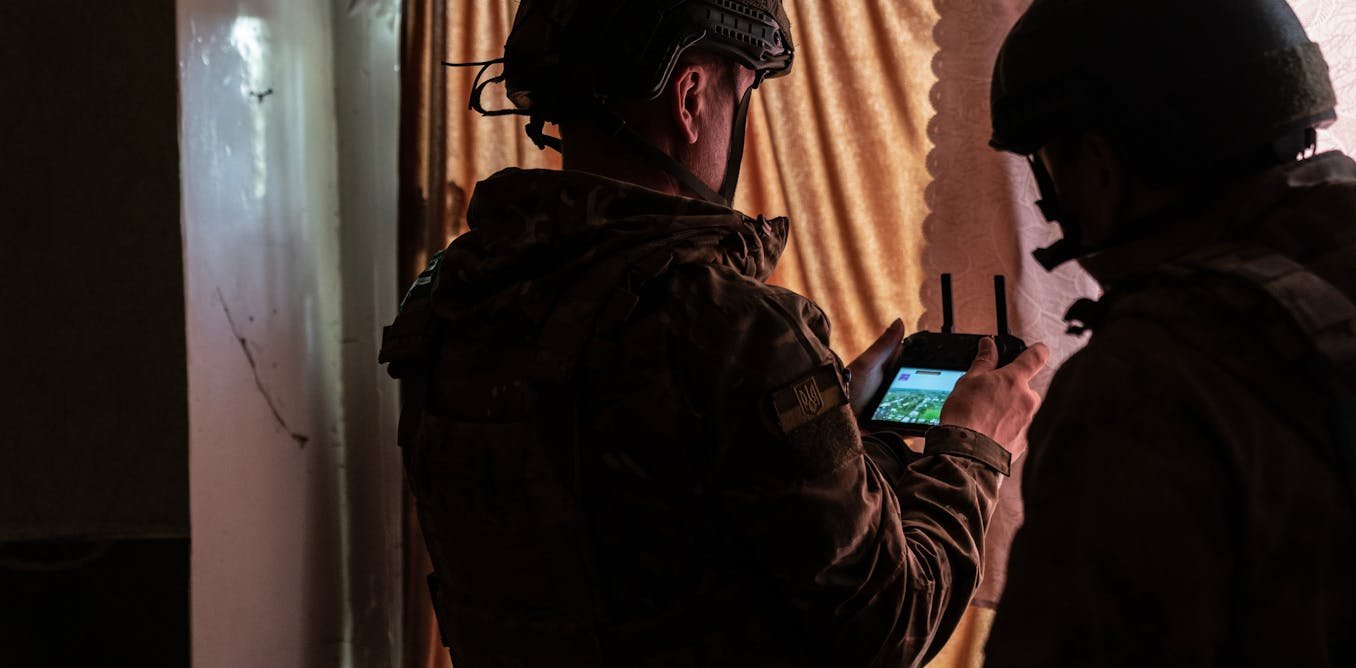
Where can you score 12 points for killing a Russian soldier in a drone attack, 20 for damaging a tank and up to 50 for destroying a mobile rocket system? Not on the latest video game, but rather through Ukraine’s Army of Drones Bonus (ADB) programme.
Launched shortly after Russia’s full-scale invasion began in 2022, before being revamped in 2025, the ADB programme is where points win prizes. Military units can use the points and virtual tokens they have accrued to buy drones and other frontline equipment to use in the conflict from the Ukrainian government’s Brave1 website.
By August 2025, military equipment worth over US$5 million (£3.7 million) had been delivered via this marketplace as digital rewards for “playing” ADB. The scheme has since extended to reconnaissance and logistics operations, while capturing a Russian soldier now grants ten times more points than killing one.
The ADB programme is an example of what researchers call the “gamification” of war – where video game-like features are integrated into military training and combat operations. Ukraine’s former defence minister, Mykhailo Fedorov, who was removed from his post in July, has said “motivation” is a key rationale for the ADB programme.
“When we change the point values, we can see how motivation changes,” he stated in 2025. Ukraine’s government has described the ADB programme as “delivering results”, with submitted video evidence confirming nearly 820,000 Russian targets were hit in 2025. Increased numbers of Ukrainian military units are also now participating in the competition.
Other schemes in this conflict have also used elements of video game design. These include Play for Ukraine. Developed by Ukrainian IT specialists in 2022, this scheme is designed in the form of a numerical puzzle game where every move a player makes helps stage a cyberattack against Russian government and media websites.
As players make moves in the game, Play for Ukraine sends requests to targeted Russian servers. They eventually become overwhelmed, causing websites to slow down or crash. Play for Ukraine’s developers say 2,048 players had helped attack more than 200 Russian websites in the first month of the scheme alone.

Gamification is neither exclusive to Ukraine or war. Our own research on the gamification of citizenship shows how mobile apps use digital rewards, points and leaderboards to incentivise good civic behaviour, such as picking up litter, recycling and community volunteering.
For example, since launching in the UK in 2021, over 10 million items of litter have been logged as binned through the LitterLotto app. Every time a person takes a photo of themselves binning litter, they earn entries into cash prize draws. The Equiwatt app also encourages UK citizens to reduce their energy usage at peak times in exchange for gift vouchers and points while competing on leaderboards.
Gamification is a popular feature of many other mobile apps too, such as Duolingo and other digital learning platforms. These apps commonly use streaks to maintain user consistency, as well as points to help users climb weekly leaderboards and progress to higher levels. The point scoring used in modern digitised warfare is a darker side to this trend.
Whose lives count?
As well as helping entrench video game features on the battlefield, the ADB programme highlights the role of foreign fighters in the Ukraine conflict and the complexities of whose lives “count”. It is well known that both Russia and Ukraine have been recruiting foreign nationals to fight in the war.
This has sometimes been state sponsored. Ukraine’s president, Volodymyr Zelensky, recently warned that the North Korean government was sending as many as 50,000 soldiers to fight with Russian forces in Ukraine. Foreign fighters have also been recruited by more unofficial means.
Russia has set up a global network for recruiting foreign nationals, targeting economically, socially, legally vulnerable people from countries such as Bangladesh, Nepal, Cuba and Kenya. The means used to recruit these people have ranged from enticement through high salaries to deceit and coercion.
So the “Russian” personnel worth 12 points for Ukrainian troops are not always Russian. Foreign fighters are also often the ones who are used as human shields, as one Bangladeshi recruit described it in a 2026 interview with DW, a German broadcaster, or pushed to the front while the Russian troops stay behind. Even in a warzone where lives are not valued, some remain less valued than others and are therefore more likely to be killed.
The theme of gamification has continued despite these extreme conditions. Some Bangladeshi soldiers fighting in Ukraine have created huge online followings, ranging from several hundred thousand people to around 1 million, by vlogging from the frontlines. They share live videos of combat from a first-person point of view, narrating everyday life in battle and providing often dramatic footage of drone attacks and near misses.
Warfare itself is clearly changing. But whether gamified or not, the lives that are lost are very much real.