Two things happened in Myanmar over the past week that belong side by side. On July 28, two Mandalay courts sentenced nine peaceful protesters to prison terms of up to 37 years under the junta’s “election protection” law and a counter-terrorism statute. Their crime was a December 2025 flash rally urging a boycott of the staged vote and an end to forced conscription.
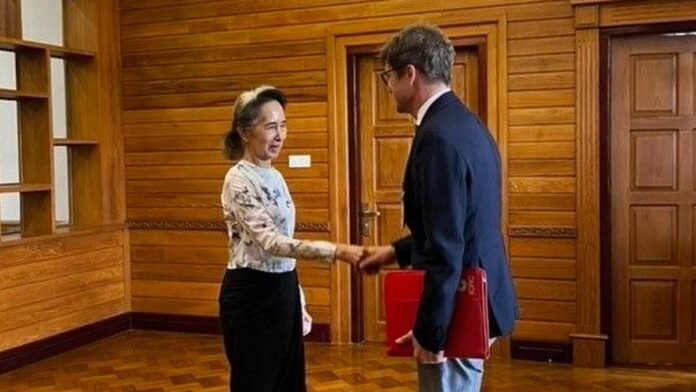
The lead defendant, 24-year-old Htet Myat Aung, was a Yangon University student union president. On August 3, in Naypyidaw, the junta released four photographs of Aung San Suu Kyi — the first images of the deposed civilian leader in more than five years — sitting in a wood-paneled room with the resident representative of the International Committee of the Red Cross.
State media announced the visit before the ICRC itself confirmed, in its characteristically restrained language, that a delegate had spoken with her in private under the organization’s standard detention procedures.
The two events are not opposites. They are the same phenomenon at different scales. Both are the vocabulary of law — statutes, courts, humanitarian protocols — deployed as coercion or as legitimacy purchase. Both arrive in the same weeks that ASEAN is being asked, quietly and repeatedly, to accept the state that produces them as normal.
That request is now being made under a fashionable argument circulating in the region’s policy commentariat: that the rules-based international order is over, that we have entered a “new realism” in which the old norms no longer apply, and that Southeast Asian states should stop appealing to a framework the great powers themselves have abandoned.
The argument sounds sophisticated. Myanmar’s own diplomacy this week is the evidence against it.
If the rules were truly dead, Naypyidaw would not need to release a photograph of Suu Kyi with the ICRC. It would simply proceed to Min Aung Hlaing’s state visit to Thailand — his first state visit to Thailand since installing himself as president in April, and his most consequential ASEAN trip to date — and dare anyone to object.
Instead, the junta stage-managed a proof-of-life tableau on the eve of that trip, and Thailand’s Deputy Prime Minister Sihasak Phuangketkeow issued a formal statement welcoming the ICRC meeting “especially… in light of the upcoming visit of the President of Myanmar to Thailand.”
The choreography is complete: the junta produces a gesture, Bangkok reciprocates with diplomatic warmth and the reciprocity becomes the currency in which legitimacy is quietly bought. As several regional analysts noted on August 3, the visit functions effectively as a diplomatic gift to Thailand — and, in the same motion, as a wedge between Thailand and the rest of ASEAN.
That wedge was laid in language weeks earlier. At the July 12 informal ASEAN meeting in Bangkok, Sihasak proposed four “indicators of progress” that quietly substituted a “reduction of violence” for the Five-Point Consensus’s original standard of “immediate cessation of violence.”
At the same press conference, Philippine Foreign Secretary and ASEAN Chair’s Special Envoy Maria Theresa Lazaro held the original line, calling for “concrete actions towards the cessation of hostilities.”
Thailand was offering the junta a softer benchmark on the eve of a state visit; the ASEAN Chair was holding the harder one. Ten days later, on July 23, the junta’s foreign ministry issued a formal statement explaining why its proxy parliament had voted to reject the Five-Point Consensus outright, invoking the ASEAN Charter, the 2008 Constitution, and “sovereignty and non-interference.”
A regime that believed the rules were finished would not spend diplomatic capital on legal argumentation. It would not need Sihasak’s softened language. It would not need the photograph. The theater is the evidence.
The photograph itself, examined carefully, shows how empty this compliance is. The ICRC’s own working standards for detention visits, published on its website, require unrestricted access to all detainees at all stages of detention, the ability to repeat visits as often as the organization deems necessary, access to all premises where detainees are held, and — critically — the restoration of family links.
The August 3 meeting was Suu Kyi’s first known contact with any foreign visitor in more than five years. Her son Kim Aris, in London, said he still has no direct contact with her, no independent confirmation of her condition, no lawyer visits, no diplomat access and no family access.
He is asking for exactly what the ICRC’s own standards require and what the UN Standard Minimum Rules for the Treatment of Prisoners, known globally as the Nelson Mandela Rules and adopted by consensus at the General Assembly in 2015, require for every criminal prisoner regardless of status — regular family communication, access to independent medical care, access to legal counsel.
One managed photo-op, five years into isolation, does not satisfy those baseline norms even for an ordinary convict. And Suu Kyi is not an ordinary convict.
She is a political prisoner recognized as arbitrarily detained by the United Nations Working Group on Arbitrary Detention in six separate opinions across two decades of imprisonment, most recently for a sequence of trials the UN Special Rapporteur called a “sham.” She is one of an estimated 15,000 to 20,000 political prisoners in the country, all of whom are held under the same regime that just produced this photograph.
The realist turns, correctly examined, strengthens the case for holding the line. The states pushing the “new realism” thesis loudest — the United States, China, Russia — can walk away from rules because their size lets them substitute power for law.
That is why they cherry-pick. Middle and small powers cannot. For sovereignty-minded ASEAN states, and for Australia, Japan, South Korea, and the EU, predictable procedure substitutes for size. It keeps trade routes open, borders respected, and disputes arbitrated rather than fought. A world where might makes right is a world where the smaller ASEAN states become terrain again, as they were before 1945.
This is where the coming UN Credentials Committee decision matters far more than its procedural obscurity suggests. This autumn the committee will decide whether Myanmar’s seat stays with the incumbent representing the 2020 mandate, passes to the junta’s post-election appointees, or is left empty as a neutral compromise. None is equivalent.
Seating the junta ratifies a coup and a fraudulent vote. An empty chair — as the Cambodia precedent showed after 1979 — becomes its own erasure, and in Myanmar’s case is precisely what the junta seeks when it cannot win the seat outright.
Only continuation of the incumbent seat honors the principle at stake: that unconstitutional seizure does not generate legitimate representation, and a democratic mandate is not extinguished by the guns that overturn it.
The July 28 sentencings and the August 3 photograph return the argument to ground. The election-protection law, the choreographed courts that handed nine peaceful protesters thirty-seven-year sentences, the room with the two chairs and the six-week-old birthday cake — rewarding any of it rewards the simulation.
The photograph is proof of life, not proof of change: two senior National League for Democracy figures died in late 2024 within days of being released from prison. Between the sentencing and the photograph stands a regime that cannot govern except by force and cannot legitimize itself except by performance. That performance requires an audience willing to be persuaded.
ASEAN and its middle-power partners are that audience. Refusing the persuasion is the minimum discipline that keeps rule of law and rule by law distinguishable.
James H. Shwe is an independent policy analyst and writer on Myanmar and Southeast Asian affairs based in California. He is not affiliated with the National Unity Government or the Steering Council for the Emergence of a Federal Democratic Union.





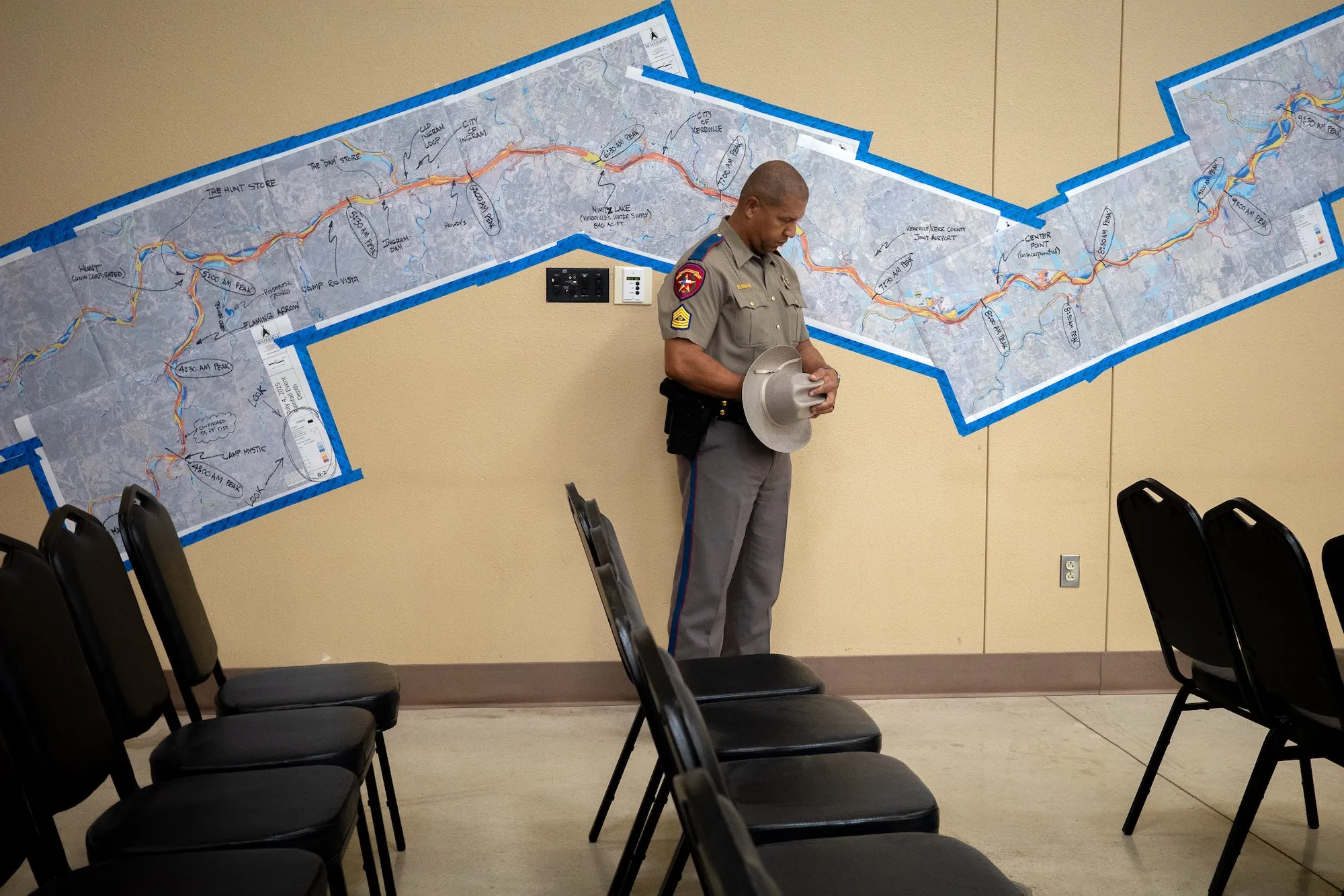 weaknesses in the state’s flood-warning and emergency management systems. Among them, the county
  said a few of the 104 sirens it had installed for landowners along the river sounded automatically, as they were designed to. Local authorities also helped dozens of people evacuate ahead of the deluge.
 United Cajun Navy’s relief efforts there last year, credits public awareness for minimizing fatalities. People checked on neighbors. They didn’t try driving through floodwaters. And they heeded calls to evacuate. “We were all on hypervigilant PTSD mode with this flood, so everyone was kind of hyperaware,” he said.