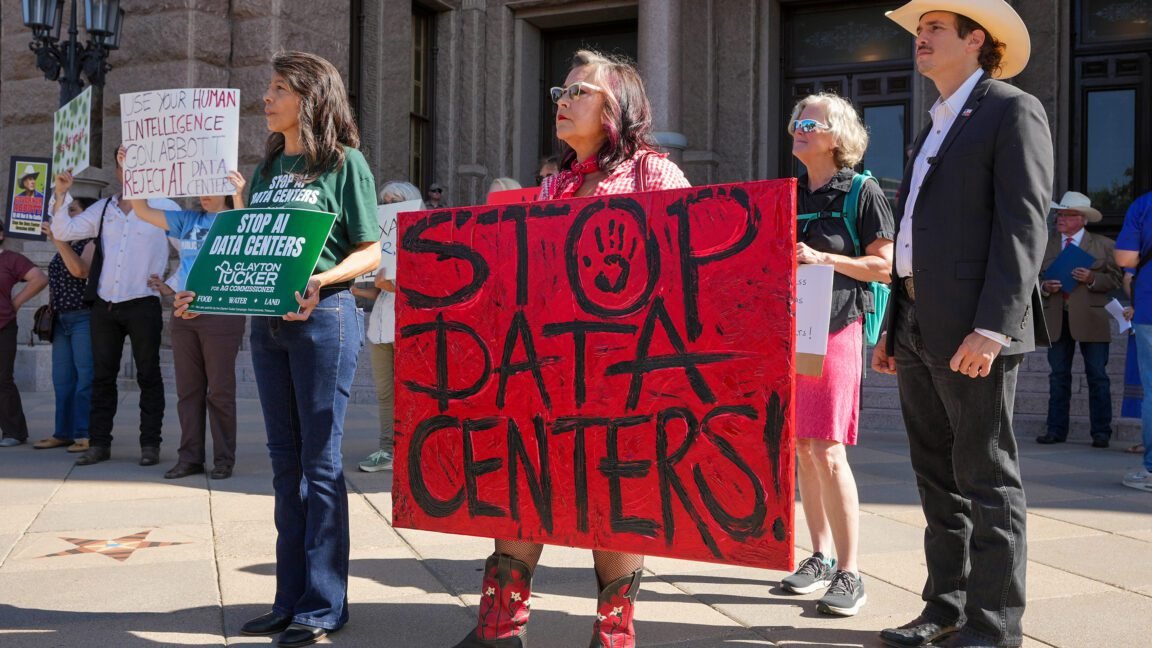
Nowhere is the US data center boom bigger than in Texas. But less than a year after declaring Texas the “epicenter of AI development,” Governor Greg Abbott has declared a moratorium on all new power grid connections for data centers—at least until developers provide more information about their projects’ potential impacts on the grid and communities.
The Republican governor directed regulators in an August 3 announcement at the Public Utility Commission of Texas and the grid operators at the Electric Reliability Council of Texas (ERCOT) to perform a “comprehensive verification and audit of all data centers advancing through ERCOT’s interconnection process.” As an independent system operator, ERCOT oversees a power grid that operates separately from the rest of the United States and provides services to most of Texas.
Texas has aggressively courted data center development with its availability of cheap land and relatively abundant energy resources, along with offering state incentives, like tax breaks and fewer regulations. That puts the state on track to surpass Virginia in becoming the largest US data center market.
But the recent AI boom and the accompanying frenzy of data center development threaten to overwhelm the Texas grid on paper, despite the state leading the country in adding new power generation. The ERCOT interconnection queue currently includes more than 1,800 projects representing over 474 gigawatts’ worth of requests to connect to the Texas grid—more than five times Texas’ record peak electricity demand—and about 90 percent of those power connection requests come from data centers.
“That unprecedented load growth could endanger the reliability and stability of the Texas electric grid,” according to the statement from Abbott’s office.
Many of those data center projects may never materialize for various reasons. But ERCOT has still forecast that data center demand and other factors could drive statewide electricity demand to double the current demand record by 2032, according to The Texas Tribune.
The AI boom has led to additional consequences for Texas. A data center tax break that originally passed with bipartisan support in 2014 has ballooned into more than $1 billion in tax breaks annually for data center developers—and The Texas Tribune reported the state government estimates it could lose $3.2 billion in sales tax revenue over the next two years.
The new directive from Abbott requires audits of data center projects that include how much data centers would depend on the ERCOT grid for power, along with obtaining projections of data centers’ annual and peak electricity consumption. The directive further requires information on how much individual data center projects depend on state financial assistance, along with details on each data center project’s ownership and controlling interests.
Possible gaps in the data center audits
Abbott also directed state regulators and grid operators to discover the extent to which data centers’ cooling systems and water usage may draw upon local water supplies needed by local communities. However, the governor’s directive does not mention the fact that data centers often use much more water through their power generation sources than directly through their cooling systems—a fact highlighted by researchers like Shaolei Ren at the University of California, Riverside.
Texas communities like Corpus Christi have already been grappling with a yearslong drought. But their water woes have been compounded by both climate change and large energy and chemical companies’ operations that have “sucked the region dry,” according to San Antonio News.
A Sierra Club report looking at federal data showed how Texas natural gas plants used 56 billion gallons of water in 2024, while coal plants consumed an additional 34 billion gallons, and nuclear plants used 26 billion gallons. By comparison, Texas data centers directly used 8 billion gallons of water for cooling purposes, but many such data centers rely on water-intensive power generation sources.
Abbott’s directive also seeks to increase scrutiny of measures that data centers are taking to “reduce impacts on neighboring property owners and communities, including noise mitigation, light controls, setbacks, traffic improvements, emergency response coordination and other community protection measures.”
But the directive conspicuously neglects to mention local air pollution and greenhouse gas emissions associated with data centers. Nonprofit newsroom Floodlight has reported that AI companies used a local permit loophole in Texas to install gas-powered turbines and backup diesel generators on site at new data center campuses—all without requiring more extensive environmental reviews or outreach to local communities.
Notably, the Texas pause on data center grid connections does not apply to data center projects that are building their own on-site power generation to get up and running as fast as possible. That “behind-the-meter power” strategy has become increasingly common among tech and AI companies like Meta, Microsoft, Amazon, Oracle, OpenAI, and Anthropic, according to research by market intelligence platform CleanView.
Such behind-the-meter power typically relies on natural gas. But with lengthy order backlogs for combined-cycle gas turbines, CleanView says data center developers are turning to alternative sources, such as “mobile gas generators strapped to semitrucks” and “aeroderivative turbines originally designed for aircraft and warships.”
Texas leads all US states in total announced behind-the-meter capacity for data centers by having 40 gigawatts of such announced capacity. That factor is driven by the Texas Permian Basin gas supply and “extensive pipeline infrastructure” along with the “state’s permissive regulatory environment,” according to CleanView.
The national resistance to data centers
Despite the oversight gaps, the Texas moratorium on data center approvals “throws a massive wrench into ERCOT’s plans to bring data centers online,” according to E&E News. The Texas grid operator has been seeking to connect data center projects to the grid in groups, with notifications for the coveted first group known as “Batch Zero” planned to go out by the end of this week. But ERCOT officials said they will postpone the Batch Zero process while working with state regulators to carry out Abbott’s directive.
Abbott’s change of tune on AI data centers comes as the incumbent governor has “seen support erode over concerns about data centers and extra-high-voltage transmission lines built in rural areas,” E&E News reported. It also pointed to polls showing Texas voters generally opposing data centers in their communities—part of a national trend among Americans—and Democratic challenger Gina Hinojosa running just one percentage point behind Abbott in a recent Fox News poll.
In a statement describing Abbott’s pause as inadequate, Hinojosa called for Abbott to issue a full moratorium on data center development until the state legislature can pass stronger rules around it. She and Democratic US Senate nominee James Talarico have both called for tighter regulations on Texas data centers.
Community concerns about data centers include local environmental impacts and rising electricity bills. State regulators have been working with utility companies to prevent residential ratepayers and small businesses from shouldering the burden of paying for the power infrastructure upgrades necessary to accommodate data center demand. The Trump administration has touted its Ratepayer Protection Pledge signed by major US tech companies, but an Ars analysis previously highlighted how that agreement lacks any meaningful enforcement mechanism.
Multiple state legislatures have introduced and debated moratoriums on data center development, including lawmakers in Virginia, which currently hosts the largest US data center market. On July 14, New York Democratic Governor Kathy Hochul announced a yearlong ban on data center construction to give the state time to work out standards for data center development.