22 C
London
Monday, August 3, 2026
Home Blog

Japan plans for the reality of war

0
japan-plans-for-the-reality-of-war
Japan plans for the reality of war

While hypersonic missiles, drones and other new weapons systems dominate the news about Japan’s military build-up, the government is also stepping up its efforts to develop first-rate combat casualty medical care.

In a worst-case scenario, the government and Japan Self-Defense Forces (JSDF) want to be ready for the kind of serious injuries and post-traumatic stress disorder (PTSD) seen in Ukraine.

It hasn’t yet proved to be a catchy topic. Although Akahata (Red Flag), the newspaper of the Japan Communist Party, recently reported on the government’s plan to ask Japanese universities to conduct research on treatment of mass battlefield casualties, there’s been little reporting from the mainstream media.

Proposed research themes include penetrating and blunt trauma, encephalopathy (brain damage), long-term storable artificial blood, artificial organs, AI-powered prosthetics, vision restoration, bone regeneration, and PTSD.

Medical and biomedical engineering will be added to the list of research topics eligible for financial support under the Security Technology Research Promotion Program, which is operated by the Acquisition, Technology & Logistics Agency (ATLA) of Japan’s Ministry of Defense. This could provide up to ¥2 billion ($12.5 million) per project.

That amount of money would be a considerable incentive for university medical schools. It should also help overcome the traditional opposition to military-related research in Japanese academia.

In any case, treatment of PTSD, brain damage and serious bodily injuries, including shock from explosions and amputation of limbs, is “dual-use” technology. It has important civilian applications in cases such as rape and bad traffic accidents.

A combat injury treatment center was established at the National Defense Medical College Hospital following the revision of Japan’s Three Security Documents (National Security Strategy, National Defense Strategy and Defense Build-up Program) in December 2022. Before that, the SDF paid relatively little attention to combat casualty care because it did not undertake many high-risk missions and perhaps was not really expecting to fight.

That approach changed, however, with the outbreak of war in Ukraine. One of the aims of the revised National Defense Strategy was to “promote fundamental reforms to improve the combat trauma care capabilities.” This, according to an government source who wishes to remain anonymous, is still a work in process.

In the area of combat care, Japan works closely with the US military.

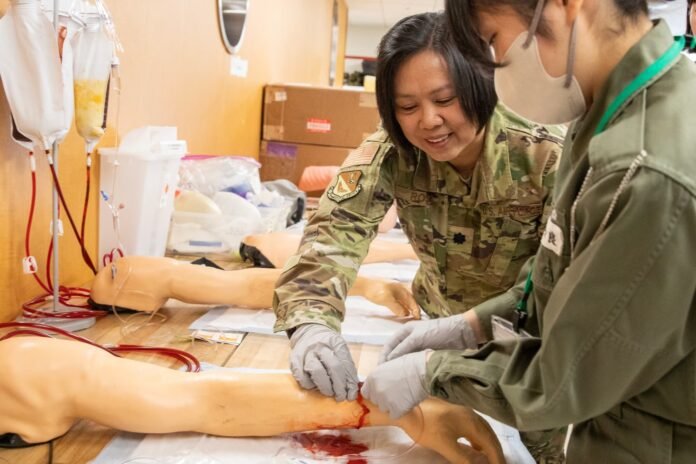
The US Air Force’s 374th Medical Group at Yokota Air Base west of Tokyo hosts an annual tour for Japanese nursing students from the National Defense Medical College, which is just 12 miles away in Tokorozawa City. The most recent tour was held in March of this year.

“The purpose of this tour,” said US Air Force Major Moshood Yinusa, “is to showcase the life and work of US active-duty nurses and foster engagement between Japanese nursing students and US culture and military medicine.”

Yokota Air Base is home to the 515th Air Mobility Operations Group of the US Air Force, which manages air mobility operations throughout the Western Pacific, and the Japanese Air Defense Command. 

JSDF personnel also participate in Tactical Combat Casualty Care (TCCC) training exercises with the US military. Watch this on video here.

Last January, at Camp Hansen, Okinawa, Japan, the Expeditionary Operations Training Group of III Marine Expeditionary Force (III MEF) ran JSDF cadets through trauma medicine scenarios to teach them how to provide medical care under the pressure of battle.

III MEF is the nucleus of a joint and coalition force that operates within the First Island Chain off the Asian mainland and across the Indo-Pacific.

Until the arrival of Donald Trump in the White House, the Japanese were careful to avoid getting dragged into American wars. Now, with China becoming more assertive and tensions having risen from Korea to Taiwan and the South China Sea, they are more concerned with keeping the US involved in East Asia and cooperating more closely with the US military while building up their own defense capabilities.

Furthermore, as Prime Minister Sanae Takaichi put it last January, “Learning from Russia’s aggression against Ukraine, countries are now urgently preparing for new forms of warfare, including the mass deployment of unmanned drones, and furthermore preparing for extended periods of fighting, under the assumption that once such conditions arise, there is a high likelihood of the situation becoming prolonged.”

Aside from the question of whether or not the example of Ukraine is relevant to Japan’s national security challenges, preparation for serious armed combat includes improvements in combat casualty care.

In April, Japan’s Ministry of Defense issued a policy presentation stating (in translation) that,

In a contingency, the incidence of Acute Stress Disorder (ASD) and Post-Traumatic Stress Disorder (PTSD) is expected to rise. Furthermore, the increased lethality of modern weaponry is likely to result in a greater number of cases involving traumatic brain injuries and musculoskeletal impairments caused by limb injuries, thereby driving up the demand for physical rehabilitation.

To ensure the capability to respond to various contingencies and a wide range of domestic and international missions, we will consolidate common medical functions across the Self-Defense Forces to promote integrated operations; establish a posture that mobilizes the full collective strength of SDF medical services – including the National Defense Medical College – and drive fundamental reforms to enhance capabilities in combat casualty care.

This is a big change from attitudes in the past, when the serious psychological and social effects of PTSD were largely ignored.

In August 2024, Japan’s Ministry of Health began its first comprehensive survey of PTSD among Japanese soldiers in WWII and its long-term impact. The results were presented in an exhibition that opened at the Shokei-kan in Tokyo in July 2025, just in time for the 80th anniversary of the end of the war.

The Shokei-kan is a museum that collects, preserves and showcases verbal testimony, historical materials, books and other information about the suffering of sick and wounded soldiers, and their families, during and after the war. Shokei here means to pass down, succeed or inherit. Kan means a building or hall. A short walk from Kudanshita Metro station, Shokei-kan is not far from Yasukuni Jinja, the shrine dedicated to Japan’s war dead.

Follow this writer on X: @ScottFo83517667

‘Speak Out in Defense of Spain’s Territorial Integrity,’ Spanish MEP Urges Netanyahu 

0
‘speak-out-in-defense-of-spain’s-territorial-integrity,’-spanish-mep-urges-netanyahu 
‘Speak Out in Defense of Spain’s Territorial Integrity,’ Spanish MEP Urges Netanyahu 


Tens of thousands crossed into a city of 84,000 in a matter of days, leaving at least 83 dead on both sides of the border and raising questions about Morocco’s role, Spain’s sovereignty and Israel’s response 

The border crisis in Ceuta prompted Juan Carlos Girauta, a Spanish member of the European Parliament, to make a direct appeal to Israeli Prime Minister Benjamin Netanyahu. 

“With my greatest admiration and respect for Netanyahu’s life story and courage, I ask Netanyahu to speak out in defense of Spain’s territorial integrity, because the Spanish government is not Spain,” Girauta told The Media Line.  

The scale of the influx from Morocco was difficult to measure in real time. Spain initially estimated that just under 50,000 people entered on Thursday, July 30, and the total reached close to 60,000, including those who followed over the next several days. By Monday, Aug. 3, police sources said about 69,500 had returned to Morocco. That figure may have included earlier arrivals and people who crossed more than once. People entered through the land frontier, climbed the fences, or swam around the Tarajal breakwater. Ceuta itself has only about 84,000 residents.

José Bentolila, president of Ceuta’s Jewish community, said residents had noticed a steady movement toward the city before the main crossing began. “We had already spent several days seeing an incessant trickle of migrants, morning and afternoon,” Bentolila told The Media Line. 

From workplaces facing the Moroccan coast, residents could see what he described as “a line of flotation rings in the water—hundreds of them.” On Wednesday, he said, police advised businesses to close because they could not predict how large the movement would become. 

As border controls were overwhelmed, much of Ceuta stopped functioning. Shops closed, bread became difficult to find, and many residents remained inside. Bentolila said people who had crossed stopped cars to ask for food, money or access to a telephone. He said police responded to fights, while residents and business owners reported thefts, looting and attempted entries into homes. “Any business that tried to open even a little had perhaps 500 people come in and had to close and call the police,” he said. “You cannot serve 90,000 people all at once.” 

By Monday, Ceuta had yet to absorb the aftermath. Between 3,000 and 5,000 migrants were still in the city, according to official estimates, and some were sleeping outside because the reception centers were full. Spanish authorities had taken responsibility for 862 children and teenagers who arrived without an adult. 

The human toll was also becoming clearer. Spanish officials reported 72 deaths on the Spanish side of the border, while Morocco’s Foreign Ministry reported 11 deaths on the Moroccan side. Spanish authorities said more than 1,000 people had received medical treatment.  

Police and military reinforcements remained in Ceuta. By Aug. 2, a 500-meter floating barrier had also been deployed off the Tarajal breakwater. 

For Ceuta’s Jewish community, the crisis brought fear but no reported antisemitic attacks. Bentolila said the synagogue and other communal sites already receive discreet police protection because authorities consider them sensitive locations. Shabbat services went ahead. “People go out with some apprehension, some fear, because they do not know what they will find in the street,” he said. “Suddenly, you may come across a group of 40 or 50 people.” 

“We have not had any antisemitic incident,” Bentolila added. “We cannot point in that direction, at least for now.” 

The emergency was concentrated in Ceuta, but the political dispute surrounding it soon reached Madrid, Brussels and Jerusalem. 

Israel’s ambassador to the United Nations, Danny Danon, accused Spain of hypocrisy for deploying troops in Ceuta after repeatedly criticizing Israeli security policies. “Maybe before it continues lecturing us, it’s time it explained to the world why it still maintains colonial enclaves in Africa,” Danon wrote, referring to Ceuta and Melilla. 

Israel’s chargé d’affaires in Spain, Dana Erlich, quickly distanced the government from the post. Danon’s comment “does not represent the position of the State of Israel,” she wrote. Bentolila said it was the only public Israeli response the community had seen. “Of course we would have liked” a message of support, Bentolila said. “That is always welcome.”  

Of course we would have liked” a message of support. That is always welcome.

For Girauta, Erlich’s clarification did not undo the political damage. He said Danon’s intervention gave supporters of Prime Minister Pedro Sánchez material to use against Vox and other Spanish defenders of Israel. Television discussions about the border failure soon included claims that Israel and the United States had contributed to the crisis. 

Online accounts also revived a 2019 post by Netanyahu’s son Yair mentioning Ceuta and Melilla. No evidence has emerged connecting Israel to the crossings. “That is the political ammunition they are giving Israel’s enemies in Spain,” Girauta said.  

Ángel Mas, president of ACOM, a Spanish organization that campaigns against antisemitism and supports relations with Israel, said Israeli anger toward Sánchez was understandable after years of disputes over the Gaza war. Mockery directed at Ceuta, however, harmed some of the people most willing to defend Israel inside Spain. “The pro-Israel position in Spain has probably not been this compromised or this weak for a long time,” Mas told The Media Line. “Who does that help? It helps Sánchez.” 

The pro-Israel position in Spain has probably not been this compromised or this weak for a long time

Neither Mas nor Girauta accepted comparisons between the border crisis and the October 7, 2023, attack in Israel. “Nothing about this is comparable to October 7,” Girauta said. 

The only resemblance they identified concerned the first hours after the border controls were overwhelmed, when residents did not know who had entered or whether the authorities controlled the surrounding streets. 

Ceuta and Melilla are Spanish autonomous cities, and their residents are Spanish citizens. Ceuta has been under Spanish sovereignty since the 17th century, although Morocco claims both Ceuta and Melilla and characterizes Spanish rule there as colonial.  

Girauta called the mass crossing “hybrid warfare” and accused Moroccan authorities of allowing or encouraging it. Mas used the same term, arguing that an influx of such magnitude was difficult to explain as a simple loss of control. 

Public evidence has not established that Morocco organized the influx. Reports citing officials familiar with Spain’s intelligence assessment said Rabat apparently did not plan the crossing but allowed it to develop by gradually relaxing border controls. Morocco denied using migration to punish Spain and blamed human traffickers, economic hardship and false information spread online. 

Sánchez visited Algiers 10 days before the largest arrivals. His July 20 meeting with Algerian President Abdelmadjid Tebboune ended with an agreement to expand political cooperation and reconvene senior officials in October. Algeria supplied 42.7% of Spain’s natural gas in May.  

With Algeria and Morocco locked in a longstanding regional rivalry, the sequence of events immediately raised questions about Rabat’s motives. Some analysts and political figures suggested that the border crisis could have been a warning over Madrid’s renewed contact with Algiers. So far, nothing made public by either government supports that theory. 

Spanish Interior Minister Fernando Grande-Marlaska did not endorse that interpretation. Even amid the crisis, he continued to refer to Morocco as a reliable partner. He blamed smuggling networks for spreading false claims about a Spanish court ruling on summary returns. 

Sánchez, meanwhile, described the crossing as an “attack” and a violation of Spain’s territorial integrity, yet thanked Morocco for helping return those who entered. 

Girauta said those positions were difficult to reconcile. 

Grande-Marlaska also said Spain’s CNI intelligence service had not warned him that a mass crossing was imminent. Reports of a breakdown between security agencies subsequently produced friction between the interior and defense ministries. 

The reaction elsewhere in Europe was swift, even though the influx remained confined to Ceuta. Twenty-two EU governments called for urgent talks on external border security. Girauta said they had reacted “with concern, great concern.”  

“It is not only Spain’s border; it is Europe’s border,” he said. 

It is not only Spain’s border; it is Europe’s border

Italy temporarily began checking passengers arriving by air and sea from Spain, focusing on travelers from outside the European Union.  

Sánchez accused European partners of abandoning Spain. European Commission President Ursula von der Leyen sought to calm fears of onward movement. “Not a single person reached mainland Spain or the rest of the EU,” she said. 

Vox MEP Hermann Tertsch was unsurprised by the response in Brussels. “We did not expect much from there,” he told The Media Line, accusing the European Parliament of repeatedly favoring illegal immigration. 

Support instead came from conservative and nationalist groups that “reacted immediately and with full solidarity with the Spanish nation and Spain’s national and territorial integrity,” Tertsch said. 

He compared the status of Ceuta and Melilla to that of a US state. “For the United States, Hawaii is the United States,” Tertsch said. “The Canary Islands and the Balearic Islands are Spanish. That is simply how things are.”

Israel’s close relationship with Morocco further complicated the position of its Spanish allies. As the crisis unfolded, Israeli Foreign Minister Gideon Sa’ar congratulated King Mohammed VI on the 27th anniversary of his accession to the throne and praised Moroccan Foreign Minister Nasser Bourita for his commitment to bilateral relations. 

Girauta said the timing was difficult to explain without a separate Israeli statement supporting Spain’s territorial integrity. 

Tertsch made the same argument in sharper terms. “Attacks on Spanish sovereignty and Spanish territories only benefit Sánchez,” he said, accusing the prime minister of trying to separate Spain from Washington, Jerusalem and its “natural allies.” 

Attacks on Spanish sovereignty and Spanish territories only benefit Sánchez

“We must not make that easier by giving an opening to those who want to present Israel and the United States as enemies that encourage the Islamist invasion of Europe,” Tertsch said. 

Mas warned Israelis not to confuse warm relations with Morocco’s government with attitudes across Moroccan society. “The Moroccan government is friendly. The people are not,” he said. “The Spanish government is not friendly, but the people are not hostile.” 

“Many Spanish Jews have their origins in Morocco,” Mas added. “There were 250,000 Jews living in Morocco until 1948.” 

Most of Morocco’s Jewish population left in the decades after Israel’s establishment, though estimates of the community’s size and the timing of its departure vary. By contrast, the Jewish communities of Ceuta and Melilla remain part of cities that have long presented coexistence among Jews, Christians, Muslims and Hindus as central to their identity. 

Bentolila said Ceuta’s residents largely know one another regardless of religion. “One of the pillars of the city is that it is the city of four cultures,” he said. “We always raise the flag of those four cultures because of the understanding among them.” 

By the beginning of the week, thousands of people remained in Ceuta, reception facilities were overwhelmed, and residents were still trying to understand how border controls had been overwhelmed so quickly.  

Bentolila would not turn the Jewish community into a party to the dispute among Spain, Morocco and Israel. His concern remained closer to home: protecting families, reopening businesses and preserving the coexistence on which the city prides itself. 


US company’s AI lets Ukraine’s cheap kamikaze drones track targets on their own

0
us-company’s-ai-lets-ukraine’s-cheap-kamikaze-drones-track-targets-on-their-own
US company’s AI lets Ukraine’s cheap kamikaze drones track targets on their own

Ukrainian drone operators have destroyed many Russian armored vehicles on the ground and even military helicopters in midair using $400 Shrike drones with explosive payloads. Now thousands of such drones are getting upgraded with an AI system capable of autonomously tracking and homing in on moving targets.

In mid-July, the Ukrainian military began receiving Shrike drones made by the Ukrainian company SkyFall equipped with AI-powered autonomy hardware and software developed by the US company Auterion. The companies plan to deliver 50,000 drones equipped with Auterion’s Skynode S strike kits in the coming months.

That allows human operators to manually fly the Shrike first-person view (FPV) drones into a battlefield area, designate a target up to half a mile away and then “flip the switch to turn it into fire-and-forget terminal guidance mode,” Lorenz Meier, co-founder and CEO of Auterion, told Ars.

The operator can abort a strike or choose a different target as long as they have a radio signal connection with the drone, Meier explained. But the drone can still automatically track and fly into targets without any human guidance, even if it loses its connection with the operator due to buildings or terrain blocking the signal or because of enemy jamming on the same radio frequencies.

To home in on targets, Auterion’s software relies solely on the visual information available from the Shrike drone’s main onboard camera. That means the Shrike drones can track and strike moving targets without any reliance on GPS—a crucial advantage on modern battlefields where GPS jamming has also become common.

That could further enhance the success rate of remotely piloted Shrike drones that have already struck many vehicle-size targets since Russia launched the full-scale invasion of Ukraine in 2022, including armored tanks, electronic warfare systems, artillery guns, and rocket launchers. Shrike drones have reportedly taken down two Russian Mi-28 helicopters, each worth as much as $19 million, according to the Kyiv Independent.

Cost-effective AI for battlefield drones

Until now, the Ukrainian military has mainly relied on human operators to manually guide drones toward their targets, with the exception of mid- or long-range strike drones such as the $5,000 AI-powered “Hornet” drones developed by the California-based company Perennial Autonomy founded by former Google CEO Eric Schmidt. Those drones often fly far beyond the frontlines to target Russian oil refineries and energy infrastructure, factories and warehouses, or even ships in the Sea of Azov and the Black Sea.

But Auterion focused on creating AI-powered capabilities for the cheaper, shorter-range FPV drones that have become the most common weapons responsible for killing or wounding soldiers on the frontlines in Ukraine. The company developed a tightly integrated flight control system and terminal guidance system optimized to run on a Western-made Arm system-on-a-chip costing just $18.

“What we are doing is replacing the existing flight controller—which has no computer, no AI—with avionics that has a microprocessor unit, has AI on board, and can track into the target fully autonomously,” Meier told Ars.

Each of SkyFall’s Shrike drones equipped with such capability costs about $2,000, compared to the $400 Ukrainian drones that rely only on manual piloting, Meier wrote in a blog post.

By comparison, he described Western militaries as still purchasing “precision munitions at six or seven figures per shot (30–60 times this price), drones procured in batches of dozens, priced like exquisite aircraft, delivered on timelines measured in years.”

The 50,000 Shrike drones equipped with Auterion’s strike kit were funded by a $100 million contract backed by an officially unnamed European country. Reuters reported that Germany is the country funding the order, and Meier also disclosed that Auterion’s team based in Munich, Germany, is fulfilling the order.

This is the largest delivery order to date for Auterion. But the company also previously committed to delivering 33,000 drone strike kits to Ukraine in July 2025, with backing from a $50 million Pentagon contract.

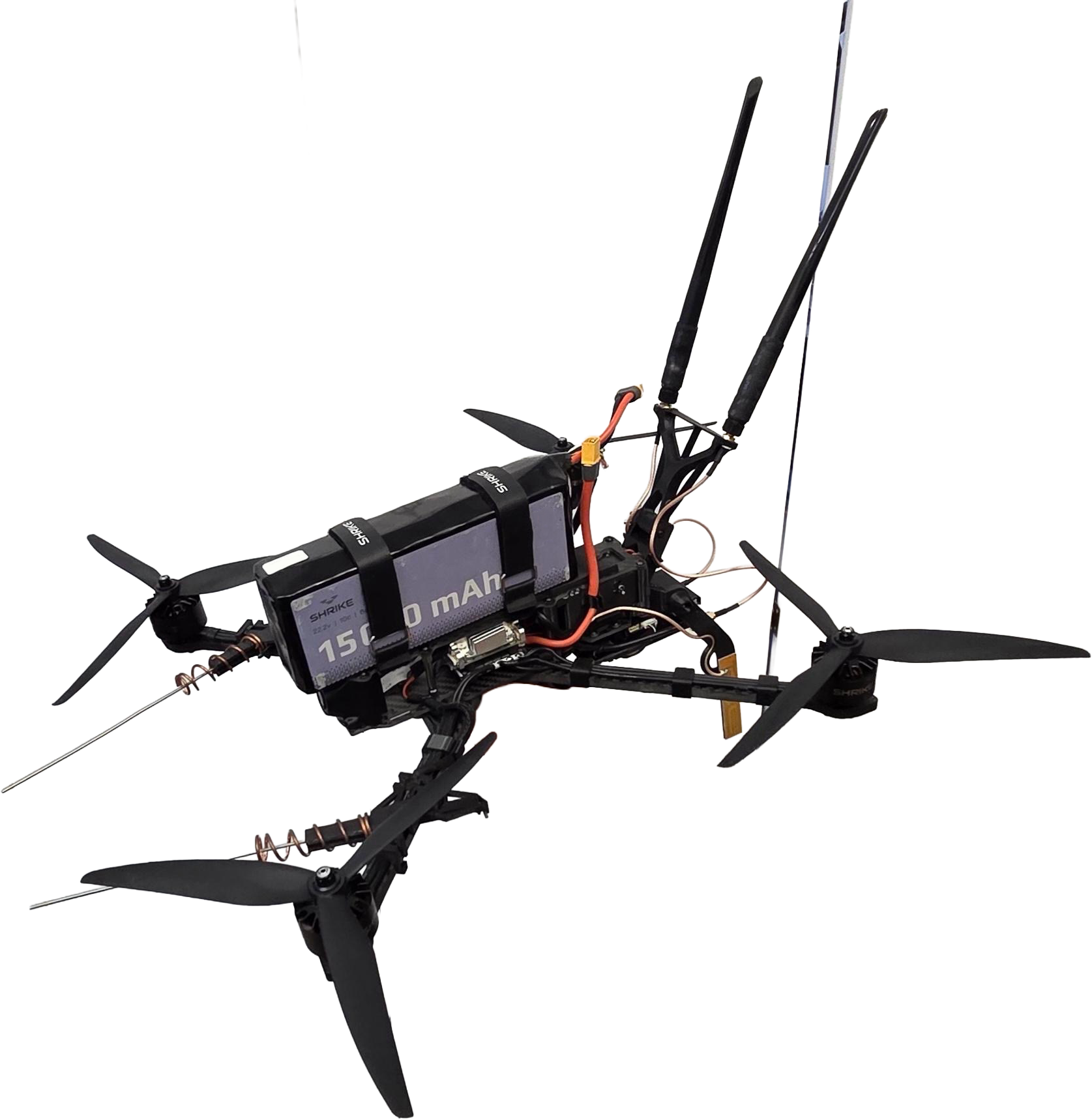
Close-up image of a Shrike quadcopter drone made by the Ukrainian company SkyFall.

A Shrike FPV drone manufactured by the Ukrainian company SkyFall that can be equipped with Auterion’s AI-powered drone strike kit.

A Shrike FPV drone manufactured by the Ukrainian company SkyFall that can be equipped with Auterion’s AI-powered drone strike kit. Credit: Auterion | SkyFall

Human control and drone swarms

The drone strike kits would also enable SkyFall’s Shrike drones to receive future software updates that could enable a single human operator to command an autonomous swarm of drones to attack targets.

Auterion did not provide a timeframe for when this might happen. But the company has already demonstrated such drone swarming capability during a live-fire combat exercise at a US military range at Camp Blanding in Florida. The demonstration involved a drone pilot commanding three autonomous strike drones to take out three separate targets.

Such swarm capability provided by Auterion’s Nemyx system means that drones can autonomously work together to prioritize higher-value targets and adjust on the fly as targets are destroyed, so multiple drones aren’t wasted on the same target, Meier explained. That can all happen without any human input after the operator first directs the drone swarm toward a given objective.

“It basically means that you can point one of our swarms at an objective, and you can either decide to point all the munitions at a single target point, or you can actually spread them out from the get-go, and they will reprioritize,” Meier told Ars. “If you kick the swarm into strike mode, the whole thing strikes. If you let it abort, the whole thing aborts.”

The autonomous drone capabilities provided by Auterion’s strike kits also simplify the piloting skill required of human operators—regardless of whether they are piloting a single drone or commanding a swarm. That could help Ukraine’s military deploy more drones using a limited number of drone operators, and could prove even more invaluable for the United States or other countries that don’t yet have large numbers of trained drone operators.

“We found that we can train people within—I’m not kidding—60 seconds to operate this drone and even to operate the swarm, because you just move up and down to steer them in the right direction towards the target,” Meier said. “And when you are close enough to acquire the target, you just select it on the screen.”

The prospect of deploying fully autonomous drones on the battlefield may seem to be creeping closer. But Meier emphasized that Auterion believes in keeping a human in the target selection process.

“I am not sure if our adversaries eventually will allow us that, because they might enter into a way of warfare where we have to send autonomous systems against autonomous systems and let them make split-second decisions,” Meier said. “But until we are at that point, we as a company, and I personally believe, it’s really good if a human operator makes a life-or-death decision.”

Ukraine’s battlefield innovation system

Having visited Ukraine eight times to talk with the country’s top political and military leaders while working alongside Ukrainian drone manufacturers, Meier praised Ukraine for developing a system that enables a rapid cycle of innovation and improvement informed by battlefield experience.

“The Ukrainian forces are relatively accepting of initial battlefield failure,” Meier told Ars. “A lot of the Ukrainian firms didn’t show up with a perfectly working product—they showed up with something that was better than nothing, and then iterated through a lot of failures towards a point where it works every single time.”

Ukraine has also created an effective system for evaluating how well new drones and other weapons perform on the battlefield in terms of hit rates and delivering results of military value, Meier said. That feeds back into the cycle of innovation and has enabled Ukrainian companies to take huge risks in developing drones, robots and other weapons, while learning from failures on how to harden their systems for modern battlefields.

By comparison, the US military’s strict schedule for selecting new drone technologies through the Pentagon’s Drone Dominance program means that companies cannot easily come back several weeks later with a greatly improved product if they fail to make the cut at each selection stage. But Meier described Auterion as being well positioned to bring some lessons learned from Ukrainian battlefields back to compete within the more regimented US system.

The US military will also need the equivalent of a common operating system for its command and control systems to work seamlessly with autonomous drones from many different manufacturers as it looks to eventually deploy thousands of drones, Meier said. He described Auterion’s long-term ambition as creating a software ecosystem that allows various software companies to develop applications for many types of drones from different companies—a vision that draws from his own experience in developing open source software and open hardware standards used in the drone industry.

“You need the autonomy to fold into your command system, which means you need the same operating system, and maybe you can afford to integrate two or three—like there are apps for iOS and Android and I think that’s OK,” Meier said. “But you can’t have 15.”

The China positivity, US negativity illusion

0
the-china-positivity,-us-negativity-illusion
The China positivity, US negativity illusion

For nearly two decades, one line in the global opinion charts held steady: the United States was better liked than China. That line has now crossed.

Pew Research Center’s July 15 report, based on 42,151 interviews in 36 countries between February and May 2026, finds China viewed more favorably than the United States in most nations surveyed.

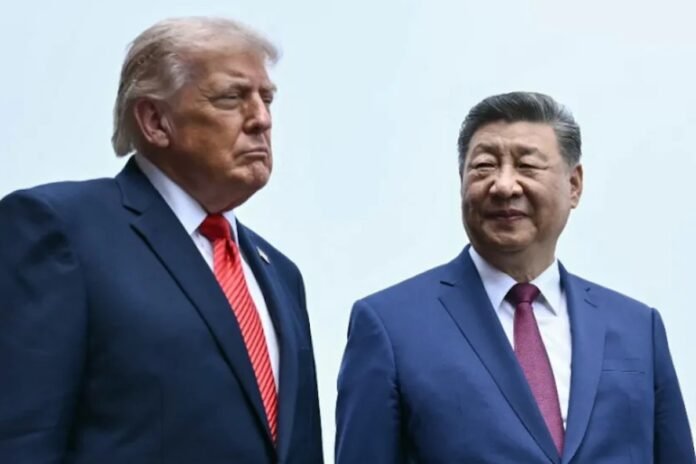
Confidence in Xi Jinping now runs ten points ahead of confidence in Donald Trump across the twenty countries Pew has tracked since 2023. Gallup recorded the same crossover a year earlier, with China at 36% approval and America at 31%.

The temptation is to read this as a scoreboard: China up, America down. It is better read as a diagnostic test. And like most tests, its real value lies in what it cannot tell us.

Start with a distinction doctors use every day. How many people currently have a disease is one question. How fast new cases are appearing is a different one. Favorability polls blur the two, and the blur matters here.

China’s standing has improved only modestly. America’s has collapsed. In Sweden, the share of people calling the US a reliable partner fell from 83% in 2022 to 31% today, a drop of 52 points. China gained just 15 points over the same period, from 12% to 27%. Canada shows the same pattern: American reliability down 48 points, Chinese reliability up 30.

Even where Xi now outpolls Trump by double digits, enthusiasm is thin. His best rating in Europe is a modest 37%, in the United Kingdom.

In other words, the crossover was produced mostly by subtraction. Pew’s own analysis says China’s lead comes largely from souring views of the United States. A patient does not become healthy because the person in the next bed is getting worse faster.

The mix of countries surveyed matters too. Nearly half of Pew’s sample consists of middle-income countries, exactly where China’s advantage is widest.

China hit record highs this year in Colombia, Indonesia, Malaysia, Mexico, Nigeria and Turkey. Across 17 middle-income publics, a median of 75% say the United States interferes in other countries’ affairs; only 45% say the same of China.

Weight the survey more toward wealthy democracies, or toward China’s own neighbors, and the headline would look different.

That is the point Asian readers should sit with. The reversal has conspicuously not happened among China’s neighbors. The United States keeps its edge in just six countries, and four of them are in the Indo-Pacific: India, Japan, the Philippines and South Korea.

In the Philippines, 81% call America a reliable partner, against 42% for China. In Pakistan, the ratio flips: 84% trust China, 36% the United States.

Living next to a great power, especially one you have a maritime dispute with, tends to strip away its charm. Asia is not converging on a single view of China. It is splitting along the line of who lives closest to it.

The most underrated finding is not the direction of the shift but its speed. The ISEAS-Yusof Ishak Institute’s survey of Southeast Asia has flipped three times in three years: to China in 2024 (50.5% to 49.5%), back to the United States in 2025 (52.3% to 47.7%) and to China again in 2026 (52% to 48%).

Opinion that swings this easily is not a store of goodwill built over decades. It behaves more like a spot price, reacting to the latest shock: a tariff announcement, an energy disruption, a careless remark. Pew’s own record shows how quickly the direction can reverse. American favorability, and confidence in the US president, jumped sharply after January 2021.

The polls also hide as much as they reveal. A single favorability number mixes feelings that pull in opposite directions. People can admire Chinese electric vehicles, high-speed rail and cultural hits such as Black Myth: Wukong and Ne Zha 2, while still distrusting how China is governed.

In only 11 of the 36 countries do roughly half or more believe the Chinese government respects its people’s personal freedoms. The United States still leads on that measure, but the gap is closing mainly because faith in America has fallen, by 25 points or more in Canada, France, Germany, Italy, the Netherlands, South Korea, Spain and Sweden.

A number that cannot tell the difference between liking a country’s products and trusting its institutions is a dangerous number to plan around.

So what should Asia’s middle powers take from all this? Neither celebration nor alarm. Global publics currently see Beijing as the more predictable partner and Washington as the more erratic one. But perceptions of predictability are themselves the most changeable thing in the data. A hedging strategy built on 2026 sentiment will be tested by 2027 sentiment.

The harder question is whether each power’s problem is temporary or built in: whether American standing can bounce back with a new administration, and whether Chinese standing can deepen without change in the governance record that global publics still watch.

Nothing in this year’s survey answers that. It only tells us that the two curves finally touched. And curves that touch once tend to touch again.

Y. Tony Yang is an endowed professor at the George Washington University in Washington, D.C.

350 more Sudanese return home from Egypt under voluntary repatriation program

0
350-more-sudanese-return-home-from-egypt-under-voluntary-repatriation-program
350 more Sudanese return home from Egypt under voluntary repatriation program

Some 350 more Sudanese nationals have returned home from Egypt under a voluntary repatriation program, according to Sudan’s official news agency SUNA.

The Al-Amal Committee for Voluntary Return, a community-led humanitarian initiative, said the returnees departed the northern Egyptian city of Alexandria on Sunday aboard seven buses.

Sudan’s Consul General in Alexandria Abdel-Dayem Ali Al-Bashir saw off the returnees and said voluntary return journeys would continue until the last Sudanese national returns home.

Ismat Ahmed Saeed, the committee’s representative in Alexandria, praised the Sudanese consulate’s role in implementing the repatriation program, expressing hope that coordination would continue for future trips.

READ: Sudan’s Burhan chairs first security meeting after army gains in North Kordofan

According to the committee, the new returnees brought the number of Sudanese who returned to Sudan from Egypt since last month to nearly 5,500 people.

Since the war between the Sudanese army and the paramilitary Rapid Support Forces (RSF) broke out in April 2023, more than 1.2 million Sudanese have fled to Egypt, according to official estimates. About 5 million Sudanese were already living in Egypt before the war, making it one of the main destinations for people fleeing the fighting.

By the end of 2025, about 428,676 people had voluntarily returned to Sudan, according to figures previously announced by the Sudanese authorities.

​​​​​​​The war between the Sudanese army and RSF over disputes about integrating the paramilitary force into the military has created one of the world’s worst humanitarian crises. It has killed tens of thousands of people and displaced about 13 million.

READ: Sudan resumes voluntary return convoys from Egypt as 1,200 citizens travel home

Lego deploys Hubble Space Telescope as detailed desktop model

0
lego-deploys-hubble-space-telescope-as-detailed-desktop-model
Lego deploys Hubble Space Telescope as detailed desktop model

For 35 years, the Hubble Space Telescope has looked out into the Universe. Now, Lego is inviting builders to look inward with its latest model of the orbiting observatory.

The new Lego Icons Hubble Space Telescope (set no. 11382) was released on August 1 for $140 at the toy company’s stores and its online shop. The 1,252-piece kit builds a 15-inch-long (38-cm) desktop model that is about twice as large as the previously released Lego Hubble models.

The Icons Hubble is the first to be sized in comparison to a Lego minifigure, such that the included astronaut provides a sense of scale for the telescope.

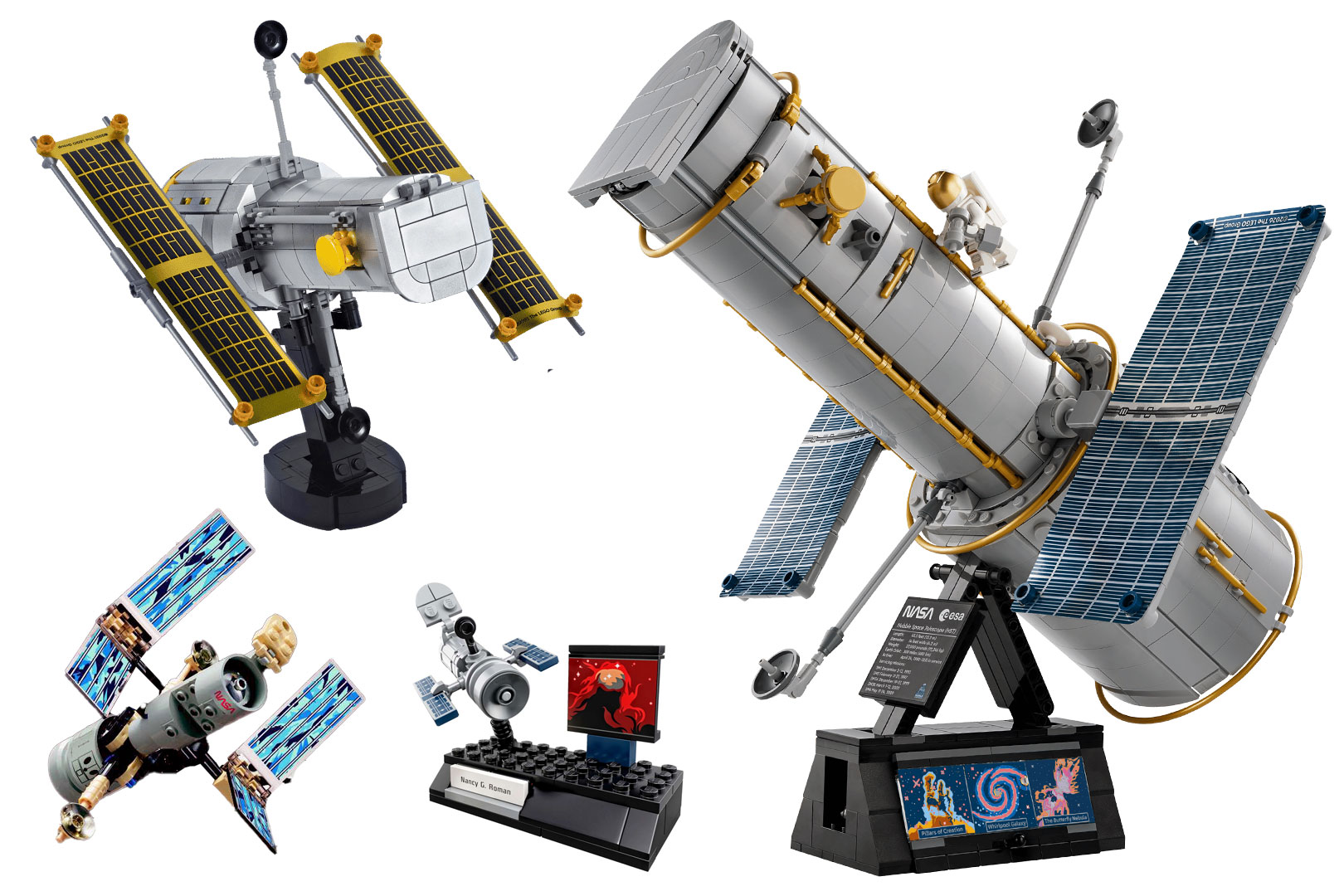
Of the previous three Hubble models, two were scaled to their companion orbiters: Lego Discovery Space Shuttle—STS-31, set 7470, from 2003 and Lego Icons NASA Space Shuttle Discovery, 10283, released in 2021. The third was a desktop model for the minifigure tribute to astronomer Nancy Grace Roman, the “Mother of Hubble,” included with the Women of NASA set, no. 21312, in 2017.

Montage image of various toy models of a space telescope.

Hubble Space Telescope Lego models, roughly to scale, including the new Lego Icons set (at right). Also pictured, the Hubble that came with the 2021 Lego Icons NASA Space Shuttle Discovery (at top left), Lego Discovery Space Shuttle – STS-31 (at bottom left) and Nancy Grace Roman desktop model from the 2017 “Women at NASA” minifigures set.

Hubble Space Telescope Lego models, roughly to scale, including the new Lego Icons set (at right). Also pictured, the Hubble that came with the 2021 Lego Icons NASA Space Shuttle Discovery (at top left), Lego Discovery Space Shuttle – STS-31 (at bottom left) and Nancy Grace Roman desktop model from the 2017 “Women at NASA” minifigures set. Credit: LEGO/collectSPACE.com

The real Hubble Space Telescope was launched on the space shuttle Discovery and deployed by the STS-31 crew in 1990. It is 43.5 feet long (13.2 meters), making the new Lego desktop model about 1:35 scale. (Lego minifigure scale is generally accepted to be between 1:35 and 1:45 scale, as the minifigures are not proportionally accurate.)

Open wide (field camera)

According to the set’s instruction book, in addition to being faithful to the overall shape and exterior details of the Hubble Space Telescope, the new Lego Icons model is the first to build representations of the science instruments and interior components that enable Hubble to operate in Earth orbit.

“In close collaboration with our partners at NASA and ESA, we’ve recreated authentic engineering details inside and out,” reads the designers’ introduction to the set in the book. “Each section of your model corresponds to real instruments that helped discover remarkable new information about our universe.”

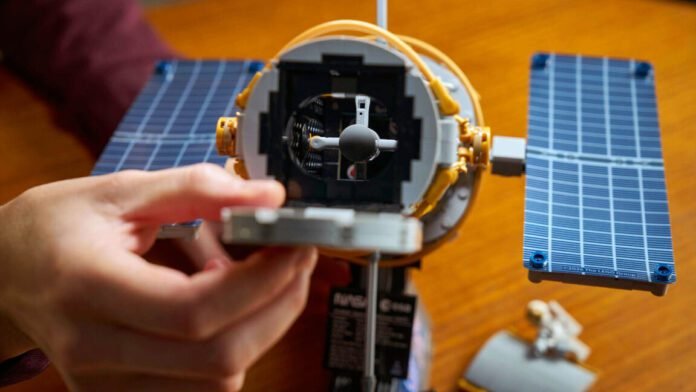
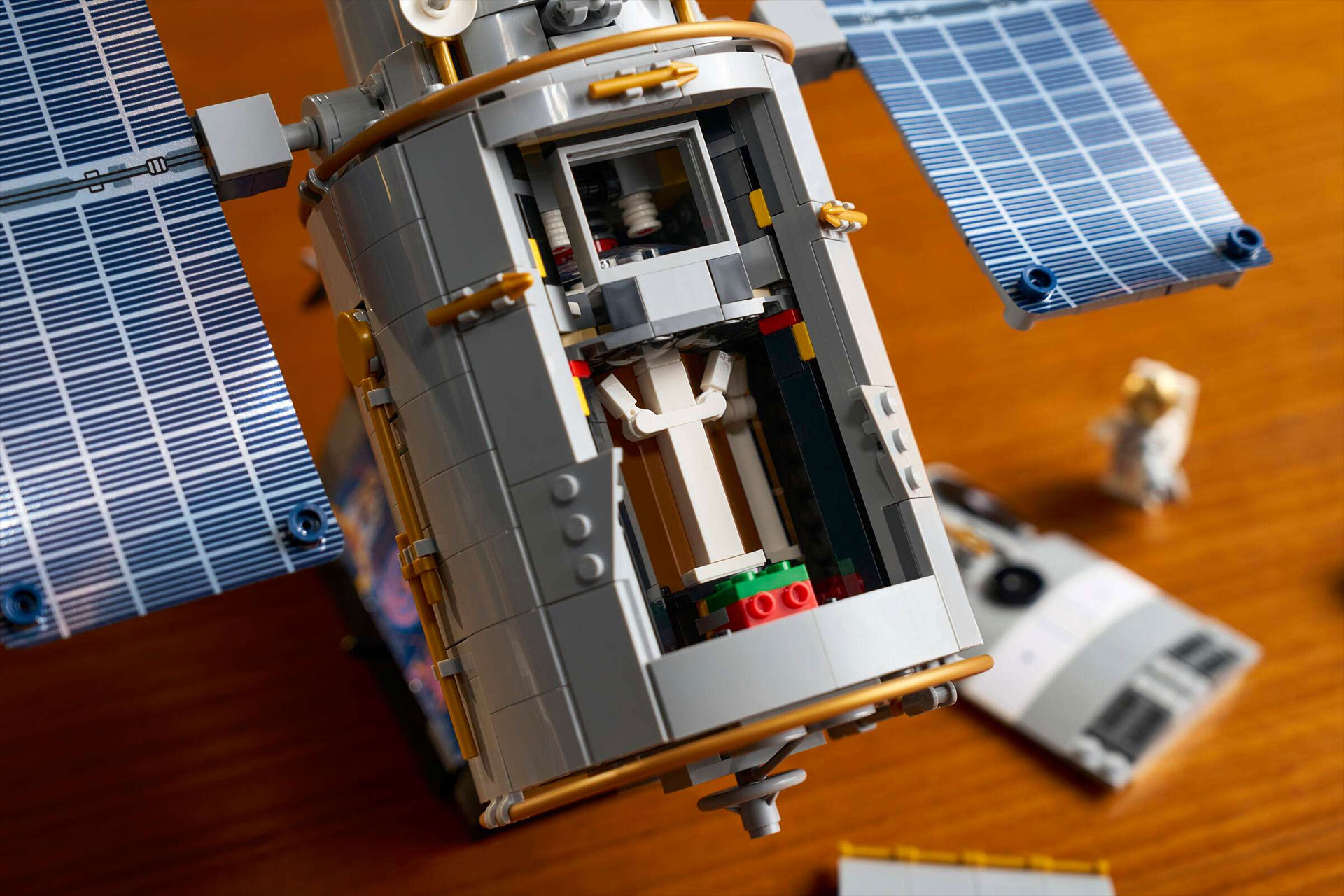
The aperture door at the top of the telescope opens, affording a view of the secondary mirror assembly inside. Two panels along the upper and lower body of the Hubble can also be removed to expose the mirrors, as well as the central baffle that directs the light from stars and galaxies to the observatory’s instruments and primary mirror.

Photo of a part of a toy brick-built model showing interior details.

Removable panels on the Lego Icons Hubble Space Telescope provide a look at the instruments and equipment inside.

Removable panels on the Lego Icons Hubble Space Telescope provide a look at the instruments and equipment inside. Credit: LEGO

As part of its storied history, the Hubble telescope was visited by astronauts five times, first to correct for an optical flaw and then to upgrade its capabilities. This Lego model is configured to reflect the Hubble’s current configuration, following its fifth servicing in 2009.

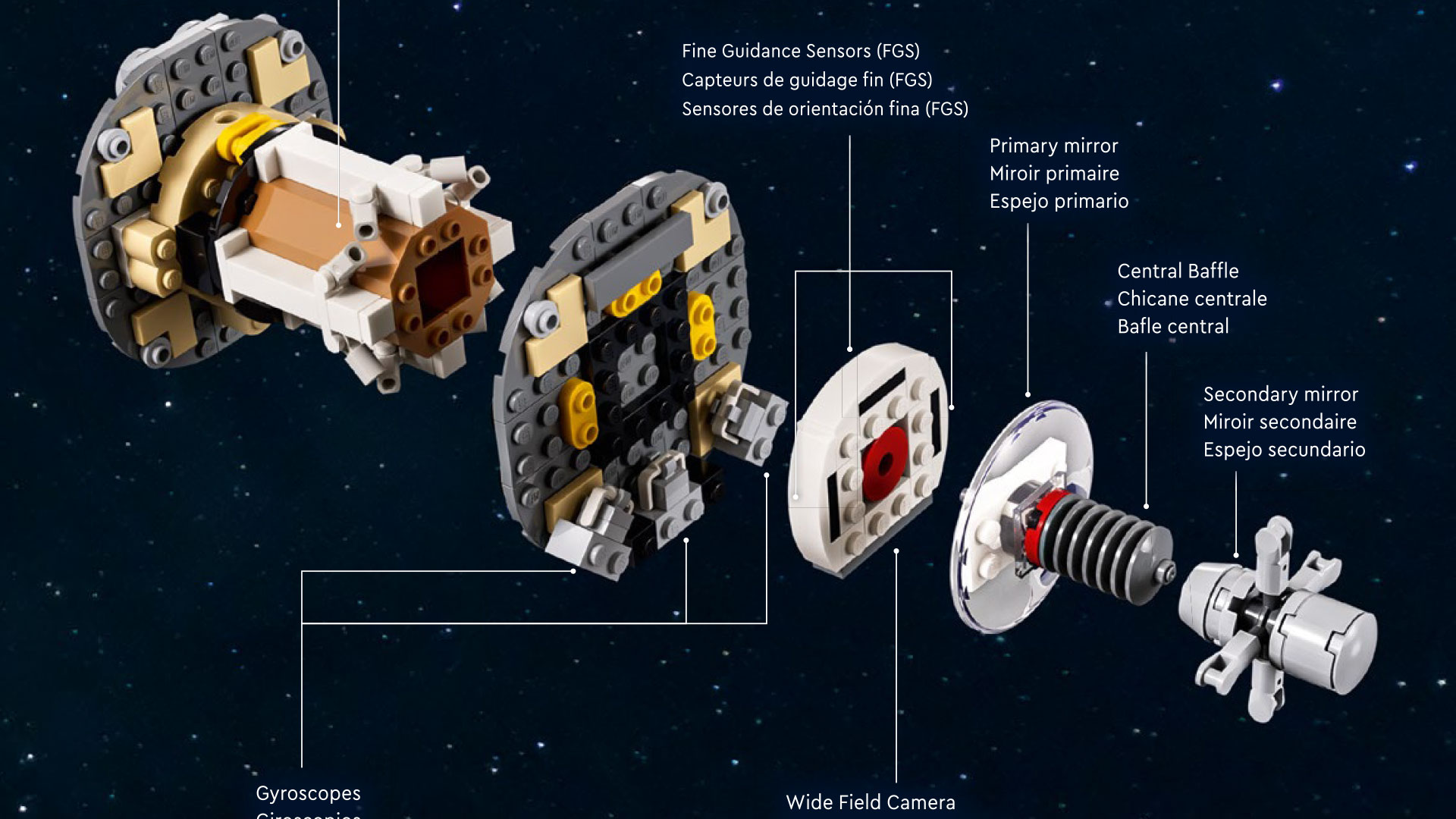
Included in the build are the Space Telescope Imaging Spectrograph (STIS), Cosmic Origins Spectrograph (COS), Advanced Camera for Surveys (ACS), and Near Infrared Camera and Multi-Object Spectrometer (NICMOS), which remain active on the real satellite today. Other details include the three gyroscopes and five guidance sensors, as well as, externally, its communications antennas and two solar array wings.

“Hubble’s solar array panels were changed twice. For this model, we chose the latest version installed,” reads a note in the instructions.

Labeled and unlabeled

The Lego designers included more details in their build than the instruction book identifies, using both brick parts and decals.

Diagram from the instruction book for the Lego Icons Hubble Space Telescope set labeling some of the science instruments and guidance equipment that are represented as parts of the model’s interior.

Diagram from the instruction book for the Lego Icons Hubble Space Telescope set labeling some of the science instruments and guidance equipment that are represented as parts of the model’s interior. Credit: LEGO

On the base of the telescope, a Lego steering wheel substitutes for the capture mechanism that may be used by a future robotic or crewed vehicle to boost or deorbit the telescope. Stickers are applied nearby to represent the vents used to relieve pressure inside Hubble’s body while also preventing stray external sunlight from entering and interfering with observations.

Decals are also applied to simulate the ports for the three fixed-head star trackers, which follow specific stars in their field of view to help determine the telescope’s attitude. The dark circular openings on the aft body are the external light paths for the trackers.

The set also includes a stand on which to display Hubble. As part of that, a decal-adorned plaque lists facts about the observatory, including the dates of its five space shuttle servicing missions. The stand also includes three translucent pre-printed parts displaying three of the telescope’s most famous observations: the Eagle Nebula (“Pillars of Creation”), Whirlpool Galaxy, and the Butterfly Nebula.

“The astounding images and data provided by the Hubble Space Telescope have brought the farthest reaches of the universe closer to Earth. We’re just beginning to comprehend its historic significance, and it continues to inspire scientists and spark the public’s imagination,” wrote the designers in the introduction to the set’s instructions. “We wanted to honor that legacy.”

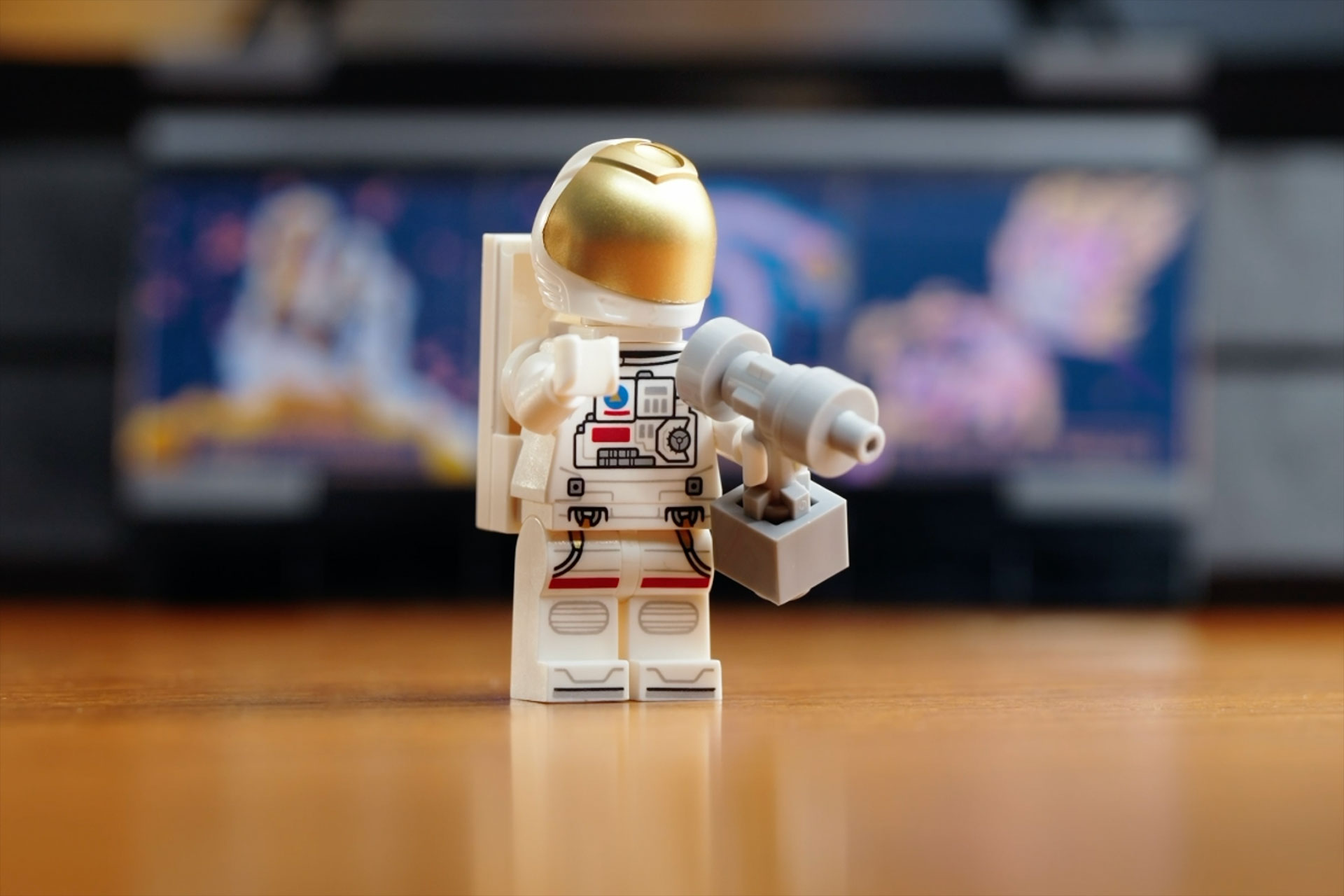
The Lego Icons Hubble Space Telescope set is built to minifigure scale and includes an astronaut minifigure.

The Lego Icons Hubble Space Telescope set is built to minifigure scale and includes an astronaut minifigure. Credit: LEGO

One more hidden detail: the astronaut minifigure is decorated so as to be wearing an extravehicular mobility unit (EMU), the spacesuit worn for the servicing missions. It does not reproduce the NASA insignia or any flight emblems, but on the back of its portable life support system (PLSS) backpack appears NASA’s celebratory logo for the Hubble Space Telescope’s first 35 years.

Gold firms as oil prices slump after Trump holds off on Iran attack

0
gold-firms-as-oil-prices-slump-after-trump-holds-off-on-iran-attack
Gold firms as oil prices slump after Trump holds off on Iran attack


Gold rose ​on Monday as oil prices fell after U.S. President Donald Trump held ‌off on fresh attacks on Iran in hopes of a swift deal, slightly easing concerns over inflation and higher interest rates.

Spot gold was up 0.7% at $4,068.54 per ounce, as of 0437 GMT. U.S. gold ​futures rose 0.9% to $4,066.60.

The U.S. dollar came under pressure after authorities intervened in the ​foreign exchange market to support the yen, making dollar-priced bullion more affordable ⁠for overseas buyers.

Gold has made a relatively cheery start to the week but gains remain ​limited given the uncertainty around the oil markets and the Middle East, so it’s an ​upbeat but guarded start for the metal, said Tim Waterer, chief market analyst at KCM Trade.

Trump said talks with Iran will happen on Monday but declined to set a deadline for an agreement. Oil ​prices fell more than 5%.

Gold has come under pressure since the start of the U.S.-Iran ​conflict, as a war-driven rise in inflation could prompt central banks to raise interest rates. Although bullion ‌is ⁠traditionally viewed as a hedge against inflation, its appeal tends to diminish in a high-interest-rate environment because it does not yield interest.

Market participants will also focus on a slew of U.S. jobs reports due this week, including job openings data, the ADP employment report, weekly ​jobless claims and the ​nonfarm payrolls report.

“Any renewed ⁠escalation in the Middle East that pushes oil higher, or a strong NFP print that reinforces September rate-hike odds, could cap the ​upside,” Waterer said.

Three U.S. Federal Reserve officials who dissented at the policy ​meeting last ⁠week in favour of a rate hike expressed concerns on Friday that without an immediate increase in short-term borrowing costs, inflation will stay stuck above the Fed’s 2% target.

Analysts at Standard ⁠Chartered said ​in a note that they continue to expect gold ​to find near-term support before recovering on seasonal buying.

Spot silver gained 1.4% to $58.46, platinum climbed 0.5% to $1,650.63, and palladium ​firmed 1.6% to $1,293.50.

Is the recycling symbol free speech? A judge just ruled it could be.

0
is-the-recycling-symbol-free-speech?-a-judge-just-ruled-it-could-be.
Is the recycling symbol free speech? A judge just ruled it could be.

A pioneering California law meant to sharply limit use of the familiar “chasing arrows” recycling symbol has been blocked by a federal judge who said it probably violates the First Amendment.

In a preliminary injunction issued last month, U.S. District Judge William Hayes halted enforcement of SB 343 after food, packaging and retail groups sued, finding that key provisions were “unconstitutionally vague” and likely infringed protected commercial speech. Enforcement of the law, passed in 2021, was expected to start this fall.

The decision is a blow to environmental advocates, who had hoped to remove the familiar symbol from a huge array of plastic products, in line with a statewide study showing that only a fraction are widely collected and actually recycled. SB 343 said only goods and packaging accepted by recycling programs serving at least 60 percent of Californians and then actually sorted for recycling — not collected and thrown away —  could bear the chasing arrows.

Hayes’ constitutional reasoning surprised supporters of SB 343 because similar arguments against environmental marketing regulations have historically struggled in court.

“The First Amendment protects free expression, not a corporation’s right to commit consumer fraud,” said Nick Lapis, director of advocacy for the nonprofit Californians Against Waste. “We see this exact playbook every time the plastics industry is asked to stop misleading the public — they suddenly hide behind the Constitution.”

In his decision, Hayes applied a standard four-part test to determine whether SB 343 would unduly restrict companies’ speech rights. The law passed the first two tests handily, as it regulates “potentially misleading” speech and was intended to serve California’s legitimate interests in reducing consumer confusion and improving recycling rates.

The next tests are where the law ran into trouble. Hayes, siding with the industry trade groups, argued that the legislation would not advance those “legitimate interests.” Rather than encouraging companies to redesign their products and packaging to comply with California’s real-world recyclability criteria, he said the law would prompt them to remove the recycling symbol altogether. Products recycled at a rate below the 60 percent threshold that the law requires would no longer make it into recycling bins, which could in theory leave more of them bound for the landfill.

Hayes said a less stringent regulation could have better advanced California’s goals. For instance, the state could have passed a law requiring more descriptive qualifiers alongside the recycling symbol. He offered a hypothetical example of a label explaining that an item is “accepted by recyclers in the greater Los Angeles area but nowhere else in California.” Such a label would provide consumers with more and better information, he argued, but would not be allowed under SB 343.

Heidi Sanborn, executive director of the nonprofit National Stewardship Action Council, said the judge’s reasoning reflected a fundamental misunderstanding of the problems facing California recycling systems. People are throwing too much stuff into their blue bins, she said. In addition to not actually being recyclable, much of this refuse — including plastic bags and other plastic films — can gum up sorting machines, causing operational delays and creating safety risks.

“People are wish-cycling, they’re so desperate to recycle,” Sanborn told Grist. “We have to pull all this [contamination] out, which is very labor-intensive, and then everybody wants to know why their bills go up.” 

Read Next

Industry groups welcomed the injunction, saying it would prevent California from “censoring truthful information on packaging.”

Scott Hochberg, general counsel and litigation director for the nonprofit Earth Island Institute, said he’s seen free speech challenges to environmental rules many times before. Big polluters have frequently invoked the First Amendment to oppose regulations that require them to disclose information — like their greenhouse gas emissions — or tone down statements about their sustainability.

“What’s relatively new and concerning is when these arguments succeed and states are blocked from implementing common-sense initiatives to protect their residents,” he said.

A lawsuit Hochberg’s organization is pursuing against Coca-Cola illustrates the same debate. It alleges the company presents itself as a “sustainable and environmentally friendly company” despite its outsize contribution to plastic pollution. Coca-Cola argued that statements about its sustainability efforts — including plastics recycling — were protected political speech rather than commercial advertising. A federal judge rejected that argument in 2024.

The companies that sued California didn’t make that same distinction; their suit is more like one filed in 1992 that sought to block a California law restricting the use of terms like “biodegradable,” “ozone-friendly,” and “recyclable.” A judge upheld the law, ruling that it would not stifle free speech because corporations could still use a restricted word or phrase as long as they included qualifiers explaining how, where, or under what conditions it applied.

The injunction against SB 343 leaves California with few easy options. Hayes’ ruling suggests the state faces a difficult road if the case proceeds to trial. Lawmakers could amend the law to address some of the judge’s concerns, though that may be unlikely given the politics surrounding the issue. California could also appeal the injunction, but the lower court would still have to decide the case on its merits.

Earth Island Institute and Californians Against Waste announced on July 27 that they are joining California as defendants. Hochberg said he hoped to provide the court with more information “about how the recycling system actually works.” Losing the lawsuit will make it harder for other states to pursue similar labeling regulations, he said. 

It could also jeopardize California’s nation-leading extended producer responsibility law, which shifts responsibility for collecting, recycling, and reducing plastic packaging from taxpayers and local governments to the companies that produce it. It relies on the same definition of recycling and is currently being challenged by a separate lawsuit.

Whatever happens next, Sanborn said she’s ready to work with industry to come up with other solutions — including legislation to clarify labeling rules at the national level. “We can and should work together to solve this,” she said. “But you should not have the right to lie to people.” 


NYPD Used High-Tech Surveillance to Find Gaza Paint Splatter Protester, Docs Show

0
nypd-used-high-tech-surveillance-to-find-gaza-paint-splatter-protester,-docs-show
NYPD Used High-Tech Surveillance to Find Gaza Paint Splatter Protester, Docs Show


Columbia University had just resumed classes for the first time since a major crackdown on pro-Palestine demonstrations roiled campus throughout the first half of 2024.

Seeking to highlight ties between Columbia University and Israel’s ongoing genocide in Gaza, the campus protest movement had culminated in a building occupation that ended with dozens of arrests, sparking activism on campuses across the country. At Columbia, classes went virtual or used a hybrid model.

On the day classes resumed their regular scheduling in September, one protester splattered the university’s famous Alma Mater statue in red paint.

Following the incident, New York Police Department investigators deployed an extensive array of high-tech surveillance and investigative tools to identify the alleged vandal, according to documents from the court case provided exclusively to The Intercept. Police leveraged networks of surveillance cameras and facial recognition software to pinpoint a suspect.

In July 2025, Jakhi Isaiah, a New Jersey-based activist whose legal last name is McCray, was charged for the incident.

As the nationwide protest movement against Israel’s genocide in Gaza became a national lightening rod and the Trump administration began to throw its weight against activists, authorities at all levels began to expend tremendous resources against pro-Palestine demonstrators. Using intensive surveillance tools in response to relatively minor crimes became typical in cases against pro-Palestine protesters.

“It deliberately sends a very chilling message that you better not dissent.”

“I think it deliberately sends a very chilling message that you better not dissent,” said Bina Ahmad, a civil rights and criminal defense attorney has represented pro-Palestine protesters but is not working on Isaiah’s case. “How many [resources] they used for such a small charge kind of says they will go to any length to grab who they want to grab and charge what they want to charge.”

The documents obtained by The Intercept also detail how NYPD investigators appeared to have abandoned the case, before being spurred to reopen it by federal officials. Both the Bureau of Alcohol, Tobacco, Firearms, and Explosives and the U.S. Marshals Service, according to the documents, were participating in a separate federal investigation into Isaiah.

Facial Recognition

Columbia claimed that the paint protest had caused thousands of dollars in damage to the statue, but maintenance crews were able to clean it up almost immediately. Photographs taken by students show that, by the end of the day, all the paint had had been removed.

The hunt for the alleged vandal soon got underway.

In the days following the incident, NYPD detectives used 21 different camera angles and tracked the person that they allege is Isaiah as he moved both inside and out of Columbia’s campus.

“If you go around New York, there’s fucking cameras literally everywhere,” Isaiah told The Intercept. “That’s freaky as hell.”

Investigators claim to have followed Isaiah’s movements using surveillance footage for more than two continuous hours surrounding the incident, tracking him even after he entered a university building and changed clothing. The person on video footage during the vandalism was masked and wore a hat. (Neither the NYPD nor Columbia responded to requests for comment.)

A camera eventually captured someone dressed in similar clothing with their mask removed while running down a nearby city street, according to the discovery documents. NYPD detectives then took the maskless image and used facial recognition tools to generate a hit on Isaiah.

Following the facial recognition ID, a probable cause to arrest notice was issued, meaning that officers Isaiah encountered would have discretion on whether or not to bring him into custody and charge him with the vandalism offenses.

Months later, Isaiah was arrested at an unrelated anti-ICE protest. Despite being in custody, he was not charged or arraigned on any offenses relating to the Columbia University incident, suggesting that the NYPD investigation against him had stalled.

Later, internal communications obtained by The Intercept revealed that while Columbia’s public safety department eventually asked the NYPD to terminate the investigation, they reversed course less than a day later, citing a “miscommunication” between university officials and the NYPD.

Newfound Attention

In June 2025, some 10 months after the paint incident, Isaiah received newfound attention from law enforcement. He was accused of being the perpetrator behind a multi-car arson carried out against NYPD vehicles at a Brooklyn precinct.

The NYPD investigation seemed to have languished, Isaiah said. Despite the police’s probable cause to arrest notice tied to his identity, Isiah said he had several run-ins with NYPD, including the ICE protest arrest, where officers stopped Isaiah, but opted not to charge him with any offenses related to the Columbia investigation.

After the federal investigation into Isaiah for arson, however, the NYPD detectives seemed to revive the case against him related to the Columbia vandalism.

Internal communications obtained by The Intercept from one week after the arson investigation began show NYPD detectives saying that “due to recent incident that occurred in the confines of the 83 Precinct involving wanted perpetrator, case has become federal and the federal authorities will continue to follow up.” Two wanted posters — one for the arson, and one for the vandalism — were attached to the email.

Following a weekslong manhunt by federal law enforcement related to the fires, Isaiah surrendered to police. (He has since pleaded guilty to one count of arson in federal court.) Following his detention by federal authorities, prosecutors in New York charged him in the Columbia paint incident.

Federal cooperation with local law enforcement agencies has ramped up in the wake of the national protest movement against U.S. Immigration and Customs Enforcement, spurred in part by initiatives like Donald Trump’s National Security Memorandum-7 and his executive order that designated “antifa” as a domestic terror group. Highly politicized federal agencies are now more regularly working hand in glove with local police departments, who now have a mandate to pursue politicized cases, said Brendan McQuade, a criminologist at the University of Southern Maine.

“This is collaboration institutionalized,” said McQuade.

When Isaiah was finally arraigned for the Columbia paint charges, an NYPD report featured a list of 41 different “associates” — people police suspected to be contacts or who he’d been arrested alongside at protests. Isaiah believes the list is part of a wider pattern of repression and investigation of pro-Palestine protesters. He wonders whether if he had not turned himself in, the list may have been used against people in his community.

“If they hadn’t found me, they probably would have kept going through that list.”

“It’s just very obvious network mapping,” he said. “If they hadn’t found me, they probably would have kept going through that list.”

Isaiah is expected to stand trial for three vandalism and graffiti-related charges in August but says that he sees his case as emblematic of larger trends in American society.

“The repression on the movement, the surveillance on the movement is often just a microcosm of the larger repression of communities as a whole,” he said.

He nonetheless remains hopeful: “Communities are still finding a way to prosper and live their lives, despite this intense level of omnipresence.”

Beyond the Singularity: China owning the physical AI revolution

0
beyond-the-singularity:-china-owning-the-physical-ai-revolution
Beyond the Singularity: China owning the physical AI revolution

The global discourse on artificial intelligence is preoccupied with a dramatic possibility: The Singularity, the moment a disembodied artificial general intelligence awakens in a server farm, escapes human control and either elevates or destroys civilization.

This is largely a software-centered vision of the future, shaped by a culture that tends to imagine intelligence as something separable from bodies, institutions, and physical infrastructure.

The Singularity is not the most plausible description of the AI future now taking shape. The more immediate revolution is the systemic embedding of intelligence into the physical environment: traffic lights, hospital wards, delivery trucks, nursing homes, farms and assembly lines. The future may belong not to a single superintelligence, but to thousands of specialized AI systems coordinating material and administrative processes.

Just as the United States established much of the digital infrastructure of the information and communication technology revolution, China is positioned to shape the emerging infrastructure of physical AI: artificial intelligence embodied in machines and integrated into the systems that organize everyday life.

Within 30 to 50 years, China may become the first major country to coordinate much of its physical and administrative infrastructure through AI. This is not a prediction of inevitability.

It is a forecast grounded in manufacturing scale, demographic pressure, infrastructure capacity, and state coordination. The question is what kind of society this transition might produce, and who will define the purposes embedded in its machinery.

Singularity’s blind spots

Many Singularity narratives treat four distinct concepts as though they were interchangeable: intelligence, agency, autonomy and power. A system can outperform a human at a particular task without possessing a will.

It can have operational autonomy, meaning that it functions without continuous human intervention, without being free to redefine its purpose. Even an exceptionally capable system cannot impose its will unless people give it access to infrastructure, money, communications, weapons, robots or institutional authority.

The hidden progression is that intelligence becomes agency, agency becomes autonomy and autonomy becomes power. Each step is often assumed rather than demonstrated.

The reality is more prosaic and more immediate. AI systems acquire social power when institutions connect them to consequential systems without adequate limits, monitoring, and accountability.

The danger is not necessarily that machines will develop minds of their own. It is that people will connect them to too many systems, grant them too much authority, and fail to construct the institutional safeguards that contain their errors.

Body and brain

In the 1980s, roboticist Hans Moravec observed a curious asymmetry. It was comparatively easy to make computers perform well on formal tests, but extraordinarily difficult to give them the sensorimotor abilities of a young child.

A child can recognize faces, navigate a cluttered room, and pick up a cup without spilling it. Such actions remain difficult for robots operating in unpredictable environments.

Moravec’s paradox helps explain why physical AI presents a different technological challenge from the software-centered systems that dominate public attention. It must connect perception, movement, judgment, and adaptation in the physical world, where mistakes have material consequences.

The comparison between the United States and China is therefore one of emphasis and comparative advantage, not a binary opposition. The United States has warehouse robotics, autonomous-vehicle programs, aerospace automation, Nvidia’s robotics platforms and substantial military and industrial AI. China also develops frontier foundation models and consumer platforms. But their centers of gravity differ.

The United States treats AI primarily as a frontier technology and commercial product. Its emphasis is on advanced models, massive computing power, and systems that expand the boundaries of machine capability.

China places greater emphasis on AI as infrastructure, embedding it in factories, transport networks, hospitals, power systems and urban management. Its horizon is integration: systems coordinating across domains to reduce friction and anticipate demand.

This difference is reinforced by industrial structure. China is the world’s largest manufacturing economy. According to the International Federation of Robotics, it accounted for 54% of global industrial-robot installations in 2024 and operated more than two million industrial robots, the largest stock of any country.

The United States does not currently match this deployment loop, partly because its manufacturing base is smaller and less integrated.

China’s robotic advantage is not automatic. Physical data must be standardized, labeled, shared where appropriate, and converted into transferable learning before it improves robotic performance.

Simulation, sensors, model design, safety testing and semiconductors also matter. Yet the volume and variety of physical operations in China provide its companies and institutions with an unusually large field in which to test and refine automated systems.

US export controls on advanced semiconductors remain a significant constraint. They may limit the large-scale training of cutting-edge models. At the same time, they may encourage Chinese firms to emphasize efficient models, domestic chips, edge computing and application-specific systems. Which effect will predominate remains uncertain.

Aging societies

Physical AI is not only a technological choice. In East Asia, it is increasingly a demographic response. Japan, China, South Korea and parts of Europe are undergoing some of the most rapid population aging in modern history.

Official Chinese projections indicate that the number of people over sixty will exceed 400 million around 2035. The ratio of working-age adults to retirees is declining, placing growing pressure on labor-intensive services.

Who will care for older people? Who will staff hospitals, nursing homes, farms, warehouses, and delivery services as the workforce contracts?

Physical AI, including assistive robots, automated meal preparation, AI-coordinated care facilities and autonomous delivery vehicles, is one of the few responses capable of operating at very large scale. It is not the only response.

Governments can raise retirement ages, reorganize healthcare, invest in prevention, encourage immigration, increase labor participation and strengthen community-based care. But none of these measures alone is likely to absorb the full impact of demographic change.

China’s centralized state can coordinate a national robotics strategy, while its large domestic market gives companies room to scale new systems. These pressures are likely to accelerate deployment.

Automation also forms part of China’s response to slower growth, local government debt, youth unemployment, and the danger of becoming trapped at middle-income levels. Physical AI is therefore not simply a technological ambition. It is becoming a social and economic imperative.

The automated society

Automation will not always mean humanoid machines imitating today’s workers. More often, the physical environment will be redesigned around machines.

Procedures may be simplified, buildings reorganized and services reconstructed until many existing occupations disappear or change beyond recognition. The future is likely to involve systemic redesign rather than the mechanical replication of human labor.

Extend this model across society. Robots harvest and transport food. AI coordinates traffic and public transport, adjusting signals before congestion forms, rerouting buses around delays and prioritizing emergency vehicles.

Hospitals and nursing homes use AI to coordinate scheduling, logistics, monitoring, and resource allocation. Assistive robots support mobility and routine physical care, while human professionals remain responsible for emotional, ethical and exceptional situations.

Humans increasingly shift from continuous operation to supervision, intervention, and governance. The environment becomes predictive not because AI has become conscious, but because coordination has become continuous.

Hangzhou’s City Brain offers a preview. What began as a traffic-management project has expanded into water monitoring, flood prevention, emergency support, and infrastructure management. An integrated system could, for example, respond to a broken water main by adjusting traffic, dispatching repair crews, and notifying residents.

Some of these combined responses remain extrapolations from existing capabilities, but the direction is clear. City Brain represents intelligence as infrastructure: not simply a product to purchase, but a system within which people live.

How standards travel

Systems deployed at home can shape infrastructure abroad. The United States established much of the digital architecture of the internet era. Its protocols and platforms spread because they were embedded in widely adopted tools.

Over the coming decades, countries will also need standards for autonomous vehicles, industrial robots, machine-to-machine communication, safety systems, digital identity and the exchange of industrial data. China is positioning itself to influence those standards through several connected channels.

The first is infrastructure export. When Chinese companies build ports, railways, power systems, factories, and smart-city projects across Asia, Africa and Latin America, they frequently provide the associated sensors, telecommunications equipment, software and control systems.

Recipient countries may adopt Chinese protocols because compatibility is included in the infrastructure they need. Purchasing Chinese hardware does not mean accepting China’s political model, but it can establish technical path dependencies.

The second is the expansion of industrial ecosystems. Chinese manufacturers increasingly combine robots, batteries, vehicles, drones, communications equipment, sensors and AI software into complete systems.

Customers purchasing those systems also acquire their interfaces, data formats, maintenance networks, and supply chains. Standards can spread through industrial practice before they are formally endorsed by international institutions.

The third is participation in standard-setting bodies. China has become increasingly active in organizations such as the International Organization for Standardization and the International Telecommunication Union.

By proposing protocols for robotics, autonomous vehicles, industrial connectivity and AI coordination, Chinese institutions can embed elements of their technological architecture in global norms. These standards are negotiated among governments, companies and technical experts rather than dictated by any one country, but China’s influence has grown substantially.

Infrastructure financing reinforces all three channels. Projects supplied and financed as integrated packages can make a particular technical ecosystem the most economical path for future expansion.

Japan, Germany, South Korea, the United States and other countries remain important competitors, and many nations will combine technologies from several sources. Nevertheless, no other country currently combines China’s manufacturing scale, state capacity, infrastructure-export reach and demographic urgency in quite the same way.

The world is unlikely to adopt China’s political system wholesale. But many countries may adopt Chinese technical standards where they arrive embedded in affordable and effective infrastructure.

What travels is not an entire political order, but elements of an architecture that can reshape local governance in partial and uneven ways.

AI governance

An automated society does not require a single omnipotent AI. It requires a layered system in which numerous specialized technologies exchange information and coordinate action. The political character of that system will depend on who establishes its purposes and controls its operation.

The same physical-AI infrastructure could support democratic or consultative governance, in which citizens influence goals through elections and public debate; technocratic paternalism, in which experts establish optimization criteria; or corporate platform power, in which private firms control essential systems.

Whatever the political system, responsible governance would require legally defined parameters, independent auditing, transparency about optimization criteria, and human authority to isolate systems, revoke permissions and revert to manual operation.

These safeguards will not appear automatically. They must be built into institutions as deliberately as sensors and software are built into machines.

The crucial question is who defines the criteria by which systems optimize. AI can measure preferences, execute priorities and model consequences, but it cannot legitimately determine whose values should prevail. Efficiency is not legitimacy.

If hospital waiting times rise, a system may identify possible causes and interventions. It can calculate the likely effects of allocating additional robots, specialists or beds. It should not determine independently which hospital or population deserves priority. That remains a political and ethical decision.

Unavoidably human

The decisive question is not whether AI will awaken and impose its will. It is who defines the purposes embedded in automated systems, who establishes their limits and who can challenge their decisions. Technological capacity is not political authority.

The future may not bring a machine god or an intelligence explosion. It may bring something quieter: a society whose machinery appears intelligent while political responsibility remains unavoidably human. We are moving from the Information Age toward an Automation Age.

The United States created much of the digital nervous system of that world. China is increasingly building its physical body, driven by demographic necessity, powered by manufacturing scale, and extended through infrastructure projects and industrial supply chains.

In 50 years, the automated environments we inhabit may bear a substantial Chinese imprint. The question is not merely who builds that infrastructure, but whether its purposes will be shaped by democratic deliberation, corporate profit, technocratic optimization or state control.

Technology alone cannot answer that question. It will be answered through politics, and the world is not paying enough attention.

0FansLike
0FollowersFollow
0FollowersFollow
0SubscribersSubscribe
- Advertisement -
Google search engine

Recent Posts