For nearly two decades, one line in the global opinion charts held steady: the United States was better liked than China. That line has now crossed.
Pew Research Center’s July 15 report, based on 42,151 interviews in 36 countries between February and May 2026, finds China viewed more favorably than the United States in most nations surveyed.
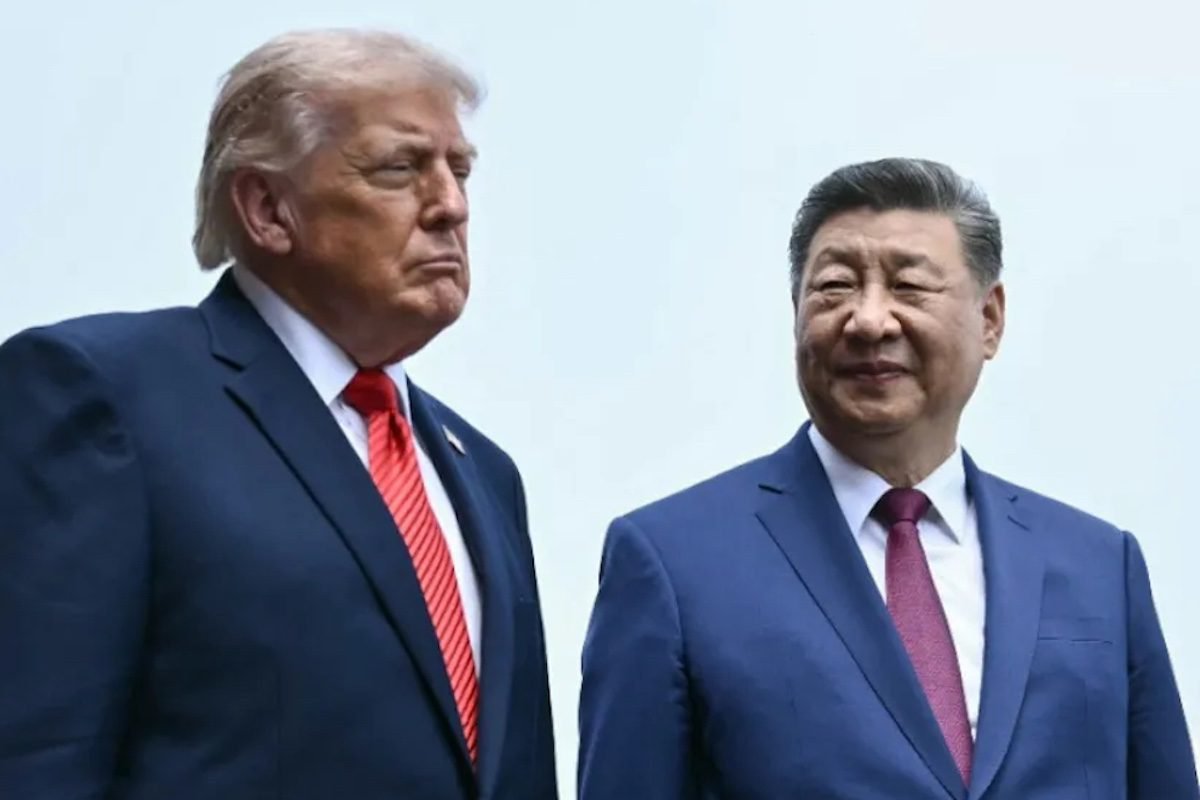
Confidence in Xi Jinping now runs ten points ahead of confidence in Donald Trump across the twenty countries Pew has tracked since 2023. Gallup recorded the same crossover a year earlier, with China at 36% approval and America at 31%.
The temptation is to read this as a scoreboard: China up, America down. It is better read as a diagnostic test. And like most tests, its real value lies in what it cannot tell us.
Start with a distinction doctors use every day. How many people currently have a disease is one question. How fast new cases are appearing is a different one. Favorability polls blur the two, and the blur matters here.
China’s standing has improved only modestly. America’s has collapsed. In Sweden, the share of people calling the US a reliable partner fell from 83% in 2022 to 31% today, a drop of 52 points. China gained just 15 points over the same period, from 12% to 27%. Canada shows the same pattern: American reliability down 48 points, Chinese reliability up 30.
Even where Xi now outpolls Trump by double digits, enthusiasm is thin. His best rating in Europe is a modest 37%, in the United Kingdom.
In other words, the crossover was produced mostly by subtraction. Pew’s own analysis says China’s lead comes largely from souring views of the United States. A patient does not become healthy because the person in the next bed is getting worse faster.
The mix of countries surveyed matters too. Nearly half of Pew’s sample consists of middle-income countries, exactly where China’s advantage is widest.
China hit record highs this year in Colombia, Indonesia, Malaysia, Mexico, Nigeria and Turkey. Across 17 middle-income publics, a median of 75% say the United States interferes in other countries’ affairs; only 45% say the same of China.
Weight the survey more toward wealthy democracies, or toward China’s own neighbors, and the headline would look different.
That is the point Asian readers should sit with. The reversal has conspicuously not happened among China’s neighbors. The United States keeps its edge in just six countries, and four of them are in the Indo-Pacific: India, Japan, the Philippines and South Korea.
In the Philippines, 81% call America a reliable partner, against 42% for China. In Pakistan, the ratio flips: 84% trust China, 36% the United States.
Living next to a great power, especially one you have a maritime dispute with, tends to strip away its charm. Asia is not converging on a single view of China. It is splitting along the line of who lives closest to it.
The most underrated finding is not the direction of the shift but its speed. The ISEAS-Yusof Ishak Institute’s survey of Southeast Asia has flipped three times in three years: to China in 2024 (50.5% to 49.5%), back to the United States in 2025 (52.3% to 47.7%) and to China again in 2026 (52% to 48%).
Opinion that swings this easily is not a store of goodwill built over decades. It behaves more like a spot price, reacting to the latest shock: a tariff announcement, an energy disruption, a careless remark. Pew’s own record shows how quickly the direction can reverse. American favorability, and confidence in the US president, jumped sharply after January 2021.
The polls also hide as much as they reveal. A single favorability number mixes feelings that pull in opposite directions. People can admire Chinese electric vehicles, high-speed rail and cultural hits such as Black Myth: Wukong and Ne Zha 2, while still distrusting how China is governed.
In only 11 of the 36 countries do roughly half or more believe the Chinese government respects its people’s personal freedoms. The United States still leads on that measure, but the gap is closing mainly because faith in America has fallen, by 25 points or more in Canada, France, Germany, Italy, the Netherlands, South Korea, Spain and Sweden.
A number that cannot tell the difference between liking a country’s products and trusting its institutions is a dangerous number to plan around.
So what should Asia’s middle powers take from all this? Neither celebration nor alarm. Global publics currently see Beijing as the more predictable partner and Washington as the more erratic one. But perceptions of predictability are themselves the most changeable thing in the data. A hedging strategy built on 2026 sentiment will be tested by 2027 sentiment.
The harder question is whether each power’s problem is temporary or built in: whether American standing can bounce back with a new administration, and whether Chinese standing can deepen without change in the governance record that global publics still watch.
Nothing in this year’s survey answers that. It only tells us that the two curves finally touched. And curves that touch once tend to touch again.
Y. Tony Yang is an endowed professor at the George Washington University in Washington, D.C.