30.5 C
London
Monday, August 3, 2026
Home Blog

How Israeli conduct in the West Bank could derail Donald Trump’s latest peace plan for Gaza

0
how-israeli-conduct-in-the-west-bank-could-derail-donald-trump’s-latest-peace-plan-for-gaza
How Israeli conduct in the West Bank could derail Donald Trump’s latest peace plan for Gaza

Hamas’s agreement to US president Donald Trump’s disarmament roadmap is welcome news. It potentially unlocks the stalemate that has kept 2 million Gazans living in catastrophic conditions since the ceasefire was announced more than nine months ago.

But there are concerns. Israel is unlikely to accept the plan, as it will require the withdrawal of the Israeli military from Gaza. The Israeli prime minister, Benjamin Netanyahu, is likely to try to stall at least until elections are held in late October.

Hamas knows this, and being in no rush to disarm, will also be content to slow-walk the process. If or when there are additional negotiations, each party is likely to object to the details to delay the process further or suspend it altogether.

Some of these hurdles can be overcome through sustained diplomatic engagement and pressure on both parties. But this is far from guaranteed. And an additional challenge that could derail any potential progress looms large beyond Gaza’s borders: the deteriorating situation in the West Bank.

I just returned from a month of fieldwork in the West Bank, meeting with local NGO workers, community leaders and youth activists and documenting settler violence, forced displacement and land seizures. Many people I met, whether in cities, refugee camps or rural areas, said they fear a repeat of Gaza in the West Bank. They fear another major war, another Nakba (meaning “catastrophe”: the term Palestinians use to describe the mass displacement of Palestinians in 1948). One person I spoke with said they felt as if “it’s going to explode”. This is a common view among people in the West Bank.

Pressure cooker

After spending weeks travelling around the territory, it wasn’t hard to see why. I have been visiting the region for more than 20 years, and life in the West Bank has never been easy for its residents. But now, it’s like a pressure cooker.

Travel within the West Bank has become much harder and slower, with additional checkpoints, gates and unpredictable road closures – mostly near expanding settlements – adding hours to simple journeys of less than 20km. On the roads that are open, settlers have lined the pavement with Israeli flags and blacked out the Arabic writing on multilingual road signs with spray paint.

road signs with Arabic writing painted over

Arabic script blacked out on road signs in the West Bank. Julie M Norman

In the cities, petrol stations are out of fuel and hospitals are short of medicine. Civil servants are out of work or earning only partial wages, as Israel continues to withhold much-needed tax revenues to the Palestinian Authority. More people are also being squeezed into urban areas as a result of both Israeli military seizures of neighbouring refugee camps and settler violence against rural communities. This is adding additional strain and tension to urban areas.

For example, I visited Tulkarem, where two refugee camps, once home to more than 33,000 people, now sit like empty ghost towns. In January 2025, the residents were forced out of the camps by the Israeli military. Most are still living in temporary shelters in schools or mosques, or in overcrowded apartments housing 30 to 40 people.

Residents of Jenin Camp were also displaced last year, and in late July, Israeli defence minister Israel Katz instructed the IDF to take control of another refugee camp, suggesting another major offensive and further mass displacement.

An abandoned Palestinian refugee camp on the West Bank

Tulkarem refugee camp sits empty after forced evacuations. Julie M Norman

Other areas I visited rarely make international headlines, but they are well known within Palestine. For example, the Jordan Valley is a mostly rural area that stretches about 10km wide and 100km long. It hugs the West Bank’s border with Jordan and is comprised mostly of small, simple farming villages. The region is also part of what is referred to as Area C under the Oslo Accords, the peace deal signed between Israel and the Palestine Liberation Organization (PLO) in 1995. The deal divided the West Bank into three areas with specific levels of security and control. Area C is under Israeli civil and military control.

All of Area C has experienced accelerated Israeli settlement growth, with over 100 new settlements approved by the current Israeli government since 2023. These are illegal under international law but supported by the state of Israel. In the Jordan Valley, there are 30 settlements as well as nine new outposts, which are typically unsanctioned by Israel initially, but usually allowed to develop into formal settlements with Israeli military protection.

A Palestinian village on the West Bank destroyed by settlers

Village of Ein Al-Hilweh, Jordan Valley, destroyed by settlers. Julie M Norman

Settlement expansion and land confiscation is not new in this area. But episodes of direct settler attacks accelerated after October 7 2023 and have continued to skyrocket across the West Bank, with about 2,500 documented attacks in 2026 alone.

These attacks were described by 600 former senior Israeli officials as terrorism, in a July 28 open letter to the Netanyahu government. Incidents range from harassment and stealing livestock, to arson, property destruction and physical, sometimes deadly attacks. In the Jordan Valley, such attacks have forced more than 45 entire villages to flee.

I visited one village, Ein el Hilweh, that had been home to 150 families. Their homes had been destroyed, and all that remained was a single tent erected by a solidarity group. At the entrance to the village, settlers had painted a picture of Greater Israel, showing the state of Israel extending across the Middle East from the Nile River in Egypt to the Euphrates River in Iraq.

Cycle of violence

The situation in Tulkarem, the Jordan Valley and other parts of the West Bank may appear disconnected from Gaza and Hamas disarmament negotiations. But they are inextricably linked for several reasons.

First, every settler attack risks unleashing an uncontrollable cycle of violence, like an incident in the village of Tal near Nablus in late July in which four Palestinians and two Israelis were killed, sparking days of retaliatory attacks. Many worry that Netanyahu will use a similar incident as a pretext for a broader military operation in the West Bank, and in turn halt negotiations or prevent any withdrawal from Gaza.

Second, even the slim chance that Hamas does disarm in Gaza doesn’t mean that armed struggle will disappear. On the contrary, in the absence of a broader, comprehensive agreement, other groups and individuals will jockey to fill that gap in both Gaza and the West Bank. Moreover, in the face of unsanctioned settler attacks, support for armed resistance as a form of self-defence in the West Bank will only increase.

Third, and deriving from the point above, no disarmament plan for Gaza and/or the West Bank will succeed without a credible pathway to Palestinian self-determination. The youth activists I met across the West Bank are hungry for a new political vision, but they do not see one. When I met with youth groups, nearly all of them told me that their greatest fear is that Palestine will cease to exist in any form by the year 2040 or 2050.

Donald Trump’s Board of Peace, which reportedly has negotiated the most recent agreement – and the international community more broadly – should leverage this moment to convince them otherwise. As discussions over potential decommissioning begin, they should be coupled with a commitment to and investment in a negotiated political process to ensure a better future for all of Palestine.


How India’s ‘Cockroach’ movement grew its wings

0
how-india’s-‘cockroach’-movement-grew-its-wings
How India’s ‘Cockroach’ movement grew its wings

Young people across India recently made international headlines for mass protests over the recurring leaks of entrance exams that help students qualify for medical schools and highly coveted government jobs. The Gen Z protesters won a major victory within a matter of weeks when Education Minister Dharmendra Pradhan resigned on July 25, 2026, bowing to their demands.

The student movement was triggered by an inadvertent insult by India’s Supreme Court Chief Justice Surya Kant, who, in May, referred to unemployed Indian youth as parasites and cockroaches. Kant’s words caught the attention of a young Indian man in Boston, Massachusetts, named Abhijeet Dipke, who graduated from Boston University in 2025 with a master’s in public relations.

Dipke posted a question on X: “What if all the cockroaches come together?” Deploying his PR skills, he built an Instagram account under the banner of the Cockroach Janta Party (“Janta” is Hindi for “the people”) and within days began to attract a following of disaffected Indian youth, angry over the reported leak of questions from the National Eligibility-cum-Entrance Test (NEET).

Illicit access to questions from the NEET medical entrance exam is part of a lucrative underground trade in a system designed to pit an estimated 2 million students against one another for only 130,000 available positions. When news of the leaks spread, an estimated 21 students took their own lives in despair rather than retake the exams.

Ahilya Majithia, a reporter based in New Delhi, documented the nascent movement and explained that while it began as an online protest, it quickly spread to the physical world, spurred by a sense of mass injustice felt by students.

“It’s one of the most competitive exams in India,” she said during an interview with me. “It’s basically an exam to get into a medical college. So, it obviously requires a lot of preparation, and people study for years to just give this exam.”

As anger grew, Dipke’s CJP offered people an outlet for their frustrations, and the satirical party’s online following ballooned into the tens of millions. “I think it did catch a lot of momentum because of social media, and that’s how the Cockroach Janta Party was also conveying their messages: through X, through Instagram,” said Majithia.

Soon, Dipke, who was living in the United States, flew from Boston to Delhi in early June. He arrived at the airport holding aloft a copy of Dr. B.R. Ambedkar’s autobiography, a legendary Dalit leader whose writings were central to the anti-caste movement in India. “Coming from a Dalit family, Dr. Ambedkar obviously had a huge influence on my life,” said Dipke in an interview with Frontline magazine.

Although Ambedkar was a left-wing socialist, Dipke’s political sensibilities are not necessarily reflected in the movement he helped to spark, one that moved at a ferocious speed.

“This protest [gave] the people the sense of power that we can fight the government to change certain things,” said Majithia. However, she added, “I don’t think this protest was ever to weaken a government body or the BJP in particular; I think this was a very non-political issue.”

With Dipke and his fellow Gen Z activists leading marches, students spent weeks demonstrating and occupying public spaces to protest a system that increasingly squeezes young people out of stable careers despite spending years studying and incurring debt to qualify for exams.

They gathered in Delhi’s storied “Jantar Mantar,” a large-scale 18th-century structure of giant sundials and other astronomical observing instruments symbolizing India’s ancient tradition of scientific inquiry.

The “cockroach” protests spread from India’s capital, Delhi, to other states, including Assam, Maharashtra, West Bengal, and Bihar, even as police brutalized protesters, as seen in widely shared online images and videos. Students were not only participating in protests but were also documenting their mistreatment at the hands of authorities with smartphones and social media.

Some of their key demands included that India’s education minister step down and that families of students who committed suicide receive financial restitution for their losses.

As far as Majithia knows, no member of Prime Minister Narendra Modi’s ruling Bharatiya Janata Party (BJP) has ever given into political pressure and resigned.

“It’s never happened,” she said. Kangana Ranaut, an actress and member of parliament, told the press that “no one can pressure the government into who to sack and who to retain”—a shocking admission of how much disdain the ruling party has for basic tenets of democracy.

However, soon after her comments, Education Minister Dharmendra Pradhan resigned, and even the international press noted just how significant the Modi government’s acquiescence was.

Since the protests ended, the CJP has also insisted that all arrest warrants against student protesters be withdrawn and threatened a resumption of actions over reports of government harassment of activists.

There have been so many failures of the education system, not just the NEET paper leak,” said Majithia. In the wake of Pradhan’s resignation, the next question is how the movement will navigate specific education and economic reforms.

Saurav Das, the CJP’s main spokesperson, who has a background in investigative journalism and is writing a book about the nation’s justice system, is in negotiations with the Modi government over the details of a longer-term education and examination five-point reform plan that includes more stringent standards for testing authorities, a contingency plan for reexamination, and better compensation for impacted students.

While the reform charter addresses the specific reasons why protesters are enraged with the government, the broader issue of economic justice for India’s youth remains in question.

An in-depth 2026 report by Azim Premji University on economic prospects for India’s youth concludes that the country has the largest youth population of any other nation in the world and that “[t]he transition from education to employment remains a major challenge, particularly for graduates.”

Specifically, the report found that “while approximately 5 million graduates were added each year, only around 2.8 million found employment, and an even smaller share entered salaried employment.”

It remains to be seen whether the CJP and its explosive entry into India’s political landscape will be able to take on the bigger problem of Gen Z’s poor economic prospects. At only a few months old, the movement has at the very least offered young people an outlet for their frustrations and a platform to flex their power.

“I think people have a lot of hope with the Cockroach Janta Party because they do think that they will work with the government to make changes and to get changes in the entire system,” said Majithia.

Sonali Kolhatkar is an award-winning multimedia journalist. She is the founder, host, and executive producer of “Rising Up With Sonali,” a weekly subscriber-funded television and radio show that airs on Free Speech TV and Pacifica stations. Her books include Breaking ICE: Community Defense Against State Terror and MAGA Fascism (Seven Stories Press, 2026), Talking About Abolition: A Police-Free World Is Possible (Seven Stories Press, 2025), and Rising Up: The Power of Narrative in Pursuing Racial Justice (City Lights Books, 2023). She is a writing fellow for the Economy for All project at the Independent Media Institute and was a senior editor at Yes! Magazine covering race and economy. She serves as the co-director of the nonprofit solidarity organization Afghan Women’s Mission and is a co-author of Bleeding Afghanistan. She also sits on the board of directors of Justice Action Center, an immigrant rights organization.

This article was produced by Economy for All, a project of the Independent Media Institute, and republished with kind permission.

Azerbaijani president approves financial aid for Palestinian Embassy

0
azerbaijani-president-approves-financial-aid-for-palestinian-embassy
Azerbaijani president approves financial aid for Palestinian Embassy

Azerbaijani President Ilham Aliyev on Monday approved a protocol providing financial assistance to the Palestinian Embassy in Azerbaijan, Anadolu reports.

The decree approving the protocol was published on the Azerbaijani presidency’s official website.

The protocol was signed in Baku on July 10, 2026. Once it enters into force, Azerbaijan’s Cabinet of Ministers will take the necessary steps to implement its provisions.

The Foreign Ministry was instructed to notify the Palestinian government that Azerbaijan had completed the domestic procedures required for the agreement to take effect.

The move follows Aliyev’s July 16 meeting with Palestinian Prime Minister Mohammad Mustafa, during which the Azerbaijani president reaffirmed Baku’s support for the establishment of an independent and sovereign State of Palestine with East Jerusalem as its capital.

Azerbaijan has provided more than $9.2 million in humanitarian and social assistance to Palestine through cooperation with the UN and the Organization of Islamic Cooperation.

The assistance has included $5 million for infrastructure modernization in Jerusalem and $630,000 for the Gaza Strip during 2013-2014.

Between 2021 and 2023, Azerbaijan allocated an additional $1.6 million to help address the effects of the COVID-19 pandemic.

In late 2024, Baku announced a further $2 million in assistance to support affected communities and finance the construction of a new school in Palestine.

Trump wants the power to stop the public from suing polluters

0
trump-wants-the-power-to-stop-the-public-from-suing-polluters
Trump wants the power to stop the public from suing polluters

Reducing rampant pollution across the United States was so important that when Congress passed many environmental protection laws, including the Clean Air Act, Clean Water Act, and Safe Drinking Water Act, it didn’t want to leave enforcement only to the executive branch.

Congress specifically wrote into those laws ways for citizens to enforce them through the courts when the government does not act to address the problem. Called “citizen suit provisions,” those parts of the laws allow regular people and advocacy groups to sue companies they believe are violating the law. Citizens can also sue federal agencies that fail to enforce the laws.

Since the 1970s, those provisions have been used in over 2,000 lawsuits. In fact, a majority of environmental cases are citizen suit cases. Citizen suits have been used to halt the construction of dams to protect endangered species, end the injection of wastewater into groundwater, and secure US$14.2 million in civil penalties for illegal emissions from a petrochemical facility. In short, these cases have shaped modern environmental law.

Now, in a legal filing, the Trump administration is saying citizens should not be allowed to enforce environmental laws. Rather, despite what the laws say, the US Department of Justice has claimed in a case involving Elon Musk’s xAI that people should be required to leave enforcement to the executive branch—even if the executive decides to take no action.

A history of success

For more than 50 years, citizen suits have been an effective part of cleaning up the environment in the US The process is fairly straightforward: A person or group must send a formal notification to the person, company or agency they suspect of violating the law—with a copy to the US Environmental Protection Agency. If after 60 days the problem is not rectified, the people can sue.

Citizen suits often ask the courts to order a stop to the polluting activity, payments for reducing or cleaning up the harm done, and civil penalties paid to the government. But if the government has already begun an enforcement action or is actively prosecuting the violator, a citizen suit cannot proceed.

The success of these cases depends on the ability of the plaintiff to prove a violation of the law. Violations of the Clean Water Act are somewhat easier to prove than violations of other statutes because the simple act of discharging a pollutant without a permit is a violation of the law. As a result, more citizen suit provisions have been brought under the Clean Water Act than under any other environmental statute.

In my area of research, plastic pollution, citizen suits have been used to hold plastic pellet manufacturers responsible for pollution. For example, the citizen suit provision of the Clean Water Act allowed Diane Wilson, a shrimper from Texas’ Gulf Coast, to sue Formosa Plastics in 2017 for persistent discharges of plastic pellets into Lavaca Bay, where some shrimp were caught, and which is connected to the Gulf of Mexico. In 2019, Formosa ended up settling for $50 million to pay for mitigation and remediation projects in the bay, cleaning up plastic and other pollution. Formosa also agreed to pay court costs and attorneys fees.

In another example, the environmental advocacy groups PennEnvironment and Three Rivers Waterkeeper in 2023 sued Styropek USA, which manufactured expandable polystyrene used for packaging and shipping, over pellet discharges into a western Pennsylvania creek. The pellets attracted and collected other toxic chemicals and were harming local aquatic plants and fish. In 2025, Styropek settled for $2.5 million. As part of the settlement agreement, Styropek agreed to install filters in the facility’s wastewater and stormwater systems to capture plastic pellets before they reached Raccoon Creek or the Ohio River. Styropek also had to eliminate the unauthorized discharge of plastic pellets from all of the facility’s stormwater drains.

Citizen suit provisions are not included in every law. But they have arisen in other contexts. For instance, a 2025 Texas state law seeks to restrict abortion rights and allows any citizen to sue doctors or other medical providers who perform or assist with abortions.

NAACP v. xAI

In April 2026, using the citizen suit provision of the Clean Air Act, the NAACP, a nationwide civil rights organization, sued xAI, an artificial intelligence company founded by Elon Musk, in federal court.

The NAACP alleged that xAI and a subsidiary company built and operated 27 natural gas-fired turbines in Southaven, Mississippi, without the required Clean Air Act permits. The turbines generated electricity to power xAI’s nearby Colossus 2 data center. The NAACP alleged that the gas plant released harmful pollutants, such as nitrogen oxides and formaldehyde, which can increase rates of asthma, respiratory diseases, heart problems, and certain cancers.

Had xAI applied for a permit to operate the turbines under the Clean Air Act, the EPA would have required xAI to use the best available technology to reduce those emissions. But xAI never applied to the EPA for a permit.

A request from the federal government

In June 2026, the US Department of Justice asked the judge to dismiss the case, claiming, among other arguments, that citizen suits cannot proceed when the federal government does not oppose the polluting behavior.

The Justice Department’s court filing cited two executive orders signed by President Donald Trump within days of the start of his second term—one declaring a “national energy emergency” and the other seeking to support “American leadership in artificial intelligence.”

According to the Justice Department, the NAACP’s lawsuit threatens “artificial intelligence innovation” and national security. The government’s filing goes on to argue that citizen lawsuits were not intended to allow everyday citizens to enforce laws in ways that go against what the federal government deems is in the public interest.

Instead, the Justice Department claimed, citizen suits should be allowed by the court only when the government fails to enforce the statute, and not when the government has decided that executive branch policy means enforcement action is contrary to the public interest.

Conflict between the government and the public

This is the first time the Justice Department has taken this position in court. But defendants and judges have questioned the constitutionality of citizen suits in the past.

Some critics, including the Trump administration, view citizen suits as a way for citizens to usurp the executive branch’s prosecutorial authority. Supporters of the citizen suit provisions, on the other hand, say they allow regular people to exercise their statutory rights to advocate for a clean and healthy environment and enforce environmental laws when the government’s efforts fall short.

Regardless of how the court rules in the NAACP case against xAI, I believe the filing from the Trump administration is another step in a broader effort to consolidate government power in the executive branch.

Sarah J. Morath is professor of law and associate dean for international affairs at Wake Forest University.

This article is republished from The Conversation under a Creative Commons license. Read the original article.

A new Houthi front and expanded Iranian attacks risk sinking Gulf nations’ choke-point workaround and widening shipping risks

0
a-new-houthi-front-and-expanded-iranian-attacks-risk-sinking-gulf-nations’-choke-point-workaround-and-widening-shipping-risks
A new Houthi front and expanded Iranian attacks risk sinking Gulf nations’ choke-point workaround and widening shipping risks

After a nine-month pause, Houthi militants in Yemen allied to Iran resumed attacks on vessels in the Red Sea on July 22, 2026, directly targeting the group’s longtime foe Saudi Arabia. A week later, a floating liquefied natural gas storage facility in Egypt’s Mediterranean port of Damietta was struck by suspected Iranian drones, causing a fire that spread to a nearby tanker.

As a longtime Gulf analyst, I believe these two maritime attacks by Iran and its proxies signal that efforts to bypass the Strait of Hormuz — which Tehran has largely shut down since being attacked by Israel and the U.S. on Feb. 28 — is no panacea for regional peace or stability in global energy markets.

Indeed, the incidents have expanded the zone of risk for shipping to two other maritime choke points: the Bab al-Mandab Strait between Yemen and the Horn of Africa, and the Suez Canal and pipeline links between the Red Sea and the Mediterranean. At the same time, they have put at risk Saudi Arabia’s strategy of redirecting oil exports away from the Strait of Hormuz through its western ports.

No longer quiet on the Houthi front

The Houthis, a rebel group that captured large swaths of northern Yemen during the near-decade-long civil war in the country, have long been an irritant to the strategic plans of Gulf nations and the U.S.

Yet during the first phase of the Iran war from Feb. 28, 2026, to the U.S.-Iran memorandum of understanding on June 17, the Houthi front in Yemen remained relatively quiet.

This was hardly surprising. The Houthis had by then withstood months of U.S. airstrikes in early 2025 that only ended with an Oman-brokered ceasefire agreement. And the group has been hit hard by a series of Israeli strikes, including one in August 2025 that killed its prime minister and nine members of his cabinet. While the strikes hit the technocratic component of the movement rather than its inner core of leaders, they underscored the Houthis’ vulnerability to external threats.

The renewed flare-up began in earnest in early July when a Houthi delegation flew on the Iranian airline Mahan Air from Sanaa to Tehran to attend the funeral of Iran’s former Supreme Leader, Ayatollah Ali Khamenei, who was killed on the opening day of the Iran war. It was the first direct flight from Houthi-controlled Yemen to Iran since 2015, and when the delegation attempted to return on July 12, the Saudi-backed and internationally recognized government in Yemen struck the runway in Sanaa, forcing the flight to divert to the port city of Hodeidah.

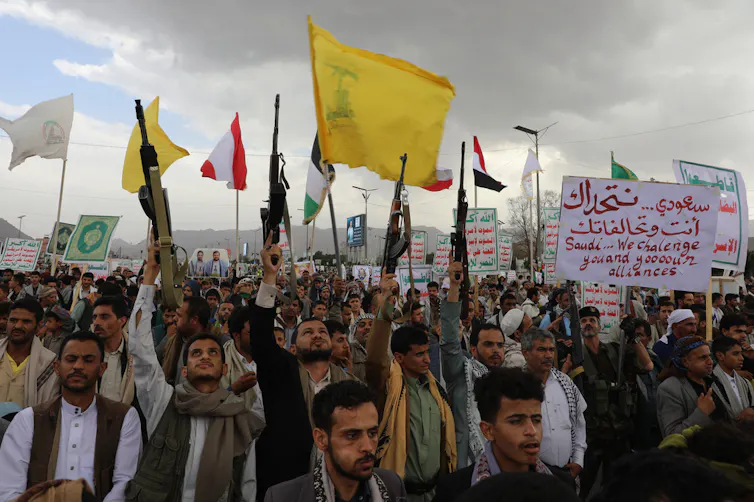
Men chant at a rally.

Houthi supporters attend a rally in Yemen’s capital against Saudi influence on July 31, 2026. AP Photo/Osamah Abdulrahman

Mahan Air is under a U.S. Treasury designation for its links to Iran’s Islamic Revolutionary Guards Corps, and the return flight reportedly carried IRGC personnel along with components for missiles and drones.

Against this backdrop, the Houthi announcement of a naval blockade on Saudi Arabia amounted to the most serious escalation of Saudi-Houthi tensions since a tenuous ceasefire largely ended Yemen’s civil war in 2022.

It also evoked memories of years of missile and drone attacks from Houthi areas on Saudi urban and energy infrastructure during the Yemeni civil war. Those attacks led the Saudi leadership to distance themselves from the American and British airstrikes in Yemen in 2025 and ensured that the long Houthi campaign against shipping in the Bab el-Mandab Strait and Red Sea from 2023 to 2025 avoided hitting Saudi vessels.

The loss of a solid Saudi plan B

This de-escalation of Saudi-Houthi tensions was critical in enabling the Gulf kingdom to quickly pivot its oil exports from its east coast ports to the west coast after the Strait of Hormuz was blocked in March 2026.

Within days of the closure, the East-West pipeline from the Saudi oil processing facility at Abqaiq to Yanbu, on the Red Sea, was operating at its full capacity of 7 million barrels per day.

This workaround allowed the Saudis to export around 3.43 million barrels of oil per day in May – less than half the prewar level, but a far higher figure than neighboring oil producers such as Kuwait, which lacks any alternative to passage through Hormuz.

To be sure, the workarounds put in place during the spring are not perfect – they remain within range of attack from Iran and its proxies. And both Yanbu, on the western coast of Saudi Arabia, and the United Arab Emirates’ own bypass pipeline from Abu Dhabi to Fujairah were targeted by missiles and drones in the first phase of the Iran war.

A commercial vessel sails in a body of water.

A vessel transits the Bab al-Mandeb Strait off the coast of southern Yemen on July 25, 2026. Khaled ZIAD/AFP via Getty Images

And it is these workarounds that are now at risk. Since July 20, the Houthis have struck at least four oil tankers in the Red Sea. In retaliation, Saudi Arabia has carried out airstrikes against Houthi targets in Yemen for the first time since the 2022 truce.

Vital Saudi oil infrastructure has also come under attack from both the Houthis and from Iranian-aligned groups in Iraq, who may have damaged the crucial processing facility at Abqaiq that acts as the nerve center for Saudi oil.

Quagmires and choke points

With the Saudis having also carried out joint airstrikes with the U.S. in Iraq on July 28, the kingdom now risks getting drawn into a conflict it has sought for years to avoid.

If the Houthi targeting of vessels in the Red Sea leads to similar restrictions on shipping in the Bab al-Mandab Strait as in the Strait of Hormuz, it would render a second regional choke point effectively inoperable.

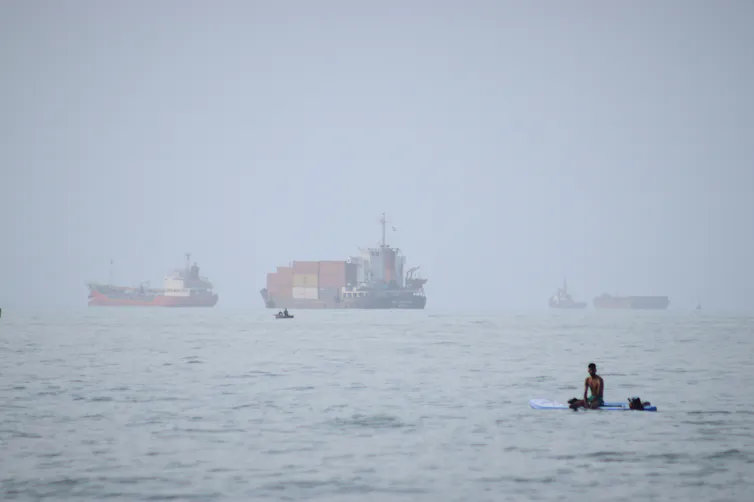
A man sits on a surfboard with container ships on the horizon.

A man sits on a surfboard as a container ship and other commercial vessels appear anchored in the Strait of Hormuz off Bandar Abbas, Iran, on July 27, 2026. Razieh Poudat/ISNA via AP

That would necessitate a workaround to the workaround, as tankers divert north through the Suez Canal into the Mediterranean – adding about four weeks to journey times and associated costs to destinations in Asia.

Even this plan B may not be secure – and this is where the significance of the drone attacks on the vessels in Egypt’s Damietta becomes clear.

Although the world’s largest oil tankers cannot transit the Suez Canal, they can utilize the SUMED pipeline to shuttle oil from the Egyptian Red Sea port of Ain Sokhna to the port of Sidi Kerir on the Mediterranean for onward collection.

This would add logistical friction to the process of first unloading and then reloading the oil cargoes. But if shippers and insurers perceive that Egypt’s Mediterranean facilities are not only within Iranian range but also capable of being hit, that raises the prospect of the Red Sea being restricted at both ends. Doing so would render Saudi Arabia’s west coast ports as vulnerable to disruption as its east coast ports in the Gulf.

The costs of an expanding conflict

The first phase of the war in Iran showed how quickly assessments of risk could affect shippers and insurers in the Strait of Hormuz, and the latest attacks could threaten to do the same for the Red Sea routes as well. An expanded conflict zone could wreak havoc on energy and commodity supply chains already stretched thin by the loss of oil production in the spring.

By abandoning the restraint they showed during the spring, the Houthis may be seeking leverage over Saudi Arabia to gain political and economic concessions. But the Saudis too have shown greater assertiveness in their conduct of airstrikes, which could add to regional escalatory dynamics.

The result is a further layer of complexity in what has become a series of overlapping conflicts that have defied resolution and risk inflicting even greater harm on the world economy in the weeks and months ahead.

FCC Commissioners Face Ethics Complaints for Taking Luxury Gifts From Paramount

0
fcc-commissioners-face-ethics-complaints-for-taking-luxury-gifts-from-paramount
FCC Commissioners Face Ethics Complaints for Taking Luxury Gifts From Paramount

Two government watchdog groups have demanded investigations into whether Federal Communications Commission members violated ethics requirements by accepting luxury gala tickets from Paramount as the company sought government approval for its $111 billion acquisition of Warner Bros. Discovery.

The complaints filed by Democracy Defenders Fund and Citizens for Responsibility and Ethics in Washington cite a recent ProPublica investigation that detailed how CBS or its parent company, now Paramount, have for years given FCC commissioners tickets to the Kennedy Center honors gala, which the television network sponsors. The commissioners accepted the gifts even as the FCC was reviewing or about to review major Paramount business decisions, including two megamergers.

Commissioner Olivia Trusty’s most recent financial disclosure said Paramount gave her two tickets to the December 2025 honors gala that together were worth more than $12,000. Trusty was one of two commissioners who voted last year to approve Paramount’s merger with another media company, Skydance.

ProPublica’s investigation found FCC members had long enjoyed a night out at the Kennedy Center courtesy of CBS or its parent company. Seven of the 10 commissioners who served since 2016 accepted tickets worth more than $260,000, according to a ProPublica analysis of ethics disclosures.

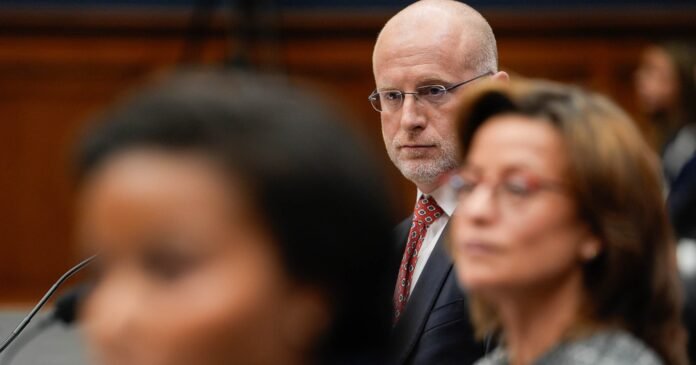
FCC Chair Brendan Carr’s financial statements show he has reported accepting honors gala tickets from CBS or its parent company eight times since his 2017 appointment to the commission, totaling over $75,000 in gifts.

Carr, who also voted in favor of the Paramount-Skydance merger last year, sat with his wife in a private skybox at the December gala with Paramount CEO David Ellison and other executives from Paramount and CBS. Such seats sold for $125,000 a ticket, according to Kennedy Center guidelines.

Carr disclosed on his latest financial statement that he accepted tickets from Paramount for himself and a guest to the 2025 gala and reception worth $12,390. Carr did not respond to a request from ProPublica to clarify the apparent difference in value between those tickets and the skybox seats. 

The FCC only released Carr’s disclosure late on Friday, more than a month after ProPublica had first requested it. The document says the agency certified it on June 22. 

Federal ethics rules ban employees from taking gifts from any entity that does business with, is regulated by or seeks official action from their agency.

“The federal gift regulations and the gratuities statute exist to ensure that government decisions are made on the merits, free from the influence of private benefits,” the Democracy Defenders Fund said in its complaint. “The public must have confidence that the FCC’s merger review process is not compromised by self-dealing or the appearance of impropriety.”

Carr, Trusty and the FCC did not respond to requests for comment. The agency’s inspector general declined to comment. An FCC spokesperson previously told ProPublica that agency ethics officers have for years cleared commissioners to accept the tickets, finding it consistent with ethics law. And Paramount’s chief of communications said it was a decades-long “CBS practice to invite government officials from both parties” to the Kennedy Center show. Carr last year defended the FCC’s approval of the Paramount merger with Skydance, saying it “advances the public interest.”

Read More

The FCC’s review of the Paramount-Warner Bros. merger is one of the final federal hurdles facing a historic consolidation of two of the five largest film studios in Hollywood. The deal would unite Paramount Skydance with Warner Bros., bringing under the control of one company Paramount+ and HBO Max streaming services; CBS and CNN; and scores of other major broadcast channels, cable networks and digital platforms.

Four ethics experts told ProPublica that by accepting the tickets, Trusty and Carr had compromised the FCC’s impartiality and should not take part in any upcoming decision on Paramount’s proposed merger.

The Democracy Defenders Fund — led by Norman Eisen, former ambassador to the Czech Republic and White House ethics czar under President Barack Obama — filed its grievance on Thursday with the federal Office of Government Ethics, the FCC’s inspector general and the FCC’s ethics office.

The group said the investigation should examine whether Carr and Trusty broke rules on accepting gifts or broke criminal laws prohibiting federal officials from accepting illegal gratuities.

Carr and Trusty should be required to repay Paramount the “fair market value” of any improper gifts and the federal ethics agency should refrain from certifying Carr’s annual disclosure report until he can prove that he has complied with ethics laws, Democracy Defenders Fund wrote. Its letter to the FCC and the Office of Government Ethics also requests that Carr be disqualified from further participation in the commission’s decision on the Paramount-Warner Bros. Discovery merger.

The nonprofit organization noted that hours after last year’s honors gala ended, Paramount announced it was launching its hostile takeover bid of Warner Bros. Discovery, a move that would later result in a merger agreement that requires FCC approval. About three months later, Carr publicly endorsed the deal on CNBC, promising swift approval.

“The facts that have been reported raise serious questions about the integrity and impartiality of FCC Chairman Carr in particular matters involving Paramount,” including the attempted merger with Warner Bros. Discovery, the letter said.

Citizens for Responsibility and Ethics in Washington, the other group that filed a written protest, requested an FCC inspector general probe of the luxury gifts.

“The reported gifts to FCC officials from businesses that are not only subject to agency regulation but presently engaged in billion-dollar mergers and acquisitions that must be approved by the commissioners themselves are extremely concerning threats to the integrity of FCC operations,” the CREW letter stated.

CREW, founded in 2003 as a nonpartisan organization dedicated to government accountability and ethics, is headed by Donald K. Sherman, a former House Ethics Committee attorney and special assistant to President Joseph Biden.

A woman in a blue suit sits at a table with a microphone in front of her. The same woman also appears on a large television screen on the wall behind where she is sitting.
Federal Communications Commission member Olivia Trusty. Jose Luis Magana/AP Images

“Government officials have the power to make decisions that impact huge swaths of the American people,” Sherman said in a statement about the organization’s demand for an inspector general investigation. “With this tremendous power comes a higher ethical standard that apparently wasn’t met. The IG can and must get answers for the public.”

The proposed merger between Paramount and Warner Bros. Discovery has drawn a flurry of legal opposition.

California, New York and 10 other states filed a lawsuit seeking to block the merger under federal and state antimonopoly laws. The Writers Guild of America, the Freedom of the Press Foundation and the Public Interest Project filed similar court challenges in recent weeks.

Paramount has recently agreed to pause its merger until the litigation is resolved or until June 1, 2027, whichever comes first.

China’s MANPADS for Iran could cost US airpower dearly

0
china’s-manpads-for-iran-could-cost-us-airpower-dearly
China’s MANPADS for Iran could cost US airpower dearly

Iran’s reported acquisition of Chinese shoulder-fired air-defense missiles could turn the war’s lower altitudes into a costly battlefield of attrition for US and Israeli airpower.

Iran was set to receive its first shipment within weeks under a signed US$60-$70 million deal for 300 to 400 Chinese-made QW-12 and FN-16 shoulder-launched air defense systems, also known as MANPADS, according to multiple media reports.

The MANPADS will aim to rebuild Iran’s short-range air defenses following five months of US and Israeli air strikes that exposed critical vulnerabilities in its fixed military infrastructure.

Brokered through Hong Kong-based intermediary Zhongqing Baoshang International Investment, the reported plan calls for the infrared-guided missiles to be shipped from Urumqi in western China through Pakistan and onward to Iran by air or land.

The weapons would allow Iranian forces to deploy dispersed, highly mobile low-altitude air-defense teams with minimal radar signatures around key strategic sites.

The reported transfer has already triggered diplomatic friction. China’s Foreign Ministry dismissed the report as groundless while Pakistan’s military public relations wing forcefully denied any logistical involvement.

US President Donald Trump noted that such shipments would directly contradict personal assurances from Chinese President Xi Jinping that Chinese companies would not supply weaponry to Iran.

The reported Chinese purchase would complement an earlier Iranian agreement with Russia. Asia Times reported that Iran signed a $591 million deal in December 2025 for 500 Verba MANPADS launchers and 2,500 missiles, with deliveries scheduled through 2029.

According to the US Army’s ODIN database, the QW-12 carries a 1.42-kilogram high-explosive warhead containing prefabricated tungsten-alloy fragments.

The shoulder-fired missile can engage targets at ranges of 0.5 to 6 kilometers and altitudes of 10 meters to 4 kilometers. Its infrared seeker can reportedly detect jet aircraft at distances exceeding 9 kilometers. The system has a claimed single-shot kill probability of more than 80%.

The infrared-guided FN-16 is likewise designed for short-range engagements against low-flying aircraft, helicopters and unmanned aerial vehicles. According to ODIN, its effective engagement range varies by target type, with helicopters and drones vulnerable at comparatively short distances.

Writing for Army Recognition in August 2026, Alain Servaes argues that US and Israeli strikes by B-2, F-35 and F-15 aircraft have destroyed significant portions of Iran’s strategic infrastructure and high- and medium-altitude air defenses, shifting the campaign toward sustained pressure on remaining targets.

He notes that this phase requires sustained intelligence, surveillance and reconnaissance (ISR), battle-damage assessment, target confirmation, special operations support and combat search-and-rescue (CSAR) — missions that can require aircraft to operate at lower altitudes.

MANPADS have limited reach against high- and medium-altitude aircraft but remain dangerous to aircraft operating closer to the ground.

Chris Gordon and Stephen Losey noted in a March 2026 Air & Space Forces Magazine article that passive electro-optical and infrared weapons provide little or no radar warning, enabling surprise “pop-up” attacks against low-flying drones and aircraft.

Unlike large, multi-vehicle air-defense systems such as the S-300 and Bavar-373, MANPADS can be operated by small, dispersed teams that are mobile, rapidly concealed and difficult to detect and destroy.

Illustrating the potential threat to unmanned aircraft, ABC News reported in July 2026 that Iran had shot down roughly 30 MQ-9 Reaper drones since the start of Operation Epic Fury.

Furthermore, the Washington Times reported in June 2026 that when combat losses in Yemen from 2017 are included, the US has already lost one-third of its 135-strong pre-war Reaper drone fleet, with the production line reported closed in 2025, making each US$56 million loss difficult to replace quickly.

These losses may be pushing the US toward older alternatives. The War Zone (TWZ) reported in June 2026 that US Central Command (CENTCOM) may have reactivated Predator drones, which carry fewer munitions than the Reaper.

The Reaper and Predator were developed during a time when US air superiority was largely taken for granted. They focus on endurance and payload rather than speed and agility.

While capable of flying above MANPADS engagement ranges, missions that bring them nearer to the ground put them at risk from short-range air defenses.

Each Reaper loss also reduces available ISR and battle-damage assessment capacity. Sustained losses in Iran could therefore have consequences beyond the conflict, particularly if US forces and allies require the same limited fleet for contingencies on the Korean Peninsula or in the Taiwan Strait.

Helicopters are particularly exposed at low altitude. Defense Security Asia reported in April 2026 that an Iranian MANPADS struck a US HH-60W rescue helicopter during a mission to recover downed F-15E pilots.

Fixed-wing aircraft are not safe from the threat, as the same outlet reported that an Iranian MANPADS also damaged a low-flying A-10 supporting the rescue operation, although the aircraft returned to its base in Jordan.

Previously, in March 2026, a US F/A-18 Hornet was hit by an Iranian MANPADS during a low-altitude strafing run, sustaining damage to the tail and engine area, but was able to return to base.

If one of those aircraft were shot down and its crew captured, the resulting negotiations could be politically damaging for the Trump administration and provide Iran with significant leverage.

China’s reported MANPADS shipment could strengthen Iran’s ability to wage an aerial war of attrition by contesting the lower-altitude battlespace.

The weapons cannot stop high-altitude or standoff strikes, but they can complicate follow-on operations by forcing US forces to hunt dispersed missile teams and protect the drones, helicopters and support aircraft operating closer to the ground.

US airpower may dominate Iran’s upper skies, but Iran could impose the mounting costs to the bombing campaign much closer to the ground.

How headlights got brighter, whiter, and more blinding after dark

0
how-headlights-got-brighter,-whiter,-and-more-blinding-after-dark
How headlights got brighter, whiter, and more blinding after dark

Every so often, I’ll be piloting some sensor-laden, software-defined press car down a dark stretch of highway when an oncoming driver’s high beams arrive like a targeted retinal strike, an involuntary reminder that modern automotive lighting has entered its own lumen arms race.

Anyone who has driven at night in the last few years knows what I’m talking about: A modern crossover crests a hill in the opposite lane, and the cabin briefly fills with enough cold-white light to suggest a police helicopter has joined traffic. The obvious assumption is that drivers are simply leaving their high beams on more often, but the reality is more complicated.

An old problem

Before cars became the modern mode of transportation, horse-drawn carriages used oil lanterns to light the way, as roads were largely unlit outside of towns and cities. These lanterns weren’t particularly bright, though, meaning that after-dark collisions and near-misses were common.

The late 1880s brought the motorcar, which used railway-style oil lamps. These emitted light like a candle and were prone to spilling, which could cause the vehicle to ignite.

Acetylene lamps arrived in the early 1900s. Like oil lanterns, they were dangerous, primarily because they relied on an open flame and produced highly flammable acetylene gas. If the gas nozzle became clogged or leaked, pockets of concentrated acetylene could build up and ignite, causing localized explosions.

Setting aside the occasional inferno, early motorcars did at least one thing well: They were faster than the horse-drawn traffic they were busy displacing. The problem, of course, is that this newfound speed arrived in a world whose lighting technology had not quite caught up with the idea of vehicles moving at more than a brisk trot. Early automotive lamps were less like searchlights and more like dim lanterns politely suggesting that there may or may not be a vehicle present.

Gas headlight of vintage, veteran car

An acetylene gas headlight on a vintage car.

An acetylene gas headlight on a vintage car. Credit: Pavel Babic/Getty Images

From the driver’s perspective, these early headlights did little more than marginally improve visibility. They struggled to illuminate meaningful distance ahead, leaving hazards—including ruts, livestock, and pedestrians—well outside detection range until the last possible moment.

Pedestrians had it worse. You might have been walking along a road at night when a faint glow appeared in the distance, followed by the realization that the glow was attached to a rapidly accelerating machine that was not good at noticing you. The entire system effectively relied on mutual improvisation: Drivers guessed where the road went, and pedestrians guessed whether they were about to become part of automotive history.

Getting brighter

Headlight regulation didn’t emerge from a single incident so much as from a steady mismatch between early motor vehicles and roads still designed for horses and pedestrians. Late-19th- and early-20th-century laws in the UK, US cities, and parts of Europe initially treated cars as “locomotives on highways,” requiring only that they carry lamps at night so they could be seen, an intentionally vague standard rooted in carriage-era lighting rules.

There was no notion of beam pattern or glare control at first, just basic visibility in otherwise unlit environments. As speeds increased and night driving became routine, these simple visibility requirements gradually hardened into the more technical headlight regulations that shaped modern automotive lighting design.

By the early 1900s, complaints from horse riders, pedestrians, and other drivers were already shaping US and European regulations that didn’t just require lamps but also implicitly pushed toward controlled illumination: shielding, positioning, and later beam shaping to reduce dazzle.

The tension was visible even then—drivers wanted more forward light as speeds rose, while everyone else wanted fewer blinding lights from oncoming traffic. That trade-off never went away; it just became formalized over time into beam cutoffs, alignment standards, and eventually modern photometric rules that try (with mixed success) to balance visibility for the driver against glare for everyone else.

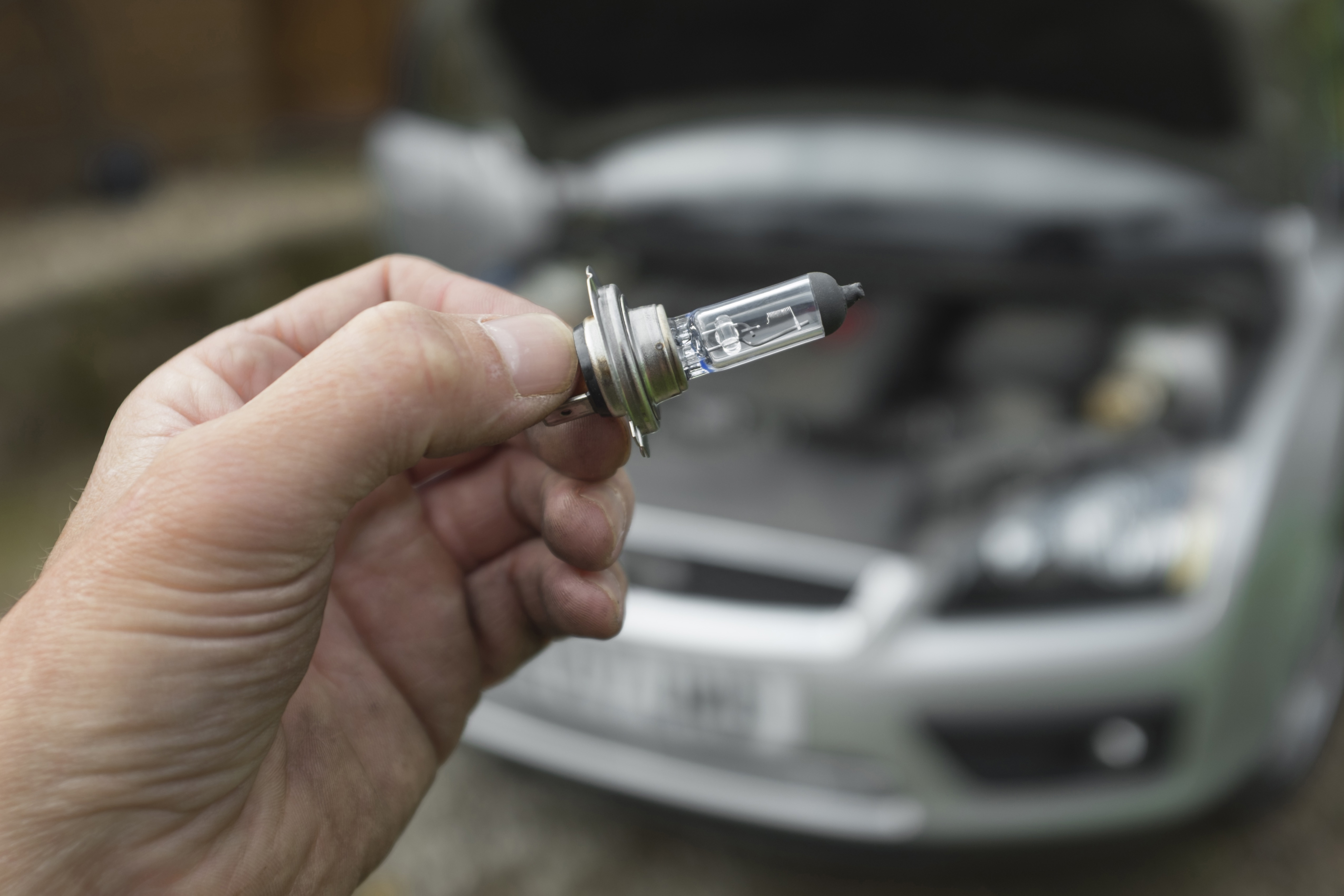
Replacment car headlamp bulb, Monmouth, Wales. (Photo by: Loop Images/Universal Images Group via Getty Images)

Halogen bulbs were better than the technology they replaced, but they were far from perfect.

Halogen bulbs were better than the technology they replaced, but they were far from perfect. Credit: Loop Images/Universal Images Group via Getty Images

Headlights have become brighter over the past two decades, largely because the automotive industry abandoned the old halogen paradigm in favor of LEDs, HID projectors, and increasingly sophisticated adaptive lighting systems.

Older halogen setups, particularly the reflector housings common through the 1980s, 1990s, and early 2000s, produced a comparatively soft, warm beam with limited reach. They were inefficient, generated excessive heat, and scattered light somewhat indiscriminately. But they tended to fail gracefully. Visibility wasn’t exceptional, but neither was the likelihood of accidentally assaulting an oncoming driver’s eyes.

Modern systems have an entirely different engineering goal. LEDs consume less power, last far longer, and can emit vastly more light from a much smaller package. Their compactness allows designers to create thinner headlights and more aggressive front-end styling, but it also means the light source itself becomes intensely concentrated. Automakers have additionally shifted toward cooler color temperatures—closer to daylight white than the yellowish glow of old halogens—because we perceive these wavelengths as sharper and more detailed at night.

The downside is that blue-white light also produces more glare and discomfort, especially in rain or on poorly marked roads. Add in the current SUV and pickup truck boom, where headlights are mounted higher off the ground than on older sedans, and even correctly aimed low beams can shine directly into the eyeline of drivers in smaller vehicles.

Then there’s the escalation effect. Modern vehicles are heavier, faster, quieter, and packed with driver-assistance systems that encourage confident nighttime driving at highway speeds. To support that, manufacturers continuously increase forward illumination distance and beam intensity.

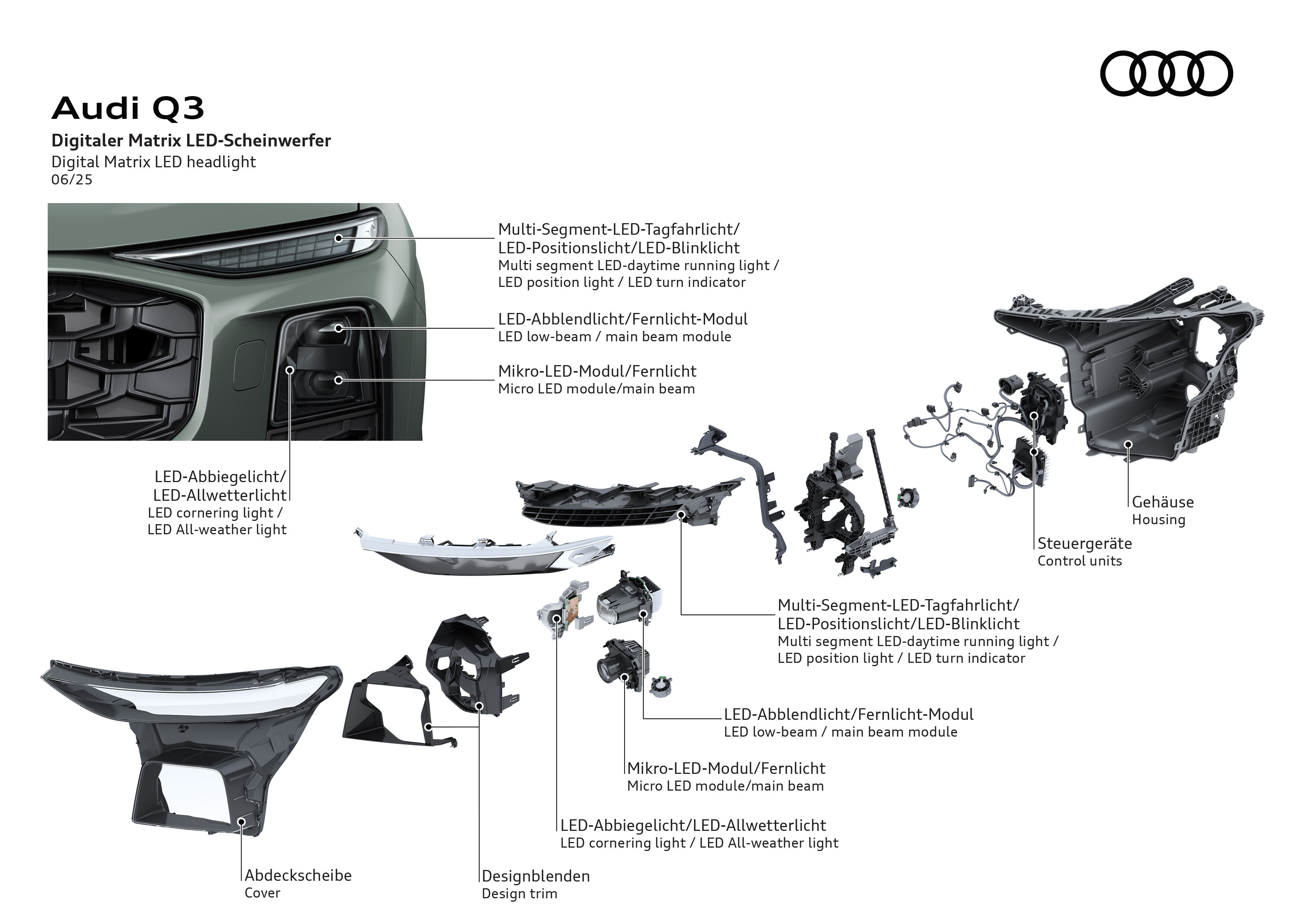
The illustration shows an exploded view of the components of a digital Matrix LED headlight, including a detailed image of the position of each light function.

The illustration shows an exploded view of the components of a digital Matrix LED headlight, including a detailed image of the position of each light function.

Digital Matrix LED headlights: Orientation light (on country roads)

Audi’s digital matrix LED lights can also project directions onto the road surface.

Adaptive matrix headlights, which can selectively dim portions of the beam to avoid dazzling other drivers while maintaining maximum illumination elsewhere, are theoretically the technological solution to the problem. In practice, though, adoption remains inconsistent, regulations vary by country, and many vehicles still rely on brute-force brightness rather than precision. The result is that nighttime driving increasingly feels less like navigating through darkness and more like surviving a rolling photonics demonstration from the consumer electronics industry.

According to 2019 to 2023 Fatality Analysis Reporting System (FARS) data, 46,154 fatalities on US roads were due to crashes at night and in non-lit areas. 446 were due to glare impeding the driver’s vision.

At the top end of the data set, the clustering of fatalities in California, Texas, and Florida is broadly consistent with baseline exposure: they are the three most populous states and, by extension, host the largest absolute number of vehicle miles traveled, so their prominence is not especially surprising. Illinois and Indiana likewise track expected behavior given their placement among the nation’s more populous states.

More notable are the outliers further down the list, where states such as Alabama and Kentucky exhibit disproportionate fatality counts that are less easily accounted for by population alone and appear, on first inspection, anomalous relative to traffic volume.

But the distribution becomes more legible when cross-referenced with demographic structure. A significant share of recorded fatalities, 108 in total, occurred among drivers aged 65 and older, suggesting that vulnerability factors tied to age may be amplifying outcomes in certain jurisdictions.

This reframes Florida’s position in fifth place, where its unusually large elderly driving population likely acts as a multiplier, helping contextualize why Texas and California remain in the upper tier. Alabama, meanwhile, remains a persistent outlier, retaining the highest relative fatality burden even when normalized against population size, indicating that exposure alone does not fully account for its placement in the distribution.

A minivan undergoing headlight testing at IIHS

A minivan undergoing headlight testing at IIHS.

A minivan undergoing headlight testing at IIHS. Credit: IIHS

High-beam rules are pretty similar throughout the US. In most states, the distance you need to dim your high beams when an oncoming vehicle is approaching is 500 ft (152 m). When you’re behind a vehicle, this is reduced to 200 to 300 feet (61-91 m).

An IIHS study found that vehicles with “good”-rated headlights were involved in 19 percent fewer nighttime crashes and 23 percent fewer pedestrian crashes than those with lower-rated systems. In general, higher-performing LED systems dominate the top of the ratings, while older halogen designs tend to cluster at the bottom, constrained by lower output and less precise beam control, despite offering advantages in simplicity and cost.

US federal headlight brightness standards have remained largely unchanged since 1997. In 2022, however, the US finally allowed adaptive driving beam headlights.

The 1997 system effectively reset industry incentives. Only one of more than 80 headlight systems tested in 2016 earned a “good” rating, but by model year 2025, that figure had risen to roughly 51 percent, with “marginal” or “poor” systems falling from 82 percent to about 16 percent.

Today’s problem

So what do manufacturers have to say about all this? I chatted with engineers at Skoda (one of VW’s brands) to find out.

Skoda says the main cause of glare at greater distances is light intensity. Light intensity, in simple terms, describes the relationship between the light output and the beam pattern.

“With halogen and HID, the main goal was to protect the plastic parts in the surrounding,” Skoda said. “Now, with LED, the main task is to protect the LED from itself and cool them right in all driving scenarios, with the optimal trade-off being the performance and cost.”

Regarding whether there are incentives that push companies toward the upper limit of allowed intensity for low beams, several of Skoda’s projects operate close to regulatory limits, though they remain in full compliance, the company said.

Despite featuring fancier technology, some modern cars still blind drivers. Skoda says this is mostly due to adaptive systems, especially matrix systems, which can cause glare because the car’s camera system isn’t recognizing objects correctly. Latency in the computing chain also plays a role. And we humans aren’t exactly amazing at flicking off our blinders whenever a car comes over the horizon.

So what about taller vehicles like semi-trucks, SUVs, and vans? Skoda claims there is no higher risk of glare at greater distances from taller vehicles; engineers won’t design differently knowing headlights will sit higher, either.

Image of a car's headlights obscuring view of road.

Credit: Getty Images

“The only thing we can play with is initial inclination,” Skoda told me. “We have several projects with higher-positioned headlights, where we set the inclination to 1.1 percent or 1.2 percent instead of 1 percent, which is standard for low-positioned headlights.”

As for maintenance, most cars, especially earlier halogen models, would require bulb changes. Depending on the vehicle, this was generally as simple as popping the hood, removing a cap from the back of the headlight, and changing the bulb.

Now, if an LED cluster malfunctions, the entire unit must be swapped out for another, due to much tighter tolerances in LED sources compared to halogen counterparts. As for headlight alignment, the higher intensities and contrasts of LED lights mean greater sensitivity to misalignment than halogen lights.

And there you have it: an unromantic explanation for why night driving now feels like a low-grade assault on your retinas. Modern lighting systems are undeniably better than what came before—brighter, more efficient, and far more capable—but, as ever, those gains come with trade-offs.

Headlights are still evolving; they’re now supported by cameras, sensors, and software that’s supposed to handle the tedious work of switching between low and high beams—or better yet, shaping the beam itself so you’re never blinding other drivers while still being able to see the road.

In theory, it’s elegant. In practice, it’s a computer trying to interpret a fast-moving, low-light world in real time, deciding whether that reflective flicker is a cyclist, a sign, or just the universe messing with it. And for all their confidence, computers still hesitate in slightly unnerving ways. Object recognition can be imperfect, beam adjustments aren’t truly instantaneous, and the entire system depends on a stack of assumptions about what a system thinks the road is doing at any given moment.

It usually works. Right up until it doesn’t.

It’s a bit like a Roomba, which will happily clean most of the floor, navigate around obstacles, and declare victory with robotic satisfaction. But it will also miss the awkward corners and stubborn patches that require a human to step in with a more old-fashioned approach (in this case, manually turning off the blinders).

On a good day, modern headlights can take most of the cognitive load out of night driving. But are we comfortable delegating yet another slice of real-time judgment to a system that is still learning how to see in the dark?

Israeli Agricultural Expertise Helps Cultivate Tanzania’s Growing Wine Industry  

0
israeli-agricultural-expertise-helps-cultivate-tanzania’s-growing-wine-industry  
Israeli Agricultural Expertise Helps Cultivate Tanzania’s Growing Wine Industry  


Tanzania is East Africa’s only commercial wine producer and has favorable conditions for expanding grape cultivation  

On the rolling hills outside Dodoma, Tanzania’s wine capital, an agricultural partnership is taking root. Israeli nonprofit CultivAid is working with local growers, researchers, and young agricultural professionals to modernize grape cultivation and winemaking through hands-on training, using Israeli cultivation techniques to improve yields, grape quality, and long-term sustainability. For local experts, the collaboration is providing something they say has been missing—practical experience, mentorship, and a roadmap for training the next generation of viticulturists.  

For Tanzanian viticulturist Jacob Timothy Mwavika, Israeli agriculture is a source of inspiration. “I have followed Israeli agriculture for many years because of its innovation and technology, especially irrigation techniques, desert agriculture and greenhouse technology,” Mwavika told The Media Line. “Israel also stands out because of the amount of agricultural research and development it invests in.”  

I have followed Israeli agriculture for many years because of its innovation

While familiar with Israel’s agricultural achievements, he admitted he knew little about the country’s wine industry before working with CultivAid. “To be honest, I had heard very little about Israeli wine compared to what I knew about table grape production,” Mwavika said.  

Tanzania’s commercial wine industry is relatively young by global standards, dating back to the early 1960s when Catholic missionaries introduced modern viticulture around Dodoma in the country’s semi-arid central region. Today, Dodoma remains the heart of Tanzania’s wine production, accounting for the vast majority of the country’s vineyards. Unlike many African nations, Tanzania has developed a commercial wine sector built largely around locally grown grapes rather than imported bulk wine. 

Despite decades of production, much of the industry continues to rely on traditional farming and winemaking practices. Industry experts say improvements in vineyard management, irrigation, modern equipment and technical training could significantly raise both grape yields and wine quality, while helping the sector capitalize on growing domestic demand, tourism and export opportunities across East Africa.  

CultivAid assisting in Tanzanian vineyard. (The Media Line)

Israel is internationally recognized for developing agricultural technologies that enable farming in some of the world’s most challenging environments. Faced with scarce water resources and arid conditions, Israeli researchers and farmers pioneered innovations including drip irrigation, advanced greenhouse cultivation, precision agriculture and water recycling. The country invests heavily in agricultural research, with close cooperation among universities, government research institutes, and farmers, enabling new technologies to move quickly from the laboratory to the field.  

This is where CultivAid has stepped in.   

“We saw that there was a lot to do,” Dr. Tomer Malhi, co-founder and CEO of CultivAid, told The Media Line. “There are many difficulties. They have low crop outputs, low quality, and pesticide issues. We have a lot of know-how and agronomy that can jump-start the crops.”  

According to Malhi, the vineyards in the Dodoma region are not yet close to their maximum capacity and could potentially double their crop output.   

Israel’s expertise is rooted not only in agricultural innovation but also in the rapid development of its own modern wine industry.  

In the past four decades, Israel’s wine industry has also undergone a dramatic transformation. Although winemaking in the region dates back thousands of years, the contemporary industry emerged in the 1980s and 1990s as wineries adopted modern vineyard management, international grape varieties, and advanced production techniques.  

Today, Israel is home to more than 300 commercial wineries, producing internationally recognized wines from regions including the Golan Heights, Galilee, the Judean Hills, and the Negev Desert, demonstrating how high-quality viticulture can flourish even in challenging climates.

According to the Israel Wine Grapes Board, Israeli wine exports totaled roughly $66 million in 2024, with the US as the main market.  

Through CultivAid training programs, Mwavika has been able to put into practice many of the techniques he had previously encountered only in books or research papers.  

“CultivAid introduced me to many experts and gave me the opportunity to physically see and practice methods that I had only learned about through reading,” Mwavika said.  

The organization has established a six-acre farm in Dodoma where research and experiments are conducted. “We are training local residents to be the best agronomists in Tanzania,” said Malhi.   

Recently, CultivAid launched a vineyard management course for 60 local participants and established a vineyard nursery as part of its long-term training program.  

As a professional viticulturist, Mwavika said that much of his knowledge came from years of field experience with limited guidance. “It has always been my dream to raise a new generation of grape specialists,” Mwavika said. “The challenge was that there was no platform to train them. CultivAid has provided that solution, and now they are helping develop young professionals with specialized skills in viticulture.”  

CultivAid has provided that solution, and now they are helping develop young professionals with specialized skills in viticulture

The initiative comes as Tanzania’s wine sector remains relatively small but shows considerable potential for growth. The country is East Africa’s only commercial wine producer and has favorable conditions for expanding grape cultivation.  

“The Tanzanian wine industry has significant opportunities for growth because there is still land suitable for grape production,” said Mwavika. “We also have a strong tourism market, where wine consumption is high, and with improvements in quality, Tanzania can become much more competitive.”  

Malhi also believes that there is significant potential. “When we began our activity, the local wine industry was producing between 4 to 5 million liters a year, and now we are at 20 million liters,” he said. The goal is to expand the supply of high-quality grapevines to meet demand from growers and wineries.   

Mwavika noted that Tanzania has an advantage in supplying the wider East African market. “Only Tanzania is able to commercially grow grapes and produce wine in the region,” he said. “The wine industry has the potential to generate significant national income and create many jobs.”  

At the same time, he pointed out that much of the sector still relies on traditional production methods.  

“There is still limited innovation and technology in the industry,” he said. “Modern equipment and improved techniques can transform both production and wine quality.”  

Beyond agriculture, the partnership has also shaped Mwavika’s perception of Israel. “I have learned that Israelis have a genuine willingness to help transform agriculture through practical training, working directly with farmers and openly sharing the results of their research,” he said. “I have not yet visited Israel, but it is something I very much hope to do.”  

I have learned that Israelis have a genuine willingness to help transform agriculture through practical training

For Ayelet Levin-Karp, CEO of SID Israel, an umbrella organization for Israel’s humanitarian aid and international development community, the significance of these projects lies in their practical, long-term impact. “Projects like CultivAid reflect a different side of Israel’s engagement with the world—one built on partnership, knowledge-sharing and long-term economic development,” she said.  

“At a time when Israel faces significant international challenges, the work of Israeli development organizations across Africa demonstrates that Israeli expertise continues to be valued because it delivers measurable results and creates lasting opportunities for local communities,” she noted.  


EU Socialists accuse governments of politicising Ceuta and undermining Schengen

0
eu-socialists-accuse-governments-of-politicising-ceuta-and-undermining-schengen
EU Socialists accuse governments of politicising Ceuta and undermining Schengen


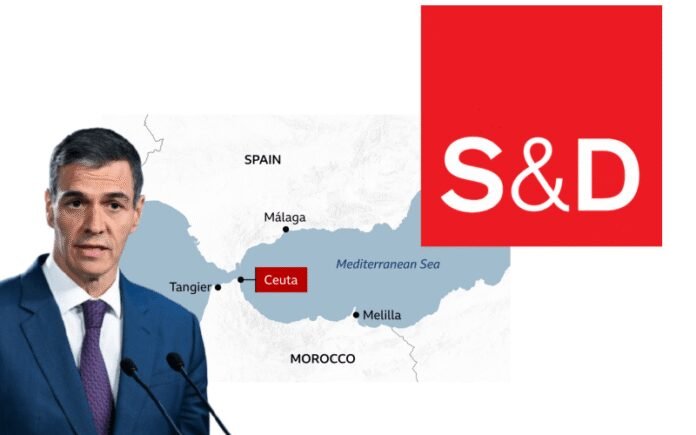
The Socialists and Democrats Group in the European Parliament called on European Commission President Ursula von der Leyen to intervene immediately to clarify the rules governing any suspension of the Schengen area by European Union member states following recent events in Ceuta.

In a letter sent to von der Leyen, the center-left parliamentary group said it was concerned about what it described as a deliberate misrepresentation by some governments of the situation in the Spanish enclave and of the possible consequences that could follow.

The group said no EU member state has the authority to expel another member state from the Schengen area and stressed that the bloc’s common rules must be applied in line with the rule of law rather than for political purposes.

The S&D Group said protecting Schengen meant safeguarding the free movement of people, which it described as one of the European Union’s greatest achievements.

The group also criticized reactions from right-wing and far-right parties and governments that called for border closures instead of showing solidarity with Spain. It argued that such responses risk creating a precedent that could allow European law to be manipulated for national political interests.

S&D Vice-President Ana Catarina Mendes said migration should be managed through regular entry channels, integration measures, rights and responsibilities, and efforts to combat traffickers and exploiters.

“Schengen cannot be defended by erecting new borders within Europe,” Mendes said. “It must be defended through a unified immigration policy and solidarity among member states.”

Mendes also referred to von der Leyen’s public statement that “no one has reached mainland Spain or the rest of the European Union,” questioning whether the legal conditions for reintroducing internal border controls had been met. She called on the Commission to clarify the legal basis for any such measures and to act in its role as guardian of the EU treaties if the conditions had not been satisfied.

Sandro Ruotolo, a member of the European Parliament’s Committee on Civil Liberties, Justice and Home Affairs, said Schengen should not become a tool for political pressure between member states.

“Schengen is one of the European Union’s most important achievements,” Ruotolo said. “It cannot be called into question on the basis of propaganda and fear.”

Ruotolo also criticized rhetoric that dehumanizes migrants, saying political leaders should address migration challenges without promoting fear or hatred. He accused right-wing and far-right governments of manipulating the principle of free movement for political purposes and urged von der Leyen to ensure that the principles underpinning Schengen are respected.

The letter adds to a growing debate within the European Union over migration policy, border management and the balance between national measures and the bloc’s shared legal framework.

0FansLike
0FollowersFollow
0FollowersFollow
0SubscribersSubscribe
- Advertisement -
Google search engine

Recent Posts