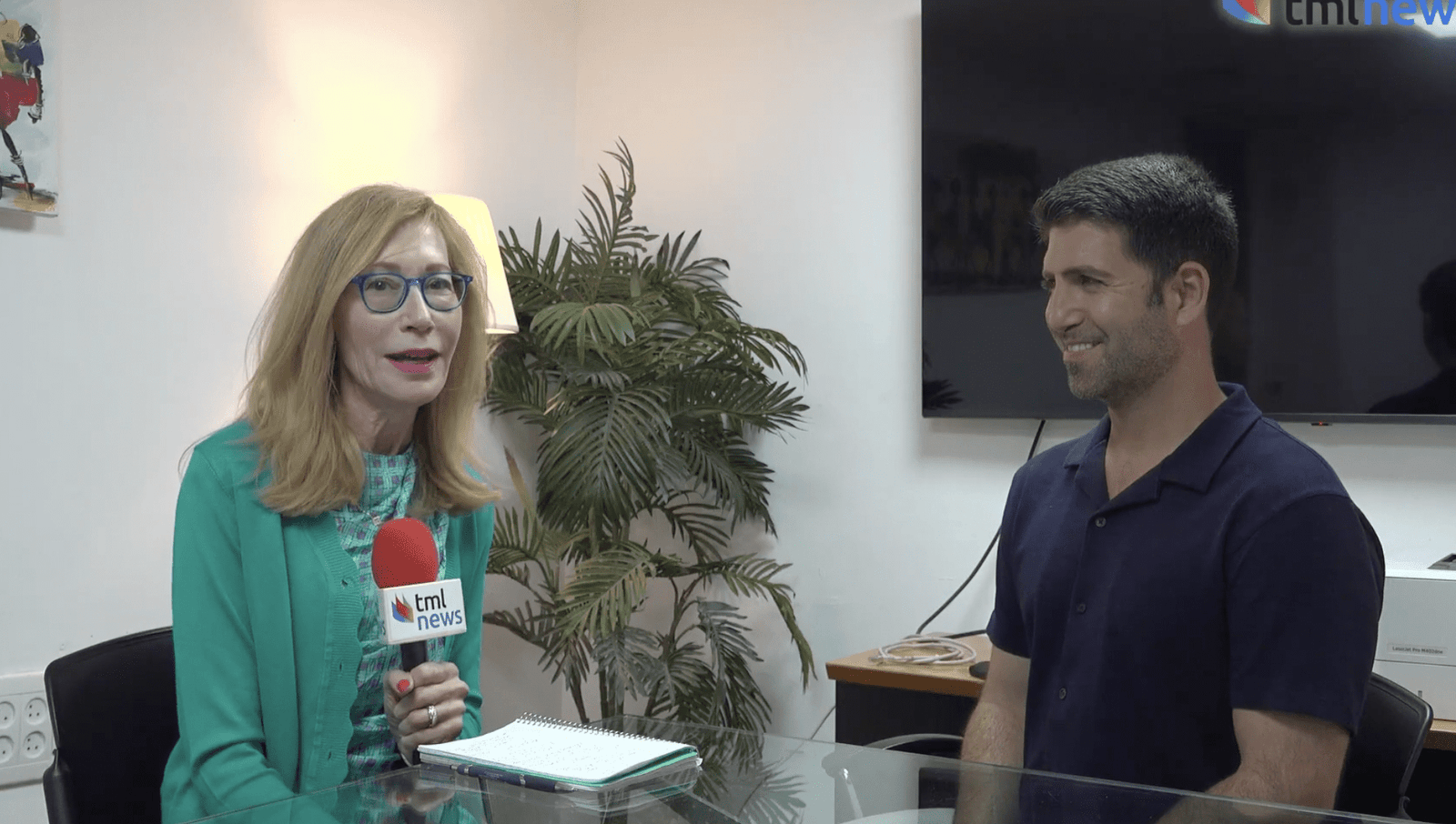
“We have a technological front line,” Chen Shmilo, former CEO of 8200 Alumni Association and a Voice of the People council member, told TML, adding that the goal is to combat antisemitism online with the same seriousness as other threats
In the new battleground for Jewish life, the fight is no longer only over policy, memory, or public opinion. It is over the conditions that shape all three: what people see, what they believe, and whether hate can be manufactured faster than truth can catch up.
The warning came during a broader discussion about efforts to unite entrepreneurs, educators, technologists, and community leaders in confronting antisemitism in the age of artificial intelligence. What emerged was not a single campaign but a multi-front response, one that treats social media, education, Jewish identity, and digital manipulation as parts of the same crisis. The speakers described a world in which hate spreads through algorithms, deepfakes, and large language models, while the counterforce must come from networks of people willing to collaborate across sectors, countries, and disciplines.
That effort came into sharper focus through “From Blueprints to Life,” a global digital gathering held on June 3, 2026. Hosted by Amalya Duek of Channel 12’s daily newscast, the broadcast highlighted the inaugural Voice of the People cohort’s initiatives and the work of its global council, with a focus on practical responses to challenges facing Jewish communities worldwide.
Voice of the People is a global Jewish network led by President Isaac Herzog that brings together Jewish voices from around the world to tackle the community’s biggest challenges through dialogue and joint action. Its goal is to turn broad conversation into concrete steps that strengthen Jewish life, leadership, and long-term resilience.
The old boundaries no longer hold. Antisemitism is not just a social problem or a political one; it is increasingly linked to technology, generation, and identity. The answers in the room came from people who were not waiting for the crisis to pass. They were already building a response, whether through education, community leadership, or tech-driven efforts to arrest the spread of hate online.
Neta Danciger, chief marketing officer of Voice of the People, described the event as reaching a meaningful milestone, showcasing the initiatives of seven entrepreneurs, either individually or in groups, whose work was already making an impact. Their projects ranged across issues: antisemitism, artificial intelligence, polarization in the Jewish world, education, early childhood, and Jewish identity. President Isaac Herzog’s appearance in the studio emphasized the significance of the event.
For Danciger, the most important development was the community that had formed around the projects. “It’s so exciting to see these 150 people,” she said, “and to look at them after a year and a half into the cohort and to see that they became a community.”
They were helping each other, she said, and acting as “generous leaders in the world, in the Jewish global ecosystem.” That kind of connection, she suggested, is what gives the initiative its lasting value. And beyond the projects themselves, there was the larger framework of the leading topics, with antisemitism sitting alongside questions of identity, relations, and education as part of a broader effort to understand where Jewish life is being pulled.
Asked about the scale of the problem, Danciger pointed to a survey of more than 10,000 Jews around the world that found rising antisemitism was the clearest challenge facing Jewish life, especially after October 7th. She said the shock of that moment has reshaped Jewish life globally and now runs through the Voice of the People’s work.
But Danciger also made clear that antisemitism was not confined to one lane. It also focused on relations between Jews and non-Jews, as well as on Jewish identity. “It’s the underlining topic, issue, and challenge for all Jews today,” she said. That line captured a central truth: antisemitism is now so embedded in Jewish public life that it shapes everything around it. The task is not merely to respond to the rise in hate, but to understand how it affects the future. That is why, she said, people in the cohort are also trying to think about Jewish identity “in the early years of development,” before prejudice and polarization fully take root.
That is where technology enters the picture. Danciger said many of the thought leaders she works with are trying to understand how antisemitism and technology “kind of interlace.” AI has dramatically changed everyday life in just the last two years, she said, and those shifts are already affecting how people encounter and amplify hatred.
The challenge is to look at what is happening now and figure out how to change the numbers—not just by reacting to hate, but by understanding the systems that spread it. The same impulse also runs through the educational work: not as a campaign to “get into” schools, she said, but as a way of preparing leaders who can carry these lessons into their own communities and professional worlds.
Education was one of the most revealing parts of the conversation, because it showed how the response to antisemitism can begin long before adulthood. When asked whether the work was aimed at schools or at educating communities more broadly, Danciger replied, “We are not looking to get into anything.” Instead, she said, Voice of the People is “fostering this community” and nurturing leaders who will do the work in their own communities and professional worlds. That model is less about institutional reach than it is about distributed responsibility. The point, she seemed to suggest, is not to parachute in with a message but to cultivate people who can help shape the message from within.
She pointed to Ranit, the CEO of the Meitarim school network in Israel, as an example. The schools bring together religious and non-religious children, and one of the projects she described concerns how to “quiet down the monster, the beast of hating each other on social media” so people can begin listening to one another. The phrase was vivid, and intentionally so. It suggested that the digital world is not just noisy but violent in ways that shape children early on.
Danciger said the hardest part is having conversations with people who disagree with you or come from different backgrounds. That is precisely why she sees schools and community programs as essential arenas for this work. The fight begins with the ability to sit in the same room, or even the same feed, without instantly turning the other person into a threat.
Chen Shmilo, former CEO of the 8200 Alumni Association and a council member of Voice of the People, translated the same concern into technological terms. He said social media has long been a platform for both positive speech and hate speech, but the rise of generative AI has made the problem more complex. Hate can now be produced, scaled, and disguised in new ways. “We have a technological front line,” he said, and the task is to combat antisemitism and hate speech online with the same seriousness that other threats receive. The stakes are not theoretical. If hatred can be automated, then the response must be at least as agile.
Our haters will always outnumber us, both offline and online, right?” It is, again, the David versus Goliath story.
Responding to a question about possible solutions to the problem, Shmilo argued that meeting the challenge requires a broad coalition of talent. “We have to harness the most talented people in the Jewish world,” he said, both in Israel and outside it. When asked whether the Jewish community worldwide had enough people to deal with such a large problem, he answered with striking candor: “Our haters will always outnumber us, both offline and online, right?” But he quickly reframed the imbalance. “It is, again, the David versus Goliath story,” he said. The larger force may have more numbers, but the smaller one can still prevail through ingenuity, speed, and collaboration.
He compared the challenge to cybersecurity, where threats evolve constantly, and responses must be developed, integrated, and scaled. What is missing, he said, is not intelligence but focus: the attention of people in tech, funding, and venture capital who are willing to work together. He stressed the need for Israelis and Jews outside Israel to collaborate. The fight, in other words, is not local. It is global, and it must be answered with a network that is just as wide as the problem itself.
One of the most alarming parts of his warning involved chatbots and large language models. Shmilo said there are already tools to identify hate speech, but not enough options for response. “We are still running short of solutions to respond quickly,” he said.
Some chatbots are generating hate speech or inaccurate Holocaust information, creating a threat not only to public discourse but to Holocaust memory itself. Asked how that could be fixed, he admitted, “I still don’t know.” But he then added that the capacity is already there: “We have the people, we have the startup nation to start working on it if we create this platform for them to start thinking, collaborating, and developing solutions.” The idea is not to start from zero, but to connect what already exists.
We have the people, we have the startup nation to start working on it if we create this platform for them
His own sense of urgency was deeply personal. Asked what drives him as antisemitic acts intensify, especially after October 7th, Shmilo said, “I’m a descendant of four Holocaust survivors.” The memory of the Holocaust, he said, is still very much alive in his family. October 7th changed him further, and he said it helped him understand more deeply how antisemitism abroad affects life in Israel. That led him to what he called “a responsibility, almost an obligation,” to be more proactive and help develop technological solutions that can at least mitigate the spread of hate speech.
He linked that obligation to his background in the 8200 Alumni Association, where he said there is a duty to promote impactful technologies by harnessing graduates’ human capital for the sake of Israeli society and the economy. Now, he said, there is “another mission, which is fighting anti-Semitism.” And because online antisemitism is really a form of hate online, he argued, it is “a global threat to liberal societies, to Western countries, to Western democracies.” That broader framing makes the issue bigger than one community’s defense. It becomes a test of democratic resilience itself.
He later returned to that idea with a line he attributed to Rabbi Jonathan Sacks: “What starts with the Jews never ends with the Jews.” The message was that the consequences of online hate spread outward, and so do the solutions. If effective methods are developed, Shmilo suggested, they could help other societies as well. Jews, then, are not only defending themselves; they may also be helping to build tools that strengthen public life more broadly. “I think we have the right people to do that. I think we can harness the brightest minds of the Jewish people, both in Israel and in the diaspora, and give it more attention and start thinking creatively and find solutions.”
When asked why media, communication, and hate speech have often been treated as secondary fronts, Shmilo said he did not have the full answer, but he identified the pattern. Communities often lack the knowledge or confidence to take on “these giants”—the social media platforms and AI systems that feel so powerful.
“It feels like we are almost unable to do something,” he said. “But I resent this idea.” He pointed to Israel’s startup culture as evidence that people once believed they could solve hard problems in finance, digital health, and other sectors, noting that initiatives such as Hack the Hate and the One Signal Collective are innovative efforts aimed at redressing the balance.
Shmilo believes antisemitism is another frontier where the same mindset can succeed. The issue is not the absence of talent, but whether that talent is organized and empowered to act.
Shiran Mlamdovsky Somech, founder of Generative AI for Good, brought that entrepreneurial spirit into the realm of digital truth. She described Hack the Hate—a tech-driven initiative against online antisemitism and hate speech—as an effort to bring together “the different sectors to talk with each other.”
The project began with a conference in 2024 and then expanded to two additional conferences in New York, held in partnership with the Yeshiva University Museum. Those events were successful, she said, because both startups and organizations wanted “to come together and to speak and to listen and to learn.” From that demand came the idea for the One Signal Collective, an innovation center where companies, academics, and other stakeholders could work together regularly.
Pressed on the issues surrounding AI, her explanation was especially powerful because she kept returning to the fact that no technical background is required to use it. In “a few clicks,” anyone can create a deepfake and generate new content. That accessibility makes the technology dangerous because people may not recognize what they are seeing, and malicious actors can exploit it at scale. Deepfake and misinformation, she said, can easily fuel hate across social media if they are not addressed. In that sense, AI is not just a tool; it is an accelerant.
She also warned about the bias built into large language models, saying those biases are aimed not only at the Jewish community but at democracy itself. To make that danger vivid, she described online images of Hitler and Anne Frank together in a grotesque invented scene. “For me, it was very, very chilling to see it,” she said. Her concern was not only that such fabrications exist, but that young people may not know how to tell the difference between real and fake. “It can be easily manipulated by those kinds of fakes and lies and propaganda,” she said. That is why, in her view, the response must include both technical solutions and a broader social protocol for responsible AI use.
When the conversation turned to social media platforms such as TikTok and Instagram, Mlamdovsky Somech said algorithms can trap users in echo chambers until they believe what they see is simply the truth. It is not exactly an industry, she said, but the truth itself may no longer remain stable. “What is reality and what is not?” she asked. “What is good, what is bad?” In her view, society now needs relevant experts to create protocols that guide platforms and other AI systems toward responsible use. The aim is not to outlaw technology, but to prevent it from becoming a machine for confusion.
What made the whole discussion compelling was the way it tied together the practical and the existential. Danciger talked about community formation, early childhood, and the difficulty of listening across differences. Shmilo spoke about survivors, October 7th, cybersecurity, and the possibility of building technological defenses. Mlamdovsky Somech focused on deepfakes, algorithmic echo chambers, and the collapse of shared truth.
Taken together, they describe a Jewish world that is not simply reacting to hate but trying to understand how hate now moves, mutates, and recruits technology in its service. And because the effort is being led by people who think across sectors, it feels less like a slogan and more like a working blueprint.
The conversation kept returning to the same conviction: the people and the tools needed to fight back already exist. The challenge is to bring them together, to trust their capacity, and to move fast enough to matter. In a moment when hate can be manufactured in seconds, and falsehood can travel farther than fact, that may be the most important work of all—building the human networks that can keep truth, memory, identity, and community from being overwritten.