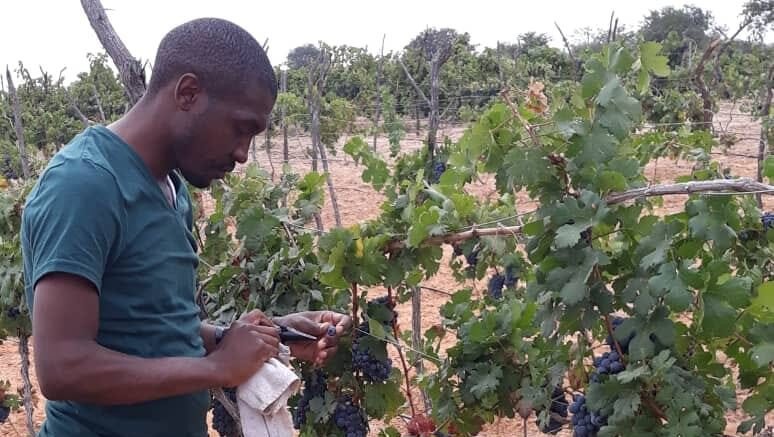
Tanzania is East Africa’s only commercial wine producer and has favorable conditions for expanding grape cultivation
On the rolling hills outside Dodoma, Tanzania’s wine capital, an agricultural partnership is taking root. Israeli nonprofit CultivAid is working with local growers, researchers, and young agricultural professionals to modernize grape cultivation and winemaking through hands-on training, using Israeli cultivation techniques to improve yields, grape quality, and long-term sustainability. For local experts, the collaboration is providing something they say has been missing—practical experience, mentorship, and a roadmap for training the next generation of viticulturists.
For Tanzanian viticulturist Jacob Timothy Mwavika, Israeli agriculture is a source of inspiration. “I have followed Israeli agriculture for many years because of its innovation and technology, especially irrigation techniques, desert agriculture and greenhouse technology,” Mwavika told The Media Line. “Israel also stands out because of the amount of agricultural research and development it invests in.”
I have followed Israeli agriculture for many years because of its innovation
While familiar with Israel’s agricultural achievements, he admitted he knew little about the country’s wine industry before working with CultivAid. “To be honest, I had heard very little about Israeli wine compared to what I knew about table grape production,” Mwavika said.
Tanzania’s commercial wine industry is relatively young by global standards, dating back to the early 1960s when Catholic missionaries introduced modern viticulture around Dodoma in the country’s semi-arid central region. Today, Dodoma remains the heart of Tanzania’s wine production, accounting for the vast majority of the country’s vineyards. Unlike many African nations, Tanzania has developed a commercial wine sector built largely around locally grown grapes rather than imported bulk wine.
Despite decades of production, much of the industry continues to rely on traditional farming and winemaking practices. Industry experts say improvements in vineyard management, irrigation, modern equipment and technical training could significantly raise both grape yields and wine quality, while helping the sector capitalize on growing domestic demand, tourism and export opportunities across East Africa.

CultivAid assisting in Tanzanian vineyard. (The Media Line)
Israel is internationally recognized for developing agricultural technologies that enable farming in some of the world’s most challenging environments. Faced with scarce water resources and arid conditions, Israeli researchers and farmers pioneered innovations including drip irrigation, advanced greenhouse cultivation, precision agriculture and water recycling. The country invests heavily in agricultural research, with close cooperation among universities, government research institutes, and farmers, enabling new technologies to move quickly from the laboratory to the field.
This is where CultivAid has stepped in.
“We saw that there was a lot to do,” Dr. Tomer Malhi, co-founder and CEO of CultivAid, told The Media Line. “There are many difficulties. They have low crop outputs, low quality, and pesticide issues. We have a lot of know-how and agronomy that can jump-start the crops.”
According to Malhi, the vineyards in the Dodoma region are not yet close to their maximum capacity and could potentially double their crop output.
Israel’s expertise is rooted not only in agricultural innovation but also in the rapid development of its own modern wine industry.
In the past four decades, Israel’s wine industry has also undergone a dramatic transformation. Although winemaking in the region dates back thousands of years, the contemporary industry emerged in the 1980s and 1990s as wineries adopted modern vineyard management, international grape varieties, and advanced production techniques.
Today, Israel is home to more than 300 commercial wineries, producing internationally recognized wines from regions including the Golan Heights, Galilee, the Judean Hills, and the Negev Desert, demonstrating how high-quality viticulture can flourish even in challenging climates.
According to the Israel Wine Grapes Board, Israeli wine exports totaled roughly $66 million in 2024, with the US as the main market.
Through CultivAid training programs, Mwavika has been able to put into practice many of the techniques he had previously encountered only in books or research papers.
“CultivAid introduced me to many experts and gave me the opportunity to physically see and practice methods that I had only learned about through reading,” Mwavika said.
The organization has established a six-acre farm in Dodoma where research and experiments are conducted. “We are training local residents to be the best agronomists in Tanzania,” said Malhi.
Recently, CultivAid launched a vineyard management course for 60 local participants and established a vineyard nursery as part of its long-term training program.
As a professional viticulturist, Mwavika said that much of his knowledge came from years of field experience with limited guidance. “It has always been my dream to raise a new generation of grape specialists,” Mwavika said. “The challenge was that there was no platform to train them. CultivAid has provided that solution, and now they are helping develop young professionals with specialized skills in viticulture.”
CultivAid has provided that solution, and now they are helping develop young professionals with specialized skills in viticulture
The initiative comes as Tanzania’s wine sector remains relatively small but shows considerable potential for growth. The country is East Africa’s only commercial wine producer and has favorable conditions for expanding grape cultivation.
“The Tanzanian wine industry has significant opportunities for growth because there is still land suitable for grape production,” said Mwavika. “We also have a strong tourism market, where wine consumption is high, and with improvements in quality, Tanzania can become much more competitive.”
Malhi also believes that there is significant potential. “When we began our activity, the local wine industry was producing between 4 to 5 million liters a year, and now we are at 20 million liters,” he said. The goal is to expand the supply of high-quality grapevines to meet demand from growers and wineries.
Mwavika noted that Tanzania has an advantage in supplying the wider East African market. “Only Tanzania is able to commercially grow grapes and produce wine in the region,” he said. “The wine industry has the potential to generate significant national income and create many jobs.”
At the same time, he pointed out that much of the sector still relies on traditional production methods.
“There is still limited innovation and technology in the industry,” he said. “Modern equipment and improved techniques can transform both production and wine quality.”
Beyond agriculture, the partnership has also shaped Mwavika’s perception of Israel. “I have learned that Israelis have a genuine willingness to help transform agriculture through practical training, working directly with farmers and openly sharing the results of their research,” he said. “I have not yet visited Israel, but it is something I very much hope to do.”
I have learned that Israelis have a genuine willingness to help transform agriculture through practical training
For Ayelet Levin-Karp, CEO of SID Israel, an umbrella organization for Israel’s humanitarian aid and international development community, the significance of these projects lies in their practical, long-term impact. “Projects like CultivAid reflect a different side of Israel’s engagement with the world—one built on partnership, knowledge-sharing and long-term economic development,” she said.
“At a time when Israel faces significant international challenges, the work of Israeli development organizations across Africa demonstrates that Israeli expertise continues to be valued because it delivers measurable results and creates lasting opportunities for local communities,” she noted.