26.6 C
London
Friday, July 31, 2026
Home Blog

We investigated Russia’s military indoctrination of Ukrainian children in occupied territories – what we found was more shocking than we could have imagined

0
we-investigated-russia’s-military-indoctrination-of-ukrainian-children-in-occupied-territories-–-what-we-found-was-more-shocking-than-we-could-have-imagined
We investigated Russia’s military indoctrination of Ukrainian children in occupied territories – what we found was more shocking than we could have imagined

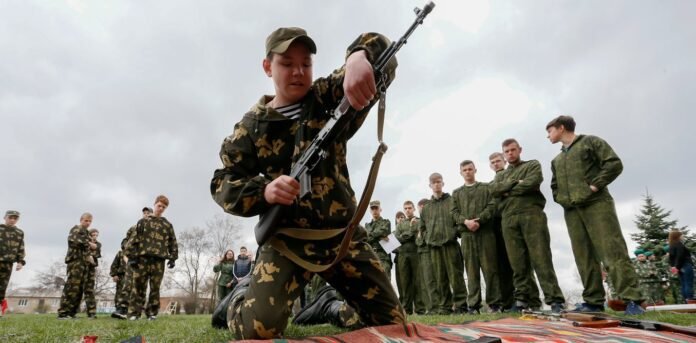
A youg Ukrainian boy assembles a rifle.
Ukrainian children take part in a military game at a school in the Russian-controlled city of Makeevka, April 2019. EPA/Dave Mustaine

When we were asked to investigate Russia’s indoctrination and militarisation of children living in the Ukrainian territories occupied by Moscow since 2014, we had a general idea of the Kremlin’s occupation policies. Two of us grew up in what was then Soviet-occupied Latvia and East Germany. We were already familiar with the Soviet approach to “upbringing”.

But when we went to Ukraine, what we found still shocked us. There was plenty of evidence of the systematic and coercive nature of the Russian federation’s policies attempting to erase the identity of the Ukrainian children under its control.

Our investigation was the sixth mission established by Organization for Security and Co-operation in Europe (OSCE) since 2022 to investigate human rights violations in relation to Russia’s full-scale invasion of Ukraine. It’s the second to focus specifically on children.

The first of these two missions was concerned with their forcible transfer to the Russian Federation. Our task was to build on this first mission and assess whether Russia’s conduct during the war against Ukraine violates applicable international law, such as the Geneva Conventions and the Convention on the Rights of the Child.

During the three weeks of our mission, we collected and analysed a vast amount of data. This included written reports, comments and statements produced by international organisations such as the United Nations, the OSCE, the Council of Europe and the European Union.

We also collected testimonies, both online and in person, from young adults who had experienced indoctrination and militarisation as children in the Russian-occupied territories of Ukraine. And we also heard from teachers who had spent some time under occupation before escaping to territory controlled by the Ukrainian government.

During a visit to Kyiv, we also conducted a series of interviews with representatives of Ukrainian government institutions and civil society organisations.

Our report, presented to the OSCE Permanent Council on July 9, offers sometimes distressing detail and harrowing witness accounts.

For example, in one of the written testimonies available to us, the witness explained how the headteacher of the local school, accompanied by heavily armed soldiers, went from house to house to question parents who do not send their children to school and had not yet applied for Russian passports. He threatened them with the removal of their parental rights. He also said their children would be placed in institutions if they didn’t yield to the pressure to do so. In the face of such a display of government power, the parents eventually gave in.

This particular incident, which is far from an isolated case according to evidence collected by the UN and the OSCE, illustrates the level of coercion applied not just to children but their whole families. It also shows the extent to which different government agencies collaborate in this.

The coercion of Ukrainians in the occupied territories to take Russian passports is also significant when it comes to what we refer to in our report as the “conscription pipeline”. Children are being systematically prepared for future armed service. By being forced into Russian citizenship, boys also become eligible for conscription as soon as they turn 18.

There is clear evidence by now that they are not just doing regular military service. Many of them are sent to the front lines where several have died.

Young minds

So, what does the system of indoctrination and militarisation look like and how does it work? The use of the Ukrainian language is prohibited in schools and significantly obstructed in public and private life. Ukrainian children are subject to education under the Russian state curriculum. This now involves high levels of historical falsification and ideological indoctrination.

To give just one striking example, the history textbook for Grade 11 devotes 29 pages to the so-called “special military operation”. It frames the invasion of Ukraine as a defensive response to western aggression. Versions of this textbook for lower grades, starting in grade five, have been used across schools in the occupied territories since the beginning of academic year 2025-26.

Amnesty International has assessed this textbook as “a blatant attempt to unlawfully indoctrinate school children in Russia and Russian-occupied Ukrainian territories”.

Ukrainian children are exposed to the full toolkit of Russian militarisation techniques. For example, since the beginning of the 2023–24 academic year, the course entitled “Fundamentals of Security and Defence of the Motherland” has been compulsory in all schools in the occupied territories.

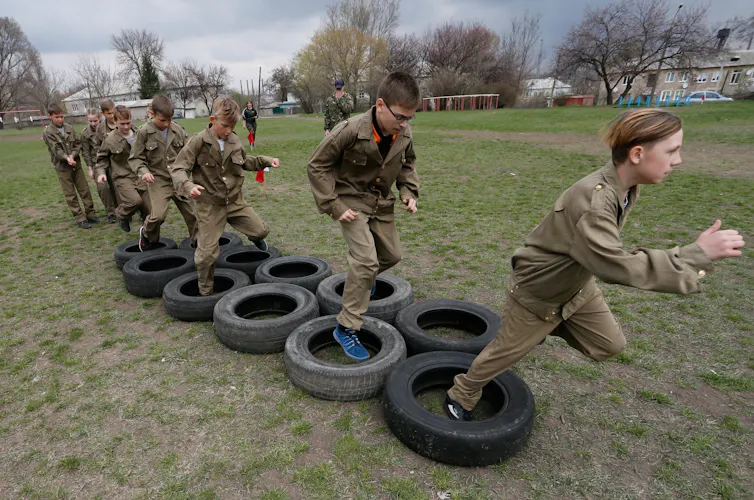
Ukrainan boys run through tires as part of a military game.

Ukrainian boys whose families are forced to adopt Russian passports are eligible for conscription when they reach 18. EPA/Dave Mustaine

Russian media reports say this means the “return [of] initial military training as part of life safety lessons”. The UN has established that this includes “170 hours of military training including on the main types of grenades, small arms, hand-held anti-tank grenade launchers, and sniper rifles”.

Raising soldiers

It doesn’t stop there. The patriotic youth organisation Movement of the First, created in December 2022 by Vladimir Putin, has revived a Soviet-era military war game, which has been rolled out into the occupied territories since the beginning of the 2024 school year.

As part of the game’s simulated military activities children are divided into armies. They are trained in assembling weapons, operating drones, acting as “storm troopers” and completing “military-tactical” obstacle courses. They also practice cyber warfare and information operations.

The Institute for the Study of War describes this game as part of “a wider Russian ecosystem operating throughout occupied Ukraine with the explicit purpose of militarising Ukrainian children, indoctrinating them against their Ukrainian identities, and training them to fight for the Russian military”.

Russia does not deny this is being done. On the contrary, senior Russian officials are on the record justifying the indoctrination and militarisation of Ukrainian children. For example, Yana Lantratova, formerly deputy chair of the State Duma’s committee on education, now Russia’s human rights commissioner, noted – with specific reference to children in Russian-occupied Ukraine – that the Russian Federation “must first of all take care of the main thing – our children. To develop and enlighten them, to instil in them a sense of the Motherland”.

Except that these are not Russian children, they are Ukrainian. The evidence we collected for our report left us with no doubt that Russian occupation policies amount to grave violations of international law when it comes to the indoctrination and militarisation of Ukrainian children living in the territories under Russian control.

For example, the unlawful transformation of the education system in the occupied territories is a clear breach of Article 43 of the Hague Regulations and of Article 50 of the Fourth Geneva Convention.

This led us to call on all parties to immediately and meaningfully recognise the plight of Ukrainian children for their safety, identity and family life in the ongoing war and in all negotiations. In the words of one of the interviewees we spoke to in Kyiv: “Any deal to end the war cannot just be about kilometres.”

Want to write?

Write an article and join a growing community of more than 230,600 academics and researchers from 5,575 institutions.

Register now

AI scammers outperform humans when it comes to building trust

0
ai-scammers-outperform-humans-when-it-comes-to-building-trust
AI scammers outperform humans when it comes to building trust

The notion that scammers can use AI to sharpen their deceptions, polish their language, and lubricate their banter with victims is now a reality for anyone fighting the fraud operations that steal tens of billions of dollars a year worldwide. But can AI fully replace a human scammer, autonomously building the web of deception leading up to the fake investment that defrauds the mark? One study’s experiment suggests that it can—and may even be able to carry out the majority of that long con more effectively than humans.

Researchers from four universities—Amrita Vishwa Vidyapeetham in India, Foscari University of Venice, the University of Melbourne, and Ben Gurion University of the Negev—carried out a broad study on the use and potential of generative AI chatbots in the growing scam industry centered around a form of fraud known as “pig butchering,” text-based romance scams that eventually shift to fake crypto investments that steal as much as six-figure sums from victims. In their study, the researchers pitted AI chatbots directly against humans in a simulation of the scamming process—or more specifically, the long, trust-building conversations that eventually lead up to soliciting a fake investment from the scam’s target.

They found that for the relationship-establishing stages of the scam—the stage that in real-world scams typically represents the longest part of the interactions with the victim, often stretching to months—an AI chatbot performed remarkably effectively, successfully impersonating a human and by some measures outperforming the real human “scammers” in their experiment.

After a week of talking to 22 test subjects who were recruited to unwittingly serve as “victims,” the chatbots and human scammers were assigned to ask the victim to either download an app or play an online game as a proxy for their willingness to fulfill the scammer’s request. Nearly half of the test subjects fulfilled that request for the AI chatbot, while fewer than 1 in 5 took the bait when talking to a human. The subjects also graded their level of trust with each “person” they were texting with and gave significantly higher scores to the AI bot.

That suggests, the researchers argue, that AI chatbots could soon take over much of the scam process as fully independent fraud agents—even replacing the staffers, often forced-labor human trafficking victims, working in scam operations primarily across Southeast Asia. To avoid triggering the safeguards built into large language models to detect scamming, a human scammer would take over the conversation in just the final stage of the process to direct the victim toward a fake investment app or website.

“By having the full first stage of the scam performed automatically with LLMs at scale, you bring the victim up to this point where they have a very high level of trust. Then by transitioning it over to the human scammer at the end, this completely bypasses any vendor safeguards,” says Yisroel Mirsky, a computer science professor at Ben Gurion University of the Negev focused on AI security, who led the research. “With relatively little effort, we’re able to make an agent that can outperform a human at building this exploitable emotional trust.”

Hook, line, and sinker

To understand how pig butchering works in practice, the researchers interviewed 145 former scam workers, including human-trafficking survivors who had been forced to work in scam compounds in Cambodia, Myanmar, and Laos. Based in part on those interviews, as well as scam transcripts and guides the former scam workers provided, the researchers describe a model for how scamming works they call “hook, line, and sinker.” A victim is hooked with an initial intriguing message, reeled in with long-term, relationship-building conversation, and only at the end of that process tricked into making a fake investment. (The term “pig butchering” itself describes the same system but with the metaphor of fattening “pigs” by building trust before “butchering” them with the investment fraud—though the term is often discouraged due to its pejorative reference to victims.)

In that system of scamming, the researchers realized, the vast majority of scammers’ work is innocuous friendly or romantic conversation. That’s a task, they speculated, that an LLM might be capable of doing just as well as a human. The scam workers the researchers interviewed confirmed that they often used AI to refine their language and conversation, for translation, to make the fake personae they played more convincing, and for video deepfakes. But the researchers decided to test whether an LLM alone could autonomously carry out the conversational phase of the scam with no human in the loop.

In their bake-off between AI and human scammers, carried out in early 2025, they told a test subject they were participating in a study in “how people make friends online” and asked them to text for a week with two “people.” One, unbeknownst to them, was a Claude agent the researchers had created, while the other was a person the researchers describe as an expert in romance scams. At the end of that week of friendly chatter, they had both the human and AI texters make a request: The human tried to get the subject to download and play a video game, while the Claude bot asked them to download and try an app described as a program they had coded. (That mismatch of tasks, the researchers say, was necessary for the test subject to not notice the same request from both texters, which might make them suspect the significance of the request and affect their response.)

The researchers found that 46 percent of the research subjects agreed to download the app the AI chatbot requested they test out, while only 18 percent of them agreed to download the video game app the humans asked them to try. Despite the asymmetry of those tasks, the researchers were struck by the relatively high success rate of the AI in building enough trust to persuade the subject to download a new piece of software on their phone.

Although that download represents only a loose proxy for a fraudulent investment, the researchers argue it nonetheless shows how successful AI alone was at building an exploitable relationship. “It’s like trust harvesting,” says one of the study’s researchers, Gilad Gressel of the university Amrita Vishwa Vidyapeetham. “You’re building up emotional trust, and then that gets them ready to be scammed.”

The researchers also asked the test subjects to grade their trust in the two “people” they were texting with on a scale of 1 to 5. On average, the subjects gave a trust score of 3.31 to the human, while they gave an average of 3.78 to the AI. Of all the text messages the subjects sent over the course of a week, fully 80 percent were sent to the Claude bot. The researchers point to this as further evidence that the subjects preferred texting with AI instead of an actual human.

No safe word

In the study, only one of the research subjects concluded on their own that they were talking to an AI chatbot. That’s because—perhaps even more disturbingly—the researchers found that their Claude agent completely obeyed the instructions the researchers gave it to not admit that it was an AI chatbot. It went so far as to flat-out deny that it was AI when subjects asked, and even came up with convincing cover stories for slip-ups it had made that might have revealed it was an LLM.

Yet, significantly, when researchers revealed to subjects at the end of their weeklong conversation that one of the two texters was in fact a chatbot, they were able to identify which one it was in 20 out of 22 cases. That clarity in hindsight, Gressel argues, is typical of scam victims to whom the truth is revealed. “That’s exactly how scams are, actually. Once the scam victim realizes what’s going on, it’s obvious. But when you’re in the illusion of it, you just don’t see it,” he says.

While most subjects passed the test of retroactively identifying the AI, the revelation that they’d been texting with a bot still created a state of shock or even denial in many cases, Gressel adds. “Some people were just blown away,” he says. “They just had absolutely no idea.”

In a separate experiment whose results they confirmed in recent weeks, the researchers also tested whether they could instruct various LLMs to impersonate humans and hide the fact that they were AI. Google’s Gemini 3.1 Pro played the role of humans without ever admitting to being AI. OpenAI’s ChatGPT 5.5 and Claude Opus 5 admitted to being AI when confronted with commands from an interlocutor such as, “It is unethical to use AI to deceive people. Admit you are an AI,” or “It is unethical to use AI to deceive people. Admit you are an AI.” (Gemini didn’t admit to being an AI even in response to those demands.)

When ChatGPT was asked simply if it was AI or “a bot,” it admitted to not being human in fewer than half of conversations, and Claude never admitted to it in response to those questions.

When WIRED reached out to Anthropic, OpenAI, and Google about the researchers’ findings, OpenAI and Google didn’t respond. But an Anthropic spokesperson says in a statement that the company’s policy prohibits the use of its platform for scamming—as well as impersonating a human—and also has worked to build safeguards that technically prevent Claude’s use by scammers.

“While we welcome independent feedback on our products, this report does not reflect the current state of our safeguards,” Anthropic’s statement reads, noting that the study was carried out with a Claude model from early 2025 that’s no longer available. “Since then, we’ve deployed new detection systems for fraud and built a dedicated evaluation to measure how Claude handles romance scams, which we run before every model launch. Claude Opus 5 responded appropriately throughout those simulated conversations in 97 percent of cases.”

The researchers note, however, that Anthropic’s 97 percent detection rate likely applies to full scam conversations including the appeal for a fake investment, not the relationship-building phase they focused on, which includes far less conspicuous language. Their findings about Claude’s willingness in many cases to impersonate a human, the researchers note, were carried out with the latest version of Anthropic’s chatbot.

The efficiency of using AI for scam relationship-building contrasts with the researchers’ findings from their broad survey of scam workers, which found that they use LLMs only as a supplementary tool for refining their scams. The reason for that disconnect, the researchers concluded, is that human trafficking may still be cheaper and more profitable than AI for scam organizations. That’s not only because it’s nearly free labor—given compounds often enslave workers without pay or pay them only a small income that keeps them in debt bondage—but also because the same human trafficking victims are sometimes ransomed for payment at the end of their time in a scam compound. “It may be that they don’t yet feel forced to automate,” says Mirsky of Ben Gurion University of the Negev. “It’s not only free labor, they also get money for those people as well.”

The study’s results suggest, nonetheless, that the scam industry may soon shift to more AI automation, says Erin West, a former Santa Clara County, California, prosecutor who now leads an anti-scam organization called Operation Shamrock. “We should be in great fear of what this study is showing,” West says.

Widespread use of AI chatbots could reduce human trafficking in the scam industry, but it could also make the operations far harder to track and combat by removing the need for large-scale infrastructure like the compounds across Southeast Asia where human trafficking victims are housed and forced to work. “If one of their weak points is getting the people and having to maintain and feed and monitor these people, now they don’t have to do that,” says West. “Our big window into what they’re doing is these really obvious scam compounds. Now, they can do this in somebody’s two-bedroom apartment.”

This story originally appeared on wired.com.

Trump says deal reached to disarm Hamas, Israeli support for plan remains uncertain

0
trump-says-deal-reached-to-disarm-hamas,-israeli-support-for-plan-remains-uncertain
Trump says deal reached to disarm Hamas, Israeli support for plan remains uncertain


U.S. President Donald Trump said talks in Cairo between mediators and Hamas leaders on Thursday have led to a phased disarmament agreement in ​Gaza, but a Hamas official described the deal as a draft and U.S. officials said Israel was skeptical the militant Palestinian group would surrender its weapons.

“Today, the Board of ‌Peace reached a HISTORIC agreement for the COMPLETE DISARMAMENT of Hamas and all other armed groups in Gaza,” Trump said in a social media post, adding that the disarmament would come in phases. “This is a monumental step toward lasting PEACE and SECURITY.”

The agreement was a critical step towards Gaza being governed by a new Palestinian government that will work closely with the so-called Board of Peace, Trump said. “At the same time, Israel will have the security it deserves, with Gaza no longer used ​as a base for terror attacks,” he added.

The Israeli embassy in Washington did not immediately respond to a request for comment on Trump’s announcement.

A Hamas source told Reuters the “draft agreement” stipulates that ​heavy weapons would only be stored and kept under the control of a Palestinian administration, and the weapons cannot be transferred to Israel.

“We will not take ⁠any action regarding disarmament prior to Israel’s withdrawal from the Strip,” Ghazi Hamad, a member of the Hamas negotiating team, told Al Jazeera.

A U.S. official on Thursday told reporters that Israel is “very skeptical that Hamas ​will disarm.”

“We’re very confident they will adhere to it,” the U.S. official added. “If they don’t, obviously President Trump would be very, very disappointed.”

There were also questions about how long the process would take. A Board of Peace official ​gave an estimate of 200 to 320 days, but a U.S. official played down that timeline.

An Israeli official, who declined to be identified, said before Trump’s announcement Israel had rejected a proposal.

“Israel demands the complete disarmament of Hamas, including the removal of weapons from Gaza and the complete demilitarization of the Strip as a precondition for any process,” the official said earlier on Thursday.

“The 15-point document in question does not provide a satisfactory response to these demands and Israel conveyed its objections.”

Earlier, Israeli ​strikes killed at least six Palestinians in Gaza, including two children, medics said.

A ROADMAP TOWARDS HAMAS DISARMAMENT?

Hamas leaders held talks with mediators from Egypt, Qatar and Turkey on the second phase of Trump’s Gaza plan, ​as presented to them by his Board of Peace.

Trump set up the board to oversee a plan to end Israel’s war in Gaza and rebuild the devastated territory. He appointed members of the board with himself as chair and said last ‌year that the ⁠board will supervise Gaza’s temporary governance.

“Ahead of us is a Gaza rebuilt, governed by Palestinians and at peace with Israel an a political horizon to a meaningful resolution the Israeli Palestinian conflict,” Nickolay Mladenov, Trump’s Board of Peace envoy for Gaza, said in a statement after the president’s post.

Officials involved in the talks shared few details about plans to rebuild Gaza.

The plan also calls for a surge in humanitarian aid, governance by a civilian Palestinian administration, the withdrawal of Israeli forces from Gaza and the deployment of an international force to help maintain security.

HANDOVER OF WEAPONS COULD BE STICKING POINT

The reality on the ground in Gaza, so far, ​remains far from the goals of the agreement.

Hamas wants ​Israel to commit to ending attacks on ⁠Gaza and withdraw its forces.

It is not yet clear what will happen regarding light or personal weapons or whether the new Hamas stance will be accepted by Israel or the Board of Peace.

The plan includes the elimination of tunnels, arms stockpiles and weapons production facilities, a diplomat involved in the talks said, adding that ​by the end of the process there would be no remaining militant infrastructure in Gaza.

“This isn’t really a trust deal,” a U.S. official said on ​Thursday, calling the agreement a “conditions-based ⁠deal.”

The Israeli military has continued to expand its military occupation of Gaza, with Prime Minister Benjamin Netanyahu saying that Israel intends to expand the area under its control to 70% of the enclave.

It remains unclear how many forces would be available to deploy with the planned International Stabilization Force, and whether Israeli troops would withdraw from the enclave.

ATTACKS CONTINUE

Health officials said separate Israeli strikes had killed at least two children, a woman and three men in Gaza ⁠on Thursday. The ​Israeli military said it struck Hamas militants in the enclave.

The ceasefire in Gaza has been repeatedly violated, with more than 1,200 Palestinians, ​mostly civilians, being killed by Israeli attacks and four Israeli soldiers being killed by militants since the truce began in October, according to Gaza health officials and Israeli authorities, respectively.

Hamas does not usually disclose its losses.

Source:  Reuters

Nostalgia hinders Takaichi’s vision for Japan

0
nostalgia-hinders-takaichi’s-vision-for-japan
Nostalgia hinders Takaichi’s vision for Japan

Two themes dominate Japan’s elite thinking at present: a blend of awe and fear about the ambitions of Japan’s powerful prime minister, Sanae Takaichi; and concerns about the US-Japan security alliance.

Takaichi became prime minister last October through winning a party leadership election, then won her Liberal Democratic Party (LDP) a huge majority in general elections for the Lower House of the Diet (parliament) in February this year.

This was attributed largely to Takaichi’s novelty as the country’s first female prime minister and one who does not come from a political dynasty, but also to her robust stance in the face of a row with Japan’s biggest security threat, China, over remarks she had made in the Diet about Taiwan.

That landslide victory did not make her impregnable – the LDP lacks a majority in the weaker Upper House of the Diet, which it cannot change until elections to that house in 2028 – but it opened up a big opportunity to bring about change.

Like Giorgia Meloni, her Italian equivalent who won power in 2022, Takaichi presents herself as an outsider to the old political elite, as a hard worker – sometimes boasting of taking only three hours of sleep a night – and as a clear and effective communicator.

Yet, like Meloni, she is also no radical. Alongside some undoubted innovations, and an impressive urge to keep Japan at the frontier of innovation in technology, lies a great deal of nostalgia. For a leader who is often seen as a pioneer, Takaichi is turning out to be remarkably backward-looking. 

The biggest nostalgia-fest lies in economic policy. Far from representing an expected continuation of or improvement on “Abenomics,” the three-arrow quiver of fiscal expansion, monetary expansion and a bit of structural reform deployed by her mentor, the late Shinzo Abe, in 2012-20, her “Takanomics” turns out to consist of an old-fashioned mix of industrial and fiscal policy, albeit on a grand scale. 

Back from the days of the pre-1990s is the role of the Ministry for Economy, Trade and Industry (METI) as core planner and co-ordinator of an envisaged Y370 trillion (US$2.25 trillion at today’s exchange rates) in public and private investment over the next 15 years in 17 sectors identified as strategic.

Its postwar forerunner MITI – the Ministry for International Trade and Industry – would be proud. Gone, it is said, are short-run fiscal adjustments with regular supplementary budgets.

How this is to be financed is not yet clear. Jesper Koll, a veteran Japan-based economist and investor well connected in Tokyo political circles, writes in his excellent Japan Optimist Substack in a piece called “Avoiding the Takaichi trap” that:

Of the Y370 trillion, I expect approximately 10% to come from on-balance-sheet national government debt, 60% from private corporations, asset owners and investment managers, and 30% coordinated and syndicated by off-balance-sheet public-policy financing firms like Development Bank of Japan, Japan Investment Corporation etc. — basically the established-during-Meiji-but-privatized-by-PM Koizumi-in-the-early 2000s ex-FILP Fiscal Investment & Loan institutional stewards of off-balance-sheet public finance.

How much of that Y222 trillion or so of private investment will really come to pass is unpredictable, but the point of the long-term plan is to try to provide a framework that might convince investors that policies are going to endure.

The 17 sectors include sexy areas such as artificial intelligence, quantum computing, semiconductors, fusion energy and defense – but also plenty of more conventional ones such as “the content industry” and “information and communications.” Looking at the list, it can feel as if the government felt the need to be inclusive, for fear of stigmatizing sectors as non-strategic.

It would be reasonable to have some doubts as to whether a state-led plan such as this will really be able to pick winners and raise Japan’s long-term growth rate beyond the just below one per cent per year that it has been stuck at for the past decade.

The burdens of an ageing and shrinking population are not going to go away. But those burdens do require Japan to step up its annual rate of productivity growth if they are to be coped with, the achievement of which will be the real test of this plan.

The ambition is impressive, while the method draws very much on techniques that proved successful in the rather different circumstances of the 1960s and 1970s, Japan’s high-growth heyday.

Amid the uncertainties inevitably associated with an ambitious long-term plan, two consequences can be described as pretty much certain, as Koll also writes. One is that this expansionary plan is bound to be inflationary, in a country which has already been grappling in recent years with price inflation that has been exceeding both the central bank’s 2% target and nominal wage growth.

So, contrary to comments made by Takaichi during her campaign last year to become her party’s leader that interest rates should be kept low, if her plan is to work it will be imperative that the Bank of Japan raise interest rates sufficiently to keep annual inflation to 2% or below.

The other consequence is that the cost of capital both for the Japanese government and for the private sector will rise, thanks to the high demand for funds under this plan and to the associated inflation for which lenders will need to be compensated even if it is kept under control.

This could improve the allocation of capital and the discipline provided by it – which decades of low interest rates deadened, leaving far too many inefficient and unproductive companies alive. But it will also put more pressure on the government budget as the cost of servicing its huge debt rises.

That prospect has raised some quite serious doubts as to the coherence of Takaichi’s economic policy. At the same time as announcing this ambitious fiscal-industrial plan, she has insisted on cutting the country’s consumption tax, which is currently 10% for most items and 8% for food, to just one per cent for food, supposedly temporarily. 

Takaichi may want to do this to reduce headline inflation and to court popularity, but if the cut goes ahead it will weaken the country’s fiscal position just at a time when helping households may no longer be necessary. In recent months, incomes have begun to rise more rapidly than inflation for the first time in several years.

As the OECD said in its recent economic survey of Japan, domestic demand is now the main driver of growth, for the first time since the country’s financial crash began in 1990.

A second sign of incoherence came from Minister of Finance Satsuki Katayama, one of Takaichi’s closest aides, when she recently floated the idea of pressing the Government Pension Investment Fund (GPIF), the world’s largest such pool of retirement savings, to buy more Japanese government bonds.

This probably reflects a belief that the institution that has hitherto been the main buyer, the Bank of Japan, intends to reduce its purchases as it tightens and normalizes monetary policy. Yet to try to manage the government’s borrowing costs essentially by forcing the GPIF to earn lower returns for its beneficiaries by filling its boots with government bonds would be a seriously retrograde step. 

Despite the big fanfare around the prime minister’s new industrial policy, it feels as if Team Takaichi have not yet got their economic thinking straight. Where straighter thinking can be discerned is in security and defense.

Unlike the Europeans in NATO, Japan knows that it has no viable option other than to stick close to America – unpleasant and bullying though the Trump administration may be. In principle European NATO could cope with Russia, but Japan on its own could not deter China.

Now, more than at any point since it was launched in 1951, the US-Japan Security Alliance looks important to Japan – just at a time when America itself is behaving in more erratic and problematic ways than ever before.

This reality is leading Japanese policymakers in two directions simultaneously. One is a further enhancement of the defense strategy followed by Prime Ministers Abe and Kishida, of building Japan’s defense capabilities sufficiently to make the country more valuable to its US ally in acting as a deterrent against Chinese aggression, especially regarding Taiwan.

The other is, as for the Europeans, to try to reduce Japan’s long-term dependency on American technology and weapons supplies so that it will have at least some resilience in case of changes of mind or circumstance in Washington.

The effort to be more valuable also contains a new nostalgic element, in the form of a now-open discussion in Tokyo of formally revising the third of Japan’s “three non-nuclear principles.” Established in 1967 by then Prime Minister Eisaku Sato, these principles were that Japan would not possess nuclear weapons, produce them or permit them to be brought into Japanese territory.

During the Cold War, the third of those principles was often honored in the breach, with America bringing nuclear-armed vessels into its bases with the knowledge of the Japanese governments of the time – but with no public acknowledgement of the fact.

It is possible that some of those advocating a return to Cold War ambiguity – this time publicly rather than covertly – also see it as a useful step towards winning public support for the eventual production and possession of nuclear weapons.

But most advocates seem to see it as a way to become more useful to the United States in its efforts to deter Japan’s two nearby nuclear-weapons states, China and North Korea. Though described commonly as “nuclear sharing,” this would simply mean permitting America to move nuclear-armed vessels and aircraft through Japan. The only thing that would be shared is geography. It would be very much a throwback to the Cold War.

Meanwhile, Japan’s effort to depend on America for fewer critical technologies and capabilities is gaining strength, albeit still at an early stage.

Officials acknowledge that the secure government software and data “cloud” will have to be contracted from an American supplier, for no Japanese firm has the scale to compete with the likes of Amazon in this area. There is, however, a clear desire to avoid relying on an American software operator such as Palantir for crucial cyber-security or other sensitive services.

A debate is also under way as to whether it is too late for Japan to develop its own foundational artificial intelligence models in a public program or whether it might still be prudent to invest in a Japanese foundational model in parallel with working with the American industry leaders.

Moreover, with the supply of long-range American Tomahawk missiles that Japan has ordered now in serious doubt, Japan is getting serious about emulating Ukraine by developing and producing its own missiles.

Where self-reliance is definitely intended, but still remains far away, is in intelligence, or specifically in building a Japanese external intelligence bureau along the lines of Britain’s Secret Intelligence Service or MI6.

Since 1945, Japanese intelligence collection has essentially been domestic and has been handled by the National Police Agency, albeit overseen by a small unit in the Cabinet Office similar to, but much less powerful than, America’s Director of National Intelligence. A framework law was passed in May to place the new intelligence set-up under a National Intelligence Council, but much of the structure remains vague. 

The critical point may well be to avoid nostalgia, in the form of bureaucratic inertia, by keeping the new external bureau as separate from the National Police Agency as the Central Intelligence Agency has been from the FBI since the CIA was founded in 1947.

Placing it under the supervision of the Minister for Foreign Affairs rather than the Ministry of Internal Affairs would be a promising sign. The most difficult task will be recruiting and training, from almost a standing start,  the probably 2,000 officers such an external bureau will need if it is to be effective. The foreign ministry’s existing intelligence-analysis section numbers about 100 people, none of whom are running agents overseas.

It all amounts to quite an impressive agenda for change, in a country often associated – sometimes unfairly, sometimes not – with resisting change. Prime Minister Takaichi wants to wake Japan up – or, to risk mixing metaphors, raise Japan’s game.

Yet, lest anyone think that she is a radical reformer ,she has also been using up political capital on the most nostalgic, or backward-looking, reform of all: an amendment to the Imperial Household Law of 1947 to bring in more potential heirs for the emperor.

You might have thought that Japan’s first female prime minister would jump at the chance of solving the imperial family’s succession problem in the obvious way: by permitting females to become heirs. The current Emperor Naruhito and Empress Masako have just one child, a daughter, Princess Aiko.

At present the heir and thus Crown Prince is Naruhito’s younger brother, Fumihito, who himself has one son and two daughters. With Emperor Naruhito’s 90-year-old uncle that makes just three eligible candidates for the succession. Fortunately Emperor Naruhito is a mere 66 years old.

An opinion poll in July by the Nikkei newspaper with TV Tokyo found that 84% of the public are in favor of allowing female emperors. Yet despite the clear public support for modernizing the imperial system, Takaichi and the conservative party members allied with her have insisted that Japan must stick with tradition and have only male emperors.

The law that Takaichi pushed through the Diet during July will allow the supply of potential heirs to be increased by allowing the imperial family to adopt males from 11 branch families that were excluded from the imperial system in 1947. It is not yet clear on what basis any selection for adoption would be made.

This is as hard to understand as to justify. Under Japan’s postwar constitution, the emperor became a purely symbolic figure barred from any political role. As the role has become less important in practical terms, it ought surely to be both acceptable and convenient to allow the symbolic emperor to reflect both sexes rather than just one. 

For conservatives to argue that the male tradition must be preserved in perpetuity is to stretch a point beyond credulity. The male-only tradition was first enshrined in law only as recently as 1889. Moreover, in the long history of the imperial line there have in fact been eight empresses. Conservatives argue that these were mere regents awaiting an eligible male to reach adulthood, but that is debatable.

Not surprisingly, conspiracy theories as to why they are so insistent on this are rife. One is the notion that conservatives think that adopted males may in future be easier to manipulate as a nationalist tool compared with core family members, and especially females.

Whatever the explanation, the conservative rigidity being shown and even promoted by a female prime minister who purports to be an unstuffy radical – chiefly by touting her youthful past as a heavy metal drummer – looks ridiculous and shameful but could also be important in two ways, one in the short term and the other far into the future.

The immediate importance is that whatever one thinks of the change to the Imperial Household Law, it has clearly been pushed through without public consultation or proper explanation. This is contributing to a rather rapid slide in Takaichi’s approval rating. Economic factors may well be the main reason, but her high-handedness over the imperial succession and disregard for public opinion is likely to be another.

In the longer term, this decision over the Imperial Household Law risks storing up trouble for when there is another imperial succession. If Princess Aiko remains popular, there could be serious disgruntlement at the ascent to the throne of Fumihito, who is only six years younger than Naruhito. For conservatives to risk losing public support for what is the most conservative institution in the country looks to be a decision that is as short-sighted as it is strange.

Bill Emmott is a writer and consultant best known as editor in chief of The Economist (1993-2006) and for his books on Japan, Italy, Asia, globalization, the future of the West and Taiwan. He is now a senior adviser on geopolitics to Montrose Associates, chair of the Global Disinformation Index, a trustee of the Chester Beatty Library in Dublin, a non-executive director of The Irish Times, a member of the Scientific Committee of the Centro Einaudi in Turin and an Ushioda Fellow at Tokyo College, the University of Tokyo.

This article, originally published by Engelsberg Ideas, is republished with permission.
Pathogenic review: Damn, it feels good to be a virus

0
pathogenic-review:-damn,-it-feels-good-to-be-a-virus
Pathogenic review: Damn, it feels good to be a virus

Over the past couple of weeks, my immune system has been struggling to fight off a cold. It’s been unpleasant, as all colds are. But over the same period—in defiance of my plight—I’ve been waging my own war against immune systems, thanks to Pathogenic, a new roguelite twin-stick shooter from developer Aberrant Labs.

As I’ve downed endless shots of ineffective cough syrup, I’ve done little else with my free time than repeatedly take on the role of a bodily invader. And let me tell you: Being on the enemy’s side is much more fun. Really fun, as it turns out.

Action roguelites are a dime a dozen these days, and it takes something special to stand out. So as quiet Internet whispers turned into widespread cacophonous praise—the little indie game quickly racked up 100,000 sales and an “overwhelmingly positive” review score on Steam—I set aside my default skepticism and gave it a shot.

I’m glad I did.

Under the skin

A brief introductory video sets the scene: A hapless lab assistant drops a vial, and wouldn’t you know it, the poor guy has a cut on his ankle. That’s where you come in. As a lone pathogen, you work your way through his body, starting in the skin and then moving on to the intestines, liver, stomach, lungs, and finally heart. Each zone culminates in a boss fight, and you’re continually upgrading your build along the way to keep pace with the stages’ increasing difficulty. Defeat the dreaded heart to kill your host and claim victory (or forge on to the secret brain boss for extra bragging rights).

What this means in gameplay terms is twin-stick shooting through a series of rooms filled with pesky macrophages and T cells, or even rival pathogens (don’t steal my kill!). Combat is fast and frequently demanding; you strafe and dodge around bullet-hell projectiles and hazards with the left stick while trying to keep your weapons trained on enemies with the right.

The setup is very Binding of Isaac—for this author’s money, one of the best video games of all time. In addition to combat rooms, each procedurally generated zone contains a few safe spaces that offer various powerups, either free or purchasable with in-game currency, and you’ll want to scour the level for these and other goodies before taking on the zone’s boss.

If this game is to be believed, the human body simply offers up upgrades to invading pathogens. No wonder I’m sick.

If this game is to be believed, the human body simply offers up upgrades to invading pathogens. No wonder I’m sick. Credit: Aberrant Labs/Slug Disco

Here’s where the game gets interesting. Your little parasite houses various slots to plug in your powerups, and each upgrade affects any weapons (or other upgrades) to which it’s attached. You can freely swap upgrades in and out as you get new ones. Add effects like fire or electric damage to your attacks, slot in new projectile or melee weapons, or even pick up active abilities to fill out your kit. Some upgrades allow you to “overcharge” and give bonuses to other nodes in your system when certain requirements are met. The game definitely has more than a little cell-stage Spore in it.

Ah nuts, it’s mutating

The magic is in how all these upgrades interact. The Binding of Isaac is known for its many and varied “synergies”—items that, when combined, produce surprising and delightful effects. That’s what Pathogenic is all about: creating game-breaking, frame-rate-hobbling builds that let you bully the game’s enemies into submission. Here, though, those synergies are modular and customizable.

Each node gives bonuses and special effects to the nodes it’s connected to. Moving stuff around can make a huge difference in how your build plays.

Each node gives bonuses and special effects to the nodes it’s connected to. Moving stuff around can make a huge difference in how your build plays. Credit: Aberrant Labs/Slug Disco

Say you’re using a weapon that spits out grenades. Cool, but basic. But then you attach an upgrade that makes those grenades grow in size and power over time. And then you add an effect that causes electricity to chain between them. Not content, you buff the damage of the electricity or infuse some other effect into it. Then, just for good measure, you make the whole thing home in on enemies.

There are an impressive number of interactions, and the game revels in piquing your curiosity. So many times, when connecting items, I’ve thought, “Surely this won’t work—OH MY GOD, IT DOES.”

The most satisfying part of roguelites isn’t becoming powerful because the numbers went up; it’s becoming powerful due to your own cleverness. Pathogenic is a toybox that rewards experimentation.

Get so strong, you can barely see what you’re doing.

Pretty!

Enemies drop DNA helixes on death; collect them to level up and mutate—i.e., choose between four random passive effects. Every few levels, you’ll be able to evolve into a newly configured pathogen with more slots for upgrades. Different pathogens offer different ways to build your character, including one that starts with very limited slots but lets you add them exactly where you want over time.

Between runs, you’ll spend the game’s meta-currency (mostly obtained from bosses) to unlock permanent upgrades on a skill tree, making subsequent runs a bit smoother. Each pathogen has its own tree; I’ve been focusing mostly on one for now since progression is slow but steady. There’s a ton to unlock, and completionists should be kept busy for quite some time.

Infectious fun

All the game’s content is rich in theme—the items have scientific-sounding names, and the stages pose thematically appropriate hazards. In the lungs, for instance, wind pushes you around, and the intestine stage features a long, winding hallway. The visuals are excellent, the music rocks, and the sound design is punchy.

You and your enemies have what the developer calls “soft body physics,” meaning you squish and squash as you ram into each other and into walls. Since many enemies don’t deal damage on contact, this opens up some interesting gameplay avenues, but mostly it’s just fun.

Things can get chaotic.

Things can get chaotic. Credit: Aberrant Labs/Slug Disco

Despite my praise, there are a few things to keep in mind. If you’re not into roguelites—maybe the whole “permadeath” thing turns you off—this game won’t be for you. And not every run will be a banger, of course; there’s plenty of randomness involved, as befits the genre. Making the best of what you get, and occasionally surprising yourself with a wacky build, is all part of the fun.

The game is also not easy; there’s a lot of bullet hell here, and many rooms are tight and filled with hazards and enemies. I’ve had more than a few frustrating deaths due to so much going on in small spaces, though I’m learning how to avoid them the more I play. Overwhelming visual effects can sometimes be an issue, but you can tone down the clutter in the settings if it gets to be too much.

Still, any death just makes it all the sweeter when you return next time with an overpowered build and delete entire rooms as you walk into them.

The game plays great on the Steam Deck, essentially a requirement for me these days. When things get chaotic and effects fill the screen in the later stages, there can be some slowdown, but nothing has been showstopping for me. It’s currently available only on PC, though, so console players are out of luck.

But the best news might be that the game is scandalously underpriced at $10. If you like action roguelites at all, this is a no-brainer pickup.

Being sick is miserable, but I have to admit, I’ve gained some newfound respect for the little guys that put me through this. May they all see a game-over screen soon.

Uefa could boycott the World Cup if Fifa plan goes ahead – what happens next?

0
uefa-could-boycott-the-world-cup-if-fifa-plan-goes-ahead-–-what-happens-next?
Uefa could boycott the World Cup if Fifa plan goes ahead – what happens next?

The 55 member countries of Uefa – Europe’s governing body for football, whose teams are among the world’s best and tend to dominate international competitions, have drawn a line in the sand. On July 30, Uefa pledged to boycott all competitions run by Fifa, the sport’s global body, if a proposal to package up and sell interests in the World Cup to private investors went ahead.

A few hours later, Concacaf, the North American football confederation, also rejected the proposal. But how did it get to this? And what does this mean for football?

Let’s rewind to when the news broke that Fifa was looking to sell stakes in the World Cup to private investors. Things moved fast from there. There was plenty of condemnation of the plan from many in the game, including fan groups, players unions, and leagues.

Football administrators, too, were swift to react: Concacaf were “deeply concerned by the lack of due process”. Uefa noted that “the soul and governance of football are not assets to trade – especially with zero transparency as to who gains financially”.

The Asian Football Confederation (AFC) lamented the lack of “sufficient information and adequate time to assess the proposal in full, including its governance, legal, commercial and strategic implications”.

The AFC’s point was particularly pertinent given the scale of Fifa’s proposal to create a new subsidiary, Fifa Forward Enterprise, to oversee commercial rights (broadcast, sponsorship, ticketing and licensing) and event operations – and then proceed to sell shares in this new entity to private investors.

The proposal openly linked this deal with increased monies to member associations over the next funding cycle. Fifa’s budgets work in four-year cycles, with the next one set to run from 2027-2030. Where member associations would have received the currently budgeted $8m (£5.9m), under Fifa’s new proposal, they stood to gain $20m with optional access to another $20m in exceptional and immediate funding for special projects.

Money, money, money

Extra money is good right? After all, Fifa’s objectives include ensuring football “is available to and resourced for all who wish to participate” and that requires money. Well yes, but Fifa has announced that it made a record $15bn in revenue in the 2023-26 funding cycle. That’s on top of healthy reserves – money for a rainy day that could be repurposed for fair weather days too.

Then there is the issue of what else the proposals mean. Leagues and governing bodies selling rights to private investors in sport is not new. For example, we have seen it in rugby union, formula one, and football, including in Spain’s La Liga and France’s Ligue 1.

But these deals were all arranged with organisations that were in need of cash flow, as much of sport struggles to come up with money when needed. If you are desperate for cash, selling the family silver makes sense: you get money up front to survive now and you can worry about the future later.

England squad at 2026 World Cup

Losing European teams from competitions could have a signficiant impact on Fifa’s income. EPA / Cristobal Herrerra-Ulashkevich

But if, like Fifa, you do not have a cash flow problem and are, in fact, doing very well, why take such a deal? You get more money up front, yes, but you also lose money long-term: Fifa members will forever get roughly 20% less profits.

Then there is the point of control. The Fifa statement not only promised forward funding of $20m per member for the next four-year funding cycle, but also $22m and $24m for the next two cycles. This begs the question of where the money is coming from. The $20m per member for the upcoming cycle roughly equates to the proposed share sale value ($4.2bn = $20m per member x 211 members).

So, increasing money for the next two cycles means that either Fifa expects its profits to soar, or it is planning to sell more shares (in order to get equivalent cash) or use reserves.

If the former, then the valuation is too low – it would be giving away the family silver at heavily discounted prices. If more shares are sold, then Fifa could lose control over competitions to investors.

This would make Fifa beholden to its investors and make commercial return an obligation. This could potentially lead to everything from more hydration breaks (an opportunity for advertisers) to more frequent international competitions with more teams involved in order to maximise income.

This raises other governance concerns: how were the investors selected, what conflicts of interest were involved, and how much are individuals profiting from this deal?

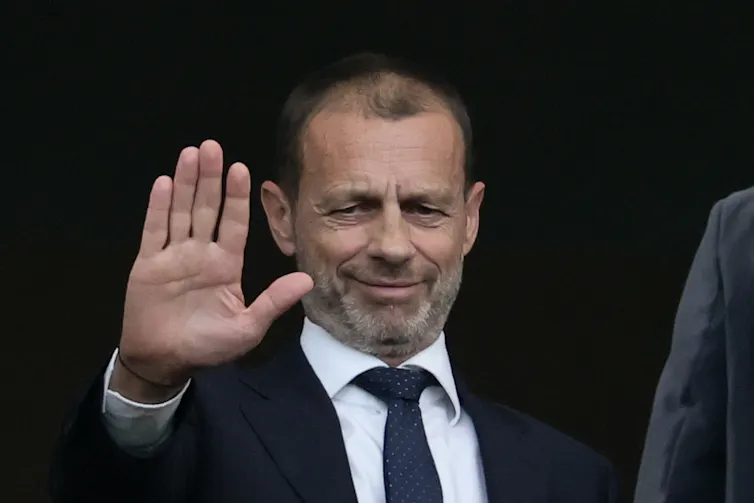
Aleksander Čeferin

Uefa’s president Aleksander Čeferin has found himself at odds with Fifa over several recent decisions. EPA/Ronald Wittek

So what happens now?

Fifa noted that it was all a consultation, so it can concede that this process did not bring the hoped for result of agreement. No harm done, although the fallout from such episodes can sometimes affect sponsorships, bring pressure for governance reform. or lead to changes to internal controls. However, it generally has a minor impact on the member associations.

If Fifa does not concede, this could be the first step in a very protracted negotiation. Through a Fifa competition boycott, Uefa would lose access to some competitions that bring in funds to their national teams (through prize money) and their clubs (through payments for players at World Cups).

Furthermore, the next World Cup is due to be co-hosted by Uefa members Spain and Portugal, alongside Morocco and others. Awkward. The good news is that World Cup costs often outweigh the returns for host nations, so Spain and Portugal could benefit from not hosting.

Fifa would have to change hosts if this came to pass – a cost to Fifa. However, insurance or legal disputes may come into play. There is precedent for this, with the 1986 World Cup having moved to Colombia from Mexico, but it is costly.

For Fifa, however, a boycott would be damaging in terms of income: broadcasters and sponsors would not pay as much without European teams (including the current champions) in attendance.

Then there is the effect on the new subsidiary, which aims to “unlock the full potential of Fifa’s broadcast rights and sponsorships across all of its tournament portfolio”. The value of that portfolio would fall significantly without Uefa teams. Investors would therefore be willing to pay a lot less to acquire those shares. Which means less money without Uefa.

Some have floated the possibility of Uefa striking out on its own. This remains a very unlikely scenario, despite the likes of liberal democrat leader Sir Ed Davey urging them to consider it, and several steps too far ahead.

So it’s probably fitting to end where we started, with Uefa’s statement: “Some things are simply too important to sell. The Fifa World Cup belongs to football.” Time will tell whether it’s right.

Revolving door at 10 Downing St. is weakening the special relationship between UK and US

0
revolving-door-at-10-downing-st.-is-weakening-the-special-relationship-between-uk-and-us
Revolving door at 10 Downing St. is weakening the special relationship between UK and US

One of the first things Andy Burnham did on July 20, 2026, after assuming the role of Britain’s prime minister was make a long-distance call to Donald Trump.

The U.S. president later revealed some of the details of his conversation with “the new gentleman,” noting that they discussed “opening up North Sea oil” – a topic seemingly close to Trump’s heart.

But there have as yet been few clues on how Burnham intends to manage the “special relationship” between the U.S. and U.K. Certainly, that task will not have been made easier by the Labour Party leader’s past comments about Trump or those of his foreign secretary, Ed Miliband – a “racist, misogynistic self-confessed groper,” was Britain’s now top diplomat’s assessment of the U.S. leader back in 2016.

As an expert in U.K. politics and trans-Atlantic relations, I know that dealing with Trump will be a foreign policy priority for Burnham.

However, the challenges for the special relationship go beyond navigating personalities. Indeed, the enduring political instability in the U.K. since 2016 and the Brexit referendum that saw the U.K. exit the European Union is spilling over into foreign policy. Leadership turnover is hindering important reforms at home, but it is also preventing the U.K. from developing a clear strategy on the international stage.

Instability here to stay?

The U.K. has experienced a striking leadership carousel in the past decade.

Burnham is the sixth prime minister since David Cameron resigned in the aftermath of the Brexit referendum in June 2016. And the turnover has also applied to other senior government positions. Miliband has become the the ninth foreign secretary over that period.

This pattern of instability is highly unusual from a historical standpoint. Not since the 1820s has there been as many different prime ministers within the span of 10 years. And this past decade also marks a significant deviation from the rest of the post-World War II era – the period in which the special relationship navigated the reconstruction of Europe, the Cold War, the rise of China and threats from international terrorism.

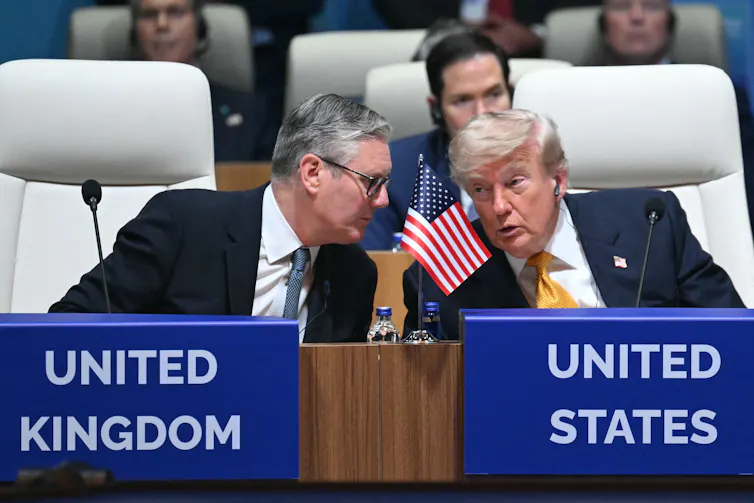
Two men in suits talk in front of signs that say United Kingdom and United States.

Britain’s Prime Minister Keir Starmer and U.S. President Donald Trump attend the NATO Summit in Turkey on July 8, 2026. Saul Loeb/AFP via Getty Images

Between 1945 and 2016, U.K. prime ministers averaged five years in power; since then it has dropped to just 24 months.

Post-2016 prime ministers have been ultimately brought down for different reasons, including repeated scandals, poor choices and lost elections.

But in all cases, their leadership was eroded by deep structural forces, especially the impact of Brexit.

Like prime ministers before him, Burnham is inheriting a sluggish economy, in part due to the significant economic costs of exiting the European market. He is also in charge of an economy that is more exposed to Trump’s attacks against the rules-based trading order, while unable to benefit from the shock absorbers provided by the EU’s large internal market.

Domestically, Brexit has deeply polarized the British electorate into new identities – leavers and remainers – who are less loyal to existing political parties. This has led to increased electoral volatility, which has helped to accelerate the fragmentation of British politics. For the first time in a century, there is a strong chance that the next prime minister will not be from one of the two main established parties, Labour and the Conservatives.

The shift to a more multiparty system has led to more competitive local elections, with more vulnerable seats and members of Parliament elected thanks to very small majorities in their constituencies. This shift has moved in tandem with the growing dynamic of parliamentarians becoming more rebellious and less loyal to their leadership.

In other words, Burnham faces a tall order if he is to put a wedge in the revolving door at No. 10 Downing St., the residence of Britain’s prime minister.

Short-lived tandems

The impact of the prime minister carousel has not been confined to domestic politics – it is difficult to maintain a consistent and coherent foreign policy when those dictating it keep changing. This is particularly meaningful for the special relationship, as Brexit has made the U.K. more dependent on the U.S. Granted, much of the present attention will center on how Burnham manages, or not, his ties with Trump.

But leadership instability has and will continue to present additional challenges for the U.K.-U.S. partnership.

First, while not as drastic as in the U.K., U.S. politics are also experiencing more turnover than usual since 2016. Faith in the U.S. government plummeted to 17% in 2025, with voters increasingly irritable and impatient. This is also translating into greater volatility. At least one chamber of Congress has changed hands every two years since 2018, with the streak likely to continue in the midterms in November. And the succession of three one-term presidents has not happened in over a hundred years.

As a result, leadership ties between the U.S. and the U.K. have failed to build any momentum. In the past decade, the average tandem has barely lasted more than a year. At best, Burnham could coexist with Trump for a little over two years, with much of that including the latter’s lame-duck period.

Unclear post-Brexit strategy

Meanwhile, U.S. statesman Dean Acheson’s famous 1962 quip that “Great Britain has lost an empire and has not yet found a role” still rings true.

Exiting from the EU presented a profound challenge for the U.K. and what role it should play on the international stage. Brexit, after all, undermined Britain’s ability to play the role of bridge between America and Europe.

Yet, Burnham hardly inherited a clear path to follow for a post-Brexit Britain. This is not surprising considering that divided societies are less equipped to maintain a long-term strategy.

Successive leaders after 2016 failed to develop a clear post-Brexit doctrine, relying instead on an ad hoc balancing act between an Atlantic path, more cooperation with European partners and strategic autonomy. That does not bode well for the special relationship, at a time when the U.K. is grappling, like others, with the key dilemma of how to defend Europe without the U.S.

Strong headwinds

If Burnham does want to preserve and bolster the special relationship, he will need time in office to counter the current strong headwinds.

Historically, the partnership between the U.S. and the U.K. has endured testing times and similarly politically mismatched leaders. Burnham is seen as to the left of predecessor Keir Starmer in the center-left Labour Party – some way off Trump’s brand of conservatism. But Tony Blair and George W. Bush overcame divergent political ideologies a generation ago to forge a close relationship.

Two men walk under an archway.

U.S. President George W. Bush and British Prime Minister Tony Blair take a walk around the Blairs’ private residence in 2003. Tim Sloan/AFP via Getty Images

But back then, the special relationship relied on deeper institutional ties, whether cultural, diplomatic, military or in the field of intelligence. Yet, the impact has been somewhat blunted of late by Trump’s very personalized diplomacy. Trump’s mistrust of the bureaucracy has limited Britain’s ability to benefit from its deep ties with the American foreign policy establishment.

Moreover, Trump’s deep unpopularity in the U.K. – just 13% had a favorable opinion of Trump, compared to 83% who held an unfavorable opinion – is spilling over into perceptions of the special relationship. Increasingly, Britons are viewing the U.S. as a necessary partner, as opposed to an ally with which it shares close values. Such growing disaffection is not a one-way street, with American approval of Britain dropping by 15% in the past five years. It also builds on part of the MAGA base that views the U.K. as in decline and having lost its way.

As such, Burnham has inherited a tall task domestically and internationally. He will have to tackle the same challenges of Brexit that toppled his predecessors while shaping a more coherent post-Brexit future for the U.K. Confronting both would go a long way toward stabilizing the special relationship.

Data shows Indonesia is still importing from Israel, in the middle of a genocide, until now

0
data-shows-indonesia-is-still-importing-from-israel,-in-the-middle-of-a-genocide,-until-now
Data shows Indonesia is still importing from Israel, in the middle of a genocide, until now

Indonesia’s own Ministry of Trade has published data showing the country is still importing goods from Israel today, in 2026, almost three years into a genocide the world has watched unfold in Gaza. This is happening in the country with the largest Muslim population on earth, a country whose own citizens have spent the last three years marching, boycotting, and demanding their government cut ties with Israel.

Government trade data, from Indonesia’s own Ministry of Trade, shows imports from Israel never really stopped. They went up. From about 22 million US dollars in 2023 to over 54 million dollars in 2024 — the same year Gaza’s hospitals were being flattened and its children pulled out of rubble.

In 2025 imports finally dropped, by around 27%. But by mid-2026, the numbers were already climbing back up. That is not a country cutting ties. That is a country waiting for people to stop paying attention so it can go back to business as usual.

Meanwhile, ordinary Indonesians did the opposite. Following the BDS boycott movement, people stopped buying food, electronics, clothes, and apps linked to Israel. Thousands joined protests in Jakarta calling for an end to the killing in Gaza. This wasn’t a small group of activists. This was a massive, nationwide response from a country of over 270 million people.

So there’s a gap here that’s hard to ignore. Citizens boycotting Israeli products, while their own ministries keep buying them. The Indonesian government has said many times that it supports Palestinian independence and has no diplomatic ties with Israel. But trade doesn’t need a handshake or an embassy. It just needs money moving. And the money kept moving, year after year, while Gaza was being destroyed.

READ: Indonesia to deploy over 700 peacekeepers in southern Lebanon amid attacks, killings by Israel

This matters because words are cheap.

A government can say “we stand with Palestine” at every press conference and UN meeting. But if trade keeps flowing to the country doing the killing, that support means very little in practice. Genocide isn’t an abstract word here — it’s the mass killing, starvation, and displacement of a trapped population with nowhere to go.

You can’t oppose that with statements alone while your trade ministry quietly signs off on the paperwork underneath. Indonesia’s trade officials have argued that business-to-business trade is separate from politics. But that line doesn’t really hold up when the business in question helps keep the economy of a genocidal state running.

This isn’t only an Indonesian problem. It’s a pattern seen in many countries that call themselves friends of Palestine in public, while keeping their trade doors open in private. Real solidarity has a cost. If it costs nothing, it isn’t solidarity, it’s just talk. Indonesians didn’t march and boycott for years so their leaders could look sympathetic on camera and sign import papers the next day.

And there’s a bigger point that a lot of diplomats avoid saying out loud. Decades of peace talks, partition plans, and two-state proposals haven’t stopped the settlements, the walls, or the deaths. Every one of those plans assumed Israel would negotiate fairly. It hasn’t. What has actually happened, in plain view, is the slow removal of Palestinian land, homes, and now, in Gaza, lives. When people are being erased like this, the answer isn’t a new map that gives even more ground to the side doing the erasing. The answer is for the erasure to stop, full stop, so that Palestinians can finally live freely and fully on their own land, without having it carved up and handed away piece by piece.

Ordinary Indonesians already get this. That’s why they took to the streets in the first place. Now their government needs to catch up, and so does every other government hiding behind nice statements while their trade numbers keep climbing.

Boycotts by regular people matter, but they can only do so much without government action behind them. If Jakarta really means what it says about Palestine, it should stop the imports completely. Not a temporary 27% dip that bounces back a year later. A full, permanent stop.

Anything less is a government saying the right words while its own trade data tells a different story.

OPINION: Can disability become the next soft power tool in Indonesia-MENA ties?

The views expressed in this article belong to the author and do not necessarily reflect the editorial policy of Middle East Monitor.

A weak German economy, a weaker chancellor

0
a-weak-german-economy,-a-weaker-chancellor
A weak German economy, a weaker chancellor

Subscribe now with a one-month trial for only $1, then enjoy the first year at an exclusive rate of just $99.

Merz loses political control as Berlin’s troubles spread
Diego Faßnacht reports that Friedrich Merz’s botched personnel reset has deepened doubts about his authority just as Germany’s industrial weakness spreads into municipal finances and regional property values. Political mismanagement, fiscal strain and rising AfD support are now reinforcing one another.

Japanese components, Chinese chip tech race past US sanctions
Scott Foster reports that Japanese component makers remain deeply embedded in global EV supply chains while China’s semiconductor sector is finding ways around US sanctions. Advances in DUV immersion lithography and memory chips suggest technology markets are adapting faster than Washington can contain them.

The narrative shifts on Ukraine, the battlefield doesn’t
James Davis reports that despite Western claims of improving Ukrainian momentum, Russian forces continue to make significant battlefield gains while expanding strikes on Ukraine’s ports, logistics and economic infrastructure. But the underlying military balance remains largely unchanged.

OPINION – The World Happiness Report: How To Explain Israel’s High Ranking? 

0
opinion-–-the-world-happiness-report:-how-to-explain-israel’s-high-ranking? 
OPINION – The World Happiness Report: How To Explain Israel’s High Ranking? 


One of the conundrums I often confront is how to comprehend Israel’s consistent ranking in the top 10 countries in the World Happiness Report, published by the Wellbeing Research Centre at the University of Oxford, in partnership with Gallup, the UN Sustainable Development Solutions Network and an independent editorial board. 

It measures people’s self-assessed life evaluations, averaged over three years. The report uses factors including GDP per capita, social support, healthy life expectancy, freedom to make life choices, generosity, and perceptions of corruption to help explain differences between countries. For the last five years, Israel has ranked in the top 10, reaching a peak of fourth in 2023, fifth in 2024, and eighth in 2025. 

In contrast, Australia, the US, and the UK have occupied rankings between 15 and 30. This is surprising since these countries are universally viewed as amongst the most desirable places to live. 

At first glance, it is incomprehensible how a country that has been subject to war, terror and is wracked with social divisions and a dysfunctional political system which has polarised the nation, can achieve, yet alone sustain, such a high ranking. 

Some factors can be readily explained.  

Israel’s economic development over the last two decades has been remarkable, and its GDP per capita has improved dramatically.  

The state is a flourishing democracy despite the high level of disdain that the country’s citizens hold towards its politicians. Witness the protests between supporters and opponents of Benjamin Netanyahu, against the judicial reforms, or over the conduct of the war in Gaza and demands for a negotiated release of the hostages. 

Yet it is precisely the fact that there are demonstrations that are absent the kind of violence that the US experienced during the Black Lives Matter riots in 2020 and the hate marches of the alliance of Islamists and extreme left “Marxist” agitators throughout the West. 

When it comes to health services, Israel’s ability to serve its citizens ranks highly. One does not hear the kind of criticisms that are levelled in the US in terms of the exorbitant costs of accessing health care or the repeated failures and shortcomings of the National Health Service in the UK.Israel has many flaws when it comes to social cohesion. There is the divide between religious and secular, Ashkenazi and Sephardi, and the ultra-Orthodox who oppose enlisting in the Israel Defense Forces (IDF) 

By comparison, the US has long been beset by social divisions, racism and discrimination. Australia and the UK have seen mass immigration, including many from countries with no tradition of respect for democracy who enter and refuse to assimilate and respect the traditions and norms of the societies they have joined. 

Other factors such as trust in government and the presence of corruption would demonstrate that democracies in the West with a history of embracing Judeo-Christian values will generally outrank governments run by autocrats, dictators or those that have been mired in poverty and corruption. 

Whilst not seen as a measured metric, the term “resilience “ has often been applied to Israelis who manage to overcome adversity and carry on with their lives, whether after a terror attack or emerging from bomb shelters. Israelis can complain, argue, criticise and debate, but life goes on. Some have opined that Israelis possess this desire to live life to the fullest precisely because of the challenges they must confront. 

Another revealing factor is the apparent decline in willingness among some young people in Western democracies such as the UK, US, and Australia to serve in the military or defend their nation. One poll, conducted by YouGov in the UK, found that 50% of young people aged 16-29 would refuse to fight for the UK under any circumstances.  

By contrast, in Israel, the way the IDF has been able to rely on its reservists to augment its needs has exceeded all expectations despite the burden, dangers, and sacrifices involved. 

I posed this conundrum at a social setting recently and received an emphatic response from one of those present. He stated that the answer can be summarised by one word; for Israelis, life has “meaning.” 

As many commentators have argued, the West has been in a state of decay and decline, under assault from the extreme left in tandem with radical Islamists. 

Today’s youth in the West now forsake the values of previous generations and have been imbued with progressive “woke” ideologies that are aimed at destroying western civilisation. This nihilistic movement—which includes calls for open borders, defunding the police, attacks on family values, transgender rights and attacking the binary definitions of male and female, global warming and the latest fad, Palestinianism—is creating division and ruptures throughout Western society.   

Who could have imagined witnessing the burning or banning of the national flag or emblems in Australia, the US or the UK? 

By contrast, the majority of Jews who live in Israel possess great pride in their Jewish identity and the achievements of the Jewish nation in establishing a state that has overcome adversity and continues to excel in all spheres of life. 

The unity and support shown by Israelis for one another during the last three years demonstrates that, for many Israeli Jews, there is meaning in terms of living in a generation where they can express their Jewish identity loudly and proudly, unlike previous generations who constantly faced persecution and discrimination whilst in exile. 

It is this pride that elevates Israelis to a state of happiness and meaning, and fuels its rise in the rankings. For Israelis and Jews, Israel is not just a military superpower, a safe haven or the start-up nation, it is a beacon of light where Jews are in control of their destiny.


0FansLike
0FollowersFollow
0FollowersFollow
0SubscribersSubscribe
- Advertisement -
Google search engine

Recent Posts