17 C
London
Friday, July 31, 2026
Home Blog

AI reckoning makes South Korean economy run for cover

0
ai-reckoning-makes-south-korean-economy-run-for-cover
AI reckoning makes South Korean economy run for cover

TOKYO — South Korea has outrun the 1997 Asian financial crisis, the 2008 Lehman shock, and the 2013 taper tantrum. Whether it can outrun its own AI boom is a harder test — and one the last week of Kospi whiplash put on stark display.

Korea sits at the front of a pack of economies — Taiwan, Japan, China among them — trying to ride the AI wave without wiping out. As the world debates whether AI is an economic asset or a liability, Korea may supply the first real answer.

Few open, top-15 economies have bet as hard on AI. In six months, chip exports have eclipsed cars, ships, electronics, cosmetics and K-pop as Korea’s core industry. In June, exports jumped 70.9% year-on-year — the sharpest rise since 1978 — on the heels of a 53.4% surge in May, as global demand for chips from SK Hynix and Samsung ran hot.

But that heat comes with a bill. Korea’s $1.9 trillion economy is discovering that being ground zero for the AI trade also means being ground zero for the control problems it creates. The Bank of Korea’s decision to raise rates this month shows how eager officials are to get ahead of inflation, market swings and the socioeconomic fallout still building.

Even before AI reshaped the outlook, Korea was carrying record household debt near $1.4 trillion. AI-driven gains risk warping property values further, pushing young Koreans deeper into leverage — while a widening gap between stock-portfolio winners and everyone else pressures ordinary households to chase the market just to keep up.

BOK Governor Shin Hyun-song’s board raised the policy rate 25 basis points to 2.75%, the BOK’s first hike since January 2023. Shin frames it plainly: Growth, inflation, and financial stability all pointed the same way.

“Unlike major countries with weak economic recoveries,” he said, “demand-side inflationary pressures are expected to gradually increase as the impact of the semiconductor boom spills over into domestic demand.” The BOK’s recent statement named “the AI investment outlook” as the key swing factor for growth and inflation through the second half of 2026.

“There’s an element of panic creeping in now,” says David Morrison, senior market analyst at Trade Nation. “Investors are exhibiting a lot of nervousness ahead of earnings reports from the major hyperscalers.”

New Fed Chair Kevin Warsh sees it differently. Hours before the BOK’s move, he told lawmakers in Washington that AI-driven cost pressure — visible in things like Apple’s 10-15% price hikes tied to memory chip shortages — is a supply-side story, not a lasting inflation threat.

“This is one of the good family fights,” Warsh said. “I don’t view a one-time change in prices as necessarily being inflationary because I think there’s a supply response.” Korea’s central bank, watching the same boom drive its own economy, isn’t taking that bet.

President Lee Jae Myung took office in June 2025 promising to lift productivity, address an aging workforce and end the “Korea discount” that has long weighed on Seoul’s markets. AI is making those harder problems look almost beside the point: The Kospi is around 6,500 — well beyond the 5,000 Lee once pledged to reach — purely on the strength of the AI trade, not structural reform.

MSCI isn’t convinced. The index provider again declined to upgrade Korea to “developed market” status, even as the Kospi hit records — a reminder that trading, hedging, settlement and asset-transfer frictions still bother foreign funds more than promises do.

Thirteen months into his term, Lee has passed little to loosen the grip of the chaebols, the family conglomerates that dominate Korea’s economy and, critics say, crowd out startups. “A manufacturing-dependent country like ours must pursue bold, transformative innovation,” Lee said in April. “Our future depends on it.” The rhetoric has outrun the legislation.

Lee has doubled down anyway, unveiling plans for Seoul to steer Korea Inc.’s AI buildout, including at least $880 billion in planned investment from SK Hynix and Samsung. “We must secure the core elements of AI faster than any other country,” he said, calling semiconductors, physical AI, and AI data centers the “triple axis” of a national push he framed as a matter of survival amid rural decline and an aging workforce.

Whether that bet is prescient or reckless won’t be clear for years. In the meantime, it’s Shin’s job to hold the economy steady through the transition.

The volatility is real. The index is up 54% this year but has logged at least six of its twelve all-time circuit-breaker halts in 2026 alone, and swung roughly 2,000 points between a June peak above 9,000 and a subsequent 40% plunge — trading, at moments, more like a meme stock than a world-class exchange.

Regulators have been caught flat-footed. Lawmakers tie part of the rout to Korea’s May rollout of leveraged single-stock ETFs; Financial Supervisory Service governor Lee Chan-jin admitted approvals for those products “had been prepared hastily.”

Finance Minister Koo Yun-cheol apologized at a hearing, conceding the products deserved closer scrutiny while insisting they were only one factor behind the turmoil. Officials have since pledged tighter oversight of leveraged ETFs, a legal framework for emergency market interventions, and round-the-clock monitoring — though concrete details, like investment caps or higher trading costs, are still missing.

SK Hynix’s own earnings capture the tension driving the swings: profit rose six-fold, but missed lofty analyst expectations, and the stock still fell 19% in Seoul, dragging the Kospi down with it — even as executives dismissed demand fears and announced $31 billion in capital spending this year.

Stock stability isn’t formally part of the BOK’s mandate, any more than it is the Fed’s. But Shin’s board is signaling something larger: that the laws of economic gravity haven’t been suspended by the AI age.

Korea’s track record argues for confidence. It clawed back from the 1997-98 crisis first, weathered Lehman, shrugged off “next Iceland” bets during the 2013 taper tantrum, and came through Covid well enough to be the first major central bank to tighten policy, in August 2021. That history is precisely why markets are inclined to trust Seoul now.

But this test is different in kind. Past crises were things that happened to Korea. This one is a bet Korea is making on itself — and whether the AI wager pays off will decide whether Lee’s government proved it could go on offense, or just rode a boom it didn’t build.

Now, though, there are reasons to worry that the AI boom is fueling a fresh bout of complacency in Seoul. AI, Team Lee hopes, will rid Seoul of the need to do the hard work of raising productivity, leveling corporate playing fields, empowering women and creating more economic space for startup companies to disrupt the economy. Perhaps Team Lee is right that AI is the miracle cure for all that ails his economy.

Yet succumbing to hubris is now more dangerous than ever. Much of the AI energy angling to transform Korea flows through those family-owned conglomerates, the chaebols, that have lorded it over the economy for decades. This is sure to set back efforts to reduce the concentration of economic power in chaebols. Should the AI trade run out of gas, the fallout will be more spectacular for Korea than it ever needed to be.
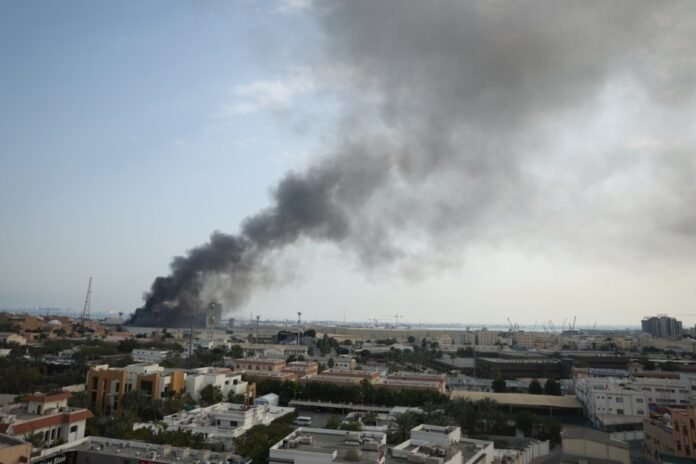

Iranian army says drones target key US facilities at Bahrain’s Sheikh Isa Air Base

0
iranian-army-says-drones-target-key-us-facilities-at-bahrain’s-sheikh-isa-air-base
Iranian army says drones target key US facilities at Bahrain’s Sheikh Isa Air Base

Iran’s army said Thursday it targeted key US military facilities at Bahrain’s Sheikh Isa Air Base with one-way attack drones amid an exchange of attacks between Tehran and Washington across the Middle East region.

In a statement, the army’s public relations office said the operation was carried out in retaliation for the killing of an Iranian Air Force Su-24 pilot at the start of the US-Israeli war on Iran in February, the official IRNA news agency reported.

It said the drones struck power generators, navigation systems and administrative and support buildings used by what it described as the US military at Sheikh Isa Air Base.

READ: CENTCOM chief proposes 2-week air campaign against Iran following killing of service members: Report

The military claimed that repeated attacks on US bases in the region over recent days had inflicted “significant damage” on military equipment and facilities despite the bases being protected by multiple air defense systems.

It described Sheikh Isa Air Base as one of the most important US military installations in the Gulf region, saying it hosts reconnaissance aircraft and serves as a major maintenance center for helicopters and drone components.

The statement claimed the repeated attacks by Iran’s armed forces had caused serious damage to the base’s combat and logistical support capabilities.

There was no immediate comment from Bahraini or US authorities on the claim.

READ: Iran claims ballistic missile strike destroyed 3 US F-35 jets at Jordan air base

Pakistan Aims To Double US Trade to $20 Billion in 5 Years 

0
pakistan-aims to double-us-trade-to-$20-billion-in-5-years 
Pakistan Aims To Double US Trade to $20 Billion in 5 Years 


Pakistan wants to increase its bilateral trade with the United States to $20 billion over the next five years. The country remains an important importer of US cotton, soybeans, and energy products, while its growing demand for advanced technology, machinery, and capital goods offers significant opportunities for American businesses.  

Deputy Prime Minister and Foreign Minister Ishaq Dar expressed these views while addressing a delegation of US Congressmen Rep.Ryan Zinke (Montana) and Rep. Michael Baumgartner (Washington), along with American business leaders in Islamabad on Tuesday.  

According to the state broadcaster Radio Pakistan, Dar has reaffirmed Pakistan’s commitment to further strengthening its strategic and economic partnership with the United States through enhanced trade, investment, and parliamentary engagement.  

The two congressmen recently held meetings with Pakistan’s military leadership, including Field Marshal Asim Munir, as well as Dar, to discuss regional security, defense cooperation, and ways to strengthen bilateral economic and trade ties.  

Highlighting improving economic indicators and ongoing structural reforms, Dar presented Pakistan as an appealing investment destination with vast potential in artificial intelligence, critical minerals, energy, manufacturing, and defense.  

“Trade between Pakistan and the US reached $9.4 billion in the last fiscal year,” he said. “Although encouraging, we are confident that by capitalizing on the complementary strengths of our economies, we can double this trade to $20 billion in the next five years.  

Welcoming the US business delegation, Dar said the presence of more than 80 American companies in Pakistan reflects confidence in the country’s market and long-term economic prospects.  

He invited US investors to explore opportunities in technology, critical minerals, energy, defense, manufacturing, agriculture, and information technology, noting that Pakistan’s improving macroeconomic outlook, structural reforms, and investment facilitation mechanisms have created a more business-friendly environment.  

He also appreciated the US EXIM Bank’s $1.25 billion in financing for the Reko Diq project, describing it as a strong vote of confidence in Pakistan’s economic future.  

Dar said Pakistan-US relationship continues to gain momentum under the leadership of Prime Minister Shehbaz Sharif and US President Donald Trump, with frequent high-level engagements reinforcing mutual trust, respect, and cooperation. Dar’s remarks come as Pakistan actively seeks to deepen economic ties with the United States and attract much-needed foreign direct investment.  

Bolstered by emerging signs of macroeconomic stability following a crucial $7 billion bailout package secured from the International Monetary Fund (IMF) last year, Islamabad is seeking to shift its traditional relationship with Washington from a primarily security-focused one to a durable, trade-driven partnership.  

By capitalizing on recent fiscal discipline, currency stabilization, and structural reforms mandated by the IMF program, Pakistani officials are eager to project the country as a viable, secure, and lucrative hub for American businesses in key sectors such as technology, energy, and mining.  


Just because a game is on disc doesn’t mean it will work in the future

0
just-because-a-game-is-on-disc-doesn’t-mean-it-will-work-in-the-future
Just because a game is on disc doesn’t mean it will work in the future

Sony’s recent decision to stop producing physical PlayStation games in the near future has naturally led to a renewed focus and appreciation for physical games that can be played just by sticking a cartridge or disc in a console. But an increasing number of those “physical” games these days still require additional downloads from a centralized server to function as intended.

For years now, the testers at DoesItPlay have been documenting this trend, testing thousands of physical game releases to see which ones live up to the promise of full “plug and play” functionality without an Internet connection. Thus far, a full 27 percent of the physical releases they’ve tested require some sort of download to fix game-breaking bugs or obtain core game content that is not stored on the physical release itself. That ratio balloons to 34 percent for tested PS5 games and 50 percent for those on the Xbox Series X.

“There is a clear trend that physical releases are increasingly treated with ignorance from larger companies,” DoesItPlay owner and head admin Clemens Itsel told Ars recently. “There is no reason physical games would ever die unless someone like Sony deliberately kills them.”

What’s missing

DoesItPlay got its start in 2019 as a passion project Twitter account maintained by Jon Doyle—who went on to found boutique physical game publisher Lost in Cult—and quickly developed into a small community of devoted physical game testers. In 2021, the group helped bring wider attention to the so-called “CBOMB” kill-switch, which threatened to make offline PS3 and PS4 consoles practically useless once their internal CMOS clock batteries failed.

When Sony eventually fixed this issue on the PS4 months later (though the PS3 remains unpatched), Itsel said he used that “breakthrough success” as an excuse to “professionalize and grow the project to what it is today.” From an initial spreadsheet tracking the group’s physical game tests, DoesItPlay has grown into a publicly searchable database of thousands of titles, each tested using a methodology designed to determine just how much the core game experience is impacted by playing exclusively on physical media.

A Cyberpunk NPC is shown talking before his textures have fully loaded on the console version of the game.

A Cyberpunk NPC is shown talking before his textures have fully loaded on the console version of the game. Credit: CCPR / @MrDelabee Twitter

Often, the games that fail these tests are ones that were released on disc in an incomplete, bug-filled state that require downloadable patches to fix. Itsel cites the infamously bad initial console releases of Cyberpunk 2077 as a prototypical example of a game where the unpatched physical disc will one day be virtually unplayable, even if “one of our testers beat the game regardless of its abysmal state at the time.”

For some games, though, the game-breaking failures of the disc version can be much more subtle. Itsel recalls how, when testing the physical release of survival-action game Atomfall, “upon returning to the main hub village everyone suddenly went hostile, which broke numerous side quests and wouldn’t let me continue my peaceful playthrough. You can still beat the game, but you have to shoot your way out of it, which is near-impossible given the nature of the combat.”

Bugs aside, DoesItPlay also documents numerous physical releases where the disc only contains a pitifully small portion of the full game, requiring a massive download to play the rest. Recent releases like Doom: The Dark Ages, Indiana Jones and the Great Circle, and The Outer Worlds 2 are just a few prominent examples where the disc version is just a small stub that barely represents the full downloadable game.

Good luck playing that disc copy of 007 First Light without access to Sony’s update servers.

Good luck playing that disc copy of 007 First Light without access to Sony’s update servers.

And even when a game disc does contain a full, playable game (or a significant portion thereof), Itsel said he has also noticed a new “blood boiling” trend of publishers inserting early mandatory download prompts that halt all progress if you don’t have an Internet connection. Games like Hogwarts Legacy, Jedi Survivor, The Elder Scroll IV Oblivion Remaster, 007 First Light, Crimson Desert, Gothic Remake, and almost every modern AAA Ubisoft game hamper their physical releases in this manner, Itsel said, a move that he considers “a spit in the face of game preservation.”

Looking across the major console platform makers, Itsel said that Microsoft is the worst offender when it comes to releasing complete games on disc. “Xbox has long given up on producing fully functioning physical releases,” he told Ars Technica. “They far too often require downloads or force players to create a Microsoft account. It’s deliberately undermining the value of physical releases by making them incomplete or online-dependent in other ways.”

While Sony’s physical releases tend to be more playable as is, Itsel said that “we can observe a decline over the recent years” in the number of PlayStation discs that don’t require any downloads. Physical game cartridges on the Switch and Switch 2 often fare better without an Internet connection, but even there Itsel said he sees more publishers opting for Game Key Cards that don’t contain any offline data. While DoesItPlay doesn’t test these Game Key Cards alongside more legitimately “physical” releases, Itsel said he considers selling a physical product that amounts to a fancy download key to be “a form of deception” on the part of Switch 2 publishers.

Fighting for the future

In the here and now, having to download additional patches to play a “physical” game is more often a minor annoyance than a massive headache. Eventually, though, the centralized platform servers containing those crucial patches will shut down, turning countless game discs into essentially unplayable coasters. Even as companies like Nintendo promise in FAQs that previous purchases and game updates on older platforms will remain downloadable “for the foreseeable future,” Itsel said that “it is just an eventuality that these servers will shut down.”

“[Current] stability of servers is… irrelevant if their upkeep is only decided by the financials and licensing agreements,” Itsel notes. “They can do whatever they want with your games, because we let them relabel a purchase into ‘licensing.’ Many always claim that they can still download their old rentals from generations ago… until they can’t anymore.”

Those statistics on the right should be worrying to anyone hoping to preserve game discs for the long term.

Those statistics on the right should be worrying to anyone hoping to preserve game discs for the long term. Credit: Does It Play

Getting today’s players to care about this problem can be an uphill battle, Itsel acknowledges. “We constantly meet dismissive arguments online,” he said. “‘Nobody cares,’ ‘Go with the times,’ ‘Every game needs a download anyway.’ Many of these people don’t even know what advantages a physical release brings. The independence. The longevity.”

“If they cared about how these companies treated the art and the customers there would be daily riots in front of every AAA gaming HQ across the planet,” he added.

While companies like Sony are showing an increasing disregard for the physical side of the game market, Itsel said he’s still heartened by “a rise in boutique labels and smaller publishers that understand the demands of the passionate physical media audience.” And on the supply side, these publishers reflect “the demand from developers to see their work immortalized, respected, and put in a position to leverage an additional revenue stream on top of digital distribution,” Itsel said.

Though the fight to maintain offline access to physical games is happening in the present, the preservation effort is really focused on the future. “When we fight for physical media or DRM-free digital options, we do this because we don’t want these cultural artifacts to vanish,” Itsel said. “Games are the most influential and commercially most successful medium of our time. These games are art. They are human history. It is about way more than the egotistical individual keeping their dopamine kicks.”

China’s DUV lithography still lags ASML by four generations

0
china’s-duv-lithography-still-lags-asml-by-four-generations
China’s DUV lithography still lags ASML by four generations

Media reports published earlier this week about China’s plan to start making its own immersion deep ultraviolet (DUV) lithography machines have caused a sharp sell-off of European chip equipment stocks. But Chinese pundits say the situation remains very far from a point where China’s DUV machines coukd compete with ASML’s.

The Information reported Monday that a state-backed manufacturer, whose identity has not been disclosed due to the sensitivity of the matter, has begun mass producing the homegrown machines. Production will be limited initially, with about five units expected this year and roughly 20 more in 2027, for delivery to leading chipmakers including Semiconductor Manufacturing International Corp (SMIC), Hua Hong Semiconductor and ChangXin Memory Technologies.

The report said the breakthrough could eventually challenge ASML’s position in China, but cautioned that the system still lags in performance and reliability and requires further testing before mass production. 

Reuters reported Tuesday that the Chinese state-owned firm mass-producing the machines is Shanghai Aishengna Electronic Technology Group.

Public information shows that Aishengna was founded in August 2023 with registered capital of 7 billion yuan (about US$1 billion), backed by two state-owned shareholders, Shanghai Electric Holding and a Shanghai International Trust subsidiary. The secretive firm has no website and has disclosed little about its operations, but Reuters reported it has absorbed teams from Shanghai Yuliangsheng, which began testing a DUV prototype last year, and from Shanghai Micro Electronics Equipment (SMEE).

ASML shares fell 13% over the first three trading days this week. BE Semiconductor Industries declined 16.3% and Infineon Technologies slipped 15.5% over the same period. The three stocks rebounded on Thursday after JP Morgan analysts called the selloff disproportionate to what the report had indicated, though their shares have yet to return to last Friday’s level.

Without confirming whether China is producing its own immersion DUV machines, the Global Times, a unit of the People’s Daily, said in an editorial on Tuesday that the significant fall in chip equipment suppliers’ shares showed that “Western investors’ blind faith in the effectiveness of blockades has been shaken, and the US-led decoupling strategy has lost much of its momentum.” 

“Western technology companies like ASML understand that once China achieves a genuine breakthrough, their market share will face a direct hit,” it said. “Therefore, the stock price fluctuations triggered by this unconfirmed report were not merely emotional knee-jerk reactions, but also a realistic risk assessment by the industry.”

“One day, the technologies once used to constrain China’s development will simply become ordinary components of its independent industrial system. For China, the task now is simply to stay focused, keep doing the work, and not be distracted by the external buzz.”

With state media calling for not being distracted by the “external buzz,” Chinese commentators have stayed silent so far this week, with only a few stock market bloggers saying that shares of Chinese chip-making equipment suppliers may gain support.

Last September, the Financial Times reported that SMIC, China’s leading chipmaker, was testing a DUV immersion lithography machine made by Yuliangsheng.

The machine is understood to be targeting 28-nanometer chip production, and Yuliangsheng had planned to deploy it on production lines by 2027.

In October, Brandon Weichert, a senior national security editor at The National Interest, wrote that a Chinese firm had reportedly sought technical support from ASML after failing to reassemble a DUV machine following an internal teardown carried out for alleged reverse engineering.

Some people may be confused by different Western media reports, but Chinese analysts have already explained that Yuliangsheng, SMEE and Aishengna are actually sharing the same team of engineers, who are developing a machine similar to SMEE’s SSA800, which has not yet been officially launched.

Yuliangsheng was founded in 2022 and is jointly owned by SiCarrier and the state-backed Chuangkewei (Shanghai) Technology. Last year, SMEE underwent a restructuring that moved its immersion DUV lithography technologies and engineers into Yuliangsheng, while it kept its extreme ultraviolet (EUV) lithography project.

Yuliangsheng’s team is now housed within Aishengna and continues developing the SSA800, though the machine could be renamed to avoid ownership disputes if Yuliangsheng or Aishengna eventually goes public.

SSX800 is roughly equivalent to ASML’s TWINSCAN NXT:1950i, a tool the Dutch company launched in 2008 for making 28 nm chips.
 
Media reports said about 70% of the SSA800’s components are made in China, listing several of its suppliers:

  • Non-objective lens (zinc selenide and laser lens) by Nanjing Wavelength Opto-Electronic Science and Technology
  • 300 millimeter large-aperture lens by MLOPTIC Corp
  • Exposure system by the Changchun Institute of Optics, Fine Mechanics and Physics
  • Dual-stage system by Beijing U-Precision
  • Temperature control system by Beijing Naura Electronics

The machine still needs to import many parts – including a 193 nm excimer laser mirror, Zeiss lenses, a vacuum chamber, synchronization control algorithm software and argon fluoride (ArF) immersion light sources – or source them from secondary markets.

In fact, Chinese chipmakers are still allowed to import ASML’s NXT:1980i machines. SMIC is reportedly using such equipment, along with multiple-patterning techniques, to produce 7 nm chips for Huawei Technologies despite US sanctions.

“China’s self-developed 28 nm DUV lithography machine still lags about four generations behind ASML’s products, with performance roughly equivalent to the Dutch company’s lithography tool from 15 years ago,” a Liaoning-based columnist writes. “But at least China has achieved a key breakthrough from zero to one in the mature process node segment.”

The columnist says China plans to invest heavily in three areas, including high-power DUV light sources, high-precision 193 nm optical lenses and synchronization control algorithms.

‘Stay rational’

In April, US lawmakers introduced the Multilateral Alignment of Technology Controls on Hardware (MATCH) Act, which aims to stop ASML from shipping all immersion DUV machines to China.

Since then, Chinese media and commentators have turned low profile when discussing the progress of domestic chipmaking equipment. They have even taken the initiative to deny an online media report claiming that the SSA800 had been officially launched and achieved a 90% yield.

ICSmart, a Chinese outlet that focuses on the chip and technology sectors, said in a May 10 commentary that it was groundless to say that “SMEE officially announced mass production of the SSA800 in January 2026 and exhibited the machine at an industry show in March.” 

“It is true that the SSA800 machine can process 150 wafers an hour, but it is far-fetched to say its mass production yield is stable in the range of 90% to 95%,” ICSmart said.
 
Citing a source at a domestic wafer foundry, ICSmart said the SSA800 series had not yet entered a commercial wafer fab in China and appeared still to be undergoing testing at the Shanghai Integrated Circuit Research and Development Center (ICRD), which provides wafer-level testing, parameter analysis and reliability verification for integrated circuits. It questioned how the machine could be deployed for mass production, let alone achieve a high yield.

The opinion piece said many Chinese people want to hear news of domestic equipment breaking through in advanced process technology, but the stronger that desire grows, the more important it is for people to stay rational.

It warned that false or self-congratulatory reports undermine the public’s ability to judge real progress and the seriousness of the incremental work being done across the supply chain.

Read: US lawmakers seek to block China’s DUV lithography access

Follow Jeff Pao on Twitter at @jeffpao3

Singer Gets Trapped in Giant Water Bottle During Concert (Video)

0
singer-gets-trapped-in-giant-water-bottle-during-concert-(video)
Singer Gets Trapped in Giant Water Bottle During Concert (Video)


Katy Perry’s latest concert stunt was supposed to bring her closer to the crowd. Instead, it nearly sent her sailing into the unknown.

The pop star found herself trapped inside a giant inflatable water bottle during her performance at the Isle of MTV Malta festival, where a playful crowd-surfing moment briefly turned chaotic.

Perry was performing “I Kissed a Girl” when she climbed inside the oversized plastic bottle, which had “Katyade” written on the side. The plan was simple enough: fans were supposed to roll her through the audience and guide her back toward a giant straw near the stage.

But the crowd had other ideas.

Video from the show shows Perry being carried away from the stage as fans pushed the inflatable bottle toward the back of the audience instead of sending her where she needed to go.

“Go back to the stage!” Perry shouted from inside the bottle. “Oh, my God!”

For a few tense seconds, it looked like the stunt had completely gotten away from her. Perry could be heard trying to redirect the audience as the huge bottle bounced over the crowd, with fans eventually realizing they needed to steer her back toward the stage.

The moment quickly turned into one of the most viral clips from the festival, with fans joking online that Perry almost became “The One That Got Away” in real time.

The inflatable bottle has been part of Perry’s recent live show, giving her a dramatic and very on-brand way to crowd-surf above her audience. The bottle stunt, branded as “Katyade,” has appeared throughout her tour as a playful way to connect with fans from the middle of the crowd.

After the Malta performance, Perry admitted the stunt went a little farther than expected.

“I basically get in this giant inflatable water bottle, and I roll it into the crowd,” she said in a clip shared by Isle of MTV Malta. “And tonight I went kind of far, and I was a little bit worried I was not gonna come back.”

Luckily, Perry did make it back. The crowd eventually rolled her toward the giant straw as intended, allowing her to finish the performance without injury.

The Malta show came near the end of Perry’s European run, which wrapped on July 25 after nearly 40 days and 20 performances. The singer has also been making headlines offstage for her relationship with former Canadian Prime Minister Justin Trudeau. The pair made their red carpet debut in June at the Tribeca Festival premiere of Katy Perry: The Lifetimes Tour — Live from Paris.

Still, for one night in Malta, it wasn’t the romance or the music that stole the show. It was Katy Perry, sealed inside a massive plastic bottle, shouting directions while thousands of fans accidentally rolled her the wrong way.

Iran struck Amazon data centers again amid widening war, satellites show

0
iran-struck-amazon-data-centers-again-amid-widening-war,-satellites-show
Iran struck Amazon data centers again amid widening war, satellites show

Satellite images have revealed new damage to Amazon data centers in the Middle East along with at least one crucial Saudi oil facility, following missile and drone attacks by Iran and its Houthi allies.

The images from Europe’s Copernicus Sentinel-2 satellites provide evidence of a widening war as the United States and several Gulf states exchange military strikes with Iran, the Houthi faction in Yemen, and Iran-backed militias in Iraq. Such satellite images also offer independent verification of claimed war damage, despite the US government having pressured US commercial firms and even Europe to restrict satellite imagery of the region.

Three Amazon data centers in the United Arab Emirates and Bahrain were already previously damaged by Iranian drone strikes on March 1. Those earlier attacks stuck Amazon with months of expected repairs and forced Amazon Web Services customers in the Middle East to migrate workloads to other cloud regions.

But on July 21, Iran’s Islamic Revolutionary Guard Corps issued a statement saying it had once again attacked and “destroyed” Amazon data centers in Bahrain by using cruise missiles. The statement was shared through the Iranian state media outlet Fars News Agency and reported by Western media outlets such as CNBC.

The Islamic Revolutionary Guard Corps followed up by releasing high-resolution satellite images showing damage to two Amazon data centers located at the coastal towns of Zallaq and Askar in Bahrain. It was not immediately clear what satellite services Iran used, but the country has reportedly been making use of commercial imagery from Chinese satellites.

Analysts used imagery from the Copernicus Sentinel-2 satellites to verify signs of the strikes on the data centers but were unable to determine the extent of the damage, according to Bloomberg News. The news outlet reached out to Bahrain, the US military, and Amazon for comment but all declined to comment or did not respond.

The AWS dashboard showing the status of AWS services in the affected cloud region has not been updated since April 30. That last status update had stated the damaged data centers were “unable to reliably support customer operations” and recommended customers migrate their resources to other cloud regions.

Amazon did not respond to an Ars request for comment.

A bigger blow to oil exports and the world

The newest Iranian strikes on Amazon data centers may have been more symbolic than anything. But Houthi missile and drone strikes on Saudi oil refineries and the crucial port of Yanbu used for oil exports could prove far more consequential for the world.

On July 20, the Houthis officially declared a naval blockade aimed at shutting down Saudi oil exports going through the Red Sea shipping chokepoint in the Bab el-Mandeb Strait. The Houthis have since attacked several Saudi oil tankers in the Red Sea, along with launching missiles and drones at Saudi oil refineries and the port of Yanbu on July 25.

The Houthi attacks threaten Saudi Arabia’s ongoing attempts to reroute oil exports away from the Strait of Hormuz shipping lanes that have been disrupted by the ongoing war between the United States and Iran. The Saudis have been sending out more oil shipments from the port of Yanbu on the Red Sea, where tankers can exit the southern end of the Red Sea via the Bab el-Mandeb Strait to reach Asian markets.

But the Iranian-backed Houthi faction in Yemen controls enough coastal territory to threaten ships passing through the Bab el-Mandeb Strait. The Houthis have also spent years battling Saudi-backed government forces and another separatist faction supported by the United Arab Emirates for control of Yemen.

Saudi government officials and the state-owned oil and gas company Saudi Aramco have not publicly said anything about potential damage from the latest Houthi strikes. That official silence has forced analysts and even oil traders to turn once again to Copernicus Sentinel-2 imagery for possible verification.

Satellite images showed one oil tank at Saudi Aramco’s Jazan oil refinery on fire, Bloomberg News reported. They also showed a flare tower emitting smoke—a sign of the oil refinery burning off excess gas to provide a safety valve for the site’s operations. Saudi Aramco subsequently shut down the oil refinery, which is typically capable of processing 400,000 barrels per day.

Other Sentinel-2 images have shown similar smoke from flare towers at the Abqaiq oil processing plant and Hawiyah gas processing plant that were targeted by the Houthis, according to Bloomberg. Such flaring activity does not necessarily indicate physical damage to the sites from the Houthi strikes.

However, the new Houthi blockade and latest attacks have already led to a 40 percent drop in oil tanker transits through the Bab el-Mandeb Strait when comparing the week of July 20 through 26 to the preceding week, according to Lloyd’s List Intelligence. The Houthis are also considering charging fees for safe passage, similar to how Iran has attempted to do so for shipping in the Strait of Hormuz, Reuters reported.

“It’s going to cause more trouble in terms of depleting oil reserves in economies that have already been struggling because of this now five-, six‑month blockade of the Strait of Hormuz,” said Michael Stephens, a senior associate fellow at the Royal United Services Institute for Defence and Security Studies, in an interview with Al Jazeera.

Without greater transparency from governments and companies, open source intelligence sources such as verified video evidence and satellite imagery can continue to help evaluate the growing human and economic costs of the war. Copernicus satellite imagery stands out in this regard because it’s a free resource and still uncensored—although the European Union recently agreed to implement a 24-hour delay on releasing new Copernicus images showing shipping lanes near the Strait of Hormuz.

US and Saudi Arabia Launch Strikes on Iran-Backed Militias in Iraq

0
us-and-saudi-arabia-launch-strikes-on-iran-backed-militias-in-iraq
US and Saudi Arabia Launch Strikes on Iran-Backed Militias in Iraq


The United States and Saudi Arabia have carried out joint air strikes against Iran-backed militia targets in eastern Iraq after a wave of drone attacks on US forces and Saudi energy infrastructure. The operation targeted logistics and weapons sites allegedly used by militias linked to Iran’s Revolutionary Guard Corps (IRGC).

The strikes came shortly after Iran launched a barrage of ballistic missiles targeting US forces in the Middle East. According to US Central Command, all the missiles were intercepted and caused no damage. Washington said the missile attack and the subsequent strikes in Iraq were separate events but warned Iran and its regional allies against further attacks.

US officials said the joint operation was a response to more than 30 drone attacks over the past 72 hours, stressing that any future attacks on American troops or Saudi oil facilities could trigger further military action.

Saudi Arabia confirmed its participation, saying it does not seek escalation but would defend itself against any aggression. Meanwhile, Iraq has launched an investigation after accusations that its territory was used to launch attacks on Saudi Arabia. Iran-backed militias denied involvement, while regional tensions continue to rise after a brief period of calm in the Gulf.

via Euronews

Taiwan’s path to victory is unclear

0
taiwan’s-path-to-victory-is-unclear
Taiwan’s path to victory is unclear

Like few other countries, Taiwan faces a legitimate existential crisis. Beijing’s position that Taiwan must submit to absorption by the People’s Republic of China, even by force if necessary, is insistent and uncompromising.

There is zero doubt this would result in the destruction of Taiwan’s democratic political system and liberal political culture. The Chinese government has already signaled that it would “re-educate” Taiwan and severely punish alleged “separatists” if it got its hands on the island. Even knowing that Taiwan’s people were watching, Beijing dismantled civil liberties and imposed harsh penalties for minor acts of dissent in Hong Kong.

China backs its bad intentions with sobering capabilities, the results of a massive military buildup and increasingly sophisticated practice runs for a blockade or invasion. Taiwan’s problem is how to emerge from this predicament with a victory – with victory defined as an end to the threat of compulsory annexation by the PRC without Taiwan needing to sacrifice its freedoms or de facto sovereignty.

The question is whether a path to victory exists. There are several possibilities. None is particularly promising.

1. Taiwan’s own efforts to deter the PRC

Taiwan has made significant self-strengthening efforts, especially in recent years. Taipei has increased defense spending to about 3% of GDP this year, and President Lai Ching-te says it will rise to 5% by 2030.

In 2025, the government reversed the trend of shrinking mandatory military service for young men by raising the commitment period from four months to one year. Training has improved with more opportunities to practice useful military skills, more realistic exercises and instruction in the operation of modern weapons such as drones and man-portable missiles.

The government is implementing civil defense training to create a more robust whole-of-society response to a potential war.

Despite these efforts, China’s military capabilities decisively overmatch Taiwan’s. An aphorism of military thought is that a successful attacker usually needs at least a three to one numerical advantage. China easily fulfills this requirement with active duty forces ten times larger than those of Taiwan, a 5,000 to 1,000 advantage in tanks, a 1,900 to 300 advantage in combat aircraft, and a navy larger than Taiwan’s by a factor of seven.

The Chinese Coast Guard has ten times the number of large (over 1,000 tons) ships as its Taiwan counterpart, and the Chinese vessels are generally larger and better armed.

China builds millions of drones per year; Taiwan hopes to increase production of drones to 1.2 million by 2030. China can also target Taiwan with thousands of ballistic and cruise missiles. The gap will only get larger.

In the category of naval vessels, central to either a blockade or invasion attempt, China adds about 30 new vessels annually, Taiwan about three. Taiwan’s self-strengthening ensures that an attack would be costly to the PRC. Nevertheless, because of China’s huge advantages in numbers of platforms, weapons and troops, Taiwan probably could not by itself defeat a PRC blockade or an invasion attempt in which Beijing was willing to tolerate heavy losses.

Therefore, there is no visible prospect of Taiwan’s war defense preparations intimidating Beijing into calling off its standing threat to use force to compel unification.

2. US military intervention

Deterrence against China is much more robust, of course, if we factor in the strong likelihood of US military intervention in Taiwan’s defense.

Note, however, that Beijing’s threat to use force against Taiwan goes back decades to a time when US forces enjoyed overwhelming superiority over the PLA in a cross-Strait war scenario. There is no reason the expect the Chinese to give up this threat now that the opposing forces are more evenly matched.

Indeed, Beijing seems to be signaling that stronger gestures of US support for Taiwan will move China closer to opting for a military solution. After the visit of then-Speaker of the US House of Representatives Nancy Pelosi to Taiwan in 2022, the PLA began routinely crossing the Taiwan Strait median line while Chinese military and Coast Guard exercises became more frequent, more operationally realistic and geographically wider-ranging.

Moreover, the durability of US support for Taiwan is in question. Previous US President Joe Biden said publicly four times he would send US forces to defend Taiwan if necessary. In contrast, current US President Donald Trump has said he would respond to a Chinese invasion attempt with economic sanctions, while opining on several occasions that Taiwan is indefensible.

Trump has shown that a US president can talk about abandoning Taiwan without being forced to recant by either Congress or the US public.

Retired Admiral Dennis Blair, former commander of US military forces in the Pacific, argues with authority in a recent Foreign Affairs article that US efforts are “reversing China’s relative military gains” and that eventually “Chinese leaders will recognize that conquering Taiwan is unrealistic.”

Blair’s assessment, however, may be overly optimistic. He assumes the US still has an abundant arsenal of precision munitions, which was questionable even before the Iran war.

He believes the Chinese expect that the American navy would retaliate by blocking China’s energy imports and freezing China out of the dollar-based international financial system. That is uncertain, and doesn’t account for China’s own ability to respond by inflicting pain on the US homefront through counter-responses such as all-out cyber-attacks on critical infrastructure and a cutoff of rare earth elements and other vital supplies to the US.

Blair seems not to account for the additional seaborne lift capacity the PLA could call in by requisitioning China’s large fleet of civilian ferries. Finally, part of Blair’s plan for the defense of Taiwan involves US attacks against ports along the Chinese coast. But a US president is unlikely to take that step in the face of threats by Beijing to use nuclear weapons if the Americans bomb the Chinese homeland.

Even in the calm of peacetime, PRC officials and scholars have opined that China’s “no first use” policy doesn’t not preclude nuclear retaliation against conventional strikes on Chinese territory. There seems little reason to hope that US support for Taiwan will cause Beijing to acknowledge that the threat to forcibly annex Taiwan is “unrealistic.”

3. Taiwan’s democratic political system

Taiwan government officials and others have argued that democracy protects Taiwan. “Our best defensive weaponry is not submarines, PAC-3 or anti-submarine aircraft but, rather, our democracy,” then-President Chen Shui-bian argued in a 2007 interview. “In it lies the key to our survival.”

There are two aspects to this argument.

First, Taiwan’s forces might fight relatively better than their authoritarian enemies. Dan Reiter and Allan C. Stam, authors of the 2002 book Democracies at War, contend that democracies usually (historically, 80 percent of the time) win the wars they fight because legitimacy and popular consent result in more motivated and effective military performance.

Second, other democracies will defend Taiwan. The logic is that any win by the authoritarian bloc of countries over the democratic bloc makes all the remaining democracies less secure.

Lai, for example, has pushed this argument, as he did during a May 2026 speech: “No democracy can afford to stand on the sidelines in the face of expanding authoritarianism. Only when democracies around the world stand together in unity can we build a more resilient line of defense for the free world.”

The democracy-as-protection argument, however, is unpersuasive. Even if Taiwan’s forces fight better man-for-man, that advantage is overwhelmed by the PLA’s massive numerical superiority. And PRC troops are not without their own kind of motivation, based on hatred of “separatists” and pride in fulfilling China’s unification aspiration.

The other democratic governments wish Taiwan well and increasingly call on China not to molest Taiwan. They could be counted on to make strong statements and perhaps levy temporary economic sanctions if China attacked Taiwan. Very few, however – probably only the US and Japan – would send substantial military assistance to Taiwan. Overall, then, the additional deterrence effect on China afforded by Taiwan’s membership in the fellowship of democracies is minor.

4. Taiwan’s importance to the international economy

A cross-Strait war would substantially disrupt shipping traffic into and out of the ports on China’s east coast, including Shanghai, the world’s busiest container port. The possibility of an economic downturn, with the consequent high risk of domestic turmoil inside China, is therefore a major disincentive against the PRC starting a war over Taiwan.

A particular vulnerability is that China, along with the rest of the world, relies on semiconductors manufactured in Taiwan. A cross-Strait war would obviously halt the delivery of chips. Hence the argument that Taiwan’s crucially important fabs represent a “silicon shield” that both prevent a Chinese attack and guarantee US military intervention.

In the 1980s, some observers argued that since Hong Kong under British administration was a goose that laid golden eggs for China, Beijing would renew Britain’s lease over the New Territories when it expired in 1997. Instead, however, Beijing prioritized nationalism over economics, taking Hong Kong back and undermining its profitability by imposing a more PRC-like political and legal system.

Beijing is not likely to call off the threat to use force against Taiwan just because war would be economically too costly. For the ruling regime, the political cost of admitting failure to achieve unification would be even greater.

In the meantime, China is investing hundreds of billions of dollars to negate the “shield” by building up an alternative domestic semiconductor industry, including design and manufacturing. China will likely be the dominant global supplier of legacy semiconductors (not the most advanced, but more widely used) in the next few years.

At the same time, US Commerce Secretary Howard Lutnick argues that the danger of a cross-Strait war creates an unacceptable vulnerability for the US and global economies and that the solution is to transfer 40 percent of Taiwan’s chip production to the US. Taiwan Semiconductor Manufacturing Company has now committed to investing $265 billion into its new US-based fabs.

The intention is not to make Taiwan more secure, but rather to make Taiwan’s security matter less to the US, reducing the US motivation to intervene in a cross-Strait war.

5. China’s domestic situation

We can imagine possible conditions in China that might remove the threat of war against Taiwan. One is social turmoil, such as occurred during the most intense years of the Cultural Revolution, when Chinese foreign policy was only semi-functional.

Another possibility is dramatically reduced economic strength, either due to sudden collapse or long-term deterioration. This could erode the government’s confidence in its ability to successfully prosecute a war, or sap public support for overseas adventurism.

A change in the regime could cause a re-evaluation of major foreign policies. An ideal development would be the PRC government deciding to redefine its Taiwan narrative, so that the CCP’s prestige and legitimacy no longer depended on promising to force Taiwan into formal unification with the PRC.

None of these developments, however, is visible on the horizon. Social turmoil is a wildcard. There are many discontented people in China, but the state has formidable tools to quell civil unrest.

China’s economy is slowing to a more modest growth rate. But even if it fails to escape from the “middle income trap,” China still enjoys global economic centrality and unmatched manufacturing capability – including military-related production.

Benevolently redefining the PRC-Taiwan relationship would require years of de-programming the Chinese public.

Even a radical change of regime from Chinese Communist Party-led Leninism to a liberal democracy wouldn’t necessarily undo the Mainland’s aggressive posture toward Taiwan. Democracies such as Japan and South Korea (not to mention the US and Denmark) continue to have disputes about ownership over territory.

So, much of Taiwan’s international existence involves “kicking the can down the road.” Unfortunately, the situation farther down the road does not look better. Taiwan is left hoping for a yet-to-be-discovered global development that will ease the pressure, but one over which Taiwan will have little if any control.

Denny Roy is a senior research fellow at the East-West Center in Honolulu. He can be reached at royd@EastWestCenter.org

Why Damietta Drone Strike Proves Egypt Can’t Hide From Regional War 

0
why-damietta-drone-strike-proves-egypt-can’t-hide from regional-war 
Why Damietta Drone Strike Proves Egypt Can’t Hide From Regional War 


The attack on two gas vessels at the Mediterranean port highlights Egypt’s growing exposure to a conflict it has largely sought to avoid 

[CAIRO] Egypt’s cabinet said Thursday that a drone caused a fire aboard two vessels at Damietta port, after initial accounts from Egyptian security sources disputed reports that the fire was caused by a drone strike. “Following the containment of the fire that affected two vessels at Damietta Port, preliminary investigations by the relevant authorities determined that it was caused by a drone,” the cabinet said in a statement.

The fire occurred Wednesday, July 29. No party has claimed responsibility, the cabinet said, and investigations are continuing. The statement said Egypt was taking “the necessary measures” to safeguard its interests and national security. It did not say where the drone originated from.  

Hany El-Aasar, executive director of the National Center for Studies and a researcher specializing in security and military affairs, said the attack marked a departure for Egypt. “The Damietta incident is clearly deliberate and intentional,” El-Aasar told The Media Line. He said the attack severely damaged Egyptian economic interests, even though the vessels were not Egyptian. “It also detracts from the legitimacy of the political system, which rests on protecting and securing the state,” he said.  

The Damietta incident is clearly deliberate and intentional

El-Aasar said Egyptian intelligence was considering every possibility, but he assessed that the available evidence pointed most strongly to the Houthi movement. He cited the group’s assessment of Egypt’s response to its escalation against Saudi Arabia and how far Cairo might go to police Red Sea shipping. “The group functions as Iran’s military arm, and that shaped a strike aimed at American interests,” El-Aasar argued. However, he also said Iran likely did not order the attack because Tehran did not want new enemies or to jeopardize its improved relations with Cairo.  

Days before the strike, Damietta appeared on a map of potential targets broadcast by Iranian state television, under the headline “What could be the targets of Iran’s revenge against Ukraine?” The accompanying text described the port’s liquefied natural gas (LNG) facility as having an annual capacity of 5.2 million tons and serving as a gateway for gas exports to Europe. Iranian media had said openly that Tehran would retaliate by striking targets connected to oil and gas shipments to Europe.  

The broadcast followed a Ukrainian drone strike on July 25 against vessels in the Caspian Sea. Kyiv said it had targeted a Russian warship and ships carrying Iranian-linked military cargo. Iran said one of the vessels hit was the civilian cargo ship Anna, and that a sailor was killed. Foreign Minister Abbas Araghchi called the attack a violation of the UN Charter and said it “cannot go unanswered.” 

The two countries’ foreign ministers spoke on July 28. Araghchi wrote afterward that Ukraine’s Andrii Sybiha had assured him the attack was unintentional. “Iran does not seek escalation either but made clear any attack on our citizens or interests is unacceptable.”  

Damietta was struck the following day.  

Egypt’s Petroleum Ministry said Wednesday that a fire had broken out aboard a regasification vessel and a storage vessel at Damietta and was brought under control with no casualties reported. The ministry did not initially give a cause and urged news outlets and social media users to rely only on its official statements.  

British maritime security firm Ambrey said Wednesday that at least one drone had struck the US-owned, Marshall Islands-flagged floating storage and regasification unit Energos Winter, and that fire spread to a second vessel, the Greek-owned Gaslog Salem. The attack occurred at 14:20 GMT.  

“The cabinet’s promised measures amount to a forensic exercise,” El-Aasar said. “They will establish responsibility and motive, assess whether the weapon matches the suspected party’s known arsenal, determine how it got through, and review security at Egyptian ports and other critical facilities.”  

Drones previously struck the Egyptian towns of Taba and Nuweiba in October 2023, injuring six people. Egypt’s military said they came from the southern Red Sea but did not identify who launched them.  

El-Aasar said Cairo viewed the previous incident as accidental spillover because the Houthis were targeting Israel. He expected the government to describe the Damietta attack in terms that avoid drawing Egypt into the US war with Iran.  

Talaat Taha, a political analyst and expert on Arab affairs, expected a tougher response. Egypt would stay out of the war, he told The Media Line, but could take the case to the UN Security Council, escalate diplomatically, or strike the responsible party.  

“Egypt can keep things under control without triggering a regional war,” he said.  

If Iran were found responsible, Taha said, Cairo’s diplomatic opening with Tehran would end. “Egypt and Iran would go back to zero,” he said. “That file would close, and we would be back to square one.”  

However, in his view, relations with the Gulf would strengthen in the wake of such an attack. “Our relations with the Gulf states are strong, and Gulf security is part of Egypt’s security,” he said, noting that Egypt had already paid a high price for Houthi attacks on Red Sea shipping. “We have suffered heavy losses from the pressure on the Suez Canal,” he said.  

Egyptian Foreign Minister Badr Abdelatty urged his Iranian and Omani counterparts on July 25 to halt all escalatory action. He had told Bloomberg two days earlier that the US-Iran crisis was bridgeable.  

The attack may reduce Egypt’s LNG import and regasification flexibility rather than its export capacity, although the operational consequences remain unclear. The affected vessels were reported damaged and operations at Damietta disrupted, while the government said the port was operating normally.  

“It’s mainly symbolic,” Elai Rettig, an assistant professor in the Department of Political Studies at Bar-Ilan University who specializes in energy geopolitics, told The Media Line. “Egypt has barely exported any LNG through its two facilities in Idku and Damietta since 2024. It suffers gas shortages, especially during the summer months, and has become a net importer of LNG. So, there’s no effect for Europe.”  

Damietta last loaded a major export cargo of LNG in 2023. Egypt has been a net importer of liquefied natural gas since late 2024 and imported a record 8.92 million tons in 2025. The Energos Winter is one of four floating regasification units Egypt uses to meet summer demand.  

Israeli gas once reached international markets through Egypt’s liquefaction plants, which Iran could use to present the strike as aimed at Israel. Rettig called that “a rather weak claim since that hasn’t happened in the past two years, and currently Damietta is used more for LNG imports.”  

“So, Iran hasn’t damaged Israel at all,” he said. “It only damaged Egypt’s energy security.”  

So, Iran hasn’t damaged Israel at all,” he said. “It only damaged Egypt’s energy security

On July 28, Eni and TotalEnergies approved the Cronos gas project off Cyprus, creating a future source of LNG exports for Damietta. Starting in 2028, Cypriot gas is expected to be processed in Egypt and liquefied at Damietta for shipment mainly to European markets, helping restore the terminal’s export role.  

Prof. Brenda Shaffer, an energy expert at the US Naval Postgraduate School, told The Media Line that Tehran will most likely pick its next targets “by opportunity, rather than a calculated choice,” and that “energy and gas facilities around the globe need to raise their security alert level.”  

Shaffer, who attributes the strike to Iran, reads it as an effort to raise global oil prices and exacerbate LNG shortages to pressure President Trump ahead of the US midterm elections. She said Egypt “demonstrated flawed defense of critical energy infrastructure,” and called the strike a wake-up call for Egyptian defense in general.  

An Abu Dhabi security source told The Media Line that the strike ended Egypt’s insulation from the war and reset the regional threat map, and that targeting now follows US-linked economic and energy assets “regardless of the host nation’s political posture.” The source said that “Staying out has been exposed as a political preference, not an operational reality.” 


Staying out has been exposed as a political preference, not an operational reality


In April, Anwar Gargash, diplomatic adviser to the UAE president, praised Egypt and several other Arab states for supporting the UAE during Iranian attacks. Egypt condemned the attacks and reportedly deployed air-defense systems and military personnel to Saudi Arabia, the UAE and Kuwait.   

The Damietta Port Authority said Thursday that the port was fully operational. “All terminals and berths are operating normally, with vessels continuing to arrive and depart, alongside ongoing loading, unloading and cargo-handling operations at the targeted operational rates,” the authority said. The port “continues to provide maritime and logistics services around the clock without interruption,” it said, and cargo handling was proceeding normally across all sectors “in accordance with approved operational plans.”  


0FansLike
0FollowersFollow
0FollowersFollow
0SubscribersSubscribe
- Advertisement -
Google search engine

Recent Posts