TOKYO — South Korea has outrun the 1997 Asian financial crisis, the 2008 Lehman shock, and the 2013 taper tantrum. Whether it can outrun its own AI boom is a harder test — and one the last week of Kospi whiplash put on stark display.
Korea sits at the front of a pack of economies — Taiwan, Japan, China among them — trying to ride the AI wave without wiping out. As the world debates whether AI is an economic asset or a liability, Korea may supply the first real answer.
Few open, top-15 economies have bet as hard on AI. In six months, chip exports have eclipsed cars, ships, electronics, cosmetics and K-pop as Korea’s core industry. In June, exports jumped 70.9% year-on-year — the sharpest rise since 1978 — on the heels of a 53.4% surge in May, as global demand for chips from SK Hynix and Samsung ran hot.
But that heat comes with a bill. Korea’s $1.9 trillion economy is discovering that being ground zero for the AI trade also means being ground zero for the control problems it creates. The Bank of Korea’s decision to raise rates this month shows how eager officials are to get ahead of inflation, market swings and the socioeconomic fallout still building.
Even before AI reshaped the outlook, Korea was carrying record household debt near $1.4 trillion. AI-driven gains risk warping property values further, pushing young Koreans deeper into leverage — while a widening gap between stock-portfolio winners and everyone else pressures ordinary households to chase the market just to keep up.
BOK Governor Shin Hyun-song’s board raised the policy rate 25 basis points to 2.75%, the BOK’s first hike since January 2023. Shin frames it plainly: Growth, inflation, and financial stability all pointed the same way.
“Unlike major countries with weak economic recoveries,” he said, “demand-side inflationary pressures are expected to gradually increase as the impact of the semiconductor boom spills over into domestic demand.” The BOK’s recent statement named “the AI investment outlook” as the key swing factor for growth and inflation through the second half of 2026.
“There’s an element of panic creeping in now,” says David Morrison, senior market analyst at Trade Nation. “Investors are exhibiting a lot of nervousness ahead of earnings reports from the major hyperscalers.”
New Fed Chair Kevin Warsh sees it differently. Hours before the BOK’s move, he told lawmakers in Washington that AI-driven cost pressure — visible in things like Apple’s 10-15% price hikes tied to memory chip shortages — is a supply-side story, not a lasting inflation threat.
“This is one of the good family fights,” Warsh said. “I don’t view a one-time change in prices as necessarily being inflationary because I think there’s a supply response.” Korea’s central bank, watching the same boom drive its own economy, isn’t taking that bet.
President Lee Jae Myung took office in June 2025 promising to lift productivity, address an aging workforce and end the “Korea discount” that has long weighed on Seoul’s markets. AI is making those harder problems look almost beside the point: The Kospi is around 6,500 — well beyond the 5,000 Lee once pledged to reach — purely on the strength of the AI trade, not structural reform.
MSCI isn’t convinced. The index provider again declined to upgrade Korea to “developed market” status, even as the Kospi hit records — a reminder that trading, hedging, settlement and asset-transfer frictions still bother foreign funds more than promises do.
Thirteen months into his term, Lee has passed little to loosen the grip of the chaebols, the family conglomerates that dominate Korea’s economy and, critics say, crowd out startups. “A manufacturing-dependent country like ours must pursue bold, transformative innovation,” Lee said in April. “Our future depends on it.” The rhetoric has outrun the legislation.
Lee has doubled down anyway, unveiling plans for Seoul to steer Korea Inc.’s AI buildout, including at least $880 billion in planned investment from SK Hynix and Samsung. “We must secure the core elements of AI faster than any other country,” he said, calling semiconductors, physical AI, and AI data centers the “triple axis” of a national push he framed as a matter of survival amid rural decline and an aging workforce.
Whether that bet is prescient or reckless won’t be clear for years. In the meantime, it’s Shin’s job to hold the economy steady through the transition.
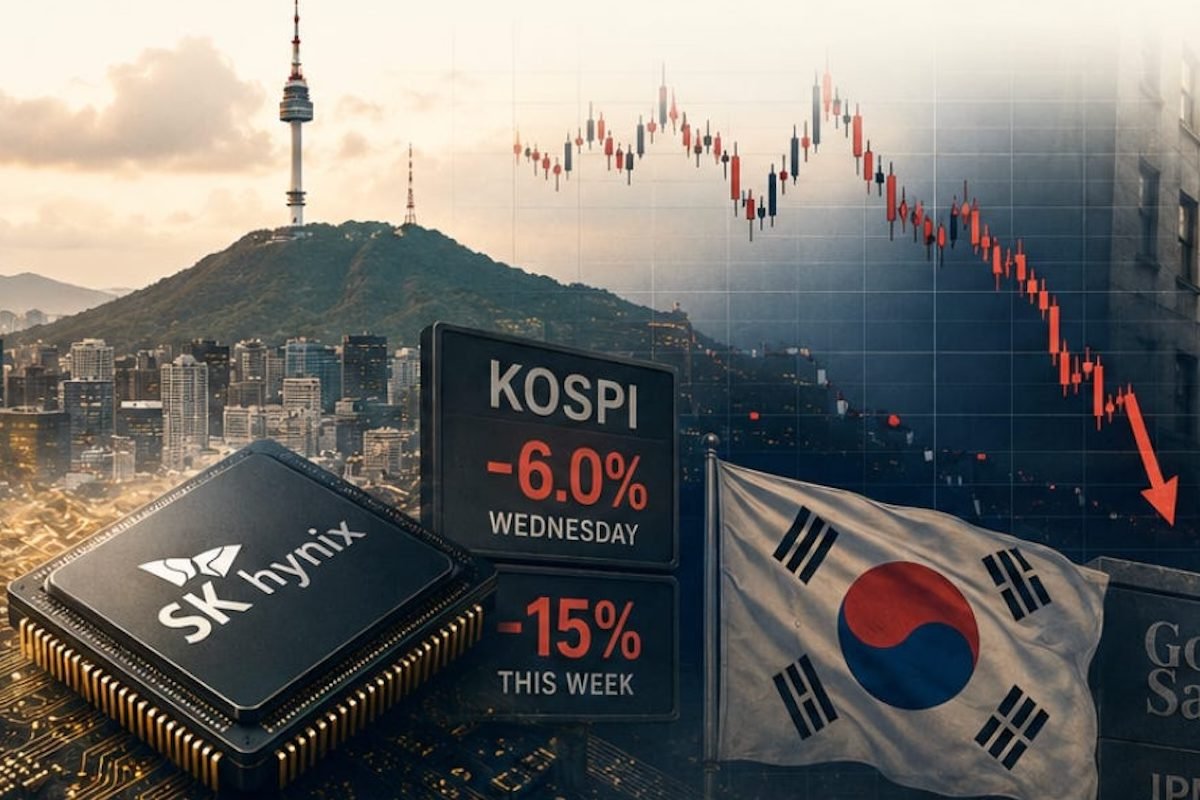
The volatility is real. The index is up 54% this year but has logged at least six of its twelve all-time circuit-breaker halts in 2026 alone, and swung roughly 2,000 points between a June peak above 9,000 and a subsequent 40% plunge — trading, at moments, more like a meme stock than a world-class exchange.
Regulators have been caught flat-footed. Lawmakers tie part of the rout to Korea’s May rollout of leveraged single-stock ETFs; Financial Supervisory Service governor Lee Chan-jin admitted approvals for those products “had been prepared hastily.”
Finance Minister Koo Yun-cheol apologized at a hearing, conceding the products deserved closer scrutiny while insisting they were only one factor behind the turmoil. Officials have since pledged tighter oversight of leveraged ETFs, a legal framework for emergency market interventions, and round-the-clock monitoring — though concrete details, like investment caps or higher trading costs, are still missing.
SK Hynix’s own earnings capture the tension driving the swings: profit rose six-fold, but missed lofty analyst expectations, and the stock still fell 19% in Seoul, dragging the Kospi down with it — even as executives dismissed demand fears and announced $31 billion in capital spending this year.
Stock stability isn’t formally part of the BOK’s mandate, any more than it is the Fed’s. But Shin’s board is signaling something larger: that the laws of economic gravity haven’t been suspended by the AI age.
Korea’s track record argues for confidence. It clawed back from the 1997-98 crisis first, weathered Lehman, shrugged off “next Iceland” bets during the 2013 taper tantrum, and came through Covid well enough to be the first major central bank to tighten policy, in August 2021. That history is precisely why markets are inclined to trust Seoul now.
But this test is different in kind. Past crises were things that happened to Korea. This one is a bet Korea is making on itself — and whether the AI wager pays off will decide whether Lee’s government proved it could go on offense, or just rode a boom it didn’t build.
Now, though, there are reasons to worry that the AI boom is fueling a fresh bout of complacency in Seoul. AI, Team Lee hopes, will rid Seoul of the need to do the hard work of raising productivity, leveling corporate playing fields, empowering women and creating more economic space for startup companies to disrupt the economy. Perhaps Team Lee is right that AI is the miracle cure for all that ails his economy.
Yet succumbing to hubris is now more dangerous than ever. Much of the AI energy angling to transform Korea flows through those family-owned conglomerates, the chaebols, that have lorded it over the economy for decades. This is sure to set back efforts to reduce the concentration of economic power in chaebols. Should the AI trade run out of gas, the fallout will be more spectacular for Korea than it ever needed to be.