18.8 C
London
Wednesday, September 2, 2026
Home Blog

UK plans measures against Israeli settlements as Sa’ar warns of response

0
uk-plans-measures-against-israeli-settlements-as-sa’ar-warns-of-response
UK plans measures against Israeli settlements as Sa’ar warns of response

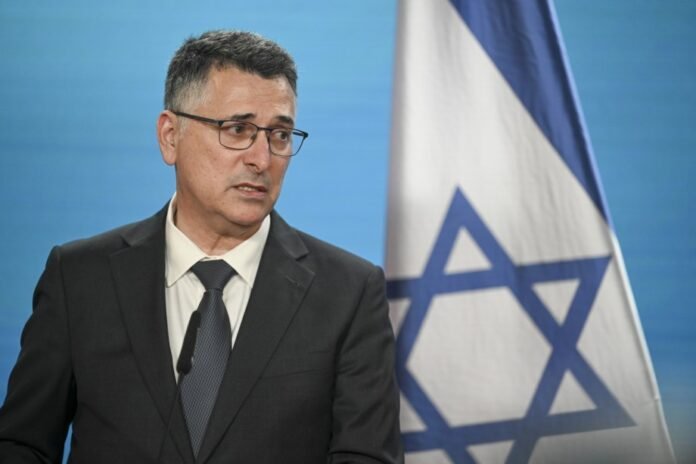
Britain is preparing a package of measures targeting Israeli settlement activity in the occupied West Bank, prompting Israeli Foreign Minister Gideon Sa’ar to warn that Israel could respond with measures of its own.

British Foreign Secretary Ed Miliband said London would announce a “comprehensive” package of measures concerning Israeli settlements in the coming weeks.

Miliband warned that continued settlement expansion, particularly plans in the E1 area east of Jerusalem, threatens the viability of a future Palestinian state and prospects for a two-state solution.

In response, Sa’ar warned that Israel would retaliate if Britain takes measures against it.

READ: UK foreign secretary condemns ‘appalling settler terrorism’ in occupied West Bank

“If Britain takes action against Israel, we will respond,” Sa’ar said, adding: “We have the tools.” He did not specify what measures Israel could take.

The exchange comes amid renewed international criticism of Israeli plans to expand settlement construction in E1, a strategically sensitive area of the West Bank between East Jerusalem and the settlement of Ma’ale Adumim.

Palestinians and several foreign governments argue that construction in E1 would further fragment the West Bank and undermine the territorial continuity of a future Palestinian state. Israel maintains that it has the right to develop the area.

READ: Palestinian commission records 2,030 Israeli army and settler attacks in West Bank in August

Google Maps renames “Lake Ontario” to “Lake America” even faster than US government

0
google-maps-renames-“lake-ontario”-to-“lake-america”-even-faster-than-us-government
Google Maps renames “Lake Ontario” to “Lake America” even faster than US government

Trade talks between the US and Canada broke down last week, leading to a wave of tariffs and retaliatory tariffs. US President Donald Trump also fell back on an old favorite to needle his opponents, signing an executive order on Thursday to rename Lake Ontario to “Lake America.”

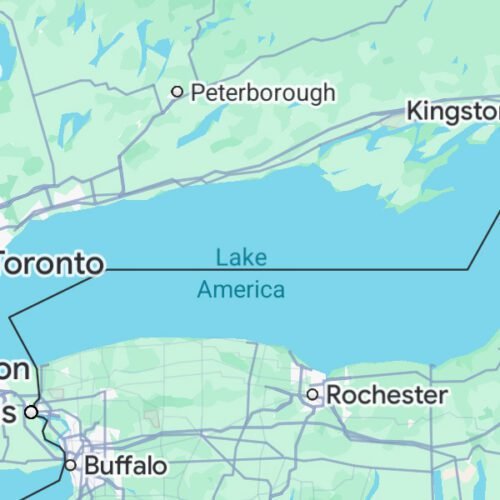
The body of water, which straddles the US-Canada border, gave its name to the Canadian province rather than the other way around. Regardless, the US government now refers to this great lake as Lake America—or it will soon. Official US government maps have yet to be updated, but Google wasted no time adopting the new, Trumpian name.

Google began rolling out this change for US users on Saturday. The company posted a brief update on its Google Maps blog, noting that it follows the US Geographic Names Information System (GNIS) for its maps, so the company implies it had no choice but to rename Lake Ontario in Google Maps, which is the most popular mapping platform in the US by a wide margin.

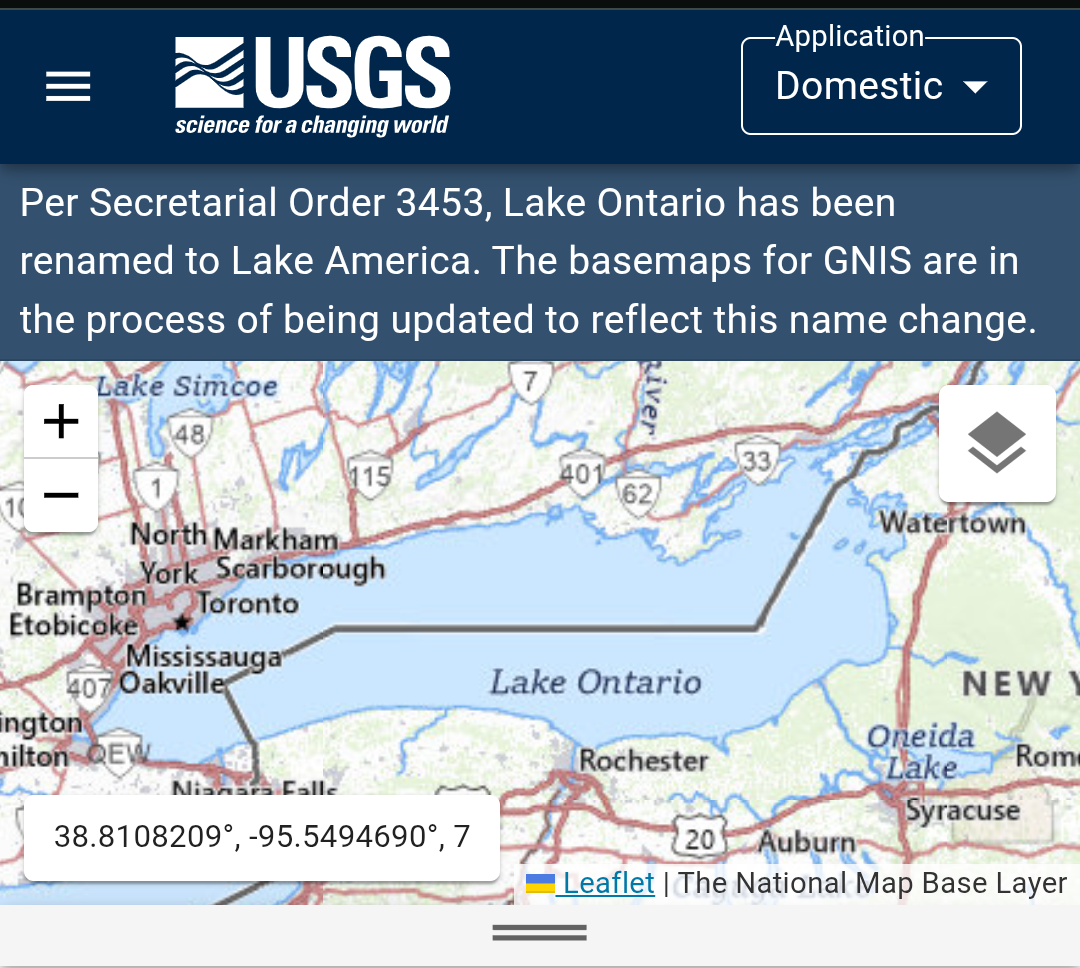
However, Google was even quicker to switch over to Lake America than the US government. While the GNIS database acknowledges the name change in a summary report, the base map layer still reflects the internationally recognized name of Lake Ontario. A message across the top of the USGS-operated website notes that the change to official maps is still pending.

As of Monday, the official GNIS map still shows “Lake Ontario,” but a message says the change is coming.

As of Monday, the official GNIS map still shows “Lake Ontario,” but a message says the change is coming. Credit: USGS

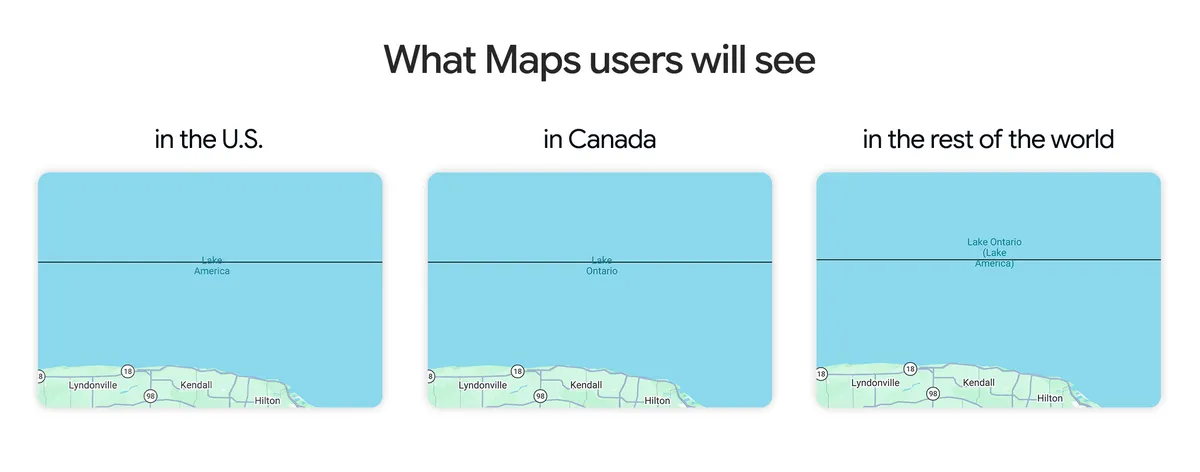
But people don’t generally go looking for GNIS maps—they check Google Maps when they want to find something. According to Google, those in the US will only see the new Americanized name. Meanwhile, Canadians will continue to see the standard Lake Ontario label. In the rest of the world, Lake Ontario will take precedence, but Lake America will be included in parentheses.

This mirrors how Google handled the “Gulf of America” situation in 2025. The company changed the name for US users, left it unchanged in Mexico, and showed both names in the rest of the world. It also reverted Mount Denali to Mount McKinley in accordance with the same order. However, the company did wait several weeks after the executive order before making that shift. Google’s rapid adoption of the new official US name for the body of water suggests that it will continue to rename geological features based on executive orders, which may only embolden the administration to rename more things.

Lake Ontario names around the world

One body of water, multiple names.

One body of water, multiple names. Credit: Google

While Apple Maps did adopt the Gulf of America name shortly after Google last year, it has not yet scrubbed Lake Ontario from its maps as of this posting. Some less-used mapping apps like MapQuest have vowed not to make the change at all.

Trump To Meet Hasidic Leaders Over Israeli Draft Dispute

0


President Donald Trump is scheduled to meet Thursday at the White House with several prominent Hasidic and ultra-Orthodox Jewish leaders, including figures identified as anti-Zionist or non-Zionist, in talks expected to address concerns over the enlistment of yeshiva students in the Israel Defense Forces.

The planned meeting, arranged ahead of Rosh Hashanah, has prompted debate in Jewish communities in the United States and Israel because some expected participants reject Zionism and oppose the State of Israel’s claim to represent Judaism.

Invitees include Rabbi Aaron Teitelbaum and Rabbi Zalman Leib Teitelbaum, leaders of rival Satmar Hasidic communities; the Skverer rebbe; the Bobov rebbe; the Vizhnitzer rebbe of Monsey; and Rabbi Malkiel Kotler, a leading figure at Beth Medrash Govoha, a major yeshiva in Lakewood, New Jersey.

Belaaz, an ultra-Orthodox news outlet, first reported that White House Jewish liaison Martin Marks had worked for months to organize the gathering. The plans called for short individual meetings with President Trump and a possible group discussion, though some of the invited leaders were reported to be considering sending representatives instead.

The question of Israeli military service is expected to feature prominently. Israel’s long-standing exemptions for many full-time yeshiva students have become a major domestic political and legal issue, with court rulings and public pressure pushing the government to increase haredi enlistment.

Rabbi Aaron Teitelbaum said he had initially considered declining the invitation, but cited “tens of thousands of Jews in Eretz Yisroel [the Land of Israel] are in distress because of the decree to draft yeshiva students.”

“We hope that we will be able to appeal to the president to help with this situation,” Teitelbaum said.

Satmar and several other haredi groups distinguish their religious identity from Zionism and have often opposed Israeli state institutions. Their views do not represent all Orthodox Jews, and many haredi communities in Israel and the Diaspora support Israel while seeking continued protections for Torah study.

The meeting is unusual because President Trump has generally met Jewish leaders who focus on US-Israel relations and combating antisemitism. Critics fear the gathering could be used to seek US pressure on Israel over the enlistment dispute. Supporters describe it as a chance for religious leaders to present their community’s concerns directly to the American president.

UN says global warming likely to exceed 1.5C within a few years

0
un-says-global-warming-likely-to-exceed-1.5c-within-a-few-years
UN says global warming likely to exceed 1.5C within a few years


Global temperatures are likely to exceed the key 1.5 degrees Celsius (2.7 degrees Fahrenheit) warming threshold within a few years, the United Nations Environment Programme said Wednesday, warning of more extreme weather and growing pressure on ecosystems, glaciers and low-lying coastal cities.

UNEP said bringing global temperature increases back below 1.5C remained possible but was “highly uncertain” and would require rapid cuts in greenhouse gas emissions, alongside measures to remove carbon dioxide already in the atmosphere.

The warning comes as countries face the growing likelihood that the temperature target set under the 2015 Paris Agreement will be temporarily exceeded.

UNEP urges focus on limiting the duration of any overshoot

Under the Paris Agreement, governments committed to keeping the rise in global temperatures within 1.5C above pre-industrial levels in an effort to limit the impacts of extreme weather.

With a temperature “overshoot” now considered extremely likely, countries should focus on limiting how long global temperatures remain above the 1.5C threshold, UNEP said in its report.

“Every year of delay and every fraction of a degree above 1.5C increases risks and makes recovery harder, with irreversible losses possible even if temperatures later decline,” the agency said.

The most optimistic scenario would see global temperatures peak at 1.8C above pre-industrial levels if all existing national pledges are implemented. However, UNEP said warming was likely to be significantly higher.

“Under current policies, median projected global warming reaches around 2.6C by 2100,” the report said.

UNEP also said carbon dioxide removal measures, including planting new forests, would be “critical” to controlling rising temperatures.

However, the agency stressed that such measures could not replace deep cuts in current emissions.

Best propaganda money can buy can’t sell Americans on Iran war

0
best-propaganda-money-can-buy-can’t-sell-americans-on-iran-war
Best propaganda money can buy can’t sell Americans on Iran war

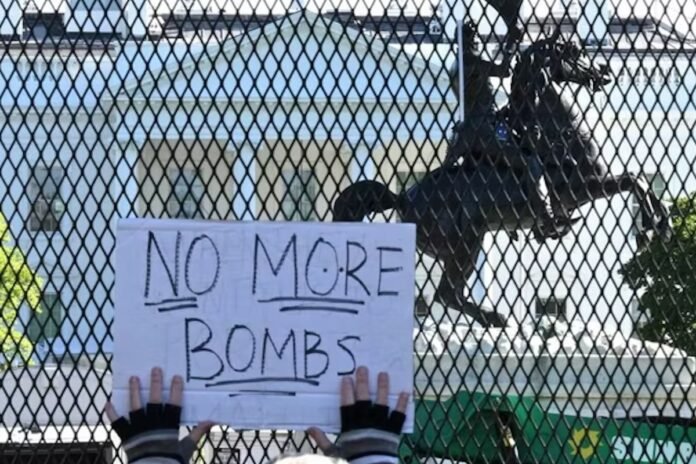
A demonstrator holds a placard in front of the White House in Washington, DC, the United States, on April 7, 2026. Photo: Li Rui / Xinhua

A new University of Massachusetts-Amherst opinion poll, conducted August 21-26, finds profound American disillusionment with President Donald Trump, with his Iran war, and with its economic fallout in their lives.

Apparently, the Ellison family’s attempt to drum up support for Donald Trump and his Iran war by buying up CBS News and gutting it as a respected news organization was a costly failure.

Likewise, Rupert Murdoch’s NewsCorp and his various pro-Trump organs, from Fox Cable News to The Wall Street Journal, have not pulled the wool over the public’s eyes in the ways that Murdoch hoped.

Israeli Prime Minister Benjamin Netanyahu boasted of the effort he expended convincing the American people to go to war with Iran, saying he had a thousand hours on US television , but while he may have prevailed on the gullible and avaricious Trump to fall on that country like a ravenous wolf, he did not succeed in altering the views of the American public on the desirability of such a war.

The only significant impact of Netanyahu on most Americans has been to convince them that the Israeli government is a combination of genocidal maniacs and welfare queens that Americans should cut off economically and perhaps even militarily.

The UMass poll asked a weighted sample of respondents how well Trump has handled his Iran war. The response of 55% of those asked this question was “not well at all.” Ouch. Another 13% replied “not too well.”

So 68%, over two-thirds, think he has done a piss-poor job on his Iran war, which was his war of choice. Two-thirds is the percentage needed in the Senate to impeach and remove a president, so if our representatives actually mirrored public opinion, Trump would be toast.

That question had to do with Trump’s handling of the war. Asked whether they approved of the war on Iran, a majority, 54%, said they strongly or somewhat disapproved, and another 20% were noncommittal, which I would interpret as not actively supporting the war even if they didn’t particularly oppose it.

Those statistics yield a picture of a war that nearly three-fourths of Americans either oppose or about which they just don’t care. It isn’t what the commander of a war would want to hear from his own public.

A majority think the war was a mistake and question whether it has made the US safer or forestalled an Iranian bomb. Another way of putting it is that only about a quarter of respondents think the US should have gone to war with Iran, and that the US is winning.

The UMass report on the opinion poll noted that Raymond La Raja, professor of political science at UMass Amherst and co-director of the poll, said, “Americans are overwhelmingly negative about Trump on the Iran situation.”

He continued: “Only one in four Americans thinks he is handling Iran well. The real divide is increasingly between Trump’s hardcore MAGA base and almost everyone else. Among Republicans who identify very strongly with MAGA, 87% approve of Trump’s handling of Iran.

But that falls to 58% among Republicans who are ‘somewhat MAGA’ and just 30% among Republicans who say they are ‘not MAGA at all.’ The more loosely attached Republicans are to the MAGA identity, the more skeptical they are of the war.”

Conducting a war in the Middle East, as even the cowboys in the G. W. Bush administration recognized, requires at least some allies. But Americans don’t think Trump plays well with other children.

Asked how he has handled working with allies in global affairs, 52% say “not well at all” and 12% say “not too well,” showing that nearly two-thirds view his foreign policy performance negatively.

Based on this sounding, we can further project that Americans are even more angry about the main fallout of the failed war on Iran, which is high inflation. Fully 80% of respondents said that the Iran War has increased the cost of gasoline and groceries. Asked about how Trump has dealt with inflation, 57% responded, “not well at all.”

A further 18% said “not too well.” That is 75%, fully three-fourths, who disapprove of his handling of inflation. Trump and the Republicans are always campaigning on being the party of business and therefore the party that knows how to handle the economy.

But only a tiny minority, 7%, think Trump is handling the economy very well, and I presume they are wealthy investors in Trump’s casino stock market. The tech-heavy Nasdaq is up 14-16% so far this year.

Juan Cole teaches Middle Eastern and South Asian history at the University of Michigan. His newest book, “Muhammad: Prophet of Peace Amid the Clash of Empires” was published in 2020. He is also the author of “The New Arabs: How the Millennial Generation Is Changing the Middle East” (2015) and “Napoleon’s Egypt: Invading the Middle East” (2008). He has appeared widely on television, radio and on op-ed pages as a commentator on Middle East affairs, and has a regular column at Salon.com. He has written, edited or translated 14 books and has authored 60 journal articles.

Common Dreams

Think twice before installing this device promising free movies

0
think-twice-before-installing-this-device-promising-free-movies
Think twice before installing this device promising free movies

As online services get better at blocking malicious traffic, the attackers and scammers behind them have been forced to find new ways to reach their targets. The alternative of choice is now what are known as residential proxy networks. These systems funnel millions of home Internet connections into a unified network, and the proxy operators allow attackers to route their malicious traffic through these connections for a fee. The online services see only IP addresses with good reputations and geolocations that don’t stand out.

More often than not, the home users have no idea that their connections are being used to facilitate crime and occasionally even nation-state attacks. Users who do know often don’t care much. In exchange for leasing out part of their unlimited bandwidth to others, many get free movie and TV show streaming. Several less tech-savvy people I know who own such digital media players have told me, after I explain how the media players piggyback off their connections, that the bonanza of content is worth it. They find the tangible benefits outweigh the abstract harm they pose.

Infecting already compromised devices

Research published Monday brings the threat into much clearer view. Security firm Plume cataloged a vast ecosystem of malware that preys squarely on users of SuperBox, just one of many media players offering pirated content. These malicious apps can be surreptitiously installed by remote attackers even when the devices are positioned behind a router. While Monday’s deep-dive analysis focused exclusively on SuperBox, Plume warned that dozens of similar streaming devices pose precisely the same threat.

“Our researchers found that these residential proxy networks are not simply monetization tools,” Plume researchers wrote. “They are actively being used as a target for additional malware delivery, enabling cybercriminals to infect already-compromised devices with entirely new malware families while remaining largely invisible to the device owner.”

The Android-based SuperBox is configured with almost all the OS-based security protections turned off. Apps that come pre-installed, or those that are available through the SuperBox app store, then run as root, meaning they have unfettered administrative system rights on the device. Paying proxynet customers can also gain root by issuing a handful of Linux commands. With that, either the app or the paying customer can install their own apps and surveil and join the local network the device is connected to, where they have the same system rights as any other connected device.

The SuperBox neuters default Android defenses, including signature verification, the “unknown sources” restriction, the permission-review dialog, and Play Protect scanning. As a result, the box’s ADB (Android Debug Bridge) is exposed to the Internet. Worse, the su binary—the code that provides the command-line interface allowing users with low-level system rights to temporarily gain administrator-level access—is set to grant root without any authentication. The combination of the ADB being exposed to the Internet and the lack of authentication for root access means that both apps and users of the proxy service can execute virtually any command they want on the device.

More often than not, users position their SuperBox behind their home router, where they may think their device is safe from Internet-connected remote attackers. In fact, that sense of security is completely false. The binary that provides proxy functions inside many SuperBox apps opens an outgoing connection to a proxy server and keeps it open as a communication channel indefinitely. Routers are unable to block the communications because the connections they rely on are outbound and encrypted between the SuperBox and the proxy server. Even users who are savvy enough to monitor traffic on their network never see anything that looks like an inbound connection to the ADB port.

“The open ADB port plays the central role,” Plume researcher Gergely Eberhardt wrote in an email. “Combined with root access, a single pm install command can silently install any APK. This bypasses every one of Android’s default protections at once: signature verification, the “unknown sources” restriction, the permission-review dialog, and Play Protect scanning.”

Intruders at gates

The open ADB, along with the default presence of apps that have built-in proxy functionality, creates a dangerous mix that makes SuperBox a potent threat.

“This combination results in further infections involving additional residential proxies or IoT botnets, and the attackers are often the very customers of the primary proxy network,” Plume wrote. “The device owners get multiple bots they never asked for and are not aware of, all competing for the same hardware, and an IP address whose reputation now reflects whatever those bots utilize it for.”

Some of the proxy networking services that make use of SuperBox take measures to prevent their customers from accessing the local networks of SuperBox users. The recently disrupted Popanet, for instance, blocks local IP address ranges from outside the local network. Even then, Popanet users can access local IPs by specifying the special wildcard address 0.0.0.0, which Android then routes to the SuperBox IP 127.0.0.1. From that vantage point, proxy users can access the rest of the local network.

Monday’s post also reported that even the Popanet network was facilitating live exploit attempts. Plume wrote:

The internal-network protection issue that we described in the previous part isn’t just a theoretical concern. To confirm whether anyone is actually exploiting it, we ran a controlled experiment. We joined the Popanet network as a residential exit node and instructed the host that any connection coming through the tunnel targeting either port 5555 or 5858 (these are the most common ADB ports) would be redirected to our local honeypot. From the operator’s perspective, our node looked like any other regular residential endpoint serving customer traffic; from the inside, every attempt aimed to reach an ADB port through our node was captured.

We let the node run for over three weeks; over that period, the honeypot recorded 1,352 distinct attempts at reaching the ADB through the gap we identified earlier. All the attacks could be split into two families of loopback addresses targeting the local machine. The first is 0.0.0.0, supplied either as a raw address or embedded in a hostname via a wildcard DNS service such as nip.io. The second is 127.0.0.1, which the proxy blocked via isLoopbackAddress() as we explained earlier.

An email sent to info@mysuperboxtv.com seeking comment didn’t receive a response before this story’s publication.

Intruding traffic attempted to install multiple malicious apps that made SuperBoxes a node in yet another proxy network or join botnets for use in DDoS attacks. The three primary apps were CECbot, a variant of Mirai, and Maskify.

It’s hard to walk away from Monday’s report with anything other than the strong conviction that SuperBox—and virtually all of its peers—pose a tangible and imminent threat to the networks they’re connected to. Even savvy people who think they can be cordoned off from the Internet are at risk. If you’re using one, you should disconnect it and throw it away. If you find a family member using one, you should intervene. With the Popanet proxy service alone running through 2 million devices, according to Google, chances are good that a home network near you is, too.

Bangladesh should think twice before joining Mecca pact

0
bangladesh-should-think-twice-before-joining-mecca-pact
Bangladesh should think twice before joining Mecca pact

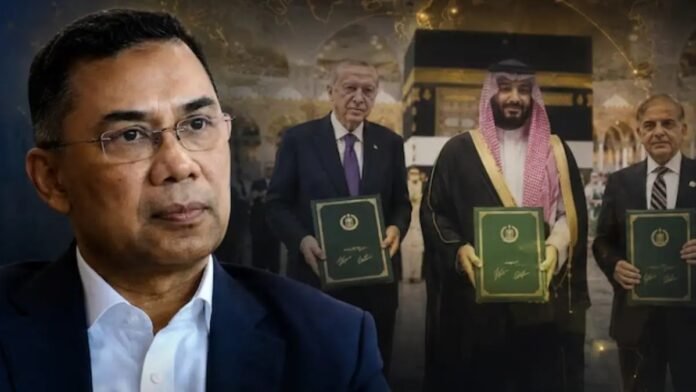
Last week, Bangladesh’s Foreign Minister Khalilur Rahman told parliament that the country would view an invitation to join the Mecca Joint Defense Agreement “positively.”

Then he also went on to add that an expanded pact could essentially become a self-defense mechanism for the world’s Muslim-majority states, and described Bangladesh’s possible membership as “an internal matter of our family, the Muslim family,” on which outsiders had no basis to raise issues or concerns.

So, the invitation may or may not come from Riyadh, but the “Muslim family” argument has already come from Dhaka – and that is where the trouble starts.

Nobody asked Bangladesh to define a military alliance in terms of religious kinship. The question was whether joining a collective-defense arrangement with Saudi Arabia, Turkey and Pakistan would serve Bangladesh’s interests.

Turning that into a matter of the Muslim family does something rather convenient: it makes scrutiny sound like an insult to faith, when it is actually the most basic responsibility of foreign policy.

If Bangladesh is going to assume obligations under a military pact, its government should be able to explain why, since religion in itself cannot be an explanation.

Bangladesh is a People’s Republic, not an Islamic Republic. While its Constitution recognizes Islam as the state religion, secularism also remains one of its fundamental principles of state policy.

More importantly, the Constitution’s principles governing international relations speak in the language of sovereignty, equality, non-interference and peaceful settlement of disputes.

That does not require Bangladesh to keep Muslim-majority countries at arm’s length. Quite the opposite: there is nothing wrong with deep relations with Saudi Arabia, Turkey, Pakistan or any other Muslim country. But friendship between states is one thing; turning a religious identity into the basis for military commitments is quite another.

Among the three countries that signed the Mecca Joint Defense Agreement on August 7, Pakistan is a self-declared Islamic Republic, Saudi Arabia is an absolute monarchy whose political identity is inseparable from its custodianship of Islam’s two holiest sites and Turkey remains constitutionally secular, though the AK Party that has governed it for two decades emerged from the country’s Islamist political tradition.

These countries have their own reasons for wanting closer security ties, but Bangladesh must decide whether those reasons are also its own. Saying that the matter belongs to the “Muslim family” neatly avoids that question rather than answering it.

The agreement itself is not a ceremonial declaration of brotherhood. Its central provision says that an armed attack against one member will be regarded as an attack against all. That is an Article 5-style collective-defense commitment, even if nobody should pretend that the Mecca pact has NATO’s institutions or military machinery.

Pakistan Foreign Minister Ishaq Dar has called the agreement “purely defensive”, while Turkish Foreign Minister Hakan Fidan has compared its central provision with NATO’s Article 5.

There is no contradiction in calling a collective-defense arrangement defensive while acknowledging that it can create obligations that pull members into a war that starts elsewhere. That is precisely why the details matter before, rather than after, a country signs.

And the pact’s details remain thin. The three countries have spoken about political and military coordination, joint exercises and defense-industry cooperation and plans for mechanisms to coordinate their senior officials and armed forces.

But there is still no publicly disclosed integrated military command comparable to NATO’s, and the precise obligations of a future member in a crisis are not nearly as clear as they would need to be before Bangladesh voluntarily takes them on.

There is another problem. Saudi Arabia, Turkey and Pakistan do not have identical security maps. Saudi Arabia’s immediate concerns include the Houthi threat in Yemen and the wider confrontation involving Iran.

Turkey’s security calculations are shaped by Syria, Kurdish militancy, the Black Sea and its own regional ambitions, alongside its longstanding territorial disputes with Greece. Pakistan’s security concerns are concentrated on Afghanistan and, much more consequentially, India.

These countries may have found useful common ground, but their strategic problems are hardly interchangeable. Whether they can turn that political convergence into a coherent collective-defense system remains to be seen.

Bangladesh, meanwhile, has an entirely different neighborhood. Its immediate security concerns involve India, Myanmar, the Bay of Bengal, maritime security, the Rohingya refugee crisis and the protection of its trade and energy routes.

None of those problems suddenly becomes easier because Dhaka acquires a mutual-defense commitment with Riyadh, Ankara and Islamabad. Also, Bangladesh does not need a promise to fight somebody else’s war to maintain friendly relations with any of the three.

Other prospective members are treating the invitation with caution rather than solidarity. Pakistan has said the agreement is open to other regional countries, while Turkey has discussed expansion.

Egypt is examining the legal and constitutional implications of joining. Other major Gulf states have yet to sign on. Their restraint is not necessarily rejection, but it shows that countries far closer to the region’s actual security flashpoints are weighing membership as a strategic choice, not a family obligation.

For Bangladesh, the biggest complication is not thousands of kilometers away in the Gulf. Rather, it is across its western border. Pakistan is one of the three pillars of the pact, and Pakistan’s defining strategic rivalry is with India.

Bangladesh does not need to take India’s feelings as a commandment. But pretending that New Delhi’s interpretation of such a move is irrelevant would be dangerously naive.

Bangladesh-India relations are already strained over Dhaka’s extradition request for toppled ex-leader Sheikh Hasina, allegations of forced push-ins along the border and the unresolved renewal of the Ganges Water Sharing Treaty.

Putting a formal defense pact with Pakistan into that already perilous mix would change the political meaning India attaches to Bangladesh’s subsequent choices, whether Dhaka likes it or not.

This is not an argument for making Indian displeasure the compass of Bangladeshi foreign policy. Bangladesh’s water, trade and border-security interests are deeply entangled with India in a way they simply are not with Saudi Arabia, Turkey or Pakistan.

Riyadh can provide investment and employment opportunities. Ankara can provide defense technology and political support. Islamabad can offer historical and diplomatic links that Dhaka may want to strengthen.

None of that changes the fact that India is Bangladesh’s neighbor, its largest immediate security counterpart and the country with which many of Bangladesh’s most consequential bilateral disputes must eventually be managed.

History also suggests caution. In 1955, Turkey, Pakistan and Iraq joined the Baghdad Pact, a Western-backed collective-security arrangement meant to contain Soviet influence. Iraq’s withdrawal after the 1958 revolution ended the original pact; its successor, CENTO, lasted until 1979, but never developed anything resembling NATO’s integrated military structure.

Meanwhile, Bangladesh has spent decades trying, with varying degrees of success, not to become an appendage of somebody else’s strategic rivalry. Joining the Mecca pact would make that harder.

It would place Bangladesh closer to a security arrangement built around three countries whose relations with India, Iran and the wider Middle East carry consequences that have little to do with Bangladesh’s own security needs.

Iran’s relevance to Bangladesh is economic, not strategic. Bilateral trade stood at roughly $15.89 million in FY2023-24 against nearly $2 billion with Saudi Arabia. Tehran is not Riyadh’s equal in Dhaka’s calculus. That is exactly why Bangladesh has no interest in inheriting someone else’s security antagonisms.

It can maintain working relations with countries on opposite sides of regional rivalries without formally attaching itself to one side. If the Mecca pact comes to be read as a hedge against Iran, Dhaka gains little by joining the contest.

None of this, however, requires Bangladesh to turn its back on the pact’s founders. It can expand defense training, military exchanges, trade, investment, labor agreements and defense-industrial cooperation with all three.

It can welcome Saudi support, buy Turkish defense equipment, work with Pakistan on various grounds and maintain warm political ties without signing a collective-defense clause that could one day oblige Bangladesh to take sides in a conflict that has nothing to do with its own territory or people.

The question Dhaka should therefore answer is embarrassingly simple: what specific security threat does joining the Mecca pact address for Bangladesh that its existing bilateral relationships cannot already address?

If the answer is a credible threat in the Bay of Bengal, along the Myanmar border or somewhere else directly affecting Bangladesh, the government should name it. If the answer is that Bangladesh belongs to the “Muslim family”, that is not a security assessment but an identity argument dressed up as foreign policy.

Jannatul Naym Pieal is a Dhaka-based journalist, writer and researcher with over a decade of experience in professional journalism. He is also the author of 10 published books and a researcher focusing on Bangladesh’s media industry and its intersections with broader social and academic fields.
Private group wants to launch “cheapest possible” mission to Alpha Centauri

0
private-group-wants-to-launch-“cheapest-possible”-mission-to-alpha-centauri
Private group wants to launch “cheapest possible” mission to Alpha Centauri

There are, by various estimates, several trillion planets within what is known as the Local Group of galaxies—our closest galaxy neighbors, including our own Milky Way. Many of these planets are within the habitable zone of their stars. So if life finds a way, where are the alien civilizations?

This is the crux of what is known as the Fermi paradox, which posits that if life is fairly common in the Universe, humans should have collected credible evidence for the existence of extraterrestrial civilizations by now. People who think about this paradox believe there may be some “filter” that limits or entirely prevents an advanced civilization from sending out probes or even life-bearing spacecraft to nearby stars.

Philip Johnston is someone who thinks a lot about the Fermi paradox. A mathematician and physicist from the United Kingdom, Johnston has gained some notoriety lately in the space community as one of the biggest proponents of orbital data centers. He co-founded Starcloud in 2024 to develop such data centers, and the company is presently valued at $2.3 billion.

Johnston is in the midst of scaling up Starcloud, working through technical issues, and raising hundreds of millions of dollars. So he’s pretty busy. But Johnston also wants to send a mission to the nearest star to our Sun and investigate the Fermi paradox.

Meet the Fermi Explorer

On Tuesday, Johnston and a handful of other entrepreneurs announced the “Fermi Explorer” mission. In concept, it is simple. They seek to raise $15 million to build a small spacecraft, carrying a 1 kg payload, and launch it to Alpha Centauri such that it reaches that system in fewer than 80,000 years. Why? In conversations about the Fermi paradox, Johnston realized such a mission would knock two “filters” off the list: Species won’t want to send spacecraft beyond their home star, or species will find that interstellar transit is too difficult.

The goal was not to run to NASA to try to get it to fund a $1 billion mission or seek to develop a new propulsion technology like the Breakthrough Starshot mission proposed a decade ago. Rather, the Fermi Explorer team wants to use existing technology to do something cheap and fast and launch by 2029.

“So we were like, ‘Fuck it, let’s send a spacecraft for the cheapest amount possible, a bog-standard minimum viable mission to Alpha Centauri,’” he told Ars.

The main stumbling block involves getting the probe—essentially a large tank of Xenon gas and some solar panels for solar-electric propulsion, and a few small scientific payloads—moving fast enough. Solar-electric propulsion is super efficient, but once a spacecraft is beyond Jupiter, the solar energy flux is low enough that it might as well be zero for a spacecraft the size of the Fermi Explorer. Johnston and a small team spoke with many people, including trajectory experts at NASA’s Jet Propulsion Laboratory, to find a solution.

Introducing the Fermi Explorer mission.

Nothing worked until Johnston linked up with Alex Wissner-Gross, a physicist who founded Physical Superintelligence, an AI technology company. They fed the mission parameters into the AI, and it returned an 81-page technical feasibility assessment that offered a novel mission profile. It involves hanging around our Sun for more than a decade before charging out to Alpha Centauri.

Essentially, after launching into low-Earth orbit on a rideshare mission, the spacecraft would fly retrograde arcs to decrease its distance from the Sun at perihelion from 1 astronomical unit (Earth-Sun distance) to 0.42 astronomical units. At these close approaches to the Sun, taking advantage of the higher solar flux as well as the Oberth effect, the spacecraft would operate its propulsion system to increase its velocity with “perihelion pump” maneuvers.

It would achieve an escape trajectory after about 12 years, at a velocity of about 25 km/s, or about 55,000 miles per hour. At this speed, the Fermi Explorer could reach Alpha Centauri within about 77,000 years, flying on a ballistic coast.

Striking off two of the Fermi filters

The team would only have contact with the spacecraft for about 18 months, Johnston said. With retroreflectors on the vehicle, he expected ground-based telescopes to be able to track it until it reached Jupiter. After that, if all the maneuvering goes as planned, it will be gone—long gone. Only to turn up in the Alpha Centauri system a very long time from now.

If this all seems a little whimsical, well, maybe it is. But Johnston said the point is to get humanity thinking about our place in the Universe. If the Fermi Explorer mission can knock down a couple of the filters that might explain the Fermi paradox, that only leaves a few options for why our galaxy appears not to be littered with alien civilizations. One is that civilizations are exceptionally rare. If it is the case, then humans maybe should take our responsibility as stewards of the galaxy a little more seriously.

Another option is that superintelligence does not last long. Perhaps, then, governments on Earth ought not to be building swarms of killer drones? Maybe we should be careful about LLM agents running amok? “We could really be facing the great filter,” Johnston said. So let us go forward with eyes wide open.

Putin says Russia is winning on battlefield, will not negotiate with ‘terrorists’

0
putin-says-russia-is-winning-on-battlefield,-will-not-negotiate-with-‘terrorists’
Putin says Russia is winning on battlefield, will not negotiate with ‘terrorists’


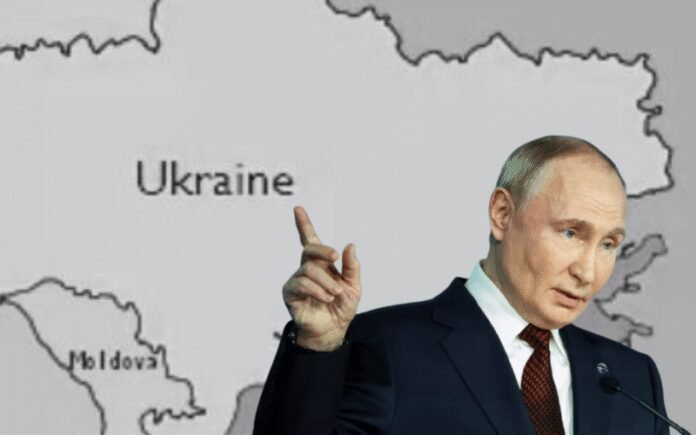
President ​Vladimir Putin said that Russia was winning the war in Ukraine and portrayed the Ukrainian leadership as “terrorists” with ‌whom Moscow could not negotiate.

Putin, in his most detailed comments on the war for many weeks, acknowledged that Ukrainian attacks inside Russia had inflicted real damage and said that drones posed a particular challenge.

But he said that Russia was advancing on the battlefield and told reporters: “I have no doubt the enemy will crumble.”

He declined to say when ​that would happen.

Rumours that Russia would be forced to order a new military mobilisation were “utter nonsense,” he said.

PUTIN SAYS RUSSIAN ADVANCES ​ARE ACCELERATING

Four and a half years into the war, Russia controls about a fifth of Ukraine. U.S.-mediated peace talks ⁠broke off in February after the United States and Israel went to war with Iran.

Opinion polls suggest growing war fatigue in Russia ​and influential voices are warning about the strain on its economy.

But Putin struck a confident, hawkish tone as he rattled through a detailed version ​of developments on the front line, saying Russian advances were accelerating.

Russian troops had captured 270 square km (104 sq miles) of the Donetsk region in eastern Ukraine in August and two large groups of Ukrainian troops – one comprising 4,500 to 4,800 men, the other up to 2,000 – were surrounded, he said. Reuters could not independently verify those assertions.

Russia continues to advance towards the ​cities of Sloviansk and Kramatorsk, Putin said, adding that Moscow’s forces were preparing to launch massive strikes against energy infrastructure in Ukraine.

Putin said that ​Ukrainian President Volodymyr Zelenskiy’s warning to airlines that Ukrainian drones would effectively shut down Russian airspace sounded like “state terrorism” and that Moscow would find a way to respond ‌if it ⁠happened.

Speaking at a news conference after a summit in Kyrgyzstan, Putin said it was not possible to negotiate with “terrorists”.

He also said, however, that Moscow was open to talks aimed at ending, rather than freezing, the war, and restated its willingness to talk to U.S. President Donald Trump’s envoys.

“If someone makes, or can make, a tangible contribution to this process, we are all in favour,” Putin said.

“The only thing we would want to avoid is ​the process spinning its wheels pointlessly. ​However, if someone is capable ⁠of bringing something positive to these negotiations – which, as we understand it, are currently somewhat frozen – then, generally speaking, we are not opposed.”

Putin specifically acknowledged that Ukrainian drone strikes had caused damage to Russian oil refineries, ​although without referring to widespread fuel shortages that have resulted from those attacks.

But he said that ​the level of protection ⁠had improved, and “we only have 10% of our refineries left to repair”.

Putin responded scathingly to an accusation by the German government on Tuesday that Russia was to blame for an attempted drone attack at Leipzig airport last month.

He said the government of Chancellor Friedrich Merz was pointing the finger ⁠at Moscow ​to distract from domestic problems and falling approval ratings.

Putin accused Germany of planting ​evidence in order to frame Russia for the drone attack, but he did not say what he was basing that accusation on.

Iran strikes back at US positions: Iranian media

0
iran-strikes-back-at-us-positions:-iranian-media
Iran strikes back at US positions: Iranian media

Iran launched missile and drone attacks against US positions on Tuesday, Iran’s semi-official Fars news agency said.

“Field observations indicate Iranian missiles and drones firing at enemy positions,” the agency said.

The report came after the US Central Command (CENTCOM) announced that American forces began striking IRGC targets in Iran.

Tensions between Tehran and Washington have remained high since the war began with strikes on Iran in late February.

A framework deal was signed in June through Pakistani and Qatari mediation.

The US began a two-week bombing campaign in July and reimposed a naval blockade after differences over navigation in the strait.

READ: US forces begin strikes on Iran’s Revolutionary Guard targets: CENTCOM

0FansLike
0FollowersFollow
0FollowersFollow
0SubscribersSubscribe
- Advertisement -
Google search engine

Recent Posts