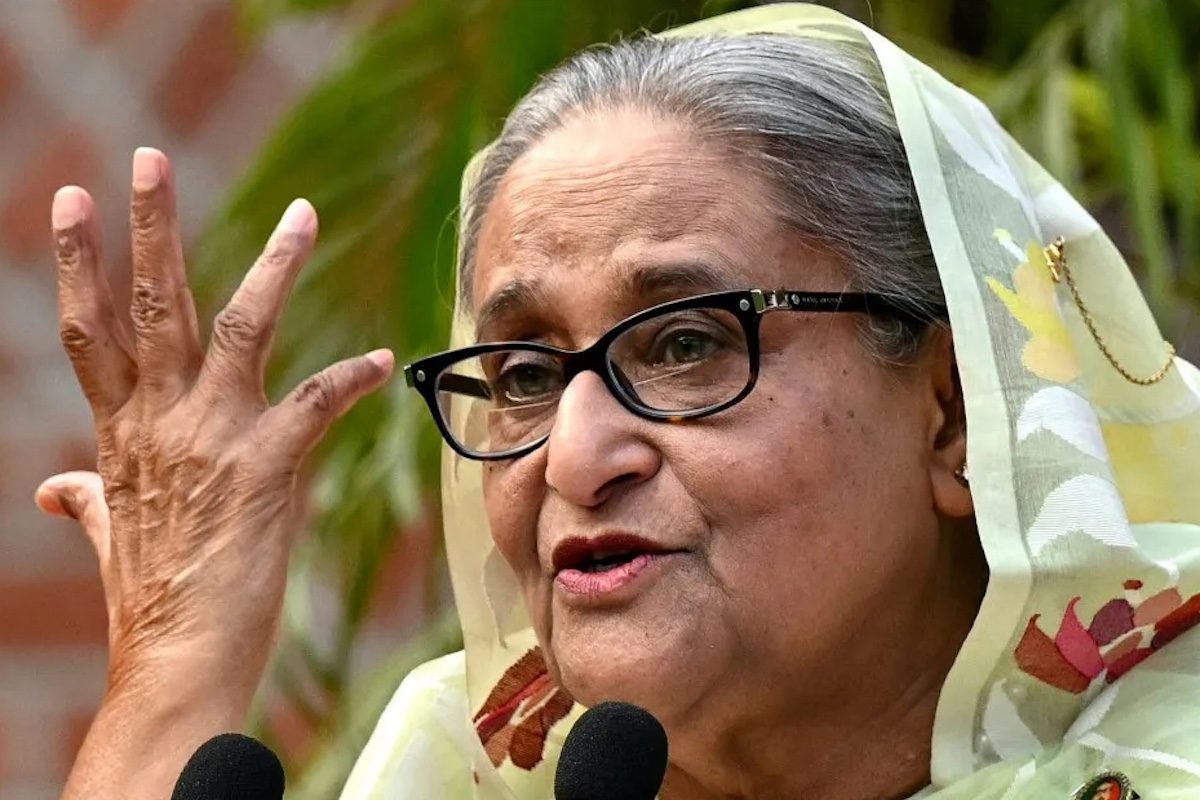
Nearly two years after fleeing Dhaka in disgrace, ousted Bangladesh Prime Minister Sheikh Hasina made her first live public address on Wednesday (August 5).
Speaking via audio from an event organized by the Foreign Correspondents’ Club of South Asia in New Delhi, Hasina attempted to signal the dawn of a political comeback. Yet what transpired was less a triumphant return than a masterclass in evasion and proxy politics.
For a leader attempting to rebuild a shattered legacy, the session exposed the profound fragility of her movement’s position and threatened to drag her Indian hosts into an escalating diplomatic confrontation.
The most striking aspect of the appearance was not what was said, but what remained conspicuously unaddressed. When directly asked when she intended to return to Bangladesh to face the dozens of legal cases and arrest warrants awaiting her, Hasina demurred.
Instead of providing a concrete strategy, she retreated into historical romanticism, recalling her return from exile in 1981 and asserting that neither prison nor death would deter her. When pressed on the mechanics of crossing a border as a fugitive, she delegated the issue entirely to her son and former adviser, Sajeeb Wazed Joy.
His response was remarkably blunt: there was no communication with the current authorities in Dhaka. The operational reality of a physical return was left entirely unexplained, save for Hasina’s vague assertion that she wished to return in December to coincide with Bangladesh’s Victory Day.
This pattern of delegation defined the afternoon. Hasina functioned largely as a figurehead issuing broad appeals to patriotism, while Joy assumed the role of principal political spokesman.
Nowhere was this dynamic more uncomfortable than when a reporter raised the defining question shadowing Hasina’s legacy: did she regret the violent suppression of the July 2024 uprising? Rather than allowing his mother to address personal accountability, Joy interjected with an aggressive “legalistic” defense.
Pointing to indemnity provisions enacted by post-uprising authorities, he argued that the Awami League had nothing to apologize for so long as violence against police and party members went unpunished.
It was a classic political pivot, converting a question of moral accountability into one of comparative culpability. Hasina never reclaimed the microphone to answer the original query.
In her absence from detailed debate, Joy advanced the core thesis that has sustained the Awami League for nearly two decades: the existential doctrine that without Hasina, Bangladesh inevitably collapses into Islamist militancy and state failure. Addressing the Delhi audience, Joy painted an apocalyptic picture of his homeland.
He claimed the country had become “another Pakistan,” alleging that al-Qaeda operatives address public rallies, Hezbollah flags fly openly and foreign intelligence agencies operate with impunity.
Yet these extraordinary claims lacked empirical backing. Nearly two years after Hasina’s overthrow, Bangladesh has experienced no major terrorist attacks, nor has India’s own security apparatus issued public alarms corroborating a surge in cross-border jihadist activity.
Counterterrorism cooperation and border security mechanisms remain functional. Joy’s rhetoric relied on conflating a broader social shift toward visible Islamic practice in a Muslim-majority nation with operational extremism — a tactic long used by the Awami League to tar political opponents and justify authoritarian governance to foreign observers.
Equally controversial was Joy’s assault on international documentation regarding the 2024 violence. He questioned United Nations findings that over 1,400 people died during the crackdown, dismissing the figures without offering contrary evidence.
He remained silent on the well-documented use of lethal state force, enforced disappearances and systemic human rights abuses that triggered the mass popular revolt after 15 years of uninterrupted rule.
If the internal politics of the appearance were fraught, its international fallout was immediate. The event took place on Indian soil despite explicit prior objections from Bangladesh’s Foreign Ministry.
Dhaka’s reaction was incandescent, dispensing with standard diplomatic pleasantries. In a blistering statement, officials branded Hasina a convicted mass murderer and declared that Bangladesh would “never be a client state.”
That single phrase captures the strategic dilemma now confronting New Delhi. During Hasina’s tenure, India enjoyed unprecedented security cooperation and economic connectivity along its eastern border.
Indian policymakers grew accustomed to viewing Bangladesh largely through the prism of their own national security interests, viewing Hasina as an indispensable guarantor of stability.
In sheltering the ousted leader and permitting her to use Indian territory as a launching pad for political attacks, India risks validating the widespread perception among Bangladeshis that New Delhi values its relationship with an autocrat over its relationship with the sovereign nation itself.
While Indian authorities did not host the event directly, allowing a private platform to proceed after official warnings from Dhaka rendered the distinction meaningless to the government now ruling in Bangladesh.
The post-2024 administration in Dhaka is demanding a relationship grounded in sovereign equality rather than regional hegemony. By permitting Hasina to campaign from its capital, India has brought a deep contradiction to the fore.
For Hasina and her family, the New Delhi event demonstrated that rhetoric alone cannot substitute for a coherent path to rehabilitation or an honest accounting of past violence. For India, it signaled that time is running out to make a definitive strategic choice.
New Delhi must decide whether to remain tethered to the legacy of a fallen ally or to secure its long-term national interest by engaging constructively with the geopolitical realities of a transformed Bangladesh.
Faisal Mahmud is a Dhaka-based journalist