Netanyahu’s Trump meeting suggests his star is waning in Washington
Appearing increasingly isolated and weakened, Israeli Prime Minister Benjamin Netanyahu travelled to Washington this week, where he had a face-to-face meeting with Donald Trump – his eighth of the US president’s second term.
Netanyahu is desperate to revive his image as the closest ally of the most powerful man in the world, but his star has fallen dramatically in Washington since his last trip.
The US president has problems of his own, so he clearly had little appetite for a photo opportunity with a deeply unpopular Israeli leader widely blamed for convincing him to launch an unwinnable war against a state few Americans saw as a serious threat.
The war has already cost at least US$37.5 billion, a 15-25% increase in gasoline prices, persistent inflation, and the deaths of 18 American servicemen. After months seeking an invitation, Netanyahu got his opportunity while in Washington for the funeral of Senator Lindsey Graham, one of Israel’s staunchest supporters in Congress.
But even before the Israeli entourage departed for Washington, Trump was plainly irritated by Israeli briefings that Netanyahu intended to present him with intelligence concerning Iran’s deeply buried “Pickaxe Mountain” nuclear facility.
In an interview with Fox News, Trump dismissed the idea that Netanyahu could tell him anything new and appeared to lend credence to the view that Israel was trying to push him towards a prolonged campaign in Iran.
Trump also brushed aside Israeli concerns about his intention to sell F-35 fighter jets to Turkey, warning Netanyahu not to try to influence his decision. He then lavished praise on Turkish president, Recep Tayyip Erdogan and – in a dig at Netanyahu’s international isolation – added that “Turkey’s not a big fan of Israel, not a great fan of Bibi. But they’ve been great for me.”
The lack of fanfare surrounding this meeting underscores Trump’s frustration that he cannot extricate himself from their disastrous joint military enterprise in Iran. After being quietly ushered into the White House through a side entrance, there was no question-and-answer session with journalists – unlike many previous Trump-Netanyahu meetings.
Only minimal information has been released by the White House, and Trump has been conspicuously discreet about what was discussed.
Netanyahu under pressure
With an election looming at the end of October, Netanyahu is trailing in the polls behind rival contender, Daid Eisenkot. So his immediate attempt to put a positive spin on the meeting suggested how desperate he is for Trump’s political endorsement.
Shortly after the talks concluded, Netanyahu released a video message declaring, without explanation, that: “This was one of the best conversations I have had with our friend, US President Donald Trump.”
Trump and his war may be unpopular in America, but the opposite is true in Israel. Trump remains extremely popular there. So Netanyahu’s association with him, and the sense of protection this symbolizes in Israel, is a significant political asset.
The war is unpopular in the US because few Americans see Iran as a serious threat. Consequently, few care how the war ends so long as a ceasefire or peace deal brings prices down.
In contrast, the criticism Netanyahu faces from his own voters is that Israel has not finished the job and that he been forced to agree to a ceasefire which his critics argue has only emboldened Iran.
As recently as last week, Netanyahu’s team would have been buoyed that Trump appeared to be on the cusp of resuming major military operations against Iran. But the day before the meeting, Trump abruptly decided to halt military operations.
He appears to have done so for three reasons. Omani-mediated talks over the Strait of Hormuz, have reportedly been making progress.
Meanwhile senior US military commanders have warned the US president that the bombing campaign had reached the limits of its effectiveness and America’s stock of air defense interceptors were becoming dangerously depleted.
And the expansion of the conflict into the Red Sea, where attacks from Iran-backed Houthi rebels on Saudi shipping pushed oil prices back above US$100 a barrel.
Israel’s wishlist
Before he had even arrived at the White House, therefore, Netanyahu had been warned against trying to push Trump towards resuming major operations in Iran.
But the Israeli prime minister still has other items on his wishlist. This includes persuading Trump to support Israel’s refusal to withdraw its troops from Lebanon until Hezbollah’s military infrastructure has been completely dismantled.
But the leaked recording of Trump’s expletive-laden rebuke of Netanyahu at the beginning of June for refusing to heed his advice to de-escalate Israeli operations in Lebanon, suggests that this might also be a tough sell for the Israeli leader.
Netanyahu was once able to exploit Trump’s unpredictability and appeal to his instincts for self-aggrandizement. Now, he is a much-diminished figure in Washington, and his political interests seem to be best served by actions that Trump has identified as threats to his own.
He is now the one buffeted by Trump’s erratic decision-making and tendency to blame anyone but himself for failure. Shutting Israel out of negotiations with Iran, selling F-35s to Turkey and raising the prospect of a nuclear deal with Saudi Arabia all run counter to Israeli interests.
But Iran’s increasing boldness may yet play in Netanyahu’s favor. Tehran’s has rejected Oman’s proposal to share management of the Strait of Hormuz. It then launched strikes against a US military base in Jordan, despite Trump’s decision to halt military operations. The US and Saudi Arabia responded by attacking Iran-based militias in Iraq.
Iran’s refusal to abandon its core strategic objectives, and its apparent interpretation of Trump’s restraint as weakness, may ultimately give Netanyahu the renewed US involvement in the conflict he has been seeking.
Saudi Arabia Taps Veteran Diplomat as Ambassador to Syria
[DAMASCUS] Saudi Arabia has appointed diplomat Ghazi bin Rafea Al-Enezi as its new ambassador to Syria, succeeding Faisal Al-Mujfel, in the latest step in the restoration of relations between Riyadh and Damascus. The process formally began in 2023 and gained further momentum following the fall of Bashar Assad’s regime in December 2024.
Al-Enezi took the oath of office before Saudi Crown Prince and Prime Minister Mohammed bin Salman, on behalf of King Salman bin Abdulaziz, during a ceremony held in Jeddah on Tuesday. The ceremony included several newly appointed Saudi ambassadors to other countries.
Faisal Al-Mujfel, the outgoing ambassador, oversaw the initial phase of the restoration of Saudi diplomatic representation in Damascus before being appointed the Kingdom’s ambassador to France. Earlier this month, Al-Mujfel presented a copy of his credentials to the French Foreign Ministry.
Al-Enezi is regarded as one of Saudi Arabia’s leading experts on Syrian affairs. He previously served as director-general of the Saudi Foreign Ministry’s Department of Arab Countries and participated in several official visits and meetings concerning Syria.
In May 2023, while holding the rank of minister plenipotentiary, Al-Enezi led a Saudi technical delegation to Damascus to discuss the technical and logistical arrangements for reopening the Kingdom’s embassy and resuming the diplomatic mission’s operations.
Saudi Arabia closed its embassy in Damascus and withdrew its diplomats in 2012 in response to the Assad government’s violent crackdown on protests.
After more than 11 years of suspended relations, Riyadh and Damascus agreed in May 2023 to resume operations at their diplomatic missions as Syria was readmitted to the Arab League.
Saudi Arabia officially reopened its embassy in Damascus in September 2024, approximately three months before the fall of the Assad regime. Riyadh subsequently expanded its contacts with Syria’s new leadership while supporting efforts to restore stability and strengthen political and economic cooperation with Damascus.
The selection of Al-Enezi, who was directly involved in the initial arrangements to reopen the embassy, reflects Riyadh’s desire to maintain continuity in its handling of the Syrian portfolio as relations between the two countries move from restoring diplomatic representation toward broader bilateral cooperation.
Woman Dies After ‘Freak’ Wine Glass Accident at Party
A 32-year-old woman who died after allegedly falling onto a wine glass during a dinner party is now at the center of a chilling death investigation after police said witness accounts did not add up.
Ilda Beatriz Goyochea died nearly a week after suffering a severe neck wound inside her home in La Rioja, a province in northwestern Argentina, according to Argentinian outlet La Voz. What was first described as a horrifying freak accident is now being investigated as a possible crime.
The incident reportedly happened during a gathering at Goyochea’s home. Witnesses initially claimed she fell onto a wine glass, causing the fatal injury. But attorneys for her family say the wound raises disturbing questions about what really happened that night.
According to the family’s attorney, Fernando Gabriel Brizuela, Goyochea suffered a straight cut to her neck measuring between three and four inches long.
“That characteristic would not be compatible with a wound caused by a broken glass, which normally produces an irregular cut,” Brizuela said.
The troubling detail appears to have pushed authorities to take the case more seriously. Two people who were at the dinner party were taken into preventative custody after a judge found contradictions in their statements about the incident.
The judge also ordered the Homicide Division of the La Rioja Police to investigate Goyochea’s death.
“An arrest warrant of this nature is never issued without solid grounds,” Brizuela said.
Still, an attorney for the suspects insists there was no attack and no motive. Lawyer Soledad Varas said the gathering was simply a night among longtime friends that ended in tragedy.
“It was a gathering of friends. They’ve known each other for years, and there were no prior conflicts between them,” Varas said.
Prosecutors, however, have argued that the absence of an obvious motive does not rule out criminal intent.
An autopsy is expected to play a key role in the case, especially in determining whether Goyochea’s neck wound could have been caused by broken glass or whether it points to something more sinister.
Goyochea was initially taken to a private clinic after the incident, but she was later transferred to a hospital because of the severity of her injuries. She died nearly a week later.
Her family is now demanding answers about what happened inside the home, including how long it took the other party guests to call for help after she was injured.
Investigators are also reviewing security camera footage from the area to determine whether anything suspicious happened outside the home on the night of the gathering.
For now, what began as a reported freak accident has turned into a disturbing mystery, with police trying to determine whether Goyochea’s death was truly the result of a shattered wine glass — or something far darker.
Andy Beshear Set Out to Make Drug Treatment Widely Available in Kentucky. Fraud and Abuse Followed.
By the end of 2020, Kentucky’s newly elected Gov. Andy Beshear had one goal above all others: Keep people alive. The state was battling two merciless threats. COVID-19 was killing hundreds of people each month, and deadly drug overdoses were among the highest in the nation. Calling addiction a disease that breeds in isolation, Beshear worried people would stop seeking treatment for fear of contracting COVID-19.
So Beshear set out to make drug treatment easier to access. Kentucky joined more than 40 other states in lifting some restrictions on Medicaid, which served most of the Kentuckians enrolled in substance abuse programs: Recovery centers were allowed to offer expensive treatment to clients without seeking approval from state Medicaid insurers.
By 2023, as the pandemic waned, other states restored Medicaid requirements that treatment centers gain prior approval before providing addiction treatment. Kentucky stayed the course. That year, providers offered more than 1,100 spots for people seeking long-term treatment that allows them to live in a facility, a state record and more slots per capita than any other state.
But as the Medicaid bills for all that treatment started piling up, so did the warnings.
In 2024 letters to Beshear’s administration and in at least three public meetings, experts across the health industry said that as a result of the 2020 changes, drug treatment providers were billing too much for subpar care that was leading to worse outcomes. By December 2025, the Kentucky attorney general’s office said Medicaid fraud in drug treatment had become a primary “area of concern.”
Despite the warnings, the Beshear administration did little to rein in the skyrocketing state spending.
Almost all those warnings came true.
In a February 2025 meeting about soaring Medicaid costs, Kentucky Medicaid Commissioner Lisa Lee said the previous year’s spending on behavioral health and addiction treatment had reached an unprecedented $2.3 billion. Stuart Owen, who works for a Kentucky Medicaid insurer, told a state advisory committee months earlier that much of that spending was driven by the drug treatment industry, including “unscrupulous providers who are exploiting the heck out of that for money.”
The payout was especially lucrative for one company, Addiction Recovery Care. ARC was Kentucky’s largest drug treatment provider and the largest recipient of state funds between 2019 and 2025. This spring, the Lexington Herald-Leader, in partnership with ProPublica, reported on how ARC exploited Kentucky’s loosened spending controls and may have falsified billing.
Beshear has been unapologetic about state spending on drug treatment. In an interview in early June with ProPublica and the Lexington Herald-Leader, he pointed to the continued decline in drug overdose deaths as proof that he made the right choice when he did not force treatment centers to show that costly drug recovery services were medically necessary before treating people for addiction.
“If we’d gone back in time too early and changed things too drastically, how many more people would have died that we’ve saved? With four straight years of drug overdose decreases, they can throw blame at me,” Beshear said. “We’ll talk about dollars, but there are people’s kids that are still alive today because they were able to get addiction treatment services and get them quickly.”
While Kentucky’s overdose deaths declined significantly between 2020 and 2025, experts said the drop was not unique. Other states hit hard by the opioid epidemic also saw year-over-year decreases in fatal overdoses, including states that didn’t loosen Medicaid billing rules, like Tennessee and West Virginia.
Academic studies mostly agree that the drop in the death rate around the country had more to do with declining opioid prescriptions, an increase in the use of the drug naloxone to reverse overdoses, and less fentanyl in the drug supply. Medicaid and behavioral health experts in Kentucky have said in state hearings that some of the services drug treatment companies billed the most for were not directly associated with a decline in overdose deaths.
Nonetheless, Kentucky’s policies allowed ARC and other companies to bill more and more for services like peer support groups rather than those led by a licensed doctor or therapist. At one time ARC treated about one-third of the Kentuckians seeking drug treatment in the state; more than half of the services it billed for were the same lower-level services that Medicaid experts warned were being abused, according to state data.
The FBI has been investigating ARC for two years, and more recently, the company’s troubles have intensified. This week the Department of Justice announced it had reached a $16 million settlement with ARC over Medicaid fraud allegations. The company directed employees to falsely bill Medicaid for services like peer support, according to the allegations, which stem from a 2023 whistleblower lawsuit filed by three former ARC employees.
The settlement resolved the allegations, the Department of Justice said, and there has been no determination of liability. In another investigation, the DOJ last month indicted ARC’s leader, Tim Robinson, for wire fraud and money laundering for a separate alleged scheme to defraud multiple lenders. He has pleaded not guilty to those charges.
The company said in April it “has never knowingly or fraudulently billed Medicaid for services, and there is no evidence that the organization encouraged employees to falsify group notes for billing purposes.”
The Department of Justice recently indicted Tim Robinson, right, founder of Addiction Recovery Care, for wire fraud and money laundering.Ryan Hermens/Lexington Herald-Leader
ARC has over the last two years been forced to close most of its facilities, resulting in a 56% decrease in long-term residential treatment beds statewide, according to the most recent data available.
By 2025, Republicans had seen enough and passed a bill requiring treatment centers to seek approval from insurers before providing treatment services. Beshear vetoed the bill, saying it “will put up barriers to and delay healthcare for Kentuckians.” Republicans overrode the veto, citing waste, fraud and abuse.
A Raft of Warnings
At public meetings and in letters throughout 2023 and 2024, Medicaid insurers and actuaries warned that Beshear’s decision not to reinstate the spending guardrails sooner had allowed billing abuse by drug treatment providers to proliferate.
Some of those Medicaid insurers sent warning letters to providers, some who were suspected of overbilling, on how to appropriately bill. At least one also tried to limit excessive billing by setting its own guidelines for services deemed “intensive, high cost and/or have the potential for overutilization,” according to a memo from Passport by Molina Healthcare, one of Kentucky’s Medicaid insurers, referring to peer support services. Peer support is similar to a 12-step program.
In August 2024, the Kentucky Association of Health Plans, which represents the state’s Medicaid insurers, sent a letter telling the state Cabinet for Health and Family Services that weak oversight had allowed “unnecessary” spending on treatment and that the services treatment centers were billing the most for weren’t leading to better health outcomes for patients.
The letter warned that addiction treatment providers were overbilling for services that weren’t based on evidence or provided by a licensed doctor or therapist.
Part of the solution, the association said in subsequent public hearings, was to reinstate the spending guardrails, known as prior authorization, that Beshear had removed during the pandemic. The prior authorization process is supposed to prevent providers from billing fraudulently or excessively for medically unnecessary services by forcing providers to get permission from insurance companies before administering care.
Tom Stephens, president of the group representing Kentucky’s five Medicaid insurers and the letter’s author, said in an interview that it was not the first time Medicaid insurers had shared concerns with the Beshear administration; it was “simply one example of concerns that had been raised over time.”
Asked about this letter, Beshear spokesperson Scottie Ellis wrote that the governor “monitored the concerns expressed publicly and those shared with his administration” and that the state health agency worked with Medicaid insurers to address them. Ellis declined to answer follow-up questions about what specific measures the administration took during that time.
More warnings followed. The next month, Somerset Mayor Alan Keck also wrote to the Beshear administration asking it to reinstate Medicaid spending controls.
Keck, whose rural southeastern Kentucky county was hit hard by opioids, told the state health secretary that treatment centers across his region were recruiting patients from out of state and using company addresses to establish residency for them in order to bill Kentucky Medicaid. He also said some companies were fraudulently billing Medicaid by misrepresenting the services they provided.
“Our communities are seeing an influx of sober living facilities that are taking advantage of Kentucky’s Medicaid system and the lax requirements that linger from the Covid-19 pandemic,” Keck wrote to then-health Secretary Eric Friedlander.
Keck, who lost a Republican primary for governor in 2023, said recently that Friedlander never responded to his letter. He believes Beshear’s administration should’ve done more to rein in the drug treatment industry’s “explosive growth.”
Beshear’s spokesperson didn’t address questions about whether the administration responded to Keck.
In November and December 2024, officials from Anthem and WellCare, two Medicaid insurers, reinforced their concerns in meetings with legislators and Medicaid officials.
The state’s own data from that period supports the insurers’ claim that the state was paying heavily for services that required little or no time from licensed doctors and therapists: Kentucky behavioral health providers were paid more than $147 million for peer support services in 2023 and 2024, Lee, the state Medicaid commissioner, told lawmakers in February 2025. During that time, Medicaid payments for psychoeducation jumped from $40.4 million to more than $168 million.
Psychoeducation is normally a part of regular appointment when a clinician explains a diagnosis and treatment plan to a patient. Most of the money spent in Kentucky on psychoeducation went to ARC. Medicaid insurers warned Kentucky was one of the only states that allowed this service to be billed for separately, and providers were abusing it.
At the heart of all of this was the suspension of prior authorization, which had served as the only check on the overuse and overbilling for low-quality care. Without it, Kentucky’s treatment landscape became a Medicaid free-for-all, said Shelby Steuart, a professor who studies health policy at the University of Maryland.
“It just became an opportunity for people to make money,” she said.
When asked about these warnings and the reasons Beshear didn’t reinstate Medicaid spending guardrails sooner, the governor’s office said his decision “helped save lives.”
Ellis, the spokesperson for Beshear, said in an email that amid the public warnings, the Cabinet for Health and Family Services, the state’s health agency, met with Kentucky’s Medicaid insurers “to discuss concerns” about the spike in spending on drug treatment.
She said that the administration sent a letter in November 2024 to clarify when and how to bill for certain services Medicaid insurers had flagged, which resulted in a more than $100 million decline in billing from 2025 to 2026. But, as the attorney general’s Office of Medicaid Fraud and Abuse Control told lawmakers in December 2025, billing increased by $40 million for other services that experts warned were being abused.
Ellis said the policies should be measured by lives saved. “In the end, actions taken by Gov. Beshear and his administration have decreased overdose deaths for four straight years,” she said.
“Willfully Ignorant, Derelict in Their Duties”
In 2024, ARC disclosed what it called billing errors that resulted in overpayments from the state, according to emails obtained through Kentucky’s open records laws.
About that time, Kentucky’s Medicaid insurers began to raise questions about excessive billing and started to sever contracts with the company. ARC turned to the state’s health agency for help, asking the health secretary to delay reinstating spending controls and to enact a system that would force Medicaid insurers to continue working with ARC.
“Time is of the essence,” ARC founder Robinson wrote in a September 2024 email to Friedlander.
Beshear’s administration balked at forcing insurers to work with the company, but ultimately declined to reinstate tighter spending controls. That year ARC was paid a record $103 million by Kentucky Medicaid, mostly for services Medicaid insurers warned were being abused.
In a June interview, Beshear defended that decision and denied that his 2020 order led to a rise in Medicaid fraud or abuse.
Beshear said that by the time Kentucky’s Republican-controlled legislature reinstated spending controls in July 2025, he was in the process of coordinating with the state’s health agency to enact some spending guardrails, but acknowledged that “admittedly, the Cabinet was probably taking too long,” he said.
Read More
Republicans have accused Beshear of mismanaging the state’s Medicaid program. During the 2025 legislative session, they revoked the governor’s power to make changes to Kentucky Medicaid without their permission. Beshear vetoed that bill, which included a provision to reinstate tighter spending controls, but the legislature overrode his veto.
Republican Sen. Chris McDaniel, who championed the bill, said in March 2025 that Beshear’s administration “had to be one of three things: willfully ignorant, derelict in their duties, or complicit. It was just too much money in one space for them not to have known better.”
Beshear in June said he’ll take the hit; at the end of the day, he said, the tide of addiction in Kentucky has receded, and it was worth it.
“If we continue at this pace, there’s a chance we end an epidemic that started in our lifetime,” Beshear said. “Opening up services through Medicaid in general to more people has been one of, if not the, most important things we’ve done to get people back on track.”
Yet more qubit tech: New quantum dot options, diamond vacancies
If you follow quantum computing news for long enough, it can start to seem like any quantum system that can alternate between two well-separated energy states can be used as a qubit. Atoms, ions, photons, electrons, and manufactured devices all have their backers. One of the key things that attracts backers is the tech’s ability to scale. We’ll need a lot of high-quality qubits to start doing any complex computations, and the ability of any technology to get us there is the subject of debate.
So even as some technologies can now support thousands of qubits, some competitors are still working on a small handful of qubits—the companies behind them are convinced that they have the potential to scale more effectively.
One of those technologies involves quantum dots that hold a single electron. Their advantage is that we can manufacture them using the same tech we use to build traditional processors, an approach that has proven to be scalable. This week saw two new papers describing different ways of using quantum dots, one of which was appealing enough that IBM bought the company that developed it. Separately, another company has released a processor showing 100 individual electrons being held in diamond defects, technology that wasn’t obvious could scale.
Flipping spins
The first news comes from a publication in Nature from a company called HRL Laboratories, the descendant of the research program launched by Howard Hughes. HRL is using manufactured quantum dots, a distinct technology from the dots used in displays, although it relies on some of the same physics principles. Both approaches use a structure that traps electrons in a region smaller than the electron’s wavelength. In displays, this allows control of the wavelength that the material emits.
For qubits, the traps are far smaller and serve to hold a single electron in place. Critically, they can be manufactured; with the right wiring, electromagnetic interactions can trap a single electron in a small patch of silicon. Once trapped, the electron’s spin, which can be up, down, or a superposition of the two, can be used as a qubit. While this technology can scale easily—we’re very good at putting wiring into silicon at scale—electron spins are hard to keep stable and are typically controlled via microwaves, requiring a separate control system.
But “typically” doesn’t mean “always,” and HRL is describing a different tech. It requires three separate quantum dots, each holding an electron, with the surrounding electronics controlling how much the spins of these three electrons can interact. That’s critical because, under certain conditions, no two electrons can have the same spin. This explains why atomic orbitals fill up the way they do, with each energy level holding just a pair, one spin-up, the other spin-down. Enabling them to interact can alter their spins.
To do operations on this kind of qubit, you simply need to control which electrons are interacting and to what extent. That is controlled electronically, allowing us to eliminate microwaves entirely. Everything is handled via wiring, eliminating the need for lots of microwave-carrying cabling into the refrigeration system that keeps the hardware near absolute zero.
HRL spends much of the paper describing its control system, which sits at an intermediate level of refrigeration and consists of a traditional processor optimized for low-temperature and low-power operations, consuming less than 3.5 watts despite being manufactured on a 130 nm process. Instructions for operating the qubits are compiled elsewhere, then loaded into the controller, after which it operates autonomously. Communications with the chip that holds the qubits are handled by a superconducting ribbon cable.
The system HRL describes had 18 qubits, and the company ran a simple error-correction code on it, demonstrating a logical error rate of less than 1 percent. That’s well below what has been achieved with other technology, but it’s an important validation that the problems HRL is facing are likely to be in the realm of engineering rather than physics.
Hybrid machines
Although the paper was published by HRL, the progress it has made has since become the property of IBM. That’s notable because IBM has bet big on competing technology in which qubits are held in a manufactured device called a transmon and controlled with microwave pulses—precisely the control system that HRL was trying to avoid. It’s not an obvious fit at first, so we asked IBM Director of Research Jay Gambetta about the decision.
“At a high level, I’m a strong believer in silicon technology—superconducting qubits are built on silicon, spins are built on silicon,” Gambetta told Ars. “It gives us flexibility to keep both parts going in parallel, build on the same foundation.” Right now, that foundation allows rapid iteration and testing of designs. IBM has typically released a new processor architecture every year, refining it over two or three generations before the next one arrives.
But Gambetta suggested that in the longer term, this raises the possibility that HRL tech will appear in an IBM system, operating alongside IBM’s existing tech. “As we look at the error correction codes going forward, some codes are better at being memories, some are better at being magic state creation,” Gambetta said. “I want to have the flexibility to build my hardware that maximizes both of them.”
Other spin tech
The same issue of Nature includes a separate paper on quantum-dot qubits from a group at Delft University of Technology. We covered their technology in May, but in short, it involves qubits based on single electrons in quantum dots and focuses on moving electrons and their spins around.
One problem with quantum dots and other manufactured qubits is that their connections are dictated by the wiring of the chip they’re on. Since error correction codes are based on the geometry of the connections among qubits, this means committing to one or a small number of error correction codes when the chip is manufactured. If better code is developed or if some operations are easier to perform with a different code, you’re out of luck until the next generation of chips.
Qubits based on trapped ions or neutral atoms don’t have this limitation. The qubits can be moved around so that any one can hypothetically be connected to any other. This provides a great deal of algorithmic flexibility and efficiency; their backers expect it’s enough to overcome the relatively slow operations compared to silicon-based qubits.
In May, however, the Delft team showed that an individual spin could be moved from one quantum dot to a neighboring, unoccupied one and that this approach could scale—the spin could be moved through several intervening dots and end up on the opposite side of the chip from where it started. In theory, this means any two spins could be moved around arbitrarily, brought into proximity, and entangled. The approach combines the advantage of manufacturing with the flexibility of atom-based systems.
Wednesday’s paper expands on that, creating a bus that electrons can be moved along, with a number of bus stops where they can be stored when not needed. We need a lot more hardware to get this to work, but that hardware is very compact, and the flexibility can be powerful.
The team describes a 1.2 micrometer bus route and says that the fidelity of sending a spin from one end to another and back is nearly 98 percent. Using a handful of spins, the researchers implement a small error-correction code. They also characterize the sources of error in their system, finding that most of it stems from two sources: noise that arises during the spin exchanges needed for entanglement and the loss of coherence while the qubits are being moved or idling, a common problem with spin qubits.
Diamonds are a qubit’s best friend?
A separate technology went pretty quiet after we looked at it a decade ago: nitrogen vacancies in diamonds. A diamond is a regular array of carbon atoms, all sharing bonds with their neighbors. But impurities can be scattered throughout the array, including the incorporation of nitrogen. Nitrogen can form one less bond than carbon, so it leaves a neighboring carbon with a single unbonded electron. The spin of that electron can be manipulated just like the spin of one held in a quantum dot.
The problem has been that it’s very difficult to control where nitrogen vacancies end up within the diamond. While it’s relatively easy to run wires to them after they’re identified, every chip made to work with nitrogen vacancies is bespoke; if you use a standardized chip layout, there’s no guarantee that there will be one—and only one—nitrogen vacancy where the wiring expects it to be. Saxon Q, a spinout of the Universität Leipzig, has apparently developed a technique that can put nitrogen vacancies within a 10-nanometer radius.
The company’s hardware is striking in several ways, most notably because it runs at room temperature. The machines it is building fit in a standard rack mount and plug right into a normal power supply. The other notable feature is its modular design; the company builds a “core” with eight qubits and can integrate multiple cores in a single rack. It announced last week that it is selling units with over 100 qubits total, which it expects to begin shipping within a few months. Larger systems are expected next year.
Both will be too small to do interesting error-corrected computations. But Saxon Q says its individual hardware qubits have a gate fidelity of over 99.9 percent, making the technology competitive with others on the market. So once again, we return to where we started: The key question remains whether the technology can scale.
US Congress hasn’t authorized Trump’s Iran war—or ended it
On July 23, the House of Representatives voted 214-208 to direct President Donald Trump to remove US forces from hostilities with Iran unless Congress authorizes them. Hours later, the Senate rejected a motion to bring a separate war powers resolution out of committee, 47-49.
The Senate did not authorize the war. It did not even vote on the resolution itself. It blocked the measure before senators had to answer the central question: Should the United States continue fighting a war Congress has never approved?
The war continued anyway. That is the dangerous precedent now taking shape in Washington. The president can begin or expand military operations, and Congress is left trying to stop them after the bombs have fallen and retaliation has begun.
If opponents cannot clear committees, procedural votes, narrow majorities and a likely presidential veto, inertia does the work of authorization. No lawmaker has to cast a clear vote for the war, but troops and civilians must still live with the consequences.
The Pentagonput its cost at US$37.5 billion, a figure that includes some anticipated expenses through September 30. A July Reuters/Ipsos poll found that 79% of Americans expected the conflict to drag on, while only 37% approved of the US strikes.
Iran’s Health Ministry said another 50 civilians were killed and 500 wounded during the renewed US strikes in July. An anti-war politics worthy of the name cannot ask Americans to care about their own soldiers while treating Iranian deaths as background noise.
For working-class American families, the war is not an argument about executive theory. It arrives as an extended deployment, a flag-draped coffin, a long recovery from injury, higher fuel prices, and another demand that public money be redirected toward a conflict with no visible conclusion. The officials who refuse to define the mission do not bear those costs equally.
Republican leaders argue that limiting Trump during active hostilities would weaken the United States and endanger deployed forces. The White House says the president needs flexibility to repel Iranian attacks and protect American personnel. It also argues that the House’s concurrent resolution lacks the force of law and warns that the measure could create “operational paralysis.”
A president must be able to protect troops from an immediate attack. That narrow defensive authority cannot become a blank check to define and prolong an entire war without Congress.
Otherwise, each deployment creates the danger later invoked to expand it: US forces enter the conflict, Iran attacks them, and protecting them becomes the rationale for another round of strikes.
Sending troops into an open-ended conflict without a public mandate is not support. It is political abandonment.
Veterans have made that point more clearly than many lawmakers. After an earlier House war powers vote, Common Defense, a grassroots organization of veterans and military families, said that “veterans understand the costs of war better than most Americans” and called congressional action essential to giving the public a voice.
Supporting troops requires more than praising their sacrifice after they die. It requires telling them what the mission is, what limits govern it, what success looks like, and when it ends.
The House vote showed that opposition to unauthorized war is not entirely partisan. All 210 Democrats present joined Republicans Thomas Massie (Ky.), Warren Davidson (Ohio), Brian Fitzpatrick (Pa.) and Tom Barrett (Mich.).
In the Senate, Republican Susan Collins (Maine) supported bringing the resolution forward, while Democratic Sen. John Fetterman (Pa.) voted with Republicans to block it.
But the larger story is institutional, not personal. Senators avoided a direct vote on whether to authorize or end the war. Procedural language cannot erase political responsibility. A senator who prevents Congress from considering restraint helps preserve the conditions under which the war continues.
The House resolution alone cannot stop the fighting. That makes Congress’ power over military funding the next real test. The White House has requested an $87.6 billion supplemental package, saying most of it would address urgent needs related to Operation Epic Fury.
Lawmakers cannot credibly call a war unauthorized while financing its continuation without meaningful limits. Any new funding should prohibit offensive operations against Iran after a brief period for immediate force protection unless Congress passes a specific authorization.
That authorization should define the enemy, mission, geographic scope, reporting requirements, and expiration date. Renewal should require another affirmative vote.
The burden must fall on those who want the war to continue. They should have to explain, publicly and repeatedly, why more Americans and Iranians must die and what political outcome those deaths are supposed to achieve.
Congressional authorization is not bureaucratic interference. It is the democratic process through which elected officials must tell the public why troops are being sent into danger. Trump owns the decision to wage and escalate this war.
But lawmakers who block restraint, keep the money flowing, and refuse to demand a defined mission are not neutral observers. They are helping sustain a war they have never been willing to own.
Congress has not authorized Trump’s Iran war. Until lawmakers either define and limit the mission or stop paying for it, troops and civilians will remain trapped between a president claiming the power to continue and a legislature unwilling to take responsibility for ending it.
Brian Hudson is a political science graduate from Bates College with a keen interest in international relations and global affairs. As a freelance commentator, he provides analysis on geopolitics, international security, and counter-terrorism. His work has been featured on news analysis platforms such as Modern Diplomacy, Eurasia Review, and others.
Elon Musk’s xAI is trying to sue its way out of a Grok reckoning
Elon Musk’s xAI is trying to sue its way out of a Grok reckoning as arrests of Grok users accused of making child sex abuse materials (CSAM) have triggered lawsuits from kids to sue xAI to force changes to the tool to block harmful outputs.
Earlier this month, xAI started suing users who are allegedly circumventing its safeguards to generate AI CSAM, seemingly hopeful that an early court win will guarantee it’s not liable for supposedly user-generated content.
For its next move, the Grok maker pointed to that lawsuit in a complaint filed Monday, accusing Minnesota of trying to force changes to Grok and Grok Imagine by enforcing a ban on nudification technology that would guarantee that xAI was liable for the harmful outputs, as well as outputs that allegedly weren’t sexualizing people without consent. According to xAI, suing a Grok user is proof that xAI is already doing everything in its power to punish bad actors, and therefore, Grok deserves safe harbor from Minnesota’s ban.
Minnesota’s law—which is due to take effect August 1—threatens firms like xAI with fines of up to $500,000 for every single harmful output discovered in the state. As xAI explained, that adds up quickly, considering that some Grok users are accused of making thousands of images of single victims. Most recently, xAI was sued last week after tipping off cops to a well-known Arkansas child photographer who allegedly used Grok to sexualize images he took of hundreds of clients. In a complaint from a 10-year-old Jane Doe, it’s alleged the photographer made hundreds of images of Doe, and thousands of images and videos of others kids. Doe’s lawyer told Ars that many of those kids are preparing to file their own lawsuits, and those claims could end up being added to a potential class action filed in March by young girls in Tennessee.
Doing the math, xAI seemingly panicked, arguing that fining AI tool makers for each output is excessive, particularly since Minnesota’s law has no distribution requirement and potentially fines xAI for images that only the user saw:
“A company whose users request just ten images in violation of the statute would face exposure up to $5 million in civil penalties alone. A company with a thousand violative images could be fined up to $500 million. And a business whose users created a hundred thousand images covered by [the law] (not at all unlikely for a publicly available program with millions of users generating billions of images) could owe an eye-popping $50 billion dollars.”
Additionally, the law gives victims a right to sue xAI over any individual output, which increases xAI’s financial risks.
The penalties are so severe, xAI said in its lawsuit that it was finally preparing to update Grok to block harmful outputs after more than six months of backlash and probes pressuring the firm to tighten its safeguards.
“Confronted with $500,000-per-image strict liability and no safe harbor, xAI has no practical choice but to restrict Grok Imagine’s image-editing features in various ways when the statute takes effect on August 1, 2026,” xAI argued. “Protected speech freely available before the law takes effect will thus be chilled.”
However, xAI would prefer to leave Grok unchanged and continue relying on its terms of use stipulating that users could be banned for using Grok to make CSAM or other kinds of non-consensual intimate images (NCII), its complaint said.
“But for [the law] and its penalties, xAI would continue to offer the editing feature exactly as it does today,” xAI said.
Nudification law is unconstitutional, xAI says
To defend Grok, Musk’s firm is turning to the First Amendment, arguing that Minnesota’s law is a “clumsy attempt to prohibit ‘nudification’” that “sweeps in a wide range of fully protected speech.” That includes nude images generated with “artistic, scientific, political, satirical, educational, medical, or religious value,” xAI argued.
Most egregiously, “liability attaches even if the depicted persons consented—or created the image themselves—and even if the image is never shared,” xAI emphasized in its complaint.
Minnesota has less restrictive means to block harms from nudification, xAI argued, while claiming that the Take It Down Act already protected users from harms of distribution.
If the court agrees, Minnesota could be enjoined from enforcing the law against any nudification app.
Without such an injunction, “providers may well have no choice but to alter their services in Minnesota rather than run the risk that users will evade their controls,” xAI argued. “And that would hamper all uses of AI image-generation tools, including those that [the law] does not purport to regulate.”
But Minnesota thinks that it has the right to block images at the source before they can be distributed and cause lifelong harms to kids. Asked for comment, the office of Minnesota Attorney General Keith Ellison provided a statement to Ars, confirming that Minnesota will likely defend the law to prevent abhorrent outputs that lawsuits claim are traumatizing victims and their families nationwide.
“We’re waiting to be served and will review the lawsuit and response in Court,” Ellison said. “But I know that using AI to generate nude images of people against their will is appalling. There are plenty of worthy debates to have about AI policy. This is not one of them. AI nudification robs the target of their dignity and can cause immense harm on an emotional, personal, and professional level.”
xAI did not respond to Ars’ request to comment.
Thighs, male breasts aren’t “intimate,” xAI says
xAI’s arguments mostly focus on how Minnesota defines “intimate parts.”
Musk’s firm prefers definitions found in anti-revenge porn laws like the Take It Down Act, which xAI said relied on a narrower definition to criminalize distribution of both real and AI-generated “intimate visual depictions.” Under the Take It Down Act, harmful images are those exposing “the genitals, pubic area, anus, or partially or fully exposed nipple of an individual,” and that supposedly ensures that benign images aren’t targeted under the law.
Less narrowly tailored, xAI argued, is Minnesota’s legal definition of “intimate parts,” which was pulled from a criminal statute that prohibits the “nonconsensual touching” of the “inner thigh, buttocks, or breast of a man or woman, as well as the groin and primary genital area.”
The law makes sense for nonconsensual touching but not for nonconsensual image generation, xAI argued. It “accordingly bans ordinary depictions of men without shirts, people in shorts or swimsuits, and other body parts routinely displayed in public—far beyond what an ordinary person would consider ‘nudification,’” xAI argued.
In its complaint, xAI seems to tiptoe around mentions of bikinis, after much of the Grok backlash following an X post Musk made that advertised Grok’s ability to put anyone in a bikini.
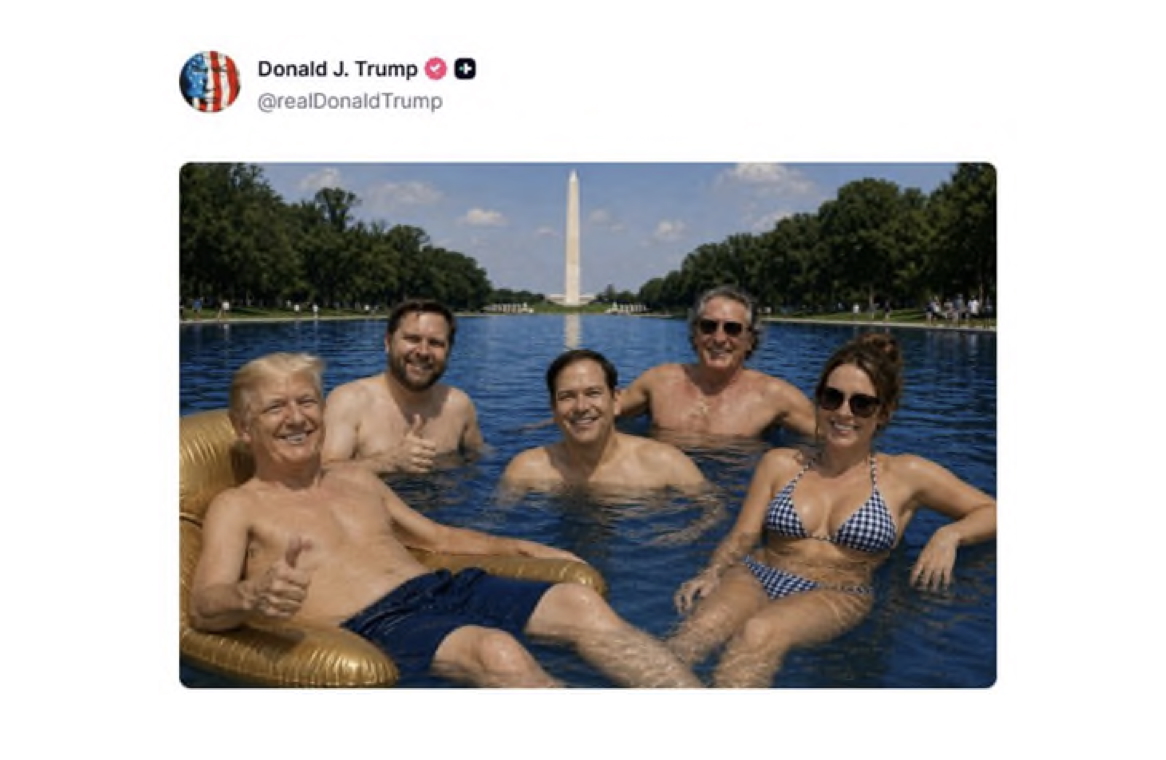
Instead, xAI focuses on protecting Grok users’ rights to generate images as a form of expression, like by mocking politicians by reimagining them in Speedos or as Sumo wrestlers, both of which would feature outputs with exposed thighs and male breasts. The closest xAI came to acknowledging that women and girls were targeted by its scandal was citing an output that Donald Trump generated, showing him with his political allies shirtless in a pool with what xAI suggested was an AI-generated woman in a bikini.
Examples of Grok nudity as “political humor.”
Examples of Grok nudity as “political humor.”
xAI’s complaint similarly seems to avoid much discussion of the arrests of Grok users, which Doe’s lawyer suggested to Ars is happening at an increasing pace, as xAI seems to be partnering more closely with law enforcement in some cases. Although xAI was criticized for failing to help cops ID one Grok user who was eventually arrested, xAI said in its lawsuit that it’s motivated to catch bad actors, and, out of 70,000 reports of suspected Grok-generated CSAM, at least 244 cases led to arrests.
On top of arguing that Grok users alone are liable for harmful outputs and that Grok deserves an exemption from nudification app bans for supposedly implementing state-of-the-art or “near-perfect” detection of harmful outputs, xAI argued that Grok’s process for creating any images or videos is entitled to First Amendment protections. That echoes other chatbot makers who have argued essentially that chatbot speech deserves the same protections as human speech.
Whether xAI’s arguments will prevail will likely depend on whether the court agrees that Minnesota’s law is not narrowly tailored enough to survive constitutional scrutiny. xAI argued that it can’t survive any level of scrutiny.
“Although Minnesota likely has a compelling interest in preventing individuals from creating nudes of other people without consent and distributing that content, the statute punishes AI platforms for assisting in the creation of a substantial amount of protected speech in relation to that limited goal,” xAI argued.
The U.S. carried out fresh strikes in Iran on Wednesday, the U.S. military said, further intensifying a five-month-old war that was already expanding beyond its main fronts to embroil additional countries in the region.
“U.S. forces began launching strikes against Iran at 8:00 p.m. ET today (0000 GMT),” U.S. Central Command said in a statement.
“The strikes are a powerful response to yesterday’s attempted Iranian attacks on U.S. forces based in the Middle East.”
Earlier on Wednesday, a drone hit a U.S.-owned gas storage tanker at Egypt’s Mediterranean port of Damietta, British maritime security firm Ambrey said in an initial assessment, while U.S. and Saudi forces launched strikes against Iran-aligned groups in eastern Iraq and Iran fired missiles at U.S. troops in Jordan.
A statement from Egypt’s petroleum ministry confirmed a fire at the port but made no mention of a drone attack. It was not immediately clear who was responsible.
The latest strikes in Iraq and Egypt threatened to draw more Middle Eastern countries into the conflict, after the Iran-aligned Houthis in Yemen last week declared a naval blockade on Saudi Arabia.
The U.S. strikes in Iran on Wednesday followed President Donald Trump’s vow earlier in the day to retaliate against Iran for firing on U.S. troops.
“So it’s our turn,” Trump told reporters at the White House, promising to “hit them very hard” even as he again said Washington would continue to aim for a peace deal with Tehran.
Iran confirmed overnight that it had fired on U.S. bases in Jordan and at ships in the Strait of Hormuz, and also spurned an Omani proposal to jointly manage the strait, a critical global shipping route for oil and gas.
The war began in February, when the U.S. and Israel launched a bombing campaign in Iran that Trump said would last only a few weeks. A temporary ceasefire agreement in June collapsed amid renewed fighting over the strait, which Iran says it now controls.
Oil prices shot up on Wednesday in one of the sharpest spikes of the five-month war. Brent crude futures rose more than 8% to push the benchmark well above $90 a barrel, reversing much of a plunge earlier this week when Trump had unexpectedly halted U.S. strikes.
‘DEATH TO AMERICA’ SHOUTED IN IRAQ
The joint U.S.-Saudi attacks marked the first time Riyadh has publicly joined strikes alongside Washington.
Iraq’s Popular Mobilisation Forces, powerful Iran-backed paramilitary groups incorporated into the Iraqi security forces, said at least 20 members were killed and 32 wounded in U.S.-Saudi strikes targeting several bases across Iraq.
Iraqi men shouted “Death to America!” as they carried the bodies of slain fighters in body bags.
Washington and Riyadh said they struck Iran-backed armed groups in Iraq in retaliation for drone attacks on Saudi oil targets launched from Iraq.
After the joint attacks, Saudi Arabia’s defense minister met with Vice President JD Vance in Washington on Wednesday to urge the Trump administration not to escalate the conflict further by attacking Yemen’s Houthis and carrying out additional strikes against the Iran-aligned militias in Iraq, two sources told Reuters.
One of the sources added that such escalation would open the door to “major unknown risks.” The White House and Saudi embassy in Washington did not immediately respond to a request for comment.
U.S. officials have privately cautioned that resuming major combat operations against Iran would carry risk given the negative impact on stocks of munitions.
The Center for Strategic and International Studies, a Washington-based think tank, estimated this week that the U.S. military has fewer than 1,000 Patriot interceptor missiles and fewer than 250 THAAD interceptors — two key air defense systems.
Though Iran denies its forces have directed strikes from Iraqi territory, Iranian newspaper Hamshahri reported that four Iranian Revolutionary Guards advisers had been killed in the strikes on Iraq.
IRAQ’S DANGEROUS RIFT
The strikes on Iraq expose a dangerous rift in that volatile country. The Shi’ite-led government is one of the few in the world to balance close military and diplomatic ties with both Tehran and Washington, but those divided loyalties are a constant source of tension and frequent domestic unrest.
The office of Prime Minister Ali al-Zaidi, who took power just two months ago, urged the parties involved to avoid escalation and said he wanted to keep the country out of regional conflicts.
The Iraqi presidency denounced the strikes on the paramilitaries as “an unacceptable attack and a flagrant violation of Iraq’s sovereignty”, while also calling for a halt to attacks by armed groups against Iraq’s neighbours.
The deep ties between Iran and Iraq, the two biggest Shi’ite-majority countries, are on display this week as hundreds of thousands of Iranian religious pilgrims head to shrines in Iraq for an annual observance of mourning for martyrs.
Hours before launching the attacks on Iraq, the U.S. military said its air defences had averted a surprise Iranian attack on U.S. troops in the region.
Jordan’s military said it had shot down five Iranian missiles. U.S. bases in Jordan have lately become primary Iranian targets, where three U.S. service members were killed this month in the worst U.S. losses since March.
Iran’s Revolutionary Guards said they had fired several ballistic missiles at U.S. military installations in Jordan, and had struck three tankers that were attempting to transit through the Strait of Hormuz along an unauthorised route.
Upstream nuclear, downstream rice: ecological MAD on the Mekong
In mid-June 2026, Russian state agencies signed an agreement with Laos to study the feasibility of building small modular reactors (SMRs) — a deal that moved a major energy question onto the Mekong River.
At first glance, developing SMRs seems premature for a country with such a light industrial footprint. But fast-growing electric vehicle (EV) manufacturing and intense competition for metals across Southeast Asia suggest the move points to something bigger: a strategic attempt to shift the region’s industrial balance of power.
Yet any meaningful restructuring of Southeast Asia’s heavy industrial supply chains is bound by physical realities that don’t bend readily to politics. Three constraints persist: reliable baseload power, direct shipping routes, and the inertia of long-established industrial systems.
Power is the price of entry
Turning raw ore into refined metal is a brutal exercise in energy scaling. Bauxite mining and primary alumina refining can run on flexible power supplies, but aluminum smelting — the energy-intensive electrolytic process that produces the metal — demands a rigid, massive load. Smelters need roughly 13,500 to 14,500 kilowatt-hours of uninterrupted power for every ton of output.
Industry data from the International Aluminium Institute shows that power costs make up more than 40% of total manufacturing expenses. Even minor shifts in electricity pricing can decide whether a local smelter survives or goes bankrupt.
Fueled by global tech and EV investments, Thailand, Malaysia, Indonesia and Vietnam are racing to build downstream manufacturing hubs. Thailand’s auto sector — which built about 1.455 million vehicles in 2025 and is projected by the Federation of Thai Industries to reach 1.5 million in 2026 — consumes aluminum steadily for car parts.
That growth, combined with new regional battery factories, is driving a sharp rise in local demand for processed aluminum.
The grid bottleneck
An aluminum smelter needs a flat, uninterrupted power demand curve — running 24 hours a day, 365 days a year. Unlike an assembly line, a smelting potline can’t power down during peak hours or slow down in dry seasons. If power drops suddenly, molten metal freezes inside the cells, destroying millions of dollars in equipment within hours.
Paper estimates may look good using cheap local electricity rates, but the real barrier across mainland Southeast Asia is grid stability. Northern Vietnam’s power grid, for instance, depends heavily on hydropower dams, making it vulnerable to seasonal droughts and frequent power gaps in dry months. Forcing an energy-intensive aluminum smelter onto a grid that already rations power for electronics and shoe factories would destabilize the local economy.
To fix this, regional planners are building liquefied natural gas (LNG) import terminals and linking cross-border power grids to buy surplus electricity from more developed neighbors. But while these links can cover peak demand for light manufacturing, they can’t deliver the cheap, massive and highly localized baseload power that non-integrated aluminum smelters require.
Strength of integrated ecosystems
The region’s established heavy industrial hubs hold an integrated advantage that downstream markets can’t easily match. These mature manufacturing regions enjoy dual supply security: they draw on vast local mineral reserves while also importing bauxite globally through deep-water maritime ports.
Major infrastructure projects reinforce that advantage. The Pinglu Canal — a new trans-regional waterway with annual capacity of 89 million tons — has transformed inland-to-sea shipping, shortening the distance from inland smelters to coastal ports and cutting freight costs.
Advanced proximity-smelting models also let upstream plants feed hot, molten metal directly to next-door rolling and extrusion factories, skipping the costly steps of casting the metal into ingots, cooling it and re-melting it at a separate site.
That energy-efficient setup lets raw metal reach Southeast Asian manufacturing lines at prices that consistently undercut new, local primary smelters.
Alternative supply risks
Russia: Siberian hydropower plants offer cheap electricity, but the geopolitical fallout since 2022 broke the country’s export model. International sanctions did more than block sales abroad — they cut Russian smelters off from raw materials supplied by partners like Australia and froze overseas processing assets, including the Mykolaiv refinery.
That disruption to shipping and foreign holdings left Russia’s domestic smelters exposed, forcing Moscow to reroute trade and lean on Asian networks to secure inputs and keep production stable.
Middle East: Gulf smelters run on stable, natural-gas-fired electricity, but the region has no domestic bauxite deposits. That total reliance on imports leaves the entire cost structure vulnerable to shipping-price spikes and sudden raw-material shocks.
Guinea: Guinea holds some of the world’s richest bauxite reserves, but weak local power grids and high electricity costs hold the country back. It remains stuck exporting raw ore, lacking the power infrastructure to move into energy-intensive primary metal smelting.
Doomsday Mekong math
Proponents of new energy projects often point to coastal nuclear plants, or the dense nuclear clusters along Europe’s Rhine and Danube rivers, to argue that mainland Southeast Asia could easily adopt nuclear power. However, that comparison misses fundamental differences in geography, industry and human survival.
Unlike Central Europe’s Rhine and Danube valleys — heavily industrialized, with lower agricultural intensity, where nuclear plants sit alongside manufacturing economies and benefit from massive freshwater dilution — the Mekong functions as a narrow, overused hydro-lifeline.
Coastal nuclear plants release warm wastewater into oceans with huge dilution capacity. The Mekong, by contrast, supports more than 60 million people who depend entirely on its seasonal flow for food and survival, according to cross-border monitoring data from the Mekong River Commission’s Joint Basin Cooperation framework.
Wet-field rice farming requires fields to be flooded constantly with river water during major growth periods. Because rice roots absorb and accumulate heavy metals and other elements from the water, the entire agricultural basin has essentially no tolerance for industrial accidents.
Long-term water testing shows that even a small, localized toxic or radioactive leak upstream would build up quickly through the soil-water-crop food chain. Any leak would permanently damage the Mekong Delta, according to the International Atomic Energy Agency’s framework on radionuclide transfer in tropical agricultural systems — a delta that provides nearly 60% of Vietnam’s national crop output and 90% of its rice exports, meaning a localized industrial failure would instantly trigger a regional food-security crisis.
Ecological MAD stalemate
As a landlocked nation with unequal power ties to larger neighbors like Thailand and Vietnam, Laos lacks most traditional geopolitical options. But its physical control over the Mekong’s upstream flow gives it a powerful strategic lever.
By opening formal energy talks with outside powers like Russia, Vientiane appears to be pursuing a classic small-state hedging strategy against regional pressure. Regardless of intent, though, the act of exploring nuclear energy sites along its western border — directly adjacent to the farming zones of northeast Thailand — introduces a new geopolitical variable.
Given how sensitive downstream nations are to Mekong water security, even the start of a long-term feasibility study for an upstream nuclear project can be read as establishing an “Ecological MAD” — mutually assured destruction — dynamic. Structurally, it’s the inherent risk of transboundary contamination, rather than explicit diplomatic coercion, that gives this project its deterrent weight in regional negotiations.
Seasonal northeast monsoons could carry airborne nuclear waste west into Thailand’s jasmine rice belt, while river flow would carry contamination downstream to Vietnam’s delta. Together, that gives the nuclear project outsized weight as an environmental bargaining chip — a calculated stalemate that pressures larger downstream neighbors to stay cooperative, giving Laos leverage in economic and political negotiations.
Investors often look to Indonesia’s sprawling archipelago as an ideal place to deploy small modular reactors to solve local industrial power shortages. But Jakarta’s processing ambitions run directly into steep infrastructure and capital constraints.
National law bans raw-ore exports to force companies to build local refineries, but those projects remain stuck on split, isolated island power grids. Using floating power barges or marine reactors to run energy-intensive aluminum smelters requires massive upfront investment with long payback periods — a risk noted in global guidelines such as the International Atomic Energy Agency (IAEA) Safety Report Series for site evaluations.
Until the capital gaps and shipping bottlenecks are fixed, local operators remain tied to captive coal plants — a choice that runs headlong into carbon taxes imposed by Western consumer markets.
The bottom line
Global supply chains will keep shifting, but the economics and physics governing heavy industry don’t change. Real advantage in metal processing still comes down to three things: low-cost baseload power, short shipping routes and deeply integrated industrial zones.
As long as these infrastructure gaps and river sensitivities persist across Southeast Asia, the region’s current division of industrial labor should remain resilient in the medium term.
Major technological breakthroughs — such as far cheaper grid-scale storage, supranational supergrids or next-generation nuclear safety systems — could reshape these constraints over the long run, but they aren’t close enough to overturn today’s dynamics anytime soon.
For now and the foreseeable future, the region’s industrial trajectory will be shaped less by ambitious greenfield shifts than by the hard math of energy limits and the weight of the Ecological MAD stalemate.
Ju Liang is an independent policy analyst with over 20 years of on-the-ground experience in Southeast Asia.He is currently based at Yunnan Agricultural University, China. All opinions expressed here are the author’s alone and not representative of any affiliated institution.
Netanyahu proposes phasing out US military aid to Israel over 10 years: Report
Israeli Prime Minister Benjamin Netanyahu proposed to US President Donald Trump a plan to gradually end direct US military aid to Israel over the next decade during their White House meeting on Tuesday, according to Israeli media on Wednesday, Anadolu reports.
Israel’s public broadcaster KAN, citing an unnamed political source, said the two leaders discussed the future of US military assistance to Tel Aviv during their closed-door talks.
According to the report, Netanyahu proposed gradually reducing US military aid until it is completely phased out within 10 years.
The outlet said Netanyahu suggested that US-Israeli cooperation on missile defense programs would continue, with the two countries shifting their focus from direct financial assistance to joint defense development projects.
Israel is the largest cumulative recipient of US foreign assistance since World War II.
According to the Congressional Research Service, Washington had provided Israel with about $174 billion in bilateral assistance and missile defense funding through May 2025, measured in nominal dollars.
Current military assistance is provided under a 2016 memorandum of understanding covering fiscal years 2019-2028, under which the US pledged $38 billion, subject to annual congressional appropriations.
The package includes $33 billion in Foreign Military Financing grants, averaging $3.3 billion annually, and $5 billion for joint missile defense programs, averaging $500 million annually.
Netanyahu has repeatedly called for reducing Israel’s dependence on direct US military aid. In interviews with The Economist in January and CBS’s 60 Minutes in May, the premier said he wanted Israel to eventually eliminate its reliance on US military financing while maintaining close defense cooperation, particularly on missile defense.
The White House did not immediately comment on the report.
Trump hosted Netanyahu at the White House on Tuesday for their first meeting since the Iran war and their eighth face-to-face meeting since the US president returned to office. The closed-door talks lasted about 90 minutes and focused on Iran, Gaza and other regional issues.