In mid-June 2026, Russian state agencies signed an agreement with Laos to study the feasibility of building small modular reactors (SMRs) — a deal that moved a major energy question onto the Mekong River.
At first glance, developing SMRs seems premature for a country with such a light industrial footprint. But fast-growing electric vehicle (EV) manufacturing and intense competition for metals across Southeast Asia suggest the move points to something bigger: a strategic attempt to shift the region’s industrial balance of power.
Yet any meaningful restructuring of Southeast Asia’s heavy industrial supply chains is bound by physical realities that don’t bend readily to politics. Three constraints persist: reliable baseload power, direct shipping routes, and the inertia of long-established industrial systems.
Power is the price of entry
Turning raw ore into refined metal is a brutal exercise in energy scaling. Bauxite mining and primary alumina refining can run on flexible power supplies, but aluminum smelting — the energy-intensive electrolytic process that produces the metal — demands a rigid, massive load. Smelters need roughly 13,500 to 14,500 kilowatt-hours of uninterrupted power for every ton of output.
Industry data from the International Aluminium Institute shows that power costs make up more than 40% of total manufacturing expenses. Even minor shifts in electricity pricing can decide whether a local smelter survives or goes bankrupt.
Fueled by global tech and EV investments, Thailand, Malaysia, Indonesia and Vietnam are racing to build downstream manufacturing hubs. Thailand’s auto sector — which built about 1.455 million vehicles in 2025 and is projected by the Federation of Thai Industries to reach 1.5 million in 2026 — consumes aluminum steadily for car parts.
That growth, combined with new regional battery factories, is driving a sharp rise in local demand for processed aluminum.
The grid bottleneck
An aluminum smelter needs a flat, uninterrupted power demand curve — running 24 hours a day, 365 days a year. Unlike an assembly line, a smelting potline can’t power down during peak hours or slow down in dry seasons. If power drops suddenly, molten metal freezes inside the cells, destroying millions of dollars in equipment within hours.
Paper estimates may look good using cheap local electricity rates, but the real barrier across mainland Southeast Asia is grid stability. Northern Vietnam’s power grid, for instance, depends heavily on hydropower dams, making it vulnerable to seasonal droughts and frequent power gaps in dry months. Forcing an energy-intensive aluminum smelter onto a grid that already rations power for electronics and shoe factories would destabilize the local economy.
To fix this, regional planners are building liquefied natural gas (LNG) import terminals and linking cross-border power grids to buy surplus electricity from more developed neighbors. But while these links can cover peak demand for light manufacturing, they can’t deliver the cheap, massive and highly localized baseload power that non-integrated aluminum smelters require.
Strength of integrated ecosystems
The region’s established heavy industrial hubs hold an integrated advantage that downstream markets can’t easily match. These mature manufacturing regions enjoy dual supply security: they draw on vast local mineral reserves while also importing bauxite globally through deep-water maritime ports.
Major infrastructure projects reinforce that advantage. The Pinglu Canal — a new trans-regional waterway with annual capacity of 89 million tons — has transformed inland-to-sea shipping, shortening the distance from inland smelters to coastal ports and cutting freight costs.
Advanced proximity-smelting models also let upstream plants feed hot, molten metal directly to next-door rolling and extrusion factories, skipping the costly steps of casting the metal into ingots, cooling it and re-melting it at a separate site.
That energy-efficient setup lets raw metal reach Southeast Asian manufacturing lines at prices that consistently undercut new, local primary smelters.
Alternative supply risks
Russia: Siberian hydropower plants offer cheap electricity, but the geopolitical fallout since 2022 broke the country’s export model. International sanctions did more than block sales abroad — they cut Russian smelters off from raw materials supplied by partners like Australia and froze overseas processing assets, including the Mykolaiv refinery.
That disruption to shipping and foreign holdings left Russia’s domestic smelters exposed, forcing Moscow to reroute trade and lean on Asian networks to secure inputs and keep production stable.
Middle East: Gulf smelters run on stable, natural-gas-fired electricity, but the region has no domestic bauxite deposits. That total reliance on imports leaves the entire cost structure vulnerable to shipping-price spikes and sudden raw-material shocks.
Guinea: Guinea holds some of the world’s richest bauxite reserves, but weak local power grids and high electricity costs hold the country back. It remains stuck exporting raw ore, lacking the power infrastructure to move into energy-intensive primary metal smelting.
Doomsday Mekong math
Proponents of new energy projects often point to coastal nuclear plants, or the dense nuclear clusters along Europe’s Rhine and Danube rivers, to argue that mainland Southeast Asia could easily adopt nuclear power. However, that comparison misses fundamental differences in geography, industry and human survival.
Unlike Central Europe’s Rhine and Danube valleys — heavily industrialized, with lower agricultural intensity, where nuclear plants sit alongside manufacturing economies and benefit from massive freshwater dilution — the Mekong functions as a narrow, overused hydro-lifeline.
Coastal nuclear plants release warm wastewater into oceans with huge dilution capacity. The Mekong, by contrast, supports more than 60 million people who depend entirely on its seasonal flow for food and survival, according to cross-border monitoring data from the Mekong River Commission’s Joint Basin Cooperation framework.
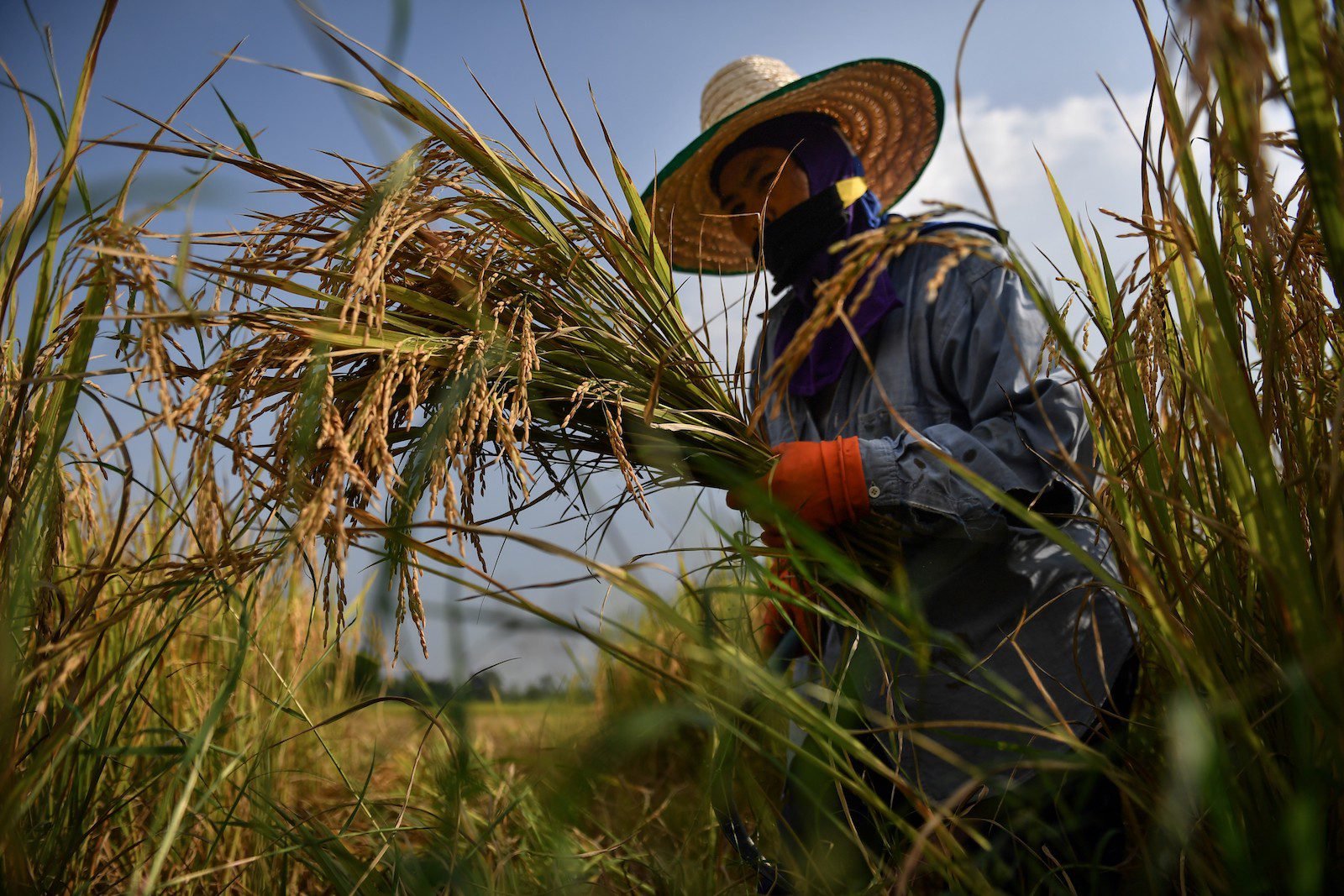
Wet-field rice farming requires fields to be flooded constantly with river water during major growth periods. Because rice roots absorb and accumulate heavy metals and other elements from the water, the entire agricultural basin has essentially no tolerance for industrial accidents.
Long-term water testing shows that even a small, localized toxic or radioactive leak upstream would build up quickly through the soil-water-crop food chain. Any leak would permanently damage the Mekong Delta, according to the International Atomic Energy Agency’s framework on radionuclide transfer in tropical agricultural systems — a delta that provides nearly 60% of Vietnam’s national crop output and 90% of its rice exports, meaning a localized industrial failure would instantly trigger a regional food-security crisis.
Ecological MAD stalemate
As a landlocked nation with unequal power ties to larger neighbors like Thailand and Vietnam, Laos lacks most traditional geopolitical options. But its physical control over the Mekong’s upstream flow gives it a powerful strategic lever.
By opening formal energy talks with outside powers like Russia, Vientiane appears to be pursuing a classic small-state hedging strategy against regional pressure. Regardless of intent, though, the act of exploring nuclear energy sites along its western border — directly adjacent to the farming zones of northeast Thailand — introduces a new geopolitical variable.
Given how sensitive downstream nations are to Mekong water security, even the start of a long-term feasibility study for an upstream nuclear project can be read as establishing an “Ecological MAD” — mutually assured destruction — dynamic. Structurally, it’s the inherent risk of transboundary contamination, rather than explicit diplomatic coercion, that gives this project its deterrent weight in regional negotiations.
Seasonal northeast monsoons could carry airborne nuclear waste west into Thailand’s jasmine rice belt, while river flow would carry contamination downstream to Vietnam’s delta. Together, that gives the nuclear project outsized weight as an environmental bargaining chip — a calculated stalemate that pressures larger downstream neighbors to stay cooperative, giving Laos leverage in economic and political negotiations.
Investors often look to Indonesia’s sprawling archipelago as an ideal place to deploy small modular reactors to solve local industrial power shortages. But Jakarta’s processing ambitions run directly into steep infrastructure and capital constraints.
National law bans raw-ore exports to force companies to build local refineries, but those projects remain stuck on split, isolated island power grids. Using floating power barges or marine reactors to run energy-intensive aluminum smelters requires massive upfront investment with long payback periods — a risk noted in global guidelines such as the International Atomic Energy Agency (IAEA) Safety Report Series for site evaluations.
Until the capital gaps and shipping bottlenecks are fixed, local operators remain tied to captive coal plants — a choice that runs headlong into carbon taxes imposed by Western consumer markets.
The bottom line
Global supply chains will keep shifting, but the economics and physics governing heavy industry don’t change. Real advantage in metal processing still comes down to three things: low-cost baseload power, short shipping routes and deeply integrated industrial zones.
As long as these infrastructure gaps and river sensitivities persist across Southeast Asia, the region’s current division of industrial labor should remain resilient in the medium term.
Major technological breakthroughs — such as far cheaper grid-scale storage, supranational supergrids or next-generation nuclear safety systems — could reshape these constraints over the long run, but they aren’t close enough to overturn today’s dynamics anytime soon.
For now and the foreseeable future, the region’s industrial trajectory will be shaped less by ambitious greenfield shifts than by the hard math of energy limits and the weight of the Ecological MAD stalemate.
Ju Liang is an independent policy analyst with over 20 years of on-the-ground experience in Southeast Asia. He is currently based at Yunnan Agricultural University, China. All opinions expressed here are the author’s alone and not representative of any affiliated institution.